


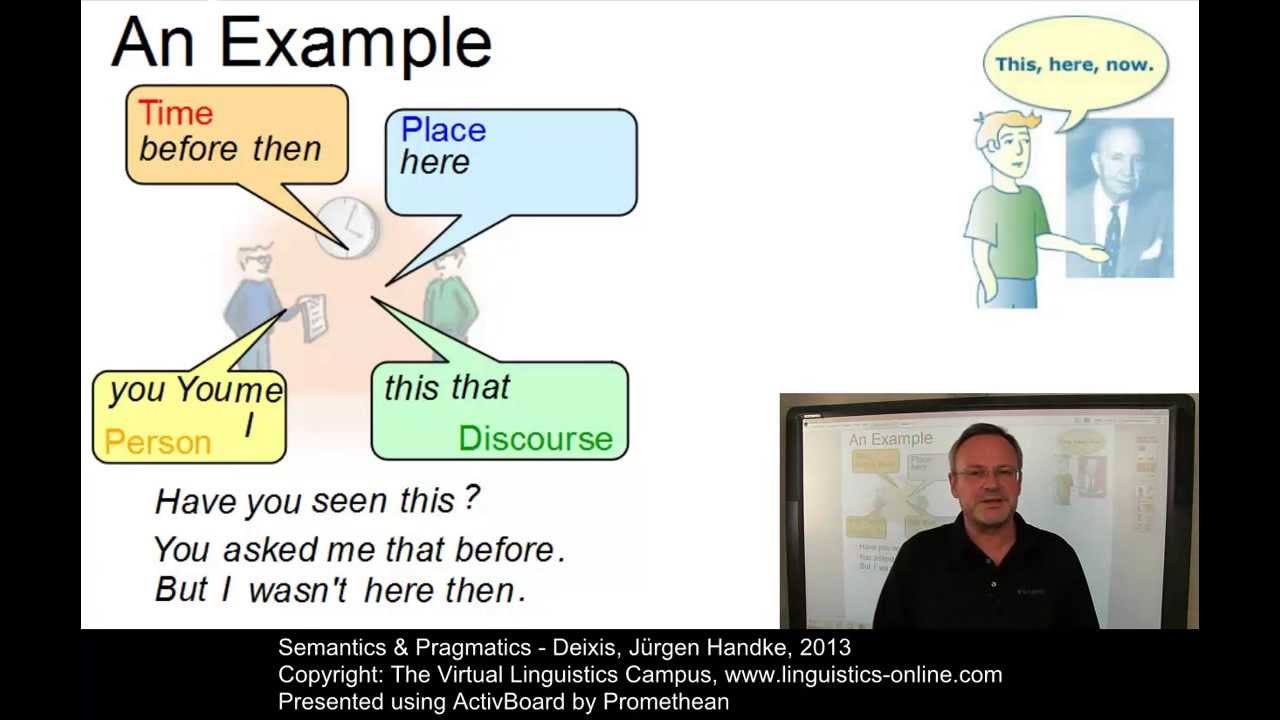





















Viewpoint and perspective are fundamental cognitive phenomena that shape how humans conceptualize and communicate about space, time, and social interactions; humans bring physical viewpoint to spaces by being present in them, and this perspective extends to abstract domains like time and social relations through experiential correlations between perception, action, and cognition, with linguistic constructions reflecting these viewpoint structures through deictic systems, tense, aspect, and spatial metaphors that map physical experience onto abstract mental spaces.
Viewpoint and Perspective in Language and Gesture | Cognitive Linguistics Talk
Added:Basic principles of Cognitive Linguistics, including the concepts of embodiment, image schemas, and conceptual framing.
An understanding of deixis and spatial reference frames (such as egocentric, allocentric, and intrinsic perspectives) in language.
The fundamentals of gesture studies, specifically David McNeill's classification of gestures (iconic, metaphoric, deictic, and beat) and their co-expressive relationship with speech.
The core concept of Embodied Cognition, which posits that human cognitive processes are deeply rooted in physical body interactions with the world.
Advanced Multimodal Discourse Analysis, focusing on how viewpoint manipulation operates in political rhetoric, media, and face-to-face interaction.
Applications of gestural perspective in Human-Computer Interaction (HCI) and the design of intuitive virtual reality (VR) environments.
Cognitive Poetics and Narratology, exploring how perspective-taking and blended viewpoints are constructed in literary texts and narrative media.
The study of gesture-speech integration in Second Language Acquisition (SLA) and how learners adopt the spatial thinking patterns of a new language.
7.1K views59likes1:19:52Original Release: 2008-04-03
so uh those of you who don't know me I'm Fay Perell here in cognitive science and I'm going to be introducing our our lecturer today before I get started on that I want to remind you all that there's a reception upstairs um in 111 delicious piles of food for all of you so please join us after the lecture for that reception all right well I'm very pleased to welcome Eve sweetzer the department of cognitive Sciences academic careers in engineering and science distinguished lecturer um Eve is a professor in the department of linguistics at UC Berkeley um she teaches in the Celtic studies program and she directed The cognitive science program at UC Berkeley for many years she graduated from Harvard with degrees in linguistics and Classics and did her graduate work at Berkeley as well um Eve is also a member of one of the earliest generations of cognitive linguists so researchers who really objected to this very long tradition of studying language uh without any interest in general cognition so Eve is uh a great Pioneer and has really had an enormous impact on how researchers all over the world see language she's had an illustrious career um publishing extensively on an intimidating range of topics in the top journals in a bunch of different fields including cognitive Linguistics and cognitive science so she's truly a distinguished lecturer uh by virtue of her success as a researcher and a scholar but of course anybody can become a widely respected researcher you know that's nothing I want to highlight another aspect of Eve's career um one that made her an ideal candidate for this a this Aces lecture uh Professor szer is notorious for being an extraordinary Mentor she has the magical ability to change people's lives simply by being supportive uh enthusiastic even about very poorly formed ideas uh and endlessly generous with her time so she's had a major impact on the lives of dozens of undergraduates uh hundreds of graduate students and it's the kind of impact that you know we as faculty all hope to have on students lives and I can speak from personal experience I met Eve when I was an undergraduate and working with her really changed my life but I know it's easy to say somebody changed my life you know so and so really shaped the the course of my destiny so I want to show you guys what this actually looked like okay okay so here is my life before I met Eve sweetzer okay and here is my life you know during the period when Eve and I became acquainted so you see things are looking up for me and here is my glorious life because of Eve sweeter so here's my future thanks to Eve sweetzer okay so all hyperbole aside uh it really is a great personal pleasure for me to invite you all to welcome uh Professor Eve sweetzer okay well now I can go hide under the table from from my embarrassment but it is true F that there's some people where all you have to do is like that the way you change their life is like point out a copy of um hand and mind or something like that it doesn't take too much to change lives that are like all ready for that particular anyway okay um so one of the things that I'm trying to gradually work on um and that I didn't know that I was that I had a coherent interest in Viewpoint and perspective um until these things kind of came together I got into the the study of gesture because I was interested in metaphor and metaphoric cognition and gestural evidence for metaphor and then working with sign researchers I got really interested in um iconicity and what the nature of linguistic and non-linguistic iconicity was and O is a really great place to investigate that um but I have for a long time been interested in a Viewpoint and perspective in mental space structures and well you sort of can't avoid um Viewpoint in um sign language and gesture so uh the ideal would be if we for me anyway my sort of like what I'd like to uh to be able to do would be to tell you a story that started with what it is to be a human being with physical Viewpoint and end up with um the obvious reasons why the range possibilities for a literary Viewpoint are what they are okay really higher order cognition from the lower order stuff and I can't do that I won't be able to do that for you today but um here are some of the pieces of the puzzle that I think I have put together anyway okay so um this is a Wallace Stevens poem um and it says I placed a jar in Tennessee and round it was upon a hill it made the slovenly Wilderness surround that Hill it took Dominion everywhere okay um what I'd like to say is by being in a space a human brings Viewpoint to the space a human brings a dtic structure a perspective a physical Viewpoint to a space by being there by being if I'm alone in a room and someone comes in my understanding of the space in the room is different from the way it was before right so that's the crucial and this is true of every other kind of human space as well so um Rafael nunia is my colleague who uh with whom I have worked on his some of his imara data and you'll see some of that later on he works up in the Andes and in these towns they believe that their houses should face the sunrise and they're on the west side of the andies so their houses face up the mountain and um in every little town there is a single house single building that faces down down the mountain faces outward so here you are climbing up a trail in the Andes I've seen all of Raphael's photos I have not climbed these Trails myself um and there's not a single window or a single door in the town visible as you approach the town it's blank sides of buildings and one building has an open door and a window that you can see as you come up the trail which one the school the government built that the Spanish speakers from down at the coast came up and thought the right way for a house to face was downhill with a view right well what's going on there why are why are houses Viewpoint right um as extensions of humans so let's uh with that note Let's uh go on here so what's interesting about um Viewpoint and perspective well um one thing that's interesting for I think a lot of people and I listed linguists cognitive scientists and blending theorists but I think more as well um is that humans just do live in and manipulate Viewpoint structures so all languages reflect that fact so I'm going to um go through some linguistic constructions that reflect Viewpoint and talk about those a bit too but if we're talking about um as blending theorists in cognitive science might say living the blend um this is one of the most fully inhabited Blends we've got we we live as if you pointed people and I will give you a blending analysis of you point a partial one anyway okay but the other crucial thing is that I think is too infrequently thought about but I think narrative theorists have come to the conclusion that it needs to be thought about seriously is that we all don't just have one viewpoint on any situation we're part of we have access to multiple viewpoints okay so by the fact that you guys are in the room right my viewpoint on the room is different than it would otherwise be um that's why I'm facing the way I'm facing that's why I'm acting and gesturing the way I'm acting and gesturing and so on um and I'm trying to make myself visible and audible to you guys right so it isn't just all about me and my viewpoint let's hope um we also have access to more or less different more Viewpoint or less Viewpoint construals so this is um well I bring this in at the end but Fay and I were just talking about her research recently um and she's been working on what a lot of people have noticed that there is this possibility of so-called participant versus global um viewpoints on situations and um gesture shows it sign language shows it whatever so things like um here I have an ASL car the car can go down a road um this is just a car out here I'm not in the picture okay I'm not here but if instead I have right I this I'm a the scared driver in the car that's participant Viewpoint okay so we have the capacity to have more or less viewpoint construals on things and all of us have um cognitively the ability to sort of gradually create maps of um spaces that don't depend specifically on Viewpoint so all of you have in your head maps of the case campus that don't defend specifically on where you are um and I have a map of Berkeley in my head all right um there's a large amount of cross- linguistic variation in how Viewpoint patterns are linguistically categorized but there are real patterns as well so we should come to that and I don't think that there's any surprise that there should be patterns because not just human perceptual apparatus but human neural architecture um puts important constraints on how we can access perspectival construals of our of our own and of other people um and I will get to primary scenes later on um but to just to finish the introduction we can't have our own single Viewpoint of space or of cognitive structure when other people are present so I I'm really coming more and more to the conclusion that Viewpoint at any given time is a complex of multiple viewpoints that the um speaker is constructing is building up rather than just okay this is what I think the world is like right it's wait a minute this is what I think this bunch of different shared viewpoints or less shared viewpoints this complex of viewpoints is about all right um so here's some of the things that um Viewpoint has been said to be about so um where the speaker and address C are so when they say something like when you say you say something linguistic like here what do you mean by here um there this that uh this chair that chair um next door next door to where I am presumably right um when the speaker and hearer are presumed to be so things like now then tomorrow last year um Chuck Filmore my old adviser at Berkeley used to always say that um you could imagine um getting when when people told him that a neutral context meant you didn't know anything about the um broader context of a message and one of his um one of his own advisers who was an advocate of dividing text and pragmatics from linguistic structure had suggested that you should consider these example sentences as if you had received them in a bottle you know from an unknown um sender and he was saying like what would I do if I received a message in a bottle that said um meet me here tomorrow right you wouldn't know the normal thing is for language to be contextualized um so that the Viewpoint can be understood okay um what an imagined what where and when an imagined precipi is and um how they can um see and reach and so on things from imagined locations in imagined spaces um but also what the speaker in address C might be assumed to know think presuppose mentally calculate and so on about whatever mental space is involved so when I choose to say the' or a I'm making a statement about whether I think you my addresses will be able to identify the reference that I'm talking about if I chose uh I would be making um the opposite Choice um if when I say if I'm making an assumption that you're okay now I'm assuming that I don't want to make a commitment about whether this is going to happen or not but if I say when well yeah I do think it's going to happen right I don't know for sure when it's going to happen but I I do know I do think it's going to happen um choices of formal and informal pronouns in languages that allow them or address terms in English for example where the pronouns don't show these things so are you going to address me as um Eve sweetzer Dr sweetzer Professor sweetzer Miss sweetzer um which of these things obviously you're saying something about your interaction with me by making one of those um choices um and my and my favorite um presuppositional verb which I'm currently trying to um decipher is no and the interesting thing about no is that it's describing somebody's mental space so I say um oh yeah Sue knows that Mark is coming I'm supposed to be talking about Sue and Sue's knowledge State Sue's cognitive States but actually I told you something about mine as well right because if I if I had said sue thinks Mark is coming I would be completely neutralized to whether I believe that Mark is coming but if I say Sue knows Mark is coming I not only say that Sue believes it but that yeah I believe that too I think that's the truth um so Viewpoint of more than one person included in one verb yeah okay um what the speaker and address C feel about the um contents of the relevant spaces so how they evaluate them so are you going to call certain Behavior famous examples um Thrifty or stingy could be the same behavior but it tells you something about the how the person evaluates um that kind of behavior um hopefully maybe and what imagine participants might think suppose calculate feel Etc about these things and lots more um so we'll talk we'll see that um dyes and Viewpoint have to do with social identification and differentiation um all kinds of fun things so in short almost anything about a particular individual's portrayal of mental spaces that is particular to that individual that tells you something about what that individual and their interlocutor's mental states are and a lot of what we say tells us something about oh yeah this is how I feel about it this is my perspective on it and this is what I think your perspective is and how I'm trying to negotiate um with it so um Viewpoint is a far and perspective are far more widely um spread phenomena in language than most people seem to think um okay so the term subjectivity is been used the people that that who who that term is associated with in linguistics are um Ron langaker and Elizabeth Trot are the two people that are the Giants of uh bringing this of developing our understanding of this and what I'm I'm going to give you a sort of more Lang aaran um view of it here but um so what subjectivity is is implicitly having the conceptualizer present in the construal so something like here wait a minute I gotta like now figure out I didn't mention me but I have to know where me is to know where here is okay um and dixis is specifically the implicit presence of the beach exchange scenario in context of the conceptualizer so I just gave you an example with here okay um so Langer stresses this this idea that um it is specifically the offstage and implic it um presence of this viewer and the viewing scene that makes something particularly Viewpoint so if I were to write a sentence that said um Eve sweetzer is in room um what number is this nine um Crawford right at uh for whatever it is uh on March 26 that wouldn't even though it might be about about me you wouldn't have to do a lot of specific processing about my viewpoint to understand that sentence but if if I if I um phoned at somebody from and said I'm here now right without knowing what the context is um they don't have a have a prayer okay um so Trot didn't didn't so much stress the implicitness of the um speaker hearer interaction in the involvement and subjectivity but I think really did um mean that um she she uh the same data is being talked about here um examples of something getting more subjective um that are classically given are a root modal um taking on an epistemic meaning um so he should be home by now might mean somebody has put an injunction on him that he ought to be home right he's got a duty of some kind but it could also mean yes um in my epistemic processes is assess that that is probable that he's home by now okay um which you really need to attribute that to me and to my epistemic processes whereas the um somebody told him to be home by now could be somebody else it doesn't have to be me that's imposing the um deontic modality um similarly aspect intense so aspect if we when we can separate it from tense the problem English sort of Demands that you express both at once but um knowing that something is perfective or imperfective doesn't tell you when it is with respect to me it tells you something about how continuative or non-continuity um also about what a Viewpoint you're taking on it maybe a global versus a participant Viewpoint for example too um but tense is just plain old Dyck right if I say was then it has to be past relative to some now or other so um tense is um but classically thought of as more Viewpoint I I might dispute that there's some Viewpoint in aspect too okay but none of these analyses have dealt with the complexity of relationships within the ground the idea that the speaker and the hearer are sharing a ground negotiating a ground um have a complex um Viewpoint structure um now I'm going to give the the next thing I'm going to give you is a sort of blending analysis of viewpoint and in order to do that I'm going to um want to be able to um separate out the idea of a viewer's perspective from the presence of a full dtic center of an idea that I am there not just some some viewer or other okay so to think about this think about um very common convention in art which is called deferred viewing so in your painting you put a person who's looking at a view okay and that person can probably see different things than you can see but you're brought into the painting and involved in the view by um indirect participation here so it doesn't have to be exactly your view um so think about that as the kind of contrast I'm talking about here so come and go and here and there I'd like to say involve um maybe not there involve uh full dyke dick centers and arrive or across from don't so if I say Sue jumped across the table it could be that she jumped across the table from me but it might just be from wherever she was and you don't know where I am with respect to it at all um Sue sat across the table from somebody whose Viewpoint we're taking but not necessarily me or you right um Sue has arrived in LA and I can say um Sue has arrived there as well as Sue has arrived here but notice I couldn't say Sue Has Come there as easily that makes that it gets a little tough um really is strongly dtic and it's strongly dtic for a proximal diis not for a distal diis okay now English has this interesting might might start anybody thinking about the relationship between um speakers and address C's viewpoints because English has a requirement that we for in certain instances displace our expressed viewpoint and take the the address C's Viewpoint rather than our own so things like um can you come to my party fine right um now this is already getting to be complex because I could say that to you here and so we wouldn't have to be at the location that you're going to come to but that location is associated with me and come has proximal diis and is assoc iated with the speaker okay fine that's already complex enough but now sure I'll come to your party and I wouldn't say sure I'll go to your party sure I'll go to Sue's party right somebody else's party but the correct way to say this the polite way to say this in English is sure I'll come to your party where I'm kind of required to take the Viewpoint of the other person so someone calls you up and you say oh I'll come right over you don't say go right over even though you then turn around and say to the person who got woken up by the phone call as well as you you say I'm going over to Sue's right okay but to sue you said I'm coming right over so you had to take Sue's Viewpoint um notice that I and you the pronouns are really hard to displace in this kind of way you wouldn't change those but the come and go centers move easily between I as come or as come Center and you as come Center and are even required to some of the time time in English Okay um so this is um what I what I call a vanilla um dtic system semantics this is what a lot of people have said about dtic systems so analyses in common analyses say things like this is near the speaker that is near the address C and not near the speaker um and maybe in a three part system um there's a Yan term which English doesn't really have nowadays which is like far from both the speaker and the add see um now it turns out that um Steve levenson for example who's done a lot of Investigation of crosslinguistic ictic systems and has found a lot of regularities in them um but among the things that he hasn't spent as much time on um and increasingly less time as we move down the list are is the reference visible to the speaker or the address C right not just um near but is it visible is it manually accessible to these people so um this tends to mean visible and manually accessible and that um not visible or not manually accessible and even does the referent count as being um possessed by or somehow in the custody of um one of these people so Bill Hanks has these lovely examples with um the Mayan speakers that he works with where um someone will be um standing next to a cooking fire and say um you know that their cooking fire um because it's her sister-in-law's cooking fire that she would never in a gazillion years dream of intruding by cooking on and um this here cooking fire on the other side of the yard which is my own cooking fire that I cook on all the time um so the connection with the person of possession or so on can really influence whether we understand these things and furthermore is the location of the referent conven or habitually associated with one of these people so here we have the example of can you come to my party um I may not be at home when I invite you or maybe even for example if it's a wedding the party might not be being held at my home right but I I'm the person who'll be giving the party okay um so we're already seeing that just near speaker near address c um and not near either is way too simple for even dtic systems forget about the rest of a Viewpoint and we also have to add into the mix um what um I might call the scale of construal so uh when I say here what do I mean I could mean um this very room right here I could mean this place on the floor and uh when we get to spao temporal stuff people all the time um Point directly down like this and say right now okay so there's a there's added temporal metaphors here as well but I could mean this spot right here in front of my feet I could mean this room I could mean case Cleveland Earth whatever um and this is the kind of vagueness that shared by lots and lots of locational terms um like home for example okay um besides Bill Hanks um Johanna Ruba work has particularly investigated the uh interesting uses of this and that and here and there so what she did what she thought she was doing was conducting interviews with um citizens of the town of San Diego about the um English only movement in California to find out people's attitudes now as it happened the interviews were all conducted in the same room on the San Diego campus the office that she occupied at that time as a graduate student so they were all in exactly the same place and she started to notice very strange uses of this and that and here and there which seemed to have to do with whether it was my kind of neighborhood culturally as opposed to um the kind of neighborhood where I don't belong that neighborhood and there were the kinds of places I wouldn't go whoever whichever ethnicity I am in the relevant interview and um this and here are the kinds of places that I would go um she also noticed even a further a field she noticed that um many of the English speaking the native English speaking um folks interviewed used you to refer immigrants that they felt they could identify with so you come here you work hard um right um and they to refer to the kind of immigrants that they didn't think were the right kind to have um so second person is already more involved in the Viewpoint that I'm expressing right and third person is outside the kind of viewpoint that I'm expressing so part of what they're saying is um somebody that I'm saying yet to is somebody I have to share some viewpoint with that I have to negotiate Viewpoint structure with and somebody who's over there they I don't need to necessarily share any Viewpoint with okay um lots and lots of social Viewpoint markers as well um so there's this delightful exchange um Japanese honorifics are often analyzed as expressing the speaker's imagined relationship to the address c um there's other ones that are to the to the person being described as well so there's two separate sets um and Below we have a descriptive honorific use which um Richard Dasher actually heard um and you can if go and look at Richard dasher's uh book on this subject and find it if you want but the Corp the same corporate secretary um was saying to the president's wife inquiring about his health he was home with the flu right um how is the honored president's um Health today and one minute later to somebody who she was cancelling an appointment with our humble not honorable um president can't keep his appointment because he's ill okay um because in one casee she was The Outsider inquiring of the family right of an Insider who was closer to the president and in the other case she's representing the president to the outside world and the president would have to say um humble me rather than honored me so for a moment she as the president's spokesperson she has to take the president's um social Viewpoint and use honorifics in the right kind of way okay um so here's some blending structure some really simple blending structures that um talk about this stuff so this is can I come to your party so this is just assuming that I have a a speaker hearer space um where there's some kind of frame involving roles of speaker and address C okay um and there's also a dtic coordinate space that involves um physical Viewpoint that's centered at one particular SE Center of perception okay and when I say can I come to your party the speaker remains over here but the dtic coordinate space is um plunked down for for purposes of come the dtic coordinate space is plunked down on top of the speaker okay um but since there's a speaker here a structure that determines what I and you are going to be like how I'm going to use them the rules are going to be a little different for other languages it's not the case in every language that go and come get um moved around exactly the way they do in English Okay now here's please come to my party and in it in this case the Dy um Center is plugged down right on top of I and there isn't anything um complex to look at but the point that we're seeing here is that um even for very everyday English data we have to be able to pull apart aspects of viewpoint right I'm the speaker let's say and a relationship between a speaker and a hearer from an imagined dtic Center and a Viewpoint sometimes it has to be the hero's Viewpoint that is the is the dtic center okay um temporal diis we were just mentioning um it's no surprise that since um time is all about relationship to an imagine present um tense is all about that we get lots of um go Futures in particular um so here we have a diagram of the kind of blend involved in a go future there's a very bad little um icon of an eye up there looking forwards um towards the profile time um and there's a um dtic Viewpoint Center of some kind so there's a subjective experience Center something like that and a um a dtive Viewpoint Center which are collocated and are both considering a profile time in the future all right um but you also get things like um I'm coming to appreciate John's sense of humor and when you say I'm coming to appreciate John's sense of humor you mean like I don't really appreciate it yet so we are talking about a possibly still in the future event right the the full appreciation of John's sense of humor um might yet be future relative to us um but we've moved the Viewpoint to that future um profile time and we're looking at it as if you know our appreciation is gradually approaching um our Viewpoint and it was Michelle emmin whose work um on Band 2 tense systems Unearthed um languages that have both come and go Futures and required this kind of displaced analysis but come Futures are way less common in the world's languages than go Futures and I think you can sort of see why because um this displacement of um dtic Viewpoint from the present is is unusual it's atypical more complex as a as a Viewpoint phenomenon okay um so now I'm going to show you some uh gestures in a moment that go with this but um this is a diagram of an imagined uh experiential basis for some of the spaciotemporal Blends that we um have so as I walk along a path I know that if I keep on walking I'm going to be at the next place ahead of me in in the at the next moment in the future at the next place ahead of that at the future moment beyond that and so on and also that I was a moment ago at the place just behind me then at the place before that at the place behind that and so on okay so places I was in the pastor behind me places I'm going to be in the future as I'm moving along the path are in front of me um and there's two separate things that could be said about visual experience and its correlation with this one is that the places that are behind me on the trail imagine me hiking in the sieras or something and going around corners and so on um I have seen the places that I have been on the trail and I have not yet seen the places that are ahead of me on the trail around the next curve and so on okay um so that corresponds to the idea that I've got like a dark area here and a light area here but of course I also have an area that's within my current visual Horizon right and that's divided in half more or less that is to say um I can't see whatever is immediately behind me and I can see the part of the visual Horizon space in that's in front of me okay and we will see that these um matter for for these different metaphors but the crucial thing for English and for most of the world's languages is that the seen part of the path is um known and behind you um and the Unseen part of the path is unknown and in front of you and future in time if you keep on moving in the same direction okay so we say things like I'm going to do it um we're going to some place in the future means um doing the thing in the future okay so um gesture as well as language shows dtic centers displacement phenomena Blended dtic structure all kinds of cool things um so just to give you like one of my smallest examples here I can say to you well you know in my Berkeley Office the light switch is right here okay now I don't even know how I am oriented with respect to the how the my usual orientation in entering my Berkeley Office I am facing west when I normally enter my Berkeley Office I know that but I don't know how I'm oriented right this moment um but you would know if you ever got to the door of my Berkeley Office you would know where my light switch was and you wouldn't assume that it's in the location of this chair or in Phase location or anything like that right because you know that this is a deferred point in another space right I'm saying okay imagine yourself at the door of my Berkeley Office wherever that is I'm sett yourself there and then follow this point okay so pointing is quite complex um and it necessarily involves a dtic structure because our bodies involve pres a consciousness of being present in some particular place um crucial backfront asymmetry in Access in visual access in um manual access in all these kinds of things um we won't right now talk about the um up down asymmetry it's there too of course and it actually fits into the dtic system as well um but this very crucial um front back asymmetry and this uh spread out of viewpoint and this these limited Fields so actually I have um neural systems in my body whose job it is to figure out whether things are in my personal space or not and they're it's a very very clever neural system because it turns on um when the thing is farther away if it's approaching me faster so it it says oh it's in your personal space um at a bigger distance if the if I've got a let's say a a softball whizzing towards me than if I have uh somebody sauntering up towards me um and it also um adapts to reach so you give a um an ape a reaching stick of some kind or other that'll enable him to reach um food that he couldn't otherwise reach and it becomes um part of the um personal space that lights up neurally here so it's a very adaptable thing but I do have this special um neural system that tells me whether something is uh part of my personal space so I have here a beginning right A Center and a neural system that's specifically devoted to that um to telling me is it close to me is it far from me is it reachable is it non-reachable um and we could say that's the beginning of a a dtic system and obviously in gesture I actually am am using my real reaching hand right I am an embodied dtic dally structured human being so I import a dtic center with me wherever I go and gesture has this um so gesture is a power you could say a very powerful icon for um representing dxis because you represent dxis by using actual diis right there's there's the light switch um okay um right yes I don't think we'll actually do all of the um we did some of it okay so here is an English language um see if I can manage to get him to start there we go me I read this three times maybe it's me it's the wickliff Country Place skilled nursing and rehabilitation home explain their slogan helping residents today remember tomorrow's yesterday now wouldn't that be today tomorrow's yesterday today okay what does that mean tomorrow's yesterday today okay so that's an English speaker who's pointing in front of him for um tomorrow right um and let's say right in front of him for today um in the space immediately in front of him for today and would Point backwards for uh the past all right now um there's you'll find all over the um linguistic literature you will find claims that there are languages where the future is behind and U the past is in front but um you can if you haven't already um I don't want to bore you if you have read um rough Nunes is in my article um there's been now when the literature is surveyed you find that actually most of those cases are mistaken understandings of linguistic usages that talk about earlier events as in front of later events and later events as behind earlier events and if those later events are also future they may be behind earlier events and also be future but um imara and probably a bunch of um andian Highlands languages around it because we have scattered data from other researchers who've been um around the Andes uh but we don't have full linguistic data on any of the other these languages um does have a system where the past is in front of ego okay and the future is behind ego and it's a static system instead of being based on oh my gosh um I've seen all the places behind me on the trail and I I um haven't yet seen the places that the future places on the trail that are ahead of me it's based on an understanding that okay here I am I'm standing right here I can see what's in front of me I can't see what's behind me and the past is known and the future is unknown all right so unknown is invisible unseen and known is visible seen and that's all there is to it now this really lacks a lot of inferences we'd sort of like to have we English speakers um think we' like to have from um spacio temporal metaphor systems that is to say here I am standing here okay um can I the fact that that wall is in front of me does that tell you anything whether I am going to be co-present with that wall in the future no right if I were moving you could make inferences about yes she's moving towards that wall she's going to um eventually get there but if I'm just standing here the fact that I'm looking at facing in a particular direction does not tell you anything about whether I'm going to be co-present with it so you can't draw the kinds of inferences about future events or events that are going to become present that you could easily draw from a um dynamic system but this is the imara spatial system and I'm gonna I'm give you an example so this guy is going to use the phrase I'm going to give you first the video then I'm going to give you with a um transcript beside it and then I'm going to give you the video again um this guy is going to um be asked what NAA Mara means and NAA Mara is a umara phrase mean meaning literally um face or eye Year and that means front time okay um face and I are the words for front in lots of situations in imara um and it means Past Times Old Times long ago times okay so let's see if we can okay so it means um Old Times Past Times um and he gestures first of all forwards with um one hand and then forwards switching the musical instrument out of his hand he gestures forwards with the other hand to say um old times here so um there he's being interrogated in Spanish so a how do you say it um K this what does it mean um Na okay K all right ah determined to get another gesture out of him okay um so we W I won't talk here about um the ways in which we talked about spatial Blends and we said I keep can keep eyeing you fixed and move um the center for Comm and go to you rather than me um similar things happen with temporal stuff so you can say things that the so-called historical present can say things like um so this guy comes up to me and then he says um or now the basic mechanisms of British parliamentary government were in place um so you can uh the dtic center and the self-location Viewpoint so to speak are separable in time as well as in space and textual diis so um very frequently in lots of languages things like this and that mean um the one that I'm about to talk about versus the one I just talked about so that these are dtic um to the text um and this is pervasive in lots and lots of languages but there's differences in the patterns of mapping um okay um so how does this all start what what would make this all be the case well babies start life with a perceptual system that gives them constant correlation between a bunch of different aspects of their experience and you can't get rid of this correlation it's just there all the time so what is their location of conscious self-awareness where are they aware of being right um the locations of physically surrounding objects and people barriers and so on um their manual grasp range so their manual grasp range correlates with where they are right um their visual phys perception of um and access to these objects their social interaction and encounter structures how do you approach people to get their notice and so on um and people who've talked about experiential correlations to talk about metaphor for example have said oh yes you know in many many circumstances that are important um the height of a liquid in a container is a good valid highly valid cue for the quantity of liquid in the container right but height isn't about quantity all the time right if I were to pour tons of of water on my lawn it wouldn't rise higher very fast um this doesn't work that way these are correlated all the time they're distinct things but they're constantly correlated and you never get rid of it um and normal visual development entails um managing to connect up your visual system with your um motor system with your um planning system for motor things with your Imaging not just of what something might um look like but what it would feel like if you touched it um what it's manipulative affordances are how you would move your hand around it um and of course what it would look like if I looked at the other side of it so I firmly believe that every single one of the chairs you're sitting on has a back even though I can't see any of them because my visual system developed normally um okay and so this is as I was saying way um more Salient and omnipresent than other primary scenes that have been talked about in the Linguistics literature and you certainly would want to say that the blend is in some sense simpler than its components so it's more complicated to make a broken up dtic Viewpoint where I have I and you and I've moved come over to you for example and it's simpler to say okay I've got one Primary Center and all the perception is mostly being done from that um viewpoint but babies are also born with of course mirror neural circuits which mean that some not all of the mirror neurons of the of the neurons which fire when I do hand motion mouth motion foot motion um also fire when I see someone else doing the relevant hand motions foot motions mouth motions and so on um not all because if all of them fired I'd be hallucinating and thinking it was me that was performing the motion but um some of these do um co co U fire for other people as well as for us so we're busy associating actions experienced from inside with similar actions experienced from the outside which we partially experience as if they were from the inside maybe um so we're busy from early babyhood categorizing actions across some kind of boundary between a participant Viewpoint and an external Viewpoint managing to think of um drinking the milk as the same when someone else does it as in we do but not of course confusing our doing it with somebody else doing it which is quite a different experience um and we keep track of our neighbors affordances so I know at any given time being a city dweller I know at any given time who can reach into my backpack and who can't um okay um and um this extends into um further aspects of the gesture system so what I'm about to show you is um an example of a really common phenomenon which is um gesturing to talk about the performance of a an action and you would always gesture in talking about doing something if it wasn't actually physically moving towards you so he came up to me okay maybe but um this way or this way okay so he went to graduate school and gradually finished his degree not he went to graduate school and gradually finished his degree right so these directions are the two and okay they'd be switched for a lefty right so dominant hand um would be the primary mover but why is that well it's because actual physical motion actual physical actions often involve moving outwards from the body to go do something graft something whatever presumably right so there's a dtic structure here where somehow the start of the process I'm talking about is located near me in my body as I gesture about it and the end of the process is is further away from me so he's going to be talking about um making a dialing a iPhone that um the interesting thing to think about for analyzing the brain is just how we have to do everyday spal motor um tasks and the key feature of stal motor cast is the bookkeeping you need to keep track of where you are your dial phone number 38537 you have to know when you're doing the three you have to know where you are is it the first three or the second right and what we' shown and suggested is that what happen Okay so this is the um transcript here right um You you dial a phone number 38537 um and you have to know what when you're doing the three you have to know where you are is it the first three or the second three okay so one more time just because you can't watch it once um the interesting thing to think about for analyzing the brain is just how we have to do everyday spal motor um tests and the key feature of station motor cast is the bookkeeping you need to keep track of where you are your di a phone number 38537 you have to know when you're doing the three you have to know where you are is it the first three or the second three right and what we've shown and suggested is that okay all right um so yes so the crucial thing here is that dialing a phone number let's say I'm dialing a phone number my arm is not moving closer to me or further away from me there is no dtic motion towards me or away from me involved in dialing a phone number but in understanding what it is to be doing a process I dally locate the beginning of the process metaphorically dially locate the beginning of the process um near me and the end of the process away from me so all of a sudden dxis is hanging around in areas that we didn't have any idea it was hanging around in okay um linguistic constructions that talk about different viewpoints on events so um in lots of languages it's very common to have a a verb that um relates to the particular kind of action so think of the baby doing drinking um there's a verb drink and it means drink whether you're doing it whether I'm doing it whoever is doing it whatever my viewpoint is um but different morphology depending on the performer of the action person and number um lots of languages have middle and reflexive forms that differentiate um self-directed action from other directed action so it is really different to um comb somebody else's hair versus combing your hair right it's a different set of motor routines and everything um but yes we still might have a verb comb and have different um forms of the verb to to talk about that kind of thing active and passive forms we might say um characterize agent Viewpoint and patient viewpoint on the same action so we could say that these are all uh perspectival as well okay um let's go on okay so how do we develop all this and what does this have to do with theory of mind because that's an important uh aspect of viewpoint certainly um so everybody seems to want to mean by Theory of Mind whatever stage of it they think is the most important stage which is um it's not that the data are so um disagreed on it's like what counts as theory of mind which stage in people's uh data counts as theory of mind but anyway um from the very beginning of their lives babies react differently to humans and animates than to non-human and inanimate things they are focused on on faces they uh even though they don't have much understanding of what it means to be human or animate of the kind that we have as adults um they share attention loide they attend to eye gaze Direction and so on um and long before children have what is officially called theory of of mind what how can children have such really quite um versatile strategies for um knowing what adults are likely to keep them from doing and managing to find ways to get to do it despite adult interference right this is not theory of Mind in the sense that they don't pass a theory of the theory of Mind tests or something yet but um surely there's something there at that point okay now at a late stage we get um what I'd like to what usually is called theory of mind which is something like a meta awareness an ability to talk about the fact and reason overtly about the fact that other people's minds not not only have minds and intentions but minds and intentions and states that are different from the state of my mind okay and be able to articulate that but that's not all there is to um having Viewpoint right children are Viewpoint from much ear and putting yourself in somebody else's position cognitively and emotionally is something that of course having these very partial um overlap between neural systems we never fully learn and we can never fully get out of we kind of can't help um empathy and um getting involved in Viewpoint and of course we never fully do that either but this ability to maintain some kind of local coherence between differing viewpoints you know that your parent is about to grab you and try to put you in bed um and you evade right and you're quite aware of it or you think of an excuse you say uh one more story daddy right um a glass of water okay um so this kind of local coherence between different viewpoints physical viewpoints and cognitive viewpoints is I think a plausible basis on which to build on later higher level awareness of different viewpoints as separate than distinct parts of a coherent scene okay so that's a start on that anyway now adult Co cognition and Viewpoint requires a whole lot of stuff a lot of different things so of course it requires that we have the experiential correlations that I talked about right that we live daily with the fact that a certain part of our visual range is also our manual reach range and so on and so on okay and that that's in front of us not in back of us and that I have to turn around to get manual reach and visual range behind me and all that okay um we project that kind of um core experiential correlation of viewpoint onto other people too so we know what other people can see or can't see um I must say that in the um interaction with the deaf Community you get a really new idea of how sensitive you need to be to what people can see or can't see because of course um you need the hands to be visible to everybody um so yes we do know what people can see and can't see but we aren't noticing everything the same that they're noticing um to meta navigate this system so go back and forth between representing which viewpoints and know when our language forces us to use come rather than go and move our dtic Center while we have um less Global and Le more Global and less Viewpoint spatial representations as well as um very specific ones um and can represent things linguistically both ways um project all of this onto um less concrete domains like time social relations neighborhoods that aren't our kind of neighborhoods um cognitive structure and um abstract selfhood and maintain more and less perspectival models of those two and be able to take apart Viewpoint Blends and remix them so maintaining as I was saying Inus and Unice separate from a proximal distal structure to re to reblend them another way I already talked about participant versus global um and here this is the last um set of videos and I think actually I'll go on and do the next one yeah okay so here all right so what this is an example of is the way in which um American English speakers when they interact with each other um they have separate from personal space but it's related to it um something which you might call personal gesture space okay and it's normal for American the speakers to um and this kind of distance thing varies with culture to sit down let's say at a table like these guys have with some distance between their two gesture spaces but not too much it would be very strange for two people to just seat themselves at opposite ends of a table for no reason that would feel pretty socially distant but also it would be weird unless you were crowded around the table by the fact that there were too many people it'd be weird to like cuddle up really close to somebody too right okay so there's a natural distance and as you will see there's a gestural line between them okay so when somebody wants to claim the floor and this is a piece from a paper that U Marissa seore and I um wrote that it's been been taking forever to come out we presented it in 04 and I hope it'll be out this year um but what we showed was that the only times that um the speakers in our sample actually crossed into the inter space or into the other person's gesture space which they did sometimes um was when they wanted to regulate the conversation start a new topic um demand the floor um whatever and so here's one example of a um new topic in floor claiming right um example and I'll give you a transcript right after okay tell me the things is your your hyper analy is fun all right so what you saying is okay tell me the things you're hyper anal about this is fun and as she starts this um she reaches forward into the other person's space um establishes the new topic and shows her sharing and solidarity also I think by uh by Reaching Forward and then she sits back to show she's not um claiming the floor anymore and waits to listen to the story all right um so one more I have to show this and then I will wrap up okay tell me the things you're your hyper this is fun okay and you don't notice these things at all people do them all the time they um hit the table they reach into the other prison space and so on that's normal interaction now you'll notice them okay you'll see them all the time and they are on this line between the two um the two speakers whatever the um closest line is along that line is is the one that you um reach gesturally all right I will not do um roll Blends too bad okay but um sign language has the same kinds of um structures that we've been talking about in gesture and I'll recommend you all to the uh work of Paul dudis um for more information about that but you can do um deferred spatial structures in sign language you can do um participant Viewpoint you can do Global Viewpoint all the things that I give you one sign example anyway all right um so to finish up at last um Viewpoint and subjectivity are inextricably involved in most of the mental structures that language expresses that we can communicate with um and so almost every kind of mental representation involves effects of blending on Viewpoint and perspective so sometimes it's really easy to align two perspectives and in that case there may be very little creative work involved plunk down the dtic center on the eye and I've got it um but if you've got multiple respectives mutually contradictory that's when you get these really fancy and interesting Blends and that's when you can do things like uh the light switches right here okay um and that is well say why why should we talk about signed languages all right I'll give one second to that um okay so gesture and signed languages are really important data um not because we don't have Viewpoint in spoken languages we do of course we have perspective and D point and so on and we haven't noticed all the ways that we have it um but because they give us a cline along which to look at the ways in which all these very high level what on Earth does it mean to say on this to mean the one I'm about to talk about in the book that's further down the page right and that to mean the one that's further up the page right that doesn't really give me a lot of direct um content but our gesture and sign language which you use space to represent diis um give us an idea of sort of where the roots of these systems are in a physical dtic system and I'll stop there okay so gonna her own question how do how do major differences in grammar change you for example in German sometimes you have a few pages find out verb is usually T other languages don't have tents other languages don't have gender or san gender right has how does that well I'm going to here invoke what um some of you may know about this what Dan slobin calls uh thinking for speaking um so this is sort of a modified warfan hypothesis Warf sort of belied that our um all of our perception our cognition everything was in to more or less degree and the warens were maybe more rigid about this than War warped by the linguistic distinctions we're making um and what Dan slobin been showing is that well maybe that's not always true that we don't have access to the same perceptions but we don't have immediate rote access in the same way to perceptions so for example um I in um attempting to use a new language let's say um Hebrew which demands um masculine and feminine in the second person where I'm not used to doing it right might have real difficulty producing those forms even though I have no trouble with the concepts of second person and um masculine feminine right for pronouns but that's still tough and I've noticed that Chinese speakers learning English who don't have to use gender in their pronouns at all they don't have any problem like they could tell you the English pronoun rule they know how to apply it to male versus female human beings that's not the issue it's just that it's not there in their root processing in the same kind of way um so that's the sort of difference that you'd expect to find um linguistically is sort of more focus on more immediate roote access to certain categories than to than to others but not necessarily the inability to understand the things that are less which of youed for okay you person than you I'm looking at a 19th century French Treatise on gestures rules for gestures and painting and drawing do you happen to know when are there earlier ones do they appear in the Renaissance you know the person to ask about that is Adam kendan who um edited the uh Andrea diorio um book and who also in his the first chapter of his um book gesture the visible visible action as utterance there we are yeah um me how to spell the name Kendon k n d o n and um gesture is the beginning you don't need to like remember the whole title um but the beginning of it does give a a sort of a history of gestures studies and there are like fabulous like Roman plaus manuscripts things like this that um have illustrations showing these supposed gestures of the characters in The plays and so on um fascinating thank you so early on you talked about come and go for an example so I got a question to got some comes and goes in it I guess which is when you were started talking about babies I thought a place you were going to go was how babies learn Digis and which could be un or or or uh gotten at by mistakes they me make as they start learning language and uses of words that they then eliminate uh so you know for example how does a how does a baby how does a human being come to know the difference between come and go uh or other diis issues has that been you didn't talk about that at all that's right and I I glossed over actually Katherine Young's radical claim that actually we um what we need to learn to do she says is to distinguish our bodies to differentiate our bodies from other ones not to um inhabit other bodies but to disinhibit them so to speak um I don't think that's true I think we have a constant awareness of what is our own bodily sensation as well but I think that's a corrective to the idea that we're somehow like experiencing things constantly only from one rigid point of view but it is difficult to negotiate these things and um there's a lot of work on children's acquisition of pronouns because that's not easy right it's easy for the kid to know that let's say the kid's name is Sam right that Sam refers to this particular person um and that Mommy refers to that particular person and daddy refers to that particular person but I and you are harder they really are and come and go also that's right you have to be able to know that not only does somebody else have like maybe a different manual access different whatever right but also has a different linguistic system for talking about it and that comes later that only comes with with a little more meta awareness but it I guess my question was has it been sorted out I mean you you you presented some things here I guess you presented them sort of as statements but also there's hypotheses in there going on has there been any exploration of these hypotheses or the the the construct of diis by looking at how language develops in in human being well as I say we know that kids make mistakes with come and go and and I Inu but we don't know much more beyond that at this stage that's right we know those are hard relative to um proper names let's say but not much more that's right so there's plenty of space for how many places you go oh yeah oh yeah yeah have you noticed any correlation between I guess what two participants in a discussion don't exactly have the uh the Viewpoint settled and they're still trying to negotiate the common Viewpoint is there any correlation between that negotiation and like speech gesture well actually this is something that I am interested in um and the the work of my grad student scha Naran right now um is really interesting here she's got a a fabulous example one of the things that she's been doing experimentally is um showing people um subjects pictures so let's say you can see a picture okay and I can't see it and you have to describe it to me well enough so that I'll be able to pick it from among a set of pictures afterwards right so I'll be able to figure it out um and there is an example she's got it's a um frame from a comic strip where the person looking at the picture doesn't get it they can't figure out what's happening and gradually as they continue to describe the situation the person who can't see the picture figures out what's happened okay and watching the um ways in which the person who cannot see the picture is trying to follow the view point gesturally of the person describing the picture until the moment when she thinks oh my gosh I get what's going on and all of a sudden she switches a Viewpoint entirely from her point of view right it's as if she's looking at the picture um so yes it it does seem as if a negotiation about these kinds of spatial things anyway now boy I I would love to know more about the more abstract things that is indeed part of the uh future project would be like looking more about um gesture in and discourse structure and interaction yeah the ding lens you have analyzed all have the extremely convenient feature of taking U complex of possibilities and compressing them to something simpler and more than more human scale so if I'm on the phone in case and I'm calling you Berkeley and I say as I have said will you come to my party and if we're doing Skype can the party at my house and I'm here and you're in ber so we have these to negotiate but in the blend and we're not deluded right in the blend I you know me and my house are now one because we collapsed now I'd like to give you a second an example and actually was really interesting at Vera's orals to see um points going on towards the screen where my image was which were not towards me because they weren't opposite each other right so I I I had a screen that was focused on Vera as you recall right so people would be pointing at me but they wouldn't be pointing towards the screen towards my screen they'd be pointing towards that other one and that was that was a very strange uncompressed right Viewpoint yeah and and uh surprising therefore because where you have the camera in the screen and these video conferences in different spots that's not the way it is uh in our usual space And so there's technology to fix that F I want to give you one example of what looks is a kind of CAS that you haven't analyzed um but it has the same phenomenon and the suggestion of how I do it here if you do it differently so this is a case where U there's a standard blending template where you have analogy and disanalogy between two different things often that are in two different spots and and in the blend they become one thing and the analogies are identity and the dis analogies are changed this is like old mental space my tax bill gets bigger every year it's this one it's ding um in 19 in 1997 Sally Bo and a primatologist and I were induced to San Diego to F giving a talk and at one point she said so you know how it is you buy the new house and you go into the bathroom and the light Swit isn't there anymore right notice the anymore now we're not diluted we don't think her new bathroom and her old bathroom are the same and that any light switches have disappeared or anything like that but what has happened is the two different possible dtic spots are now in the blend collapsed into one and what would have to be a disanalogy between two different spots becomes CH a change in the one dtic spot which gets us back to a more human scale that's how I am I think that sounds right that sounds very right you have some other examples I mean do you have any complexities in that to add well I have I have to go back and think about you know I I did right about the uh right that her apartment her apartment gets bigger every year or whatever um but I'll have to re reconsider those uh those Blends um as as part of this as well I think part of what has has made it so slow to get at some of these basic ones is that once you see them they're totally obvious right it would be very weird if let's say addressing you I um or claiming the floor from you I reached out over here rather than over here to claim the floor right um but the fact that there's this line between us um and that that has to do with what our two dtic um self structures are like reaching out over there means Mark why don't somebody else a chance one more question if there is one I'm curious about what there are structures that negotiate between in the more complex Viewpoint sets so I guess one thought I was having is do you give away who you really side with when you say something like Sheila came to understand John's point of view as opposed to Sheila went to or move to understanding uh Jan's point of view okay now this is really even more complex because even understand right presupposes that um there's something right about the understanding that she's reaching right understand and know but let's say Sheila came to believe that such and such doesn't seem to have quite as much complex Viewpoint structure right when I take away the um the verb that demands that you identify um the thing that she believes believed with my own beliefs um the come seems to stay right there so to speak the dtic center is now with with the um Viewpoint that she's arriving at it's not my viewpoint so she came to believe that this was the case that doesn't tell you whether I believe it or not so I think understand was the interference yeah I guess I mean are there things like are group viewpoints and I mean things that that comish that that Encompass more than just the two I mean they're now di actic yeah and I haven't even talked about I mean like you could add to the list of viewpoint stuff um all the words that have particular frames right so um Chuck filmore's old old example right the trial where um one side of the trial insisted on referring to the fetus and the other side to the baby um right um well that's the frame that you've got and as um George Lov has been pointing out if you once start fighting about whether or not tax relief is a good idea you've already um given in right if you're calling it tax relief relief is relief from something painful and oppressive um so right find another word because you you have already participated in the Viewpoint um and at that point you're not effectively fighting for the other Viewpoint anymore so yeah the anything that involves um presuppositional structure framing uh whatever also is part of this and that's why I was saying so so much of what we say reveals what our particular Viewpoint of the world is and the list of things that you get in textbooks of linguistic Viewpoint phenomena is just nothing compared to the number of ways that you can give yourself away all right thanks very much thank you
Up Next

37:36
How Language Shapes Thought: Advanced English Listening Practice for C1 Learners
@English_Learning_Today
307 views•2025-12-19
36:52
Constraint Interaction in Optimality Theory: Epenthesis & Deletion
@Vidyamitra
180 views•2018-08-20

8:59
Forensic Linguistics: How Language Solves Crimes | PBS
@pbsstoried
1M views•2024-01-25

21:32
Accent Expert Explains U.S. Regional Dialects | Part 1
@WIRED
9.3M views•2021-01-21
Related Study Plans & Knowledge Roadmaps
Structured learning paths in Linguistics
linguistics
Optimality Theory: Tableaux & Constraints
01Phonological Basics: Sounds, Syllables & Rules
02Foundations of Optimality Theory: GEN, CON, and EVAL
03The Constraint Inventory: Markedness vs. Faithfulness
+ 2 more learning modules
15h5 modules
Explore Roadmap
linguistics
Morphosyntactic Alignment: S, A & P Systems
01Foundations of Syntax: Transitivity and Arguments
02The Linguistic Variables: Mapping S, A, and P
03Nominative-Accusative Alignment
+ 3 more learning modules
12h6 modules
Explore Roadmap
linguistics
Analyzing Sign Language: Phonology & Syntax
01Foundations of Sign Language Linguistics
02Phonology: The Five Parameters of a Sign
03Morphology: Word Formation and Classifiers
+ 2 more learning modules
14h5 modules
Explore Roadmap
linguistics
Pragmatics: Speech Acts, Grice & Politeness
01Introduction to Pragmatics: Meaning in Context
02Grice’s Cooperative Principle & Implicature
03Speech Act Theory
+ 2 more learning modules
14h5 modules
Explore Roadmap