























Research on grammatical gender's effect on perception faces significant methodological challenges, including reliance on unpublished studies, inconsistent results across replications, and the fact that grammatical gender is primarily determined by phonetic rules rather than conceptual associations. Many languages assign gender arbitrarily based on word endings, and native speakers often cannot explain why certain nouns have specific genders. Studies showing effects may actually reflect participants' awareness of gender categories during testing rather than genuine perceptual differences. The distinction between grammatical gender (a linguistic classification system) and conceptual gender (inherent qualities of objects) is crucial for understanding what these studies actually measure.
Does Grammatical Gender Shape Thought? A Linguistic Analysis
Added:You've probably heard of the famous keys and bridges experiment, that found that German and Spanish speakers would use stereotypically feminine adjectives to describe grammatically feminine objects, and stereotypically masculine adjectives to describe grammatically masculine objects. It's probably the most famous experiment in linguistics ever, because it was seen as demonstrative proof that grammatical gender can have a legitimate effect on your perception. In case you're not familiar with it here's a couple quick summaries.
Despite the fact that this was never published, it is by far the most cited piece of supported evidence that grammatical gender has this effect on our perception.
Nearly every single source that I can find that supports this idea cites this exact same study: German and Spanish speakers describing keys and bridges.
Now most of the time when people think they're citing this experiment, they're actually citing an article authored by Boroditsky, Schmidt & Phillips, entitled "Sex, Syntax & Semantics." Now the article does mention the experiment, and seems to cite it pretty clearly. And if you take a look at the work cited you'll see what looks like that exact 2002 study: "Can Quirks of Grammatical Gender Affect the Way You Think?" But this was not a published study.
It even says so outright: "Manuscript submitted for publication." Not "accepted for publication," "submitted for publication." Now in the review process before publication, there could be quite a few edits before it's actually published. And it looks like there are quite a few in this case, because the study "Can Quirks of Grammatical Gender Affect the Way You Think?" does exist. It's authored by Phillips and Boroditsky, with Schmidt strangely missing. But the famous keys in bridges experiment is never mentioned here. The study lists five different experiments.
The first has German and Spanish speakers ranking how similar they find objects to men and women. The second did the same thing but with German and Spanish bilingual speakers.
The third is the same as the first experiment, but with an added vocal interference task. And the fourth and fifth experiment is centered around English speakers learning a fictional language. No keys, no bridges. Now there's also a 2000 study written by Boroditsky and Schmidt, entitled "Sex, Syntax, and Semantics," the exact same title is Boroditsky's article. This one mentions two different experiments, neither of which are the bridges and keys experiment. Now I'll go into the specifics as to why a lot of this research can't really be conclusive later, but I do want to quickly mention this study: "Key is a llave is a Schlüssel," where a group of researchers attempted to repeat Boroditsky's experiment, noting that the original was never published, and weren't able to replicate the results. A lot of this starts to call into question the idea that grammatical gender has this effect at all. Personally I've never been that convinced. If you start examining this claim a little deeper, you'll realize it's a lot less logical than it may seem at first, for a couple reasons. First of all, if you're going to suggest that grammatical gender can have this effect on our perception of genderless objects, well then there are quite a few objects in quite a few languages that are going to make this claim at least a little bit questionable. I guess Hebrew speakers view breasts as masculine.
And Spanish speakers view dresses as masculine but dress shirts as feminine. And I guess Irish speakers view girls as masculine. Hell there's a lot of nouns like this here are a couple more: Vagina is masculine in French.
Breast is masculine in French.
Ovary is masculine in French.
Egg cell is masculine in French.
Dick is feminine in French.
Balls is feminine in French.
Foreskin is feminine in German.
Bosom is masculine in German.
Dick is feminine in Spanish.
Pussy is masculine in Spanish.
Cock is feminine in Spanish.
Beard is feminine in Spanish.
Beard is feminine in French.
Beard is feminine in Welsh.
Beard is feminine in Slovenian.
Beard is feminine in Irish.
Beard is feminine in Romanian.
Beard is feminine in Portuguese.
Breast is masculine in Portuguese.
One of the words for women in Norwegian is also masculine.
But this seeming lack of consistency goes well beyond just ironically gendered body parts.
For example nouns in Hebrew that stem from a verb, will follow a certain structure based on the structure of the verb. And any noun that stems from a reflexive verb, a transitive verb or a simple verb will be feminine. Reading Writing Listening Thinking Eating Feeding Attacking Fall Jump Sinking Shower Construction Replacement Preparation Assembly Running Chase Fighting Incineration Inspiration Competition Help Obstacle Driving Purchase Sale Rejection Unification Separation Acceptance Rent Check Shout Enjoyment Hatred Conviction Violation Grasp Recovery Creation Destruction Appearance Disappearance Self-defense Defeat Order Ask Answer Walking Standing Sitting Taking control And overcoming difficulties.
Now if these groupings seem a little random, it's because the thing that determines whether or not a noun is masculine or feminine very rarely has to do with the concept itself. The overwhelming majority of the time it's just because of phonetics. In Spanish nouns are feminine, not because they're girly, but usually because they end with either 'a', 'dad', 'tad' or 'ción'. In French feminine nouns typically end with either an 'ion' or an 'e' with these three exceptions. In Portuguese the masculine nouns typically end with either a consonant or an 'o' and the feminine nouns typically end with an 'a'. And Italian seems to have the same o/a rule although nouns that end in 'e' apparently can be either. In Russian the feminine nouns typically end with an 'a' or a 'я' and the neuter nouns typically end with an 'o', 'e' or a 'ё'. Нouns in Hebrew will be feminine if they end with a 'ת' or if they end with a 'ה' and are pronounced "ah." Arabic's gender rules seem to be very similar to Hebrews in terms of the sounds that must end words in order to be feminine. And German seems to have quite a few rules, that I'm not going to pretend to understand, but do seem to center around word suffixes. Which is why if a native speaker of a gendered language ever tells you that it "sounds wrong" to use the wrong gender on a specific noun they are probably referring to phonetics. The same way it would feel weird to say I want "an banana" and "a apple." Number two: German speakers, is this masculine or feminine?
Well apparently, it's both. Not only that but the word for "ocean" can be masculine or feminine.
A "cold" could be masculine or feminine. And "food" and "car" can be masculine, feminine or neuter. Which ultimately illustrates one of the biggest problems with this Theory. Which is that And most nouns will have multiple different names for it in crosses their mind. Often you have to explain to them why an object is a specific gender, because very often they won't actually know why unless they've been specifically educated on it.
What's up Aba?
Do you know why it's בית גדול and not בית גדולה?
Yeah do you know?
I know but do you know why?
Feminine yeah, feminine in English.
No feminine is נקבה.
Would you say גרביים גדולים or גדולות?
No not much Aba. What's up with you?
Now if you're wondering why my dad said socks were feminine when they're listed as masculine, it's because well technically they're both. Unlike English Hebrew has an official body that quote unquote approves correct and incorrect uses of the language, called the Hebrew language Academy. Now despite the fact that גרביים according to the Academy were masculine, people had been using it as a feminine noun for years. After enough of this the Academy finally conceded and said "Fine, you can use both." Now why did Hebrew speakers refer to גרביים as feminine even when they were listed as masculine? Well it's probably because the word for shoes, נעליים, is also feminine, so גרביים being feminine just seemed like a more natural choice.
Which seemed to be my dad's thought process as well.
I bring this up because this seems like a perfect example of grammatical gender not affecting the way we think, but the way we think affecting grammatical gender. And the most important thing to realize that a lot of people who don't speak a gendered language don't, is that They are not the same thing. Gender, to be honest, is a bit of a misnomer. Many languages just classified nouns into different groups, and over time, the group that had men in it was called masculine, and the group that had women in it was called feminine. But that's not because any of the nouns in the class were inherently masculine or feminine. Many languages divided their nouns into more than two classes, which is where we get languages that have neuter nouns like German and Russian. But that doesn't mean Native German and Russian speakers are inherently super progressive. And grammatical gender works very differently in many different languages. In plenty of languages the classes separate animals from inanimate objects, but for whatever reason, these groups are still called gender. Alright now let's take a look at some of those studies I mentioned earlier by Boroditsky, and why I don't think they hold that much weight. One recurring pattern I'm noticing in quite a lot of these studies is that they're not asking these subjects just to describe inanimate objects, they're asking them to compare them to people who are either male or female. And doing it this way can make the participants a lot more likely to keep the gender of these objects in mind, given that they're comparing it to actual gendered people. Essentially doing it this way makes it a lot more likely that the participants realize what's going on, and when you realize that all of these results seem a lot less reliable. And remember the results of all five of these experiments from this 2003 study were just about overall similarity. No specific descriptions whatsoever, just that they are similar. And the fact that they group them as similar isn't even all that surprising to begin with. Given that these objects are often grouped together because of their grammatical gender, it's not crazy to imagine that they might group them together in terms of similarity, but this doesn't actually tell us how any of these people would describe these objects. An example of this happening in English would be grouping things like mice and lice together, because they're plural and singular forms are the same. And it's not crazy that somebody would do this, because when you're studying English these two examples are constantly brought up together as an example of this exception. But that doesn't mean anybody inherently views the characteristics of mice and lice as similar. And in case you think that's just wild conjecture, Boroditsky also lists this as a possibility in that original article, "Sex, Syntax, and Semantics." Where it says: Now it continues to say that they actually tested for this possibility, by teaching a group of new subjects noun classes that were not based on biological gender and instead were completely arbitrary. And apparently the similarity ratings were actually lower when these groupings were completely arbitrary, which would seem to dispel this notion. But just like the key and bridges experiment, this test which disproves this specific hypothesis, is nowhere to be found in the actual published study. I've seen studies that show that there might be a connection between grammatical gender and gender identity, which I think is pretty cool, but it's entirely different from the question here. This study by Alexander Guiroa in the 1980s was looking at Hebrew, which is a gendered language, but it's gendered in a way that's very different from languages like German and Spanish, because the verbs are also gendered. Which means the sentence I eat can be said two different ways depending on if the person speaking is male or female, so you're constantly incorporating gender into your own actions. And it makes sense that if you're constantly repeating your own gender in virtually every single sentence you say, that that might lead you to solidify your gender identity a little bit sooner than you would in a language where you're not constantly referencing your own gender. And remember, the original question to all of this was whether or not grammatical gender can affect your perception of inanimate genderless objects. And the only study that doesn't directly mention gender in some way that claims this is one that was never published. And much of the research that has come out since then is not nearly as conclusive or consistent. There was that study I mentioned earlier that attempted to replicate Boroditsky's key and bridges experiment. This 2017 study on polish and French speakers, which found that while people may assess objects as either masculine or feminine the findings of previous studies that suggested that feminine features were ascribed to natural objects were not replicated. This **2006 study which found six unsuccessful attempts at replicating one of Boroditsky's experiments, although granted not the key and bridges one. As well as somebody who tried to compare the Google hits of "beautiful bridge" vs "strong bridge" across many different languages, and found that languages were bridge is masculine were actually more likely to use the words "beautiful bridge."
Who also made the interesting observation that it seemed like poorer countries were more likely to call bridges "strong" and wealthier countries were more likely to call them "beautiful." And not to throw a big old "correlation doesn't equal causation" over here, but we have to remember that there are plenty of confounding variables. We can't immediate immediately assume that its grammatical gender that's causing any of these similarities at all, if they even exist.
But that's exactly what Boroditsky does in the conclusion to her 2003 study, when she says that people's thinking about objects can be influenced by aspects of grammar that differ across languages. A conclusion that comes from five different similarity experiments each of which explicitly mentioning sex and gender. Here's a couple facts for you if you're having some trouble understanding why you can't make this assumption. Did you know that you are significantly more likely to be the victim of a violent crime during the summer months?And not coincidentally ice cream consumption is the highest during July and August. Does this mean that ice cream is the crime?
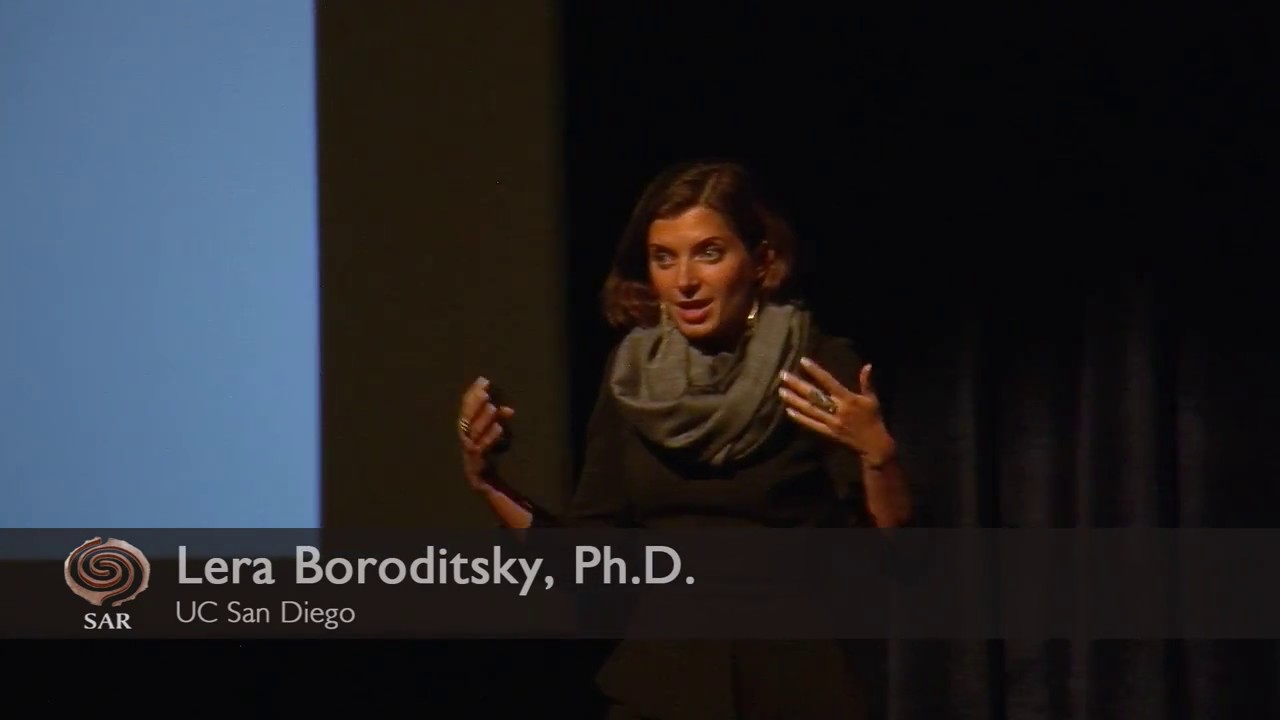
And similarly we can't assume that grammatical gender is what's causing this difference in similarity. Maybe it's cultural. For all we know maybe Germans just have really girly bridges. Now I found this other talk that Boroditsky gave where she cited four different experiments, all related to grammatical gender, that I wanted to briefly go over. The very first one she mentions is about the voices people choose to make make when asked to personify the days of the week. Alright so I found this 108 year old study that she's referencing. Remember what I said before about how directly mentioning gender can make it more likely for the participants to keep gender in mind? Well the same thing applies here. Even if they weren't explicitly mentioning gender, when you voice a character the very first thing you're going to decide is whether or not this character is male or female. So you're forcing them to immediately consider gender, which is going to make the results of any of these studies much more biased.
And you can apply the exact same criticism to her second example.
Now her third example is her unpublished keys in bridges experiment, which I don't think I need to go over again, but I do want to point out something she said which I found pretty interesting.
Anyone else wondering why she considers extended feminine but long masculine? Because I am. Now she might have just misspoken because she doesn't list extended as any of the feminine adjectives when describing the experiment in her article, but it does kind of call into question what exactly a stereotypically masculine or feminine adjective even is. I mean most adjectives in the English language I'm not sure I would categorize as masculine or feminine. Not only that but a few of the adjectives she describes in her article are ones that I would not describe as stereotypically masculine or feminine. And "shiny", something she describes as a feminine adjective here, she describes as a masculine adjective when describing a different experiment.
I only mentioned this briefly but here she's describing the fourth and fifth experiment out of her 2003 study, where she taught English speakers the fictional language Gumbuzi, where nouns were either soupative or oosative. She specifically did not call these categories gender, but placed all of the females within one category in all the males within another, in order to see if this would still have an effect on people just learning the language.
And apparently the fact that English speakers use the word shiny when describing dramatically masculine objects suggests that people's thinking can indeed be influenced by grammatical gender.
But in her key and bridges experiment that exact same conclusion is made because shiny is used to describe grammatically feminine objects. Oh and also if you remember what I said earlier about how all five of the experiments were just similarity experiments in which no specific descriptions were given whatsoever, and are wondering where in the study English speakers are asked to describe specific objects with specific adjectives? Well, the answer is: Like her key and bridges experiment, she does describe it in this article, but it looks like these specific methodologies did not hold up to scrutiny when they actually went through the peer review process. Which is probably why the instances in which people are describing objects with specific adjectives are nowhere to be found in the published study. Now the very last study she mentions talks about how we choose to personify abstract concepts.
Now this is something that I'd actually be willing to believe: that people are more likely to personify abstract concepts in a way that matches their grammatical gender. But I don't think this means what she is implying this means.
Because personifying an abstract concept as either male or female, is very different than viewing the concepts as stereotypically masculine or feminine. And if you're wondering how on Earth could you personify a concept as male, but not view it as masculine, let's look at this example sentence in Hebrew: This sentence translates to: with צדק meaning "justice", דבר meaning "thing" and טוב meaning "good." Now perhaps you're assuming that that last word, הוא, must mean is. But it doesn't. הוא literally translates to "he." And this is not just some poetic way to say this. This is an incredibly common way to word this kind of sentence because the word is does not exist in Hebrew. Why do I bring this up? Well because Hebrew speakers will naturally refer to grammatically masculine objects and concepts as "he."
So if they decided to personify justice as a woman, they would now either have to refer to this woman as "he", which would feel strange, or they would have to continually refer to this grammatically masculine concept using words that translate to she and her, which to a native speaker of a gendered language will feel wrong. And you might think that this would still lead to some sort of internal bias, because they're still choosing to personify this abstract concept as either a man or a woman, but remember it's not as if they just walk around thinking about justice being inherently masculine or feminine. These studies are in reference to people who are forced to choose whether or not justice is a man or a woman. They have to pick something. And it's more likely that the thing they're going to pick is going to be the gender that allow allows them to use their language in the way that feels the most natural. And given that Hebrew speakers would never refer to a grammatically masculine concept like justice as היא, and would never refer to women as הוא, the only logical choice that allows him to be consistent is personifying justice as a man. And this phenomenon is not exclusive to Hebrew, this is incredibly common across many gendered languages. The word "lo" in Spanish can mean either "it" or "him."
And you don't even have to look that far in order to see that personifying or identifying something as male or female is not the same thing as viewing it with stereotypically masculine or feminine traits. You can see this just in English. We often personify the sun as a she, but I'm not sure I would describe the sun as anything other than "GIANT AND SCORCHING."
Boats for some reason are also she's. Would I view a boat as dainty and delicate? I suppose this boat I might, but not this one! And I think bears are probably a very good example about how personifying or identifying something as female, is not the same thing as viewing it with stereotypically feminine traits. "She's got an upright broad stance so she's "This is such a clear example of "If it's a female grizzly you are literally better off Now one really interesting experiment that I found in Boroditsky's 2000 study, had English speakers classify different animals or objects as either masculine or feminine. The interesting part here is that these English speakers did not speak Spanish or German, so they didn't speak a gendered language. But according to Boroditsky the choices they made for the animals still tended to align with their grammatical gender. Now this association was only found with the animals in this particular experiment, but it does seem to suggest that there might be something else causing this association in the first place, because according to Boroditsky, people who do not speak gendered languages are still making associations between grammatical gender and generic animals. And the fact that they were able to find this association in this experiment kind of solidifies my belief that much of the race research on this topic is either too vague or inconsistent to say anything conclusive, and that even in instances where associations can conclusively be found, what is conclusively causing these associations is a lot less clear. Now I do want to make one thing clear here as I wrap this up which is that I'm a guy that gets on TikTok and says things like So you should take all of this with the smallest grain of salt.
Now I did also look into Boroditsky's standing amongst the linguistic community, and it does look like I'm not the very first person to bring up these concerns. And I do hope even if you disagree with my overall stance here, that the information I have presented here leads you to be a little bit skeptical when people make incredibly broad and drastic claims. And to be clear here I think all the ideas that I've showcased here, even the ones I disagree with, are rooted in the idea that and I agree. I just don't think we have to believe that language changes the way we think in order for language to be something beautiful and worth studying.
Up Next

Whorf Hypothesis: Language, Thought & Anti-Racist Origins
@suzyjstyles
119 views•2022-05-27
Constraint Interaction in Optimality Theory: Epenthesis & Deletion
@Vidyamitra
180 views•2018-08-20

Forensic Linguistics: How Language Solves Crimes | PBS
@pbsstoried
1M views•2024-01-25

Accent Expert Explains U.S. Regional Dialects | Part 1
@WIRED
9.3M views•2021-01-21
Related Study Plans & Knowledge Roadmaps
Structured learning paths in Linguistics