



























Benjamin Lee Whorf's linguistic relativity hypothesis proposes that the structure of our native language influences how we perceive and categorize the world, with different languages creating different cognitive frameworks; this anti-racist perspective challenges the notion that some languages are more sophisticated than others, instead viewing linguistic diversity as valid alternative ways of conceptualizing reality, where speakers of different languages habitually experience the world through distinct perceptual and conceptual lenses shaped by their linguistic structures.
Whorf Hypothesis: Language, Thought & Anti-Racist Origins
Added:Basic concepts of linguistics, including structural differences between languages in grammar, vocabulary, and syntax.
The historical transition in anthropology from social Darwinism to cultural relativism, pioneered by Franz Boas.
Edward Sapir's foundational theories on the relationship between language, culture, and individual personality.
The general distinction between linguistic determinism (the strong Whorfian view) and linguistic relativity (the weak Whorfian view).
Empirical studies in neo-Whorfianism, such as cross-linguistic experiments on color perception, spatial orientation, and time conceptualization.
Major critiques of linguistic relativity, particularly Steven Pinker's arguments for 'mentalese' and universal cognitive architecture.
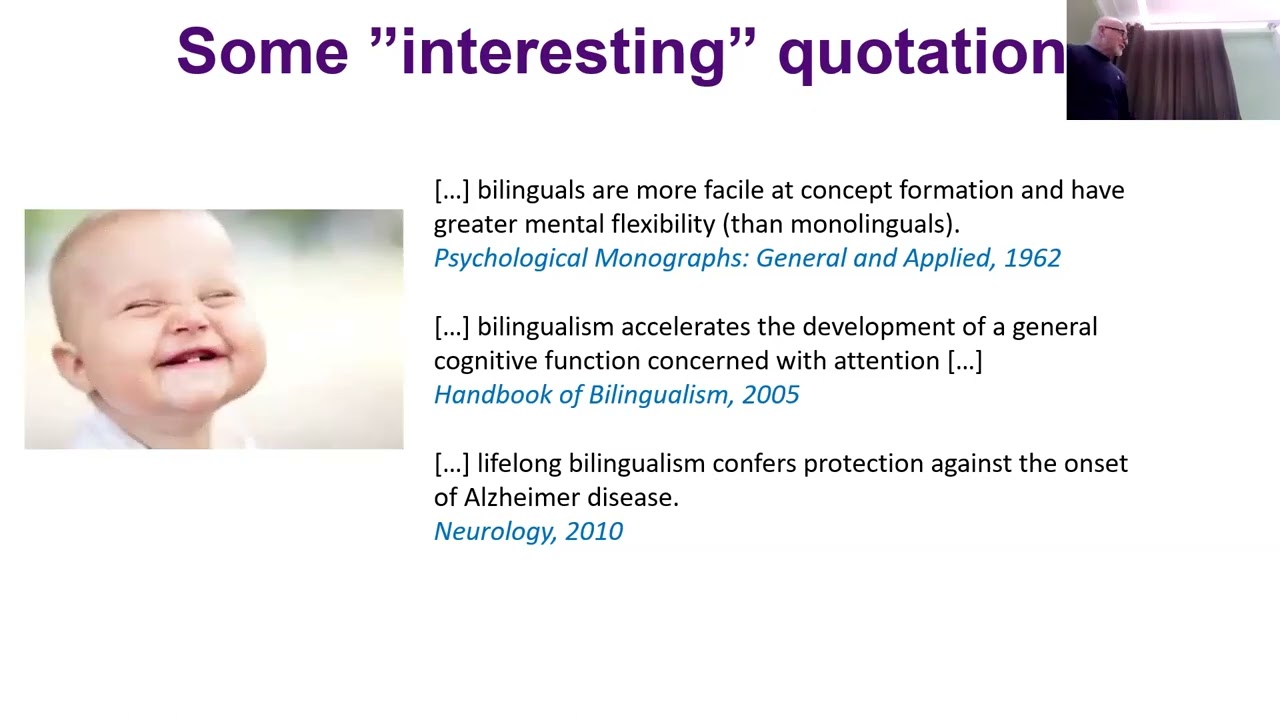
The cognitive effects of bilingualism and multilingualism on decision-making, perception, and personality expression.
The practical application of linguistic framing in political discourse, marketing, and the development of gender-neutral or inclusive language.
119 views3likes19:50Original Release: 2022-05-27
Welcome to the research lab on Language in Perception and Thought. In this class we'll be investigating whether the languages that we speak contain structures or symbols that might cause us to experience our world in different ways my name is Suzy Styles and I come to this area with a background in formal linguistics.
I studied linguistics and Asian Studies at the Australian National University and from there I spent a year at a university in Japan brushing up my Japanese language skills. I was at Tōhoku University in the North of Japan in Sendai, so although the majority of my Japanese is very Tokyo style, the standard language that is recognized in Japan, I also have a little bit of awareness of the Tōhoku-ben, the Tōhoku variety of Japanese as well.
When I had the experience of moving to Japan and really reshaping the ways that I was able to engage with the world in language, I felt like new worlds had opened up to me in really interesting ways and this realigned my interest in language, from being something that was sort of academic, to being something that was grounded in the mind of an individual, and that's when I made the transition to psycholinguistics in order to understand the processes of language in the mind.
I went over to the University of Oxford to begin my PhD working on language acquisition in babies since then I've been fascinated in the relationships between language and the mind, and what we can learn about them using psychological measurement techniques.
So the perspective we'll be taking in this class is to interrogate the Whorfian hypothesis, which is often broken down into two parts; linguistic relativity and linguistic determinism.
Now linguistic relativity talks about the way that languages might bias us to experience our world in different ways whereas linguistic determinism is often interpreted as meaning that the languages that we speak might constrain us to only be able to think about or encounter the world in particular ways that align with our linguistic structures. Some researchers refer to these two perspectives as the the weak and the strong version of the Whorfian hypothesis with weak aligning with linguistic relativity and strong aligning with linguistic determinism.
However we will be taking the neo-Whorfian approach which is, on one side we can recognize differences in the way that people structure their linguistic experiences of the world - we can look at cross-linguistic differences contextual use differences priming bilingualism and even linguistic subcultures. On the other side of the neo-Whorfian approach, we can look at whether these linguistic differences might be related to different processing biases, different habits in thought, how these differences might behave in different domains of cognition perception or thinking and we can use as our toolkit things like errors and processing speed as ways of getting under the skin of the relationship between language and other domains.
In this section of the lecture I'd like to talk very briefly about Benjamin Lee Whorf. So Whorf was not a classically trained linguist when he first started grappling with this idea of words in the mind he was an inspector for the Hartford Fire Insurance Company and he has talked about how when he was going around visiting different companies to evaluate their risk of a fire in order that they could put together an insurance package for the different companies, he noticed something very interesting about the way that different workers might treat oil drums depending on whether they understood that the oil drum was full full of gasoline that is a highly flammable liquid or empty - full of air - or perhaps some residue of gasoline but not full of flammable oil. Now what's interesting from the perspective of a fire insurance assessor is that the empty drum is actually in some ways riskier. So that empty drum if it just has a little bit of oil in the bottom it will be full of this volatile gas, this oil-smelling air that can catch fire much more easily than the liquid fuel itself. So from the insurance perspective it's very important to know which are the full and which are the empty drums.
And what Whorf had noticed was that some of the workers in these oil processing plants would go out to take their cigarette breaks, and instead of lighting their cigarettes near the FULL drums, they would light them near the EMPTY drums. And so Whorf's interpretation of this interesting event was that the workers had in their mind this idea of what emptiness was and they had in their mind this idea of the flammable nature of oil but the concept of empty and its linguistic label describing the drum as not containing flammable material was leading them to riskier behavior.
So this was Whorf's first insight into the idea that the nature of words and how we use them might actually be guiding the way that we think. What's important to know about Whorf is that he came to this field with a deeply anti-racist perspective.
So a lot of thinkers in his time were proposing that people who spoke 'primitive' languages had 'primitive' understandings of the world and therefore that it was the role of Europeans to educate and eradicate these 'primitive' languages on the basis that the European model was more successful, more sophisticated, and therefore correct.
And to give just one example here from the Shawnee language Whorf came to the task of linguistic description by saying there are many different ways of conceptualizing the same event in language. So the example here is a bit of a strange one, it's about cleaning a rifle with a ramrod - or at least that's how we would construe that action in English. So in English when we think about cleaning a rifle with a ramrod there are sort of three senses of meaning. One of them is an idea that things can be clean or have or achieved a state where they are sparkling and bright, we have an ablative sense which is the idea that we'll use something to achieve an outcome, and then we have a tool that we're going to use to perform this action. In the Shawnee language which is one of the indigenous languages of the Americas, he observed a different way of construing exactly the same action. The idea was broken into three words, one of which was something about creating a dryness among wetness, the second concept that was encoded linguistically was the inside of a hole, and then the third concept was a motion that was being described for the function by which the dry space would be created on the inside of a hole.
So when he came to this challenge of what is a 'primitive' language and what is a 'primitive' person, he actually said just because Europeans construe the world in a particular way it doesn't mean that their way is right, it doesn't mean that it's more sophisticated, and it doesn't mean that it's better. It's just different. So I'm going to share with you now a quotation from Whorf and I've selected some highlights for you.
So in his 1956 writing Whorf said "We dissect nature along lines laid down by our native language, the categories and types that we isolate from the world of phenomena we do not find there because they stare every observer in the face; on the contrary, the world is presented in a kaleidoscope flux of impressions which has to be organized by our minds—and this means largely by the linguistic systems of the mind.
We cut nature up, organize it into concepts, and ascribe significances as we do, largely because we are parties to an agreement to organize it this way—an agreement that holds throughout our speech community and is codified in the patterns of our language... and because of this... all observers are not led by the same physical evidence to the same picture of the universe, unless their linguistic backgrounds are similar or can in some way be calibrated."
So I hope you're able to see here that Whorf's approach to language, grounded as it was in this anti-racist sentiment that Western European modes of thinking, Western European modes of knowledge, were not necessarily better than anybody else's, just different. Whorf is also aligning with an idea that we have speech communities who share patterns of representation among us and that those patterns of representation are likely to impose their structure on our experiences on our thoughts.
The Whorfian hypothesis is often broken down into two elements, linguistic relativity and linguistic determinism, and I'll go through each of those in order. So first, linguistic relativity the idea that languages by their nature differentiate things into categories that differ and these biases may affect us to think about things differently from each other. So here is an example I'll share with you from Japanese.
Here we have a terraced rice field, a grain that has been harvested from the plants, a cooked dish that has been created from the grain, and a particular recipe that has been put together using this plant as an ingredient.
Now to a Japanese speaker each of these things has a different name.
For an English speaker, on the other hand, there's just one, "rice". Our English speaker considers all of these different things to be 'rice' — Rice in the field... Rice is the grain... Rice is what we cook... and down the bottom we have curry with rice. For the Japanese speaker on the other hand, we have 'ine' the crop 'kome' the grain, 'gohan' the cooked grain, and in this instance which is 'raisu' when it has been prepared in a non-Japanese non sticky-rice manner of preparation, so here we have 'kare- raisu'.
So linguistic relativity tells us that these two speakers would habitually differentiate these forms of the grain differently from one another. The Japanese speaker would habitually differentiate 'kome' from 'gohan' on the basis of whether or not it's cooked, and the English speaker, although they can tell the difference between these two things, simply doesn't bother to hold in mind when they hear or think about rice whether or not it was cooked at the time. Linguistic determinism takes this one step further and suggests that for this English speaker, the English speaker might think of the crop, the grain, the cooked grain, and the dish as being somehow fundamentally the same.
Some theorists go on to characterize linguistic determinism as a kind of overly strong version of the Whorfian hypothesis — They sort of suggest that if you only have one word for all of these different things then you cannot notice or detect or pay attention to the differences. So this is often characterized as a difference between a weak interpretation of the Whorfian hypothesis, something that might be more aligned with linguistic relativity, and a strong interpretation of the Whorfian hypothesis: if you haven't got words for it then you cannot process it in a way that is not aligned with your linguistic structures. So at one end of the scale we might see conceptual biases and at the other end conceptual constraints.
The neo-Whorfian approach takes a slightly different angle on this question. It says perhaps there are different ways that language might impose itself on our cognitive processes in different domains, and perhaps language might impose itself more strongly or more weakly under certain conditions. So the neo-Whorfian approach simply says, can we find evidence for cognitive biases or perceptual biases that are aligned with features that are coded in different languages?
So we've already seen that we can characterize this space as a difference between strong or weak effects. The neo-Whorfian approach asks how strong are they? Under what conditions can we see them?
Are we seeing something like a four millisecond difference in how quickly we can recognize uh a color between different communities of speakers? Or are we seeing something like an inability to process mathematical procedures if we do not know the names for numbers?
The neo-Whorfian approach also takes its starting point from the linguistic structures of the particular languages it investigates, so it's linguistically guided — given a particular linguistic structure what predictions can we make about cognition, perception, thinking more broadly, or action? The neo-Whorfian approach can also ask how plastic are these effects? Can we push them around a bit? Can we change ourselves from one moment to the next? Or one mode to the next simply by changing our linguistic experience? our linguistic expectations?
or our linguistic context? The neo-Whorfian approach also asks a fundamental question about how is the acquisition of language involved in these processes? It's always worth thinking about the acquisition process when we see a difference in performance that might be aligned with a linguistic structure. How did that come to be? If we think about the acquisition of the linguistic feature, and the acquisition of the cognitive performance that we're measuring, how do those two relate? What was the starting point before the linguistic feature was acquired?
And how plastic or adaptive is that to different linguistic and different cognitive outcomes?
So we're going to pay a little bit of attention to what pre-linguistic states look like we're also going to pay a little bit of attention to how the limitations of a human body and a human brain may be involved in constraining what plasticity is possible. So there may be things about our bodies or brains that mean that we perceive the world directly in certain ways and language may be an epiphenomenon that can only interface with these processes in some ways but not others. So that's what we'll be exploring together in this class. Hopefully you can see that this is a really interesting area of psychology and psycholinguistics. This is one of the reasons we get students from a variety of disciplines enrolling in the class, so you may have classmates in the lab who don't have the same background as you and that's a great opportunity to learn across the disciplines. So we often get linguists enrolling in the class, we often have psychologists enrolling in the class, but we sometimes have communications students, engineers, philosophers, and all sorts of other disciplines as well... so I'm excited to get to know you so we can explore this territory together. One of the things that's very important to me is, as a community of scholars, that we take the time we have together to build each other up and learn from each other's past experiences and perspectives on what we are learning.
So this class will have lots of opportunities for interactive discussions, and lots of opportunities to share perspectives as well. In fact if you check the syllabus documents you may even see that your class participation grade includes some elements that come from your constructive and collaborative attitude towards your classmates. So that's the brief overview to Whorf and the Whorfian perspective that we'll be taking together in this class, and I look forward to getting to meet you and discuss these issues further in the coming weeks!
Up Next

79:52
Viewpoint and Perspective in Language and Gesture | Cognitive Linguistics Talk
@case
7.1K views•2008-04-03
36:52
Constraint Interaction in Optimality Theory: Epenthesis & Deletion
@Vidyamitra
180 views•2018-08-20

8:59
Forensic Linguistics: How Language Solves Crimes | PBS
@pbsstoried
1M views•2024-01-25

21:32
Accent Expert Explains U.S. Regional Dialects | Part 1
@WIRED
9.3M views•2021-01-21
Related Study Plans & Knowledge Roadmaps
Structured learning paths in Linguistics
linguistics
Optimality Theory: Tableaux & Constraints
01Phonological Basics: Sounds, Syllables & Rules
02Foundations of Optimality Theory: GEN, CON, and EVAL
03The Constraint Inventory: Markedness vs. Faithfulness
+ 2 more learning modules
15h5 modules
Explore Roadmap
linguistics
Morphosyntactic Alignment: S, A & P Systems
01Foundations of Syntax: Transitivity and Arguments
02The Linguistic Variables: Mapping S, A, and P
03Nominative-Accusative Alignment
+ 3 more learning modules
12h6 modules
Explore Roadmap
linguistics
Analyzing Sign Language: Phonology & Syntax
01Foundations of Sign Language Linguistics
02Phonology: The Five Parameters of a Sign
03Morphology: Word Formation and Classifiers
+ 2 more learning modules
14h5 modules
Explore Roadmap
linguistics
Pragmatics: Speech Acts, Grice & Politeness
01Introduction to Pragmatics: Meaning in Context
02Grice’s Cooperative Principle & Implicature
03Speech Act Theory
+ 2 more learning modules
14h5 modules
Explore Roadmap