







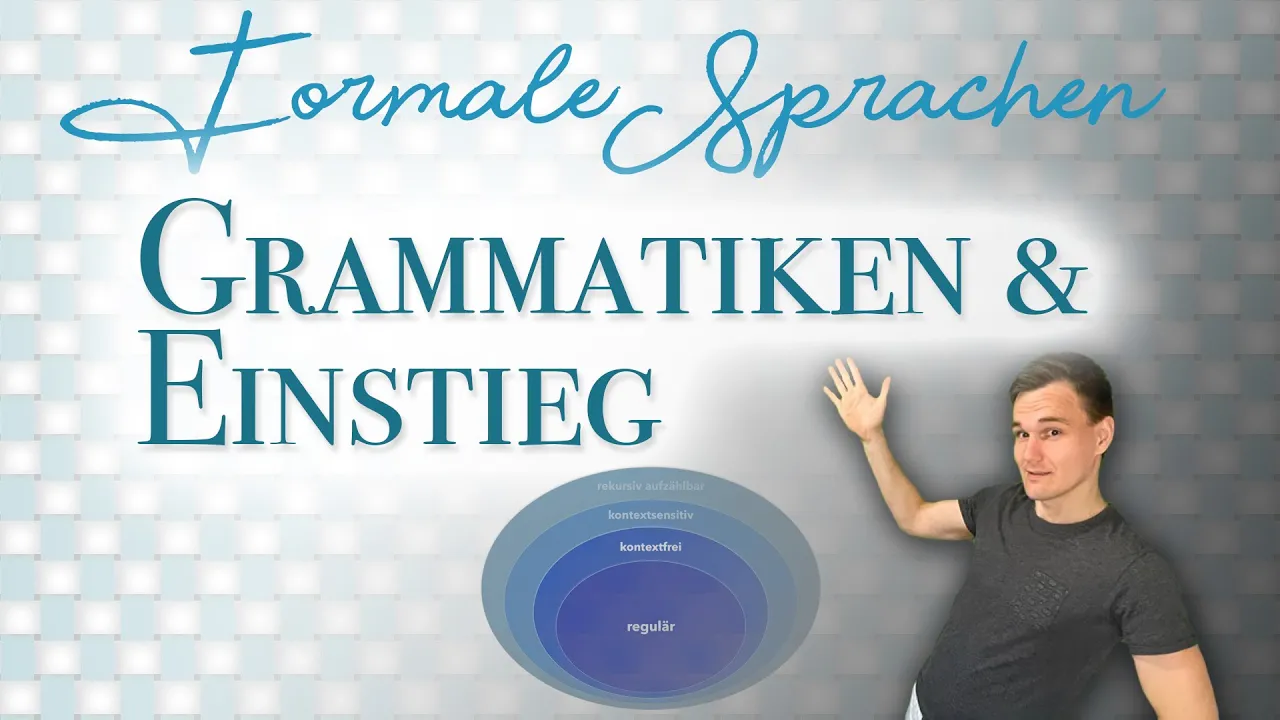











The Chomsky Hierarchy, developed by Noam Chomsky in 1959, classifies formal languages into four types based on their computational complexity: Type 0 (Recursively Enumerable) corresponds to unrestricted Turing machines; Type 1 (Context-Sensitive) requires predictable but potentially unbounded memory; Type 2 (Context-Free) uses a stack-based memory structure; and Type 3 (Regular/Finite-State) requires no memory at all. This hierarchy provides the theoretical foundation for understanding programming languages, compilers, and parsing algorithms, showing how different language structures correspond to different computational capabilities.
Chomsky Hierarchy Explained | Computerphile
Added:Basic set theory and mathematical notation for alphabets, strings, and formal languages.
The concept of an abstract machine and computational models (such as state-transition systems).
An introduction to formal grammars, including the definitions of terminal symbols, non-terminal symbols, and production rules.
Familiarity with Finite State Automata (FSA) and how they recognize regular expressions.
Turing Machines and the fundamental limits of computation, including the Halting Problem and decidability.
Compiler Design, focusing on how lexical analysis and parsing algorithms (like LL and LR parsers) apply Context-Free Grammars.
Computational Complexity Theory, exploring how hierarchy levels map to resource bounds (e.g., P vs. NP).
Modern Natural Language Processing (NLP) syntax models and the debate over the Chomsky hierarchy's adequacy for human languages.
252.6K views6.1Klikes6:57Original Release: 2016-01-13
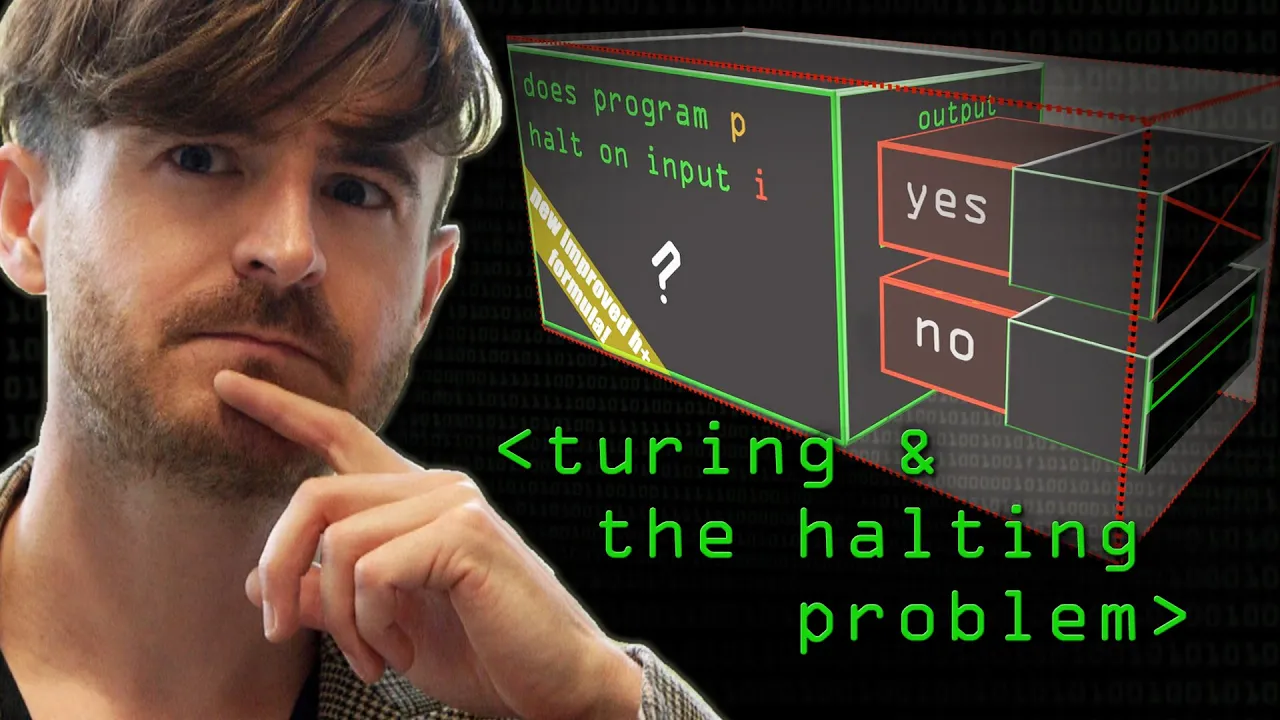
Recently we've had a request saying can Computerphile do something on finite state automata. And in considering what to do about that it did seem to me that it would be a good idea to look at where finite-state automata sit in the scheme of things. We've done a lot about Turing machines for example, we've covered the fact that really every single computer, of any sort nowadays, is a Turing machine. So what I'd like to do is to refer to a diagram which shows, if you like, the various types of Turing machine - a hierarchy where if you go inside you make less and less demands on what you need. And, if you look at this set of circles here, I can even related it back to some of the videos we've done previously. You will remember that when we were doing the Ackermann function we eventually decided that it's of the Recursive sort, which means it will terminate but it could take an awful long time. If you remember in leading up to that, I said there's a certain sort of Turing Machine, outside that, which is a real so-and-so which says: "Sometimes the algorithm you give me will give an answer - and you're happy, but sometimes I will go into a loop and when you say `How can I detect, in general, that you are in a loop?', the answer is `You can't!' " And we've done other videos with my colleague Mark Jago all about the Halting Problem as it's called and then we went one even worse: we've been out in the outer perimeter of hyperspace here, to say are there some problems that are so awful that no algorithm can exist? And we did the Busy Beaver if you remember which is a sort of encoding of a particular Turing Machine. It says: "Look, there's not a general algorithm here - I'm not trying to do n factorial. What I'm asking is, for machines of this sort, can you predict how many zeros it will print out?" And the answer is there isn't an algorithm that can say how those Busy Beaver programs will behave in general - if only there was! What you have to do is to run them all and just exhaustively say "I don't know, there isn't an algorithm, just try them".
What happened after Godel and Turing and others, in the nineteen thirties, did all this, is people started saying "Well these Turing Machines, y'know, it's wonderful - they're a pencil and paper thing but you could imagine building hardware to do them and, of course. those are general-purpose computers as we now know them. But people said: "Is there a sort of subset of Turing Machines where you can either say 'it doesn't need more than a definite amount of RAM - guaranteed - that would be nice to know. ' " And those come out to be in this inner circle of Type 1, here, Then people started to say;"Hey there's this thing called a 'pushdown store', which the Americans call a 'stack'. That's a one-ended memory device. You can't dip into it, arbitrarily. You can either take something off the top or push something new on the top. So any addition or reading of your memory can only be done at the top of the stack. Is that a sort of special case? Yes it is. >> Sean: And we've looked at that with your Towers of Hanoi haven't we? >> DFB: Yes, Towers of Hanoi is a classic example of something where you just want to get hold of the whole bunch of disks and sort them, in your hand, like RAM, y' know, just park that one there, store that one there, think about it put them back together and plonk them back on the rod. But you can't do that! You can only do it one-ended and for something that y'know, "I could do that in two or three moves if only I could take all the discs off", you end up having to do 64 moves. And then there's one right in the middle in the inner circle here, that needs no memory at all - in principle. And that's what these finite-state automata are all about. You might ask "Who discovered all this - who filled in all these gaps?" Because there we are with Turing, who perversely discovers the most general thing going, in the nineteen thirties. But people don't know the simpler story underneath.
Well the person who discovered it is still with us. I think he must be in his late eighties now - his name is Noam Chomsky and I think my friends say that you ought to pronounce it "Homski" like the "ch" in [Scottish] "loch". But I'm happy to be put right on that. He's genius - near genius - guy, I think he's been at Harvard, MIT, places like that ever since he was young. He really was talented. He's a 'linguistician'. If you study the structure of natural languages - any languages, computer languages even, I think I'm right in saying you're a 'linguistician'. Well, in the late nineteen fifties he started saying: "Look, to understand natural languages better, I'm going to look at the most restrictive form of language I can think of". Y'know really simple things.
How about a language whose words are just strings of the letter 'i'. So 'iii' is a word; five i's, 'iiiii, 'is a word. Any number of i's is a different word. How simple can that be?
Yes, very simple. And then he went on to say things like "Yeah, what's a bit more complicated than that?" Because those very simple languages as we'll find, next time, don't need any memory at all - they really don't.
And what's the one that sits outside - he did more investigations and said: "Ah! there is one where a one-ended memory will work".
Yeah - these are the Chomsky Type 2. So, remember Chomsky - it goes, as it were, the opposite way around. Type 0 is the most general, right, the Recursivley Enumerables. A subset of Type 0 is the Recursively Enumerables that really do terminate - e.g. Ackermann. Type 1 is the one where it needs RAM but you can predict how much RAM. So he discovered that sort - that's the Type 1 i.e. Turing Machines with a predictable and finite amount of RAM requirement. And he just filled in the whole picture. And in the period really from about 1959 to the middle 1970s a huge amount of work filling in the middle of this diagram. And that includes things like computer languages, Algol, how to parse them, how to compile them.
And it was all filled in - in the middle of this diagram. But all basically referring back to that work that Chomsky did in 1959, saying: "These are the language varieties".
Up Next

29:03
Syntax Parsing: Top-Down, Bottom-Up, and CKY Algorithm
@naturallanguageprocessing6035
16.1K views•2017-02-15
87:26
Introduction to Secure Multiparty Computation with Yehuda Lindell
@fhe_org
7.7K views•2021-02-04

24:22
Rust RAII Memory Management Explained | Computerphile
@Computerphile
271.2K views•2023-02-23
19:25
Enigma Machine Mechanics: WWII Encryption Explained
@JaredOwen
13.2M views•2021-12-11
Related Study Plans & Knowledge Roadmaps
Structured learning paths in Computer Science
computer-science
Container Runtimes: Namespaces, Cgroups & Go
01Linux Systems & Go Programming Foundations
02The Core of Isolation: Chroot and Filesystems
03Linux Namespaces: Process Isolation
+ 3 more learning modules
32h6 modules
Explore Roadmap
computer-science
Building a CHIP-8 Emulator: Rust & CPU Basics
01Computer Architecture Foundations (Bits & Bytes)
02Rust Programming for Systems Development
03CHIP-8 Virtual Hardware Specifications
+ 2 more learning modules
32h5 modules
Explore Roadmap
computer-science
Building BitTorrent: Go, P2P & Concurrency
01Go Fundamentals & Concurrency
02Networking Foundations & P2P Architecture
03Bencode Parsing & Torrent Metadata
+ 3 more learning modules
26h6 modules
Explore Roadmap
computer-science
Actor Models (C++ Concurrency & Lock-Free)
01C++ Multi-Threading Foundations
02Thread Pools and Task Scheduling
03Atomics and Lock-Free Queue Design
+ 3 more learning modules
45h6 modules
Explore Roadmap