Cryptography is classified into three main categories: symmetric cryptography (where the same key is used for encryption and decryption), asymmetric cryptography (using a public key for encryption and a private key for decryption), and hash functions (which produce fixed-size outputs from variable-length inputs without requiring a key).
Introduction to Cryptography: Lecture 1 by Christof Paar
Added:Deep Dive
Basic modular arithmetic (e.g., the modulo operation and its properties), which is essential for understanding both classical and modern ciphers.

Basic Maths Lecture
434
Modular arithmetic combines standard integer operations with the modulo operation. The modulo function (a mod n) returns the remainder when a is divided by n, always producing a result between 0 and n-1. Key properties include: a mod n < n, if a < n then a mod n = a, and a mod n = (a + kn) mod n for any integer k. This is used in everyday life (clock time) and is essential for cryptography.
Click to watch →

Introduction to Modulo Arithmetic | Class 12 Applied Maths #maths #12th #appliedmathematics
703
Modular arithmetic is a system of arithmetic for integers that deals with remainders only. Given two positive integers x and y where x > y and y ≠ 0, x can be expressed as x = y × q + r, where q is the quotient and r is the remainder satisfying 0 ≤ r < y. Key operations include: (1) Basic modulo: x mod y = remainder when x ÷ y; (2) Property: x mod y = (x + ky) mod y for any integer k; (3) Addition modulo m: (a + b) mod m, taking remainder if sum ≥ m; (4) Subtraction modulo m: (a - b) mod m, taking remainder if difference ≥ m; (5) Multiplication modulo m: (a × b) mod m, taking remainder if product ≥ m. For negative numbers, the remainder must be positive.
Click to watch →
Criptografía Aplicada #1 - Introducción a la Criptografía y el Cifrado César
2K
Modular arithmetic is the mathematical foundation underlying all cryptographic algorithms. Computers have limited memory and cannot represent infinite numbers, so when values exceed maximum representable limits, they wrap around—exactly what modular arithmetic models. The division algorithm states that any integer equals divisor times quotient plus remainder. The 'mod' operation extracts the remainder when dividing by a modulus. Congruence is an equivalence relation where a ≡ b (mod n) means a and b have the same remainder when divided by n. This creates equivalence classes where multiple numbers represent the same value. For modulus 3, numbers like 7, 10, 13, and -2 are all equivalent because they all have remainder 1 when divided by 3.
Click to watch →

Class 12 Applied Maths 2023: Basic Concepts Of Modulo Arithmetic Applied Maths 2023 24
5.2K
Modulo arithmetic is a type of arithmetic involving addition, subtraction, and multiplication but not division. The modulo operation (mod) finds the remainder when one number is divided by another. For example, 25 mod 3 = 1 because 25 ÷ 3 = 8 remainder 1. When dividing negative numbers, ignore the negative sign, perform the division, then apply the negative sign to the remainder. Two numbers A and B are congruent modulo N (written as A ≡ B (mod N)) if they leave the same remainder when divided by N. Modulo arithmetic supports three basic operations: Addition modulo N means adding two numbers then finding remainder when divided by N. Subtraction modulo N means subtracting two numbers then finding remainder. Multiplication modulo N means multiplying two numbers then finding remainder. Division is not performed in modulo arithmetic because the remainder is determined through division. To find the last digit of a number, divide by 10 and find the remainder. To find the last two digits, divide by 100 and find the remainder. To find the last three digits, divide by 1000 and find the remainder. Clock arithmetic problems use modulo 24 because there are 24 hours in a day. Modulo arithmetic has four main properties: Addition Property (A + K ≡ B + K (mod N)), Subtraction Property (A - K ≡ B - K (mod N)), Multiplication Property (A × K ≡ B × K (mod N)), and Power Property (A^k ≡ B^k (mod N)). These properties allow operations on both sides of a congruence while preserving the congruence relationship.
Click to watch →
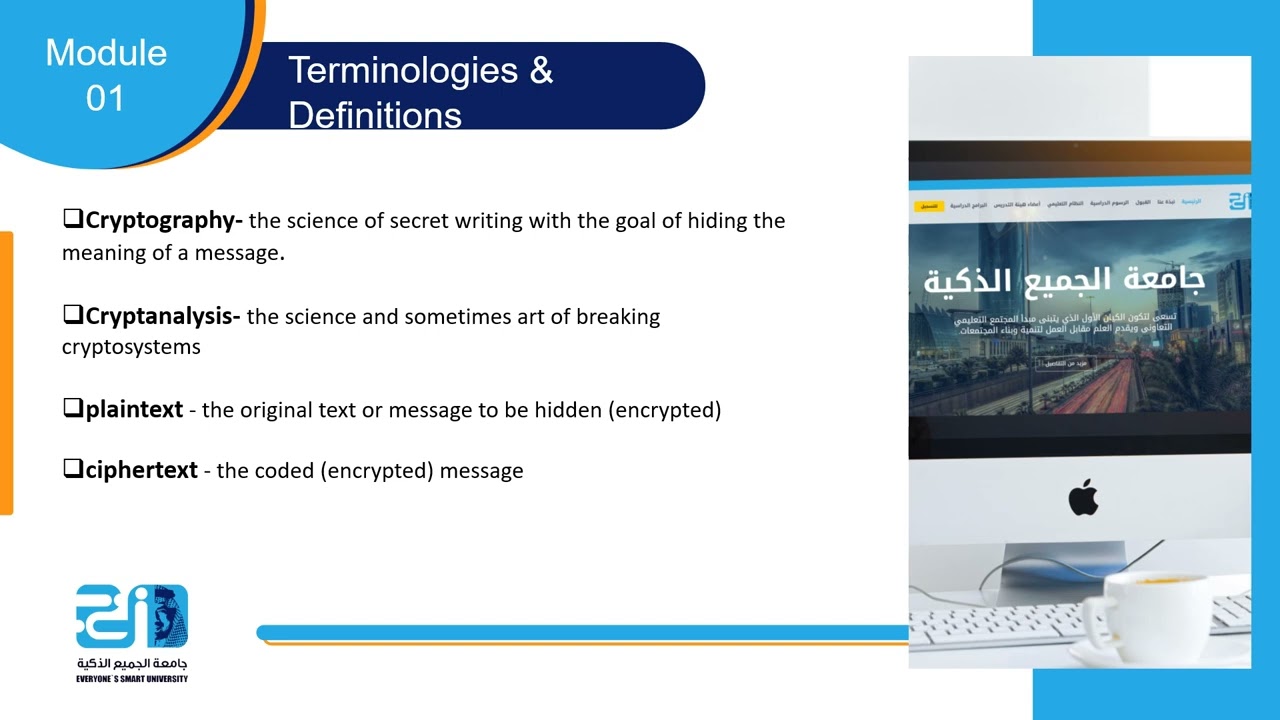
Introduction to Cryptography - Lecture 1 - ESU
718
Modular arithmetic is fundamental to cryptography, ensuring operations remain within valid ranges. With values 0-25 (representing A-Z), modulo 26 keeps results within bounds—for example, 13+16=29 becomes 4 mod 26, and 13×16=208 becomes 8 mod 26. The Caesar cipher (shift cipher) applies this principle by adding a key value to each letter's numerical equivalent, then taking modulo 26. Decryption reverses this by subtracting the key and applying modulo 26 again to handle negative results. Using key 17, 'attack' encrypts to 'RKKT B' and decrypts back to original. This demonstrates how modular arithmetic enables systematic, reversible transformations that form the mathematical foundation of classical encryption techniques.
Click to watch →
Deep Dive
Fundamental computer science concepts, specifically binary representation of data and the bitwise XOR operation.

Level 1 : Session 6 | Bitmasks & Bit Manipulation
1.3K
This comprehensive section establishes the mathematical and computational foundations for binary representation and bitwise operations. A number system is defined by its base (B), where digits range from 0 to B-1, with each position representing a power of B. The binary system (base 2) uses only 0 and 1, forming the foundation of computer representation. The instructor explains how to convert decimal numbers to binary by repeatedly dividing by 2 and recording remainders, then reading them in reverse order. This algorithm works for any base conversion by changing the divisor. The section covers the three fundamental bitwise operations: AND outputs 1 only when both corresponding bits are 1; OR outputs 1 if at least one bit is 1; XOR outputs 1 when bits differ. XOR is its own inverse: XORing a number with itself gives 0, and XORing with 0 leaves it unchanged. Left shift (<<) and right shift (>>) operations are equivalent to multiplying and dividing by powers of 2. Essential utility functions include checking if a bit is set using (number >> k) & 1, setting bits using OR with (1 << k), clearing bits using AND with the complement, and toggling bits using XOR. These operations are fundamental for low-level programming, data compression, and algorithm optimization.
Click to watch →
L-12 For Loop in C Language मराठीत | Swapping of Two Numbers Without Using Temp / Bitwise Operator
928
The XOR operation works on binary representations of numbers. The instructor demonstrates with binary: 2 is 010, 3 is 011. XORing them: 010 XOR 011 = 001 (which is 1). This shows how XOR operates bit by bit. Understanding binary representation is essential for grasping how XOR works at the hardware level.
Click to watch →

비트 연산자(AND, OR, XOR, NOT) | 음수 표현 방법 | 2의 보수 | 진수 변환 | 비트란?
5.3K
This comprehensive section covers the foundational concepts of how computers represent and process data. A bit is the smallest unit of data, representing either 0 or 1, with the number of bits determining the range of representable values (1 bit = 2 values, 8 bits = 256 values). The video explains different number systems: binary (base-2) for computers, decimal (base-10) for humans, and hexadecimal (base-16) for compact binary representation. The section demonstrates converting between decimal and binary by repeatedly dividing by 2 and recording remainders. It also covers the three fundamental bitwise operations: AND (both bits must be 1), OR (either bit being 1), and XOR (bits must be different). These concepts form the basis for understanding all computer arithmetic and data processing.
Click to watch →

🦾 XOR - Cyfrowy hardcore - Programowanie ZAAWANSOWANE #14
333
XOR operates on individual bits with the truth table: 0 XOR 0 = 0, 0 XOR 1 = 1, 1 XOR 0 = 1, and 1 XOR 1 = 0. The operation returns 1 when bits differ and 0 when they match. In C++, XOR uses the caret symbol (^). The instructor demonstrates with examples like 53 XOR 24 = 45, showing how to read numbers, calculate XOR, and output results in both decimal and binary formats. XOR is fundamental to binary addition in computers: 0+0=0, 0+1=1, 1+0=1, and 1+1=0 (with carry). XOR gives the sum bit while AND gives the carry bit. To flip a specific bit, XOR the number with a mask containing a 1 at the target position: 1 << bit_position. The instructor explains that XOR with 0 leaves bits unchanged, while XOR with 1 flips them.
Click to watch →
Admitere 2025 - Operatii pe Biti
329
Computers store all numbers in binary format (base 2), where each bit represents a power of 2. The decimal number 7 is represented as 111 in binary (2^2 + 2^1 + 2^0 = 7). Bitwise operations like XOR (exclusive OR) work directly on binary representations, returning 1 when bits differ and 0 when they match. Left shift (<<) moves bits left, multiplying by 2, while right shift (>>) moves bits right, dividing by 2. These operations form the foundation of low-level programming and computer arithmetic.
Click to watch →
Deep Dive
Elementary algebra and discrete mathematics, including basic concepts of sets, functions, and prime numbers.

رياضيات للصف الثالث الاعدادى – حل تدريبات الاضواء بكتاب الاضواء صفحة 43 العلاقات والدوال
23K
A function (دالة) is a relationship where every element in the domain (المجال) has exactly one arrow pointing to an element in the codomain (المجال المقابل). If any element has more than one arrow or no arrow, it's not a function. The domain is the set of all elements in the first set, the codomain is the set of all elements in the second set, and the range (المدى) is the set of elements in the codomain that actually have arrows pointing to them. Functions can be represented as ordered pairs (بيان عين) or arrow diagrams (مخطط سهمي). A prime number is a natural number greater than 1 that has exactly two factors: 1 and itself. Sets can be defined using inequalities, such as the set of natural numbers greater than or equal to 1 and less than or equal to 3, written as S = {1, 2, 3}.
Click to watch →

Elementare Diskrete Mathematik (2019W), VO1: Organisatorisches, Kombinatorik (I)
150
The course covers selected elementary contents of discrete mathematics. The first block focuses on combinatorics, which is relatively basic and serves as an entry point. The next two blocks cover proof techniques, essential for teacher education students. The course also covers number representations in different positional systems, number theory (primes, divisibility), and modular arithmetic (calculating with remainders). Finally, there is a brief introduction to algebraic structures, which are sets with defined operations, such as natural numbers, real numbers, vector spaces, and sets of propositions. Students will acquire a solid understanding of selected concepts, procedures, and working methods of elementary discrete mathematics.
Click to watch →
Relation & Function prep (3) algebra lesson 2 🔥🔥🔥 & العلاقات والدوال الصف الثالث الإعدادى لغات
265
Functions can be defined using set notation with conditions, such as 'f = {(x,y) | x ∈ X, y = 3x}'. This notation specifies both the domain and the rule that determines the output for each input. A prime number is a natural number greater than 1 that has exactly two distinct positive divisors: 1 and itself. The first few prime numbers are 2, 3, 5, 7, 11, 13, 17, 19, 23, 29, 31, 37, 41, 43, 47, 53, 59, 61, 67, 71, 73, 79, 83, 89, 97.
Click to watch →

3 Adım Deneme Sınavları | AYT | 1. Adım 1. Deneme | Matematik Testi | AYT.MAT | MEB | 01-10 | EBA
52.9K
This segment covers finding prime numbers and basic set theory operations. For finding primes less than a given number, list all numbers and eliminate those divisible by any prime less than or equal to their square root. For finding primes with digit sum conditions, list all numbers with that digit sum, then test each for primality. For set theory, the segment covers: (1) intersection (elements in both sets), (2) union (elements in either set), (3) difference (elements in A but not B), and (4) Cartesian product (ordered pairs from both sets). The number of elements in Cartesian product equals the product of the number of elements in each set.
Click to watch →

Дискретная математика. Вводная лекция.
30.2K
The fundamental concept of the entire course of discrete mathematics is the concept of a set. The objects of study of discrete mathematics are discrete sets, i.e., collections or sets of certain elements. Therefore, teaching discrete mathematics begins with the most general, deeply abstract section of this science - set theory. A set is understood as a collection of elements of any nature that can be counted, and the number of elements is finite. In contrast, a set is called infinite if the number of elements is infinite. Discrete mathematics studies exactly finite countable sets.
Click to watch →
Deep Dive
An intuitive grasp of probability theory, which helps in understanding encryption security and key spaces.

Cyber Security การประยุกต์ใช้ทฤษฎีความน่าจะเป็นในระบบการเข้ารหัส
113
Cyber Security protects data from unauthorized access through encryption, which transforms readable information into unreadable formats. Encryption serves five main purposes: password protection, digital currency security, electronic signatures, identity verification, and secure communication. While encryption offers advantages like data confidentiality and attack prevention, it has disadvantages including complexity and potential misuse. Probability theory underpins encryption security through random key generation, security strength assessment, and attack probability analysis. Key length directly impacts brute force resistance: 4-digit keys crack in under 0.01 seconds, 6-digit keys in 0.001 seconds, while 128-bit keys make attacks practically impossible.
Click to watch →

Lecture 10: Multiple Encryption and Brute-Force Attacks by Christof Paar
57.5K
Block ciphers can be modeled as random mappings from plaintext space to ciphertext space. When encrypting a single plaintext with a random key, the resulting ciphertext is essentially randomly distributed across the ciphertext space. With a key space much larger than the block size (e.g., 80-bit keys vs. 64-bit blocks), many different keys will map the same plaintext to the same ciphertext by chance. The probability calculation shows that with 2^L keys and 2^N possible ciphertexts, each ciphertext is hit by approximately 2^(L-N) different keys on average. This mathematical framework explains why false positives occur and forms the basis for understanding how many test pairs are needed to reliably identify the correct key.
Click to watch →
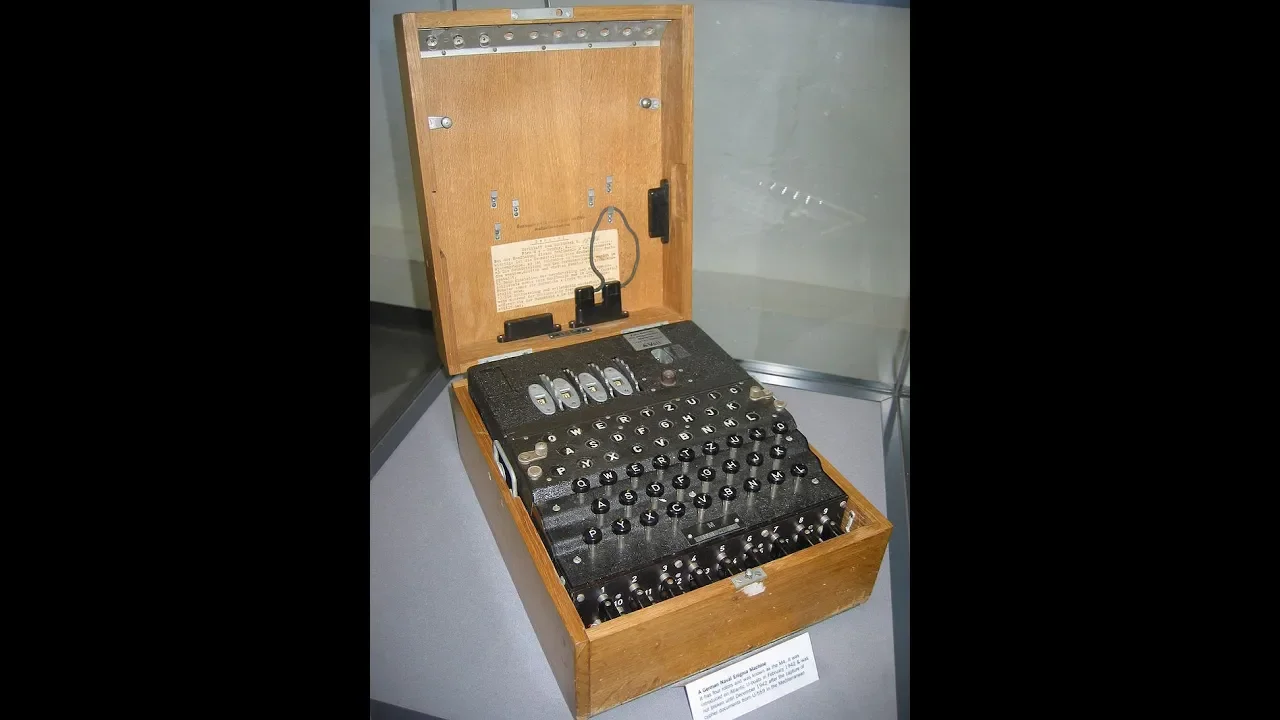
Breaking Enigma - Exploiting a Pole Position
256.4K
Probability theory explains how encryption complexity increases exponentially with each additional transformation layer. For a coin flip with 2 outcomes, 2 flips yield 4 possibilities (2^2), 3 flips yield 8 (2^3), and so on. Similarly, for a 6-sided die, rolling twice yields 36 combinations (6×6). This exponential growth principle applies to cryptographic keys, where each additional transformation layer dramatically increases the number of possible combinations.
Click to watch →

Shannons Theory
15.1K
A simple cryptographic system demonstrates probability calculations: plaintext symbols A and B with probabilities 1/4 and 3/4; ciphertext symbols 1, 2, 3, 4; keys K1, K2, K3 with probabilities 1/2, 1/4, 1/4. The encryption maps A to 1, 2, 3 with keys K1, K2, K3 respectively, and B to 2, 3, 4. Ciphertext 1 occurs only from A with K1: probability 1/4 × 1/2 = 1/8. Ciphertext 3 occurs from A with K3 (1/16) or B with K2 (3/16), totaling 4/16 = 1/4. This illustrates how to compute probabilities for any cryptographic system.
Click to watch →

CCNA Cybersecurity operations Chap9 - Part1
493
This section explains that modern encryption algorithms are designed to be secure even when the algorithm is publicly known (Kerckhoffs's principle). Two fundamental properties must be satisfied: plaintext cannot be derived from ciphertext without the key, and incorrect key guesses should not reveal information about the actual key. The lecture explains key length (measured in bits) and key space (number of possible keys), demonstrating how key space doubles with each additional bit. A key length of 40 bits provides 2^40 possible keys, while 256 bits is recommended for adequate security. Longer keys require more complex mathematics and longer processing times.
Click to watch →
Prerequisite Knowledge
- Concept 01Basic modular arithmetic (e.g., the modulo operation and its properties), which is essential for understanding both classical and modern ciphers.
- Concept 02Fundamental computer science concepts, specifically binary representation of data and the bitwise XOR operation.
- Concept 03Elementary algebra and discrete mathematics, including basic concepts of sets, functions, and prime numbers.
- Concept 04An intuitive grasp of probability theory, which helps in understanding encryption security and key spaces.
Subsequent Learning
- Step 01Symmetric-key cryptography, including the deep study of stream ciphers and block ciphers like DES and AES.
- Step 02Asymmetric (public-key) cryptography, specifically key-exchange protocols like Diffie-Hellman and encryption schemes like RSA.
- Step 03Cryptographic hash functions and Message Authentication Codes (MACs) to ensure data integrity.
- Step 04Real-world security protocols (such as SSL/TLS, SSH, and IPsec) that integrate these cryptographic primitives to secure internet traffic.
Course Plan
Defining Scope
Course Plan
0:24Playing Section
- 1
Instructor outlines the day's agenda.
- 2
Starts with classifying cryptography.
The Practical Security Perspective: The Limitations of Mathematical Cryptography
While academic introductions to cryptography focus heavily on mathematical algorithms and proofs of computational hardness, practical security experts argue that this theoretical approach overemphasizes the strongest link in the security chain. In real-world systems, cryptographic algorithms are rarely broken directly. Instead, adversaries bypass the mathematics entirely by exploiting implementation flaws, side-channel attacks (such as timing or power analysis), weak key management, and human error. This perspective, often summarized by security expert Bruce Schneier's observation that 'cryptography is usually bypassed, not penetrated,' contends that studying cryptography in isolation ignores the systemic vulnerabilities of software engineering and human factors, which are the primary failure points in actual secure communication.
Deep Dive
Symmetric-key cryptography, including the deep study of stream ciphers and block ciphers like DES and AES.
Symmetric Key Cryptography | Stream Cipher & Block Cipher Explained | Network Security | Simplilearn
61.4K
Symmetric key cryptography uses a single shared secret key for both encryption and decryption, making it faster and more efficient than asymmetric cryptography for encrypting large volumes of data; it employs two main cipher types—stream ciphers that encrypt data one bit at a time (like RC4) and block ciphers that process data in fixed-size chunks (like AES, DES, and 3DES)—with applications spanning banking security, data center protection, and secure internet browsing via HTTPS.
Click to watch →

Chapter 3, part 1: Symmetric Key Crypto --- stream ciphers, A5/1, shift registers
54.8K
Symmetric key cryptography employs two fundamental approaches: stream ciphers and block ciphers. Stream ciphers generalize the one-time pad by trading provable security for practicality—using a short key stretched into a pseudorandom keystream via an algorithm, then XORing with plaintext. Block ciphers function as codebook systems where each key selects a different substitution table for fixed-size blocks. Historically, stream ciphers dominated from WWII through the 1970s due to hardware limitations, but modern processors now favor block ciphers for most applications.
Click to watch →
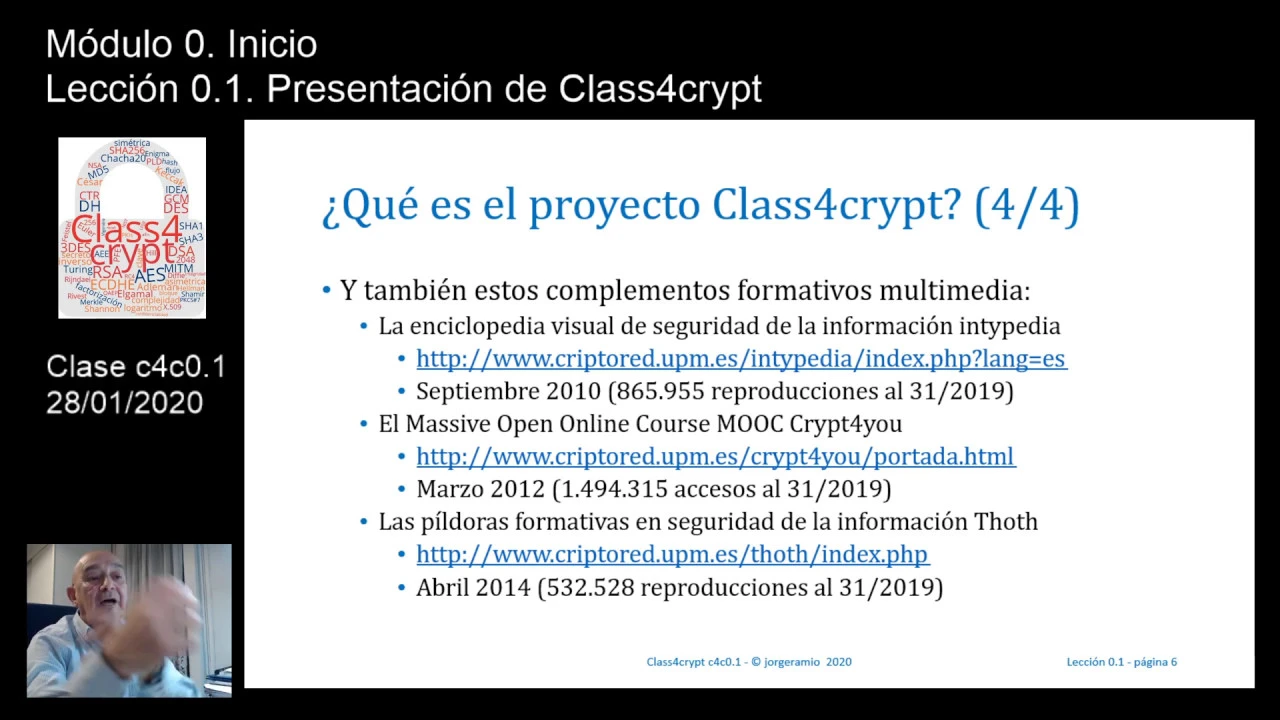
Class4crypt c4c0.1 Presentación
7.8K
Module 8 covers symmetric block ciphers and their modes of operation. DES (56-bit key, 64-bit block) was the first military-grade cipher but was broken by brute force attacks between 1997-1999. AES (128, 192, or 256-bit keys, 128-bit blocks) replaced DES and is the current standard. The course covers ECB, CBC, CTR, and GCM modes, along with padding schemes (zero padding, PKCS#7). Module 9 covers stream ciphers using XOR with keystreams generated from Linear Feedback Shift Registers (LFSRs). RC4 was widely used until 2013-2014 when vulnerabilities were discovered. ChaCha20 with Poly1305 is a modern alternative. Golomb's postulates evaluate keystream randomness.
Click to watch →
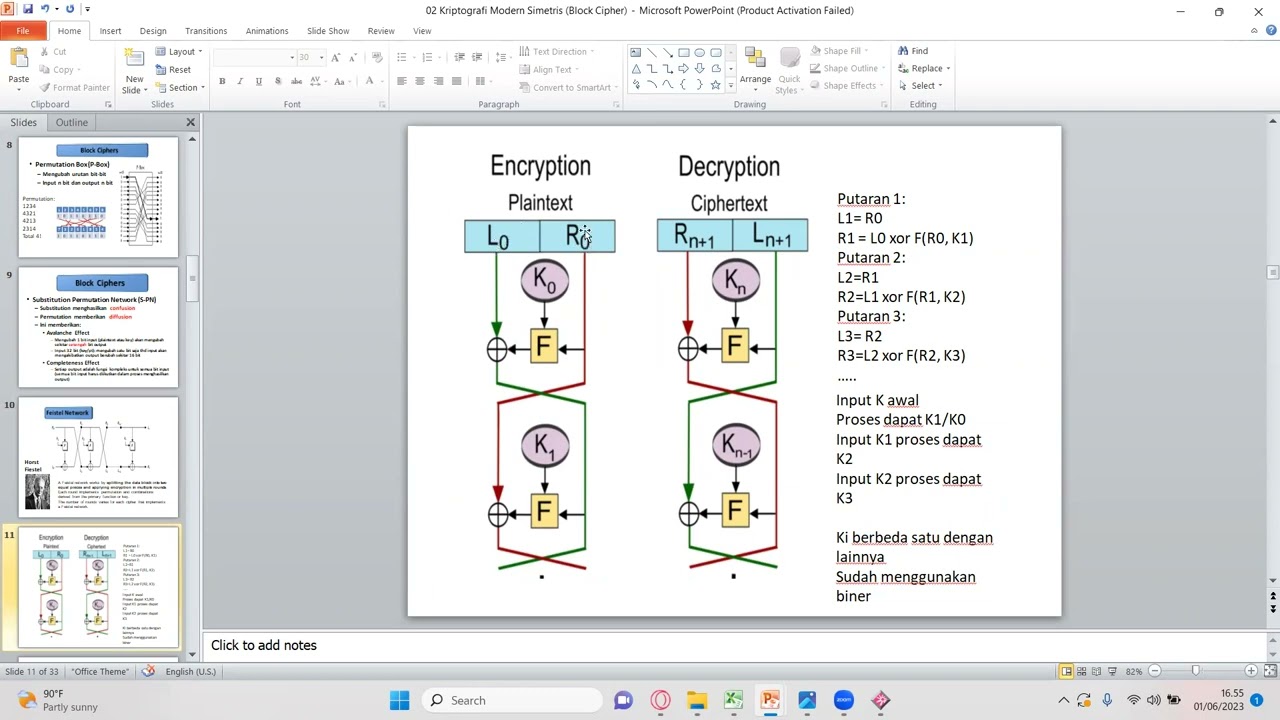
Overview Kriptografi : Kriptografi Klasik dan Modern (Kunci Simetris dan Asimetris)
235
Modern symmetric cryptography includes block ciphers (DES, IDEA, AES) and stream ciphers (RC4, AES-CTR). Block ciphers divide plaintext into fixed-size blocks (32, 64, 128 bits) with operations like Substitution (S-box) and Permutation (P-box). The Feistel Network divides blocks into halves, applies multiple rounds with XOR operations. AES uses 10-14 rounds with SubBytes, ShiftRows, MixColumns, and AddRoundKey. AES operates in GF(2^8) using XOR for addition and polynomial multiplication modulo x^8 + x^4 + x^3 + x + 1. Modes of operation include ECB, CBC, CFB, OFB, and CTR. Stream ciphers process data continuously using keystream generation. Random number generation is critical, using PRNGs like Linear Congruential Generators (LCG) and Mersenne Twister.
Click to watch →

🔴 Live Ethical Hacking for Beginners | Lecture - 37 | Cryptography | White Fortress Security
137
Symmetric key cryptography uses the same key for encryption and decryption, requiring secure key exchange between parties. DES (Data Encryption Standard) uses a 56-bit key on 64-bit blocks, while AES (Advanced Encryption Standard) supports 128, 192, or 256-bit keys on 128-bit blocks. Triple DES applies DES three times for stronger security. Block ciphers encrypt fixed-size data blocks using complex mathematical operations, while stream ciphers encrypt data bit-by-bit. AES is faster and more secure than DES, making it the modern standard for symmetric encryption.
Click to watch →
Deep Dive
Asymmetric (public-key) cryptography, specifically key-exchange protocols like Diffie-Hellman and encryption schemes like RSA.
Asymmetric Algorithms - CompTIA Security+ SY0-501 - 6.2
75.5K
Asymmetric cryptography uses pairs of public and private keys for secure communication. Diffie-Hellman key exchange (1976) allows two parties to establish a shared symmetric key over insecure channels without transmitting the key directly. Each party combines their private key with the other's public key to derive the same symmetric key. RSA (1977) by Rivest, Shamir, and Adelman uses large prime numbers for encryption, decryption, and digital signatures. DSA modifies Diffie-Hellman for digital signatures and is FIPS-compliant. These protocols form the foundation of modern secure communications, enabling secure key establishment and authentication without prior shared secrets.
Click to watch →

Symmetric and Asymmetric Cryptography - SY0-601 CompTIA Security+ : 2.8
149.4K
Asymmetric cryptography enables secure communication through key pairs generated from large random numbers and prime values. The encryption process involves obtaining a recipient's public key, combining plaintext with it to create ciphertext, and decrypting using the corresponding private key. Diffie-Hellman key exchange allows parties to establish identical symmetric keys without transmitting them directly by combining private and public keys on both sides. This hybrid approach solves the fundamental key distribution problem that symmetric encryption alone cannot address, forming the basis of modern internet security protocols.
Click to watch →
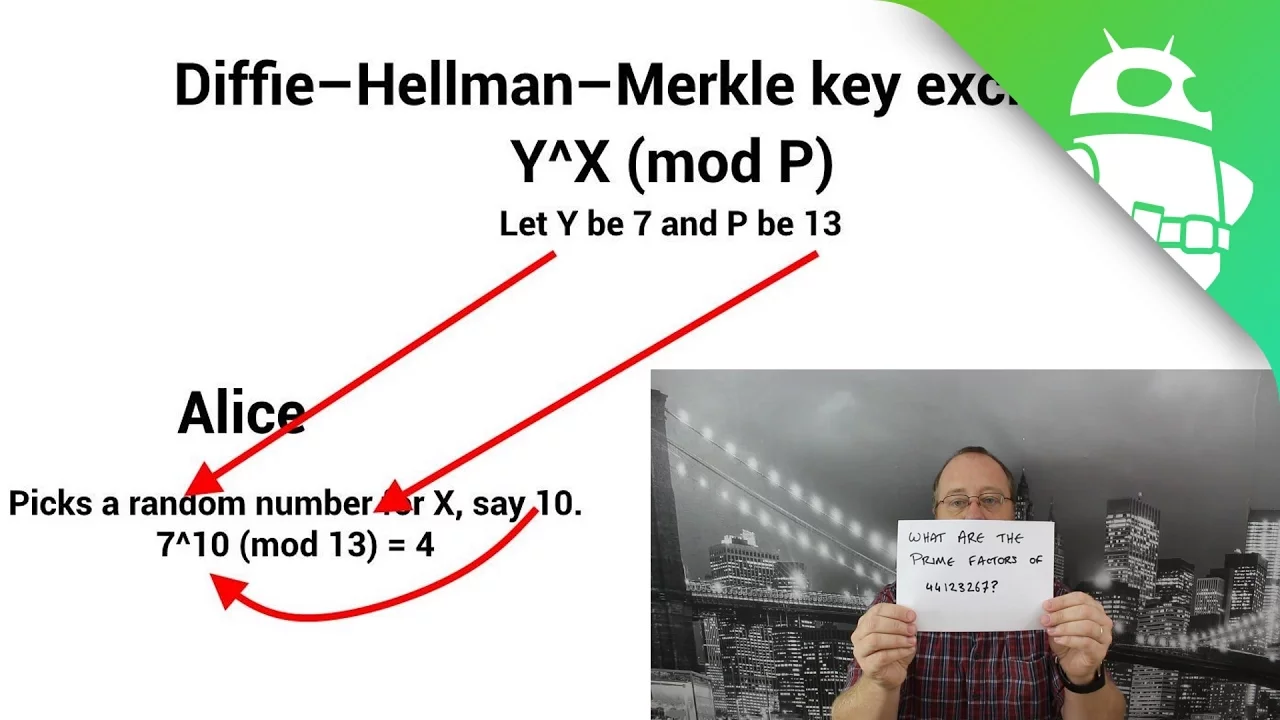
How does public key cryptography work – Gary explains
84.4K
Public key cryptography enables secure communication between parties who have never met before by using asymmetric encryption where different keys are used for encryption and decryption; the Diffie-Hellman key exchange allows two parties to establish a shared secret key over an insecure channel through modular arithmetic, while RSA provides a practical implementation using prime factorization as a one-way function that makes it computationally infeasible to derive the private key from the public key.
Click to watch →

Блокчейн 2. Криптография
4.2K
Asymmetric encryption uses mathematically related key pairs - a public key that can be shared openly and a private key that must be kept secret. Data encrypted with the public key can only be decrypted with the corresponding private key, eliminating the need for secure key exchange. The Diffie-Hellman key exchange allows two parties to establish a shared secret key over an insecure channel by each generating a public-private key pair, exchanging public keys, and computing the shared secret using their private key and the other party's public key. This protocol is based on the difficulty of computing discrete logarithms. RSA is another public-key encryption algorithm based on the difficulty of factoring large numbers, using modular exponentiation for encryption and decryption.
Click to watch →
013. Криптография, шифрование (часть 2) - Владимир Иванов
34.1K
Symmetric key cryptography requires a unique shared secret for each pair of communicating parties, which becomes impractical for large-scale systems (100 million users would require ~5 trillion keys). This scalability problem motivated asymmetric cryptography, which uses public-private key pairs. Diffie-Hellman allows two parties to establish a shared secret over an insecure channel using public parameters (prime P, generator G). Each party generates a private random number, computes a public value (G^private mod P), and exchanges these values. Each party then raises the received value to their own private exponent, resulting in the same shared secret. RSA uses large prime numbers to create public-private key pairs where the public key encrypts and the private key decrypts. RSA key generation: (1) Select two large random primes p and q, (2) Compute n = p × q (modulus), (3) Compute φ(n) = (p-1)(q-1), (4) Choose public exponent e coprime to φ(n), (5) Compute private exponent d such that e × d ≡ 1 (mod φ(n)). RSA encryption: C = M^e mod n. RSA decryption: M = C^d mod n. Correctness relies on Euler's theorem: a^φ(n) ≡ 1 (mod n) for a coprime to n. RSA is computationally expensive due to modular exponentiation with large numbers, making it unsuitable for encrypting large data directly. Instead, RSA exchanges a symmetric session key, which is then used for efficient data encryption. Key strength is measured by effective search space: RSA 1024-bit keys provide ~80 bits of security (due to factoring difficulty), while AES-256 provides 256 bits. RSA keys must be much longer than symmetric keys for equivalent security. Current recommendations suggest RSA 2048-bit keys for adequate security.
Click to watch →
Deep Dive
Cryptographic hash functions and Message Authentication Codes (MACs) to ensure data integrity.

Authenticating Data with Message Authentication Codes
21.3K
Message Authentication Codes (MACs) are cryptographic mechanisms that ensure data integrity and authenticity by generating a fixed-length tag from a message and secret key, allowing recipients to verify that a received message has not been modified during transmission; MACs defeat adaptive chosen ciphertext attacks by making most ciphertexts invalid without the secret key, and they prevent padding oracle attacks by ensuring decryption never proceeds when the authentication tag is invalid, thereby protecting against ciphertext modification vulnerabilities that exist in encryption-only systems.
Click to watch →

UNIT 3 Case study of Cryptography & Message Authentication | DoS, MD5,SHA 1 | Cyber Sec|Honors|AKTU
908
Message authentication verifies message authenticity and integrity through three approaches: (1) Message encryption-based authentication uses symmetric encryption where successful decryption proves sender identity; (2) Message Authentication Codes (MAC) generate fixed codes from messages and secret keys using MAC algorithms; (3) Hash functions generate message digests (digital fingerprints) for integrity verification. MD5 produces 128-bit digests through 64 rounds of processing with logical functions and modular addition, while SHA-1 produces 160-bit digests through 80 rounds. Both have been cryptographically weakened but remain useful for file integrity checking. HMAC combines hash functions with secret keys for authenticated integrity. The choice depends on security requirements and performance needs.
Click to watch →

OliCyber.IT 2026 - Training Camp - Cryptography 3 - Funzioni di hash e MAC
140
Hash functions provide integrity against random errors but not against malicious attackers who can modify both the message and its hash. Message Authentication Codes (MAC) provide both integrity and authentication by using a shared secret key. A MAC consists of a generation function (key + message → tag) and a verification function (key + message + tag → valid/invalid). Secure MACs must resist adaptive chosen-message attacks, where attackers can request tags for messages of their choice and then attempt to forge a tag for a new message. The unforgeability property ensures that even with unlimited access to valid message-tag pairs, attackers cannot produce valid tags for messages they did not previously request.
Click to watch →

Computer Security - Principles and Practice | Chapter Three | University Class Video
1.9K
This section covers two fundamental cryptographic techniques for ensuring message integrity and authenticity. Message Authentication Codes (MACs) use a shared secret key to generate a small data block appended to messages, allowing receivers to verify authenticity without encryption. One-way hash functions transform variable-length messages into fixed-size digests without secret keys, offering three authentication methods: conventional encryption, public key encryption, and secret value appending. Both approaches rely on computational irreversibility—unlike encryption algorithms, MAC and hash functions cannot derive original inputs from outputs. These techniques form the foundation of secure communication protocols where data integrity must be verified while maintaining confidentiality.
Click to watch →

Data Integrity using hash function
259
A Message Authentication Code (MAC) combines hash functions with symmetric cryptography to verify both data integrity and authenticity. The sender computes the MAC using a shared secret key known only to the sender and receiver, then sends both the message and MAC. The receiver recomputes the MAC using the same key and compares it with the received MAC. If they match, the message is authentic and unmodified. Unlike simple hash functions, MACs prevent replay attacks because the shared secret key is required to generate a valid MAC, ensuring only authorized parties can produce valid authentication codes.
Click to watch →
Deep Dive
Real-world security protocols (such as SSL/TLS, SSH, and IPsec) that integrate these cryptographic primitives to secure internet traffic.

Introduction (CSN11131)
473
Secure communication protocols include: (1) SSL/TLS for establishing encrypted web connections, where students can examine packets to understand how secure tunnels are set up, (2) SSH for authenticating remote connections, and (3) IPsec for VPN-type protocols. These protocols implement the cryptographic concepts discussed in the module to provide practical secure communication channels. Understanding these protocols is essential for implementing real-world security solutions.
Click to watch →

Encryption and Cryptographic Techniques
146
Secure communication protocols implement cryptographic principles to protect data across networks. TLS (Transport Layer Security) secures web communications through asymmetric key exchange followed by symmetric encryption, protecting against eavesdropping, tampering, and forgery. It evolved from SSL through versions 1.0 to 1.3, with TLS 1.3 reducing handshake round trips and eliminating outdated algorithms. IPsec (Internet Protocol Security) secures IP communications by authenticating and encrypting each packet, operating in two phases: Phase 1 negotiates Security Associations (SAs) for secure channel establishment, while Phase 2 secures actual data traffic using ESP or AH for confidentiality, integrity, and authenticity. SSH (Secure Shell) enables secure remote access through four phases: connection establishment, key exchange, host authentication (preventing man-in-the-middle attacks), user authentication (passwords or public key), and encrypted session creation. These protocols collectively secure web transactions, virtual private networks, and remote system administration across modern networks.
Click to watch →

Java and Post-Quantum Cryptography
114
TLS (Transport Layer Security) uses three primary cryptographic primitives to secure internet communications: (1) Key exchange, which establishes a shared session key between two parties; (2) Digital signatures, which provide authentication to verify the identity of communicating parties; and (3) Symmetric encryption, which uses the established key to encrypt data over the insecure internet channel.
Click to watch →
Lecture 7: Security, Continued - CSCI E-1 2011 - Harvard Extension School
11.1K
SSL/TLS (used for HTTPS) and SSH (Secure Shell) are protocols that implement public and private key cryptography to secure internet communications. SSL/TLS encrypts web traffic between browsers and servers, while SSH provides secure remote command-line access to computers. Both protocols use key exchange to establish secure sessions, then use symmetric encryption for efficient data transfer. These protocols protect against eavesdropping and man-in-the-middle attacks.
Click to watch →

Class 12 Computer Science: Data Communication - ONE SHOT | Full Chapter Revision & Important Topics!
672
Security protocols protect data transmission: (1) SSL/TLS (Secure Socket Layer/Transport Layer Security) - encrypts data for secure transmission, (2) IPsec (Internet Protocol Security) - authenticates and encrypts IP packets, (3) SSH (Secure Shell) - enables secure remote login and command execution. These protocols ensure data confidentiality and integrity during transmission.
Click to watch →
Course Plan
Defining Scope
Course Plan
0:24- 1
Instructor outlines the day's agenda.
- 2
Starts with classifying cryptography.
The Practical Security Perspective: The Limitations of Mathematical Cryptography
While academic introductions to cryptography focus heavily on mathematical algorithms and proofs of computational hardness, practical security experts argue that this theoretical approach overemphasizes the strongest link in the security chain. In real-world systems, cryptographic algorithms are rarely broken directly. Instead, adversaries bypass the mathematics entirely by exploiting implementation flaws, side-channel attacks (such as timing or power analysis), weak key management, and human error. This perspective, often summarized by security expert Bruce Schneier's observation that 'cryptography is usually bypassed, not penetrated,' contends that studying cryptography in isolation ignores the systemic vulnerabilities of software engineering and human factors, which are the primary failure points in actual secure communication.
Basic modular arithmetic (e.g., the modulo operation and its properties), which is essential for understanding both classical and modern ciphers.
Fundamental computer science concepts, specifically binary representation of data and the bitwise XOR operation.
Elementary algebra and discrete mathematics, including basic concepts of sets, functions, and prime numbers.
An intuitive grasp of probability theory, which helps in understanding encryption security and key spaces.
Symmetric-key cryptography, including the deep study of stream ciphers and block ciphers like DES and AES.
Asymmetric (public-key) cryptography, specifically key-exchange protocols like Diffie-Hellman and encryption schemes like RSA.
Cryptographic hash functions and Message Authentication Codes (MACs) to ensure data integrity.
Real-world security protocols (such as SSL/TLS, SSH, and IPsec) that integrate these cryptographic primitives to secure internet traffic.
886.8K views10.6Klikes1:17:24@introductiontocryptography4223Original Release: 2014-01-30
(Intro sound.)
Professor So, I try to be a good teacher and always write down what we are Supposed to do on a given Thursday and whatnot.
So, the program um, for today starts with the um, classification. Classification of what?
classification of cryptography then some, um some basics about cryptographic set up
Up Next

8:03
How Recommendation Algorithms Work: Collaborative Filtering Explained
@ExplainingTechLikeYoureFive
352 views•2026-03-25
87:26
Introduction to Secure Multiparty Computation with Yehuda Lindell
@fhe_org
7.7K views•2021-02-04

93:19
Lecture 8: Advanced Encryption Standard (AES) - Christof Paar
@introductiontocryptography4223
322K views•2014-01-30
19:25
Enigma Machine Mechanics: WWII Encryption Explained
@JaredOwen
13.2M views•2021-12-11
Related Study Plans & Knowledge Roadmaps
Structured learning paths in Computer Science
computer-science
Container Runtimes: Namespaces, Cgroups & Go
01Linux Systems & Go Programming Foundations
02The Core of Isolation: Chroot and Filesystems
03Linux Namespaces: Process Isolation
+ 3 more learning modules
32h6 modules
Explore Roadmap
computer-science
Building a CHIP-8 Emulator: Rust & CPU Basics
01Computer Architecture Foundations (Bits & Bytes)
02Rust Programming for Systems Development
03CHIP-8 Virtual Hardware Specifications
+ 2 more learning modules
32h5 modules
Explore Roadmap
computer-science
Building BitTorrent: Go, P2P & Concurrency
01Go Fundamentals & Concurrency
02Networking Foundations & P2P Architecture
03Bencode Parsing & Torrent Metadata
+ 3 more learning modules
26h6 modules
Explore Roadmap
computer-science
Actor Models (C++ Concurrency & Lock-Free)
01C++ Multi-Threading Foundations
02Thread Pools and Task Scheduling
03Atomics and Lock-Free Queue Design
+ 3 more learning modules
45h6 modules
Explore Roadmap