Franchising is a business model where individuals (franchisees) invest in an existing business model by paying fees (initial and ongoing) to the business owner (franchisor) in exchange for the right to operate under the franchisor's brand, systems, and support, with success dependent on following established rules, maintaining good communication, and managing the business effectively.
Franchising Explained: How the Franchise Model Works
Added:Deep Dive
Basic business structures and ownership models, such as sole proprietorships, corporations, and partnerships.

مراجعة بزنس اولى ( مادة السكند 1 ) - جزء ( 1 )
125
Three main ownership structures: (1) Sole proprietorship - single owner with unlimited liability, simple procedures, lower taxes; (2) General partnership - multiple partners sharing management and unlimited liability; (3) Corporation - legal entity separate from owners, shareholders own shares but aren't liable for debts. Limited partnerships combine limited partners (capital contribution, limited liability) with general partners (management, unlimited liability). Each structure offers different advantages in control, liability, and funding capacity.
Click to watch →
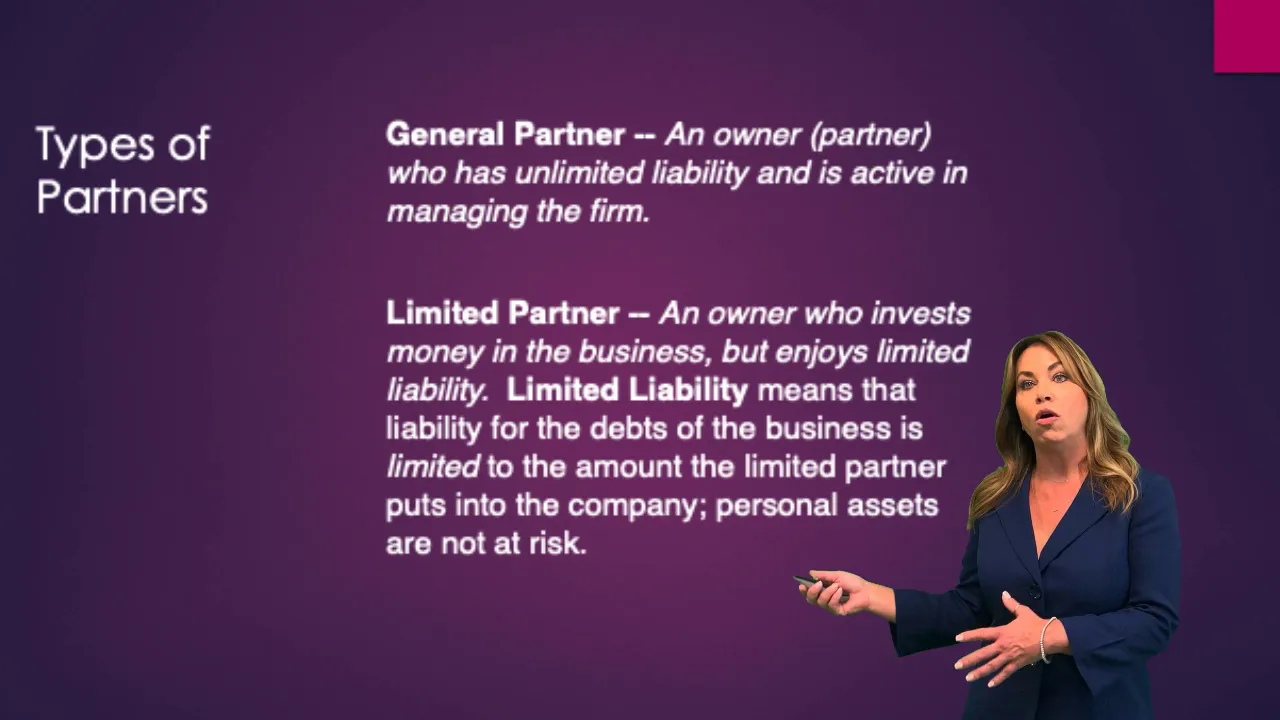
3 Basic Types of Business Entities (Professor Lisa Farmer)
515
The three basic types of business ownership are: (1) Sole proprietorship - a business owned and usually managed by one person; (2) Partnerships - when two or more people are legally in business together, becoming co-owners called partners; (3) Corporations - a separate legal entity with the authority to act and have liability apart from its owners.
Click to watch →

Doing Business in the Philippines
4.8K
Business organizations can be structured as sole proprietorships, partnerships, or corporations. A sole proprietorship is owned by one individual with unlimited personal liability for business debts. A partnership involves two or more owners who share liability jointly and severally. A corporation is an artificial legal entity created by operation of law with four key attributes: it is an artificial being, has the right of succession, perpetual existence, and the power to enter into contracts. Corporations provide limited liability protection to shareholders, meaning owners are not personally liable for business debts beyond their investment.
Click to watch →
BUSINESS ACTIVITY REVISION - OCR GCSE BUSINESS 2024
751
Business ownership structures include sole proprietorships (one owner, unlimited liability, all decisions), partnerships (shared ownership, unlimited liability with partners responsible for each other's actions), limited partnerships (one unlimited liability partner, others only risk investment), corporations (legal identity separate from owners, limited liability), private limited companies (Ltd, shareholder approval for new members), public limited companies (PLC, shares traded on stock exchange), limited liability partnerships (hybrid with limited liability and operational flexibility), and franchises (operating brands on behalf of original owners).
Click to watch →
![[KSSM/SPM] Tingkatan 4 Prinsip Perakaunan - Bab 1 : Pengenalan Kepada Perakaunan (Part 2)](https://i.ytimg.com/vi/H_JM1AUbIU4/maxresdefault.jpg)
[KSSM/SPM] Tingkatan 4 Prinsip Perakaunan - Bab 1 : Pengenalan Kepada Perakaunan (Part 2)
21.8K
This section covers the characteristics of sole proprietorship and partnership business structures. A sole proprietorship is a business owned and operated by one individual with single ownership, unlimited liability (owner personally responsible for all debts), simple structure, all profits belong to the owner, and high risk (owner loses personal assets if business fails). A partnership is a business owned by two or more individuals with 2-20 partners for general partnerships (up to 50 for professional partnerships), shared ownership and profits, shared liability (partners jointly and severally liable), active partners manage the business, and passive partners (sleeping partners) do not participate in management but share profits. Partnerships are governed by partnership agreements.
Click to watch →
Deep Dive
The concept of brand equity and intellectual property, including how trademarks and proprietary business systems are licensed.

Todo cambia cuando conoces la PI
301
Registered brands enable licensing agreements where third parties use the brand for royalties, expanding market presence without owner investment. Franchise agreements transfer brand rights plus business knowledge and operational systems. Denominations of origin protect products whose quality derives from geographic origin, like tequila or regional coffee. Intellectual property rights constitute intangible assets forming part of business patrimony, which can be inherited, transferred, licensed, or used as collateral for financing.
Click to watch →

5 Assets Guaranteed to Make You Rich
125.3K
Trademarks give ownership over names, phrases, or looks. Michael Buffer trademarked 'Let's get ready to rumble' and earns over $400 million from five words. Every time a sports league, movie, or game show wants to use it publicly, they must pay him. You're not selling a product—you're selling the right to use your brand. When that brand is valuable or attractive, the money shows up whether you're working or not. This is the power of owning intellectual property rights.
Click to watch →

Fundamentals of Intellectual Property rights
186
This segment explores intellectual property and brand equity. The speaker explains that brand equity represents the value of a brand, which is protected through intellectual property rights. The session covers how strong intellectual property protection helps build and maintain brand equity, which is a valuable asset for businesses. The speaker emphasizes that understanding this relationship is essential for brand managers and business professionals seeking to maximize the value of their brand assets.
Click to watch →

FREE CS Executive | ECIPL |Chapter 12| Intellectual Property Rights | Class 1 #freeclasses #csduniya
4.1K
Trade marks consist of word marks (text-based identifiers) and logo marks (graphic-based identifiers) that together create comprehensive brand identity. Intellectual Property Rights relate to creation of human mind and human intellect, with the key concept being 'prevent'—preventing others from using protected intellectual property without authorization. IPR enables creators to control how their work is used and negotiate licensing agreements. Established brands can command higher licensing fees because their reputation provides value to licensees. This creates a business model where intellectual property becomes a revenue-generating asset.
Click to watch →

# Hecto Millionaire Bernt Ullmann Reveals Star Branding with Jennifer Lopez Nicki Minaj
396
A brand represents a promise that must be delivered consistently across all consumer touchpoints. Successful brands create powerful emotions because customers may forget what a company says or does, but they will never forget how the brand makes them feel. For a brand to succeed, it must be credible, authentic, and aspirational. Brand equity is an intangible asset that gives a brand incremental value in the consumer's mind, allowing brands to command premium prices, generate predictable revenue streams, and create opportunities for licensing and brand extensions. Companies can license their brand to other manufacturers who pay royalties for the right to use the brand name, enabling expansion into new product categories without building manufacturing capabilities.
Click to watch →
Deep Dive
Fundamental financial literacy, specifically understanding initial capital, operating expenses, royalties, and return on investment (ROI).

CA FINAL COSTING - REVISION SERIES - PERFORMANCE MEASUREMENT BY CA SANKALP KANSTIYA
123.4K
Return on Investment (ROI) is calculated as Net Profit After Tax divided by Capital Employed. It measures how efficiently capital is utilized to generate profits. The formula can also be expressed as Controllable Contribution divided by Capital Employed. ROI helps evaluate divisional performance and investment decisions by providing a relative return metric that allows comparison across different-sized investments.
Click to watch →

management accounting/chapter2 performance measurement/return on investment/mcom/calicut university
11.4K
Return on Investment (ROI) is a critical financial metric measuring investment profitability. The core formula is ROI = (Profit / Capital Employed) × 100, expressing returns as a percentage of invested capital. Profit is calculated as Sales minus Cost of Goods Sold minus Operating Expenses. Capital Employed represents total invested capital, calculated as Shareholders' Equity plus Long-term Liabilities minus Current Liabilities. Understanding these foundational concepts enables accurate ROI calculation and meaningful performance comparisons across investments.
Click to watch →
Learn to Earn in Stock Markets Part 2 of 4
171
Fundamental analysis is the art and science of analyzing stocks through financial numbers including sales, profit after tax, debt, creditor days, equity, ROI, debt to equity, cash flow, and litigations. A key practical skill is market capitalization filtration: by setting a minimum threshold of 1000 crore rupees, approximately 3000 companies can be removed from the initial list of 4109 companies, leaving 990 companies for analysis. Return on investment (ROI) is calculated as: (Total Earnings / Initial Investment) × 100. In the bread business example, starting with 1000 rupees and earning 10 rupees profit daily for 365 days results in total earnings of 3650 rupees, yielding a 365% ROI. Money rotation refers to using the same capital repeatedly to generate profits, applicable to all businesses including dairy, pharma, retail, car manufacturers, and soap companies.
Click to watch →

Dhanwantari Business Plan 2.O Update 2026 #shortsfeed #motivation #networkmarketing
2K
Fund is calculated as 4% of company repurchase turnover. For example, if royalty (5%) is ₹11,000, fund (4%) would be approximately ₹8,800. However, fund distribution is exclusive to Pearl level and does not include other distributor levels.
Click to watch →

INVESTIR EM FRANQUIAS VALE A PENA? Veja como realmente funciona!
250
Franchises charge two main types of fees: royalties (percentual or fixed amounts) for using the brand and name commercially, and an initial investment fee for the business structure. Royalties function like a rental fee for using someone else's brand, while the initial investment covers the physical and operational infrastructure needed to operate the franchise.
Click to watch →
Deep Dive
Introductory contract law concepts, particularly how bilateral agreements establish operational boundaries and mutual obligations.

CA Foundation Law | Contract Act - Day 1 | Toofan Revision Batch By CA Amol Jain #Ajsir
8.2K
A bilateral contract is one where both parties have mutual obligations - each party is both a promisor and a promisee. Both parties have promises to perform. For example, when a teacher promises to provide classes and a student promises to pay fees, both parties have obligations, making it a bilateral contract.
Click to watch →

The Indian Contract Act, 1872 | Nature of Contracts | January/May 2026 | Business Laws | Part 8
4.4K
A bilateral contract is a contract in which both parties commit to perform their respective promises. Both parties have obligations to fulfill. For example, if A offers to sell a car to B for ₹21 lakh and B accepts, both A and B have promises to fulfill - A must deliver the car and B must pay the price. This creates mutual obligations.
Click to watch →
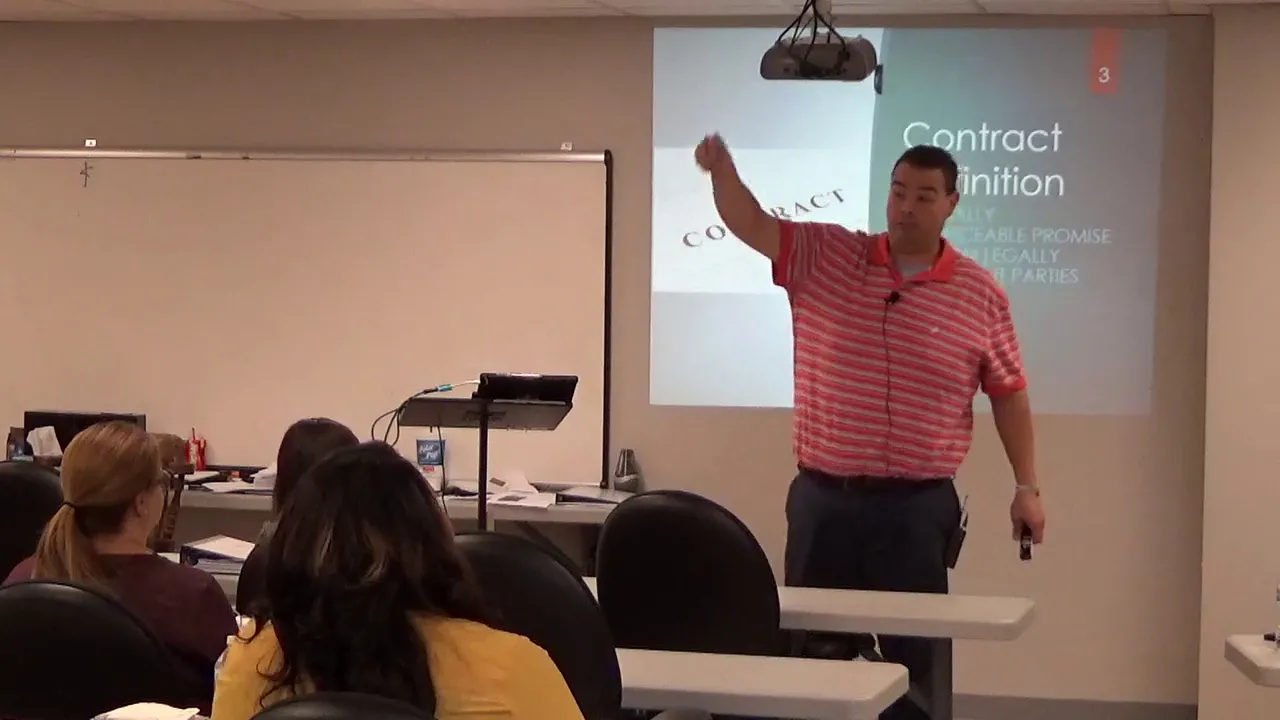
Ch 9 Pt 1 Basic Contract Intro and Terms through Bilateral and Unilateral
2.4K
A bilateral contract involves two parties who have both promised to do something. Unlike unilateral contracts where only one party is bound, bilateral contracts create mutual obligations. In a typical sales contract, the buyer promises to purchase and the seller promises to sell. In a lease, the landlord promises to provide the property and the tenant promises to pay rent. Both parties are equally bound by the terms of the agreement.
Click to watch →

CMA Foundation || Law || Indian Contract Act || L11 || Prof. Darshan Dhoka
5.2K
A Bilateral Contract is a contract where obligations fall on both parties. In such contracts, each party has both rights and obligations - one party's obligation becomes the other party's right, and vice versa. This is the most common type of contract where both parties are bound to perform their respective obligations.
Click to watch →

L9. Indian Contract Act, 1872 | Law by CA Hemangi Kothari | June - Dec 26 #cma
155
A bilateral contract is a normal contract where two parties are bound to perform their respective obligations. Both parties have obligations to fulfill. Example: A partnership contract where all partners must perform their duties. The key characteristic is that both parties are under reciprocal obligations.
Click to watch →
Prerequisite Knowledge
- Concept 01Basic business structures and ownership models, such as sole proprietorships, corporations, and partnerships.
- Concept 02The concept of brand equity and intellectual property, including how trademarks and proprietary business systems are licensed.
- Concept 03Fundamental financial literacy, specifically understanding initial capital, operating expenses, royalties, and return on investment (ROI).
- Concept 04Introductory contract law concepts, particularly how bilateral agreements establish operational boundaries and mutual obligations.
Subsequent Learning
- Step 01The legal and regulatory environment of franchising, focusing on the Franchise Disclosure Document (FDD) and Federal Trade Commission (FTC) guidelines.
- Step 02Financial modeling and unit-level economics, including calculating break-even points after factoring in ongoing royalty and advertising fees.
- Step 03Advanced expansion models, such as multi-unit franchising, area development agreements, and master franchise structures.
- Step 04The operational process of turning an existing, independent business into a scalable franchise system (franchisability analysis).
Franchise Model
Franchise Model
0:00Playing Section
- 1
Explains how individuals buy rights to operate a proven business model.
- 2
Details the fees paid, including initial and ongoing costs for support.
- 3
Describes the franchisor's provisions, such as branding and training.
The Illusion of Entrepreneurial Independence and Asymmetric Power Dynamics
While franchising is marketed as an accessible path to business ownership, critics highlight that it often creates an illusion of entrepreneurial independence. In reality, the franchisor-franchisee relationship is heavily asymmetric. Franchisees shoulder almost all the financial risk and capital investment, yet they possess very little operational autonomy. Franchisors retain tight control over daily operations, supplier selection, and marketing, often charging markups on required goods. Furthermore, contract terms heavily favor the franchisor, who can unilaterally alter operating manuals, mandate expensive store renovations, or practice 'encroachment'—opening competing locations nearby. Consequently, many franchisees function more like highly leveraged managers than independent owners. They face the risk of total financial ruin if the branch fails, while the franchisor continues to collect royalties based on top-line revenue rather than bottom-line profitability. This model can lead to systemic wealth transfer from individual investors to corporate franchisors.
Deep Dive
The legal and regulatory environment of franchising, focusing on the Franchise Disclosure Document (FDD) and Federal Trade Commission (FTC) guidelines.

Cómo Franquiciar Tu Negocio (5 marzo 2024 Rev)
114
The Federal Trade Commission (FTC) regulates franchises to prevent fraud. The first franchise was Dairy Queen in the early 1900s. The Franchise Disclosure Document (FDD) is a legal document that must be created by a franchise lawyer and contains 21 items covering franchise responsibilities, franchisor history, costs, and other critical information. The FDD is public information available on websites like Franchise Exchange.
Click to watch →

Franchising 101 With Tim Pickwell | Starting Strength Gyms #54
1.1K
The Federal Trade Commission regulates franchising through the Franchise Disclosure Document (FDD), which must be used in all 50 states alongside state laws. Unlike state registration laws, federal law doesn't require registration or review but mandates specific disclosure formats. Fourteen registration states plus the FTC agreed on a standardized FDD form to avoid having 14 different versions. Exemptions exist for large established franchisors with significant net worth and operating history, or for sophisticated high-net-worth individuals deemed capable of independent evaluation.
Click to watch →
![How to Franchise Your Business [7 Steps]](https://i.ytimg.com/vi/MaOR1nbcTW4/maxresdefault.jpg)
How to Franchise Your Business [7 Steps]
57.9K
The Franchise Disclosure Document (FDD) is a critical legal document required by federal and state laws that franchiseors must disclose to prospective franchisees before taking any money or signing agreements. It serves as a prospectus containing all necessary information for franchisees to make informed investment decisions. Key requirements include: disclosing the FDD at least 14 days before signing or receiving payment, updating it annually or when material changes occur, registering it in franchise registration states, and understanding that franchising and licensing are legally equivalent—calling a relationship a license does not avoid franchise regulations.
Click to watch →

Bricks and Minifigs Admitted Something Huge... And Nobody Noticed
146.7K
The Franchise Disclosure Document (FDD) is a government-mandated document that the FTC requires every franchise company in America to publish annually. Potential franchisees must receive this document at least 14 days before signing any agreements or making any payments. The FDD contains 23 items covering the company's financial health, legal history, fees, trademarks, and what happens when franchisees try to leave. Importantly, no government agency verifies the information inside the document, but the government requires disclosure of specific risks.
Click to watch →

HealthyYou vs Naturals2Go vs Healthier4U - Which One's the Worst?
16.6K
Franchises are highly regulated by the Federal Trade Commission (FTC) and must update their Franchise Disclosure Document (FDD) on an annual basis. This regulation protects both potential franchisees and franchisors. Business opportunities, on the other hand, fall under the FTC's business opportunity rule in some states (24 states specifically), which provides less regulatory protection than franchise regulations.
Click to watch →
Deep Dive
Financial modeling and unit-level economics, including calculating break-even points after factoring in ongoing royalty and advertising fees.

Юнит-экономика для продавцов Wildberries
363
Unit economics helps sellers understand per-unit profitability, making business models transparent and easier to manage. Key applications include: adjusting sale prices, evaluating whether to enter promotions, identifying profitable versus unprofitable products, and making informed decisions about product assortment changes. Unit economics does not account for changes over time, physical metrics like cash flow gaps, accounts receivable, or accounts payable, or unsold inventory. A company can show unit economics profitability while actually facing cash flow problems. Financial models span 1-5 years with monthly columns and include: revenue, operating expenses, financial activities, working capital, and cash flow statements. Financial models enable scenario planning for business decisions: how much growth is sustainable, what happens if sales increase, what happens if costs rise. They help determine break-even points and payback periods. Initial financial models should be developed with the seller and a financial manager. Inventory value is calculated by multiplying quantity on hand by unit cost. ABC analysis categorizes inventory by value.
Click to watch →

CA Inter & CMA Inter - COSTING | Marginal Costing - Class 2 | Gourav Kabra @gkabra
8.6K
Sales can be calculated as Selling Price per Unit multiplied by Quantity Sold. Profit can be calculated as Profit per Unit multiplied by Quantity Sold. Break-Even Point in Units is Break-Even Point in Sales divided by Selling Price per Unit. Change in Profit is the difference between final and initial profit positions. The instructor demonstrates these calculations through practical examples, showing how to analyze business performance changes from unit-level data.
Click to watch →

GESTÃO E ANÁLISE DE CUSTOS - UNIDADE 3
1.4K
The economic break-even point considers achieving a desired profit level: (Fixed Costs + Desired Profit) / Unit Contribution Margin. The financial break-even point considers financial obligations to third parties: (Fixed Costs + Fixed Expenses - Non-Cash Expenses) / Unit Contribution Margin. Non-cash expenses like depreciation are subtracted because they don't require actual cash outflow. In a practical example with R$8 selling price, R$6 variable costs, and R$4,000 fixed costs, the unit contribution margin is R$2. The accounting break-even point is 2,000 units. If desired profit is R$1,000, the economic break-even point is 2,500 units. If depreciation is R$800, the financial break-even point is 1,600 units.
Click to watch →

25 مهني المحاسبة الادارية ثالث تجاري حل تمارين ف 2
24.1K
Unit-level data can be converted to monetary break-even analysis using the income statement framework. The break-even point in monetary terms equals Fixed Costs divided by Contribution Margin Ratio. When unit price is 1000, variable cost percentage is 60%, and fixed costs are 10 million, the contribution margin ratio is 40%, and the break-even point equals 25 million. Contribution Margin per Unit equals Unit Price multiplied by Contribution Margin Ratio, which equals 400 when unit price is 2000 and ratio is 20%. Variable Cost per Unit equals Unit Price multiplied by Variable Cost Percentage, which equals 1200 when unit price is 2000 and percentage is 60%.
Click to watch →

شرح #محاسبة_التكاليف الفرقة الثانية معهد فني تجاري (نقطة التعادل) المحاضرة (2) 2026
10.5K
When unit costs are not directly given, calculate them from total data. Total variable costs equal the sum of all variable cost categories (production variable costs plus marketing variable costs). Divide total variable costs by production volume to get variable cost per unit. When selling price per unit is not given, divide total sales revenue by production volume. After calculating unit costs, apply break-even formulas. Given selling price of 50 pounds and variable cost per unit of 40 pounds, contribution margin per unit is 10 pounds. With fixed costs of 30,000 pounds, break-even point by quantity is 3,000 units. Break-even point by value is 150,000 pounds. For net profit calculation at 6,000 units: (6,000 - 3,000) × 10 = 30,000 pounds profit. At 2,000 units: (2,000 - 3,000) × 10 = -10,000 pounds (10,000 pounds loss).
Click to watch →
Deep Dive
Advanced expansion models, such as multi-unit franchising, area development agreements, and master franchise structures.

Seminar Playback: Winter 2015 Franchise Business Network (FBN) Meeting
202
North American companies expanding internationally must choose between company-owned units and franchise units. Company-owned units suit larger global brands, while franchising offers faster expansion through franchisee capital and shifts localization risks. Five main forms exist: single unit franchise (for similar countries like US-Canada), area development agreement (territory-based), representative (agent for recruitment), subfranchising (master franchisee becomes subfranchisor), and joint venture (equity partnership). Hybrid structures include test period agreements, combined development/master franchise agreements, and trademark license combinations.
Click to watch →

Welcoming Businessmen With Futuristic Venture Approaches - Franstart : Episode -1
156
Five main franchise models: (1) Single unit franchise - most popular, one unit with possible exclusivity, (2) Multi-unit franchise - bundle of locations (Levi's example), (3) Master franchise - country-to-country, duplicating company role with sub-franchising, (4) Area development franchise - responsible for developing area with deeper market capabilities (Subway uses this with 30 area developers in India), (5) Conversion franchise - modernizing existing retail rather than creating new points. International companies should avoid single master franchises as it's like putting all eggs in one basket.
Click to watch →

Bisnis Waralaba dan Filosofinya
336
There are five main forms of franchise business: (1) Unit franchising is the most common form where the franchisor grants the franchisee the right to operate a business in a specific location or area according to established standards; (2) Area development franchising grants the franchisee the right to develop and operate multiple units within a designated geographic area, with commitments to meet development targets or face contract termination; (3) Master franchising allows the master franchisee to either operate the business themselves or sell franchise units to third parties, commonly used for international expansion; (4) Affiliation or confusion franchising permits the franchisee to use their existing brand alongside the franchisor's well-known brand, common in hotel and food service industries; (5) Non-traditional sensitizing franchising involves selling franchisor products at specific locations within other businesses' premises, requiring two separate agreements. Advantages include low capital requirements, no extensive experience needed, and standardized quality. Disadvantages include limited operational flexibility, dependence on franchisor reputation, and significant costs including franchise fees and royalty payments.
Click to watch →

Franchise model કેવી રીતે કામ કરે છે? Franxpo 2025 | New Business Idea 2025 in Gujarati |
548
Franchise expansion operates through different models. In Franchise on Franchise Operated, the franchisee invests and operates using franchisor's systems. In Franchise on Company Operated, the company operates and franchisee receives fixed returns. In Build Operate Transfer, the company builds and operates initially before transferring. Expansion occurs at different levels: Unit Franchise for single outlets, Area Master Franchise for multiple outlets in a region, and Territorial Master Franchise for entire states or regions.
Click to watch →

นับหนึ่งแฟรนไชส์ จากธุรกิจเล็กๆ ปั้นอย่างไรให้เป็นแฟรนไชส์
803
Franchise territories are structured to prevent market cannibalization and ensure franchisee success. Single Unit Franchise restricts each franchisee to one location, suitable for low-margin product franchises. Multi Unit Franchise allows franchisees to own multiple locations, suitable for high-margin businesses. Exclusive Multi Unit Franchise assigns exclusive geographic territories with radius restrictions. Sub-Franchise allows master franchisees to sell additional franchises within their area. Master Franchise is used for international expansion, granting rights to operate in entire countries with complete systems including manufacturing.
Click to watch →
Deep Dive
The operational process of turning an existing, independent business into a scalable franchise system (franchisability analysis).

Como Funciona Uma Franqueadora
513
Not all businesses can be franchised. A comprehensive franqueability analysis must evaluate: (1) Dependency level on individual talent or specific skills, which cannot be transferred; (2) Clear business differentiation beyond price and quality; (3) Documented, replicable methodology for operations; (4) Strategic-operational alignment ensuring ideas can be executed; (5) Pilot unit testing before wider implementation. The three largest franchise consulting firms in Brazil are not franchises themselves because their models lack replicability.
Click to watch →

The Keys to Building a Successful Franchise System
294
A business is franchisable only if it works successfully for franchisees, consumers, and the franchisor. Beyond franchisability, franchisors must distinguish between legally enforceable brand standards (recipes, marketing mechanisms) and recommended best practices (employment policies). This distinction prevents joint employment liability while maintaining system consistency. Franchisors must document their operational knowledge in manuals and training programs, transitioning from knowing how to run their business to being able to teach others to run it successfully.
Click to watch →

Cómo PREPARAR TU EMPRESA para ESCALAR CON ÉXITO 🪐
1.3K
To test if a business truly depends on systems rather than people, ask: If you replaced 100% of your team tomorrow, would you achieve the same results? If replacing any employee makes it difficult to find a replacement who can perform the same work, it means that employee has undocumented processes in their head. Franchisability—the ability to replicate a business model across different locations and contexts—forces entrepreneurs to identify and document processes that can be replicated, preventing internal chaos and enabling systematic scaling.
Click to watch →

Franchise 101 - Turning Your Business Into a Scalable Model
211.6K
Franchise readiness requires three essential elements: (1) protecting your core business DNA/IP that must remain intact across all franchise locations, (2) developing comprehensive Standard Operating Procedures (SOPs) and processes that ensure consistent brand experience, and (3) establishing clear ROI expectations and support systems for franchise partners. Successful franchising depends on achieving product-market fit first, creating a replicable model, and carefully selecting partners who share your vision and have relevant expertise. The franchisor must determine which business functions to centralize (like content, training, and quality control) versus which to delegate to partners (like local operations and admissions), ensuring both brand consistency and partner profitability.
Click to watch →

COMO O MEU NEGÓCIO PODE VIRAR FRANQUIA? | PASSO A PASSO PARA FRANQUEAR O SEU NEGÓCIO | Zanon Cast 33
5.2K
Before franchising, businesses must undergo analysis to determine if they are franchise-ready. A business must first be validated and profitable before it can be franchised. The first prerequisite for any franchise is that the business generates actual results and income. For a business to be franchiseable, it must be replicable - meaning the process can be taught to others.
Click to watch →
Franchise Model
Franchise Model
0:00- 1
Explains how individuals buy rights to operate a proven business model.
- 2
Details the fees paid, including initial and ongoing costs for support.
- 3
Describes the franchisor's provisions, such as branding and training.
The Illusion of Entrepreneurial Independence and Asymmetric Power Dynamics
While franchising is marketed as an accessible path to business ownership, critics highlight that it often creates an illusion of entrepreneurial independence. In reality, the franchisor-franchisee relationship is heavily asymmetric. Franchisees shoulder almost all the financial risk and capital investment, yet they possess very little operational autonomy. Franchisors retain tight control over daily operations, supplier selection, and marketing, often charging markups on required goods. Furthermore, contract terms heavily favor the franchisor, who can unilaterally alter operating manuals, mandate expensive store renovations, or practice 'encroachment'—opening competing locations nearby. Consequently, many franchisees function more like highly leveraged managers than independent owners. They face the risk of total financial ruin if the branch fails, while the franchisor continues to collect royalties based on top-line revenue rather than bottom-line profitability. This model can lead to systemic wealth transfer from individual investors to corporate franchisors.
Basic business structures and ownership models, such as sole proprietorships, corporations, and partnerships.
The concept of brand equity and intellectual property, including how trademarks and proprietary business systems are licensed.
Fundamental financial literacy, specifically understanding initial capital, operating expenses, royalties, and return on investment (ROI).
Introductory contract law concepts, particularly how bilateral agreements establish operational boundaries and mutual obligations.
The legal and regulatory environment of franchising, focusing on the Franchise Disclosure Document (FDD) and Federal Trade Commission (FTC) guidelines.
Financial modeling and unit-level economics, including calculating break-even points after factoring in ongoing royalty and advertising fees.
Advanced expansion models, such as multi-unit franchising, area development agreements, and master franchise structures.
The operational process of turning an existing, independent business into a scalable franchise system (franchisability analysis).
149.3K views1.4Klikes1:52@FranchisingOnlineOriginal Release: 2016-02-08
how does franchising work franchising is a way for individuals to invest in an existing business model and gain a competitive Advantage operating their own business the business owner or franchisor licenses to franchisees the right to operate a business or to distribute goods or services for a specific period of time and in return the franchisees pay the franchise or fee this usually comprises an initial payment and then regular ongoing fees why pay fees the franchisee is investing in a proven system with all the experience and knowledge of the franchisor on hand that can be an easier and quicker way to get a return on investment than starting up a business from scratch what are the rules of course there are limitations the franchisee will have to operate their business according to the rules and processes set out by the franchise or after all the tried and tested formula is what has made the business a success what does the franchise or provide an existing business model A brand operating systems and processes marketing strategy training support how long is a franchise term the franchisee who follows the rules can run their business for the length of the franchise term it could be 3 years 5 years or longer at the end of the term the franchisee may be able to renew the franchise agreement but this isn't always the case franchise success good communication with a franchisor and a great attitude to the business will really make a difference franchisee success is dependent on many things the brand business support location costs and ultimately the franchisees ability to manage and control the [Music] business
Up Next
41:17
Business Valuation Strategy for Founders: A PE Framework for Long-Term Growth
@joecartertwinflame
6.4K views•2025-10-07

46:36
Retention Habits of Top DTC Ecommerce Brands Revealed
@SendItPodcast
44K views•2026-03-03

15:23
Decoy Effect: How Pricing Psychology Influences Consumer Spending
@bobinvestsUS
90K views•2026-01-05

17:30
The Planned Obsolescence of Light Bulbs and Tech
@veritasium
25.3M views•2021-03-26
Related Study Plans & Knowledge Roadmaps
Structured learning paths in Business
business
Pop-Up Retail: Strategy, Design & Execution
01Introduction to Pop-Up Retail & Strategic Goal Setting
02Budgeting, Site Selection, and Legal Essentials
03Experiential Retail Design & Visual Merchandising
+ 2 more learning modules
15h5 modules
Explore Roadmap
business
Reg CF: Startup Funding, Marketing & Launch
01Introduction to Equity Crowdfunding & Reg CF
02Platform Selection & Legal Preparation
03Crafting High-Converting Campaign Assets
+ 2 more learning modules
14h5 modules
Explore Roadmap
business
Productized Services: Scaling Solo Freelance
01Foundations of Productized Services
02Packaging and Scope Definition
03Pricing and Subscription Models
+ 2 more learning modules
15h5 modules
Explore Roadmap
business
Gov Procurement: Find, Bid & Win Contracts
01Introduction to Government Procurement & Business Setup
02Small Business Certifications & Set-Asides
03Finding and Analyzing Contract Opportunities
+ 2 more learning modules
14h5 modules
Explore Roadmap