


























Nash Equilibrium occurs when each player's strategy is a best response to the others', meaning no one has an incentive to deviate. In coordination games like the Investment Game, multiple equilibria may exist, including Pareto-efficient and inefficient ones. Unlike Prisoner's Dilemma, communication can help coordinate on the good equilibrium without contracts or side payments, as demonstrated when a persuasive speech shifted class behavior from a bad equilibrium to a good one.
Nash Equilibrium: Coordination Games and Bank Runs
Added:Basic concepts of Game Theory, including players, strategies, payoffs, and the representation of games using payoff matrices.
The fundamental definition of a Nash Equilibrium as a situation where no player has an incentive to unilaterally deviate from their chosen strategy.
The distinction between simultaneous-move and sequential-move games, and how players make decisions under uncertainty about others' choices.
The assumption of rationality in economic agents, specifically how individuals attempt to maximize their own expected utility or payoff.
The Diamond-Dybvig Model, a seminal economic framework that formalizes how bank runs occur as a Nash equilibrium under maturity mismatch.
The concept of Schelling Points (or focal points) and how cultural norms, historical precedents, or external cues help players coordinate in games with multiple equilibria.
Global Games theory, which introduces incomplete information to explain how unique equilibria can be selected in coordination problems and financial crises.
Policy interventions and institutional mechanisms designed to prevent coordination failures, such as deposit insurance (e.g., FDIC) and central bank 'lender of last resort' facilities.
Macroeconomic coordination failures, exploring how lack of coordination among firms and consumers can lead to persistent economic recessions and underemployment.
155.7K views949likes1:09:14Original Release: 2008-11-21
Professor Ben Polak: Okay, so last time we came across a new idea, although it wasn't very new for a lot of you, and that was the idea of Nash Equilibrium. What I want to do today is discuss Nash Equilibrium, see how we find that equilibrium into rather simple examples.
And then in the second half of the day I want to look at an application where we actually have some fun and play a game.
At least I hope it's fun. But let's start by putting down a formal definition. We only used a rather informal one last week, so here's a formal one.
A strategy profile--remember a profile is one strategy for each player, so it's going to be S_1*, S_2*, all the way up to S_M* if there are M players playing the game--so this profile is a Nash Equilibrium (and I'm just going to write NE in this class for Nash Equilibrium from now on) if, for each i –so for each player i, her choice--so her choice here is S_i*, i is part of that profile is a best response to the other players' choices. Of course, the other players' choices here are S_--i* so everyone is playing a best response to everyone else.
Now, this is by far the most commonly used solution concept in Game Theory. So those of you who are interviewing for McKenzie or something, you're going to find that they're going to expect you to know what this is.
So one reason for knowing what it is, is because it's in the textbooks, it's going to be used in lots of applications, it's going to be used in your McKenzie interview.
That's not a very good reason and I certainly don't want you to jump to the conclusion that now we've got to Nash Equilibrium everything we've done up to know is in some sense irrelevant. That's not the case.
It's not always going to be the case that people always play a Nash Equilibrium. For example, when we played the numbers game, the game when you chose a number, we've already discussed last week or last time, that the equilibrium in that game is for everyone to choose one, but when we actually played the game, the average was much higher than that: the average was about 13.
It is true that when we played it repeatedly, it seemed to converge towards 1, but the play of the game when we played it just one shot first time, wasn't a Nash Equilibrium. So we shouldn't form the mistake of thinking people always play Nash Equilibrium or people, "if they're rational," play Nash Equilibrium.
Neither of those statements are true.
Nevertheless, there are some good reasons for thinking about Nash Equilibrium other than the fact it's used by other people, and let's talk about those a bit. So I want to put down some motivations here--the first motivation we already discussed last time. In fact, somebody in the audience mentioned it, and it's the idea of "no regrets." So what is this idea?
It says, suppose we're looking at a Nash Equilibrium.
If we hold the strategies of everyone else fixed, no individual i has an incentive to deviate, to move away. Alright, I'll say it again.
Holding everyone else's actions fixed, no individual has any incentive to move away. Let me be a little more careful here; no individual has any strict incentive to move away.
We'll see if that actually matters.
So no individual can do strictly better by moving away.
No individual can do strictly better by deviating, holding everyone else's actions.
So why I call that "no regret"? It means, having played the game, suppose you did in fact play a Nash Equilibrium and then you looked back at what you had done, and now you know what everyone else has done and you say, "Do I regret my actions?" And the answer is, "No, I don't regret my actions because I did the best I could given what they did." So that seems like a fairly important sort of central idea for why we should care about Nash Equilibrium. Here's a second idea, and we'll see others arise in the course of today.
A second idea is that a Nash Equilibrium can be thought of as self-fulfilling beliefs. So, in the last week or so we've talked a fair amount about beliefs.
If I believe the goal keeper's going to dive this way I should shoot that way and so on. But of course we didn't talk about any beliefs in particular. These beliefs, if I believe that--if everyone in the game believes that everyone else is going to play their part of a particular Nash Equilibrium then everyone, will in fact, play their part of that Nash Equilibrium.
Now, why? Why is it the case if everyone believes that everyone else is playing their part of this particular Nash Equilibrium that that's so fulfilling and people actually will play that way? Why is that the case?
Anybody? Can we get this guy in red?
Student: Because your Nash Equilibrium matches the best response against both. Professor Ben Polak: Exactly, so it's really--it's almost a repeat of the first thing. If I think everyone else is going to play their particular--if I think players 2 through N are going to play S_2* through S_N*--then by definition my best response is to play S_1* so I will in fact play my part in the Nash Equilibrium. Good, so as part of the definition, we can see these are self-fulfilling beliefs.
Let's just remind ourselves how that arose in the example we looked at the end last time. I'm not going to go back and re-analyze it, but I just want to sort of make sure that we followed it. So, we had this picture last time in the partnership game in which people were choosing effort levels. And this line was the best response for Player 1 as a function of Player 2's choice.
And this line was the best response of Player 2 as a function of Player 1's choice. This is the picture we saw last time. And let's just look at how those--it's no secret here what the Nash Equilibrium is: the Nash Equilibrium is where the lines cross--but let's just see how it maps out to those two motivations we just said.
So, how about self-fulfilling beliefs?
Well, if Player--sorry, I put 1, that should be 2--if Player 1 believes that Player 2 is going to choose this strategy, then Player 1 should choose this strategy. If Player 1 thinks Player 2 should take this strategy, then Player 1 should choose this strategy. If Player 1 thinks Player 2 is choosing this strategy, then Player I should choose this strategy and so on; that's what it means to be best response. But if Player 1 thinks that Player 2 is playing exactly her Nash strategy then Player 1's best response is to respond by playing his Nash strategy.
And conversely, if Player 2 thinks Player 1 is playing his Nash strategy, then Player 2's best response indeed is to play her Nash strategy.
So, you can that's a self-fulfilling belief.
If both people think that's what's going to happen, that is indeed what's going to happen.
How about the idea of no regrets?
So here's Player 1; she wakes up the next morning--oh I'm sorry it was a he wasn't it?
He wakes up the next morning and he says, "I chose S_1*, do I regret this?"
Well, now he knows what Player 2 chose; Player 2 chose S_2* and he says, "no that's the best I could have done. Given that Player 2 did in fact choose S_2*, I have no regrets about choosing S_1*; that in fact was my best response." Notice that wouldn't be true at the other outcome. So, for example, if Player 1 had chosen S_1* but Player 2 had chosen some other strategy, let's say S_2 prime, then Player I would have regrets.
Player I would wake up the next morning and say, "oh I thought Player 1 was going to play S_2*; in fact, she chose S_2 prime.
I regret having chosen S_1*; I would have rather chosen S_1 prime.
So, only at the Nash Equilibrium are there no regrets. Everyone okay with that?
This is just revisiting really what we did last time and underlining these points. So, I want to spend quite a lot of time today just getting used to the idea of Nash Equilibrium and trying to find Nash Equilibrium.
(I got to turn off that projector that's in the way there. Is that going to upset the lights a lot?) So okay, so what I want to do is I want to look at some very simple games with a small number of players to start with, and a small number of strategies, and I want us to get used to how we would find the Nash Equilibria in those simple games.
We'll start slowly and then we'll get a little faster.
So, let's start with this game, very simple game with two players. Each player has three strategies and I'm not going to motivate this game.
It's just some random game. Player 1 can choose up, middle, or down, and Player 2 can choose left, center, and right and the payoffs are as follows: (0,4) (4,0) (5,3) (4,0) (0,4) (5,3) again (3,5) (3,5) and (6,6). So, we could discuss--if we had more time, we could actually play this game--but isn't a very exciting game, so let's leave our playing for later, and instead, let's try and figure out what are the Nash Equilibria in this game and how we're going to go about finding it. The way we're going to go about finding them is going to mimic what we did last time.
Last time, we had a more complicated game which was two players with a continuum of strategies, and what we did was we figured out Player 1's best responses and Player 2's best responses: Player 1's best response to what Player 2's doing and Player 2's best response to what Player 1 is doing; and then we looked where they coincided and that was the Nash Equilibrium.
We're going to do exactly the same in this simple game here, so we're going to start off by figuring out what Player 1's best response looks like. So, in particular, what would be Player 1's best response if Player 2 chooses left? Let's get the mikes up so I can sort of challenge people. Anybody?
Not such a hard question. Do you want to try the woman in the middle? Who's closest to the woman in the middle? Yeah.
Student: The middle. Professor Ben Polak: Okay, so Player 1's best response in this case is middle, because 4 is bigger than 0, and it's bigger than 3.
So, to mark that fact what we can do is--let's put a circle--let's make it green--let's put a circle around that 3. Not hard, so let's do it again.
What is Player 1's best response if Player 2 chooses center? Let's get somebody on the other side. (Somebody should feel free to cold call somebody here.) How about cold calling the guy with the Yale football shirt on? There we go.
Student: Up. Professor Ben Polak: All right, so up is the correct answer.
(So, one triumph for Yale football).
So 4 is bigger than 3, bigger than 0, so good, thank you. Ale why don't you do the same?
Why don't you cold call somebody who's going to tell me what's the best response for Player 1 to right.
Shout it out. Student: Down.
Professor Ben Polak: Down, okay so best response is down because 6 is bigger than 5, which is bigger than 5; I mean 6 is bigger than 5. So what we've done here is we've found Player 1's best response to left, best response to center, and best response to right and in passing notice that each of Player 1 strategies is the best response to something, so nothing would be knocked out by our domination arguments here, and nothing would be knocked out by our never a best response arguments here for Player 1. Let's do the same for Player 2; so why don't I keep the mikes doing some cold calling, so why don't we--you want to cold call somebody at the back to tell me what is Player 2's best response against up?
Student: Left. Professor Ben Polak: So, the gentleman in blue says left because 4 is bigger 3, and 3 is bigger than 0. Let's switch colors and switch polygons and put squares around these.
I don't insist on the circles and the squares.
If you have a thing for hexagons you can do that to0--whatever you want. What's Player 2's--let's write it in here--the answer, the answer was that the best response was left, and Player 2's best response to middle--so do you want to grab somebody over there?
Shout it out! Student: Center.
Professor Ben Polak: Because 4 is bigger than 3, and 3 is bigger than 0, so that's center.
So, in my color coding that puts me at--that gives me a square here. And finally, Player 2's best response to down?
And your turn Ale, let's grab somebody.
Student: Left--right. Professor Ben Polak: Right, okay good. Because 6 is bigger than 5 again, so here we go. What we've done now is found Player 1's best response function that was just the analog of finding the best response line we did here.
Here we drew it as a straight line in white, but we could have drawn it as a sequence of little circles in green; it would have looked like this.
The same idea, I'm not going to do the whole thing but there would be a whole bunch of circles looking like this. And then we found Player 2's best response for each choice of Player 1 and we used pink rectangles and that's the same idea as we did over here.
Here we did it in continuous strategies in calculus, but it's the same idea. So, imagine I'm drawing lots of pink rectangles. And again, I'm not going to do it, but you can do it in your notes; same basic idea. Just as the Nash Equilibrium must be where these best response lines coincided here because that's the point at which each player is playing a best response to each other, so the Nash Equilibrium over here is--do you want to cold call somebody?
Do you want to just grab somebody in the row behind you or something, wherever?
Anybody? Yeah, I think you in the Italia soccer shirt; I think you're going to get picked on, so okay what's the Nash Equilibrium here?
Student: The down right. Professor Ben Polak: So the down-right square. So, the Nash Equilibrium here is--no prizes--no World Cup for that one--is down right.
So, why is that the Nash Equilibrium?
Because at that point Player 1 is playing a best response to Player 2 and Player 2 is playing a best response to Player I.
Now, I want to try and convince you, particularly those of you who are worried by the homework assignments, that that was not rocket science. It's not hard to find Nash Equilibria in games. It didn't take us very long, and we went pretty slow actually.
So let's look at another example.
Oh, before I do, notice this--before I leave this game I'm just going to make one other remark.
Notice that in this game that each strategy of Player 1 is a best response to something, and each strategy of Player 2 is a best response to something. So, had we used the methods of earlier on in the class, that's to say, deleting dominated strategies or deleting strategies that are never a best response, we'd have gotten nowhere in this game. So, Nash Equilibrium goes a little further in narrowing down our predictions.
But we also learned something from that.
We argued last time, in the last few weeks, that rationality, or even mutual knowledge of rationality or even common knowledge of rationality couldn't really get us much further than deleting dominated strategies, or if you like, deleting strategies that are never best responses.
So, here we've concluded that the Nash Equilibrium of this game is down right, a very particular prediction, but notice a perfectly rational player could here, could choose middle. The reason they could choose middle, Player 1 could choose middle is--could be that-- they say (rationally) they should choose middle because they think Player 2 is choosing left. Then you say, "well, why would you think Player 2 is going to choose left?" Player 1 could say, "I think Player 2 is going to choose left because Player 2 thinks I'm going to play up." And then you say, "but how could Player 2 possibly think that you're going to play up?" And then Player 1 would say, "I think Player 2 thinks I'm going to play up because Player 2 thinks that I think that he's going to play center."
And then you could say, "how could Player 2 play …" etc., etc., etc. And you could see you could work around a little cycle there. Nobody would be irrational about anything: Everything would be perfectly well justified in terms of beliefs.
It's just we wouldn't have a nice fixed point.
We wouldn't have a nice point where it's a simple argument.
In the case of down right, Player 1 thinks it's okay to play down because he thinks 2 is going to play right, and Player 2 thinks they're going to play right because he thinks Player 1's going to play down.
So, just to underline what I'm saying rather messily there, rationality, and those kinds of arguments should not lead us to the conclusion that people necessarily play Nash Equilibrium.
We need a little bit more; we need a little bit more than that. Nevertheless, we are going to focus on Nash Equilibrium in the course.
Let's have a look at another example.
Again, we'll keep it simple for now and we'll keep to a two-player, three-strategy game; up, middle, down, left, center, right and this time the payoffs are as follows: (0,2) (2,3) (4,3) (11,1) (3,2) (0,0) (0,3) (1,0) and (8,0). So, this is a slightly messier game. The numbers are really just whatever came into my head when I was writing it down.
Once again, we want to find out what the Nash Equilibrium is in this game and our method is exactly the same.
We're going to, for each player, figure out their best responses for each possible choice of the other player. So, rather than write it out on the--let me just go to my green circles and red squares and let me get my mikes up again, so we can cold call people a bit. Can we get the--where's the mike? Thank you.
So, Ale do you want to just grab somebody and ask them what's the best response against left?
Grab anybody. What's the best one against left? Student: Middle.
Professor Ben Polak: Middle, okay.
Good, so middle is the best response against left, because 11 is bigger than 0. Myto, do you want to grab somebody? What's the best response against center? Student: Middle.
Professor Ben Polak: Middle again because 3 is bigger than 2 is bigger than 1. And grab somebody at the back and tell me what the best response is against right?
Anybody just dive in, yep. Student: Down.
Professor Ben Polak: Okay down, good.
Let's do the same for the column player, so watch the column player's--Ale, find somebody; take the guy who is two rows behind you who is about to fall asleep and ask him what's the best response to up? Student: Best response is--for which player? Professor Ben Polak: For Player 2. What's Player 2's best response for up? Sorry that's unfair, pick on somebody else. That's all right; get the guy right behind you. What's the best response for up?
Student: So it's [inaudible] Professor Ben Polak: So, this is a slightly more tricky one. The best response to up is either c or r. This is why we got you to sign those legal forms. Best ones to up is either c or r. The best response to middle?
Student: Center. Professor Ben Polak: Is center, thank you. And the best response to down?
Student: Left. Professor Ben Polak: So, the best response to down is left.
Here again, it didn't take us very long.
We're getting quicker at this. The Nash Equilibrium in this case is--let's go back to the guy who was asleep and give him an easier question this time. So the Nash Equilibrium in this case is? Student: Nash Equilibrium would be the two [inaudible] Professor Ben Polak: Exactly, so the middle of center. Notice that this is a Nash Equilibrium. Why is it the Nash Equilibrium?
Because each player is playing a best response to each other.
If I'm Player 1 and I think that Player 2 is playing center, I should play middle. If I'm Player 2, I think Player 1 is playing middle, I should play center.
If, in fact, we play this way neither person has any regrets. Notice they didn't do particularly well in this game. In particular, Player 1 would have liked to get this 11 and this 8, but they don't regret their action because, given that Player 2 played center, the best they could have got was 3, which they got by playing middle.
Notice in passing in this game, that best responses needn't be unique. Sometimes they can be a tie in your best response. It could happen.
So, what have we seen? We've seen how to find Nash Equilibrium. And clearly it's very closely related to the idea of best response, which is an idea we've been developing over the last week or so.
But let's go back earlier in the course, and ask how does it relate to the idea of dominance? This will be our third concept in this course. We had a concept about dominance, we had a concept about best response, and now we're at Nash Equilibrium.
It's, I think, obvious how it relates to best response: it's when best responses coincide.
How about how it relates to dominance?
Well, to do that let's go back. What we're going to do is we're going to relate the Nash Equilibrium to our idea of dominance, or of domination, and to do that an obvious place to start is to go back to a game that we've seen before. So here's a game where Player 1 and Player 2 are choosing ά and β and the payoffs are (0,0) (3,-1) (-1,3) and (1,1). So, this is the game we saw the first time. This is the Prisoner's Dilemma.
We know in this game--I'm not going to bother to cold call people for it--we know in this game that β is dominated –is strictly dominated by ά.
It's something that we learned the very first time.
Just to check: so against ά, choosing ά gets you 0, β gets you -1. Against β choosing ά gets you 3, β gets you 1, and in either case ά is strictly better, so ά strictly dominates β, and of course it's the same for the column player since the game's completely symmetric.
So now, let's find the Nash Equilibrium in this game.
I think we know what it's going to be, but let's just do it in this sort of slow way. So, the best response to ά must be ά. The best response to β must be ά, and for the column player the best response to ά must be ά, and the best response to β must be ά.
Everyone okay with that? I'm just kind of--I'm rushing it a bit because it's kind of obvious, is that right?
So, the Nash Equilibrium in this game is (ά, ά). In other words, it's what we would have arrived at had we just deleted strictly dominated strategies. So, here's a case where ά strictly dominates β, and sure enough Nash Equilibrium coincides, it gives us the same answer, both people choose ά in this game.
So, there's nothing--there's no news here, I'm just checking that we're not getting anything weird going on.
So, let's just be a bit more careful.
How do we know it's the case--I'm going to claim it's the case, that no strictly dominated strategy--in this case β--no strictly dominated strategy could ever be played in a Nash Equilibrium. I claim--and that's a good thing because we want these ideas to coincide--I claim that no strictly dominated strategy could ever be played in the Nash Equilibrium. Why is that the case?
There's a guy up here, yeah. Student: The strictly dominated strategy isn't the best response of anything.
Professor Ben Polak: Good.
Student: It should be the best response to find the Nash Equilibrium. Professor Ben Polak: Good, very good. So a strictly dominated strategy is never a best response to anything.
In particular, the thing that dominates it always does better. So, in particular, it can't be a best response to the thing being played in the Nash Equilibrium. So that's actually a very good proof that proves that no strictly dominated strategy could ever be played in a Nash Equilibrium.
But now we have, unfortunately, a little wrinkle, and the wrinkle, unfortunately, is weakly dominated--is weak domination. So we've argued, it was fairly easy to argue, that no strictly dominated strategy is ever going to reappear annoyingly in a Nash Equilibrium. But unfortunately, the same is not true about weakly dominated strategies.
And in some sense, you had a foreshadowing of this problem a little bit on the homework assignment, where you saw on one of the problems (I think it was the second problem on the homework assignment) that deleting weakly dominated strategies can lead you to do things that might make you feel a little bit uneasy. So weak domination is really not such a secure notion as strict domination, and we'll see here as a trivial example of that.
And again, so here's the trivial example, not an interesting example, but it just makes the point.
So here's a 2 x 2 game. Player 1 can choose up or down and Player 2 can choose left or right, and the payoffs are really trivial: (1,1) (0,0) (0,0) (0,0).
So, let's figure out what the Nash Equilibrium is in this game and I'm not going to bother cold calling because it's too easy.
So the best response for Player 1, if Player 2 plays left is clear to choose up. And the best response of Player 1 if Player 2 chooses right is--well, either up or down will do, because either way he gets 0.
So these are both best responses.
Is that correct? They're both best responses; they both did equally well. Conversely, Player 2's best response if Player 1 chooses up is, sure enough, to choose left, and that's kind of the answer we'd like to have, but unfortunately, when Player 1 plays down, Player 2's best response is either left or right. It makes no difference.
They get 0 either way. So, what are the Nash Equilibria in this game? So, notice the first observation is that there's more than one Nash Equilibrium in this game. We haven't seen that before.
There's a Nash Equilibrium with everybody in the room I think, I hope, thinks it's kind of the sensible prediction in this game. In this game, I think all of you, I hope, all of you if you're Player 1 would choose up and all of you for Player 2 would choose left. Is that right?
Is that correct? It's hard to imagine coming up with an argument that wouldn't lead you to choose up and left in this game. However, unfortunately, that is--this isn't unfortunate, up left is a Nash Equilibrium but so is down right.
If Player 2 is choosing right, your best response weakly is to choose down. If Player 1 is choosing down, Player 2's best response weakly is to choose right.
Here, this is arriving because of the definition of Nash; it's a very definite definition. I deleted it now.
When we looked at the definition we said, something is a Nash Equilibrium was each person is playing a best response to each other; another way of saying that is no player has a strict incentive to deviate.
No player can do strictly better by moving away.
So here at down right Player 1 doesn't do strictly better; it's just a tie if she moves away.
And Player 2 doesn't do strictly better if he moves away. It's a tie.
He gets 0 either way. So, here we have something which is going to worry us going on in the course.
Sometimes we're getting--not only are we getting many Nash Equilibria, that's something which--that shouldn't worry us, it's a fact of life. But in this case one of the Nash Equilibria seems silly. If you went and tried to explain to your roommates and said, "I predict both of these outcomes in this game," they'd laugh at you.
It's obvious in some sense that this has to be the sensible prediction. So, just a sort of worrying note before we move on. So, this was pretty formal and kind of not very exciting so far, so let's try and move on to something a little bit more fun. So, what I want to do now is I want to look at a different game.
Again, we're going to try and find Nash Equilibrium in this game but we're going to do more than that, we're going to talk about the game a bit, and a feature of this game which is--to distinguish it from what we've done so far--is the game we're about to look at involves many players, although each player only has a few strategies. So, what I want to do is I want to convince you how to find--to discuss how to find Nash Equilibria in the game which, unlike these games, doesn't just have two players--it has many players--but fortunately, not many strategies per player.
So let me use this board. So this is going to be called The Investment Game and we're going to play this game, although not for real. So, the players in this game, as I've just suggested, the players are going to be you. So, everyone who is getting sleepy just looking at this kind of analysis should wake up now, you have to play. The strategies in this game are very simple, the strategy sets, or the strategy alternatives.
Each of you can choose between investing nothing in a class project, $0, or invest $10. So, I'm sometimes going to refer to investing nothing as not investing, is that okay? That seems like a natural to do.
You're either going to invest $10 or nothing, you're not going to invest. So that's the players and those are the strategies, so as usual we're missing something. What we're missing are the payoffs. So here are the payoffs; so the payoffs are as follows: if you don't invest, if you do not invest, you invest nothing, then your payoff is $0. So nothing ventured nothing gained: natural thing. But if you do invest $10, remember each of you is going to invest $10 then your individual payoffs are as follows.
Here's the good news. You're going to get a profit of $5. The way this is going to work is you're going to invest $10 so you'll make a gross profit of $15 minus the $10 you originally invested for a net of $5.
So a net profit--so $5 net profit, that's the good news.
But that requires more than 90% of the class to invest, greater than or equal to 90% of the class to invest.
If more than 90% of the class invests, you're going to make essentially 50% profit. Unfortunately, the bad news is you're going to lose your $10, get nothing back so this is a net loss, if fewer than 90% of the class invest. I mean a key rule here; you're not allowed to talk to each other: no communication in the class. No hand signals, no secret winks, nothing else.
So, everyone understand the game?
Including up in the balcony, everyone understand the game?
So, what I want you to do--I should say first of all, we can't play this game for real because there's something like 250 of you and I don't have that kind of cash lying around.
So we're not--pretend we're playing this for real.
So, without communicating I want each of you to write on the corner of your notepad whether you're going to invest or not.
You can write Y if you're going to and N if you're not going to invest. Don't discuss it with each other; just write down on the corner of your notepad Y if you're going to invest and N if you're not going to invest. Don't discuss it guys.
Now, show your neighbor what you did, just so you can--your neighbor can make you honest. Now, let's have a show of hands, so what I want to do is I want to have a show of hands, everybody who invested. Don't look around; just raise your hands, everyone who invested?
Everyone who didn't invest! Oh that's more than 10%.
Let's do that again. So everyone who invested raised their hands … and everyone who didn't invest raise their hands. So I don't know what that is, maybe that's about half. So now I'm thinking we should have played this game for real. I want to get some discussion going about this. I'm going to discuss this for a while; there's a lot to be said about this game. Let me borrow that, can I borrow this? So this guy; so what did you do? Student: I invested.
Professor Ben Polak: Why did you invest?
Student: Because I think I can lose $10.
Professor Ben Polak: All right, so he's rich, that's okay. You can pay for lunch.
Who didn't invest, non-investors?
Yeah, here's one, so why didn't you invest?
Shout it out so everyone can hear.
Student: I didn't invest because to make a profit there needs to be at least a 2:1 chance that everyone else--that 90% invest. Professor Ben Polak: You mean to make an expected profit? Student: Yeah, you only get half back but you would lose the whole thing.
Professor Ben Polak: I see, okay so you're doing some kind of expected calculation. Other reasons out there?
What did you do? Student: I invested.
Professor Ben Polak: I'm finding the suckers in the room.
Okay, so you invested and why? Student: You usually stand to gain something. I don't see why anybody would just not invest because they would never gain anything.
Professor Ben Polak: Your name is?
Student: Clayton. Professor Ben Polak: So Clayton's saying only by investing can I gain something here, not investing seems kind of--it doesn't seem brave in some sense.
Anyone else? Student: It's basically the same game as the (1,1) (0,0) game in terms they're both Nash Equilibrium, but the payoffs aren't the same scale and you have to really be risk adverse not to invest, so I thought it would be-- Professor Ben Polak: So you invested? Student: I invested, yeah. Professor Ben Polak: All right, so let me give this to Ale before I screw up the sound system here. Okay, so we got different answers out there. Could people hear each other's answer a bit? Yeah.
So, we have lots of different views out here.
We have half the people investing and half the people not investing roughly, and I think you can make arguments either way. So we'll come back to whether it's exactly the same as the game we just saw.
So the argument that-- I'm sorry your name--that Patrick made is it looks a lot like the game we saw before.
We'll see it is related, clearly.
It's related in one sense which we'll discuss now.
So, what are the Nash Equilibria in this game?
Let me get the woman up here? Student: No one invests and everyone's happy they didn't lose anything; or everyone invests and nobody's happy.
Professor Ben Polak: Good, I've forgotten your name?
Student: Kate. Professor Ben Polak: So Kate's saying that there are two Nash Equilibria and (with apologies to Jude) I'm going to put this on the board.
There are two Nash Equilibria here, one is all invest and another one is no one invest. These are both Nash Equilibria in this game. And let's just check that they are exactly the argument that Kate said.
That if everyone invests then no one would have any regrets, everyone's best response would be to invest.
If nobody invests, then everyone would be happy not to have invested, that would be a best response.
It's just--in terms of what Patrick said, it is a game with two equilibria like the previous game and there were other similarities to the previous game, but it's a little bit--the equilibria in this case are not quite the same as the other game. In the other game that other equilibrium, the (0,0) equilibrium seemed like a silly equilibrium. It isn't like we'd ever predict it happening.Whereas here, the equilibrium with nobody investing actually is quite a plausible equilibrium.
If I think no one else is investing then I strictly prefer not to invest, is that right?
So, two remarks about this. Do you want to do more before I do two remarks? Well, let's have one remark at least. How did we find those Nash Equilibria? What was our sophisticated mathematical technique for finding the Nash Equilibria on this game? We should - can you get the mike on - is it Kate, is that right?
So how do you find the Nash Equilibria?
Student: [Inaudible] Professor Ben Polak: All right, so in principle you could--I mean that works but in principle, you could have looked at every possible combination and there's lots of possible combinations.
It could have been a combination where 1% invested and 99% didn't, and 2% invested and 98% didn't and so on and so forth. We could have checked rigorously what everyone's best response was in each case, but what did we actually end up doing in this game?
What's the method? The guy in--yeah.
Student: [Inaudible] Professor Ben Polak: That's true, so that certainly makes it easier.
I claim, however--I mean you're being--both of you are being more rigorous and more mathematical than I'm tempted to be here. I think the easy method here--the easy sophisticated math here is "to guess."
My guess is the easy thing to do is to guess what flight would be the equilibrium here and then what?
Then check; so a good method here in these games is to guess and check. And guess and check is really not a bad way to try and find Nash Equilibria.
The reason it's not a bad way is because checking is fairly easy. Guessing is hard; you might miss something. There might be a Nash Equilibrium hidden under a stone somewhere.
In America it's a "rock." It may hidden under a rock somewhere. But checking with something that you--some putative equilibrium, some candid equilibrium, checking whether it is an equilibrium is easy because all you have to do is check that nobody wants to move, nobody wants to deviate.
So again, in practice that's what you're going to end up doing in this game, and it turns out to be very easy to guess and check, which is why you're able to find it. So guess and check is a very useful method in these games where there are lots and lots of players, but not many strategies per player, and it works pretty well.
Okay, now we've got this game up on the board, I want to spend a while discussing it because it's kind of important. So, what I want to do now is I want to remind us what happened just now.
So, what happened just now? Can we raise the yeses again, the invest again. Raise the not invested, not invest. And I want to remind you guys you all owe me $10. What I want to do is I want to play it again. No communication, write it down again on the corner of your notepad what you're going to do. Don't communicate you guys; show your neighbor. And now we're going to poll again, so ready. Without cheating, without looking around you, if you invested--let Jude get a good view of you--if you invested raise your hand now.
If you didn't invest--okay. All right, can I look at the investors again? Raise your hands honestly; we've got a few investors still, so these guys really owe me money now, that's good.
Let's do it again, third time, hang on a second.
So third time, write it down, and pretend this is real cash. Now, if you invested the third time raise your hand. There's a few suckers born everyday but basically. So, where are we heading here?
Where are we heading pretty rapidly?
We're heading towards an equilibrium; let's just make sure we confirm that.
So everyone who didn't invest that third time raise your hands. That's pretty close; that show of hands is pretty close to a Nash Equilibrium strategy, is that right? So, here's an example of a third reason from what we already mentioned last time, but a third reason why we might be interested in Nash Equilibria. There are certain circumstances in which play converges in the natural sense--not in a formal sense but in a natural sense--to an equilibrium.
With the exception of a few dogged people who want to pay for my lunch, almost everyone else was converging to an equilibrium. So play converged fairly rapidly to the Nash Equilibrium. But we discussed there were two Nash Equilibria in this game.; Is one of these Nash Equilibria, ignoring me for a second, is one of these Nash Equilibria better than the other?
Yeah, clearly the "everyone investing" Nash Equilibrium is the better one, is that right?
Everyone agree? Everyone investing is a better Nash Equilibrium for everyone in the class, than everyone not investing, is that correct? Nevertheless, where we were converging in this case was what?
Where we're converging was the bad equilibrium.
We were converging rapidly to a very bad equilibrium, an equilibrium which no one gets anything, which all that money is left on the table.
So how can that be? How did we converge to this bad equilibrium? To be a bit more formal, the bad equilibrium and no invest equilibrium here, is pareto dominated by the good equilibrium.
Everybody is strictly better off at the good equilibrium than the bad equilibrium. It pareto dominates, to use an expression you probably learned in 150 or 115.
Nevertheless, we're going to the bad one; we're heading to the bad equilibrium.
Why did we end up going to the bad equilibrium rather than the good equilibrium? Can we get the guy in the gray?
Student: Well, it was a bit of [inaudible] Professor Ben Polak: Just now you mean?
Say what you mean a bit more, yeah that's good.
Just say a bit more. Student: So it seemed like people didn't have a lot of confidence that other people were going to invest. Professor Ben Polak: So one way of saying that was when we started out we were roughly even, roughly half/half but that was already bad for the people who invested and then--so we started out at half/half which was below that critical threshold of 90%, is that right? From then on in, we just tumbled down. So one way to say this--one way to think about that is it may matter, in this case, where we started. Suppose the first time we played the game in this class this morning, suppose that 93% of the class had invested.
In which case, those 93% would all have made money. Now I'm--my guess is--I can't prove this, my guess is, we might have converged the other way and converged up to the good equilibrium.
Does that make sense? So people figured out that they--people who didn't invest the first time--actually they played the best response to the class, so they stayed put.
And those of you did invest, a lot of you started not investing as you caught up in this spiral downward and we ended up not investing. But had we started off above the critical threshold, the threshold here is 90%, and had you made money the first time around, then it would have been the non-investors that would have regretted that choice and they might have switched into investing, and we might have--I'm not saying necessarily, but we might have gone the other way. Yeah, can we get a mike on?
Student: What if it had been like a 30/70 thing or [inaudible] Professor Ben Polak: Yes, that's a good question. Suppose we had been close to the threshold but below, so I don't know is the answer.
We didn't do the experiment but it seems likely that the higher--the closer we got to the threshold the better chance there would have been in going up.
My guess is--and this is a guess--my guess is if we started below the threshold we probably have come down, and if was from above the threshold, we would probably have gone up, but that's not a theorem.
I'm just speculating on what might have happened; speculating on your speculations.
So, here we have a game with two equilibria, one is good, one is bad; one is really quite bad, its pareto dominated.
Notice that what happened here, the way we spiraled down coincides with something we've talked about Nash Equilibrium already, it coincides with this idea of a self-fulfilling prediction. Provided you think other people are not going to invest, you're not going to invest.
So, it's a self-fulfilling prediction to take you down to not investing. Conversely, provided everyone thinks everyone else is going to invest, then you're going to go up to the good equilibrium. I think that corresponds to what the gentleman said in the middle about a bare market versus a bull market. If it was a bare market, it looked like everyone else didn't have confidence in everyone else investing, and then that was a self-fulfilling prophesy and we ended up with no investment.
Now, we've seen bad outcomes in the class before.
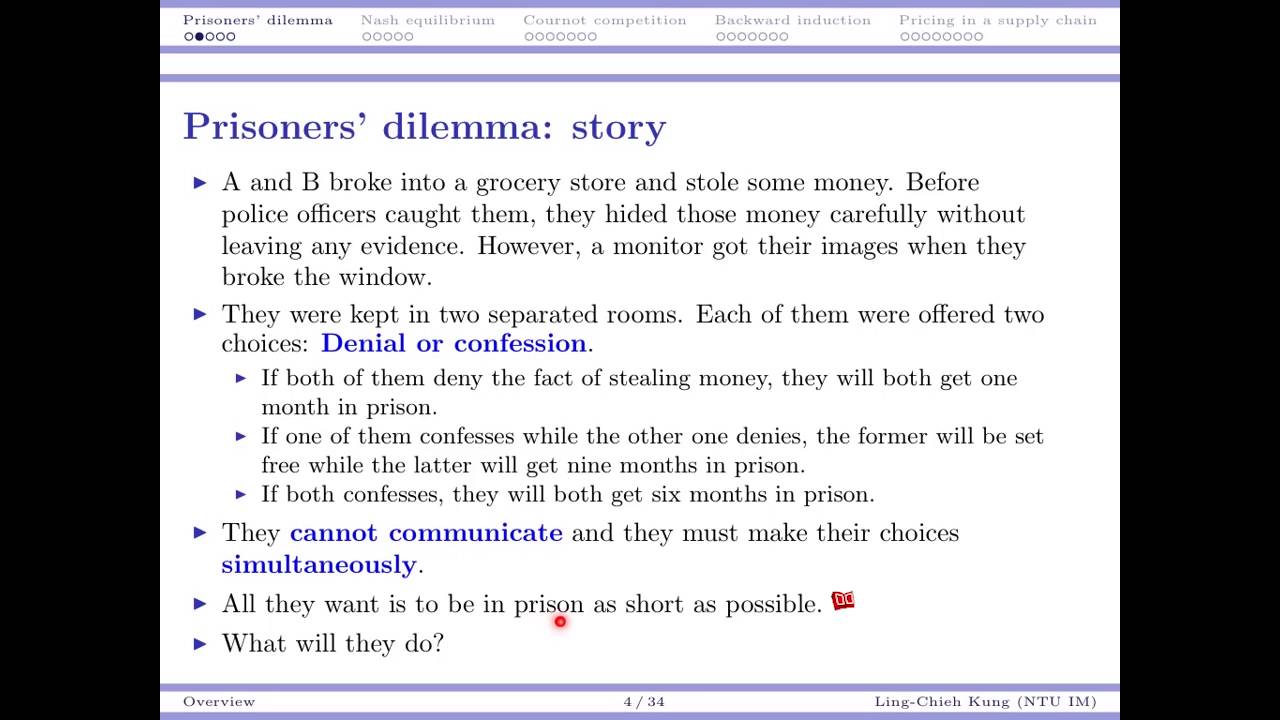
For example, the very first day we saw a Prisoner's Dilemma. But I claim that though we're getting a bad outcome here in the class, this is not a Prisoner's Dilemma. Why is this not a Prisoner's Dilemma? What's different between--I mean both games have an equilibrium which is bad.
Prisoner's Dilemma has the bad equilibrium when nobody tidies their room or both guys go to jail, but I claim this is not a Prisoner's Dilemma. Get the guy behind you.
Student: No one suffered but no one gets any payoffs.
Professor Ben Polak: Okay, so maybe the outcome isn't quite so bad. That's fair enough, I could have made it worse, I could have made it sort of--I could have made that--I could have lowered the payoffs until they were pretty bad. Why else is this not a Prisoner's Dilemma? The woman who's behind you.
Student: Because there's no strictly dominated strategy.
Professor Ben Polak: Good; so in Prisoner's Dilemma playing ά was always a best response. What led us to the bad outcome in Prisoner's Dilemma was that ά, the defense strategy, the non-cooperative strategy, the not helping tidy your room strategy, was always the best thing to do.
Here, in some sense the "good thing," the "moral thing" in some sense, is to invest but it's not the case that not investing dominates investing. In fact, if all the people invest in the room you ought to invest, is that right?
So this is a social problem, but it's not a social problem of the form of a Prisoner's Dilemma.
So what kind of problem is this? What kind of social problem is this? The guy in front of you.
Student: Perhaps it's one of cooperation.
Professor Ben Polak: It's one of--okay.
So it's--it would help if people cooperated here but I'm looking for a different term. The term that came up the first day--coordination, this is a coordination game.
For those people that read the New Yorker, I'll put an umlaut over the second "o."
Why is it a coordination game? Because you'd like everyone in the class to coordinate their responses on invest.
In fact, if they did that, they all would be happy and no one would have an incentive to defect and there would in fact be an equilibrium. But unfortunately, quite often, we fail to have coordination.
Either everyone plays non-invest or, as happened the first time in class, we get some split with people losing money. So, I claim that actually this is not a rare thing in society at all.
There are lots of coordination problems in society.
There are lots of things that look like coordination games.
And often, in coordination games bad outcomes result and I want to spend most of the rest of today talking about that, because I think it's important, whether you're an economist or whatever, so let's talk about it a bit.
What else has the structure of a coordination game, and therefore can have the outcome that people can be uncoordinated or can coordinate in the wrong place, and you end up with a bad equilibrium?
What else looks like that? Let's collect some ideas.
I got a hand way at the back. Can you get the guy who is just way, way, way at the back, right up against the--yes, there you go, great thank you.
Wait until the mike gets to you and then yell.
Student: A party on campus is a coordination game.
Professor Ben Polak: Yeah, good okay.
So a party on campus is a coordination game because what--because you have to coordinate being at the same place, is that right? That's the idea you had?
Go ahead. Student: [inaudible] Professor Ben Polak: Good, okay that's good.
So that's another in which--there's two ways in which a party can be a coordination problem.
One is the problem that if people don't show up it's a lousy party, so you don't want to show up.
Conversely, if everyone is showing up, it's great, it's a lot of fun, it's the place to be and everyone wants to show up. Second--so there's two equilibria there, showing up and--everyone not showing up or everyone showing up.
Similar idea, the location of parties which is what I thought you were driving at, but this similar idea can occur. So it used to the case in New Haven that there were different--actually there aren't many anymore--but there used to be different bars around campus (none of which you were allowed to go to, so you don't know about) but anyway, lots of different bars around campus. And there's a coordination game where people coordinate on Friday night--or to be more honest, the graduate students typically Thursday night.
So it used to be the case that one of those bars downtown was where the drama school people coordinated, and another one was where the economists coordinated, and it was really good equilibrium that they didn't coordinate at the same place. So one of the things you have to learn when you go to a new town is where is the meeting point for the kind of party I want to go to.
Again, you're going to have a failure of coordination, everyone's wandering around the town getting mugged.
What other things look like coordination problems like that?
Again, way back in the corner there, right behind you, there you go. Student: Maybe warring parties in the Civil War signing a treaty.
Professor Ben Polak: Okay, that could be a--that could be a coordination problem. It has a feeling of being a bit Prisoner's Dilemmerish and in some sense, it's my disarming, my putting down my arms before you putting down your arms, that kind of thing. So it could be a coordination problem, but it has a little bit of a flavor of both.
Go ahead, go on. Okay, other examples?
There's a guy there. While you're there why don't you get the guy who is behind you right there by the door, great. Student: Big sports arena, people deciding whether or not they want to start a chant or [inaudible] Professor Ben Polak: Yeah, okay. I'm not quite sure which is the good outcome or the bad outcome. So there's this thing called, The Wave. There's this thing called The Wave that Americans insist on doing, and I guess they think that's the good outcome. Other things?
Student: Battle of the sexes.
Professor Ben Polak: Let's come back to that one.
Hold that thought and we'll come back to it next time.
You're right that's a good--but let's come back to it next time.
Anything else? Let me try and expand on some of these meeting place ideas. We talked about pubs to meet at, or parties to meet at, but think about online sites.
Online sites which are chat sites or dating sites, or whatever. Those are--those online sites clearly have the same feature of a party.
You want people to coordinate on the same site.
What about some other economic ideas?
What about some other ideas from economics?
What else has that kind of externality like a meeting place? Student: I mean it's excluding some people, but things like newspapers or something, like we might want only one like global news site.
Professor Ben Polak: So, that's an interesting thought, because it can go both ways. It could be a bad thing to have one newspaper for obvious reasons, but in terms of having a good conversation about what was in the newspaper yesterday around the--over lunch, it helps that everyone's read the same thing. Certainly, there's a bandwagon effect to this with TV shows. If everybody in America watches the same TV show, which apparently is American Idol these days, then you can also talk about it over lunch. Notice that's a really horrible place to coordinate. There are similar examples to the American Idol example. When I was growing up in England, again I'm going to reveal my age; everybody decided that to be an "in" person in England, you had to wear flared trousers.
This was--and so to be in you had to wear flared trousers.
This is a horrible coordination problem, right?
So for people who don't believe that could ever have happened in England that you could ever these sort of fashion goods that you end up at a horrible equilibrium at the wrong place, if you don't believe that could ever happen think about the entirety of the Midwest. I didn't say that, we're going to cut that out of the film later.
What else is like this? I'm going to get a few ideas now, this gentleman here. Student: The establishment of monopolies, because a lot of people use Microsoft, say then everything is compatible with Microsoft so more people would use it.
Professor Ben Polak: Good, I've forgotten your name.
Student: Steven. Professor Ben Polak: So, Steven's pointing out that certain software can act this way by being a network good. The more people who use Microsoft and Microsoft programs, the bigger the advantage to me using Microsoft, and therefore--because I can exchange programs, I can exchange files if I'm working with my co-authors and so on, and so you can have different equilibria coordinating on different software, and again, you could end up at the wrong one. I think a lot of people would argue--but I'm going to stay neutral on this--a lot of people would argue that Microsoft wasn't necessarily the best place for the world to end up. There are other technological network goods like this. These are called network externalities. An example here would be high definition television. You want to have one technological standard that everyone agrees on for things like high definition televisions because then everyone can produce TVs to that standard and goods that go along with that standard, and of course it--each company who's producing a TV and has a standard line would like theirs to be chosen as the standard. Again, you could end up at the wrong place. You could end up with a bad equilibrium. How about political bandwagons?
In politics, particularly in primaries, there may be advantage on the Democratic side or on the Republican side, in having you all vote for the same candidate in the primary, so they get this big boost and it doesn't seem like your party's split and so on.
And that could end up--and again, I'm going to remain neutral on this--it just could end up with the wrong candidate winning. There's a political bandwagon effect, the person who wins New Hampshire and Iowa tends then to win everything, so that's another example.
Any other economic examples? Can we get this guy in here?
Student: Stock exchange. Professor Ben Polak: Yeah, okay, so in particular which stock exchange to list on.
So there's a huge advantage having lots of stocks in the same stock exchange. There are shared fixed costs; there's also liquidity issues and lots of issues of that form but mostly the form of fixed costs.
So there's a tendency to end up with one stock exchange.
We're not there yet but we do seem to be going that way quite rapidly. The problem of course being, that might not be the best stock exchange or it might give that stock exchange monopoly power.
Let me give one--let me try one more example.
What about bank runs? What's a bank run?
Somebody--what's a bank run? Student: It's when the public loses confidence in--because their security of their money in banks, then they rush to withdraw their deposits. Professor Ben Polak: Good. So you can imagine a bank as a natural case where there's two equilibria.
There's a good equilibrium, everyone has confidence in the bank, everyone leaves their deposits in the bank.
The bank is then able to lend some of that money out on a higher rate of interest on it. The bank doesn't want to keep all that money locked up in the vault.
It wants to lend it out to lenders who can pay interest.
That's a good equilibrium for everybody.
However, if people lose confidence in the bank and start drawing their deposits out then the bank hasn't got enough cash in its vaults to cover those deposits and the bank goes under. Now, I used to say at this point in the class, none of you will have ever seen a bank run because they stopped happening in America more or less in the mid 30s. There were lots and lots of bank runs in America before the 1930s, but since federal deposit insurance came in, there's far fewer.
However, I really can't say that today because there's a bank run going on right now. There's as bank run going on actually in England with a company called Northern Security--no, Northern Rock--it's called Northern Rock, as we speak, and it really is a bank run. I mean, if you looked at the newspaper yesterday on The New York Times, you'll see a line of depositors lined up, outside the offices in London of this bank, trying to get their deposits out. And you see the Bank of England trying to intervene to restore confidence.
Just be clear, this isn't simple--this isn't a simple case of being about the mortgage crisis.
This bank does do mortgages but it doesn't seem to be particularly involved in the kind of mortgages that have been attracting all the publicity. It really seems to be a shift in confidence. A move from the good equilibrium of everyone remaining invested, to the bad equilibrium of everyone taking their money out.
Now, there are famous bank runs in American culture, in the movies anyway. What is the famous bank run in the movies, in American movies? Student: It's a Wonderful Life. Professor Ben Polak: It's a Wonderful Life; there's actually--there's one in Mary Poppins as well, but we'll do It's a Wonderful Life. How many of you have seen It's A Wonderful Life? How many have you not seen It's a Wonderful Life? Let me get a poll here.
How many people have not seen--keep your hands up a second, keep your hands up. You need to know that if you're on a green card, you can lose your green card if you haven't sent It's a Wonderful Life.
So, in It's a Wonderful Life there's a run on the bank--actually it's a savings and loan, but never mind.
We'll think of it as a bank. Luckily, it doesn't end up with the savings or loan, or bank, going under.
Why doesn't the bank go under in It's a Wonderful Life?
Why doesn't it go under? Yeah, the guy in green?
Can we get the guy in green? Student: Everyone agrees to only take as much as they need [inaudible] Professor Ben Polak: For the people who didn't hear it, everyone agrees only to take out a small amount, perhaps even nothing and therefore the bank run ends.
Everyone realizes the bank isn't going to collapse, and they're happy to leave their money in the bank.
Now, it's true everyone agrees but what do they agree?
What makes them agree? What makes them agree is Jimmy Stewart, right? Everyone remember the movie?
So Jimmy Stewart gets up there and he says--he gives a speech, and he says, look, more or less,--I mean he doesn't say it in these words but he would have done it if he had taken the class--he says, look there are two equilibria in this game.
(I can't do the--whatever it is, the West Pennsylvania accent, is that what it is, or whatever it is.) But anyway; there are two equilibria in this game; there's a bad one where we all draw our money out and we all lose our homes eventually, and there's a good one where we all leave our money in and that's better for everyone., So let's all leave our money in. But he gives this--he's a bit more motivationally stimulating than me--but he leads people leaving their money in. So, what I want to do is, I want to pick on somebody in the class now--everyone understands this game, everyone understands there's two equilibria, everyone understands that one equilibrium is better. Let's play the game again.
Let's choose the game again, but before I do I'm going to give the mike to Patrick here and Patrick is going to have exactly five seconds to persuade you.
Stand up. Patrick's going to have five seconds to persuade you to tell you whatever he likes starting now. Student: Okay, so clearly if we all invest we're always better off, so everybody should invest. Professor Ben Polak: All right, now let's see if this is going work.
Okay, so let's see what happens now.
Everybody who is going to invest raise their hands and everyone who's not investing raise their hands.
Oh we almost made it. We must have almost made it.
So notice what happened here. Give another round of applause for Patrick. I think he did a good job there.
But there's a lesson here; the lesson here is the game didn't change. It's the same game that we've played three times already. This was the fourth time we've played it. We had a totally different response in playing this time. Almost all of you, the vast majority of you, perhaps even 90% of you invested this time and you did so in response to Patrick.
But Patrick wasn't putting any money down, he wasn't bribing you, he wasn't writing a contract with you, he wasn't threatening to break your legs, he just was pointing out it's a good idea. Now, remember the Prisoner's Dilemma, in the Prisoner's Dilemma, if Patrick--Patrick could have got up in the Prisoner's Dilemma and given the same speech and said look guys, we're all better off if we choose β in the Prisoner's Dilemma than if we choose ά; roughly the same speech.
What will you have done in the Prisoner's Dilemma?
You would have all chosen ά anyway.
So Patrick tried to persuade you, or Patrick communicating to you that you do better by choosing β in the Prisoner's Dilemma doesn't work but here--don't go yet. Here it does work.
Why does Patrick--why is Patrick persuasive in this game but he isn't persuasive in the Prisoner's Dilemma?
Can we get the mike on Katie again?
Why is Patrick persuasive in this game and not before?
Student: He's not trying to get you to play a strictly dominated strategy. Professor Ben Polak: He's not trying to get you play a strictly dominated strategy and more than that, he's trying to persuade you to play what? To play a Nash Equilibrium.
So, there's a lesson here, in coordination problems, unlike Prisoner's Dilemma, communication--just communication, no contracts--communication can help. And in particular, what we can persuade each other to do is to play the other Nash Equilibrium. Now, this gives us one more motivation for a Nash Equilibrium.
In a Prisoner's Dilemma, to get out of it we needed a contract, we needed side payments, we needed to change the payoffs of the game. But a Nash Equilibrium can be a self-enforcing agreement. We can agree that we're going to play invest in this game, and indeed we will play invest without any side payments, without anybody threatening to break your leg, without any contracts, without any regulation or the law.
I'm assuming Patrick isn't that violent.
We're going to end up doing the right thing here because it's in our own interest to do so. So coordination problems which we've agreed are all over society, whether it comes to bank runs or bubbles in the market, or fashion in the Midwest, they're all over society.
Communication can make a difference and we'll pick that theme up on Monday.
Up Next
32:42
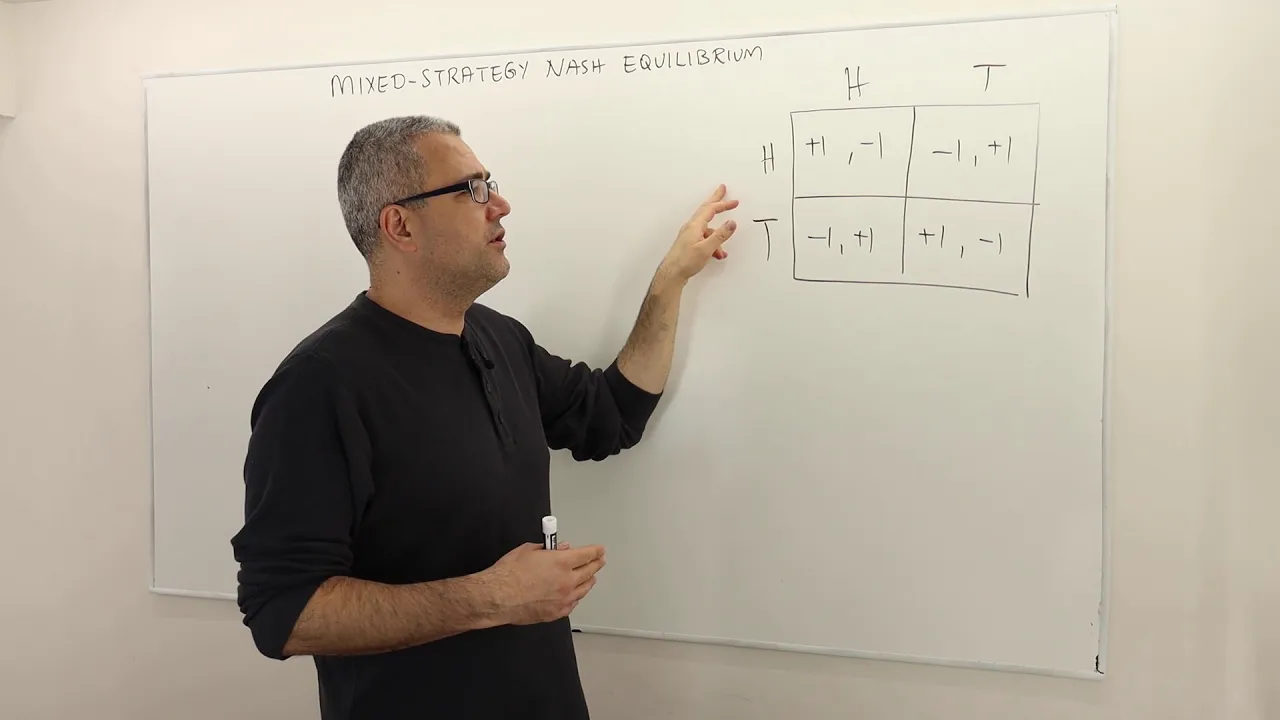
Mixed Strategy Nash Equilibrium Explained (Game Theory 4) | Matching Pennies
@selcukozyurt
69K views•2020-10-21

5:07
Impact of Yuan in Indo-Russian Trade Amid Sanctions
@WION
261.9K views•2022-07-01

71:32
Monetary Policy Explained: Central Banking & the Fed
@YaleCourses
249.5K views•2012-04-05

113:18
The Age of Easy Money: Fed & Inflation | Full Documentary
@frontline
21.2M views•2023-03-15
Related Study Plans & Knowledge Roadmaps
Structured learning paths in Economics
economics
Sovereign Debt: Defaults, IMF & Restructuring
01Introduction to Sovereign Debt & Government Bonds
02Debt Sustainability & Credit Ratings
03Anatomy and History of Debt Crises
+ 2 more learning modules
12h5 modules
Explore Roadmap
economics
Market Design: Matching Theory & Gale-Shapley
01Introduction to Market Design and Price-Free Markets
02Two-Sided Matching & The Gale-Shapley Algorithm
03School Choice Systems and Mechanism Design
+ 2 more learning modules
10h5 modules
Explore Roadmap
economics
Impossible Trinity: Forex, Capital & Policy
01Introduction to Monetary Policy and Central Banking
02Exchange Rates and International Capital Flows
03The Mundell-Fleming Model
+ 2 more learning modules
8h5 modules
Explore Roadmap
economics
Healthcare Economics: Market Failures & Systems
01Introduction to Healthcare Markets and Market Failure
02Asymmetric Information and Adverse Selection
03Moral Hazard and Insurance Design
+ 2 more learning modules
12h5 modules
Explore Roadmap