Impossible Trinity: Forex, Capital & Policy
Learning Goal: Analyze the macroeconomic trade-offs of the Mundell-Fleming "Impossible Trinity" (Trilemma), evaluating how open economies choose between fixed exchange rates, free capital mobility, and independent monetary policy.
- Prerequisites: Basic macroeconomics (concepts of aggregate demand, aggregate supply, and money supply).
- Estimated Total Study Time: 8 hours
Module 1: Open-Economy Central Banking and the Balance of Payments
This module builds the foundational balance-of-payments (BOP) accounting framework required to understand how open economies interact. You will master the accounting identity where the Current Account (CA) and the Capital/Financial Account (KA) must sum to zero (), and how central banks manage their foreign exchange (FX) reserves to balance these accounts under different regimes.
Recommended Videos

Why this video
This video is essential for setting up the fundamental Balance of Payments (BOP) accounting identity. It breaks down the current account (comprising net exports, net factor income, and unilateral transfers) and the capital/financial account. It explains mathematically why these accounts must balance out in equilibrium, and outlines how foreign exchange transactions are recorded, laying the groundwork for how central banking actions interact with international capital flows.
Module 1 Gap Acknowledgment & Self-Study Guide
While the video above covers the essential BOP accounting identity, the video pool contains a gap regarding the precise accounting mechanics of sterilized vs. unsterilized foreign exchange intervention by central banks.
- The Core Concept:
- In an unsterilized intervention, a central bank buying foreign currency to prevent domestic currency appreciation prints domestic money to do so, expanding the domestic monetary base () and lowering domestic interest rates ().
- In a sterilized intervention, the central bank offsets this domestic liquidity expansion by simultaneously selling an equivalent amount of domestic government bonds in open market operations, leaving the domestic money supply unchanged.
- Independent Study Search Query: To master this distinction, search YouTube for:
"Sterilized vs unsterilized foreign exchange intervention mechanics"or"Central bank balance sheet foreign exchange intervention".
Knowledge Checkpoint
- State and write out the Balance of Payments accounting identity, defining its main components (Current Account and Capital Account).
- Explain how a current account deficit must be financed by a capital account surplus under a floating exchange rate regime.
- Contrast how a central bank's balance sheet changes when conducting an unsterilized FX purchase versus a sterilized purchase.
Module 2: Exchange Rates and International Capital Flows
This module transitions from the accounting framework to market operations. You will explore how foreign exchange rates are determined, the mechanics of fixed versus floating exchange rates, and how arbitrageurs drive international capital mobility by exploiting interest rate differentials.
Recommended Videos
Why this video
This video steps through the micro-mechanics of arbitrage under a fixed exchange rate regime. It illustrates what occurs when the market equilibrium exchange rate deviates from the peg declared by the central bank. You will learn the exact actions of arbitrageurs and how their behavior forces the central bank to buy or sell its domestic currency to defend the official exchange rate.

Why this video
To comprehend capital flows, you must first master the money market's domestic benchmark: the LM curve. This video provides a precise mathematical and graphical derivation of the LM curve using Keynesian liquidity preference theory. By understanding how money demand (transactional and speculative) interacts with money supply to determine interest rates, you will be prepared to see how capital flows react when domestic interest rates deviate from global rates.
Knowledge Checkpoint
- Explain how international arbitrageurs exploit differences between domestic interest rates and world interest rates under perfect capital mobility.
- Describe the actions a central bank must take if market forces are exerting downward pressure on its pegged exchange rate.
- Write out the equilibrium equation for the money market () and describe the slope of the LM curve.
Module 3: The Mundell-Fleming (IS-LM-BP) Model
This module introduces the comprehensive open-economy macroeconomic framework: the IS-LM-BP model. You will learn how to mathematically derive and graphically shift the IS (goods market), LM (money market), and BP (Balance of Payments) curves under different exchange rate regimes.
Recommended Videos

Why this video
This video is a premier introduction to the IS-LM-BP framework. It details how the traditional closed-economy IS-LM model is extended by adding the BP curve. It demonstrates how net exports (NX) enter the goods market (IS) and how capital flows enter the financial market (BP), illustrating the graphical representation of external balance.

Why this video
For a rigorous academic understanding, this video presents the mathematical derivation of the IS-LM-BP model using general functions. It walks through the equations step-by-step, explaining how the open-economy IS curve incorporates the current account function , where is the exchange rate. It mathematically proves why the IS curve is flatter in an open economy compared to a closed one due to import leakages.
Why this video
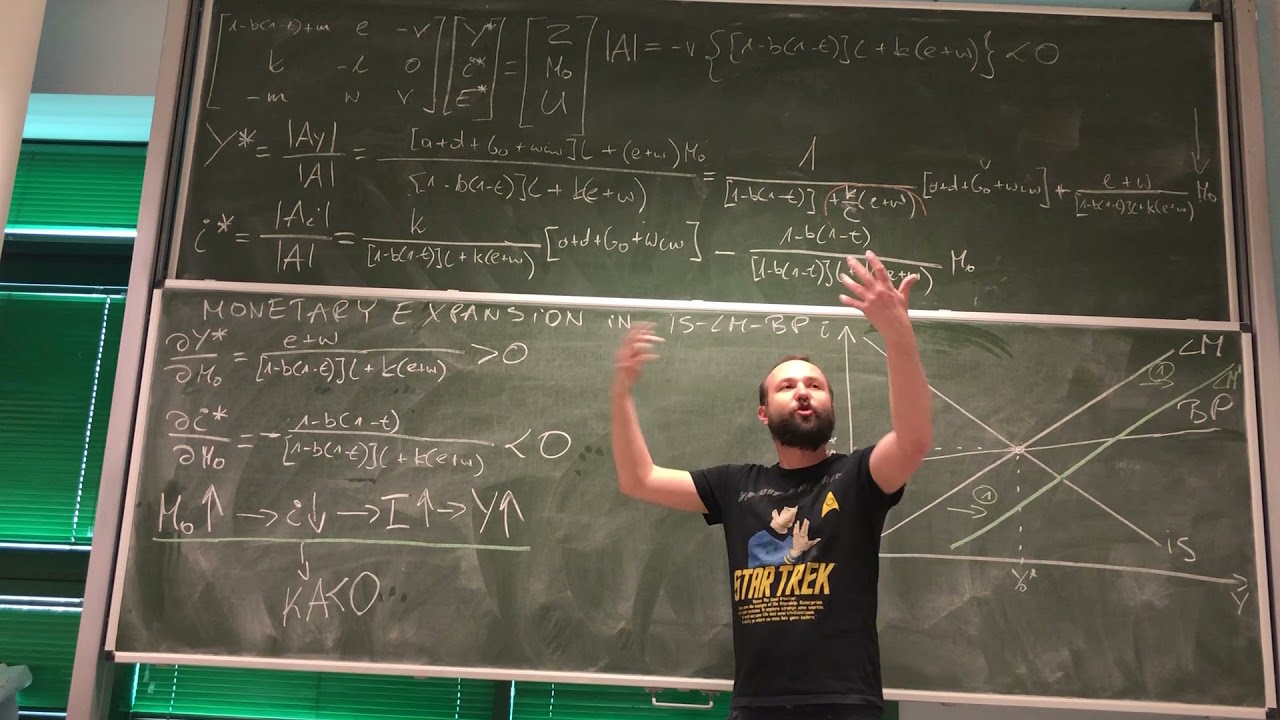
This mathematical lecture utilizes linear algebraic structures to perform comparative static derivatives on the IS-LM-BP model. By working through the linear equations, you will see how variables like government expenditure () and money supply () mathematically shift the equilibrium output (), interest rate (), and exchange rate ().
Knowledge Checkpoint
- Derive the mathematical equation for the open-economy IS curve, highlighting how imports act as a marginal leakage that flattens the curve.
- Graphically draw a three-curve IS-LM-BP diagram showcasing: (a) a trade surplus/capital inflow scenario (points above the BP line) and (b) a trade deficit/capital outflow scenario (points below the BP line).
- Explain how the slope of the BP curve changes depending on the degree of international capital mobility (from perfectly immobile to perfectly mobile).
Module 4: The Impossible Trinity (The Trilemma)
This module presents the intellectual core of the curriculum: the Impossible Trinity. You will analyze why a country can only select two of the three policy options: free capital flow, a fixed exchange rate, and an independent monetary policy. You will trace the feedback loops that occur when a nation attempts to break this rule.
Recommended Videos

Why this video
Based on Mankiw’s seminal macroeconomic framework, this video systematically models a small open economy with perfect capital mobility under fixed exchange rates. It explains why monetary policy becomes completely impotent under these conditions, as any attempt to change interest rates triggers massive capital flows that force the central bank to buy or sell currency, reversing the initial policy change.

Why this video
This video explores the alternative side of the Trilemma: a small open economy with floating exchange rates and free capital mobility. It demonstrates that under floating rates, fiscal policy is rendered ineffective due to exchange rate crowding-out, while monetary policy becomes highly potent because changes in interest rates translate directly into currency depreciation/appreciation, driving net exports.

Why this video
This academic video reviews the Mundell-Fleming model under fixed exchange rates, focusing on achieving both internal balance (full employment and price stability) and external balance (BOP equilibrium). It provides the core theoretical argument for the Trilemma by showing that with perfect capital mobility and a fixed rate, a nation must surrender its monetary policy to maintain external balance.
Knowledge Checkpoint
- Draw the "Trilemma Triangle" and identify the three policy pairs available to policymakers, labeling which option is surrendered in each pair.
- Explain step-by-step why an expansionary monetary policy fails under a fixed exchange rate with free capital mobility.
- Describe the process of "exchange rate crowding-out" that neutralizes fiscal policy under a floating exchange rate with free capital mobility.
Module 5: Real-World Applications & Financial Crises
Theory meets reality in this final module. You will evaluate how different nations navigate the Trilemma and analyze structural adjustments during macroeconomic shocks. You will also look at how imperfect capital mobility changes policy dynamics.
Recommended Videos
Why this video
In the real world, capital mobility is rarely absolute. This video models the Mundell-Fleming framework under imperfect capital mobility (upward-sloping BP curve). It shows how partial capital controls allow countries to retain some degree of monetary independence even under a fixed exchange rate, explaining the policy choice of nations like China.
Why this video
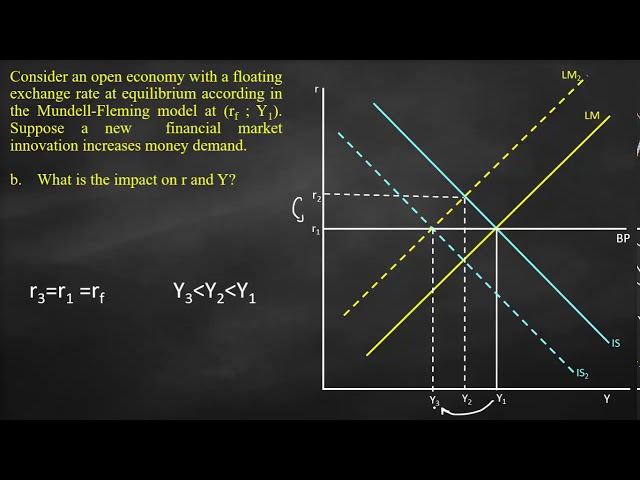
This video models the impact of an endogenous economic shock: a sudden shift in money demand (negative money market shock) under a floating exchange rate regime. It illustrates the real-world feedback loops as output, interest rates, and exchange rates adjust to find a new equilibrium.

Why this video
Using a step-by-step graphical approach, this video analyzes a negative goods market shock (such as a drop in foreign demand for exports) under fixed exchange rates. It traces how the drop in output forces central banks to intervene in the foreign exchange market to preserve the currency peg, leading to contractionary domestic monetary consequences.
Module 5 Gap Acknowledgment & Self-Study Guide
While the videos in this module cover imperfect capital mobility and various economic shocks, the video pool does not contain direct, comprehensive case studies of historical crises, such as the 1997 Asian Financial Crisis or China's modern currency management.
- The Core Concept:
- The 1997 Asian Financial Crisis is a classic case of Trilemma failure. Southeast Asian nations tried to maintain fixed pegs to the US Dollar while liberalizing capital accounts, leaving them open to speculative attacks once foreign reserves were depleted.
- China's Choice: China avoids this by enforcing capital controls (imperfect capital mobility), allowing them to manage their exchange rate (renminbi) and run an independent monetary policy.
- Independent Study Search Query: Search YouTube for:
"The 1997 Asian Financial Crisis documentary"or"How China manages the Impossible Trinity".
Knowledge Checkpoint
- Explain how an upward-sloping BP curve (imperfect capital mobility) alters the effectiveness of monetary policy under a fixed exchange rate compared to the perfect capital mobility case.
- Trace the adjustments in the IS-LM-BP model following a sudden domestic surge in money demand under a floating exchange rate.
- Map the path of output and foreign exchange reserves in a fixed exchange rate economy hit by a sharp, permanent decline in export demand.
Course Map
Key People Index
- Robert Mundell & Marcus Fleming: Nobel laureate Robert Mundell and IMF economist Marcus Fleming independently extended the closed-economy IS-LM model to open economies in the early 1960s, creating the standard IS-LM-BP model that forms the basis of the policy Trilemma.
- John Hicks & Alvin Hansen: Developed the original IS-LM model (Investment-Saving / Liquidity-Money) in 1937 to formalize John Maynard Keynes' General Theory.
- N. Gregory Mankiw: Harvard macroeconomist whose textbook-style exposition of the Mundell-Fleming model under fixed vs. floating exchange rates is the global standard for teaching intermediate open-economy macroeconomics.
Final Self-Assessment
Perform a self-evaluation using the comprehensive checklist below to confirm your mastery of the curriculum:
- I can write the core Balance of Payments identity and explain the macroeconomic relationship between national savings, domestic investment, and the net capital outflow.
- I can graphically derive the downward-sloping IS curve and upward-sloping LM curve, and explain how the introduction of international trade (net exports) flattens the IS curve.
- I can explain the economic intuition behind the Balance of Payments (BP) curve and prove mathematically why its slope depends on the sensitivity of capital flows to interest rate changes.
- I can define "Uncovered Interest Rate Parity" (UIP) and explain how it dictates international capital movements under perfect capital mobility.
- I can list the three pillars of the Impossible Trinity (Trilemma) and state why it is mathematically and operationally impossible to achieve all three simultaneously.
- I can contrast the relative effectiveness of monetary policy versus fiscal policy under a fixed exchange rate system with perfect capital mobility.
- I can contrast the relative effectiveness of monetary policy versus fiscal policy under a floating exchange rate system with perfect capital mobility.
- I can explain the mechanics of a "speculative currency attack" using the Trilemma framework (e.g., the 1997 Asian Financial Crisis).
- I can explain how a central bank utilizes sterilization (using government bonds) to temporarily shield its domestic money supply from the monetary consequences of a foreign exchange market intervention.
- I can outline how China uses capital controls to maintain a managed exchange rate while retaining an independent domestic monetary policy.