Ag Policy: Subsidies, Price Floors & Markets
Learning Goal: Analyze the economic consequences of domestic agricultural policies, focusing on how price floors, subsidies, and crop insurance affect farming decisions, consumer prices, and market efficiency.
- Estimated Total Study Time: 11 hours
- Prerequisites: None (Introductory microeconomics concepts are covered in Module 1)
Module 1: Foundations of Microeconomics in Agriculture
This module establishes the microeconomic foundation required to evaluate agricultural policies. You will study how competitive forces of supply and demand establish equilibrium in agricultural markets, and how economists use the concepts of consumer surplus, producer surplus, and deadweight loss to measure market efficiency.
Recommended Videos
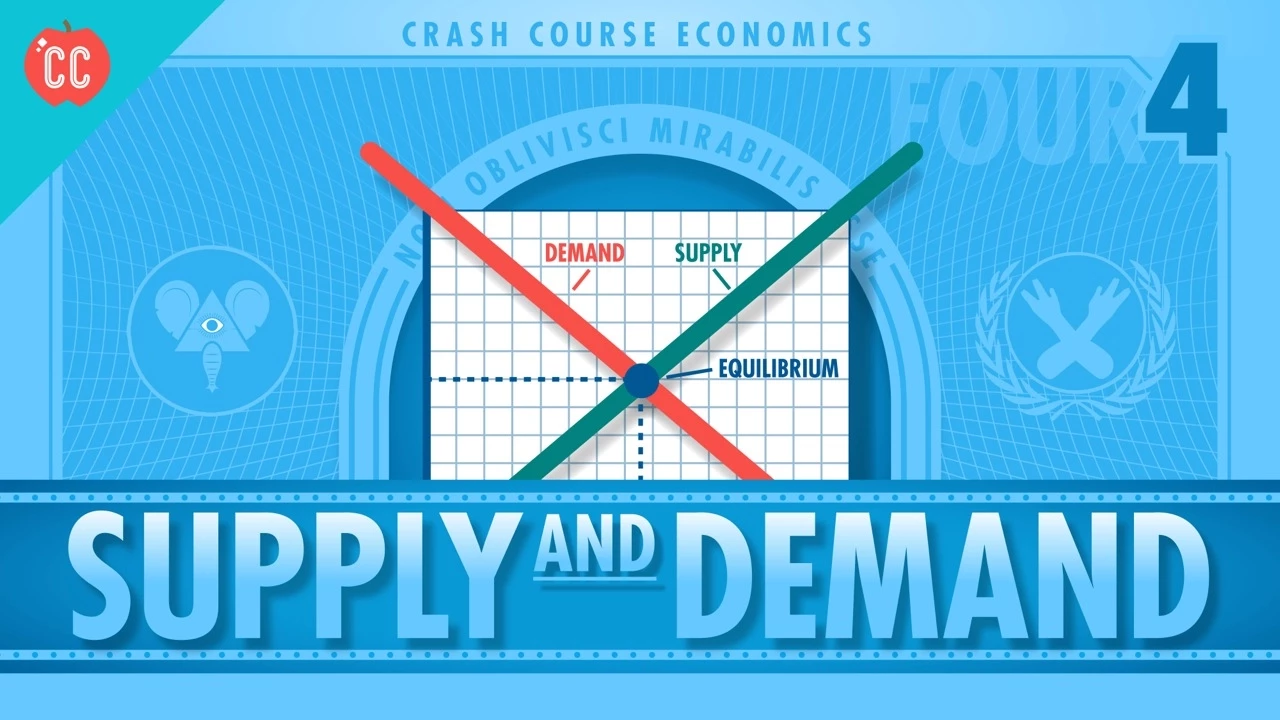
Why this video: This video introduces the foundational components of competitive market supply and demand, specifically highlighting agricultural commodities like strawberries. It explains how price signals dynamically coordinate production decisions and balance consumer consumption with producer output.

Why this video: Measuring policy impacts requires a clear understanding of welfare economics. Jacob Clifford explains how to define, locate, and calculate consumer surplus and producer surplus on a standard supply and demand diagram, providing the baseline metrics of market efficiency.

Why this video: To understand why government policies can be economically inefficient, you must understand deadweight loss. This video demonstrates how market equilibrium maximizes total economic surplus and models how any deviation from equilibrium quantity results in an efficiency loss for society.
Knowledge Checkpoint
- Draw a competitive market diagram and label the equilibrium price () and equilibrium quantity ().
- Shade and calculate the areas representing Consumer Surplus (CS) and Producer Surplus (PS) under free-market conditions.
- Define deadweight loss (DWL) and explain why it occurs when a market operates away from its equilibrium point.
- Explain how price changes act as signals to agricultural producers to scale production up or down.
Module 2: Price Floors and Government Price Supports
This module focuses on government-mandated price floors and agricultural price supports. You will analyze why governments intervene to keep prices artificially high, how these price floors generate persistent surpluses, and how government purchases of surplus agricultural goods shift economic welfare from taxpayers and consumers to producers.
Recommended Videos
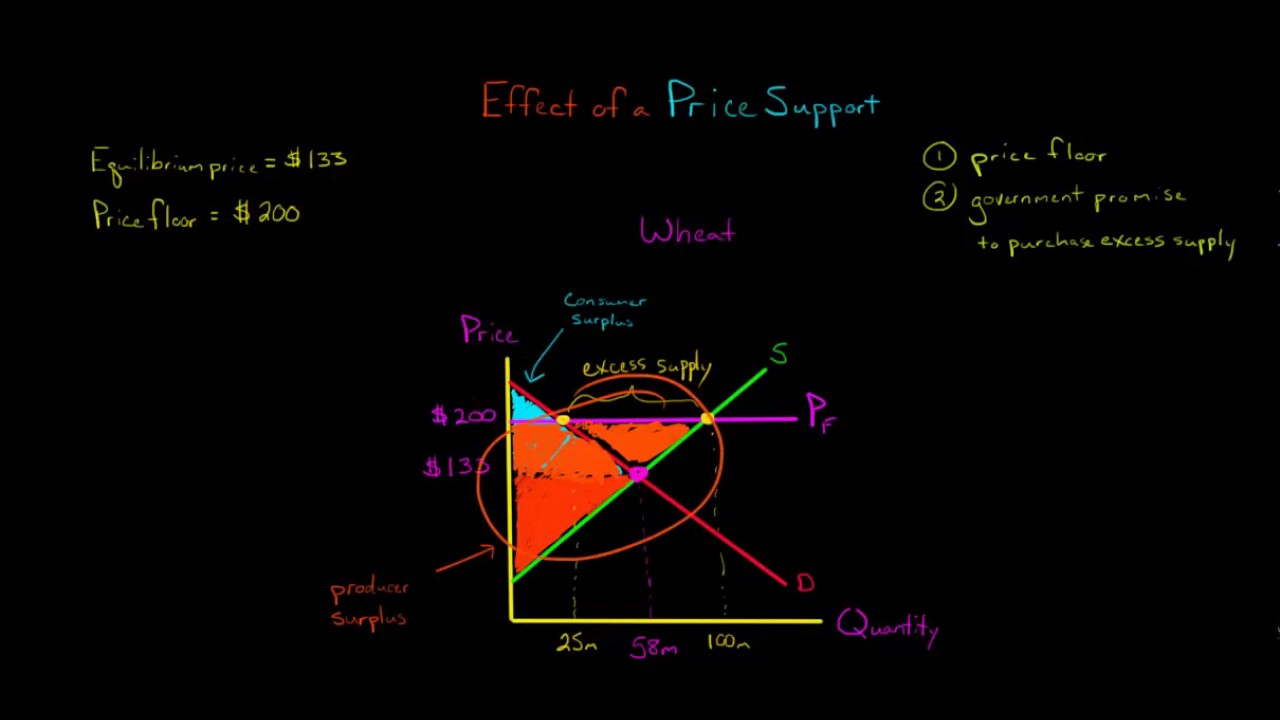
Why this video: This video directly addresses the mechanics of agricultural price supports. It provides a step-by-step graphical analysis showing how combining a price floor with a government guarantee to buy up the excess supply impacts consumer surplus, increases producer surplus, and creates a net deadweight loss.

Why this video: This animated guide is excellent for mastering the mathematical side of policy analysis. It demonstrates how to calculate consumer surplus, producer surplus, and deadweight loss when a government-mandated price floor shifts the market away from its natural equilibrium.

Why this video: Using a clear wheat market example, this short video visually details the specific burden placed on governments when they enforce agricultural price floors. It maps out the exact geometric area representing the cost of buying up unsold agricultural surpluses.
Knowledge Checkpoint
- Distinguish between a standard binding price floor and a price support policy.
- Graphically identify the quantity of surplus () generated by a price floor set above the equilibrium price.
- Explain how a government-backed surplus buyback program increases the overall deadweight loss of a price floor.
- Detail the twin financial burdens placed on consumers under a price support system (higher grocery prices and taxpayer-funded government purchases).
Module 3: Agricultural Subsidies and Production Decisions
Here, we explore the mechanics of direct agricultural subsidies. You will learn the critical distinction between coupled subsidies (linked to actual production volumes or current market prices) and decoupled subsidies (fixed payments based on historical farm parameters). This module highlights how subsidies distort market incentives, inflate land values, and motivate overproduction.
Recommended Videos

Why this video: Presented from an active farming perspective, this video explains the mechanics of modern U.S. farm policy. It breaks down complex Farm Bill programs—such as Agricultural Risk Coverage (ARC) and Price Loss Coverage (PLC)—and explains how historical "base acres" (established in 1985) continue to govern payouts.
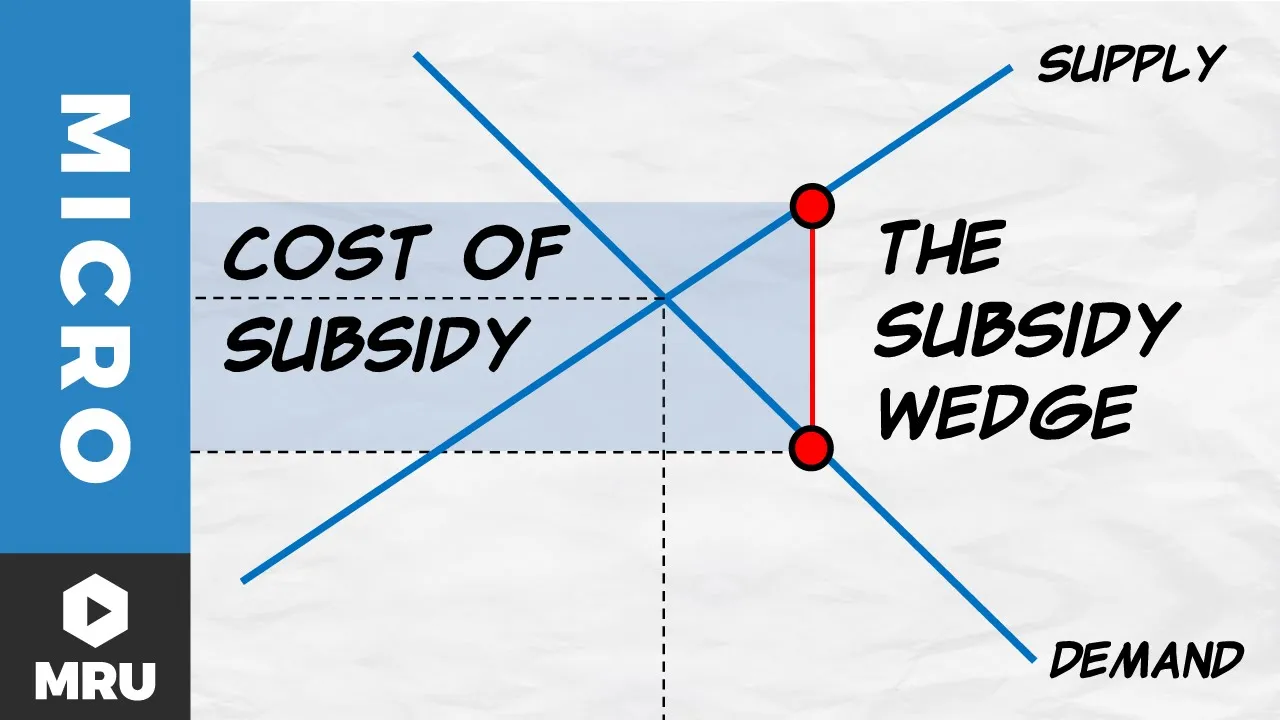
Why this video: This video covers the core economic theory of subsidies. It uses supply and demand graphs to demonstrate how a subsidy acts as a "negative tax," shifting the supply curve downward/rightward, creating a wedge between what consumers pay and what producers receive, and generating deadweight loss.

Why this video: This video directly addresses a key curriculum gap: the economic difference between coupled and decoupled subsidies under World Trade Organization (WTO) rules. It explains how coupled subsidies distort trade by directly incentivizing overproduction, whereas decoupled subsidies try to support farm incomes without dictating planting decisions.
![How Europe Is Ruining Agriculture [And How to Fix It]](https://i.ytimg.com/vi_webp/KNuo8keQzGU/maxresdefault.webp)
Why this video: This short video provides a practical, real-world case study of decoupled subsidies. It focuses on how Europe's Common Agricultural Policy (CAP) reformed in 2003 to issue payments based on the total area of land owned rather than the quantity of crops harvested, illustrating both the intent and structural limitations of decoupled support.
Deep-Dive: Coupled vs. Decoupled Subsidies
Coupled Subsidy: Payment = f(Current Production Volume, Current Price) Distortion: Direct incentive to overproduce, crashing world market prices.
Decoupled Subsidy: Payment = f(Historical Base Acres, Historical Yields) Distortion: Capitalizes directly into land values, increasing barriers to entry for new farmers.
Knowledge Checkpoint
- Define coupled subsidies and explain how they distort a farmer's planting decisions compared to a free market.
- Define decoupled subsidies and explain how they separate government payments from current production volumes.
- Graphically show how a production subsidy shifts the supply curve, lowers consumer prices, and creates deadweight loss.
- Describe how agricultural subsidies become capitalized into land values, making farmland more expensive to rent or purchase.
Module 4: Crop Insurance and Risk Management
Farming is highly vulnerable to weather and market fluctuations. This module evaluates the federal crop insurance framework, examining how government premium subsidies cushion farm business risk. We also investigate the market failures that emerge when governments heavily subsidize risk: specifically, moral hazard and adverse selection.
Recommended Videos

Why this video: This video bridges a major policy gap by walking through the practical mechanics of federally subsidized crop insurance. It explains how policies protect crop revenue, how coverage levels are chosen, and how the federal government subsidizes a significant portion of the premium to protect farmers against devastating yield losses.

Why this video: To understand the inefficiencies of crop insurance, you need to understand asymmetric information. This video clearly distinguishes between moral hazard (behavioral changes after obtaining insurance) and adverse selection (hidden information before buying a policy), setting up the theoretical framework for agricultural risk analysis.

Why this video: This academic lecture dives deeper into the microeconomics of moral hazard. It explores how shifting risk to an insurer reduces an individual's incentive to take preventative precautions, a concept crucial to explaining why subsidized farmers might plant crops in highly risk-prone areas.
Self-Directed Study Guide
Recommended Independent Search Queries:
- "How federal crop insurance subsidies distort farming decisions"
- "Prevented planting crop insurance moral hazard"
Focus Concept: Research "Prevented Planting" provisions. Understand how federal payouts can sometimes exceed the expected net returns of harvesting a crop, incentivizing farmers to leave marginal, flood-prone acres unplanted while still collecting taxpayer-subsidized insurance payouts.
Knowledge Checkpoint
- Explain how federally subsidized crop insurance differs from private, unsubsidized insurance.
- Define moral hazard in agricultural insurance and provide an example (e.g., planting on marginal, erosion-prone soils because losses are covered).
- Define adverse selection and explain how it can lead to higher average premiums if lower-risk farmers opt out of insurance programs.
- Identify who pays for the majority of the risk under the U.S. Federal Crop Insurance Corporation (FCIC) model.
Module 5: Market Efficiency, Trade, and Policy Synthesis
This final module synthesizes domestic agricultural policies within a global and environmental framework. You will analyze how wealthy countries' farm subsidies distort international trade, undermine farmers in developing countries, encourage intensive farming practices that damage the environment, and misallocate natural resources.
Recommended Videos

Why this video: This video directly addresses the environmental consequences of agricultural support. It details how domestic subsidies encourage choices that lead to land degradation, biodiversity loss, and water scarcity, illustrating how government payments can accidentally accelerate environmental damage.

Why this video: Journalist George Monbiot delivers a sharp critique of the global subsidy system. He argues that subsidizing agricultural land regardless of its environmental output rewards intensive, destructive farming practices, offering a clear connection between domestic financial policy and environmental issues.

Why this video: Focusing on international trade, this documentary excerpt shows how massive agricultural subsidies in industrialized nations (such as Europe's direct payments per hectare) spill over into global markets, undercutting unsubsidized smallholder farmers in developing nations.

Why this video: This video explores policy reform, analyzing how the half-trillion dollars spent annually on global agricultural subsidies could be redirected. Monbiot discusses how to transition from subsidizing pure production to incentivizing ecological restoration and carbon sequestration.
Synthesis: The Policy Feedback Loop
Domestic Subsidies (US/EU) │ ▼ Artificial Overproduction │ ▼ Dumping Surplus in Global Markets │ ├──────────────────────────────────────────┐ ▼ ▼ Destruction of Livelihoods Overuse of Fertilizers/Water in Developing Nations & Land Degradation (Local)
Knowledge Checkpoint
- Explain how domestic agricultural subsidies in developed nations depress global commodity prices and hurt farmers in developing countries.
- Describe the environmental externalities caused by coupled subsidies (e.g., overuse of fertilizers, clearing marginal lands, and monoculture farming).
- Evaluate how redirecting agricultural subsidies from "production volume" to "environmental stewardship" could affect both market efficiency and conservation.
- Summarize the net welfare impact of agricultural policies on three key groups: farmers, domestic taxpayers/consumers, and international producers.
Course Map
This flowchart shows the recommended learning path and the conceptual dependencies between the modules.
Key People Index
This index highlights the key economic educators and policy critics featured across the curriculum:
- Jacob Clifford (@JacobAClifford): An economics educator known for clear, visual explanations of microeconomic welfare graphs, consumer/producer surplus, and deadweight loss.
- George Monbiot (@GuardianLive / @NewStatesman): A prominent environmental journalist and author who critiques public agricultural subsidies. He writes on how modern farm payments encourage environmental damage and lobbies to redirect public funds toward ecological restoration.
Final Self-Assessment
Review your understanding of the entire curriculum with these assessment questions:
- Can you define consumer surplus, producer surplus, and deadweight loss, and point them out on a supply and demand graph?
- Can you explain how a price floor set above market equilibrium creates a surplus, and identify which areas on a graph represent the financial cost of a government buyback program?
- Do you understand the difference between coupled and decoupled agricultural subsidies, and can you explain how each affects a farmer's planting decisions?
- Can you explain why decoupled subsidies often make land more expensive to rent or buy, rather than just lowering food prices?
- Can you define moral hazard and adverse selection, and explain how they apply to federally subsidized crop insurance?
- Do you understand how subsidized crop insurance can encourage farmers to plant crops on high-risk, environmentally fragile lands?
- Can you explain the international trade consequences when wealthy countries subsidize their agricultural exports (often called "dumping")?
- Can you identify the environmental downsides of farm subsidies, such as overusing chemical fertilizers and accelerating habitat loss?
- Can you summarize who wins and who loses from agricultural subsidies (comparing large corporate farms, consumers, taxpayers, and small farmers in developing nations)?