
![[경제학 마인드 입문 013] 소비자잉여(cs), 생산자잉여(ps), 순사회편익(sw), 사회후생, ps와 이윤 사이의 관계 (윤지훈)](https://i.ytimg.com/vi/0MWaeKje-oM/maxresdefault.jpg)

























A subsidy is a negative tax where the government gives money to consumers or producers, and unlike taxes, the legal recipient of the subsidy (who gets the check) does not determine who economically benefits—the actual distribution depends on the relative elasticities of supply and demand; when supply is inelastic and demand is elastic, producers capture most of the subsidy benefits, while subsidies create deadweight loss by increasing trade beyond the efficient market level, resulting in wasteful transactions where the cost to suppliers exceeds the value to demanders.
Subsidies Explained: Incidence, Elasticity & Deadweight Loss
Added:The basic Law of Supply and Demand and how market equilibrium is established.
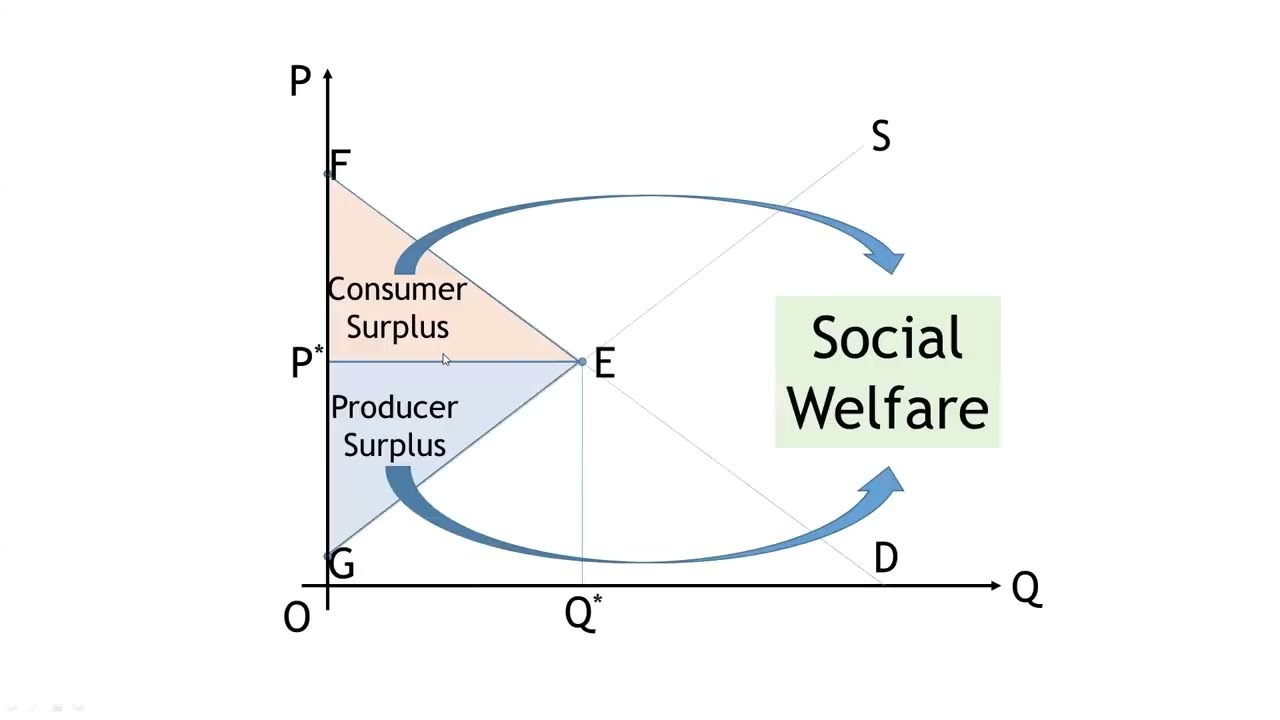
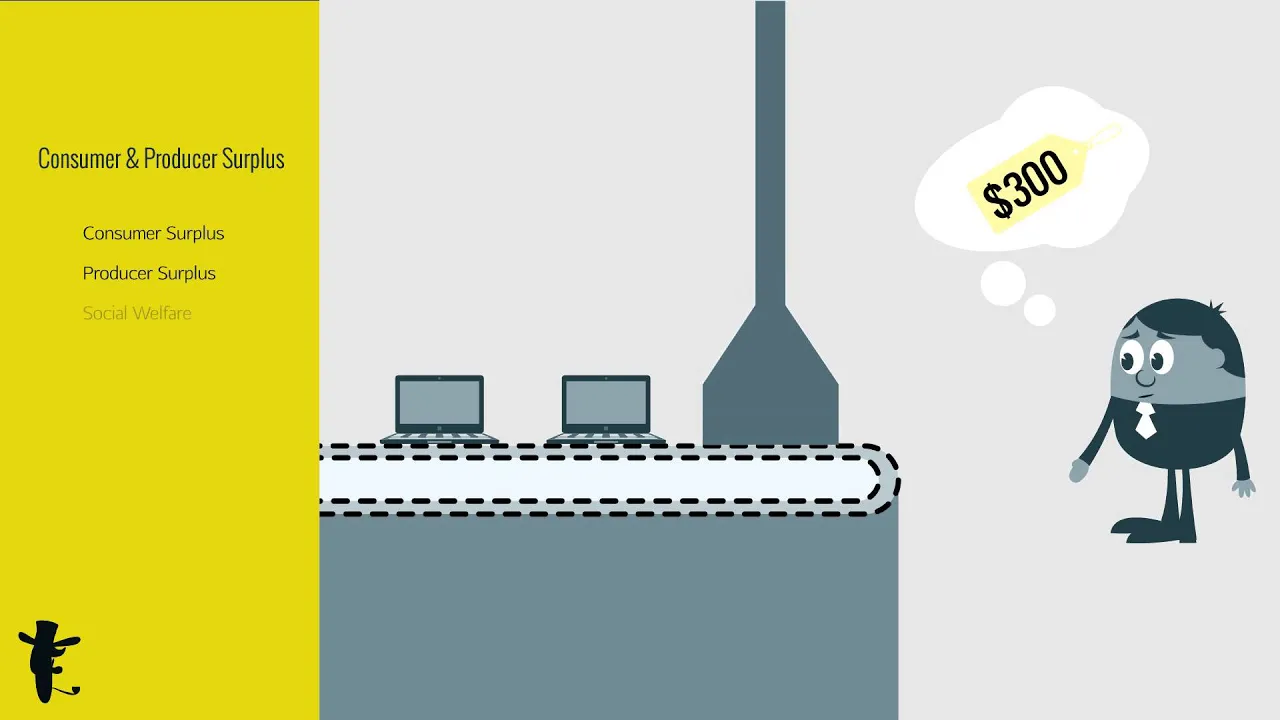
The concepts of Consumer Surplus, Producer Surplus, and Total Social Welfare.
Price Elasticity of Demand and Supply, including how to interpret elastic versus inelastic curves.
The economic analysis of tax incidence, as understanding how taxes shift curves and burdens directly translates to understanding subsidies.
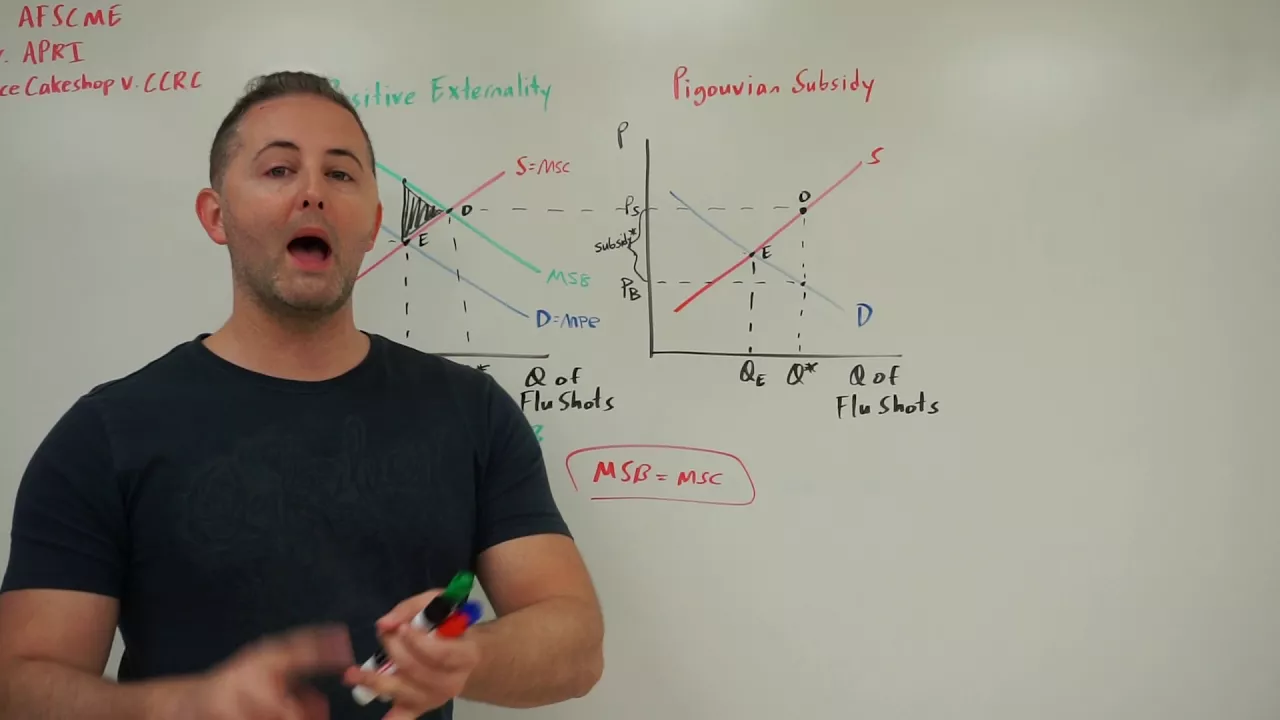
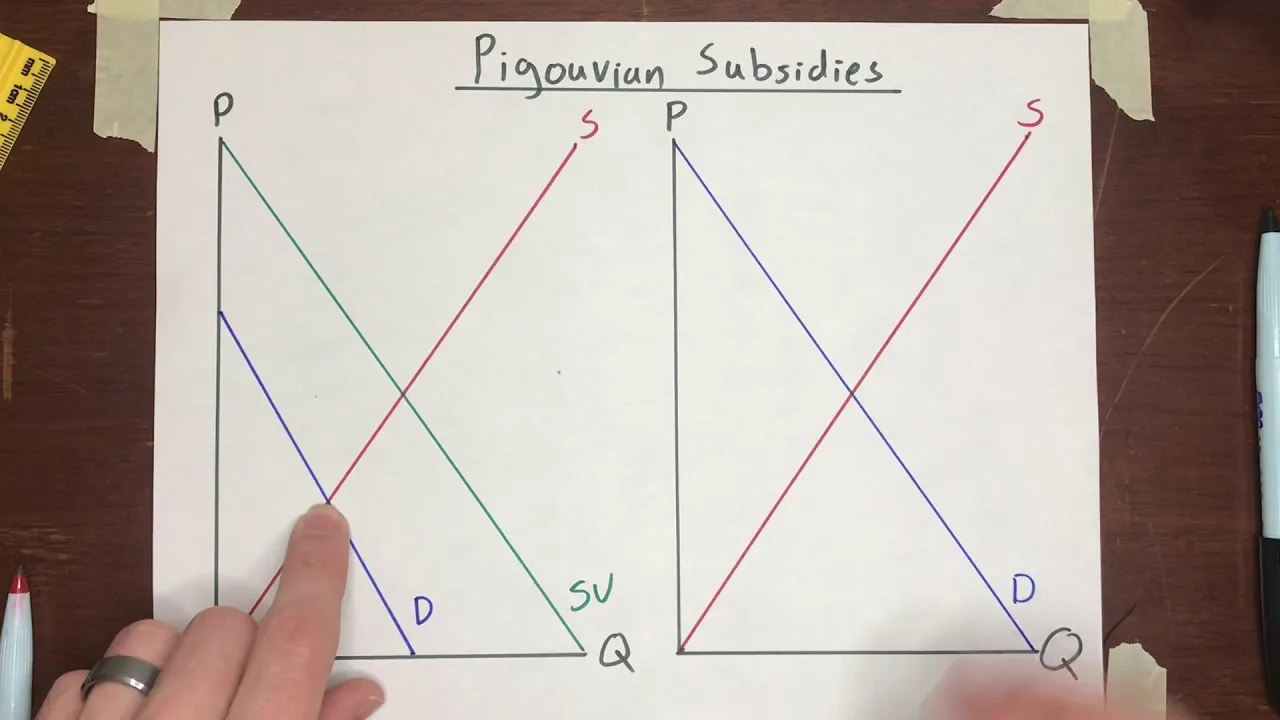
Pigouvian Subsidies: How governments use subsidies to internalize positive externalities and correct market failures.
International Trade Impacts: How domestic subsidies affect global trade dynamics, export competitiveness, and World Trade Organization (WTO) disputes.
Comparative Policy Analysis: Evaluating the welfare and deadweight loss differences between subsidies, price controls (ceilings and floors), and quotas.
Real-World Policy Evaluation: Analyzing the economic, environmental, and political consequences of agricultural, fossil fuel, or green energy subsidies.
325.4K views2.1Klikes12:31Original Release: 2015-01-28
♪ [music] ♪ - [Prof. Alex Tabarrok] Today we're going to start looking at subsidies.
We're going to move quite quickly because if you've understood the material on taxes, the material on subsidies should follow pretty easily.
However, if you haven't understood the material on taxes, this is going to be even more mysterious.
So make sure you understand taxes before we move on to subsidies.
Here we go.
Now a subsidy is really just a negative or a reverse tax.
Instead of taking money, the government gives money to consumers or producers.
Now here are some economic truths about subsidy.
Who gets the subsidy does not depend on who receives the check from the government.
Once again, the legal incidence of the subsidy -- who gets the check -- is not the same as the economic incidence.
That should always already be familiar from our discussion of taxes.
Similarly, who benefits from the subsidy does depend on the relative elasticities of demand and supply -- again, just as with taxes.
Finally, subsidies must be paid for by taxpayers, so instead of revenues, there's a cost to a subsidy.
And they create an inefficient increase in trade, also called a deadweight loss.
Let's take a look in more detail.
Okay, we have a lot to cover in this diagram so put on your thinking hats.
We begin as usual at the Market -- free market equilibrium.
Let's say that's at price of two dollars and this quantity.
Now, I'm not going to go through the proof that the legal incidence of who gets the subsidy does not influence the economic incidence.
Instead, I'm going to jump right to the key point, which is that a subsidy drives a wedge between the price received by sellers and the price paid by the buyers.
The only difference from the tax is that the price received by sellers with the subsidy is going to be more than the price paid by the buyers.
So we can use the same wedge analysis that we used before except we're going to drive the wedge into the diagram from the right hand side.
So now consider the height of this wedge -- let's suppose that's a dollar -- and let's drive it in to the diagram until the top hits the supply curve and the bottom hits the demand curve.
This is now going to tell us everything we need to know.
So at the top, at point B, this tells us the price received by sellers -- suppose that's $2.40.
The bottom, at point D, tells us the price paid by the buyers -- $1.40.
Notice that the price received by the sellers has got to be $1 more than the price paid by the buyers, the $1 coming from the subsidy.
Notice also the key idea -- it doesn't matter whether the suppliers receive the check from the government, or whether the buyers receive the check from the government.
On net, when all is said and done, the sellers will receive $2.40 per unit, and the buyers will pay $1.40 per unit.
By comparing with the free market price, we can see who is getting the relative gain from the subsidy.
In this case, both the suppliers and demanders get some of the gain.
So the suppliers used to get $2 per unit -- now they're getting $2.40, so they get 40% of the gain.
The buyers used to pay $2 -- now they're paying $1.40, so they get 60% of the gain.
Who gets the gain is going to depend upon the relative elasticities of supply and demand and you want to convince yourself of that by drawing some more diagrams like this, but draw them with a really inelastic supply curve.
See what happens.
Then draw it with a more elastic supply curve, a supply curve which is more elastic than the demand curve.
See what happens -- so test out different things.
Next, a tax creates revenues for the government -- a subsidy creates costs to the government.
What is the cost?
Well, notice that the per unit subsidy is $1 -- that's given by the height of the wedge.
What's the quantity which is subsidized?
Well, it's this quantity right here.
So the total cost of the subsidy is $1 times the quantity, or the subsidy amount times the quantity, so it's given by this blue area right here.
Finally -- got a lot to cover, but it should all be fairly standard now -- notice that what the subsidy does, another effect of the subsidy, not surprisingly, is that it increases the quantity exchanged.
So it increases it from quantity -- no subsidy -- to the quantity with the subsidy.
Now, on these additional units exchanged, notice what the supply and demand curve tells us.
It tells us that on those additional units, the cost to the suppliers of supplying those units exceeds the value to the demanders of those units.
So, this additional quantity is creating a waste.
The cost to the suppliers exceeds the value of those units to the demanders.
So the subsidy creates a deadweight loss.
There's too much trade going on, as opposed to the tax -- where the tax reduces beneficial trades, the subsidy increases wasteful trades.
Okay, take a good look at this diagram.
Make sure you understand each part of the diagram, and we're going to give some applications and give a few more ways of looking at this diagram.
But this is really the key idea -- everything in this diagram right here.
Do you remember our intuition for who bears the burden of a tax?
It's that elasticity is like escape.
So the more elastic the demand curve, the more the demanders are able to escape the tax.
The more elastic the supply curve relative to the demand curve, the more able the suppliers are to escape the tax.
Here I want to give you a similar intuition and way of reminding yourself about what happens with the subsidy.
And that is, when you have no elasticity or when you have an inelastic curve, then there's no entry.
No elasticity equals no entry.
And when there's no entry, that's when you gain the benefits of the subsidy.
When no one can come in to take the subsidy, you get the benefit.
So when there's no elasticity, no entry, you get the benefit of the subsidy.
Let's take a look.
Let's redo our tax analysis.
So suppose we have a fairly elastic demand curve and a fairly inelastic supply curve, and here's our tax wedge.
We drive it in the diagram and what we see is that the suppliers bear more of the burden of the tax.
That is, the price to them falls.
They're bearing the brunt of the tax because the suppliers have nowhere else to go.
They can't take their resources used to produce this good and use it to produce other goods in the economy.
The supply is relatively fixed, the resources are most useful for producing this particular good, so the suppliers cannot escape.
For the very same reasons, the suppliers will get most of the gains of a subsidy.
So here's our subsidy wedge -- we drive it in to the diagram.
We could read off the diagram here that the price to the suppliers is going to rise much more than the price to the buyer falls, relative to the market price.
So what's going on?
Well, what's going on is that we have this subsidy, but because the supply curve is inelastic, we don't see a lot of resources coming from elsewhere in the economy to grab up that subsidy, to take that subsidy.
The resources in the rest of the economy are not good at producing this type of good, so it's only the resources which are already in this market, the fixed resources -- they're the ones which are going to grab up the subsidy.
The price is going to go up because we don't have a lot of resources coming from other areas of the economy to produce this good.
Or we can think about this from the point of view of the demanders.
When the demand is relatively elastic, they can escape the tax.
But, similarly, when the demand is elastic, the demanders from other parts of the economy with the substitute goods, they're going to come in and grab up that subsidy.
They're going to keep the price high because demanders are going to stop consuming the substitute good, and they're instead going to move into this market to consume this good.
And because you get all of these demanders from elsewhere in the economy coming in to buy this good, the price doesn't fall very much.
Okay, once again, play around with this.
Draw some demand and supply curves, put in a tax wedge, put in a subsidy wedge until this all becomes intuitive.
And remember that, in the case of subsidies, no elastic or less elastic means less entry, less entry means more gains to the subsidy -- they get more of the benefits of the subsidy.
Let's do an application.
Farmers in California’s Central Valley get a big water subsidy.
They typically pay $20 to $30 an acre-foot for water that costs $200 to $500 an acre-foot to produce.
So who benefits the most from this subsidy?
Is it the California cotton suppliers, or is it the buyers of California cotton?
Let's think about it this way.
The buyers of California cotton -- what kind of substitutes do they have?
Are they going to have an elastic demand or an inelastic demand?
The buyers of California cotton are going to have a very elastic demand, right?
Because they can substitute cotton grown in Georgia, they can substitute cotton grown in Pakistan, in India, in many other places in the world.
In fact, the price of cotton is basically set in a world market, so if we have a subsidy for California-cotton suppliers, that's not going to push the world price down very much at all.
It's simply going to induce some buyers to buy more California cotton and a little bit less of cotton from Pakistan or from India.
On the other hand, the California cotton suppliers -- they've got a pretty inelastic supply curve.
There's not that much land there to begin with, and it's really pretty fixed for growing agricultural goods, and probably fairly fixed for growing cotton.
So, the California cotton suppliers are going to get most of the benefits of this subsidy.
It's not going to lower the price of pants at the Gap.
Instead it's going to go into the pockets of the California cotton suppliers, of the farmers.
Not surprisingly, it's the farmers in California who lobby extensively for this subsidy, and it's not the consumers of cotton.
So as we've just shown, subsidies can often be wasteful.
And one of the reasons that we have subsidies is politics -- the power of Special Interest Groups in lobbying and so forth.
We'll talk more about that another time.
However, subsidies can also be useful, particularly if there's a reason why the demand for a good understates the true value of that good.
We'll give lots of examples of this type of thing when we come to talk about externalities, but before we do that I want to give you one more example, where this should be fairly intuitive and that's wage subsidies.
So the next lecture, we'll look at wage subsidies for unskilled or lower-skilled workers and we'll compare that with the minimum wage.
Thanks.
- [Narrator] If you want to test yourself, click “Practice Questions.” Or, if you're ready to move on, just click “Next Video.” ♪ [music] ♪
Up Next

30:39
How Farm Subsidies Work: A Comprehensive Economic Guide
@griggsfarmsllc
15.3K views•2024-08-31
5:07
Impact of Yuan in Indo-Russian Trade Amid Sanctions
@WION
261.9K views•2022-07-01
7:14
Austrian Business Cycle Theory | Explaining Economic Booms and Busts
@MarginalRevolutionUniversity
106.3K views•2017-11-28

113:18
The Age of Easy Money: Fed & Inflation | Full Documentary
@frontline
21.2M views•2023-03-15
Related Study Plans & Knowledge Roadmaps
Structured learning paths in Economics
economics
Sovereign Debt: Defaults, IMF & Restructuring
01Introduction to Sovereign Debt & Government Bonds
02Debt Sustainability & Credit Ratings
03Anatomy and History of Debt Crises
+ 2 more learning modules
12h5 modules
Explore Roadmap
economics
Market Design: Matching Theory & Gale-Shapley
01Introduction to Market Design and Price-Free Markets
02Two-Sided Matching & The Gale-Shapley Algorithm
03School Choice Systems and Mechanism Design
+ 2 more learning modules
10h5 modules
Explore Roadmap
economics
Impossible Trinity: Forex, Capital & Policy
01Introduction to Monetary Policy and Central Banking
02Exchange Rates and International Capital Flows
03The Mundell-Fleming Model
+ 2 more learning modules
8h5 modules
Explore Roadmap
economics
Healthcare Economics: Market Failures & Systems
01Introduction to Healthcare Markets and Market Failure
02Asymmetric Information and Adverse Selection
03Moral Hazard and Insurance Design
+ 2 more learning modules
12h5 modules
Explore Roadmap