Healthcare Economics: Market Failures & Systems
Learning Goal: Analyze how asymmetric information, adverse selection, and moral hazard create market failures in healthcare markets, and evaluate how different national financing and insurance systems attempt to resolve them.
- Prerequisites: Basic understanding of microeconomics (supply and demand, market equilibrium, and marginal utility).
- Estimated Total Study Time: 12 hours
Module 1: Introduction to Healthcare Markets and Market Failure
This module establishes why healthcare cannot be analyzed using standard competitive market models. You will explore the foundational work of Nobel laureate Kenneth Arrow and learn how unique characteristics—such as unpredictable demand, third-party payment systems, and massive pricing opacity—prevent the "invisible hand" from achieving allocative efficiency in healthcare.
Recommended Videos
- Why this video: This video introduces the core differences between healthcare and standard consumer markets. It clearly explains why emergency situations eliminate a consumer's ability to "shop around" or compare prices, rendering standard market mechanics ineffective when patients face life-threatening conditions.
- Knowledge checkpoint:
-
- Explain why price elasticity of demand is highly inelastic during medical emergencies.
-
- Contrast purchasing decisions for consumer goods with those made for emergency medical procedures.
-
- Why this video: This video provides a structured academic framework of healthcare market failures. It focuses on the principal-agent problem (where physicians act on behalf of patients but may have conflicting financial incentives) and explains how this agency relationship disrupts market efficiency.
- Knowledge checkpoint:
-
- Define the "principal-agent problem" within the context of a doctor-patient relationship.
-
- List three primary reasons why healthcare fails to deliver socially optimal outcomes without regulatory oversight.
-

- Why this video: This concise clip highlights Kenneth Arrow’s seminal 1963 paper, which serves as the intellectual foundation of health economics. Arrow predicted that because patients cannot predict their future health status or assess the quality of medical advice, a standard free market will fail.
- Knowledge checkpoint:
-
- State Kenneth Arrow's primary thesis regarding predictability and health markets.
-
- Explain how unpredictability of illness necessitates the existence of health insurance markets.
-
Module 2: Asymmetric Information and Adverse Selection
This module analyzes the mechanics of asymmetric information—when one party in a transaction holds more relevant data than the other. You will study George Akerlof's "Market for Lemons" model and mathematically trace how hidden risk profiles drive healthy consumers out of private insurance pools, triggering the destabilizing "death spiral."
Recommended Videos
- Why this video: Delivered by MIT, this rigorous lecture translates George Akerlof’s "Lemons" concept to the dynamics of private insurance. It explains how high-risk and low-risk individuals interact with uniform premium pricing, leading to adverse selection.
- Knowledge checkpoint:
-
- Describe the difference between symmetric and asymmetric information in market transactions.
-
- Outline how asymmetric information forces insurers to price premiums based on average group risk rather than individual risk.
-
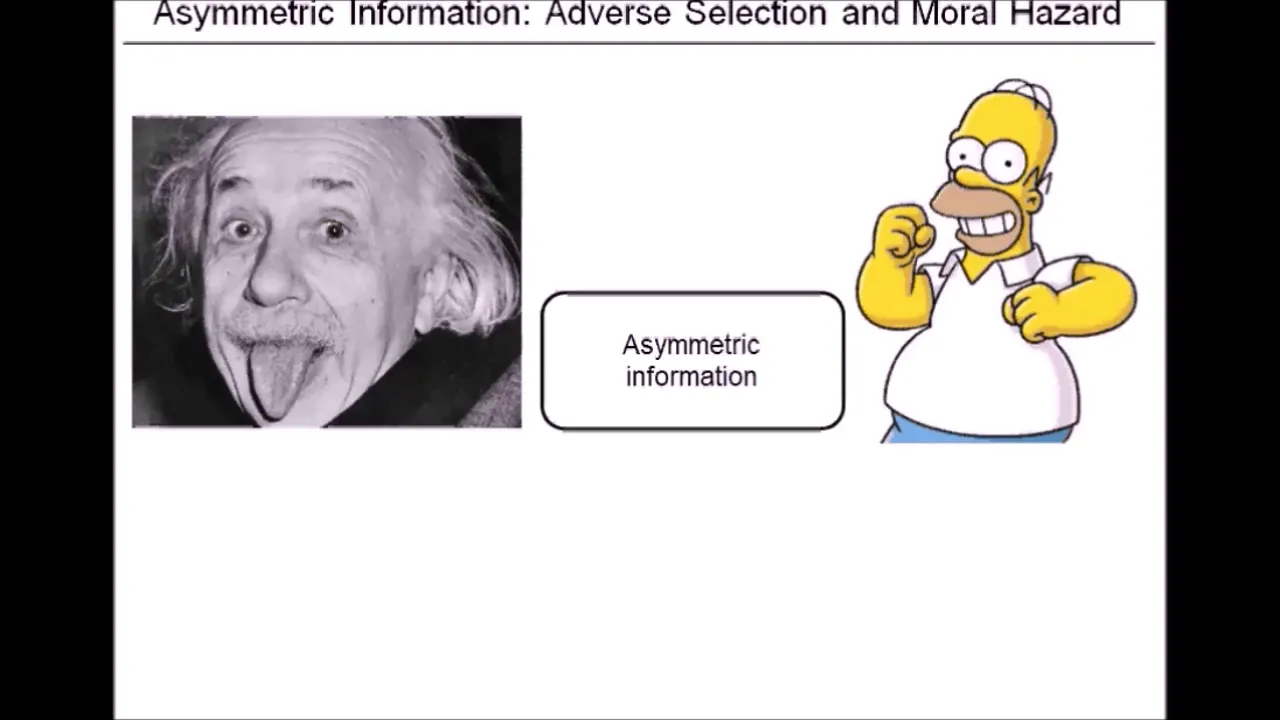
- Why this video: This educational video clearly distinguishes adverse selection from moral hazard. It highlights that adverse selection is an ex-ante (pre-contractual) problem where hidden information determines who enters the insurance pool.
- Knowledge checkpoint:
-
- Contrast ex-ante asymmetric information (adverse selection) with ex-post asymmetric information (moral hazard).
-
- Explain why high-risk individuals are systematically more motivated to purchase insurance than low-risk individuals.
-
- Why this video: This video models the mechanics of the "death spiral." It explains how the exit of healthy individuals increases average claim payouts, forcing insurers to raise premiums, which in turn drives out the next-healthiest tier of consumers.
- Knowledge checkpoint:
-
- Step-by-step, outline the positive feedback loop that constitutes an insurance "death spiral."
-
- Explain how a policy tool like an individual mandate mathematically counteracts adverse selection by altering the risk pool.
-
Module 3: Moral Hazard and Insurance Design
This module investigates how being insulated from financial risk changes consumer behavior. You will explore ex-post moral hazard (consuming more healthcare services because out-of-pocket costs are subsidized) and evaluate the microeconomic design of cost-sharing instruments designed to curb this over-consumption.
Recommended Videos

- Why this video: This video reviews the RAND Health Insurance Experiment, the most famous empirical study in health economics. It proves that individuals with zero-copay insurance plans consume significantly more medical care than those with cost-sharing plans, without showing corresponding improvements in overall health outcomes.
- Knowledge checkpoint:
-
- State the primary finding of the RAND Health Insurance Experiment regarding cost-sharing and utilization.
-
- Explain how moral hazard leads to allocative inefficiency (welfare loss) where the marginal cost of care exceeds its marginal benefit.
-
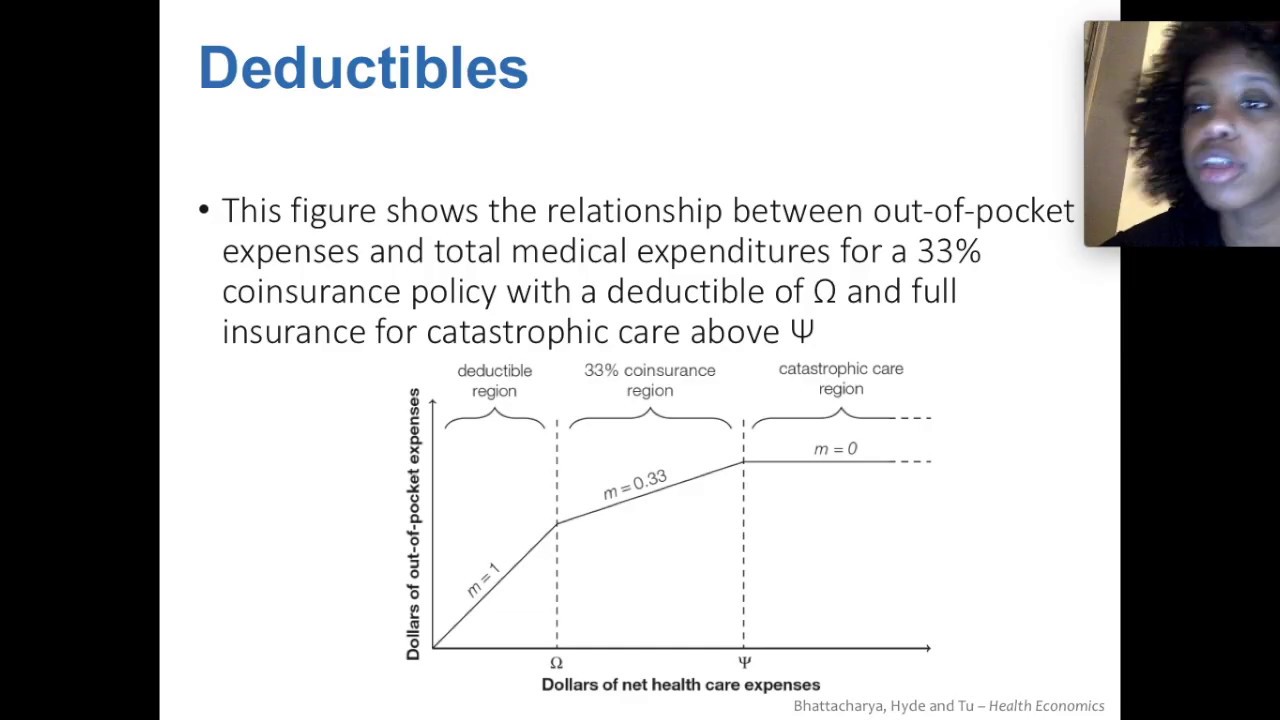
- Why this video: This lecture addresses a critical curriculum gap by providing a microeconomic explanation of cost-sharing mechanics. It details how deductibles, copayments, and coinsurance alter the consumer's budget constraint and marginal cost curve to align individual incentives with social efficiency.
- Knowledge checkpoint:
-
- Differentiate between a deductible (fixed threshold), a copayment (fixed fee per unit), and coinsurance (percentage of cost).
-
- Illustrate graphically or explain how a positive coinsurance rate (e.g., 20%) shifts the consumer's perceived price line and reduces excess demand.
-
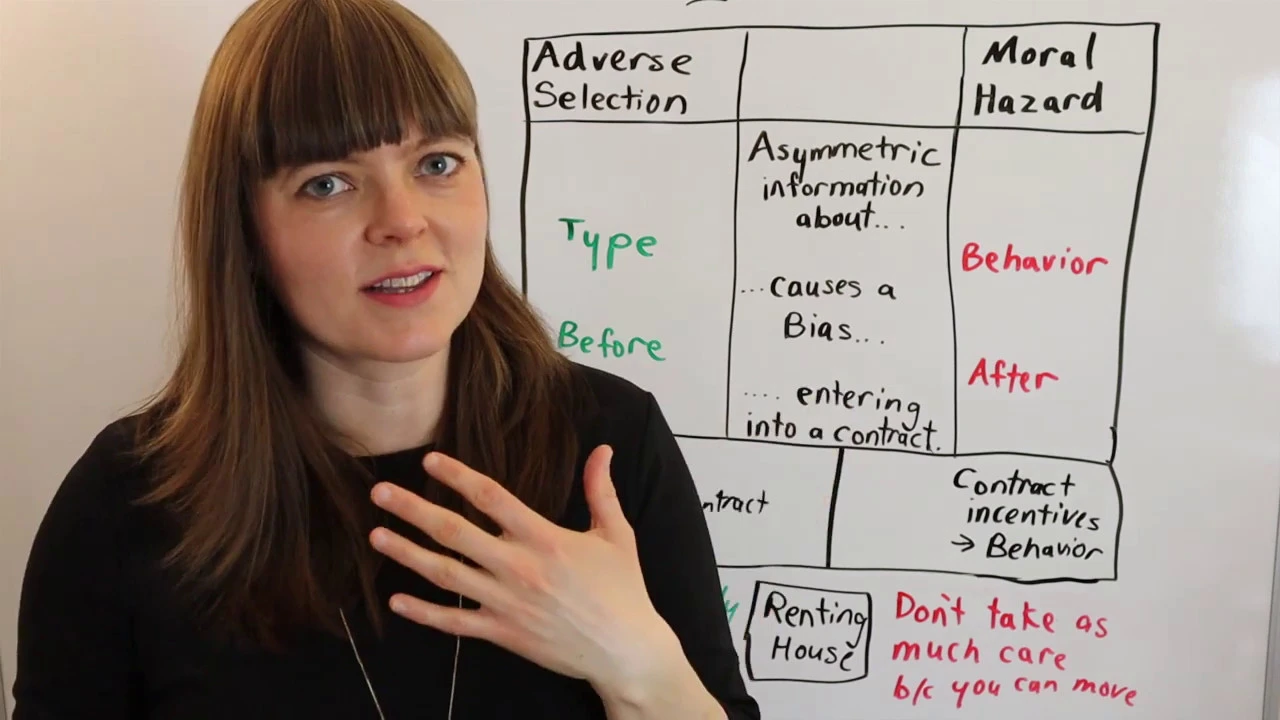
- Why this video: This academic clip uses microeconomic intuition to demonstrate how copayment structures directly influence consumer choice. It explains how zero-copay systems encourage consumers to opt for expensive, low-marginal-benefit procedures.
- Knowledge checkpoint:
-
- Explain how a zero-price signal at the point of service distorts consumer incentives.
-
- Discuss the trade-off insurers face when setting high deductibles (mitigating moral hazard vs. preventing necessary preventative care).
-

- Why this video: This video provides a thorough walkthrough of real-world insurance structures, linking theoretical concepts to practical benefit designs. It explains how these mechanisms function sequentially throughout a plan year.
- Knowledge checkpoint:
-
- Explain how an out-of-pocket maximum alters consumer behavior once it is reached.
-
- Calculate a patient's total responsibility for a 2,000 deductible, 20% coinsurance, and a $5,000 out-of-pocket maximum.
-
Module 4: Global Healthcare Models and Financing Systems
This module introduces the taxonomy of global healthcare systems. You will study and compare the four classic models: Beveridge (socialized medicine), Bismarck (social health insurance), National Health Insurance (single-payer), and Out-of-Pocket (market-driven), analyzing how different countries organize financing, delivery, and universal coverage.
Recommended Videos
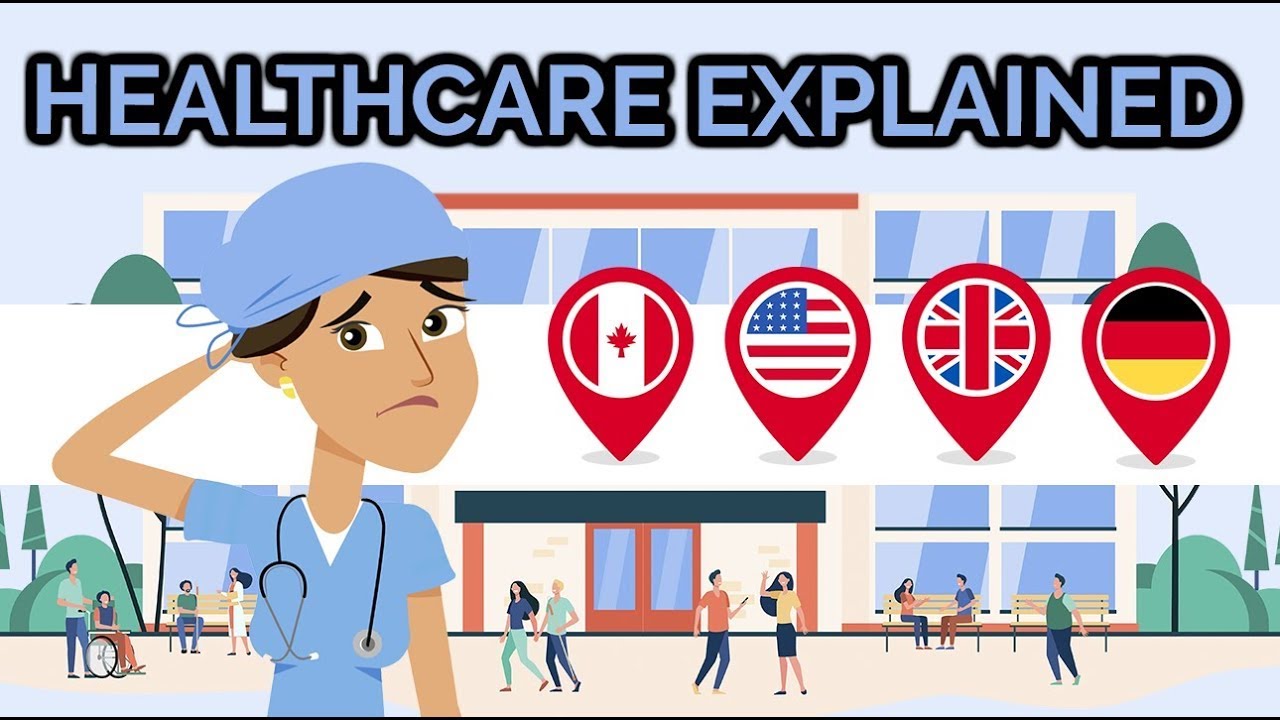
- Why this video: This video is an exceptional comparative guide. It breaks down the funding source, service delivery, and ownership structure of the four international health models, setting a clear baseline for global comparative health policy.
- Knowledge checkpoint:
-
- Compare who finances and who delivers care in the Beveridge and Bismarck models.
-
- Identify which model corresponds to the National Health Insurance (NHI) system used in Canada.
-

- Why this video: This video provides historical and structural context for the Bismarck system (originating in late 19th-century Germany). It illustrates how private, non-profit "sickness funds" can operate under tight government regulation to achieve universal coverage.
- Knowledge checkpoint:
-
- Describe the role of "sickness funds" in the Bismarck model.
-
- Explain how a Bismarck system maintains private delivery of care while guaranteeing access regardless of employment status.
-
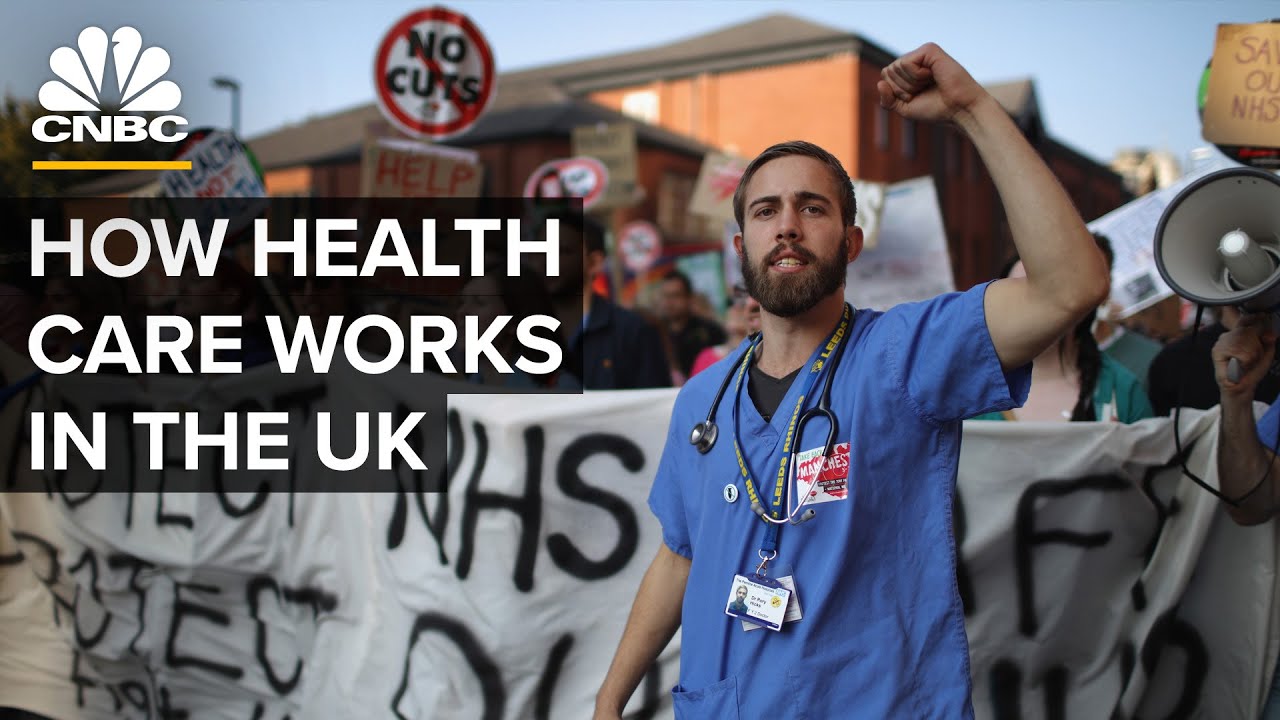
- Why this video: This case study of the United Kingdom’s National Health Service (NHS) illustrates the Beveridge model. It demonstrates how a system funded entirely by general tax revenue operates, and highlights its distinct structure compared to the mixed US model.
- Knowledge checkpoint:
-
- Explain how the UK NHS acts as both the payer and the direct employer/owner of healthcare delivery facilities.
-
- Discuss how a Beveridge system uses non-price rationing (like wait times) to manage demand, given that care is free at the point of service.
-
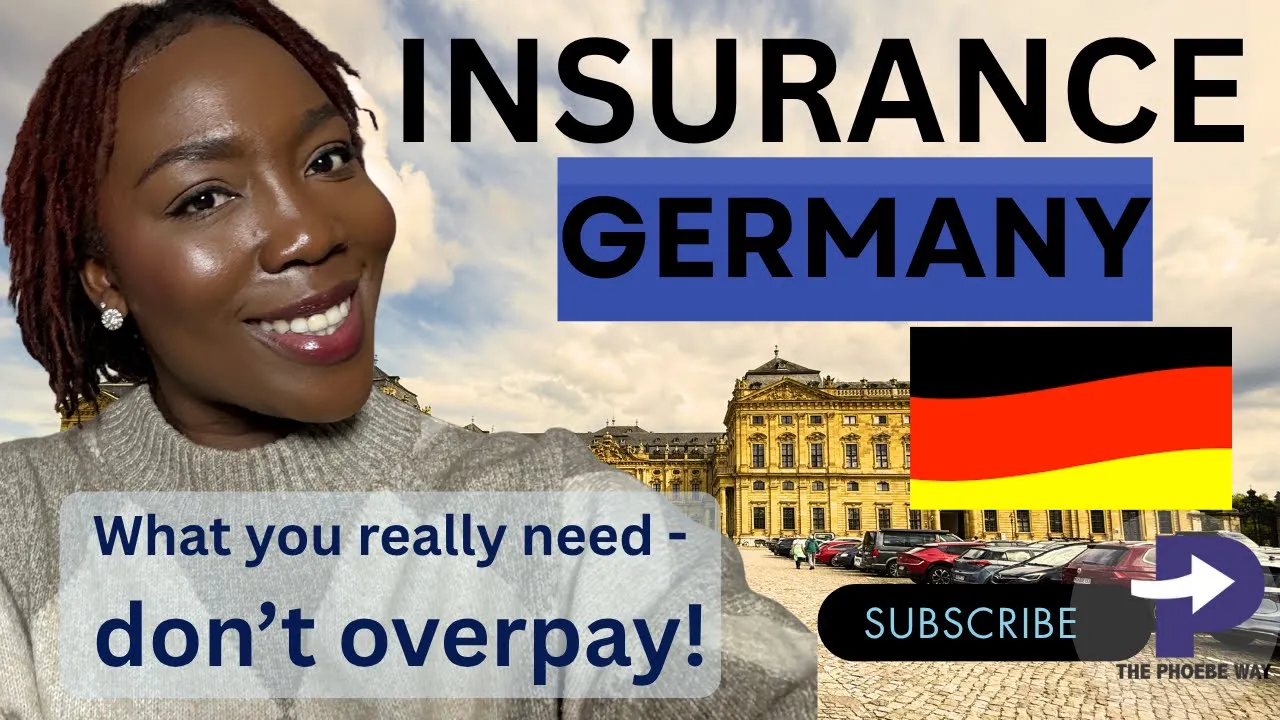
- Why this video: This video offers a practical look at how Germany’s modern Bismarck system operates, explaining the coexistence of Statutory Health Insurance (SHI) and Private Health Insurance (PHI).
- Knowledge checkpoint:
-
- Explain how payroll taxes are split between employers and employees to fund German Statutory Health Insurance.
-
- Describe who is eligible to opt out of public SHI and choose private PHI in Germany.
-
Module 5: Evaluating Policy Trade-offs and the Iron Triangle
This module introduces a non-partisan framework to evaluate health policy: the Iron Triangle of Healthcare (Access, Quality, and Cost). You will analyze why a system cannot optimize all three dimensions simultaneously and evaluate how different national systems manage these trade-offs to address market failures.
Recommended Videos

- Why this video: This video introduces William Kissick’s "Iron Triangle" framework. It explains how any health policy intervention that improves access or quality inevitably places upward pressure on costs, requiring systems to make deliberate structural trade-offs.
- Knowledge checkpoint:
-
- Define the three vertices of the Iron Triangle of Healthcare.
-
- Explain why a policy to increase access (e.g., universal coverage) can lead to either higher costs or reduced quality/wait times.
-

- Why this video: This non-partisan discussion examines how state and national policies balance affordability and patient safety. It avoids political rhetoric to focus on the economic trade-offs of regulatory standards.
- Knowledge checkpoint:
-
- Give an example of a policy designed to improve quality that inadvertently increases administrative costs.
-
- Discuss the trade-offs of using government intervention to regulate hospital and drug pricing.
-

- Why this video: This video introduces the policy tools used to control moral hazard on the supply side, such as Cost-Effectiveness Analysis (CEA). It explains how governments and insurers decide which treatments are cost-effective enough to cover.
- Knowledge checkpoint:
-
- Explain how Cost-Effectiveness Analysis (CEA) functions as a supply-side constraint on healthcare expenditures.
-
- Discuss the ethical and economic trade-offs of rationing care based on cost-per-benefit calculations.
-
Course Map
This map outlines the structured pathway of your learning journey:
Key People Index
- Kenneth Arrow (1921–2017): Nobel laureate whose 1963 paper established health economics as a distinct field. He demonstrated that uncertainty and informational asymmetry make healthcare markets fundamentally different from competitive consumer markets.
- George Akerlof (1940–Present): Nobel laureate who developed the "Market for Lemons" model (1970). His work shows how asymmetric information can degrade product quality within a market and lead to complete market failure.
- William Beveridge (1879–1963): British economist who authored the 1942 Beveridge Report. His ideas led to the creation of the UK's National Health Service (NHS), establishing a healthcare model funded by progressive taxation and delivered by government-owned providers.
- Otto von Bismarck (1815–1898): Prussian Chancellor who established the world's first modern social insurance system in 1883. His multi-payer model relies on joint employer-employee payroll contributions to fund non-profit "sickness funds."
- William Kissick (1932–2013): Academic and author of Medicine's Dilemmas: Infinite Needs, Finite Resources. He formulated the "Iron Triangle of Healthcare," demonstrating the inherent trade-offs between access, quality, and cost containment.
Final Self-Assessment
Complete this comprehensive self-assessment to verify your mastery of the curriculum's learning objectives:
- Market Failure: Can you explain three distinct economic reasons why healthcare cannot achieve Pareto efficiency under a completely unregulated free market?
- Arrow’s Thesis: Can you explain how the dual uncertainties of when illness occurs and which treatment will work necessitate non-market institutions?
- Asymmetric Information: Can you contrast the buyer-seller dynamic in a health insurance transaction and identify who holds the information advantage?
- The Lemons Problem: Can you map George Akerlof's used-car lemons model directly onto a private health insurance market with unregulated premium pricing?
- Death Spiral: Can you write a step-by-step description of the feedback loop that leads to the collapse of an insurance pool?
- Moral Hazard: Can you explain why price-subsidized medical care causes a welfare loss where the marginal cost of production exceeds the marginal consumer benefit?
- Cost-Sharing Mechanics: Can you mathematically and graphically explain how a deductible, copayment, and coinsurance each work to shift incentives and curb excess consumption?
- RAND Experiment: Can you cite the main empirical takeaway of the RAND Health Insurance Experiment regarding the relationship between cost-sharing, utilization, and health outcomes?
- Comparative Models: Can you list the four global health models, identify the primary financing source for each, and name a country that utilizes each model?
- Bismarck vs. Beveridge: Can you explain the difference between Germany's sickness funds and the United Kingdom's NHS in terms of ownership of clinical facilities and employment of physicians?
- The Iron Triangle: Can you explain why any reform designed to expand access will inevitably compromise quality or increase costs within William Kissick's model?
- Supply-side Controls: Can you evaluate how cost-effectiveness analysis (CEA) and waitlists are used to manage resource allocation in systems where care is free at the point of service?