























The Austrian School of Economics, developed by Ludwig Mises and Friedrich Hayek, argues that central bank manipulation of interest rates distorts market price signals, causing entrepreneurs to make malinvestments that eventually lead to economic busts; when central banks artificially lower interest rates through inflationary credit expansion, investments appear more profitable than they actually are, creating a boom followed by a painful correction as these misallocated resources are liquidated.
Austrian Business Cycle Theory | Explaining Economic Booms and Busts
Added:Fundamental concepts of macroeconomics, specifically the traditional phases of the business cycle (expansion, peak, contraction, and trough).
The role of central banks, monetary policy, and how interest rates are manipulated to influence economic activity.
The loanable funds market and how interest rates function as a price signal reflecting society's collective time preference.
Basic supply and demand dynamics and how market prices coordinate resource allocation among producers and consumers.
A comparative analysis of business cycle theories, contrasting the Austrian explanation with Keynesian, Monetarist, and Real Business Cycle (RBC) models.
An in-depth study of capital theory and 'Hayekian Triangles' to understand how artificial credit expansion distorts the stages of production.
Historical case studies of major economic events, such as the Great Depression or the 2008 Great Recession, analyzed through the lens of Austrian Business Cycle Theory.
The economic debate surrounding alternatives to discretionary central banking, such as free banking, nominal GDP targeting, or the gold standard.
106.3K views1.8Klikes7:14Original Release: 2017-11-28
♪ [music] ♪ - [Tyler] The Austrian School of Economics has come up with its own approach to business cycles, and the most important proponents here are Ludwig Mises and Nobel Laureate Friedrich Hayek.
Now, the Austrian School of Economics, more generally, it emphasizes market price signals and how those price signals communicate decentralized information to entrepreneurs.
The Austrian theory of the business cycle postulates how central banks might distort those price signals, and give rise to a cycle of boom and then bust.
So the basic scenario is this -- imagine a central bank, and that central bank sets out and increases the rate of inflation.
For the Austrians, this is very often a bad idea.
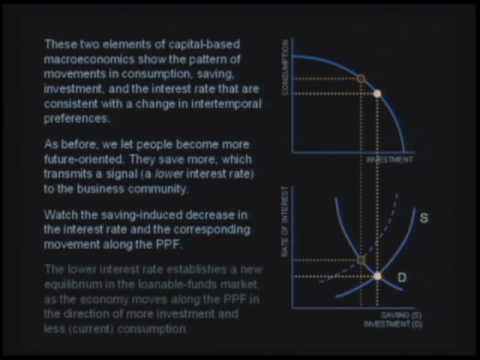
There's new credit put into the system, and that lowers market rates of interest.
But the Austrians stress the point that this lower rate of interest and the extra credit -- they're not market phenomena.
It's due to the results in the plans of the central bank.
So imagine, at an interest rate of 5%, an entrepreneur might think, "There's a whole bunch of investment projects, and they're not worthwhile if I have to borrow and pay 5%."
But if that interest rate falls 3%, 2%, 1%... all of a sudden, a lot of those investments will look more profitable.
So more homes will be built; more factories will be built.
But the thing is, they're not actually more profitable.
They just seem more profitable at first because, according to the Austrians, the market price signal has been distorted.
That's the boom part of the business cycle.
So imagine a comparison.
Let's say the central bank had not done anything, but consumers had saved more.
Well, that would lower interest rates.
Interest rates would be lower, but there would also be more consumer savings.
The difference when the central bank lowers interest rates is you have the lower rate but not the increase in consumer savings.
So the savings of the economy are actually not geared to support this extension of long-term investment goods.
Over time, those investments will be what the Austrians call "self-reversing."
It will be revealed eventually -- the demand for homes -- it's not that high.
The demand for what that factory was producing -- it's not that high.
Maybe consumers instead want to buy ice cream and bananas, other shorter-term goods.
As those long-term investments turn out to be unprofitable, they are liquidated, workers are laid off, and that is the best part of the boom-bust business cycle.
What are potential examples?
Well, many Austrian economists have argued that very early in the 21st century, the Federal Reserve was too easy with credit.
This encouraged too many mortgages and too much investment in homes, and that may have been a factor behind the real estate bubble of the 2008 crisis.
So you look, for instance, at the economic problems in the eurozone.
After the euro was introduced, many investors thought that lending money to Greece was, in effect, as riskless as lending money to Germany.
There was an implied governmental guarantee from the European Union itself -- at least that's how it was perceived.
So too many investors lent too much money to Greece.
That later turned out to be a malinvestment.
Again, this is not exactly the classic Austrian theory, but it's still a case where government intervention sent some of the wrong price signals.
So what's the Austrian solution?
Well, typically, Austrians favor a relatively small role for government because they see markets as working relatively well and governments as distorting market price signals.
A lot of Austrians have also argued for relatively tight money, and they don't want the central bank to be trying to stimulate the economy with more credit or lower interest rates.
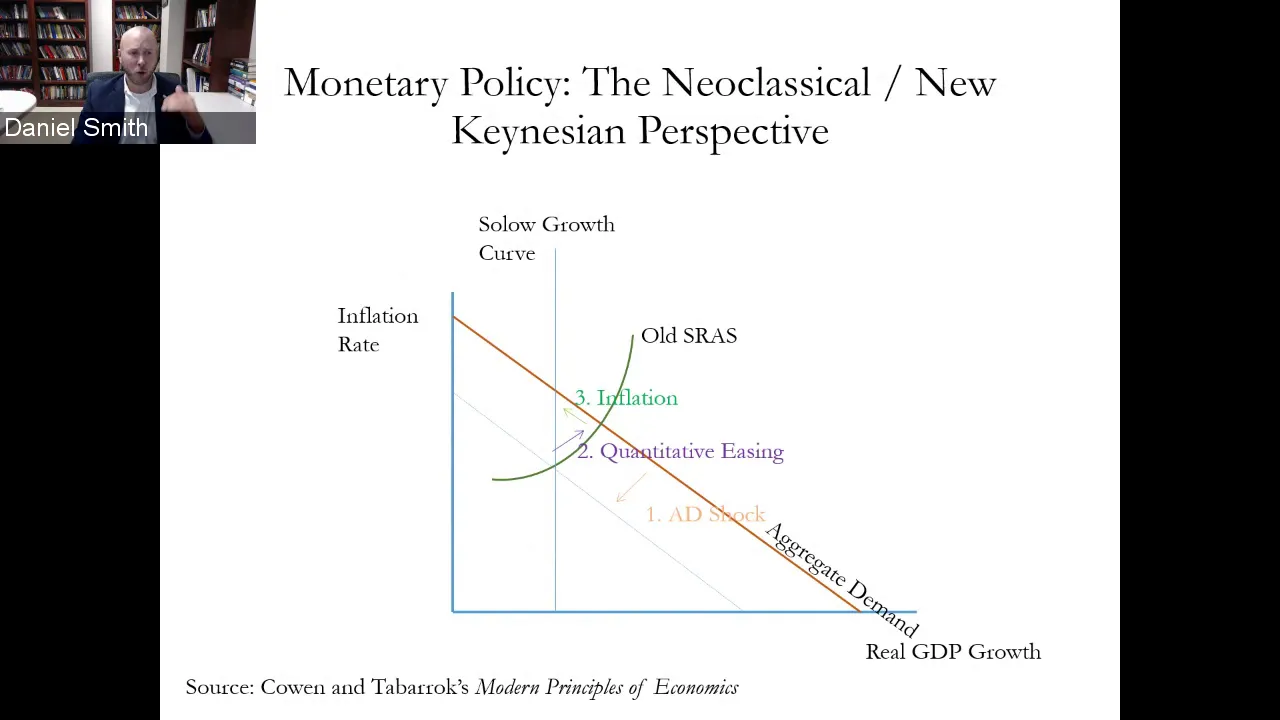
Okay, so how might we graph the Austrian theory in terms of an aggregate demand-- aggregate supply diagram?
This is a little complicated, but here's one way that you could capture at least some of the Austrian element.
When the boom comes, think of the aggregate demand curve as shifting out and to the right.
That's the economic stimulus.
At first, output goes up, but those new investments -- precisely because they're not well matched to what consumers really want -- in the longer term the economy is poorer; the economy is less productive.
So, over time, think of the long-term aggregate supply curve as shifting back and toward the left.
When you put those two developments together, what you'll see is that in the longer run, output is lower, as you could indicate by this point here, C' Once the economy adjusts, you'll have had a wasteful boom and a costly process of correction.
And that move back to C' because of the mismatch of what is produced and what consumers want?
Well, that's the bust.
Okay, so what are some possible problems with the Austrian theory?
First, the Austrians don't quite explain why so many smart market entrepreneurs are so tricked by the central bank and the increase in the money supply.
Interest rates are lower.
Well, so what!
A lot of entrepreneurs know that central banks manipulate interest rates all the time.
The entrepreneurs might just think, "Hmm, I should wait, or I should just make up my own mind.
Let's not be fooled this time around."
The second problem in the Austrian theory -- why is the downturn, why is the bust so painful?
Let's say the economy built more investment goods, and then it doesn't finish all those projects.
It switches back to consumption goods.
Why does there have to be so much unemployment?
It seems here that the Austrian theory may have to rely on some Keynesian or monitorist mechanisms of sticky wages, sticky prices, falling aggregate demand, or other ideas.
Finally, many versions of the Austrian story, they imply that consumption and investment -- they tend to move in opposite directions.
So, think back to the Austrian boom.
When the boom starts, there's a greater production of investment goods and less money being spent on producing consumer goods -- that's the Austrian model.
But when we look at the actual data, we find more co-movement.
That is, the production of investment goods and consumer goods tends to move together.
And that's an outcome not exactly matching the predictions of Austrian theory.
So, to sum up, I would say this -- the Austrian account is not a mainstream account, and probably most economists wouldn't agree with it.
There are still many economists who believe in the Austrian theory, and it may, in fact, explain some features of business cycles, but it still remains to be seen whether it can be a more fundamental explanation.
- [Narrator] You're on your way to mastering economics.
Make sure this video sticks by taking a few practice questions.
Or, if you're ready for more macroeconomics, click for the next video.
Still here?
Check out Marginal Revolution University's other popular videos.
♪ [music] ♪
Up Next

3:26
Hayek's Insight: How Prices Convey Information in Markets
@FraserInstitute
70.2K views•2015-06-12

5:07
Impact of Yuan in Indo-Russian Trade Amid Sanctions
@WION
261.9K views•2022-07-01
12:31
Subsidies Explained: Incidence, Elasticity & Deadweight Loss
@MarginalRevolutionUniversity
325.4K views•2015-01-28

113:18
The Age of Easy Money: Fed & Inflation | Full Documentary
@frontline
21.2M views•2023-03-15
Related Study Plans & Knowledge Roadmaps
Structured learning paths in Economics
economics
Sovereign Debt: Defaults, IMF & Restructuring
01Introduction to Sovereign Debt & Government Bonds
02Debt Sustainability & Credit Ratings
03Anatomy and History of Debt Crises
+ 2 more learning modules
12h5 modules
Explore Roadmap
economics
Market Design: Matching Theory & Gale-Shapley
01Introduction to Market Design and Price-Free Markets
02Two-Sided Matching & The Gale-Shapley Algorithm
03School Choice Systems and Mechanism Design
+ 2 more learning modules
10h5 modules
Explore Roadmap
economics
Impossible Trinity: Forex, Capital & Policy
01Introduction to Monetary Policy and Central Banking
02Exchange Rates and International Capital Flows
03The Mundell-Fleming Model
+ 2 more learning modules
8h5 modules
Explore Roadmap
economics
Healthcare Economics: Market Failures & Systems
01Introduction to Healthcare Markets and Market Failure
02Asymmetric Information and Adverse Selection
03Moral Hazard and Insurance Design
+ 2 more learning modules
12h5 modules
Explore Roadmap