Prices serve as a mechanism for conveying dispersed information throughout an economy, allowing individuals to make optimal decisions without needing comprehensive knowledge of market conditions; when supply decreases (such as due to bad weather affecting coffee crops), prices rise and signal consumers to seek alternatives, enabling efficient resource allocation through price adjustments rather than centralized coordination.
Hayek's Insight: How Prices Convey Information in Markets
Added:Deep Dive
Basic concepts of supply, demand, and market equilibrium.

What is Market Equilibrium? | Macroeconomics 5 of 31 | Study Hall
5.7K
The laws of supply and demand describe how quantity demanded decreases when prices rise (consumers want to spend less) while quantity supplied increases (businesses seek more profit). When prices drop, firms produce less but demand rises. Market equilibrium occurs where supply equals demand—the price where everything sells and no one goes empty-handed. Economists use notation D1 for demand curves and S1 for supply curves, with P1 representing equilibrium price and Q1 representing equilibrium quantity. This framework allows application across all products and industries.
Click to watch →

FIN 505: BUSINESS ECONOMICS
208
Supply represents suppliers' willingness and ability to offer goods, with the Law of Supply stating a positive price-quantity relationship. Key determinants include production costs, future price expectations, and number of suppliers. Demand represents buyers' willingness and ability, with the Law of Demand stating an inverse price-quantity relationship. Market equilibrium occurs where demand and supply curves intersect, where quantity demanded equals quantity supplied. Market forces push prices toward equilibrium - above equilibrium creates excess supply (surplus) with downward pressure; below equilibrium creates shortage (excess demand) with upward pressure. The equilibrium price is also called the market clearance price. A shift in supply alone does not determine the new equilibrium price - demand must also be considered.
Click to watch →

Introduction to Economics | Unit 2 Part 4 | Market Equilibrium | Economics 101 | Basic Economics
238.4K
This section establishes the core concepts of market economics. Demand represents willingness and ability to buy, while supply represents willingness and ability to sell. The law of demand shows inverse relationship between price and quantity demanded, while the law of supply shows direct relationship. These relationships create downward-sloping demand curves and upward-sloping supply curves. Market equilibrium occurs where these curves intersect, meaning quantity demanded equals quantity supplied. At equilibrium, the market clears with no surplus or shortage, establishing the foundation for understanding how markets function and reach balance.
Click to watch →
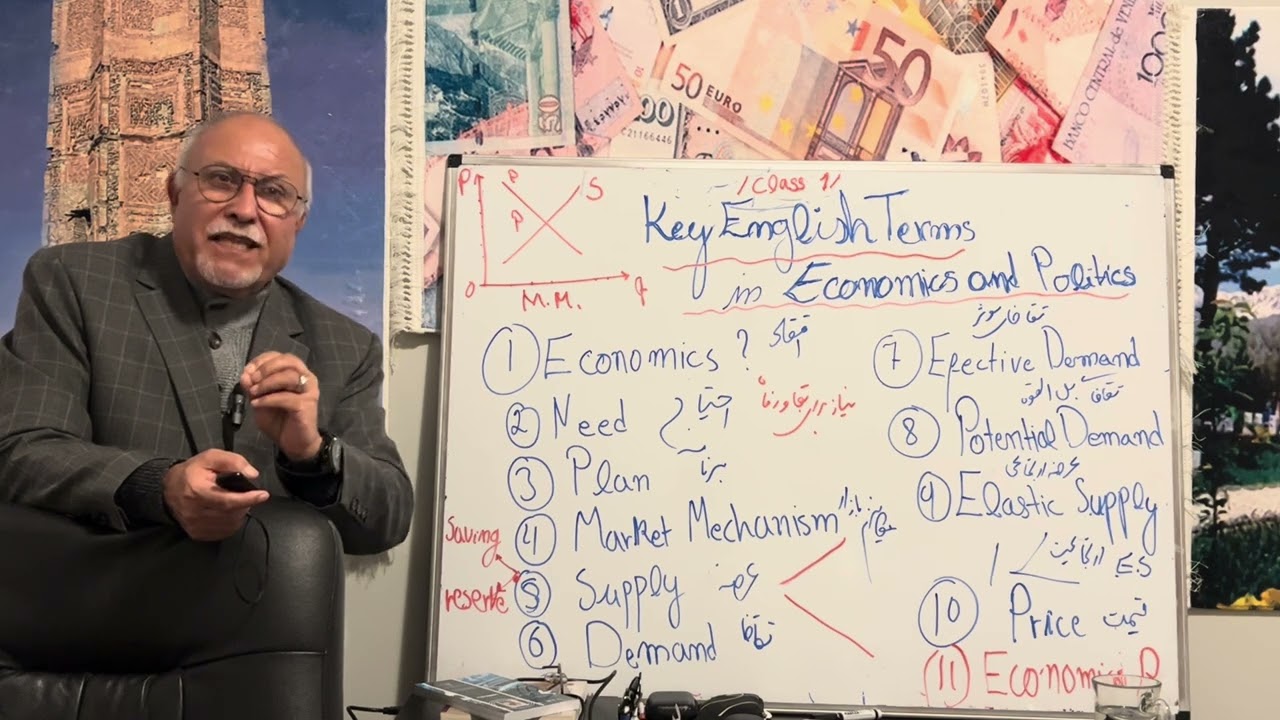
جلسه اول - اصطلاحات كليدي اقتصادي سياسي ،كانادا وانكوور چيليواك ٨ نوامبر ٢٠٢٤ ميلادي ١٤٠٣ خورشيدي
1.1K
Supply (عرضه) is the quantity of goods available for sale at a particular price, time, and location. Demand (تقاضا) is the quantity consumers want to purchase at a particular price, time, and location. The interaction between supply and demand determines market prices. When supply increases while demand remains constant, prices decrease. When demand increases while supply remains constant, prices increase. When both increase proportionally, prices remain unchanged. Effective demand (تقاضای مؤثر) is demand backed by purchasing power and actually occurs in the market, influencing prices. Potential demand (تقاضای بالق) is desire without financial means. Only effective demand affects market prices.
Click to watch →

Oferta, Demanda y Mercado II
964
Supply and demand are the two fundamental forces that make markets function. Families (consumers) represent demand, while producers (companies) represent supply. The determinants of demand include: price of the good, consumer income, prices of related goods (substitutes and complements), consumer tastes and preferences, expectations, and number of buyers. Substitutes satisfy the same need (e.g., Coca-Cola and Pepsi), while complements are consumed together (e.g., coffee and sugar). The Law of Demand states that, ceteris paribus, higher prices lead to lower quantities demanded, resulting in a demand curve with negative slope. The determinants of supply include: price of the good, prices of factors of production, technology, expectations, and number of sellers. The Law of Supply states that, ceteris paribus, higher prices lead to higher quantities supplied, resulting in a supply curve with positive slope. Market equilibrium occurs when supply equals demand, determined by the intersection of the demand curve (negative slope) and supply curve (positive slope). At equilibrium, the market clears with no shortage or surplus. When price exceeds equilibrium, excess supply (surplus) exists, causing prices to fall. When price falls below equilibrium, excess demand (shortage) exists, causing prices to rise. Comparative statics analysis compares two equilibrium states through a three-step process: determine whether an event affects demand or supply, determine how it shifts the curve, and compare initial and final equilibria.
Click to watch →
Deep Dive
The fundamental differences between market-based economies and centrally planned (command) economies.
Plus Two Economics - Short Essay Question Prediction 100% Sure Questions.. | Xylem Plus Two Commerce
28.8K
The key differences between market economy and centrally planned economy are: (1) Ownership - in market economy, ownership is by private individuals and private agencies, while in centrally planned economy, ownership is by the government (socialist), (2) Motivation - market economy operates on profit motive, while centrally planned economy focuses on social welfare, (3) Price mechanism - market economy uses price mechanism for resource allocation, while centrally planned economy uses planning mechanism.
Click to watch →

Y1 37) Economic Systems - Market, Command and Mixed Economies
135.7K
Market economies feature private ownership of resources with allocation determined by market mechanisms, driven by profit maximization incentives. Command economies involve government control over all resources, with decisions made to maximize social welfare. Key differences include: freedom of choice is high in markets but low in commands; competition exists in markets but not in commands; variety and quality of goods are higher in markets due to profit incentives; and government intervention is minimal in markets versus maximal in commands. These structural differences create distinct outcomes in how resources are allocated and economic decisions are made.
Click to watch →

economics important question answer for 12th board exam
693
The key differences between market economy and command economy are: (1) In market economy, demand and supply forces have complete dominance, while in command economy, they have limited dominance; (2) Market economy has private ownership of production, while command economy has government ownership; (3) Market economy produces for profit, while command economy produces for social welfare; (4) Market economy has no government intervention in production decisions, while command economy involves government intervention; (5) Market economy has consumer sovereignty, while command economy restricts consumer sovereignty; (6) Market economy allows capital accumulation, while command economy restricts it. Examples of market economies include USA, France, Japan, while command economies include China and former Soviet states.
Click to watch →

Unit 01 - Focus Area 03 - Economic Systems - Arshad Ismail - AL Economics
2K
The main differences between market and command economies include: (1) Resource allocation mechanism - market uses price mechanism, command uses planning mechanism; (2) Ownership of resources - market has private ownership, command has government ownership; (3) Economic goals - market focuses on profit and efficiency, command focuses on social welfare and equality; (4) Competition - market has high competition, command has low competition; (5) Consumer sovereignty - market has high consumer choice, command has limited consumer choice; (6) Government role - market has limited government intervention, command has extensive government control.
Click to watch →

MİKRO İKTİSAT TEMEL KAVRAMLAR SORU ÇÖZÜMÜ - 11
5K
A market economy (capitalist system) features free buyers and sellers, price mechanism functioning, and minimal government intervention. Prices emerge from supply-demand intersection, not firm decisions. The government provides only basic services like security and justice. In contrast, a command economy features state dominance, central planning, and mandatory economic directives. Key differences include: market economies have no central plans while command economies use central planning; market economies have low government pay while command economies have high state control; market economies allow private ownership while command economies restrict it. Examples of command economies include historical Soviet Russia and North Korea.
Click to watch →
Deep Dive
The economic problem of scarcity and how societies decide to allocate limited resources.

FACTOR OF PRODUCTIIN, PART 1, ECONOMICS CLASS 10 ICSE, BACKBENCHERS ACADEMY#MAYANK SIR|FULL CLARITY|
2.1K
Economics is the study of how scarce resources are allocated to satisfy unlimited human wants. Scarcity means resources are limited relative to demand. This creates allocation challenges - societies must decide how to distribute limited resources among competing uses. For example, land must be allocated for agriculture, forests, housing, and industry. The fundamental economic problem is making optimal choices when resources cannot satisfy all wants.
Click to watch →

🔴 CCE Group B Mains Live Online Batch | Demo Lecture 4 | Economics | Patiya
2.5K
The fundamental economic problem is scarcity - the gap between unlimited wants and limited resources. Resources are limited but human wants are unlimited, and resources have alternative uses. This creates the need for choice and allocation decisions. The economic problem requires societies to answer three fundamental questions: (1) What to produce? (2) How to produce? (3) For whom to produce? These decisions are made through market mechanisms, government planning, or a combination of both.
Click to watch →

#5 What is Production Possibility Frontier? | PPF Introduction Class 12 | CUET Economics 2026| Ch 1
1.3K
Scarcity is the fundamental economic problem where resources are limited while human wants are unlimited. This forces societies to make choices about resource allocation. The central economic problems include: what to produce, what quantity to produce, how to produce (technology choice), and for whom to produce. Resources have alternative uses, meaning they can be allocated to different purposes. For example, limited milk can be used to make coffee, sweets, or cheese, but not all simultaneously. The allocation decision determines which combination of goods and services can be produced.
Click to watch →

NB1. Top 10 Basic Concepts of Economics (Macro / Micro)
10.1K
Scarcity is an economic problem resulting from the limited nature of economic resources or factors of production. The four main economic resources are land (natural resources), labor, capital (tools, machines, factories), and entrepreneurship. Every society must determine how to allocate these scarce resources. In market economies, markets through the laws of supply and demand allocate resources. In command economies, central planners make allocation decisions. In traditional economies, tribal chiefs and customs determine resource allocation.
Click to watch →

ECO403_Lecture01
48.7K
Scarcity is the fundamental economic problem where available resources are limited while human wants are unlimited. At the individual level, people have limited income but unlimited desires for goods and services. At the societal level, natural resources, labor, and other resources are limited. This scarcity forces individuals and societies to make choices about how to allocate resources efficiently to maximize output and satisfy the most important needs first. Economics provides principles for managing scarce resources effectively.
Click to watch →
Deep Dive
How individual incentives guide consumer purchasing decisions and producer behavior.

Why Do People Like Free Markets?
90.9K
People respond predictably to both positive and negative incentives. Positive incentives are hopes of reward, while negative incentives are fears of penalty. For example, consumers buy more in response to lower prices (positive incentive) and buy less in response to higher prices (negative incentive). Producers also respond to incentives, such as a restaurant switching from selling food to selling smoothies if it can make more profit.
Click to watch →

Testimonios. Nº1. Dr. José Esquinas Alcázar.
679
Consumption is not a neutral act. When consumers choose specific products, they either incentivize or disincentivize certain production types. This includes supporting either agribusiness models or production systems oriented toward human health and wellbeing. Consumers must be aware that their purchasing decisions shape the food system.
Click to watch →

Microeconomics | Chapter-01 | Part-02| BBA | UNS | University of Scholars
296
An incentive is something that induces a person to act—either a reward or punishment. Rational people respond to incentives by comparing costs and benefits. When apple prices rise, consumers eat fewer apples while producers harvest more. Gas price increases drive consumers toward hybrid cars. Cigarette tax increases reduce smoking. Samsung responded to Apple's separate accessory strategy by creating its own accessory products, increasing revenue. Public policy makers must consider how policies affect incentives, as policies that ignore incentive effects often face unintended consequences. Small changes in incentives can produce large behavioral changes, making incentive analysis crucial for understanding market economies and designing effective policies.
Click to watch →

ECO403_Lecture02
17.3K
People respond to incentives. When incentives change, individuals adjust their behavior accordingly. For example, an increase in apple prices serves as a positive incentive for producers to grow more apples (by hiring more labor and expanding orchards) but as a negative incentive for consumers to reduce apple consumption (by switching to substitute fruits).
Click to watch →

Examen economie - Consumenten -en producentensurplus I Digistudies (Havo/Vwo)
1.2K
Consumers and producers have different economic incentives in a market. Consumers strive to maximize their consumer surplus, which means they want the difference between what they are willing to pay and what they actually pay to be as large as possible. Producers strive to maximize their producer surplus, meaning they want to receive as much money as possible for their products while still being willing to sell at lower prices. These incentives drive market behavior and efficiency.
Click to watch →
Prerequisite Knowledge
- Concept 01Basic concepts of supply, demand, and market equilibrium.
- Concept 02The fundamental differences between market-based economies and centrally planned (command) economies.
- Concept 03The economic problem of scarcity and how societies decide to allocate limited resources.
- Concept 04How individual incentives guide consumer purchasing decisions and producer behavior.
Subsequent Learning
- Step 01The history of the Socialist Calculation Debate and the counterarguments to Hayek's view on planning.
- Step 02The concept of 'Spontaneous Order' and how complex systems like law, language, and markets self-organize.
- Step 03Market failures and asymmetric information, exploring when and why price signals might fail to convey accurate data.
- Step 04The application of Hayek's decentralized knowledge theory to modern systems like prediction markets, blockchain, and decentralized autonomous organizations (DAOs).
Price Signals
Informed Choices
Price Signals
0:00Playing Section
- 1
Explains how prices convey essential economic information without requiring personal knowledge of underlying causes.
- 2
Uses Sarah's coffee purchase to illustrate how price changes drive efficient decisions.
Information Asymmetry and Market Failure (The Stiglitz Critique)
While Friedrich Hayek argued that prices efficiently convey dispersed information, economists like Joseph Stiglitz challenge this through the concept of information asymmetry. Stiglitz demonstrates that in real markets, information is almost always imperfect, costly, and unequally distributed. Consequently, price signals alone cannot perfectly coordinate economic activity. This imbalance leads to systemic market failures, such as adverse selection and moral hazard, where prices fail to reflect the true quality or risk of transactions (as seen in healthcare and financial sectors). Furthermore, prices fail to capture externalities—such as environmental damage—meaning the social costs of production are left out of the market equation. Under the Greenwald-Stiglitz theorem, markets with imperfect information are rarely Pareto efficient. Therefore, this perspective argues that price signals are fundamentally incomplete, and targeted government intervention is necessary to correct these inherent failures and coordinate society's resources effectively.
Deep Dive
The history of the Socialist Calculation Debate and the counterarguments to Hayek's view on planning.

The Life & Thought of Friedrich Hayek
100.7K
The socialist calculation debate transformed socialism from moral to practical question: could it organize society? Oskar Lange countered that socialists could solve calculation problems through better accounting. Meanwhile, Keynes advocated government stimulus through spending and inflation, directly opposing Hayek's view that such intervention distorts price signals. During Great Depression debates, Hayek focused on individual transactions while Keynes emphasized economic aggregates, fundamentally disagreeing on whether aggregate figures adequately represent economic reality.
Click to watch →

Quinn Slobodian - Globalists
18.9K
Hayek conceived of the market as primarily a space of communication where we all have tacit knowledge and the market accesses this through competition. He used 'signal' terminology inspired by neuroscience in the 1950s, viewing goods as vehicles for information. The payoff of neoliberalism is recombining the world's information into ever more complex forms. The socialist calculation debate of the 1920s had socialists claiming they could plan as well as the market, while Mises and Hayek argued no because you can never understand knowledge inside everyone's heads. By the 1950s, scholars wished they had computers in the 1920s to beat Mises and Hayek. By the 1990s, scholars showed corporations like Walmart as socialist spaces enabling planning through technology, revisiting debates about whether the market or planning better aggregates information.
Click to watch →

Marxism vs libertarianism: The economic calculation problem
9.2K
Von Mises argued socialist planning was impossible due to economic complexity, claiming only market price signals could efficiently allocate resources. Hayek reframed the debate, arguing socialism was technically difficult and economically inefficient rather than impossible. Both attacked caricatures of socialism represented by Stalinist bureaucratic planning. Leon Trotsky was the only coherent defender of genuine socialist planning, criticizing Soviet bureaucracy while defending the planned economy's achievements. Trotsky argued that genuine planning required workers democracy, where workers would participate in decisions about production, investment, and distribution. The fundamental problem was not economic calculation but class struggle over who controls production—for profit or for need. The Soviet Union demonstrated significant economic progress through planned production, while the Great Depression exposed capitalism's inability to explain or solve its own crises.
Click to watch →

Friedrich von Hayek - Full Feature, He fought Social Justice & Defended Liberty for 100 years!
7K
Hayek and Mises transformed the question of socialism from moral to practical: whether it can actually organize society. Without freely adjusting prices based on private property, there are no signals for planners to calculate relative values or determine efficient production methods. Critics like Oscar Lange argued intellectuals could govern society from above. Hayek countered that dispersed economic knowledge makes central planning technically impossible regardless of planners' benevolence. This debate revealed fundamental tensions between spontaneous market coordination and top-down economic management.
Click to watch →
![[아이네상스] 노예의 길 (2) - 프리드리히 하이에크](https://i.ytimg.com/vi/sASz75wT0zw/maxresdefault.jpg)
[아이네상스] 노예의 길 (2) - 프리드리히 하이에크
11.3K
Planning advocates present four main arguments for central planning: (1) The Monopoly Argument: technological progress inevitably creates monopolies that make competition difficult; (2) The Complexity Argument: modern economies are too complex for effective management without central planning; (3) The Protection Argument: without monopolies, beneficial technologies will not be widely adopted; (4) The Psychological Argument: experts become planning advocates due to unfulfilled ambitions. Hayek rebuts each: monopolies result from government policy, not technology; competition performs better under complex conditions; monopolies prevent innovation rather than enable it; and experts' frustration leads them to ignore trade-offs and broader contexts.
Click to watch →
Deep Dive
The concept of 'Spontaneous Order' and how complex systems like law, language, and markets self-organize.

Why is "deBt" spelled with a "B"???
3.7K
Spontaneous order is the phenomenon where complex, beneficial systems emerge without deliberate design or central authority. In language, words emerge from the bottom up as people pursue their own communication needs. In economics, the 'feeding of Paris' demonstrates how millions of people cooperate without anyone deciding to feed Paris. The genius of markets is that dispersed knowledge is communicated through prices. This concept, studied by economists like Professor Caldwell, applies to legal systems, culture, and art. The video argues that this spontaneous order is more stable and beneficial than constructed orders, as demonstrated by the failure of Esperanto and the success of English.
Click to watch →

Order without intent: How spontaneous order built our world.
8.2K
Spontaneous order is the phenomenon where complex, beneficial systems emerge naturally through the decentralized actions of individuals pursuing their own goals, rather than being deliberately designed by a central authority; this concept explains why constructed systems like Esperanto failed while natural systems like language, markets, and culture succeeded, as demonstrated by examples ranging from the emergence of language through repeated communication to the functioning of markets where prices coordinate dispersed knowledge without requiring anyone to possess comprehensive information about the entire system.
Click to watch →

Concurrence institutionnelle et concurrence fiscale – Pierre Garello
125
Law is part of spontaneous orders like markets, money, and language. These fundamental things in society are not created from above but emerge spontaneously. The idea of harmonization is contrary to the concept of spontaneous order. This perspective suggests that legal systems should be allowed to develop organically rather than being imposed through top-down harmonization efforts.
Click to watch →

Tom G. Palmer in Athens Part One
133
The rule of law requires laws to be simple, clear, and understandable. When laws become numerous and contradictory, people cannot follow all of them, destroying the concept of law. Laws should be rules of behavior that generate predictable consequences and coordinate human behavior. Spontaneous order emerges naturally in nature, chemistry, physics, and human institutions without being designed for that purpose. Language evolves naturally, and the economy functions without central planning. Human minds are wired to seek designers for order, but much order emerges spontaneously and generates more social cooperation than any conscious plan could achieve.
Click to watch →
Spontaneous Order: An Introduction
115.6K
Spontaneous order refers to systems and patterns that emerge as unintended consequences of individual human action, arising naturally from decentralized interactions rather than through deliberate design or central planning; examples include languages, markets, and common law, which develop organically from individuals pursuing their own interests without coordinated effort, demonstrating that complex social structures can form without a central organizer.
Click to watch →
Deep Dive
Market failures and asymmetric information, exploring when and why price signals might fail to convey accurate data.
A Level l AS Economics (9708) l Market Failure l part 1/4 l by Abdul Hadi
375
Asymmetric information occurs when one party in a transaction has more knowledge than the other, creating an information gap. This information failure leads to market failure. Examples include restaurants serving goat meat as beef (producer knows, consumer doesn't) and used car markets where mechanics can deceive consumers about vehicle conditions. The information asymmetry prevents efficient market outcomes and requires intervention.
Click to watch →
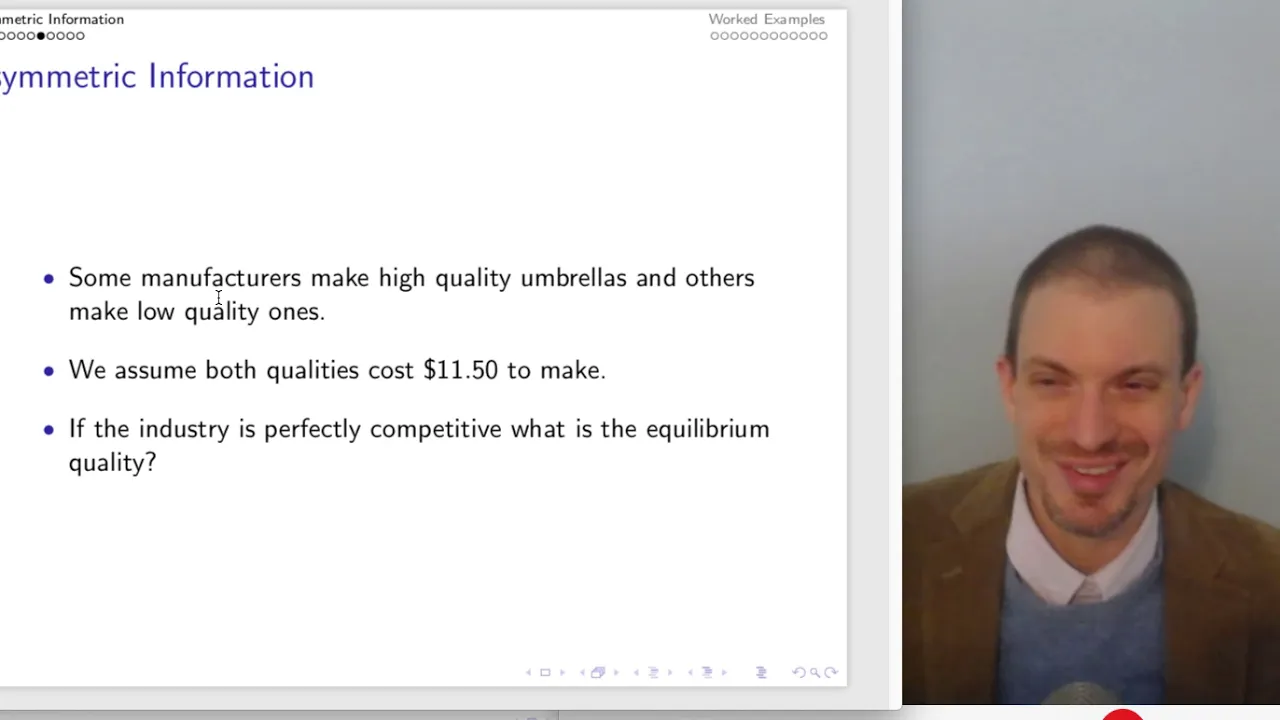
Intermediate Micro: Asymmetric Information
6.7K
Asymmetric information occurs when one party in a transaction possesses more relevant information than the other, leading to market failure when the presence of low-quality goods (lemons) drives out high-quality goods (plums) because buyers cannot distinguish quality and thus are unwilling to pay prices that would sustain the market for good products; this happens when buyers' expected value of a randomly selected item falls below what sellers of high-quality goods would accept, causing only low-quality goods to remain in the market.
Click to watch →
24. Market Failures II: Informational Asymmetry
59.2K
Information asymmetry occurs when different parties in a transaction possess unequal information, creating market failure. George Akerlof's lemons problem demonstrates this using the 1970 used car market: sellers know car quality while buyers cannot distinguish good cars from lemons. Buyers become suspicious that anyone selling must be trying to unload a defective vehicle, preventing mutually beneficial transactions even when they would exist with full information. This fundamental market failure explains why private insurance markets often fail without government intervention.
Click to watch →

Asymmetric Information & Market Failure: Akerlof's Lemons Explained
65.4K
Akerlof's Lemons model demonstrates how asymmetric information—where sellers know more about product quality than buyers—can cause market failure in used car markets. When buyers cannot distinguish between high-quality cars worth £4,000 and low-quality 'lemons' worth £1,000, they only offer an average price of £2,500. This causes high-quality sellers to exit the market, leaving only low-quality cars, which further drives down prices and eventually destroys the market entirely. Similar adverse selection problems occur in insurance markets when buyers know more about their risk profiles than insurers.
Click to watch →

Asymmetric Information: Adverse Selection & Moral Hazard Explained
45.2K
Asymmetric information, where one market participant has more or better information than another, leads to two major market failures: adverse selection (hidden information problems causing low-quality products to dominate markets, as seen in used car markets where buyers cannot distinguish good cars from lemons) and moral hazard (hidden action problems where agents take excessive risks because principals cannot observe their behavior, such as insured drivers driving recklessly). These inefficiencies can be corrected through signaling mechanisms (like warranties that allow high-quality products to differentiate themselves) and incentive-compatible reward systems that align agent behavior with principal interests.
Click to watch →
Deep Dive
The application of Hayek's decentralized knowledge theory to modern systems like prediction markets, blockchain, and decentralized autonomous organizations (DAOs).

🤯XRP and Altcoin Holders! She Researched Something THEY DON'T ALLOW Then Died!
1.9K
DAOs run on smart contracts, governance, and funding, and are transparent and borderless. They can fund anti-gravity bounties and enable open-source R&D without black budgets. Prediction markets like Polymarket, Augur, and Nosis let anyone bid on future events using real money, with prices becoming the crowd's best estimate of probability. Chainlink oracles feed real-world data into the system, making it trustless. Polymarket has resolved billions in volumes on elections, wars, Fed moves, and even 'Will NASA announce breakthrough propulsion by 2027?'—traders literally pricing future timelines in real time. This creates a public, auditable forecast that would make a classified cube unnecessary.
Click to watch →

F. Hayek y el sistema de precios
1.2K
Hayek argued that economic knowledge includes not only scientific and technical knowledge but also local and temporal information about specific circumstances. This knowledge is dispersed among individuals, is incomplete (each person has only part of the picture), and may be contradictory. This information cannot be effectively transferred to a central authority without losses, making decentralized organization the best way to utilize information in society.
Click to watch →

Ethereum (Roadmap) in 30min by Vitalik Buterin - Devconnect
55.7K
This section establishes Ethereum's foundational philosophy contrasting centralized trust (like FTX) with decentralized blockchain trustlessness. It explains blockchain architecture: blocks added every 12 seconds, proof-of-stake consensus, and approximately 2 million daily transactions. The core innovation is programmability through smart contracts—computer programs that automatically execute upon user interaction. Primary applications include payments, financial derivatives, prediction markets, and DAOs (Decentralized Autonomous Organizations). The double spending problem is explained as the fundamental challenge solved by blockchain consensus mechanisms, preventing digital inflation through duplicate asset transfers.
Click to watch →
What I Learned from Hayek
4.1K
Friedrich Hayek argued that economic planning is fundamentally limited by the dispersed nature of human knowledge, where information is scattered across millions of individuals in society rather than concentrated in any central authority; therefore, competition serves as the essential mechanism for mobilizing and utilizing this decentralized knowledge to guide economic decisions, which challenges the notion that comprehensive economic planning can effectively coordinate complex market activities.
Click to watch →

Gabriel Zanotti - El Socialismo y el Mercado como proceso
9K
Friedrich Hayek developed the insight that prices function as a mechanism for synthesizing dispersed knowledge across society. Rather than assuming perfect information, Hayek argued that the market process coordinates individual knowledge through price movements. Each participant possesses unique local knowledge, and prices aggregate this dispersed information. Knowledge differs fundamentally from mere information—it requires interpretation within specific contexts to form expectations about the future.
Click to watch →
Price Signals
Informed Choices
Price Signals
0:00- 1
Explains how prices convey essential economic information without requiring personal knowledge of underlying causes.
- 2
Uses Sarah's coffee purchase to illustrate how price changes drive efficient decisions.
Information Asymmetry and Market Failure (The Stiglitz Critique)
While Friedrich Hayek argued that prices efficiently convey dispersed information, economists like Joseph Stiglitz challenge this through the concept of information asymmetry. Stiglitz demonstrates that in real markets, information is almost always imperfect, costly, and unequally distributed. Consequently, price signals alone cannot perfectly coordinate economic activity. This imbalance leads to systemic market failures, such as adverse selection and moral hazard, where prices fail to reflect the true quality or risk of transactions (as seen in healthcare and financial sectors). Furthermore, prices fail to capture externalities—such as environmental damage—meaning the social costs of production are left out of the market equation. Under the Greenwald-Stiglitz theorem, markets with imperfect information are rarely Pareto efficient. Therefore, this perspective argues that price signals are fundamentally incomplete, and targeted government intervention is necessary to correct these inherent failures and coordinate society's resources effectively.
Basic concepts of supply, demand, and market equilibrium.
The fundamental differences between market-based economies and centrally planned (command) economies.
The economic problem of scarcity and how societies decide to allocate limited resources.
How individual incentives guide consumer purchasing decisions and producer behavior.
The history of the Socialist Calculation Debate and the counterarguments to Hayek's view on planning.
The concept of 'Spontaneous Order' and how complex systems like law, language, and markets self-organize.
Market failures and asymmetric information, exploring when and why price signals might fail to convey accurate data.
The application of Hayek's decentralized knowledge theory to modern systems like prediction markets, blockchain, and decentralized autonomous organizations (DAOs).
70.2K views920likes3:26@FraserInstituteOriginal Release: 2015-06-12
[Music] Welcome to Essential Hayek. I'm Don Budro, professor of economics at George Mason University, senior fellow at the Frasier Institute, and blogger at Cafe Hayek. This video is part of the Frasier Institute's initiative to present the key ideas of FA Hayek in an easily accessible format.
In this video, we explore one of Hayek's best known ideas and perhaps his most profound insight. The role of prices in conveying information. All economists understand that people make decisions based on the costs they face and the benefits they expect to receive. In most cases, the key cost of a decision is the price the person faces to purchase a good or service. This idea is complex, so let's simplify it with an example. This is Sarah. Sarah loves coffee and prefers Colombian coffee, which she buys from her local grocery store. The local store usually sells her favorite coffee to her for $10. Sarah doesn't know any of the details or costs of how the coffee beans are grown, the irrigation at the coffee farm, how the beans are roasted, or how the coffee is transported to her store.
All she knows is that her favorite Colombian coffee costs $10 and that it's worth it to her given the enjoyment she gets from drinking Colombian coffee. But what happens if bad weather in Colombia severely damages the coffee market there? Bad weather and crop damage mean fewer coffee beans from Colombia and that results in the price of Colombian coffee going up. So when Sarah next goes to her local grocery store, she finds that the price of her favorite Colombian coffee is now $20. Sarah doesn't know why the price went up, nor does she need to know why.
The increased price sends her a signal that prompts her to make an informed decision.
She can pay $20 for her favorite Colombian coffee, but the higher price for Colombian coffee means that she'll have to give up more of something else to buy that coffee. In fact, Sarah is likely to voluntarily choose to buy another type of coffee. One perhaps even at a lower price than her normal Colombian coffee, say Indonesian coffee, which costs $9.
So, even though Sarah doesn't have any of the information about why the price of Colombian coffee changed, she makes the same decision based purely on the change in price that she observes in her grocery store that she would have made had she known that a weather disaster in Colombia destroyed much of that country's coffee crop.
What Hayek explained and clarified is that people make decisions as if they have incredible amounts of information about why the price of a good or service is what it is when in fact they have little or no information about why the price is what it is. They simply know what the price is. And that is sufficient to prompt each of us to act as if we know vast quantities of facts about economic reality that we can't possibly really know.
To learn more and download Essential Hayek for free, visit www.essentialhayek.org.
Up Next

109:31
Housing Market Crisis: Causes, Data, and Future Outlook
@Nickjfreitas
71.4K views•2025-07-29

5:07
Impact of Yuan in Indo-Russian Trade Amid Sanctions
@WION
261.9K views•2022-07-01
10:33
Behavioral Economics Explained: Rationality, Nudges, and Risk
@crashcourse
1.1M views•2016-03-12

113:18
The Age of Easy Money: Fed & Inflation | Full Documentary
@frontline
21.2M views•2023-03-15
Related Study Plans & Knowledge Roadmaps
Structured learning paths in Economics
economics
Sovereign Debt: Defaults, IMF & Restructuring
01Introduction to Sovereign Debt & Government Bonds
02Debt Sustainability & Credit Ratings
03Anatomy and History of Debt Crises
+ 2 more learning modules
12h5 modules
Explore Roadmap
economics
Market Design: Matching Theory & Gale-Shapley
01Introduction to Market Design and Price-Free Markets
02Two-Sided Matching & The Gale-Shapley Algorithm
03School Choice Systems and Mechanism Design
+ 2 more learning modules
10h5 modules
Explore Roadmap
economics
Impossible Trinity: Forex, Capital & Policy
01Introduction to Monetary Policy and Central Banking
02Exchange Rates and International Capital Flows
03The Mundell-Fleming Model
+ 2 more learning modules
8h5 modules
Explore Roadmap
economics
Healthcare Economics: Market Failures & Systems
01Introduction to Healthcare Markets and Market Failure
02Asymmetric Information and Adverse Selection
03Moral Hazard and Insurance Design
+ 2 more learning modules
12h5 modules
Explore Roadmap