








![[넛지 파이널에디션 / 리처드 탈러, 캐스 선스타인] 행동경제학 고전 / 넛지 개념, 뜻 / 넛지 예, 유용성 / 선택설계 / 슬러지](https://i.ytimg.com/vi_webp/mT4YipwWQNM/maxresdefault.webp)


![[알릴레오 북's 16회] 자유의지냐? 운명이냐? / 운명의 과학 - 한나 크리츨로우](https://i.ytimg.com/vi/hTYZF_6xt_M/maxresdefault.jpg)




Behavioral economics is a subfield that studies how psychological, social, and emotional factors influence economic decisions, revealing that people are often irrational, impulsive, and shortsighted rather than the rational actors classical economics assumes; key concepts include bounded rationality (limitations on information, time, and cognitive abilities), the framing effect (how options are presented influences decisions), loss aversion (people feel losses more intensely than equivalent gains), and nudge theory (subtle environmental changes can guide behavior without restricting choices), as demonstrated through experiments like the ultimatum game and real-world applications such as pricing strategies and public policy interventions.
Behavioral Economics Explained: Rationality, Nudges, and Risk
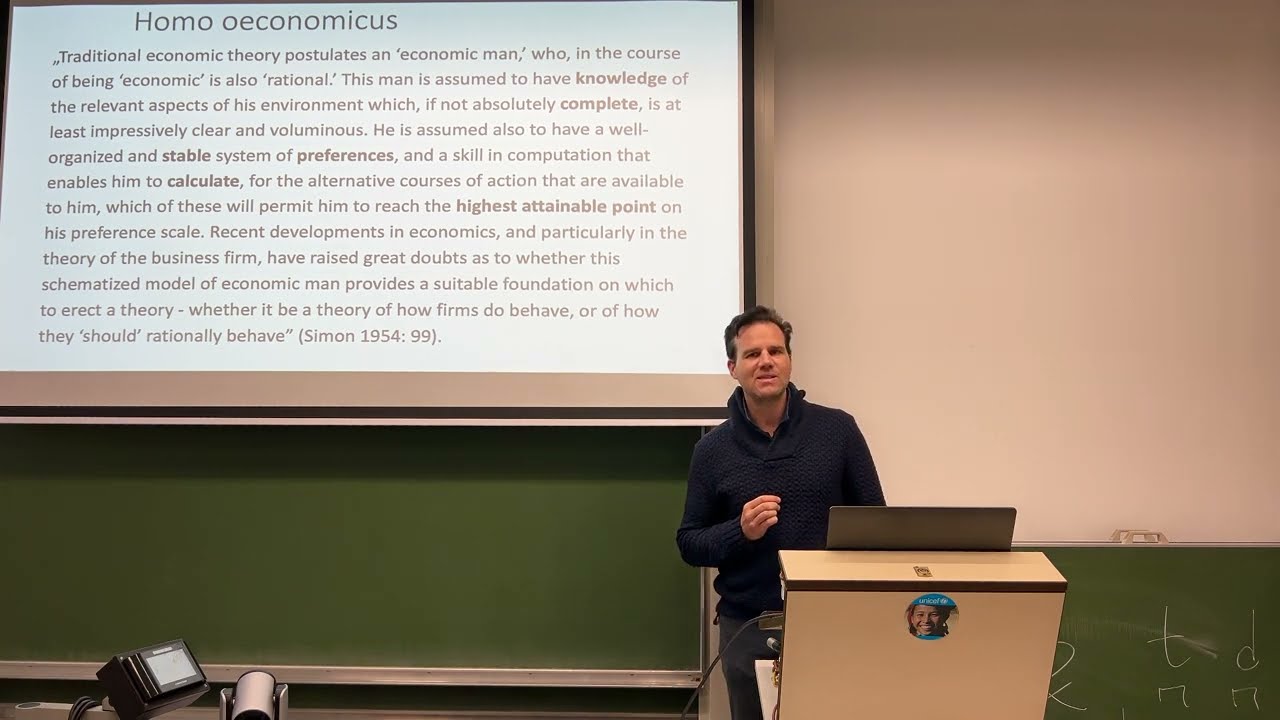
Added:Classical Rational Choice Theory and the concept of 'Homo economicus' (the rational actor model).
Basic Microeconomics principles, specifically consumer choice theory and utility maximization.
Fundamental concepts of risk and probability, including expected value and expected utility theory.
Introductory psychology concepts related to cognitive biases and decision-making heuristics.
Prospect Theory, including loss aversion, framing effects, and value functions formulated by Kahneman and Tversky.
Choice Architecture and Nudge Theory applications in public policy, health, and environmental design.
Behavioral Finance, exploring market anomalies, investor psychology, and speculative bubbles.
Experimental Economics and Game Theory, examining social preferences like fairness, reciprocity, and altruism in economic transactions.
1.1M views20.7Klikes10:33Original Release: 2016-03-12
Adriene: Hi, this is Crash Course Economics, I’m Adriene Hill.
Jacob: And I’m Jacob Clifford. So, when economists make their models, they generally assume that people are rational and predictable.
Adriene: But when we look at actual human beings, it turns out that people are impulsive, shortsighted, and, a lot of times, just plain irrational. Look! Balloons!
Jacob: Today we’re talking about Behavioral Economics and how people actually make decisions.
[Theme Music] Behavioral economics is a subfield of economics that focuses on the psychological, social, and emotional factors that influence decision-making. That's not necessarily new. In fact, our old buddy Adam Smith, discussed it in The Theory of Moral Sentiments in 1759.
But generations of economists chose to ignore many irrational elements of decision making since it makes it harder to predict human behavior.
But in the last few decades, behavioral economics has made a comeback. Several Nobel Prizes have been awarded to researchers that blend economics and psychology and behavioral economics is being applied to more and more fields like marketing, finance, political science, and public policy.
Now it’s important to mention that irrational human behavior doesn’t negate everything you’ve learned here at Crash Course Economics. It just adds another layer of complexity, which is exactly what we love at Crash Course Now in most cases, people are rational. When the price falls for a product, people have a tendancy to buy more of that product, so the law of demand holds true. But economists also accept that there is bounded rationality. Limits on information, time, and abilities might prevent people from seeking out the best possible outcome.
For example, if the price for ice cream is really low consumers might not buy more.
In fact, they might buy less if they think that that low price means that ice cream tastes horrible.
Now if that happens, then the law of demand doesn’t hold true, which creates a serious problem in classical economics.
I mean it is the LAW of demand. You can’t have a situation that breaks the law and still call it a law. That doesn’t happen in other disciplines like physics…except it does.
The Newtonian laws of physics, like gravity, hold true most of the time but they break down at the quantum level. They explain the orbits of planets, but they have a harder time explaining the orbits of electrons And It’s the same in economics. Classical economic theories explain the big picture stuff pretty well, but there are still a lot of things about individual decision-making that we just don’t fully understand.
Adriene: In our ice cream example one of the problems is lack of information. Classical economics assumes that consumers have perfect information when making choices. That is, they know or at least can quickly access information about prices and quality, but, in reality, they often don’t.
Sure, the consumer could ask around or call their friends to see if they’ve tried that type of ice cream but they're probably not gonna do that. In this situation, consumers may act on the limited information they have, a suspiciously low price, which means either the ice cream is a great deal or it tastes like mayonnaise. They just don’t know.
Prices do send a lot of signals, and there’s even science on how prices change perception.
A study in California analyzed the brains of people taste testing a variety of red wines.
The researchers gave participants fake prices and scanned their brains to determine the level of enjoyment.
The results were surprising. When they thought the price was higher, they actually liked the wine more.
This held true even when the subjects were given the exact same type of wine but were told it was a different higher-priced wine. The researchers said "Contrary to the basic assumptions of economics…marketing actions can successfully affect experienced pleasantness by manipulating non-intrinsic attributes of goods.” So, once you’ve got a palatable Pinot Noir, you might be able to raise the price, and actually raise the demand. All you have to do is change perceptions.
The idea that perceptions and passions influence our actions also applies in finance.
Many economists used to believe that assets, like stocks and real estate, would stay at or near their real value because cold, calculating investors would buy undervalued assets and sell overvalued assets. But that doesn’t explain bubbles: In real life, investors aren’t always cold and calculating. They can get worked up and irrational sometimes.
This helps explain bubbles. From the Dutch Tulip Mania of the 17th century, to the 2008 financial crisis.
Investors became irrationally exuberant, and were driven not by logic, but by what economist John Maynard Keynes once called, “Animal Spirits.” So behavioral economics doesn’t blow up traditional economic theory, it just seeks to understand when and why people behave differently than economic models suggest. Let’s go the Thought Bubble: Jacob: One of the most popular experiments in behavioral economics is called the ultimatum game.
In this experiment, two players decide how to share a specific sum of money, let’s say $100.
The first player is given all the money and then is asked to propose a way of splitting it with the second player.
Now if the second player accepts the deal both players get to keep the money.
But, if the second player refuses, nobody gets to keep the money.
When the first player offers to split the money 50/50 the second player almost always accepts.
But what happens when the first player offers an unequal split, like 80/20?
Would you accept that offer? Well, It turns out that less equal offers are often rejected.
Now that doesn’t seem surprising, but it directly contradicts classical economic theory. It’s irrational.
The rational choice would be for the second player to accept any offer, even if it's only a dollar.
After all, a dollar is better than nothing. But human behavior is not motivated solely by gain; it’s also shaped by complex ideas like fairness, injustice, and even revenge.
The ultimatum game shows that people aren’t always as predictable as many economists like to suggest.
If people were entirely rational then they would consistently make the same decision given identical options, but sometimes people's preferences are dependent on how the options are presented. Psychologists call this type of cognitive bias the Framing Effect.
I mean, would you rather eat beef that's 75% fat free or 25% fat? Would you rather enter a raffle that claims that 1 out of every 1000 players is a winner or a raffle that points out that there will be 999 losers. Would you support a law named the “Improve our Schools Act” or one named the “Raise our Taxes Act”?
Each of these scenarios can be framed in ways that influence your decision. Classical economics argues that framing should have relatively little effect on decision making because most people are rational and intelligent, but in the real world, people can be pretty irrational.
Adriene: Thanks Thought Bubble. So, Businesses have known about the psychology of decision making for a long time. For example, a gym might break down its membership fee and advertise it only costs only $1 a day, which seems way more affordable than $365 a year.
And a TV priced at $499.99 seems like a better deal than one priced at $500.
This is called psychological pricing. It can make people feel like they’re getting a good deal.
Interestingly, high-end retailers sometimes do the opposite. They set their prices at whole dollars, basically signalling their goods are of a higher quality than you might see at a discount store.
Behavioral economists also like to talk about nudge theory. Nudges encourage people to act a certain way, without actually changing the choices that are available to them.
Fighting childhood obesity is a priority in many countries and policy makers have suggested a whole range of solutions. Everything from banning soda in schools to running media campaigns promoting healthy eating. Behavioral economists approached the problem a little differently.
They wanted to see if they could get children to eat healthier by rearranging school cafeterias.
They put healthier food like fruits and vegetables on eye-level shelves and less healthy foods, like desserts, in less convenient places. Classical economic theory suggests that this idea wouldn’t work since rational people would pick the brownie.
But it turns out, students choose the healthier foods. Nudge theory works and it’s changing how we implement public policy. There are some issues that can be addressed best with the right type of nudge.
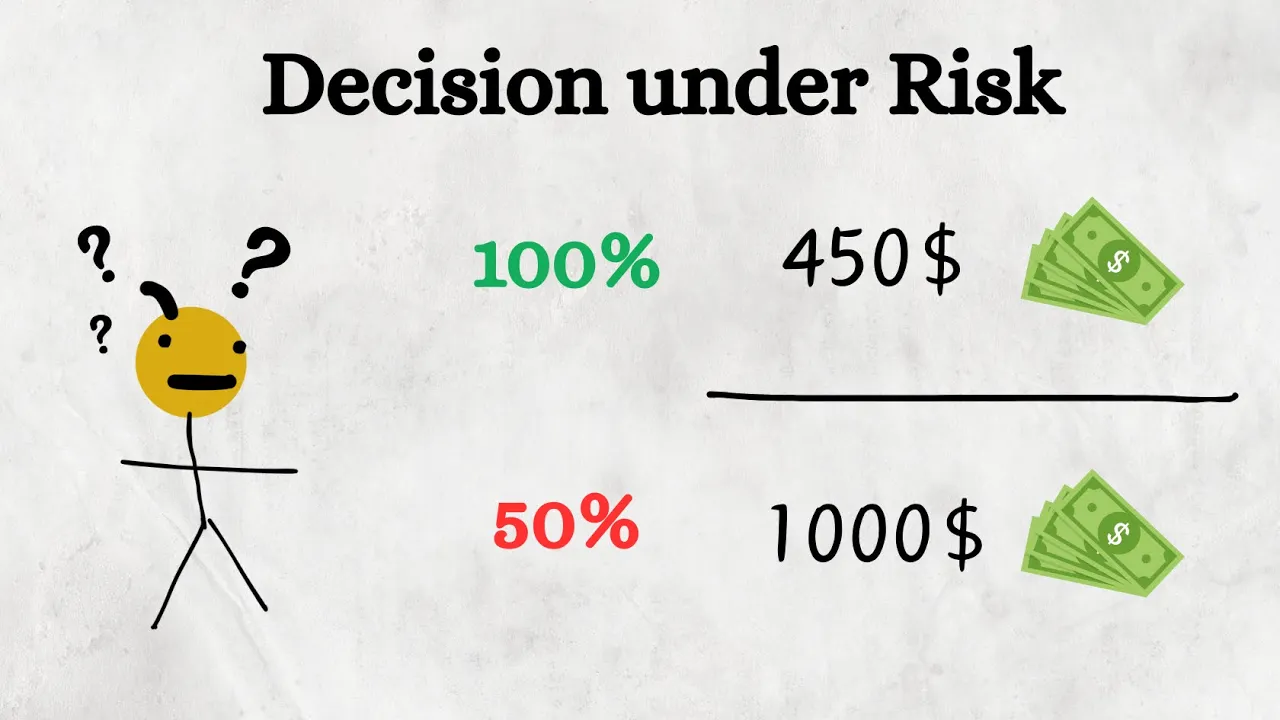
Jacob: Let’s talk about something else behavioral economists look at: risk. Let’s say someone offered you two sealed envelopes. One has a hundred dollars, and one has no dollars.
You can choose an envelope, or you can take $50 cash right now.
So do you take the fifty bucks? Or what about $49?
Now, this is unlikely to happen to you in real life, but the exercise is about your attitude towards risk. Since there’s a 50/50 chance of getting $100 or nothing, the expected return, or the average of the possible outcomes is $50.
If you’re willing to accept $50 cash to abandon the envelopes, then you’re risk neutral.
But If you accept less than $50, just to avoid walking away with nothing, then you’re risk-averse.
Behavioral economists have done lots of studies about risk and in particular loss aversion, the idea that people strongly want to avoid losing. Studies show that, in general, losses are more painful than gains are pleasurable. So people might choose a safe course of action even if it’s not the most logical choice.
Let’s say we flip a coin and if it’s heads I give you $100 but if it’s tails, you have to give me $50.
Now, mathematically you should go for it. But many people won’t because they want to avoid losing.
Adriene: Understanding of loss aversion can help businesses and policymakers influence decisions.
For example, some grocery stores in the Washington DC tried to decrease the use of disposable plastic bags by offering five cent bonuses if customers brought reusable bags.
The policy didn’t do that much. Later they tried a five-cent tax on plastic bags, and, this time, people used fewer disposable bags. This is loss aversion at work. The pain of having to pay 5 cents per bag was greater than the benefit of receiving 5 cents per bag.
Another study analyzed how loss aversion can help incentivise employees. Researchers divided workers into three groups. The first was a control group that wasn’t given a bonus.
The second group was promised a bonus at the end of the year based on meeting specific goals.
Participants in third group were given the bonus at the beginning of the year and were told that they would have to pay it back if they didn’t meet specific goals.
The workers in the first and second groups performed about the same.
But those in the third group performed significantly better. We just hate losing.
Jacob: So, behavioral economics has a lot to tell us. Accounting for emotion gives us a realistic view of how people actually behave.
Adriene: We might not always be the rational actors classical economists believe us to be.
For years, economics has had a blind spot. But behavioral economics helps us get a better look at how we make decisions.
Thanks for watching. We’ll see you next week.
Jacob: Thanks for watching Crash Course Economics. It's made with the help of all these awesome people.
You could help keep Crash Course free, for everyone, forever, by supporting it at Patreon.
Thanks for watching. DFTBA.
Up Next

58:43
Introduction to Psychology and Economics | MIT 14.133 (Spring 2020)
@mitocw
231.8K views•2021-09-27
5:07
Impact of Yuan in Indo-Russian Trade Amid Sanctions
@WION
261.9K views•2022-07-01

7:31
Deficits & Debts Explained: Economics of Government Spending
@crashcourse
1.5M views•2015-09-23

113:18
The Age of Easy Money: Fed & Inflation | Full Documentary
@frontline
21.2M views•2023-03-15
Related Study Plans & Knowledge Roadmaps
Structured learning paths in Economics
economics
Sovereign Debt: Defaults, IMF & Restructuring
01Introduction to Sovereign Debt & Government Bonds
02Debt Sustainability & Credit Ratings
03Anatomy and History of Debt Crises
+ 2 more learning modules
12h5 modules
Explore Roadmap
economics
Market Design: Matching Theory & Gale-Shapley
01Introduction to Market Design and Price-Free Markets
02Two-Sided Matching & The Gale-Shapley Algorithm
03School Choice Systems and Mechanism Design
+ 2 more learning modules
10h5 modules
Explore Roadmap
economics
Impossible Trinity: Forex, Capital & Policy
01Introduction to Monetary Policy and Central Banking
02Exchange Rates and International Capital Flows
03The Mundell-Fleming Model
+ 2 more learning modules
8h5 modules
Explore Roadmap
economics
Healthcare Economics: Market Failures & Systems
01Introduction to Healthcare Markets and Market Failure
02Asymmetric Information and Adverse Selection
03Moral Hazard and Insurance Design
+ 2 more learning modules
12h5 modules
Explore Roadmap