

![(M5E3) [Microeconomics] Expected Utility Theory](https://i.ytimg.com/vi/zrXWSXmOVFA/hqdefault.jpg)










![[알릴레오 북's 16회] 자유의지냐? 운명이냐? / 운명의 과학 - 한나 크리츨로우](https://i.ytimg.com/vi/hTYZF_6xt_M/maxresdefault.jpg)

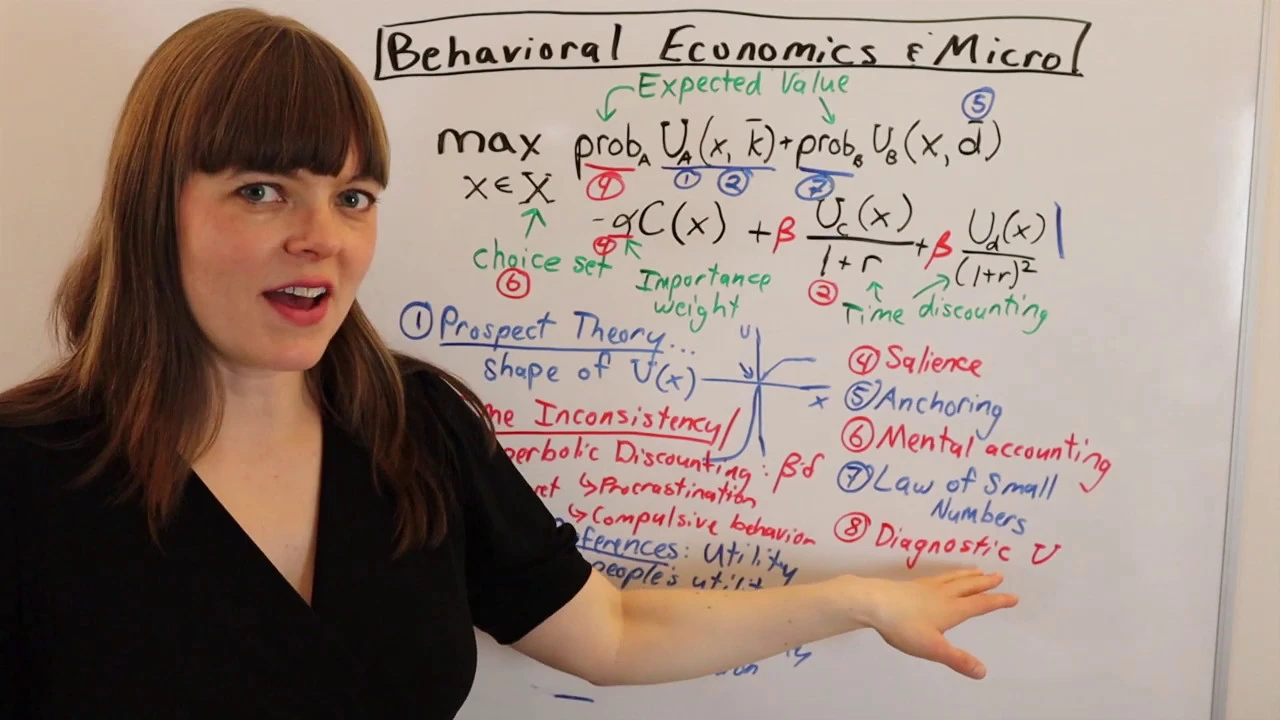
Behavioral economics integrates psychology and economics to study how psychological and economic factors jointly influence human behavior, challenging the classical economic model's assumptions of perfectly rational, self-interested agents with stable preferences, perfect self-control, and optimal information processing; instead, real-world behavior reveals systematic deviations such as limited self-control, reference-dependent preferences, social influences, and bounded rationality, which can be addressed through tractable model improvements rather than complete replacement of standard economic principles.
Introduction to Psychology and Economics | MIT 14.133 (Spring 2020)
Added:Standard Microeconomic Theory: Familiarity with the rational actor model, utility maximization, and consumer choice theory.
Expected Utility Theory: Understanding how classical economics models decision-making under risk and uncertainty.
Basic Probability and Statistics: Comfort with probability distributions, expected values, and quantitative reasoning.
Introductory Cognitive Psychology: Broad awareness of cognitive limits, heuristics, and how human perception can deviate from objective reality.
Prospect Theory and Reference-Dependent Preferences: Analyzing how people value gains and losses differently, incorporating loss aversion and framing effects.
Time Inconsistency and Intertemporal Choice: Exploring present bias, hyperbolic discounting, and the design of commitment devices.
Social Preferences and Behavioral Game Theory: Modeling non-selfish utility, including fairness, altruism, reciprocity, and strategic behavioral interactions.
Behavioral Public Policy and Nudge Theory: Investigating how governments and organizations use choice architecture to influence savings, health, and environmental decisions.
231.8K views4.5Klikes58:43Original Release: 2021-09-27
uh welcome everyone this is 1413 psychology and economics also known as behavioral economics my name is frank schilbach i'm a faculty member in the economics department teaching and doing research in behavioral economics and psychology and economics and development economics there's syllabi over here in case anybody uh uh needs one so let me sort of start with introducing ourselves uh including myself as i said i'm uh frank schilbach i'm an economics phd i'm from harvard recently um i'm from germany in case uh as you may have noticed i do research at the intersection of development behavioral economics in particular i'm interested in integrating uh psychological issues and uh helping us understand better um uh the lives of the poor and so they study all sorts of issues related to poverty how poverty itself affects people's behavior um and how conditions of poverty or things that are associated with poverty might feed back into people's decision making and their productivity or labor market behaviors and then perhaps sort of lead to the persistence of poverty through those kinds of effects so i have some work on financial constraints how financial constraints affect people's behavior in terms of thinking about money itself i have some work on sleep deprivation among the urban poor i'm thinking about pain and substance abuse and how that might affect people's choices uh uh most recently i'm interested in uh things related to mental health in particular depression and loneliness how those might affect people's well-being and then their um behaviors um i have um office hours um where you can sign up on my website uh currently they're on tuesday afternoons but you know if you cannot find times that work for you please email me and you'll find some time that that works out my assistant is krista moody in case you want to sort of get a hold of me and and i um i'm not available for some reason you can reach out to her um so now let me give you sort of the overview of the class i'm going to start sort of uh reading through four things one first i'm going to sort of tell you what is this class what is behavioral economics or what is psychology economics what do we mean by that is it sort of just putting two fields together or is it something more specific which you'll argue uh it is i'm going to give you some example then about like um uh how you might sort of use behavioral economics um in a specific example uh and a policy that might affect all of you and in fact it will because we have a specific laptop policy in this class uh and we'll tell you a little bit how to think about this there will also be a problem set that will help you think about this a bit more uh then we talk about somewhat boring uh course logistics um and at the end we do a questionnaire quiz um for everybody in part because we want to know some information for you in part we want to sort of learn a little bit about some decisions that um you might make okay great sorry this is okay so what is um psychology economics so you may have heard of this uh the class used to be called economics and psychology or behavioral economics uh for our purposes that's kind of like all um um uh the same some economists sort of argue that um uh all economics is about behavior so like you know uh behavioral economics is sort of a bit of a weird word um so that's why partially i'm using sort of the word psychology and economics in some sense it's sort of broader than that one definition is it's a field of economic academic research that studies the joint influences of psychological and economic factors on behaviors you could be sort of broader and say we're trying to integrate insights from not just psychology but also anthropology sociology medicine psychiatry etc and so on into economics and trying with an attempt to make economic models more realistic and therefore more predictive and help us understand people's behavior better and then help us uh make better policies perhaps in trying to influence um people's behavior now uh as i said you know that's medicine sociology etc broadly be trying to use insight from those fields and trying to understand have you missed something by making the fairly stark assumptions that economic models um usually make that leads me to what are the standard economics models in some sense what we're going to try and study to some degree is deviations from the classical or the the sort of the standard economic model so then of course we need to understand what is the standard economic models to start with which leads me to in part uh some prerequisites of the class or you should have taken at least some economics or know some economics to start with because i'm going to talk a lot about sort of deviations from those models and sort of if you haven't sort of taken any uh class before don't really know that very well then understanding the deviations will be a little bit tricky so for those of you who have taken economic classes what do we usually assume about people's behavior what are sort of some of the assumptions that we make about economic behavior yes stable preferences yes um so first well defined preferences in the sense of like people know what their preferences are they can state them and then they're also stable in a sense of like when i ask you today would you rather have apples or bananas um uh that'll not change unless they're sort of new information or your circumstances change of course if i ask you tomorrow and you already have a bunch of apples and then you'd say you want bananas that doesn't mean your preferences have changed but if i ask you about tomorrow what would you like for lunch you tell me a choice you want apples rather than bananas and then tomorrow you show up and nothing else has changed and you say now i want bananas well then your preferences are not stable that's one assumption yes what else do you have yeah more broadly they're rational yes and what does that mean they behave deterministically to optimize some utility function right exactly so people essentially optimize some utility functions so we say here people have a utility function they know what that is and you're sort of saying that maximize it to to optimize in a certain way they don't make mistakes in that maximization process so that's to say if you tell me you like apples over bananas uh and then you choose bananas well then you know something is sort of going wrong in some ways that we haven't fully understood it might be that you're sort of like just making uh mistakes that could be construed as uh irrational it's hard to rationalize with a model what else self-interest yes so like usually in a lot of models um all like the sort of the the easiest models are very narrowly defined self-interest so people care about themselves they care about what they consume and not about what others consume or or or what others think of them sort of narrowly defined self-interest yes yes so essentially perfect self-control usually a sort of one version of putting that one version of putting that is in some sense sort of going back to what you're saying earlier sort of to say stable preferences if i'm telling you i'd like to exercise tomorrow and that's my preference uh tomorrow i'm not gonna sort of be like oh yeah actually you know i changed my mind and now i'm just watching movies or the like right so that's the version of sort of preferences being stable but the inherent underlying issue there is like self-control problems in the sense of like if i like certain things or make certain plans for the future i have the self-control to follow through on those plans that's usually an assumption and that then shows up as preferences being stable what else yeah yeah so usually there is like a discount um factor in terms of like how much you uh like consumption today versus consumption tomorrow um that is usually in any economic model usually we think of like the discount factor being constant as like how you think about today versus tomorrow is the same as you think about today versus in two days from now or in like a year from now and a year and a day from now so usually there's a constant discount factor for the future usually we sort of employ economic sorry constant discounting or exponential discounting what else do we have yeah risk reverse yes risk aversion in the sense of like yes people um are risk-averse and people often sort of define their preferences over outcome so we have a utility function that we tend to concave and the utility function is and we'll get to this in a few lectures but the utility function tends is concave and it's defined over outcome as opposed to over changes of outcomes that shows up usually as sort of like essentially like a a strictly concave utility function and that's risk aversion what about information how do people think about information how do they use information bayesian and what what does that mean exactly so people essentially are perfect uh information processors you can call them bayesians but essentially it's sort of for those of you know that it's sort of the use bayes rule essentially which is to say uh if you gave a statistician a problem how to update information people are able to do that in their heads and you know that's a pretty stark assumption but essentially it's like when you people have certain information uh standard economics does not necessarily assume that everybody has full information in a sense that everybody knows everything but if you give them some information then they update their uh beliefs accordingly right so they essentially they optimally use new information and then form their beliefs their posterior beliefs based on having a new information and what they believed previously um their priors there's another assumption usually and i sort of can actually sort of put this out for you which is there's another assumption that is people have no taste for beliefs or information what do we mean by that we mean by that as essentially people use information only to make decisions so if you tell me something about like what's going to happen tomorrow or if you tell me something about my health status or the like i use that to make better decisions so if you tell me i'm sick i'm going to use that information to go to the doctor but people usually don't assume that people have certain beliefs about whether they're sick or healthy or whether they're smart or not or are they good looking or not usually the assumption is that beliefs are only used so information is only used to make better decisions not that people get utility from beliefs but instead you might say well i'm really good looking and smart and maybe smarter than you actually are and the reason why people might believe that is because that makes them feel good about themselves that's what they're usually an assumption that people standard economic models make i think we mentioned almost everything we sort of said bayesian information processor essentially processing information optimally well-defined and stable preferences maximize expected utility which is sort of like in some sense um rationality if you want apply exponential discount weighting a current and future well-being people are narrowly defined in terms of their self-interest and people have preferences over final outcomes not changes so what you care about is how the weather is today not kind of like how the weather changed between yesterday um and today or tomorrow and we'll talk about all of these by the way these are all sort of like some terms that seem maybe unfamiliar to you we'll talk about all of these kinds of assumptions and perhaps how to deviate from them specifically okay so now now that we have those assumptions now what kinds of deviations uh when you look into the world and sort of one part how you think about behavioral economics is uh in some sense think about the world and try to sort of observe what's going on in the world and try to see which assumptions might be violated um in an important way and try to sort of improve our models so when you think about the world and look at these assumptions can you come up with real world examples um uh that might sort of violate these assumptions yes um the uh the last assumption that you listed uh the one beliefs or information is violated on a constant basis people tend to believe what they want to believe and you have an example specific um this is very common as regards like political matters i'm not gonna name like obvious reasons but uh like people like often like choose to discount information that goes against their belief right um right so um so one reason could be and there's uh quite a bit of work recently we'll talk a little bit about this in this class about sort of how political beliefs or other reasons why people might be motivated to believe certain things one clear example would be sort of climate change not just because of political reason there's some interesting work about like when people live in flood areas for example what do they think about climate change and sort of you might sort of say well if you really uh live in an area that's potentially affected by floods you might really want to know about climate change and know what's going on and really try to inform yourself but what people tend to do is sort of try to ignore the issue and try to sort of be happy as long as sort of uh nothing happens now that's one example yes yes um so purposes might not be well defined so say like if i have a decision on what i want to eat i want to eat like steak over chicken if i'm presented with the opportunity but i prefer chicken or pork but i might also prefer poor purple steak right so it's not always well defined right so one part that you're telling is like essentially so one one part might be it's might not just be well-defined there's other issues like for example that irrelevant other autism assumption economics usually is to say if you choose between a and b the availability of seed should not matter for your choice between a and b but often that's not the case right so if i offer you apples and bananas and you also can get cherries now suddenly your choice between apples and bananas might change even if you can't get the cherries like if i even if you don't choose the cherries um eventually so exactly so like there might be sort of people's preferences might not be uh well defined they might also not be stable any other example yes um also for the well-defined preferences like we have information processing constraints if i'm given a menu of 100 choices it's going to be difficult for me to know which one right exactly so the the people have lots of information around themselves and like if you think about like to process that information if you go to a supermarket it's impossible to know uh all the prices all the goods and make all these choices so in some sense we're like there's an abundance of information everywhere and you know we have to sort of figure out how to how to deal with with that any other example yes right exactly so one part is to say people um have preferences of a final outcome not changes which would just say uh you know you might feel about the weather in certain ways uh um you know depending on like how the weather was yesterday another version of that would be like you evaluate your the outcomes that you get based on your expectations and sort of if you thought you know today is going to be really nice uh or you know today is something that your day is going to be really good but then it happened to be not as good for whatever reason the weather is bad or you know something bad happened to you today the typical assumption would be to say well um you should just evaluate the final outcome it shouldn't matter what you thought about previously would what might happen you're going to look at like what happens at the end and that's how you evaluate your uh your well-being yes um you might need a commitment device so that you don't uh like you might avoid buying potato chips because you think you'll eat them that doesn't really make sense right so people might on purpose restrict their choices in certain ways right so you might sort of um and this is what gets me eventually to the laptop policy but people might sort of essentially know that in the future they make certain choices you might um for example in the laptop case you might say i'm gonna use a laptop in class with all the best intentions to taking notes and uh paying attention but you know at the end of the day you know you're gonna like watch the football review from yesterday or whatever other stuff comes up you're going to chat with your friends and so on and so forth so now in some sense if you're sophisticated as in like if you know um what you're going to do in case you sort of make certain choices you might say i choose not to even allow myself to use a laptop at all the reason being because i know that essentially i'm going to misbehave in the future and that's sort of we'll talk about this um soon i think in lecture three or four which is essentially people's demand for commitment as we call it which is to say people have demand for restricting their choice and in any neoclassical model does this make any sense because like you're going to choose optimally anyway and then you need to make the best choice for yourself in any case that's an assumption so why would you ever sort of shut down certain choices because for example in an emergency or there might be something really important coming up in class where you might want to use your laptop regardless of what's happening uh why would you shut that uh down exactly so demand for commitment is is is another example uh yes people are also not like anywhere near perfect uh invasion information processors either we are as a general rule people are pretty bad at uh updating their um you know their their beliefs based on new information and we frequently traffic in 100 and zero percent certainties like very often which um you know far more often than like what you would um expect from an invasion information right exactly so you know uh one summary of that is to say bayes rule a lot of this sort of updating uh behavior is really hard it's actually tough to do um and for those of you who do statistics math etc you might be able to do that very well but in way you're like a very small share of the population who actually uh uh does that well but even among those you know there's a bunch of stuff that's really hard to compute in your head uh you might be able to write it down and figure it out eventually but usually the assumption is that people just do all of this stuff in their heads and really complicated problems and you know that's that's sort of clearly not the case in many situations and then of course like um uh that's sort of one part of that sort of among mit students uh but then you know um there's other populations that are um uh less educated they might not even know what bayes rule is uh uh they might be illiterate and so on and so forth so is there the assumption of like people's perfectly processing information is even perhaps more um um uh you know 10 years right so there's two parts to that there's essentially people uh this is essentially the assumption of narrowly defined self-interest people caring only about themselves of their own consumption so there's two parts to that one is you might care about your friends you might give money to your friends you might sort of help them out you might help them with homework you might help them in uh you know any other situations you might send money to charity and so on and so forth this is kind of like you care about other people like the well-being of other people is in your utility function one way or the other the second part is what you uh uh already uh discuss as well which is kind of like social influences call it which is essentially peer effects you care a lot about what other people think about you you care a lot about what other people do people get jealous people get angry people get envious and sort of their behavior about what they want at the end of the day is very um volatile or malleable essentially based on uh influences from others right and that might sort of show up uh in all sorts of ways including in terms of like peer effects um people do all sorts of things because other people think that's cool but it's not necessarily what's best for them if they had to choose on their own okay great so let me stop here there's a lot of other examples that we can come up with i have a few here so one is sort of limited self-control that's one of my favorite pictures about a gym attendance where you say well uh you know they seem to be people have preferences for going to the gym um but then you know there's an escalator um and people like you know not working out so much so in some sense uh something is is perhaps um a miss here when you look at sort of i mean this is one of my favorite things to do is like in or not just not quite as it's a it's a fun thing to do i mean one of my favorite things um uh um uh uh when you sort of google um uh terms and this is um calories or weight watchers or the like where you say well what is people's interest in googling those kinds of terms over the course of a year and as you can imagine what you see are these spikes are essentially january 1st people start sort of like googling calories they like start googling weight watchers and so on and so forth and now of course you can sort of think about some models that sort of can rationalize in some sense in saying like well january is just a good way to start a a diet and so on but you know really the the right thing to do is sort of people and january 1st they have all the best of it intentions to lose weight uh uh eat healthier um exercise more and so on and so forth and then you know um uh the year starts the semester um happens and so on and so forth and the good attention sort of like um a fade away which is essentially as um limited self-control um there's some interesting things about demand for information especially when it comes to health you know every time i ask this um and i've taught this class a few years so far every time i ask this i should have realized how old i am who knows dr house oh not bad so can anybody explain to me 13 and dr house and what is sort of their deal and what does this have to do with demand for information so who's 13 or what is her health issues she's got like i think yes she has huntington's yes right so [Music] right so she has a disease which is called huntington's disease which we'll also talk about more in the class which essentially is a brain disease where over time your brain more or less degenerates and that's a it's a really a bad condition and uh where like at age 40 50 that manifests and it's a very serious condition it's a genetic disease in the in the sense that like if your parents have that disease the chance of you having it is way way higher than in the general population uh there's a test for it but there's no cure so now um the dilemma and the show then comes where uh she essentially is thinking about getting tested and dr house who's in some ways very rational and others not so much essentially encourages her to test or get that test and any rational model would say well you should really get that or any sort of neoclassical model would say you should get that test why why should you get the test why is that helpful and what's that health information helpful for right exactly you would say information is good why is information good because there's lots of important choices that you might make that depend on that information you might think about like how much money you want to save you think about like your choices about taking vacation about career choices about partner choices about having children all sorts of issues about health behaviors you might sort of take better care of yourself there's all sorts of really important decision that might hinge on the fact like your life will be dramatically different whether you have huntington's disease or not now 13 does not want to i think she actually does the test and then doesn't want to see the result and why is that yes and so that's one view to view that i think you know in some things as i said you may could make other decisions like economic choices you could save more you could see the doctor more you could go more on vacations or whatever do fun things in life but you could say well maybe that's not that important but the neoclassical or the the classical economics model would still argue that you should get that information it wouldn't hurt you you wouldn't want to refuse it so why is she but why is she refusing it yes i think maybe she doesn't want to leave the rest of her life exactly so she essentially derives utility from information if you want from her beliefs she likes to sort of pretend to herself that she's healthy or like the chance of her being healthy is very high now under some assumptions you might want to not get tested and sort of see the results of that test because once you have the test it's very hard to pretend if it's positive it's very hard to pretend to yourself uh uh uh that you're healthy because there's a hard test saying that um before the test you can still sort of think like try to forget about it and try to sort of live a happy life sort of until the symptoms set in but that's a clear violation of the classical model of the assumptions that i was showing you above the next part is uh default effects so what i'm showing here here is the fraction of organ donors by country and type of default there's uh two types of defaults um often for organ donations this is from a few years ago but i think overall things have not changed that much um there's opt-in versus opt-out so in the countries on the left essentially you have an opt-in policy in a sense like if you don't do anything you're not an organ donor so you have to like actively say in some form or some form of like declaration that you want to be an organ donor on the right there's like opt out policies which means essentially if you don't do anything you'll be automatically registered or viewed as an organ donor you can opt out but only um uh only if you do so you'll actually be opted out otherwise if there's an accident in the lake you'll be viewed as an organ donor now what's weird about this graph or why is this sort of uh potentially a violation of the neoclassical or the typical economics assumptions yes the people have the same preference of whether they want to opt-in or opt-out that everyone should have this would be the same proportion across but the difference is that um the effort required to make that change or the difference the lack of indifference causes there to be the imbalance between the opt-out and the opt-in right exactly so um some people on uh you know don't want to get in trouble but some people argue germany and austria is actually not that different so i'm german so you know some austrians might disagree but you would say you know overall germans and austrians are not that different overall and you think you know their preferences in particular they might be different but their preferences for organ donations are probably pretty similar across those two countries which is a reasonable assumption second lots of people care a lot about what happens to them after they die right so they for whatever reasons religious or others they might actually care a lot about at the end of the day um uh what happens to their body and so on and that's obviously their choice um to make now if you assume those two things then it's very hard to reconcile this this picture because essentially um the opt in and out out is a very small change to make it's very um simple and easy to do you just have to like fill out some form maybe it takes you an hour maybe two you have to maybe go to some office or the like but if you really care you could easily do it yet you see huge differences in outcome based on this very simple um small change which it's very hard to model a right on a model that sort of rationalizes this behavior so somehow the default sort of the way in which the decision is presented seems to really affect people's behavior in a fundamental way okay next one is glow caps this is like a help for people to take their medication in particular for the elderly which essentially is a reminder um uh for people you can sort of program this in certain ways like every day or every few hours um a glow cap starts either sort of making sounds or like starts blinking and the like and gets you to take your medication and it's a very sort of simple proof of concept that you know reminders are important and can save people's lives and people have done studies on that and so on but essentially it's a very simple proof of concept that memory is limited right if your memory was perfect if you could remember everything if you sort of had all sorts of if you're a perfect information processor you would not forget about your medication especially if it's important especially if it's medication uh that potentially saves your lives yet you know we see that people's demand people's uh uh medication usage um is uh strongly affected by sort of types of policies or products um that can help people uh remember so that's essentially a rejection of um perfect memory um next one is charity so if you think about you know um people in all sorts of ways seem to care about others in the sense of like just giving uh money uh here's one charity that's called gift directly which is a very nice charity in a sense that like what it does essentially is a very simple way of helping the poor by just directly transferring money to poorer countries so on the right you see an actual recipient from give directly that person has a phone they're sort of a mobile phone based uh transfers where essentially you can send money to people with mobile phones so if you decided now to give hundred dollars um to that person it could be that person or a similar person uh 95 of those or 90 of those dollars would then in fact arrive at the phone a cell phone of that person now um why are people doing this presumably because they care about others one way or the other um it could be either that you know in some sense that's part of the utility function just donating money to others makes you happier and that's essentially a way in which you improve your well-being you just have others well-being in your utility function or it could be things like what we said previously it could be like you sort of think it's like appropriate thing to do maybe other people's do it's like an important thing to do maybe you could tell your friends about it and so on and so forth but one way the other people give lots of money to charity which in some sense says one way or the other you must care about others overall so others are in your utility function so now attention um if you've seen this before um uh don't tell your friends about it here's a simple attention test that i want you to do what's interesting about this is in some ways like um you know you might have seen this before some of them may have she's seen the gorilla before uh who didn't see the gorilla it's okay i didn't see it either but something some people have seen it before that there's a bunch of experiments that people have done that essentially show that you know often a large fraction of people don't see this gorilla and there's various ways in which people do other types of experiments there's types of experiments where essentially people they go to like some bank teller the bank teller says i'm going to go away and then comes back and then there's a different person who comes back and people don't notice there's various versions of that and so what's interesting about this in some sense is so a it proves in some ways that attention is limited you just focus your attention on some things and not others and you might miss important things now that's okay in some ways there's sort of a version of that that says well it might be sort of like rational inattention in some sense you focus on the important things in life and you might miss some things and that's okay in some sense i ask you or the video asks you to count the number of passes so in some sense the gorilla is irrelevant and that's true in this case but in many other cases people might sort of not rationally pay attention they might sort of miss some really important things in their lives in part because you know they're distracted and part because they don't want to pay attention and so on um and sort of some of the strand of behavioral economics which we'll talk about is sort of like when people do not pay attention and then make mistakes because of that okay so i could go on and on with lots of different examples but the bottom line here is that most researchers in psychology economics believe that the classical um model of behavior to the homo economics is too too extreme in various ways uh that that person is too selfish um too rational and too willful and um you know in some ways we want to kind of understand how relaxing some of these assumptions might make economic models more realistic now in some sense no economist would in fact argue that the assumptions of the standard models are exactly correct the questions are are these deviations important do they actually matter for something important in explaining people's behavior and you know which of those assumptions for deviations uh actually matter and that's kind of like the name of the the game here um in fact when you look at sort of like when you talk to cognitive scientists uh psychologists etc um they will tell you the world is full of uh cognitive biases and uh you might not be able to read this and that's kind of the point there's like so many different things in which we're biased in some sense every choice that we make or anything we do there's lots of biases that interfere with people's choices and almost any choice you can think of or any behavior they can think about there will be a psychology or other experiments showing that people do not uh behave perfectly now the key question then is which of those assumptions are are important or which of those assumptions violations of assumptions should we focus on and for that i want to step back a little bit and say okay what is actually a model what are economic models are trying to do and so what is a model a model is a simplified representation of the world um and we we know in some sense that the assumptions of the models are not true they're sort of supposed to be approximately true and exactly uh false so when you think about like used models of the earth in some sense they're like flat spherical ellipsoid and so on and so forth um models so good models do not accounts for bumps and and grooves and so on a perfect replica of the earth is not a useful model to use you kind of want to simplify and capture the essence of what's what's um important so now then what's a good model well a good model and you can read a bit about this in and get back in lapses paper a good model is supposed to be simple it's supposed to be easy to work with and tractable so in some sense you have only like a few variables or a few things that you uh that matter it's conceptually insightful in the sense that like it it focuses on important things it tells you about behavior that we really care about and important ideas it's generalizable in a sense like ideally we are trying to look for some behaviors that are general in some sense so if i can just explain you one simple choice in one domain and write a model about it but that model doesn't apply for anything else that's not a good model um to work with the model is supposed to be falsifiable in a sense like we can actually test them and that's kind of what we do in experimental and behavioral economics we try to test people's theories or our theories and then sort of empirical work and then sort of falsify or reject models that are wrong and we should be able to make good predictions for people's behavior now are the assumptions of the standard models true for most people the answer is no but the key insight here is that the key properties of good models is simplicity so in some sense assuming perfect rationality selfishness and willpower is actually a simple thing to do in some sense the reason why economists have made those assumptions to start with is not necessarily because i thought people are perfectly rational or or that they're not these uh psychological issues going on the reason is actually simplicity it's an easy thing to do you model how you think people should behave and how you behave perfectly and making some of these models sort of richer in their psychology is actually complicated and makes the models more complex and harder to analyze so that is just to say well then the question is like can we find some assumptions of economics can we make them more realistic in a tractable way in a sense can we find key things that we change that keep the models tractable while then also explaining important things better than we can before right so it's not about just taking all sorts of like psychological issues that might be going on and say well economic assumptions are wrong or models of economics are wrong or the assumptions of those are wrong we know that these assumptions are wrong the question is can we make somewhat simple assumptions or improvements of those assumptions based on insights from psychology and other fields that help us improve those models and then make better uh predictions and all of that in a tractable way so now this is very important here i'm a good behavioral economic economist or a good student in this class is also a good economist behavioral economics is not sort of trying to replace standard economics so i don't want you to go to my colleagues and say you know 1401 1402 and so on this is all garbage frank is telling you um we do things differently in fact you very much need to know those kinds of things from like standard economics to understand what the assumptions are and how to best to deviate from that and so as such then like key principle principles of mainstream economics continue to apply decision makers are still highly sophisticated markets and incentives matter they're in fact play a key role in shaping behavior and markets allocate resources well most of the time the question is can we sort of focus on important deviations and try to fix those and then again like sort of methodological principles still apply you use observational experimental data mathematical models are good and so on and so forth and ideally models would sort of nest the special case stuff perfect rationality or perfectly sort of standard economic models i mean trying to build in some parameters that deviates from that and try to understand can we make better predictions and then so often prices are actually the most important aspects of choice here's one experiment by ito at all that try to essentially sort of change people's um energy usage and so on and they have like two treatments one is uh called moral suration which essentially is telling people uh uh sort of appealing to their morals in some ways and the other one is essentially just financial incentives straight up changing the price of people's choices and what you see in this experiment essentially is um uh there's a in red you have the impact is all treatment effects over time comparing like a treatment group and a control group and you see and read the treatment effects of the incentives and you see these are relatively large and persists over time and you see the treatment effects of the moral suasion treatment which happens to be you know reasonably large to start with but essentially just goes away what we learned from that we were learned from that prices matter and maybe in this case moral surveillance is just not that important and that's perfectly fine we're trying to identify sort of situations or cases where some of the underlying psychological issues are important and we've learned from an experiment that in some cases this doesn't apply well so be it then we should focus on other cases where the psychological issues are are more important okay so then um what sort of our broad approach to each topic we're trying to sort of start with intuitive empirical and uh experimental examples how people behave in in some situations we're trying to think about their motivations trying to see about how they make choices and behaviors and how they behave in certain situations and then we're going to try to sort of model this in a more precise way and try to consider how the modeling of that perhaps deviates from the neoclassical uh or sort of the classical model of economics some other times you also just start from the classical model of economics look at the predictions and say well can we reject that or do we make certain predictions that are just not true and then say can we sort of improve those types of assumptions and then overall they're trying to think about then you know how these hypotheses or deviations might be able to explain how people behave and markets and what choices they make and how perhaps we can think about policies that might affect the people's well-being their welfare or any other consequences any questions so far okay so um now i want to give you one very simple and some sense stylized example of uh which would demonstrate a little bit what sort of like you know classical economic uh standard uh economic assumptions are and may how sort of enriching a model with psychological considerations um might be more powerful so um when you think about laptops in class what are sort of standard economic concept considerations should you allow laptops should they be laptops in class is that a good thing or a bad thing or what do we think about that and now i'm asking for like standard non-psychological issues just saying like he went to like a classical economist and says should we allow laptops in class what would be considerations for that yeah uh yes so you know you could call that a psychological or not but essentially it could distract people essentially and that's uh externalities tend to be sort of like uh very much like in classical economics essentially if you smoke it affects others similarly if a laptop it might affect others it's a little bit sort of in the middle between psychological and economic considerations because in some sense uh you know if somebody next to you would use a laptop and i would just say well why don't you just focus on class anyway you should be able to just ignore that but setting that aside that exactly externalities are surely one considerations that we have what's the pro side why would we allow laptops what's good about laptops in class yeah like it could just be efficient for taking notes some people might need to use them some people maybe are dispensing stuff like that so it's just good exactly it's like a useful technology to take notes and you might just be better that it might be more comfortable it's easier for it to do maybe it's also saved some paper or whatever what else are laptops good for yeah i mean more choices just always better so if each person has their laptop they can choose what's better for them yes exactly if you are so inclined and want to watch football from yesterday the replay and so on if you prefer that and that's good for you uh you know who should be stopping you right and so uh at some sense laptops are useful for um note-taking they're also useful for uh non-class activities and as you say each student should be able to choose for themselves um what's good and um uh that may be involved like paying attention or or or not now what else sort of some psychological conservations we had one of them which is essentially distracting others which essentially is the externality um what else yeah right exactly you might sort of uh have all the best intentions of taking notes of the what i said previously but then you know it gets a little dull and boring at minutes when it's 40 and you might sort of be inclined to sort of think about other uh stuff and sort of start surfing in the internet or the like or start chatting or whatever that sort of essentially limited self-control one way or the other yeah yeah i think so i think even if you don't fall into the limitation you kind of have to spend energy resisting that temptation and that might kind of distract you right so there's some cognitive resources potentially from from that that's a very nice observation exactly that that also might be true there's another part to that which is people tend to overestimate how much they can multitask and there's like a large number of experiments that say well i'm actually paying attention i'm look you know i'm just sort of reading some other stuff i'm chatting with my friend um and people actually think they pay attention and they learn trust me they do not so essentially there's a large large literature on people thinking that they can multitask when in fact they cannot there's a very human thing to do you might think you know you can study for an exam by watching tv chances are you're not studying um very well so that's essentially some form of like um um overconfidence um right and then there's another part which is sort of like uh uh sort of some with different psychological consideration which is people tend to not like hard paternalism as in like if you sort of like we talk about this at the very end when we talk about policy people don't like certain hard rules about like you're allowed to do this where you don't allow to do x or y you have to come to class or whatever people tend to not like that um that's more like another sort of consideration you think about like what is the right policy um to do now what policy solutions could we do what what laptop policies have you seen or how do you think about them maybe somebody else yes i haven't seen it but let the people with laptops sit in the back yes you could have you could do that um yeah and sort of that's kind of like minimizing the the externality potentially um it's not really helping with self-control i guess right because if particularly if you sit in the back nobody sees what you're doing um and you might be so inclined to to do all sorts of things uh yes right so that's sort of like hard paternalism with some uh exceptions potentially yeah um i've seen like only devices that are flat on the table for note-taking yeah i've seen track of class um so if they see you doing something not academic they can technically take you forward yeah that's what they're for no no um anything else i've seen classes where you're just allowed to use your laptop because i guess right exactly that's sort of less affair saying like you know what's best for you in some sense since this is sort of like a psychology income behavioral class uh you know i i tend to tend to disagree with some of those assumptions but yes exactly that's less affair any other thoughts uh okay so then uh here they are so there's um less affair there's educational intervention which essentially just providing people information about um um laptops or what laptops do for learning uh there's some experiments i'll show you in a second educational interventions tend to actually not work particularly well so essentially just giving people information tends to not change behavior um often in the way we'd like to do that you could tax laptop users say it's costly to do that would be the typical sort of like public economic sort of solution i think i'm not allowed to take money from you guys so so i might not not do that you could ban laptops this is from um that was a previous suggestion to say except for students with medical need you could make a non-laptop section the default and let students opt out or opt in depending on that and essentially saying like the default choice is one uh essentially no laptops but you can opt into that by emailing the a ta and then use it in a certain section uh we'll talk about in the problems in a little bit why that might be a good idea you could also set up an active choice between the laptop and the no laptop sections so here's the educational interventions the the evidence and there's very clear evidence from various settings that shows that laptops in class are not good for learning on average there's a very nice article by susan donarski in the new york times he'll put this this online as well that you can read but essentially one of these studies is a randomized control trial that um mit a grad student a former mit grad student had done in an intro econ class this is carter adal and essentially what they find is that allowing computers in class reduced test scores by 0.18 standard deviations that's quite a large number that's essentially saying they didn't randomize across classes like at the classroom level whether they allowed laptops in class or not interestingly they found negative effects both of like unconstrained laptops like any laptop use but also the flat tablet solutions so even the flat tablet solution was worse than sort of the note taking which pen and paper um you know and there's a bunch of evidence that sort of shows that so in this class what we're going to have is sort of a version of opt-in policy which is there's going to be a laptop section starting next class which is going to be on the front and one side of the class the reason being we're trying to sort of minimize externalities uh it's in the front not in the back um the reason being that if you're in the very back then there's no supervision i'll i guess ask some uh tas to sit sort of like in the back if there's too much uh other activities going on maybe there won't be a laptop section um anymore anyway there will be sort of conservations about that and the problem said but the point of all of that is to say if you just had the standard economic considerations you would make certain policies um on very sort of simple considerations by missing important facts and that might be sort of the psychological externality might be the self-control problems the overestimation of people's ability to multitask and so on and so forth and all of those things might sort of like interfere with people's optimal choices and that that makes certain more paternalistic policies uh potentially more promising but again in the problem said you'll you'll think about some of these um uh solutions any questions on the laptops yes i might be thinking of a different study but it is the same one it i thought that in their other classes they previously were not like allowed to use laptops so it might be that they had not optimized themselves for laptop usage during class that's interesting uh so i think there are several studies that show that um i don't know the details on that uh but if you can send that to me i'm happy to to just look at that and reconsider i think my my view overall is that sort of the the existing evidence essentially shows laptops are bad since i'm interested in your uh learning um um and that's what i go with but i'm happy to be um to be educated um i'll try and put the slides online um i was the night before in case you want to print them out or look at them or whatever during class i'm um you're welcome um to do that okay so then let me tell you very briefly about like um uh different topics of the class and what we're gonna cover so first we're gonna have an introduction uh and overview today's introduction lecture the overview um will be on wednesday we'll show a cover kind of like providing an overview what the different topics are and how to think about them and what evidence do we actually have so i was kind of like a little bit hand wavy in a sense of like showing you lots of like flashy pictures of people misbehaving but in fact um you know i'm going to show you some more sort of rigorous evidence that we have that in fact uh some of the assumptions of the um classical model are violated and sort of like how we think about them and how we might sort of incorporate them into economics so that's going to be an overview on wednesday then we're going to talk a lot about preferences you can think about essentially when people make choices there's a utility function and sort of one set of behavioral economics issues or changes to the utility function this might be time preferences and people's self-control which we already discussed it might be risk preferences how people think about risk or they think about gains and losses and how their preferences are reference dependent this is what um a student was saying earlier about like how you evaluate something might it depend a lot on your expectation of that outcome as opposed to just the outcome itself uh let me talk quite a bit about social preferences this is sort of like how much we uh uh how much we weigh others um utility uh in our youtube our utility function or their consumption and our utility function uh we'll do some experiments in class um on that which which should be a lot of fun and then discuss various issues about a how much people care about others and how they're affected by others behavior and social influences so that's kind of like the first half of the class broadly about like changes in people's then preferences going to talk more about beliefs broadly speaking and sort of people's how people view information in the world you talk a little about emotions what's called projection and attribution bias these are issues about for example when people are hungry or tired they might make quite different choices um and and so that might affect their preferences but it might also affect their their beliefs in some sense if you think about how you're going to behave if you're hungry right now it's very hard for you to believe or think about like that you're not might not be hungry in the future this is sort of the classical example of shopping on an empty stomach um there's lots of different applications of that it's like people buy convertibles when it's sunny um and then return them when it rains but there's also much more serious issues in particular things like depression for example when people are depressed it's very hard for them to think about how it might feel when they're not depressed anymore in the future so we'll talk about sort of production and attribution bytes which is kind of these biases and how to think about people's states of the world we talk about limited attention that people sort of don't pay attention to certain things in the world and sort of how that might affect people's behavior how we might sort of exploit that potentially for taxing them or how we might sort of direct their attention to certain things and might improve their behavior similarly then we talk about beliefs and learning this is kind of like how what information do they have available a you know how they update uh their beliefs when they get information and are they able to process information well b is the demand for information do people get utility from beliefs this is what i was talking about like health behaviors other health information where people might have motivated beliefs in the sense that like they like to believe certain things uh um when in fact they're not true in part because it makes them happy or in part because they want to be right about something or their party or whatever uh you'll talk a little about mental accounting which is like people tend to sort of narrowly bracket their choices they might sort of have certain accounts in their behavior and decide sort of separately as opposed to aggregating their behavior as a whole and that sort of issue that's less research but quite interesting overall then we're going to move towards sort of more radical deviations if you want from the standard model which is things like malleability and inaccessibility of preferences which is to say people might not actually know what they want they might not even understand what their preferences are or their preferences are easily manipulable i can sort of like make you choose a or b or b or a versus b or b versus a depending on what kind of situation i put you in and you might not even notice that i'm doing that um and in fact and that makes things a lot trickier because then in some sense it's much harder to sort of say should the government or any sort of other policymaker choose a or b if we don't even know what people's preferences are people don't even know what their own preferences are we're going to talk about happiness and mental health this kind of broadly speaking what makes people happy and can we think about that in particular sort of like financial choices and others i'll tell you a little bit about some of the work on mental health that i have been doing thinking about kind of like how mental health might affect economic behaviors and choices and in part how people's demand for mental health interventions might be shaped by influences of others uh we're going to talk about gender and racial discrimination um which sometimes there's sort of classical and neoclassical models of discrimination when we in particular think about sort of issues of discriminations that are sort of not uh rational in the sense of like uh think about like unfair in some sense um discrimination um finally going to talk about sort of policy and paternalism uh one broad issue is about and this goes back to malleability and inaccessibility of of preferences which is essentially ways in which choices can be affected through frames defaults and nudges assumptions that say i can manipulate your choice architecture in certain ways that make you choose certain things uh you know i might sort of send you letters to do your taxes i can sort of like frame certain or set certain defaults for organ donations or for uh savings choices and the like and that might have profound effects on people's behavior uh once we go through that in the sense of like showing you some evidence that people it's possible to do that we're going to talk a little bit about policy and paternalism in a sense of like say okay now if i know i can change your behavior in certain ways what kinds of policies should we do and should we in fact do that or you know should we tax people should we set certain frames and defaults and you know i'll be potentially making some people worse off while making some people better off by doing these kinds of policies there's often also some ethical issues associated with that and then finally i talk about poverty this is sort of mostly the research that i do and thinking about sort of poverty issues through the lens of of psychology again i'll tell you a little bit about the the work i do myself um partially to talk a little bit about so how financial constraints are just thinking about money affects people's behavior and then second how other issues related to poverty might shape people's choices decision making and their sort of labor market outcomes earnings and so on and whether it's potentially something that you might want to call a psychological or behavioral poverty trap any questions on these topics okay so then readings for next time this is wednesday please read um there's a paper on the course website um by matthew raven who is one of sort of like the uh all-stars in behavioral economics uh 20 years ago he already wrote a very useful perspective on psychology and economics that sort of discusses a lot of the issues of behavioral economics how to think about that um again read sections one and two we're not going to sort of test you specifically on like very specific things but you should sort of be able to sort of uh remember at least roughly what's what's in that paper
Up Next

17:26
Why We Make Irrational Decisions: Behavioral Economics Insights from Dan Ariely
@TED
2.2M views•2009-05-19

5:07
Impact of Yuan in Indo-Russian Trade Amid Sanctions
@WION
261.9K views•2022-07-01
48:22
Market Failures II: Informational Asymmetry | MIT 14.01
@mitocw
59.2K views•2020-07-16

113:18
The Age of Easy Money: Fed & Inflation | Full Documentary
@frontline
21.2M views•2023-03-15
Related Study Plans & Knowledge Roadmaps
Structured learning paths in Economics
economics
Sovereign Debt: Defaults, IMF & Restructuring
01Introduction to Sovereign Debt & Government Bonds
02Debt Sustainability & Credit Ratings
03Anatomy and History of Debt Crises
+ 2 more learning modules
12h5 modules
Explore Roadmap
economics
Market Design: Matching Theory & Gale-Shapley
01Introduction to Market Design and Price-Free Markets
02Two-Sided Matching & The Gale-Shapley Algorithm
03School Choice Systems and Mechanism Design
+ 2 more learning modules
10h5 modules
Explore Roadmap
economics
Impossible Trinity: Forex, Capital & Policy
01Introduction to Monetary Policy and Central Banking
02Exchange Rates and International Capital Flows
03The Mundell-Fleming Model
+ 2 more learning modules
8h5 modules
Explore Roadmap
economics
Healthcare Economics: Market Failures & Systems
01Introduction to Healthcare Markets and Market Failure
02Asymmetric Information and Adverse Selection
03Moral Hazard and Insurance Design
+ 2 more learning modules
12h5 modules
Explore Roadmap