


















Moral hazard is a type of asymmetric information where agents take hidden actions after signing contracts that are unobservable to other parties, leading to market failure; unlike adverse selection (which involves hidden characteristics), moral hazard involves hidden choices that agents make after contracts are signed, such as workers shirking effort, drivers driving recklessly, or unemployed individuals reducing job search effort, and solutions include performance-based pay, deductibles, and monitoring to align incentives.
Lecture 10: Moral Hazard - Economics of Asymmetric Information
Added:Basic Microeconomic Principles: Understanding market efficiency, Pareto optimality, and the standard competitive market model.
Introduction to Asymmetric Information: Comprehending the general concept of information asymmetry and how it deviates from perfect competition.
The Principal-Agent Framework: Understanding the foundational model of delegation where a principal hires an agent to perform a task.
Adverse Selection (Hidden Information): Distinguishing pre-contractual informational asymmetry (hidden characteristics) from post-contractual issues.
Contract Theory and Incentive Design: Formulating optimal contracts (e.g., deductibles, performance bonuses) to align the interests of agents with principals.
Insurance Market Economics: Analyzing real-world mitigation strategies for moral hazard, such as co-payments, deductibles, and experience rating.
Corporate Governance: Examining how executive compensation packages, stock options, and board oversight resolve agency problems in large corporations.
Systemic Moral Hazard and Financial Regulation: Studying macroeconomic implications, such as government bailouts and 'Too Big to Fail' dynamics in banking.
384 views5likes57:05Original Release: 2021-08-09
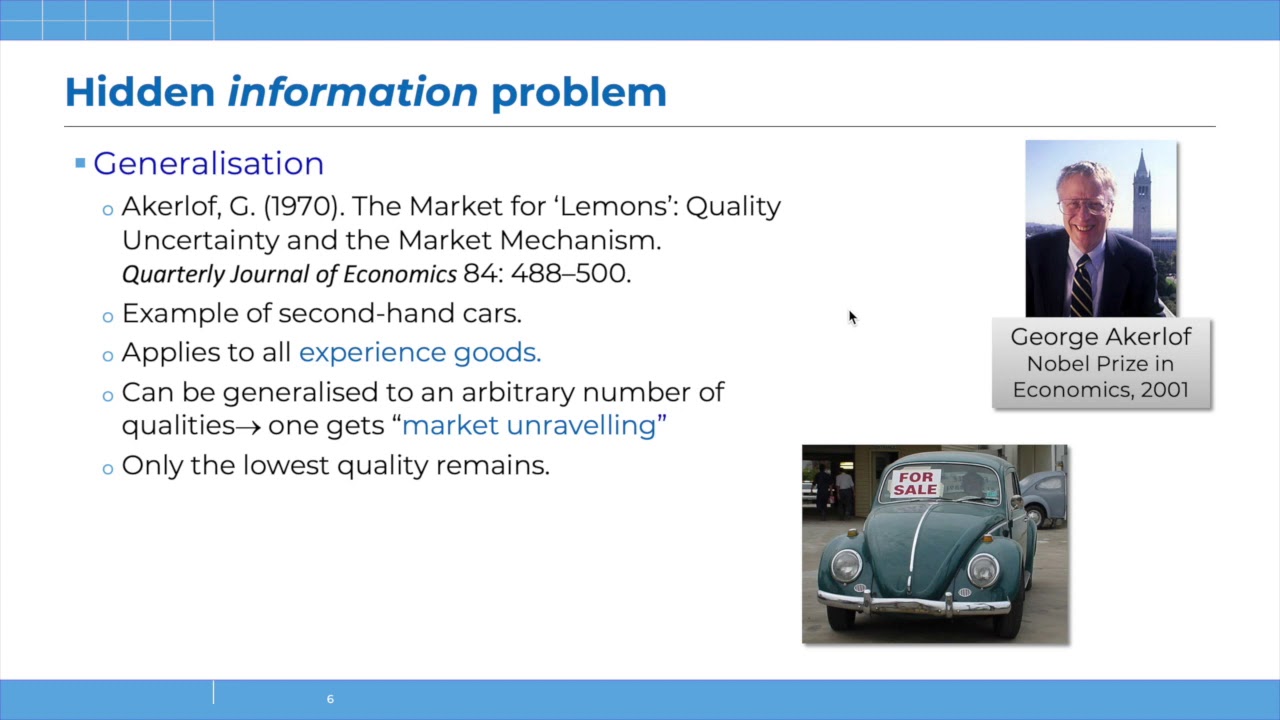
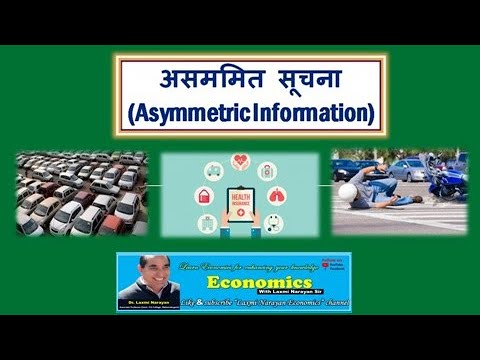
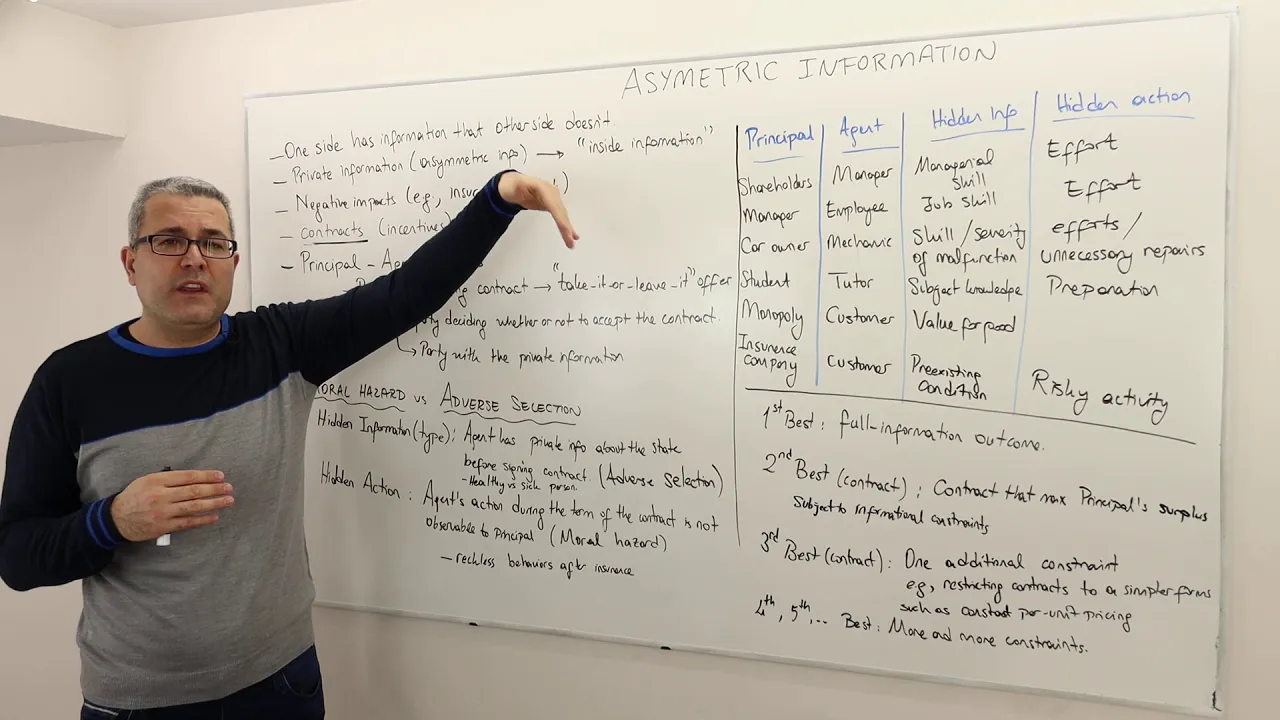
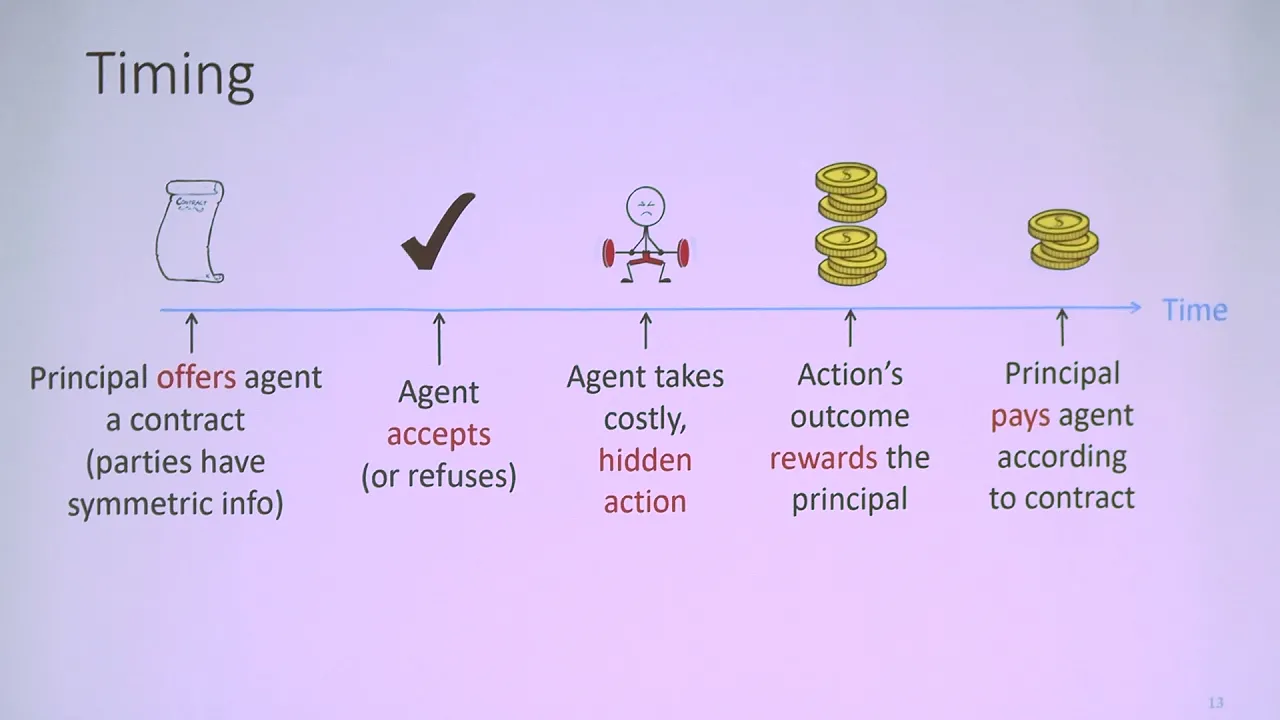
hi everyone welcome to this lecture about the second part on asymmetric information in this lecture i will talk about moral hazard it's a second type of asymmetric information which again is going to lead to market failure i'm going to explain how this happens on the market and i will of course make the distinction between adverse election and moral hazard first the usual disclaimer i do not allow this content to be published without my consent if i see this content uploaded online i will take it out and report whoever uploaded it let's start with the definition of adverse election oh sorry moral hazard moral hazard in economics refers to the outcome of a situation where one or several agents make hidden actions that are unobservable to other agents the definition follows the same format as the one for adverse election but this time the expression i emphasized is not hidden knowledge but rather hidden actions this is the fundamental difference between these two phenomena there is asymmetric information its source is going to be different and it will also lead to a market failure through a different mechanism so moral hazard is about doing taking some actions that are not going to be observed by the other side of a contract let me give you a couple of examples a worker's effort is not directly observable so when a worker is on the job most of the time his or her efforts are hardly observable there are of course some kinds of jobs where the employer can directly see how hard the employee is working but for many jobs the employer is not directly monitoring the employee's actions we can observe the result of the workers as in we can observe how much they produce you can count this but you don't know how hard they worked to get to that level of production so for all the employer knows the worker could shirk which means be lazy and still achieve a good result sometimes it happens without working too hard things work out pretty well a driver can decide to be careful or not the insurance company has no way to check whether the driver is driving in a very careful way or in a um in a careless way is he speeding up on the highway is he paying attention to the traffic lights to pedestrians around him and so on the insurance company has no way to monitor that an unemployed person's effort to find a job is not directly observable to the unemployment benefits provider when a person is unemployed but still looking for a job this person is entitled to receive unemployment benefits this um this measure unemployment benefits is used to give enough time to unemploy people to find a job that fits their preferences skills and so on if imagine that you lose your job today it is august 9th right now imagine you have to pay rent next month and you don't have enough money to pay rent well in a panic you will accept any job that comes in your way so you'll go to starbucks tim hortons mcdonald's any job that is easy to obtain as long as it can pay the bills if you get unemployment benefits which can represent sometimes 80 percent i believe or maybe 60 to 80 of your former wage then you can pay your bills without immediately finding a job which gives you more time to relax but also to look for a benefit the efforts to find a job are not directly observable though although the unemployment benefit provider often asks a proof that the worker is actively looking for a job the rest of the efforts are not directly observable so for all we know for all the government knows this unemployed person could just send two resumes a day on linkedin literally just send them which takes 15 minutes with a couple of emails and say well i've been actively looking for a job look i sent resumes the government doesn't know if sending these resumes took 10 minutes or maybe 10 hours because there was a lot of preparation behind tailoring the resumes to the different jobs maybe making customized cover letters and so on and so forth so how does that informational symmetry differ from adverse selection in adverse selection the source of asymmetry is exogenous so agents are of a certain type ex ante ex ante means before signing the contract and this type is not something that can change they are either the bad the bad driver type or the good driver type or the high ability worker the smart type of worker or the low ability worker they could be um the safe type of borrower or the risky type of borrower but here we are talking about something related to the nature of the agent it is not something the agent can change that's in his genetics if you like so exogenous means it comes from outside it's exterior it's something that is fixed that the agent has no control over the agent happens to be comfortable in a car he's a good driver he's not comfortable in a car he's a bad driver he's a smoker or he's a non-smoker that can have an influence of course on the insurance premium if the insurance company knew is the same as the qualities of the car the car that sellers are trying to sell is either a lemon or a peach no way to change that with moral hazard the source of asymmetry is endogenous it comes from within inside agents choose to do or not do an action that is unobservable so drivers for instance could be the same exante they could both be good drivers or both be bad drivers but they might choose to behave in a different way when it comes to driving so you could have a driver that decides to drive safe or to drive risky this driver could be a bad driver in the first place or a good driver in the first place that would be the adverse election part the moral hazard part is how do they decide to behave which is why we say endogenous it comes from within it is something they decide workers could also be the same example it could be both we could have two low ability workers or two high ability workers but they might behave differently on the workplace one of them might decide to work hard the other one might decide to not work hard at all so their actions happen exposed after signing the contract pre-post and this is the main difference in both of these situations something is not observed by the other side of the contract the insurance company or the bank or the employer or the government and so on so to put ideas in perspective i want to talk about more hazard in the case of the insurance market then from there i will go into the general moral hazard model in agency relationships so moral hazard is the increased risk that's the hazard part of the term of a bad or immoral behavior due to being insured against the negative consequences of such behavior let me give you a couple of examples those are empirical facts that we observe fire insurance results in more arson arson means to set things on fire so as houses get insured against fire we observe more houses being burned down now you could come up with at least two different stories which are both related to moral hazard you could probably come up with more the first one is knowing that the house is insured against fire home owners might be less careful about leaving the gas stove on or things like that which might maybe lead to the house burning down so knowing that they have a safety net knowing that the insurance company is going to repay for the amount of the loss or some part of the loss makes agents more careless the second reason could be well knowing that they're going to get this money back they might decide to set the house on fire on purpose to get that money and kind of run away with money in their pockets that also is a mojo azure behavior knowing that they will get all the money back they are behaving the bad way insurance against theft and accidents decreases precaution you can apply the same reasoning as a fire insurance on cars knowing that your car is insured and any variable inside the car is injured some drivers are less careful and they might not lock their car which result in theft or maybe accidents unemployment insurance decreases job search knowing that you're going to get paid without having to work for a certain amount of time you might decide to kind of cruise and enjoy life for a little i know people who do the exact uh this exact thing for six months a year they work and the remaining six months when it comes to summer time they enjoy unemployment benefits because they know they can find they can go back to their job six months later actions are not observable if they were observable the contract or the insurance coverage could be contingent on action and moral hazard could be avoided that sounds barbaric that sounds fancy it's actually very easy to understand if you know how much effort your customer is putting into his health or his driving or in looking for a job if you know exactly how much effort he's putting then you can make the contract depend on the effort and you can tell you can say well if you if you get a fine or if you get um if i know that you're driving above the speed limit then i'm going to increase the insurance premium i'm going to pay you i'm going to make you pay more if i know that you're looking actively for a job i'm going to give you the amount of your full wage from before you got unemployed but if you're not work if you're not putting a lot of effort to find a job then i'm only going to pay you half as the government so if there was no asymmetric information then the side of the contract that doesn't observe act that doesn't observe actions well if he does observe actions he can make the contract depend on what he sees however in general we do not see that so an indirect way of punishing bad behavior to make sure that somebody is not behaving the bad way is to decrease the coverage you propose less than full insurance this way a driver for instance knows that if he is being careless on the road he might get into an accident and if he gets into an accident he doesn't get the full amount of the loss paid back to him so he will end up with less money after an accident that should give him incentives to not be too careless so proposing less than full insurance provides better incentives but the outcome is inefficient because we expose the agent to risk in order for him or her to behave well if you offer full insurance to your to your customer your customer is going to use that and maybe go to the doctor more than he should even if he doesn't need to he says oh i don't care i'm getting the money back which is costly to the insurance company same they might decide to drive carelessly because because being careful is costly it's annoying they'll say yeah whatever if i have an accident the insurance company will pay back for the for the repairs it's all good so imagine the full the insurance company offers full insurance it means that after signing the contract the driver's income is the same regardless whether he gets into an accident or not either he doesn't get into an accident he pay the insurance premium but his car is intact so he has the full value of his car or he pays the insurance premium but he gets into an accident the car suffers some damages but the insurance company repays the driver for the full amount of the loss so at the end of the day the driver will end up with the same amount of money whether he gets into an accident or not and this is where the trick is if it doesn't matter then a driver for whom it is costly to drive carefully will not drive carefully instead he will prefer to be reckless the idea is that full insurance is removing the risk for the driver so the driver doesn't have any incentives to be safe and the driver cannot tell the insurance company believe me i'm going to drive safe because nobody will ever tell to a company to an insurance company that they are going to speed up on a highway nobody wants to say that it's the same as saying i am selling uh very bad quality products no firm will tell you that so it's impossible for you to believe a firm that tells you oh i'm selling good things well of course is going to say they sell bad things same here so the insurer cannot believe such a commitment now let's talk about moral hazard in the more general case of agency the insurance market i just talked about is just a special case of it in general moral hazard problems arise in agency relationships where parties sign an agreement or contract but there are going to be two specific things happening the first one is that the parties have diverging interest what one wants is not what the other ones an example if you sign a contract to work for your employer your employer will probably want you to work hard you don't want to work hard because working hard is costly it's annoying however you want to get paid as much as possible the employer however wants to pay you as little as possible because your wage represents a cost to your employer so you sign a contract but you do not have the same incentives and the second feature is that some actions are not observable so there is going to be some information asymmetry and because of that after signing the contract one party will have opportunistic behavior they will have incentives to behave their own way the way they want which is not the way the other party wants them to behave for instance an employee will want to not work hard and still get paid which is the opposite of what the employer wants from the worker so there's a need for incentives and well in particular monetary incentives based on observable indicators the employer needs to find a way to pay the agent or to injure the agent in such a way that the agent will want to behave the right way and we can set up incentives non-monetary but also monetary incentives based on things that both the employer and the employee or the insurance company and the driver observe a couple of examples think about a performance-based pay in employment you do not necessarily know how hard your employees are working they could be on social media all day you know you don't really know they are in the office nobody is looking over their work so instead you could pay them based on their performance and the performance could be based on sales profits output anything that is observed by the employer so the employer could think well i'm going gonna pay you high if you give me high profits you could get me high profits by working hard or not but as long as my profits are high i'm gonna pay you high if my profits are low i'm gonna pay you low as easy as that commissions are a great way for employers to make sure their employees are going to work hard many jobs involve a salary based on commission sometimes there's a fixed base salary which is a minimum wage and then the rest is going to be a commission in the form of a percentage of the sales made clothing stores typically pay their employees on commission and this is why you have so many employees in clothing stores coming to you as soon as you step a foot in the door hi good afternoon how are you how may i help you today is there anything you're looking for let me know if you need me to look for another size you know all these things well this is because if they um manage to make you buy then a percentage of the sale is going to go to their wage you probably have seen also employees that sometimes give you advice and once you say oh i'm going to take this piece of cloth of clothing they tell you okay uh so once you get to the cashier tell them that you were advised by sabrina o'brien or whatever and you can check on a receipt that there was a you've been served by and the name of the employee this is not for you to know this is for the employer to know so that they can compute commissions at the end of the month some jobs are entirely based on commission so if a worker decides not to be proactive and sell by just staying in his corner folding some clothes he will not get paid so this is the best incentive to work hard if you don't work hard in this case you don't get paid deductibles in insurance in insurance there is this option called a deductible that consists in an amount of money that a driver has to pay if he gets in an accident so he pays the insurance premium at the beginning of the year no matter what happens during the year if he gets into an accident he will get some coverage back but he will have to pay a certain amount of money to the insurance company this way even if insurance is full after paying the deductible in the case of an accident the driver will not end up with the same amount of income as if no accident happens this is a way to expose the driver to risk and this deductible is based on something observable which is if the driver got into an accident because the if the driver gets into an accident he will file papers he will file a claim and the insurance company will just see oh well he got into a car accident he's going to have to pay the deductible stock option plans in corporate governance many executive positions in big firms higher ups managers regional managers branch branch manager cfo ceo those positions usually include not only a base wage but also stock option plans those are plans that consists in offering stocks of the company at a discounted price to the worker so the worker can buy stocks of his own firm and well if he wants to increase the value of his stocks he's going to have to work hard that's especially the case for higher positions where when you're a ceo for instance well your decisions are going to have an impact on the profits of the firm which in turn will have an impact on the value of the stock it is not so the case if you are just a salesman in a regional store where just your sales will not have a huge impact on the overall profits of the firm which in this case won't have an impact on the price of the stock so sometimes employees are offered this kind of stock option plans like a discount on the stocks of the company but usually it's um higher positions that benefit from maybe actually a free free stocks or a highly discounted price for professional athletes and lawyers we can actually set performance based on well for athletes we can see the amount of victories or medals or positions in championship or tournaments competitions in general and for lawyers we can assess the performance of a lawyer based on the cases they um they win so whenever an athlete is doing well in in in terms of performance we can give him a bonus pay on top of his base wage as a way to motivate him more for lawyers same thing lawyers can maybe perceive a bonus based on the number of cases they solved and they won at the end of the year to give them an incentive to work even harder to give you an example for athletes in fighting and i'm thinking about mma like the ufc kickboxing boxing often after a fight the promotion the organization that organizes the fights gives bonuses to reward the best fight of the night the best knockout of the night the best submission of the night and so on and so forth to give you an idea right now at the ufc a um fighting bonus is equal to 75 000 so if you happen to fight hard offer a great performance many rounds a lot of fighting a lot of back and forth a very entertaining fight you might get 75 000 on top of what you got paid to fight if you uh ko your opponent same you might get a 75 000 bonus that is an extra incentive for you to work hard on the ring in the ring and i'm pretty sure that athletes at in the nba nfl mlb and so on also get bonus bonuses at the end of their uh at the end of the season based on how many points they scored how many games they played and so on and so forth so let's go over a model of hidden action we have a principle p that hires an agent a so highers here is a general vague term and the word principal and agent are vague as well any agency relationship in economics is also called a principal agent relationship or principal agent model the principal is the one writing the contract the agent is the one signing the contract so to give you an example here imagine a principal in the form of a shareholder so it is one of the owners of the company who doesn't work at the company only owns some stocks the shareholder hires an agent in this case that could be a ceo cfo or a manager of some sort the agent is going to be called a to work on a project on her behalf so the shareholder is like okay i have this money i need to i need somebody to work on this project the return from the project isn't certain it could be either a success or a failure i am simplifying things a lot here i'm just making it binary success or failure whereas usually there would be a continuum amount a continuum of output levels or profit levels the agent can exert an unobservable effort but it is costly to him so i'm going to assume something very simple here the agent can either exert a lot of effort or no effort easy and again in real life there is a continuum of possible efforts working being very lazy a bit lazy working medium amount hard very hard insanely hard you could make as many categories as you want another assumption is that if the agent works hard the project is successful with a higher probability than if he is lazy that is also an assumption that makes sense when somebody works hard there is a high chance of high profits or a success obviously the principal prefers success to failure and in this case he will want the agent to work hard i will talk about this later it is not always the case let's like in the market for lemons go over different information structures in the first one we assume perfect information where everything is observable we see everything so in this case effort is observable so the principal the shareholder knows how hard the agent is working in this case the principal can use an input-based performance schemes input is like labor capital and so on so effort is an input the principal can then pay the agent based on whether he works hard or not not on the result like the profits or the failure or the success but based on how hard he works and the wage could be something like the employer pays a nice wage if the agent worked hard but nothing otherwise well in this case the agent will work hard if the wage is good enough to sign the contract you have to think about opportunity costs of signing the contract after all the manager the agent might prefer to work somewhere else so he might not sign the contract so the employer needs to make sure he signs the contract but once he signed the contract the contract the contract can say well you're going to get a nice pay if you work hard but if you don't work hard and i know whether you work hard or not i am not paying you at all it's a pretty cut throat performance scheme but this way the agent will never decide to shirk that's the perfect information case it is efficient the agent accepts as long as the contract is better than what he could do somewhere else and he works hard now let's go over the second information structure there will be only two here as opposed to three in the case of adverse election if you remember in adverse election i went over the case of perfect information imperfect information but symmetric where nobody knows the type of car that is being sold in the case of asymmetric information where only one side of the market knows what the quality of the car is so here since the agent decides how much effort to put there is no point in looking at the second case the second case says nobody knows anything well a worker who decides to work hard knows if he is working hard he might not know his type but that's the adverse election part so it doesn't make sense to have the second information structure here so let me move on to the third one directly imperfect and asymmetric information hidden action case so the agent is paid a wage which is possibly contingent on effort or project outcome it just depends on what's observable but here i am assuming that effort is unobservable so the wage cannot depend on how hard the agent works because simply the principal has no way to tell he doesn't know if the agent works works hard or not so he cannot pay him based on that rather he can pay him a fixed wage but if he pays him a fixed wage the agent is getting paid the same whether he works hard or not so what do you think is going to do the minimum why does he need to work hard if he's getting paid the same amount and a fixed wage act like full insurance think about it no matter what happens no matter the level of profits no matter the amount of efforts the agent is putting into his work he is getting paid the same wage so why would he exert a costly effort why would he provide effort when providing efforts is annoying is getting paid the same just show up at the office do the minimum no need to work overtime no need to yeah just do the minimum to get paid so what i mentioned before was that insurance is a broader concept here this is the idea that the agent is not subject to risk he's not exposed to risk in his pay if his pay is not risky as in it will be the same no matter what no incentive to provide efforts so a fixed salary gives no incentives the agent will not work hard but be lazy and more generally the agent not bearing any risk results in moral hazard same as full insurance against fire same as unemployment benefits given to you without any condition and so on obviously the principle here is not able to provide the right incentives so he has to propose a different type of contract we saw in previous examples that things like commissions piece rates bonuses deductibles in insurance markets could be used to expose the agent to some risk so because effort is not observable but output is or profits are observable then the wage can depend on what is observable so the principal could tell the agent i'm going to pay you a high wage if the project is a success but i'm going to pay you a low wage if the project is a failure whether it's a success or failure is something that everybody can observe how hard the agent works for it is not observed by the principle so what the agent is going to do in his head is compare his expected utility by working hard versus not working hard remember if he works hard there is a higher probability of a success and there is a higher probability then of getting a nice wage so on one hand providing efforts is annoying and costly on the other hand a success is more likely and so a high pay is going to be more likely so the agent is going to compare the potential wage he can make with the effort he has to provide if this expected utility is higher than not providing effort and get paid it could be also be high remember even by not working hard the project could be a success so then the agent will decide whether he works hard or not based on this potential contract it is also possible that at the end of the day he decides to work hard but the project still ends up in a failure so he might still get a low wage and that's the gamble here he could work hard but might still get paid a low wage he could be lazy and still get paid a high wage so this is the risk that the agent is exposed to so in general a variable pay bonuses piece rates your wage could be based on what you produce per piece you get paid per piece profit shares you could maybe get a certain percentage of the profits made deductibles for insurance are ways to solve the moral hazard problem these are ways to expose the agent to risk and to make him behave the way the principal wants him to behave it is inefficient risk bearing because it's necessary to make the agent work hard but it is inefficient because if information was perfect we would not need to expose the agent to risk you work hard i pay you a lot you don't work hard i don't pay you there is no risk here as long as the agent works hard he gets paid the high amount here there is a probability that even by working hard he gets paid a low wage because the project fails so let me go over the general problem i mentioned earlier that the principal wanted the agent to work hard but in reality the principal might not always want that to happen think about it if you want to make your employee work hard you have to pay him more but how much you have to pay him compared to how much profits he can bring might not be a good deal compared to paying him a low amount and he doesn't provide any effort if i need to pay you a million dollars to a card i might prefer you to not work hard and i can pay you minimum wage right so the firm the principal the employer the insurance company faces a two-stage decision problem there are two things a firm needs to take into account first how much does the firm need to pay its employee for each level of effort it wants him to exert well if i don't want my employee to work hard i pay him minimum wage that will do but if i want him to work hard i need to pay him more so first of all for each level of effort how much do i need to pay him first thing then second what level of effort is going to maximize my expected profits if he doesn't work hard on one hand the probability of a success will be smaller but i won't have to pay him a lot so there is a trade-off on the other hand if he works hard he might bring high profits with a with a good probability but at the same time i might have to pay him a lot for that and maybe the expected profits are higher or lower if you want your agent to work hard so first how much do i need to pay you to work hard versus not hard second what do i want you to do do i want you to work hard or not given what i have to pay you in each case maybe my profits will be higher if i let you be lazy and there are many jobs like that think about mcdonald's mcdonald's could pay you on the number of burgers you produce sure but at the end of the day the burgers you produce only depends on the number of customers who want burgers so there is no point in producing more burgers than needed so if mcdonald's pay you per burger pays you per burger then you might decide to produce way more burgers than needed which lead leads to a loss for mcdonald's so mcdonald's instead can say no just make a burger when it's needed when a customer wants that burger so in this case you get paid minimum wage you do your minimum amount of work which is make a burger when a burger is needed so it's not always obvious that the principal wants the agent to work hard or in general provide efforts so let me summarize all of that moral hazard problems arise emerge if the parties to an agreement have diverging interests they do not want the same thing in general they want the opposite actually and at the same time some actions are not observable by one party of the agreement potential solutions are then based on what's observable in the form of monetary incentives you pay somebody based on how much profits he brings you or you pay him a bonus if you see that he's doing well in one form or another it could also be indirect monetary incentive like a promotion it could be a promise you could tell your new worker well we are a fast-paced firm if you work well we are going to promote you within one or two years so maybe you might not get paid high right now but if you do a good work within a year you're gonna get a promotion and you're gonna get paid more or it could be deductible indeductible is not a way to reward you if you behave well but it's a way to penalize you if to punish you if you behave bad so that's the thing you can use two different ways you can reward good behavior you did well i'm gonna give you a bonus or you can punish bad behavior you did not do well i'm gonna give you a penalty i'm gonna take money from you or i'm gonna pay you less we could also solve this problem if well there was no information asymmetry in the first place by monitoring actions then the principal might be able to base the the contract on input on effort for instance the principal could hire an i.t guy who looks at what everybody does on their computers at the office if they see that the employee is spending too much time on youtube or social media and so on then they might say well i saw that you only worked six hours today instead of eight you came to the office for eight hours but there are two big hours where you were not working at all you were on youtube watching funny funny videos so i'm gonna pay you for only six hours monitoring of actions is costly you need to have somebody to check after somebody else you need 19 guy for instance to look at the history of um of navigation of all of the employees costly but it's possible penalties and fines in law enforcement think about parking lots in downtown any city in the world parking spots are not free in general you have to pay for them and they're not always controlled there is not always policemen or cops of the sorts that um verify that people pay for the parking so you might decide to not pay for parking hoping that you don't get fined because nobody is going to control that but every now and then cops of course control that and will give you a fine of course you will look at the probability of getting a fine versus paying for parking every day but if parking every day costs you ten dollars and cops only check that parking spot maybe once a week and a fine is equal to 35 then you might make the math in your head and think i could go to i would not pay for parking for the whole week get a fine every now and then like 35 which is still cheaper than paying for parking ten dollars a day five days a week fines in law enforcement is another way to monitor your actions there is also a thing called transfer of ownership i talked about it in the previous tutorial and we'll talk about it again in this tutorial about more hazard companies can sometimes only keep a fixed amount of the profits made on a project for instance and leave all of the money all of the rest of the money to the agent it is a typical way to remunerate cab drivers cab drivers pay a fixed fee to their employer to be able to use the car that has the name on it the phone number and so on they pay a fixed fee like a rent and any money they make after paying the rent goes directly to their pockets so if they decide to work an extra hour the money made on that hour is entirely going to their pockets so that gives them an incentive to be on the road as much as possible which is beneficial to the company because well seeing a cab driving around all day or maybe all night is gonna um is a very it's a very good promotion tool you have the yellow cab or the black car with the name on it with the phone number on it and the more people see that cab in particular the more they're going to think oh well there's this cab i can call i know this company because i see them around all the time there could also be repeated interactions so think about implicit contracts working with the same people every day might give you this implicit relationship where well you have expectations of your colleagues and colleagues have expectations of your work and expect you to provide a certain amount of work the promise of a promotion is also an implicit contract it's only a promise they might not promote you but that might be sufficient for you to provide efforts again the outcome may still be inefficient because each of these solutions are exposing the agent to risk let me finish with another distinction between moral and adverse selection same as before adverse election is about hidden information which comes from the costs of distinguishing among individuals with different characteristics the good versus the bad driver the smart versus the non-smart student the healthy versus the unhealthy customer but it's in their genes it is not something they can change with more hazard it's about the choices that agents are going to make after signing the contract so that arises from the costs of measuring and controlling different behavior of individuals a driver might decide to be risky or to be safe an employer or an employee sorry might decide to work hard or not whether he's smart or not doesn't matter he might decide to work hard or not well both problems cause market failure i hope that by now i convinced you of that in reality things are pretty complicated we have both problems interacting with each other think about a driver ex-ante the driver could be good or bad that's just in his nature but on top of that the driver might decide to be careful or not so now you end up with not two different cases but four cases a good driver who decides to be safe a good driver who decides to be careless a bad driver that decides to be safe and a bad driver that decides to be careless four possible types of people same as a worker it could be a productive worker that works hard a productive worker that doesn't work hard because you know he's productive he knows he's going to get the job done so he's a bit lazy about it or a non-productive worker who works hard maybe to compensate for his lack of talent or skill or a bad worker just non-productive worker who doesn't work hard in these lectures i made the distinction between the two problems to see where the market failure is coming from in each case but in real life we always end up with both you can have naturally healthy people good genes never sick never any weight problems no diabetes no allergies that decide to stay healthy after being insured but you have the ones who are naturally healthy but decide to go a bit crazy because they are injured and on the other hand you have the not so healthy people to start with that keep being unhealthy don't do anything to change that or you have the unhealthy people who are to be who are careful about the health because they care which dominates will of course depend on the circumstances so over this course over the course of this whole course we broke a couple of preferred competition conditions every time and see how this affected the market equilibrium outcome first thing we broke the price taking behavior we violated this assumption by assuming a monopolist so a price making situation instead of a price taking situation we went over the case of the weight of a of a monopolist and lo and so that there is a dead weight loss we then talked about externalities and public goods which are specific cases that also can lead to a market failure as in the outcome is not power too efficient anymore i quickly talked about different types of goods in tutorials where good are not homogeneous because they're not homogeneous firms have market power and because they have market power again the price or the quantities will not be competitive and i talked about the information structure the we violated the condition of perfect information and see where that led there are other conditions for perfect competition that i did not talk about in length which once violated also lead to a market failure i hope that these two lectures about adverse election and mall hazard help you understand why this kind of contract are being proposed to agents why warranties are proposed on goods what is the objective behind a warranty what is the objective behind advertising behind lineups you know what is the value of signaling how can it be used and how do education institutions use their reputation as a way to increase the tuition fees because their reputation can be used as a signal for students to get a better job or a better deal once they get a new job that's it for this lecture on asymmetric information have a good rest of your week and well maybe not see you in the next one but have a good one let's say that bye
Up Next

46:04
Food Deserts in Virginia: A Documentary on Food Insecurity
@VSUOfficialChannel
271.7K views•2015-03-04

5:07
Impact of Yuan in Indo-Russian Trade Amid Sanctions
@WION
261.9K views•2022-07-01
10:33
Behavioral Economics Explained: Rationality, Nudges, and Risk
@crashcourse
1.1M views•2016-03-12

113:18
The Age of Easy Money: Fed & Inflation | Full Documentary
@frontline
21.2M views•2023-03-15
Related Study Plans & Knowledge Roadmaps
Structured learning paths in Economics
economics
Sovereign Debt: Defaults, IMF & Restructuring
01Introduction to Sovereign Debt & Government Bonds
02Debt Sustainability & Credit Ratings
03Anatomy and History of Debt Crises
+ 2 more learning modules
12h5 modules
Explore Roadmap
economics
Market Design: Matching Theory & Gale-Shapley
01Introduction to Market Design and Price-Free Markets
02Two-Sided Matching & The Gale-Shapley Algorithm
03School Choice Systems and Mechanism Design
+ 2 more learning modules
10h5 modules
Explore Roadmap
economics
Impossible Trinity: Forex, Capital & Policy
01Introduction to Monetary Policy and Central Banking
02Exchange Rates and International Capital Flows
03The Mundell-Fleming Model
+ 2 more learning modules
8h5 modules
Explore Roadmap
economics
Healthcare Economics: Market Failures & Systems
01Introduction to Healthcare Markets and Market Failure
02Asymmetric Information and Adverse Selection
03Moral Hazard and Insurance Design
+ 2 more learning modules
12h5 modules
Explore Roadmap