














![코로나 봉쇄와 러우 전쟁, 미중 갈등... 세계무역의 판이 뒤집힌다 [압권 15화 1부]](https://i.ytimg.com/vi_webp/Hvgav88KUek/maxresdefault.webp)



![공멸의 길로 가는 트럼프! 약한 나라가 먼저 쓰러진다! [코너별 다시보기]](https://i.ytimg.com/vi_webp/LnzeD4j91Cc/maxresdefault.webp)
Free trade, despite its idealized image of prosperity for all, operates through complex mechanisms that create winners and losers globally; while industrialized nations preach free trade principles, they simultaneously employ protectionist measures such as subsidies, tariffs, and trade barriers to shield their domestic industries, particularly in agriculture and manufacturing, thereby creating an unfair system where developing countries are forced to open their markets prematurely without equivalent protection, ultimately benefiting multinational corporations and wealthy investors while harming small farmers, workers, and local economies worldwide.
Free Trade's Broken Promise: Winners, Losers, and Protectionism
Added:The economic theory of comparative advantage, which explains how countries benefit from specializing in goods they can produce at a lower opportunity cost.
The fundamental differences between free trade policies and protectionism, including the mechanisms of tariffs, import quotas, and export subsidies.
The role of major international trade institutions and agreements, such as the World Trade Organization (WTO) and regional trade blocs like NAFTA/USMCA.
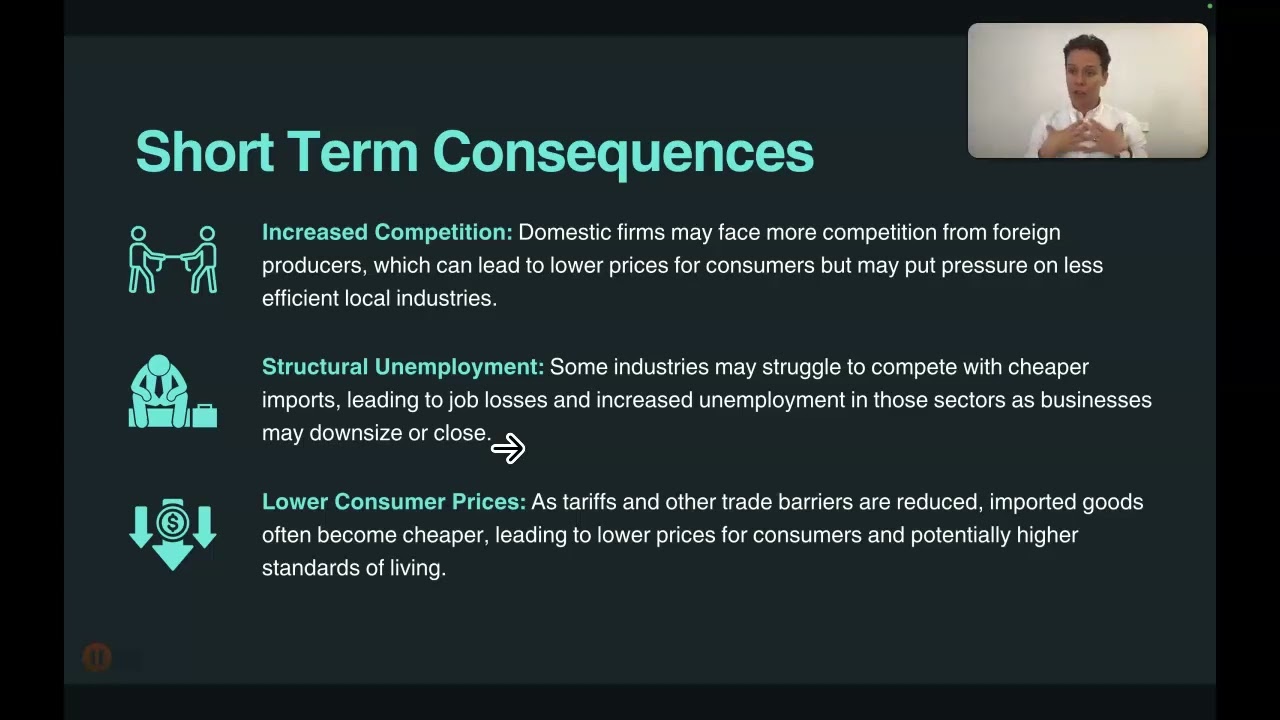
How trade dynamics influence domestic labor markets, specifically the concepts of structural unemployment and industry relocation.
The design and efficacy of Trade Adjustment Assistance (TAA) programs aimed at retraining and compensating workers displaced by global competition.
The political economy of trade barriers, exploring why governments implement tariffs despite widespread economic consensus on the overall benefits of free trade.
Modern shifts in global trade strategies, such as 'near-shoring', 'friend-shoring', and the balance between economic efficiency and national supply chain security.
The relationship between persistent trade deficits, currency valuation, and macroeconomic stability in developing versus developed nations.
2.7M views20.3Klikes42:26Original Release: 2018-06-06
[Music] Free trade. Millions of tons of goods in motion across the planet.
It brings prosperity, or so we're told.
Protectionism and isolationism are evils from the past. Or they were until Donald Trump called for duties on steel imports to the US.
Europe and China threatened reprisals.
Are we on the brink of a full-scale trade war? First, I'm signing an executive order to ensure that we fully collect all duties imposed on foreign importers that cheat. They're cheaters.
How are we being deceived when it comes to global trade? And what role do we ourselves play in that deception?
[Music] Germany can't expect the rest of the world to buy its goods while remaining reluctant to buy goods from abroad.
The arguments made for and against free trade are full of contradictions.
Germans are proud of the country's rank at the top of the list of exporting nations, seemingly unaware that free trade destroys livelihoods at home and abroad.
It's a David and Goliet situation, but just that in this case, it's golad that wins because the European Union is the goliet in the whole show.
Who are the real winners? And is free trade really as free as it sounds?
[Music] the port of Hamburg. From here, German products are shipped to countries all over the world. In return, around 9 million containers arrive here every year, most of them from China. The city in northern Germany is a gateway to Europe for goods from Asia. And when they enter the EU, many products are subject to import duties.
Cars from Asia and the US are taxed at 10%, clothing at 12%, smartphones aren't taxed at all.
[Music] Customs duties are complex. There are thousands of different types of terrace in countless variations.
Agents Gabby Jansen and Ava Hoffman from the port's central customs office check imports every day.
It's their job to ensure that goods are declared properly. There are a vast number of loopholes.
It says it's a microfiber coat for a pet.
That's right. Made of knitted polyester.
Exactly. From the size, I'd say it's supposed to be for a dog.
Made in China.
And they're different sizes. This one's apparently for a mediumsized dog.
Do the dog coats have leather parts as well? In that case, they'd be charged at a lower rate.
100% polyester. So, at the moment, that means a 12% import tax.
If these were settled, that would only be 2.7%.
They have no idea what's behind that difference. It's a decision taken at the EU level. All they do is check the contents of containers.
[Music] I've been working here for a long time and working here you feel like Germany isn't the world's top exporter but that most of the stuff is coming from China.
The Chinese make pretty much everything.
The question is do import tariffs bring benefits outside of government coffers?
I guess they protect a country's domestic economy.
Is that true? What role does protecting domestic industries play in an era of global free trade?
[Music] We've come to the town of Hilborgousen in the German state of Turingan, home to Vulfgang Rener's company, Marida and Centurion.
The former top cycllor cross cyclist was the man who brought mountain biking to Germany in a big way.
Today he's a successful entrepreneur.
[Music] The company offers a range of models and business is booming. So where do the bikes come from?
This bike, it's made in Germany.
No, it's not made in Germany.
But it's a German brand. Yeah, it's a German brand. So, where does the frame come from?
Like so many things, the frame comes from China. It's painted and assembled in Taiwan. Quality control all happens here.
Made in this way, a bike like this pays a 15% import duty when it arrives in the EU.
But if it was shipped directly to Germany from a factory in China, the importer would have to pay almost 50% in punitive tariffs. Why? Because a Chinese company can make bikes much more cheaply than a German firm ever could.
20 years growing has become the world's largest bicycle manufacturing leading enterprises. The group we have established.
In this promotional video, Chinese bicycle manufacturer Fushida claims it has the largest bike factory in the world.
International first class production technology and more than 100 robots welding machine.
Companies like these are subsidized by the Chinese government. But that's just one reason Chinese products are so cheap. There's also scale are creating miracles one after another.
With a production capacity of 100 million bicycles a year, China could quickly swamp the world with its products of various markets all over the world.
Companies like Wulfgang Reners would go under. So he sees the import tariffs as protecting Europe's bicycle manufacturing industry.
Sometimes you have to have protectionism.
It's unavoidable.
The point is that in business you need a fair playing field.
You can see it in other areas too where government subsidies keep other manufacturers from competing because the market is distorted.
So it's about jobs in Europe.
Sure. It's about jobs and fairness.
The import duty ensures that Chinese bikes are more expensive when purchased in Europe. Punitive tariffs, a form of pure protectionism. But there are ways around them. For instance, having the bike frames that are produced in China finished in Taiwan, then punitive tariffs don't apply. The final assembly of bicycles made with Chinese frames then takes place in Europe.
It's an industry that provides 100,000 jobs on the continent.
[Music] Rena is glad that protectionist tariffs keep Chinese competitors out of Europe's markets, but the international trade in bicycles is a hotly fought segment, and the companies trying to grab a slice of the pie will go to great lengths to do so.
Not long after the EU implemented punitive tariffs on bikes from China, they began to arrive from Cambodia, Malaysia, Indonesia, and other places.
When it grew clear that the bikes were actually being made by Chinese firms, punitive tariffs against those countries were put in place. Then Tunisia began exporting them and was soon slapped with tariffs.
Today, components for the bikes are still mostly made in China, but the frames are finished elsewhere, like Taiwan, because that's where the rules say value is added. The bikes are then no longer subject to punitive tariffs when they're imported into the EU.
[Music] So, what happens when the market for bicycles isn't protected by high import duties? In the US city of Philadelphia, bike store owner Brian Cathwick used to sell exclusively American brands that had been produced domestically.
But that changed a few years ago. There are still American brand names, but the bikes all originate in the same place.
Made in China.
It doesn't matter which the manufacturer is, whether it's Tre, whether it's Canidale, whether it's Specialized, all their bikes at at some price point or at some level are made are made in China.
[Music] without protectionist policies like those in Europe. He says Chinese bikes have flooded the market in the US and that has in turn destroyed a lot of jobs in the country, especially in his home state of Pennsylvania, where the bike manufacturing industry once flourished.
[Music] The store owner says it's not a good feeling to promote the sellout of the domestic sector by selling cheap imports. But what choice does he have?
Keeps my family fed.
you know, I own two different bicycle shops. Um, to be able to offer the offer my consumer um a bike for under $400 that has gears to be able to offer a bike for under $300 that's like a single speed ride around the city. It's nice to be able to do that.
President Trump has threatened many sectors with punitive tariffs, but not the bike industry. In general, Cathwick is critical of protectionist measures, but he would have made an exception for bicycles.
This one is made in China.
It depends on what perspective you're looking from. You know, people who have lost their jobs because it's been farmed out to China or Taiwan.
They'll probably have a very different view than somebody who's never been affected by that.
But isn't free trade supposed to bring more prosperity for everyone?
American woes in many areas of trade can't just be traced back to China but also to Germany says professor Herabad Dieter.
He teaches his university students in Fru Haen that being an export giant also has a dark side.
German products sell well internationally not just because they're high quality but also because wages in the country have only climbed moderately in recent years while the euro has remained relatively weak.
Trump is angry about the trade imbalance and deer says he has a point.
Surpluses in Germany mean deficits in other countries. Germany expects the rest of the world to go into debt with Germany, but also likes to criticize the rest of the world for being too deeply in debt. It wants to have its cake and eat it.
Germany really does profit immensely from global trade.
In 2017, it exported goods worth over€1.2 trillion euros. Like China, that makes the EU a big net exporter.
Germany has a whopping 250 billion e trade surplus.
The US has a deficit of around 500 billion. With many more goods and services flowing in than flowing out, ongoing debt has long-term consequences for America.
[Music] One country's loss is another's gain.
[Music] We head next for Bavaria.
On the river Zal here, Manfred Schmidt works for Sheffller, a company making products that are often exported to the US. He earns a good salary and can afford to buy the things he wants.
That includes many products made available by free global trade.
Just like most households all over the world, the Schmidz home is full of things made in other countries.
Is anything here in their living room actually made in Germany?
[Music] Very little. If we got rid of everything that wasn't made in Germany, there'd be nothing left. land is with one exception, the antique sewing machine proudly on display.
What about clothing? We take a look in the family closet.
[Music] Made in Turkey.
Made in Bangladesh.
Designed in Germany. Made in China.
[Music] Even their pantry is full of food from all over the world.
Manfred Schmidt nearly lost his job when Sheffller wanted to move his plant to a cheaper location abroad.
The employees fight to keep the plant drew national attention. Schmidt and his colleagues came to an agreement with the company. It worked for a while.
For 10 years, we put in five unpaid hours a week. And then they came overnight and said, "We're closing the plant." That was a shock for all of us who worked there because we were all thinking, "We do 5 hours a week for free, so that's a pretty sum the company is getting for nothing.
The shadow side of globalization.
Manfred Schmidt was lucky. He was able to stay with the company, but he had to move to another plant.
Everything's all sweetness and light now. And they act like we're the winners because we make good money in the industry, but that's down to relocations and plant closures. We were lucky to get positions in Shrine. But in another company, they might just let everyone go, and those people will be the losers.
Manufacturers usually go where it's cheapest. We take a look at the Schmidt family bicycles. The brands are all German, but we know where they were all made. At least the frames.
Cheap production in China that caused hundreds of thousands of jobs, especially in the US.
Back to Philadelphia. The city is a dynamic growing urban center.
But in the surrounding region, the factories and jobs have disappeared like in many parts of the US.
Sarah Parker and her neighbor Susan Schwiker don't count themselves as losers in the globalization era and they don't like Donald Trump, but they're on a mission. Buy American.
I know. Sarah has a popular website and by American is its clarion call.
Um some games like board games okay are made in USA so we'll see every store a little different.
In her USA love list she gives thousands of fans advice on how to replace products made in other parts of the world. She says it's about their jobs.
Oh, check it out. American flags.
You wouldn't believe how often American flags are not even made in the United States.
This is made in the United States.
Is it?
Yeah. Oh, yeah. Oh, good. I like it when they when they put the label in the United States on the front because people really do care about that. This was made in a small town somewhere, I'm sure. I don't know where, but by looking for the made in USA label, um, I'm supporting that small town and the people who made it.
Parker says she herself experienced how jobs moved south of the border to Mexico and depopulated whole areas as the factories died.
China. China. Yeah.
She decided to do something about it.
My first job after college was selling Chevrolet. Uh I went back a few years ago and that dealership is closed, weeds growing, completely abandoned. Uh it's sad to see. Um and the the pride that people have when they build something and then are able to purchase it. I think that we've lost that.
It's often hard to determine the origin of global products. That's the new norm.
The two Americans say that should bother us more.
You know, they don't have to tell you where things are made. I think it's only food things and cars. So, we're actually lucky they give us as much information as they do.
Parker admits that she made an exception when she bought a Volvo. The Swedish car maker now belongs to a Chinese multinational.
in her household. She says she's trying to buy only Americanmade products with at times limited success.
What's not?
Um, so there's some things that I'm not sure, but I know the KitchenAid um is assembled in Ohio. I think I read that the bowl is made in Korea. I know that the toaster is not You cannot buy an Americanmade toaster.
I thought this was Americanade.
The label isn't because it says General Electric. Her initiative sounds like it has a nationalist agenda.
Parker says it all boils down to a matter of choice.
I think it's only nationalistic if you are saying we're only going to buy Americanmade products. We make a lot of choices as consumers. We choose things because they have uh recycled content in them or we choose things because they reflect a particular lifestyle that we want. Uh choosing something that's made either in your own community or your own country is just another consumer choice.
I'm glad that we have those choices which is why for me at least it's not a nationalistic effort is not American.
So what would happen if we all followed her advice and tried to buy only products made domestically? If borders closed and protectionism reigned.
It's happened before. At the beginning of the 20th century, world trade and globalization really took off. But it soon hit major speed bumps.
The US slid into the Great Depression.
Germany faced a huge economic crisis of its own and protectionism suddenly reared its head. Voices calling for isolationist policies grew loud. During the 1930s, the US began to adopt an increasingly aggressive protectionist stance, raising tariffs drastically to protect American industries and jobs.
Germany also put up barriers to international trade. The mixture of protectionism and nationalism ended in the horrors of the Second World War.
[Music] There were disastrous developments in world trade. In terms of volume, it fell by 2/3 within four years.
By today's standards, that's unimaginable.
If we saw a 5% fall in trade, people would call it a major crisis.
But back then, it fell drastically and dramatically.
And that development can be traced back to protectionist policies put in place by the United States of America.
To prevent other major conflicts, the body that would eventually become the World Trade Organization was set up, headquartered in Geneva.
Its fundamental principle that free trade brings prosperity for all has never really been accepted. On the contrary, the WTO has come under heavy fire in recent years.
And the US, led by Donald Trump, largely ignores it.
[Music] Is protectionism set to send the world into a new economic and political tail spin? Or are dire predictions just half the story?
In the town of Mulaker in the German state of Benver, the Stola group makes tiles. Business is brisk. The construction industry is healthy. But the business is facing stiff competition from China. Tiles from there are unbeatably cheap. So the EU has put punitive tariffs in place.
Tiles imported from China now have an import duty of 26.3% protecting jobs here from Asian competitors.
If they didn't exist, says Wilson, baths and kitchens in Germany would soon all be tiled with Chinese products.
[Music] I think it's justified in the current climate because the competitive situation is unbalanced. We know that Chinese manufacturers are selling their over capacities internationally at very very low prices and that puts us in a situation where we can no longer be competitive.
We can't keep up if we have to play by those rules.
[Applause] Punitive tariffs on tiles is also a protectionist measure, but it keeps people in jobs in Germany and helps push for better production and environmental standards.
[Applause] We produce here in Germany. We're expected to comply with laws that are relevant in Germany. and we do so we exercise control over things like environmental aspects. Of course, we don't have that for products coming from abroad.
Then there's the issue of weight versus value. Does it really make sense to transport these products over such long distances?
Without punitive tariffs, European tile makers wouldn't hold out long under the pressure exerted by their Chinese counterparts.
If the EU hadn't instituted protectionist measures, the industry would soon disappear. And not just the tile industry.
In all, the block has put punitive tariffs in place for 53 types of imports from China, among them steel, porcelain, and even ironing boards.
The anti-dumping measures have been accepted by the WTO.
Protectionism is alive, well, and apparently protecting jobs.
[Music] But although the EU has taken measures to protect its businesses, it frowns on other countries trying to do the same.
Cameroon Mamembal is on her way to her plantation.
The path takes her through the jungle.
She's the head of a village cooperative located in the rainforest north of Yaund.
The walk takes about an hour in each direction.
There's no street.
The cooperative members harvested over two tons of onions here last year and sold the crop at a market in the distant capital. The proceeds fed the entire village.
We use onions as a remedy. For example, when you have digestive complaints, we use it as an antiseptic. And we make our sauces with onions.
Cameroonians wouldn't know what to do without onions.
Now the women from the village are planting cassava instead. Not because they want to, but because it no longer makes sense to plant onions.
Onions imported from Europe have destroyed the market.
To protect farmers like these, Cameroon would have to raise import duties even more. But it can't because a new free trade agreement with the EU called EPA prohibits that.
Our onion fields stretched from here down to the river and over there.
But then we stopped being able to sell all of them because of the huge number of imports.
That's why we had to stop growing them.
consumes hundreds of thousands of tons a year. Until now, they were all grown domestically.
Just as they do every day, the women in the cooperative prepare dinner.
For now, they still have their own onions, produce that not only feeds them and their families, but also helps them survive.
[Music] My dad Uhhuh.
50 km south at a market in Yaund, it's growing harder and harder to find onions grown domestically.
Every morning, trucks arrive here filled with onions. Most of them have been imported from Holland. They're the ones packaged in red nets.
Mamembal has dressed up for the trip to Yaund to talk about the onion issue.
She's meeting up with Ivonne Takang, who heads up an office that examines the effect free trade is having on everyday consumers here.
The two discovered that Dutch onions cost around a third less than homegrown varieties.
But how can that be when there's already a 30% punitive import tariff on the vegetable?
And as though the cheap onions weren't bad enough for the farmers, other agricultural products like garlic from China are also flooding markets in the fruitful country.
We have no chance. As you can see, we asking time to protect our domestic markets first and build our economies before thinking of opening our markets to the world. European overp production is undercutting Africa's agriculture sector.
Mamembal doesn't know what to do next.
What happened with onions could happen just as easily with other farm products and the new free trade agreements with the EU don't allow Cameroon to raise punitive tariffs any further to protect the industry.
I think it's high time they understand that they should leave African countries to build their own markets just as the EU took time to build its own markets.
It's time that let us build our market and then we can think partnership agreements with the EU.
In other words, Europeans are denying Africans what they need most, the right to institute measures to protect their still vulnerable agriculture sector.
All industrialized countries, including Germany, were only able to grow into economic heavyweights because they initially threw up big barriers to foreign competition.
But that fact is conveniently forgotten nowadays.
Without protectionism, in other words, Germany never would have turned into the industrial powerhouse it later became.
Back in the 19th century, the iron chancellor Ottoen Bismar closed borders to keep out imports of wood and grain from Russia.
And Britain also protected itself by coming up with the made in Germany label. At the time, it was meant to identify cheap mass-produced knives.
Only later did the description grow to have positive connotations.
Countries preach free trade principles when they themselves are especially competitive and they preach it for the sectors where they're especially competitive. But in areas where they're less competitive, they allow protectionism, like in agriculture in Europe, for example, in Switzerland.
We've come to the canton of Sgalan.
Not long ago, the Swiss decided in a referendum to support more food security and quality in their country.
And this is one of the people behind the movement, the president of the Swiss farmers union, Marcus Ritter. He owns a typical family farm in the area, and he firmly believes that unlimited free trade can be a dangerous thing.
If all trade were free, if every border was open, then for economic reasons, food production here in Switzerland would make no sense at all. It would have to be relocated to places where production is cheapest and where labor costs next to nothing. But then it wouldn't be here in Switzerland.
Swiss pay rates are on average 50% higher than even in wealthy neighbor Germany. Rita could never produce food here in Switzerland as cheaply as he could anywhere else in Europe.
But it's about more than price. It's also about having a domestic industry and saving jobs. That's why the country has imposed import duties on a range of products.
The amount of those duties makes a big difference here in whether a business can today be run profitably. Where the duties are very low, as is the case with milk, for example, it makes things very tough. Where they're higher, as they are with things like fruit and veg, in those markets, they work very well.
[Music] Here is how the Swiss do it.
Strawberries are a good example. Most of the year they're charged three Swiss Franks of import duty per 100 kg.
But during the harvest season in Switzerland that climbs to 510 francs, which basically amounts to a ban on strawberry imports. With onions, importers usually pay just under three franks per 100 kilos. But while Swiss onions are being harvested, it's 126 Franks.
With ve importers pay 109 francs in duties within a fixed limit. If you want to import more though, you'll have to dig deep. 2,900 Franks on duties for just 100 kg of meat.
So, what about bicycles? No matter where they're from, they cost just 12 Franks a piece in tariffs.
The Farmers Union president likes the flexible import duty system. It keeps cheap competitors out of the market when it counts most.
The Swiss farmers say it's not just about protecting their livelihoods. They insist it's also about conservation and animal welfare. Only with protectionism, they say, can those and other values be enforced.
Cattle breeder Marcus Ritter doesn't believe free trade principles are compatible with production standards the Swiss would accept.
What's very important is that here in Switzerland, we also believe we have an ethical responsibility to produce the food here that we can and not just seek to use our purchasing power to get things on the world market as cheaply as possible. So price plays a role, but ethical responsibility also plays an important one. Of course, the Swiss pay a high price for supporting domestic production of food, but it's the only way to make farmers in the country competitive in a cheaper world. That's protectionism.
And Germans do it, too.
Germany subsidizes every hectare of farmland in the country to the tune of €280 annually.
In all, countries in Europe invest around€60 billion euros every year in agriculture.
But that encourages the overproduction of milk and pork which are dumped cheap on the Chinese market. That's the other hidden side of European protectionism.
And the Americans do it as well. Farmers there also receive huge subsidies while giant aggraus multinationals export produce all over the world. The biggest losers in that equation are small farmers in poor countries. Which brings us back to Cameroon.
For years, European firms exported poultry parts here that no one in Europe wanted. That destroyed Agnes Koa's breeding business. No one bought her Cameroonian chickens anymore, at least until the country decided to be more protectionist and barred imports of chicken parts.
Since then, business has slowly picked up. People in her village are slowly beginning to raise birds for sale again.
Ka is a well-known figure in the area.
She's happy to show us her small farm.
She hopes that things now will get a little better.
These coups remained empty for years because European chicken, especially parts from Germany, simply made it too cheap for her to compete.
But now, the ban on imports has given her a fresh start.
It's going well again.
I love my business. I'm so happy.
You can earn money again with chicken farming.
A chicken market in Yaund Day. The birds on offer here are domestic varieties.
They had grown scarce while cheap European imports dominated sales.
Francisco Mari from the NGO Bread for the World has come on an inspection tour.
15 years ago, he was one of the first to raise a public outcry about how Europe's poultry waste was destroying livelihoods in Africa.
He's glad to see that Cameroon's ban on the import of frozen poultry parts has restarted domestic production. Closing the border helped in this case, but Cameroon has to lift the ban because, according to an agreement signed with the EU, tariff and non-tariff barriers have to go.
But Mari believes that at this critical juncture in its development, Cameroon more than ever needs to protect its industries.
Of course, markets should be protected as long as their products can't compete with ours. That's justified.
And many countries have only now begun to ramp up their own production with these kinds of systems.
Why shouldn't Africa be allowed to do that?
Maui knows all about the price of chicken and he's also acquainted with the desperate situation people face here and in other African countries.
The free trade agreements that the EU is forcing on them, he says, are one-sided and outdated.
They give these countries no advantages that they didn't already have, namely market access.
and they had to open up their own markets step by step to get it. Cameroon has little chance to protect itself.
Other industries and trades also need protecting, says Mari, because they're still in a critical phase.
[Music] Companies in Cameroon, for instance, could begin building powerful motorcycles. Today, they all come from China.
Free trade does bring prosperity to some people, but it also widens the gap between rich and poor.
The richest 10% of humanity now owns 90% of the wealth on the planet.
The poorest 50% of the world's population has to make do with almost nothing. Just 0.2% of the wealth.
The winners are those who can afford to invest in global concerns.
Google parent company Alphabet has quintupled in value in the last few years. Apple's value has risen by a factor of 10.
During the same period, the world economy has only grown by about a third.
But capital flows across borders wherever money can be made. So the finance sector also profits at a vast scale from free trade.
The problem is there are no global rules for taxation that allows big companies to park billions in offshore tax havens like the Cayman Islands or Panama.
[Music] There are no global controls in the areas where they have the potential to make a difference to the world's poorest.
That's why protests are growing louder like this one at a WTO meeting in Buenesares.
Critics say the organization is little more than a cartel there to protect the interests of the powerful industrialized nations and global concerns.
[Music] People like Mama Embal have few chances in a world like that because without protectionism trade can never be fair.
Food production in particular has to be shielded from cheap competition whether in developing countries or industrialized ones.
If we want to continue producing food products in the region rather than in the cheapest place in the world and if the products only follow the highest purchasing power then the only way to sustain that is with protectionism but a positive protectionism based on sustainability.
Africa doesn't need fetterss. It needs protection while its industries grow.
And only when that happens will the flood of migrants to Europe searching for a better life finally slow.
Francisco Mari says the current model is fundamentally flawed.
The rules of world trade are actually made to allow big countries to invest in small ones and gain access to their resources.
There's a lot of hypocrisy there, especially in agriculture.
Everyone bangs on about how we need free trade, but is busy protecting themselves in a huge way with subsidies to their own farmers.
So, it's a two-faced deception, crying out for free trade internationally while practicing protectionism at home. That won't work. It's unfair and I believe there's no future in it.
The global exchange of goods is always a fight for prosperity. And in the end, there are winners and losers. Trade that is truly free is a myth and will always remain one.
[Music]
Up Next

61:17
Why Tariffs Fail: An Economic Analysis with Expert Insight
@EzraKleinShow
372.5K views•2025-03-12
5:07
Impact of Yuan in Indo-Russian Trade Amid Sanctions
@WION
261.9K views•2022-07-01
28:26
E-Waste Recycling Innovations: From Solar Panels to Smartphones
@DWDocumentary
255.4K views•2023-06-20

113:18
The Age of Easy Money: Fed & Inflation | Full Documentary
@frontline
21.2M views•2023-03-15
Related Study Plans & Knowledge Roadmaps
Structured learning paths in Economics
economics
Sovereign Debt: Defaults, IMF & Restructuring
01Introduction to Sovereign Debt & Government Bonds
02Debt Sustainability & Credit Ratings
03Anatomy and History of Debt Crises
+ 2 more learning modules
12h5 modules
Explore Roadmap
economics
Market Design: Matching Theory & Gale-Shapley
01Introduction to Market Design and Price-Free Markets
02Two-Sided Matching & The Gale-Shapley Algorithm
03School Choice Systems and Mechanism Design
+ 2 more learning modules
10h5 modules
Explore Roadmap
economics
Impossible Trinity: Forex, Capital & Policy
01Introduction to Monetary Policy and Central Banking
02Exchange Rates and International Capital Flows
03The Mundell-Fleming Model
+ 2 more learning modules
8h5 modules
Explore Roadmap
economics
Healthcare Economics: Market Failures & Systems
01Introduction to Healthcare Markets and Market Failure
02Asymmetric Information and Adverse Selection
03Moral Hazard and Insurance Design
+ 2 more learning modules
12h5 modules
Explore Roadmap