























Supply and demand is a fundamental economic principle where the interaction between buyers (demand) and sellers (supply) determines market prices and quantities; when prices rise, suppliers produce more while consumers buy less, and when prices fall, suppliers produce less while consumers buy more, ultimately reaching an equilibrium point where the quantity supplied equals the quantity demanded.
What Is Supply and Demand? | Economics Explained
Added:The fundamental economic concept of scarcity, which dictates that resources are limited while human wants are virtually unlimited.
The basic definition of a market as a decentralized mechanism where buyers and sellers interact to exchange goods and services.
The concept of opportunity cost and how individuals evaluate trade-offs when making economic decisions.
How economic incentives influence consumer behavior and producer motivations.
Price Elasticity of Demand and Supply, which measures how responsive buyers and sellers are to changes in price.
The economic impacts of government interventions, such as price ceilings, price floors, taxes, and subsidies.
Different market structures, including perfect competition, monopolistic competition, oligopoly, and pure monopoly.
The concept of market failure, including externalities and public goods, where price signals fail to allocate resources efficiently.
4.8M views55.2Klikes10:22Original Release: 2015-08-14
Mr. Clifford: I'm Mr. Clifford... and this is Adriene Hill, welcome to Crash Course economics.
Let's start by talking about something that most people take for granted.
Adriene: Is it grocery stores, is it the census, is it GPS, is it goldfish, is it frogs? Oh, it's probably these strawberries, right?
Mr. Clifford: No, I was gonna say markets.
Adriene: But, strawberries are great.
Mr. Clifford: Yeah, but where do you think strawberries came from?
Adriene: The ground, the farmer, the market, the grocery store, the miracle of life?
Mr. Clifford: Now look around you. Where did all that stuff come from? And who made it?
And why? Well, the answer is simple, but it's underrated. It's markets, and for most of us farms and factories and stores, but mainly it's just markets. Can I have a strawberry now?
[Theme Music] Adriene: So a market is any place where buyers and sellers meet to exchange goods and services.
The key to markets is the concept of voluntary exchange. That is, that buyers and sellers willingly decide to make a transaction.
Let's say you go to a farmer's market and you buy a box of strawberries for $3. You value the box of strawberries more than the $3 you gave up to get it. The seller valued the $3 more than the box of strawberries. The transaction's a win-win because you got your strawberries and the farmer got his money. You both felt better off; that's voluntary exchange.
This same process happens in the labor market. Say that instead of the farmer's market, you bought your strawberries at your local supermarket. The cashier voluntarily decided to work there.
He values the $10 an hour he makes there more than he does sitting at home watching the Walking Dead. At the same time, the owner of the store values the labor of the cashier more than the $10 an hour she pays him.
And so it goes, on and on, all the way up the chain of production, from the driver that delivered the strawberries to the farmer that grew the strawberries to the tractor that the farmer purchased. The point is that markets are everywhere and most are based on voluntary exchange.
Mr. Clifford: The part of all this that most people take for granted is how efficient the system is. Competitive markets turn out to be pretty great about allocating or distributing our scarce resources towards their most efficient use.
So if farmers produce, like, too many strawberries, then the price will fall as sellers try to sell them off. Lower prices means less profit for the strawberry farmers, and those farmers will have an incentive to produce something else like lettuce or Brussels sprouts. So if farmers don't produce enough strawberries, buyers will bid up the price and the farmers will have an incentive to produce more, which then drives down the price. That's like magic except it's not.
The information that markets generate to guide a distribution of resources is what economists call price signals. Markets also incentivize the production of high-quality products. If the strawberries are brown and nasty then no one's gonna want to buy them, and if the tractor's a piece of junk, the strawberry farmer's gonna tell other farmers to buy some other tractor.
Now, ideally the eventual result of voluntary exchange is that sellers can't make themselves better off without making something that makes buyers better off.
Businesses, and in particular large corporations, are often villainized as greedy, heartless institutions that take advantage of consumers, but if markets are transparent and buyers are free to choose, then businesses will have a hard time taking advantage of people.
Now obviously greed and deception happen in real life, and there are situations where consumers don't have a choice, but for the most part, if you really don't like the policies or practices of a particular company, then don't shop there. After all, in the free market, every dollar that is spent signals to producers what should be produced and how it should be produced.
Adriene: We've established that prices and profit determine where resources should go, but where do prices come from? Who determines the price of my box of strawberries? To answer that, we're gonna draw - get ready for it - supply and demand. Let's go to the runway.
Mr. Clifford: If there's only one thing you should learn in economics, it's supply and demand. Let's use the market for strawberries to help us understand this concept. Up here on the Y axis, we have the price of strawberries, down here on the X axis we have the quantity of boxes of strawberries.
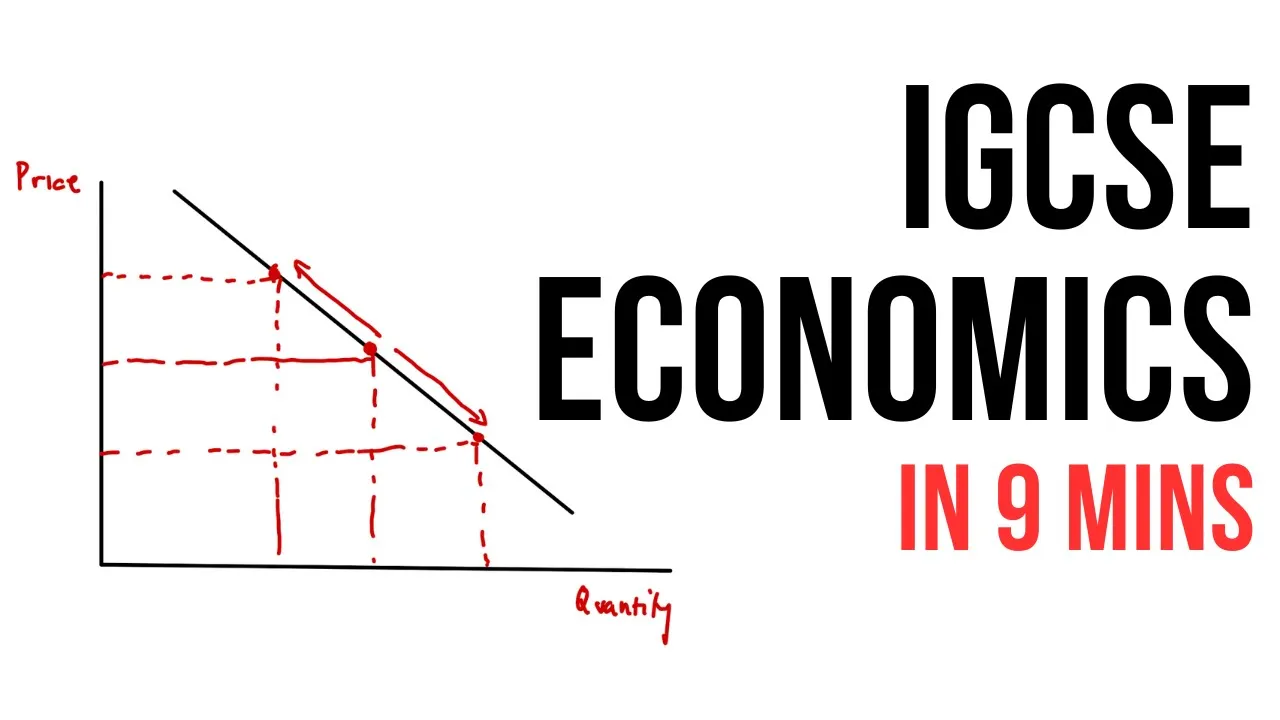
Let's start by looking at buyers and how they respond to a change in price. If the price goes up for strawberries, then some buyers will go buy blueberries or they'll go on that all bacon diet. The point is, they're gonna buy less strawberries. And if the price goes down for strawberries, then people are gonna buy more. This is called the law of demand: when the price goes up, people buy less, when the price goes down, people buy more. On the graph it's show by a downward sloping demand curve.
Now let's think about sellers like the farmer in the farmer's market. If the price of strawberries go up, then that farmer will make more profit, so will have an incentive to produce more strawberries. If the price goes down then he's not gonna want to produce strawberries.
That's called the law of supply, and on the graph it's shown by an upward sloping supply curve.
Now let's put supply and demand together. If the price is really high at $10 then producers would like to produce a lot of strawberries, but consumers won't want to buy them. This mismatch is called a surplus. And if the price goes down for strawberries, let's say down to $1, then buyers want to buy a whole lot, but producers won't have incentive and they'll produce very little. At the end you have mismatch, but this one's called a shortage.
And there's only one price where the quantity that buyers want to buy is exactly equal to the quantity that sellers want to sell, and it's right here where supply equals demand.
The price is called the equilibrium price, and the quantity is called the equilibrium quantity.
Adriene: Okay, sure your graph makes sense, but the price of strawberries isn't always $3; sometimes it goes up to $6, and at Whole Foods, local, artisanally grown strawberries, the fancy fancy strawberries, can cost upwards of $12. But I guess Whole Foods is a whole other world where price has nothing to do with realistic economics. We'll stick to normal strawberries. In fact, the prices for all sort of stuff change all the time.
External forces can shift both the supply and demand curves, changing the equilibrium price and quantity. For example, let's assume that this graph shows the demand and supply of strawberries in the summer. What happens in the winter? Will the change in weather affect buyers' demand? Or producers supply? Spoiler alert: it's supply. Colder temperatures make it harder to grow strawberries. The result is the entire supply curve is gonna shift to the left.
This is because at all possible prices, there'd be fewer strawberries produced. That's it.
This graph is just a tool that economists and everyone else used to show the results of a change in a market. I know it seems complicated at first, but there are really only four things that can happen in a market.
Supply can decrease, supply can increase, demand can decrease, or demand can increase.
Some people might wanna talk about a price being fair or right. Well, that all depends on your point of view. The buyer always considers a low price to be a very fair price, while the seller considers it unfair and vice versa. In general, economists don't really like to push opinions about prices. Voluntary exchange suggests that the price is there for a reason.
For example, assume the demand for strawberries inexplicably falls, so the demand curve shifts to the left and the equilibrium price and quantity fall. Farmers might go to the government for assistance, but most economists would argue there's no reason to bail them out.
The market's spoken. Strawberries are so over.
Furthermore, if the government helps the farmers by giving them a subsidy, it would be putting resources towards something that society doesn't value. That would be inefficient. Luckily, every reasonable person on Earth values strawberries, so they continue to get produced.
Mr. Clifford: Now, the downside is, the supply and demand model only applies to analyzing strawberries. Nah, I'm just joking; it applies to all sorts of stuff. In fact, let's look at a market for a commodity known for its volatility, both because of its fluctuating prices and because sometimes, it explodes: gasoline.
Now when you see gas prices are moving all over the board, that's just demand and supply.
For example, in 2014, the retail gas price in the United States fell dramatically. Why?
Well, it was demand and supply. The economies of both Europe and China weakened, which decreased the demand for gasoline, shifting the demand curve to the left. At the same time, new fracking technology and restored production of oil in Iraq and Libya caused the supply of gasoline to increase, or shift to the right. The combination drove gas prices down by more than 40% per gallon. And that's it. Now you can tell all your friends you understand supply and demand.
It's a big day for you. It's a big day.
Adrienne: So markets and supply and demand are awesome. But sometimes, they're not awesome.
For example, we don't wanna use the market approach when it comes to firefighters.
[Phone rings] 911, what's your emergency?
Mr. Clifford: My house is on fire, how much do you charge to put it out?
Adrienne: It'll be $10,000, what's your credit card number?
Mr. Clifford: They're all melted!
Adrienne: [hangs up] Okay, that one's obvious, but what about the market for human organs?
After all, there's a huge shortage, and thousands of people die each year waiting for transplants.
Should there be a competitive market for human kidneys? A free marketeer would say sure, why not? If a donor wants $15,000 more than he wants his other kidney, why stop him?
Mr. Clifford: Well. Ethics. I mean, there's several problems that arise with an unregulated market for human kidneys. First is the moral question, is it fair for a poor person who can't afford a kidney to die while a rich person lives? Well, probably...no, not at all. Another problem results in the law of supply. When there's an increase in the price of kidneys, there's an incentive for people to steal and sell kidneys. In fact, the World Health Organization has stated, "Payment for organs is likely to take unfair advantage of the poorest and most vulnerable groups, undermines altruistic donations, and leads to profiteering and human trafficking. I mean, all bad things. Now, that being said, why do 70% of American economic association members support some kind of payment for organ donors?
Adrienne: Well, it's because you can solve some of these problems with a market approach, but the market must be regulated. Often family and friends are willing to donate a kidney, but they're not a match for the patient. Economists generally support creating kidney exchanges, where pairs of willing donors are matched with strangers that agree to donate to each others' loved ones. In both cases, the supply of donated kidneys would increase, which would alleviate some of the shortage. Like we've said before, free markets are awesome, but they can't solve all our problems Sometimes, they need to be regulated, and sometimes, they should be avoided.
So there you have what, for most people, is the start and for many, the end of economics.
Supply and demand. Economists and politicians often like to refer to the interaction of supply and demand as laws, and we've done that too, but to be clear, it's not an absolute law, like the law of gravity.
Mr. Clifford: As we've tried to point out here on Crash Course, economics is about human choices and their consequences. Even though supply and demand behave in a predictable way that we've seen in the models, we can't lose sight of the fact that both of them are reliant on humans acting as buyers and sellers.
Adrienne: Our actions influence supply and demand in a way that they can't influence gravity, no matter how much we might want to.
Mr. Clifford: Whoa.
Adrienne: That's After Effects. And that's something to keep in mind when you hear us or anybody talking about economic laws. Thanks for watching. We'll see you next time.
Mr. Clifford: Thanks for watching Crash Course Economics, it was made with the help of all these nice people. You demanded it, and they supplied it. Now, if you want them to keep supplying it, please head over to Patreon. It's a voluntary subscription platform that allows you to pay whatever you want monthly to help make Crash Course free for everyone forever. Thanks for watching. DFTBA.
Up Next

7:19
Calculating Consumer & Producer Surplus with Price Floor
@economicsfun
110.3K views•2011-05-28

21:53
Tiebout Model & Club Theory: Local Public Goods | Public Finance
@Vidyamitra
12.6K views•2016-04-14

7:31
Deficits & Debts Explained: Economics of Government Spending
@crashcourse
1.5M views•2015-09-23

113:18
The Age of Easy Money: Fed & Inflation | Full Documentary
@frontline
21.2M views•2023-03-15
Related Study Plans & Knowledge Roadmaps
Structured learning paths in Economics
economics
Intellectual Property: Innovation vs Monopoly
01Foundations of Market Power: Monopolies & Deadweight Loss
02The Economic Trade-Off of Intellectual Property
03Patents: R&D Incentives vs. Market Monopolization
+ 3 more learning modules
12h6 modules
Explore Roadmap
economics
Sovereign Debt: Defaults, IMF & Restructuring
01Introduction to Sovereign Debt & Government Bonds
02Debt Sustainability & Credit Ratings
03Anatomy and History of Debt Crises
+ 2 more learning modules
12h5 modules
Explore Roadmap
economics
Market Design: Matching Theory & Gale-Shapley
01Introduction to Market Design and Price-Free Markets
02Two-Sided Matching & The Gale-Shapley Algorithm
03School Choice Systems and Mechanism Design
+ 2 more learning modules
10h5 modules
Explore Roadmap
economics
Impossible Trinity: Forex, Capital & Policy
01Introduction to Monetary Policy and Central Banking
02Exchange Rates and International Capital Flows
03The Mundell-Fleming Model
+ 2 more learning modules
8h5 modules
Explore Roadmap