






















In the Mundell-Fleming model with fixed exchange rates, a negative goods market shock (such as decreased consumer confidence) initially shifts the IS curve left, reducing output and interest rates; however, capital flight caused by lower interest rates forces the central bank to sell foreign currency reserves, decreasing money supply and shifting the LM curve left, which ultimately restores the original interest rate but results in permanently lower output, making monetary policy non-discretionary while fiscal policy can restore original output levels.
Mundell-Fleming Model: Negative Goods Market Shock Explained
Added:The fundamental mechanics of the IS-LM model for closed economies, specifically how interest rates and output are determined.
The core assumptions of the Mundell-Fleming model, including the concept of perfect capital mobility and the small open economy assumption.
The definition and operational mechanics of a fixed exchange rate regime, including how a central bank intervenes in the foreign exchange market to maintain a pegged currency.
The components of aggregate demand in an open economy, particularly net exports and how they are affected by income and exchange rates.
Analyzing a negative goods market shock under a floating exchange rate regime to compare and contrast the differing impacts on output and interest rates.
Examining the effects of monetary and fiscal policy expansion/contraction under a fixed exchange rate regime within the Mundell-Fleming framework.
Understanding the 'Impossible Trinity' (or Policy Trilemma), which asserts that a country cannot simultaneously maintain a fixed exchange rate, free capital movement, and an independent monetary policy.
Applying the Mundell-Fleming model to historical macroeconomic events, such as the collapse of the Bretton Woods system or the 1992 European Exchange Rate Mechanism (ERM) crisis.
831 views6likes6:22Original Release: 2020-05-07
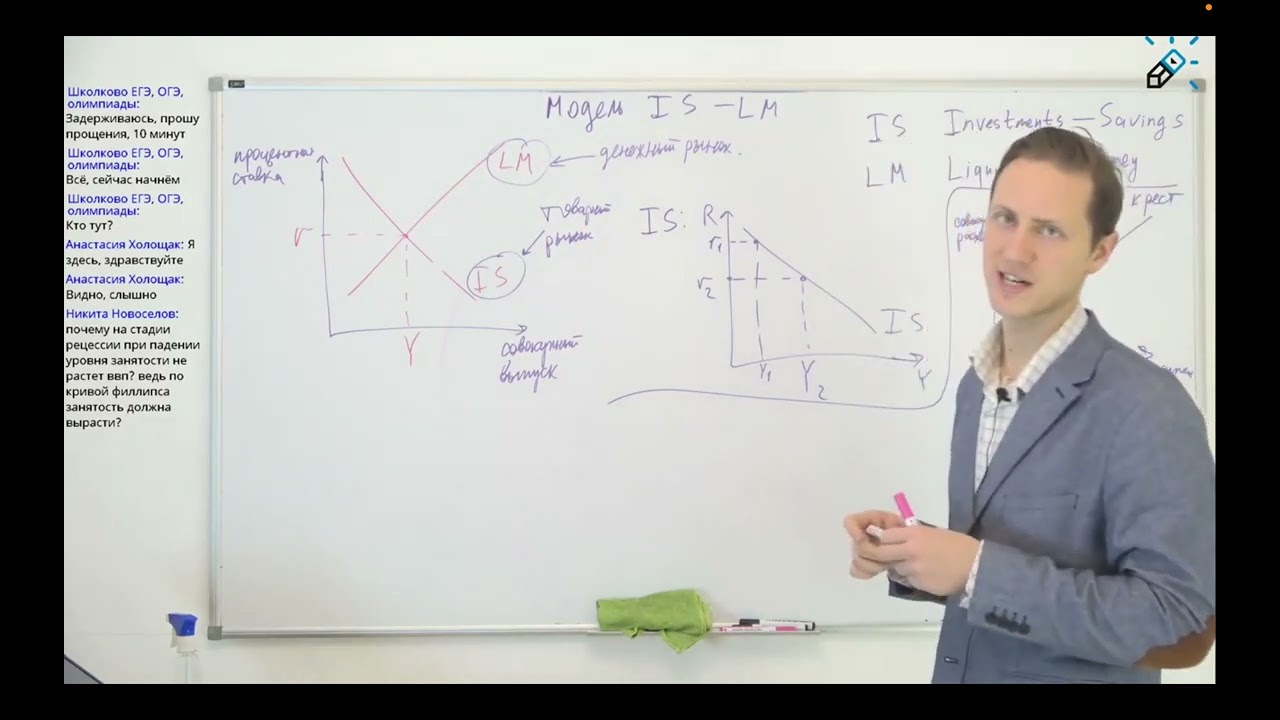
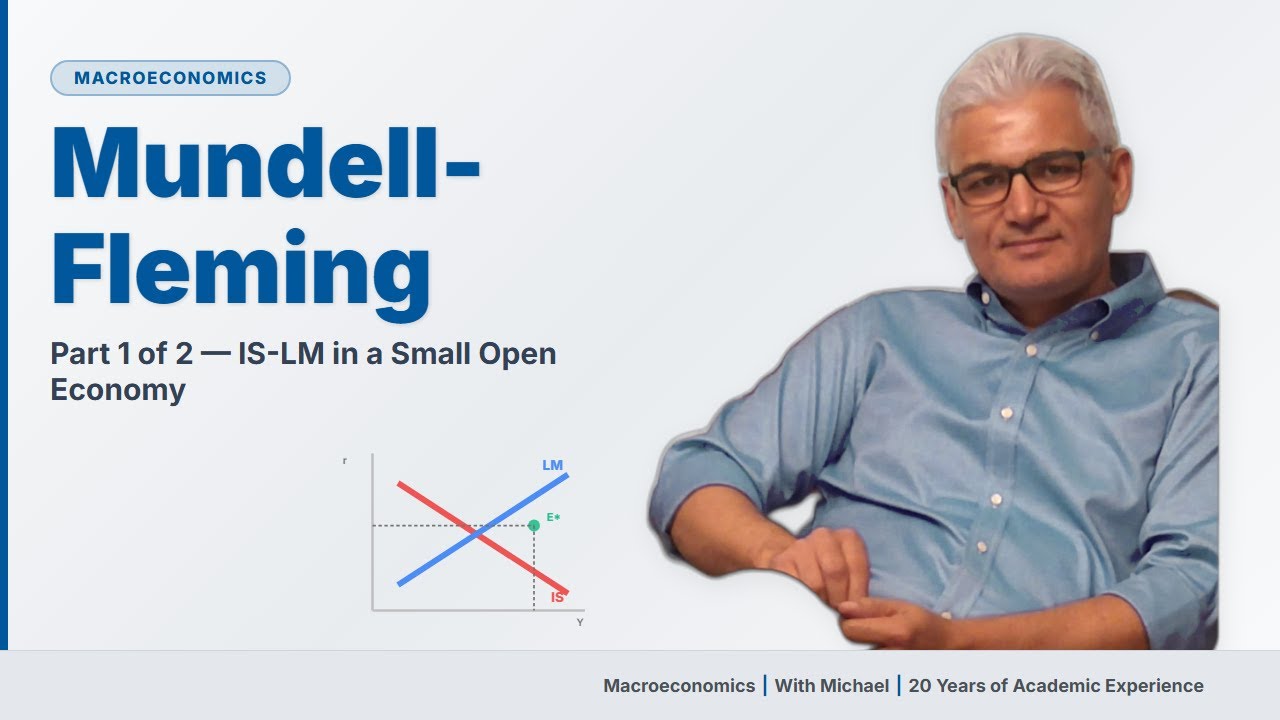
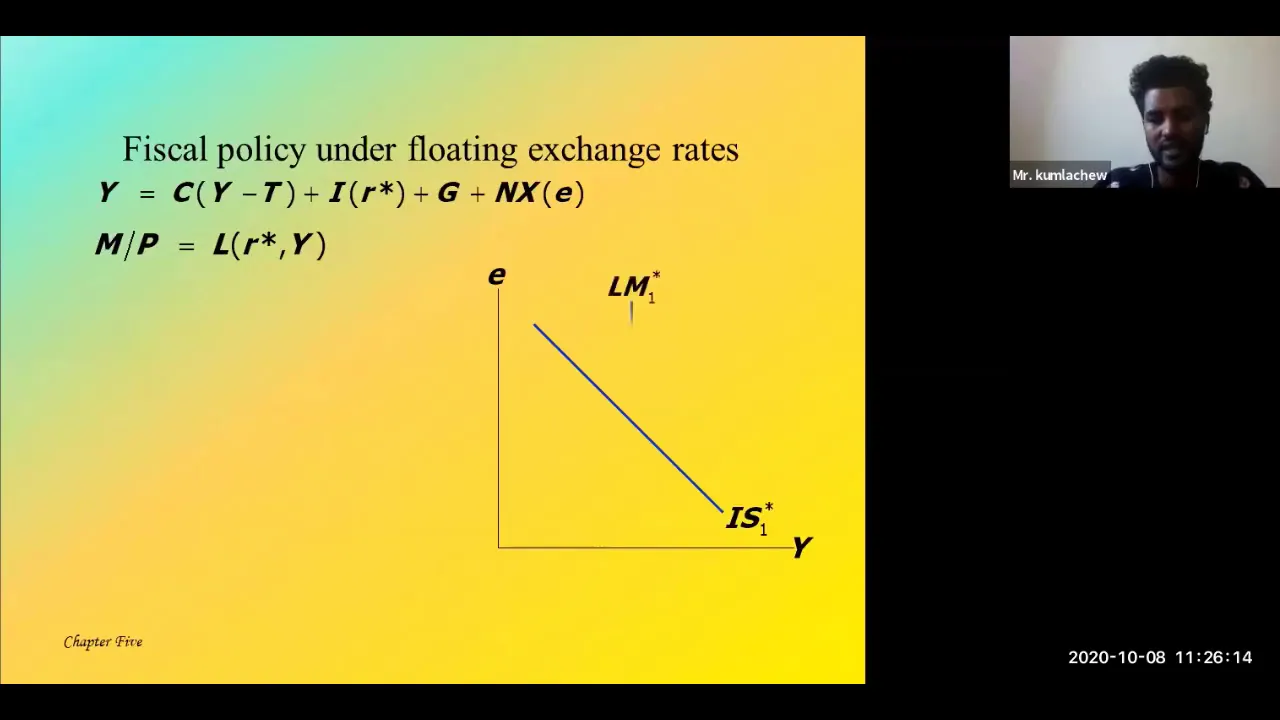
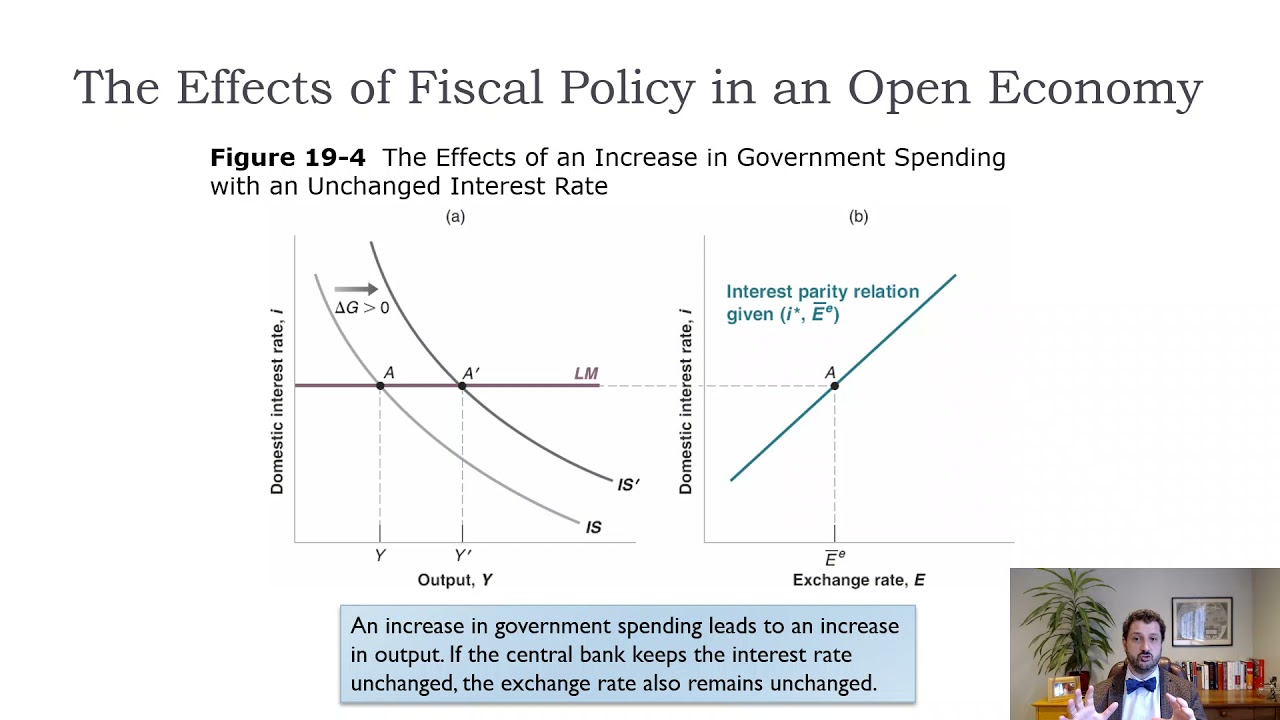
this is an example about Mundell Fleming model negative shopkins the goods market the question is considering economy with a fixed exchange rate suppose the economy is hit by a negative goods market demand shop say a decrease in consumer confidence work through the impact of this in the absence of any government intervention the analysis can be conducted entirely means is LM part of payment framework but you are welcome to use any supporting graphs including the goods market and money market so we'll start with our y-axis which is radiance trade our x-axis which is the real output we have our downward bias curve and we have our upward LM curve and then we have our horizontal bands pain curve we see that all the three curves intersect at the same point which means that we are at equilibrium which will give us R 1 which we can call it RF as what was mentioned in the question and we have here our y1 then in the question they said that we have a lower consumer confidence which would result in higher consumption if consumption decreases it would result in lower aggregate demand lower aggregate demand will effect is curve therefore is will be lower which means it will just to the left therefore we're gonna shift is curve here to the left we will get a new point of intersection between is 2 and the original LM curve this will give us Y 2 which is lower than Y 1 and R 2 which is lower than R 1 so because we have a lower interest this means that we will have a lower cash flow which means investors would prefer to take the front away from Australia and put it up load in order to get higher interest their fourth cash outflow will be higher we stood in the question that we have a fixed exchange rate therefore in order to maintain the nominal exchange rate the central bank RP a they need to go into open market sale of foreign currency so when they say the foreign currency they were by the domestic currency consequently the money supply will decrease which would result in a higher in straight this higher in straight will affect the LM curve the for LM curve will be lower which means just to the left there for a limited worship to the left in order to intersect with the point of intersection between is 2 and to paint this point the food I would shift Alima curve to the left so now the market reach equilibrium because the Street curves intersect at the same point so now we will have our one which is our original mean straight but our output will be Y 3 which is lower than Y 2 which is lower than Y 1 the second part of the question what is the impact on in straight and output this was the last point we mentioned we said that interest rate will be the same which means R 1 is equal to RF it's the same but output became lower than Y 2 lower than Y 1 the third part of the question provide a narrative of the economic events experience it in its transition from the starting point before the shock to the final equilibrium after the shock make sure the narrative is consistent with the graph be sure to describe economic events not a description of your graph we have an active shot in the goods market which is lower consumer confidence this would result in lower consumption which would lead to lower output consequently demand for money will fall due to the transaction motive since income level drops therefore in straight will decrease this would result in a capital flight from the domestic economy seeking is the higher in straight available abroad which will result in a higher cash outflow the oversupply of domestic currency in the forex market as investors seek to exchange it in order to buy foreign bonds this would lead to a depreciation of the currency since we have a fixed exchange rate the central bank will point up the excess supply of currency in order to maintain the nominal exchange rate because as we mentioned we have a fixed exchange rate the reduction in money supply would cause higher in straight this would lead to lower investment and lower output even more we see that the in street is pushed up back so that there is no investment increase to make up for the consumption decrease we said here we have here a lower consumption then in straight decreased this could result in higher investment but at the same time we increase in straight so it would result in lower investment so this one will offset this one because in straight will return back to its original level the four will end up with a lower consumption therefore we will end up with the same in straight but output dropped the next part of the question what would be an appropriate fiscal policy response in order to keep the economy act why one is the fiscal policy response feasible we said our region shock was shifting is curved to the left fiscal policy would affect eyes curve therefore if we could return ice curve back to its original level this means that will turn back to our original equilibrium therefore we can use our fiscal policy in terms of higher current spending or lower taxes the for ice curve will shift to the right to its original level zip or will return back to our original interest which is r1 equal to RF and our output will be equal to y1 the last point of the question what would be an appropriate monetary policy response in order to keep the economy at y1 is am not a policy response feasible so when you talk about monetary policy we talk about money supply with all bottom straight which will affect LM but remember in the question we said we have fixed exchange rate which means anytime will change money supply and we change in straight this will affect exchange rate therefore in order to maintain a fixed exchange rate we cannot unit ripples therefore our monetary policy is not independent which we call it non-discretionary monetary policy
Up Next

4:29
The Neurobiological Mechanics Behind Choice | Peter Bossaerts
@facultyofeconomics
223 views•2025-01-15
5:07
Impact of Yuan in Indo-Russian Trade Amid Sanctions
@WION
261.9K views•2022-07-01
6:00
Mundell-Fleming Model: Negative Money Market Shock Analysis
@Inlecture
1.2K views•2020-05-07

113:18
The Age of Easy Money: Fed & Inflation | Full Documentary
@frontline
21.2M views•2023-03-15
Related Study Plans & Knowledge Roadmaps
Structured learning paths in Economics
economics
Sovereign Debt: Defaults, IMF & Restructuring
01Introduction to Sovereign Debt & Government Bonds
02Debt Sustainability & Credit Ratings
03Anatomy and History of Debt Crises
+ 2 more learning modules
12h5 modules
Explore Roadmap
economics
Market Design: Matching Theory & Gale-Shapley
01Introduction to Market Design and Price-Free Markets
02Two-Sided Matching & The Gale-Shapley Algorithm
03School Choice Systems and Mechanism Design
+ 2 more learning modules
10h5 modules
Explore Roadmap
economics
Impossible Trinity: Forex, Capital & Policy
01Introduction to Monetary Policy and Central Banking
02Exchange Rates and International Capital Flows
03The Mundell-Fleming Model
+ 2 more learning modules
8h5 modules
Explore Roadmap
economics
Healthcare Economics: Market Failures & Systems
01Introduction to Healthcare Markets and Market Failure
02Asymmetric Information and Adverse Selection
03Moral Hazard and Insurance Design
+ 2 more learning modules
12h5 modules
Explore Roadmap