





![EC1002 Chapter 14 Lesson 3 - Perfect Capital Mobility [Full]](https://i.ytimg.com/vi/LRLpRljqjtQ/hqdefault.jpg)





![54. MUNDELL FLEMING MODEL | FIXED EXCHANGE RATE REGIME |Macroeconomics Detailed discussion [Part 2]](https://i.ytimg.com/vi_webp/wj2-BmBK_s8/maxresdefault.webp)









![[맨큐거시53] 제6장 개방경제 (18) - [부록] 대국개방경제 (1) 순자본유출곡선 (p.182-184)](https://i.ytimg.com/vi/pabj3LxzBZA/hqdefault.jpg?sqp=-oaymwEmCOADEOgC8quKqQMa8AEB-AH-CYAC0AWKAgwIABABGHIgTigzMA8=&rs=AOn4CLBdqnvH6HNukrl4tHGj1gfKbs-wGA)


![환율(기본편) [경제야 놀자 5편]_STEPS](https://i.ytimg.com/vi/I9x90Ti-skI/maxresdefault.jpg)

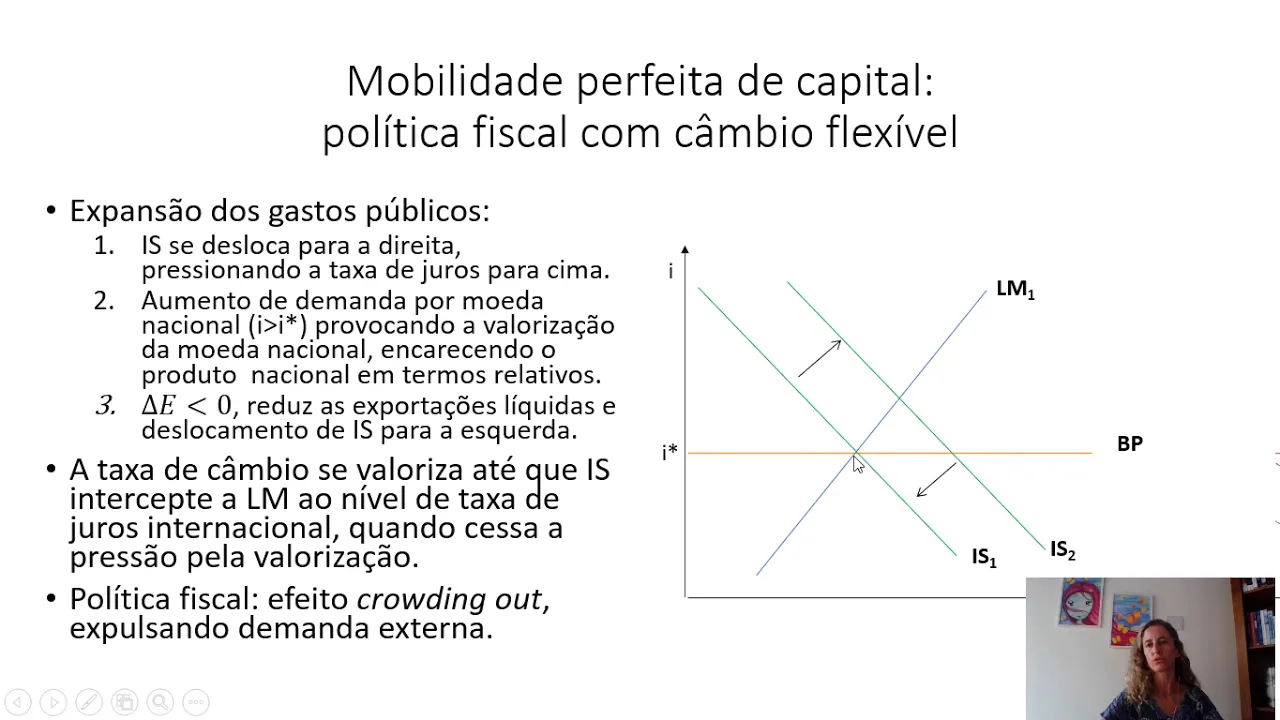
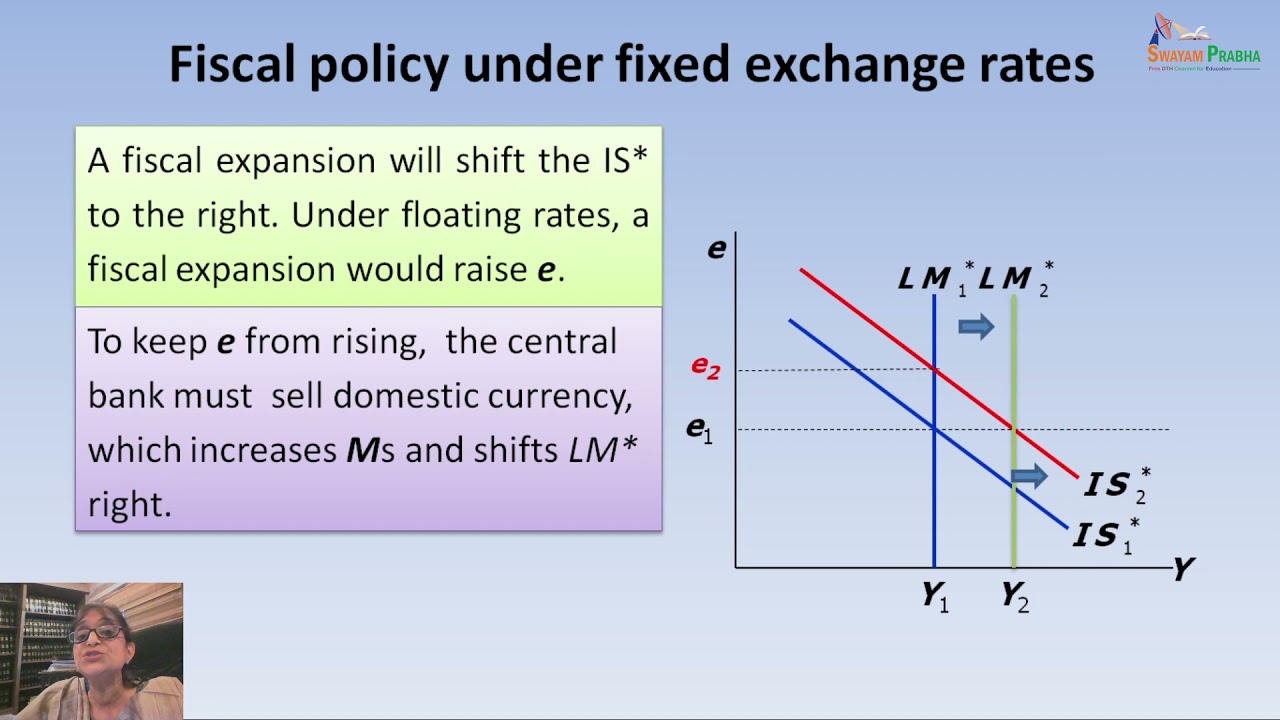
In a small open economy with floating exchange rates, fiscal policy (government spending or tax cuts) shifts the IS curve rightward but leaves national income unchanged because the resulting currency appreciation reduces net exports sufficiently to offset the expansionary effect; conversely, monetary policy (increasing money supply) shifts the LM curve rightward, raising national income through currency depreciation that stimulates net exports, while trade restrictions (tariffs or quotas) shift the net export schedule outward but also raise the exchange rate without affecting income, as the appreciation reduces net exports by the same amount.
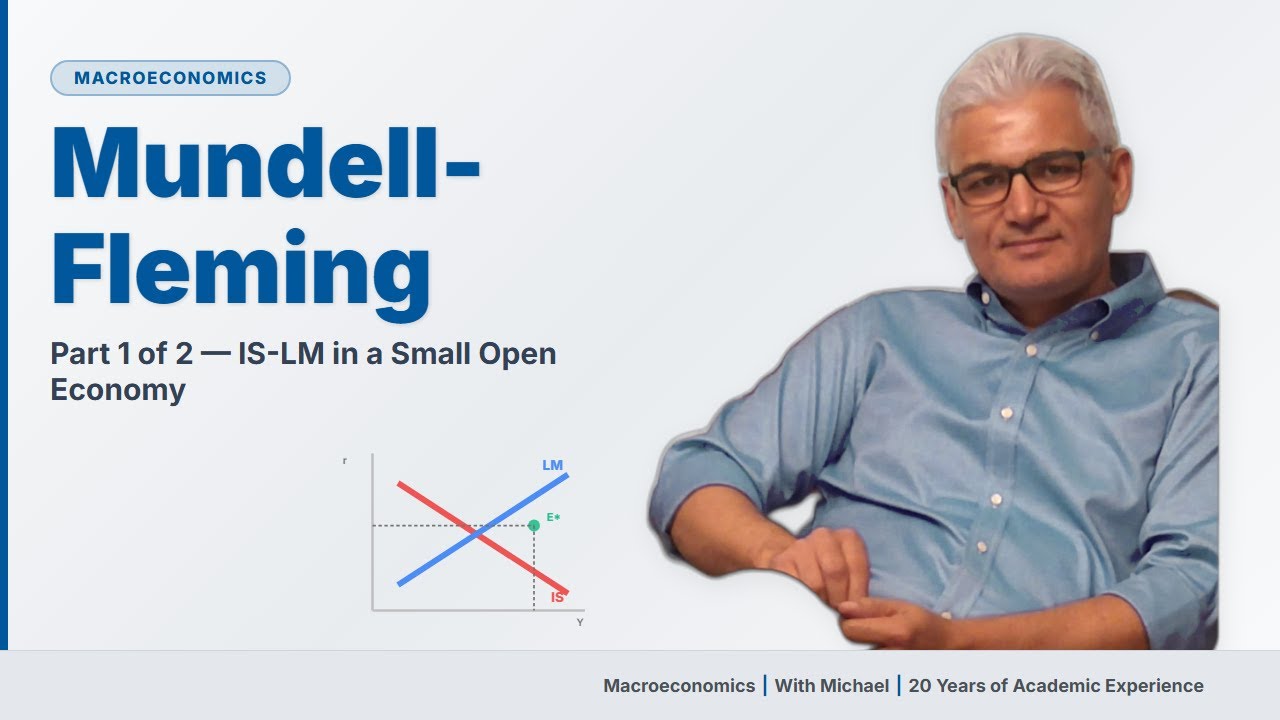
Mundell-Fleming Model: Small Open Economy & Floating Exchange Rates
Added:The standard IS-LM model for a closed economy, representing equilibrium in the goods and money markets.
Basic concepts of open-economy macroeconomics, particularly how exchange rates are determined and how they impact net exports.
The concept of capital mobility and the Balance of Payments, including the capital and current accounts.
The core distinction between fixed and floating exchange rate systems.
The Mundell-Fleming model under Fixed Exchange Rates to compare how policy effectiveness shifts under different currency regimes.
The 'Impossible Trinity' (or Policy Trilemma) of international finance, which explains the trade-offs between monetary autonomy, exchange rate stability, and capital mobility.
The role of country risk premiums and interest rate differentials in the Mundell-Fleming framework.
The Large Open Economy model, where domestic economic policy is large enough to influence world interest rates.
Analysis of historical economic events, such as currency crises and the transition of major economies to floating rate regimes.
2.3K views47likes20:15Original Release: 2021-01-10
welcome dear audience student and Scholars here I'm Dr AMJ scholar in our previous video we have developed the mundle Flaming model in this video we are going to discuss the small open economy under flating exchange rates the mundle Flaming model dear Scholars before analyzing the impact of policies uh in an open economy we must specify the international monetary system in which the country has chosen to operate that is with we must consider how people engaged in international trade and finance uh can convert the currency of one country into the currency of another country we start our discussion with floting exchange rate we start with the system relevant for for most major economies today that is floting exchange rates under system of floting exchange rates uh The Exchange rate is set by market forces and is allowed to fluctuate and respond uh to uh changing the economic conditions in this case the exchange rate e adjusts to achieve simultaneous equilibrium in the Goods Market and the money market when something happens to change that equilibrium the exchange rate is allowed to move to a new equilibrium ium value let's now consider three policies that can change equilibrium uh level of the economy that is the fiscal policy monetary policy and trade policy our goal is to use the mundle Flaming model is to show the impact of policy changes and to understand the economic forces at work uh as the economy moves from one equilibrium to an other equilibrium so let's discuss our first uh policy that is fiscal policy okay suppose that the government stimulates domestic spending by increasing government purchases or by cutting taxes because such expens fiscal policy increases planed expenditure it shifts uh the is stady curve to the right so here we have one of the main question that what are the economic forces that lies behind the different outcome to answer this question we must think through what is happening to the international flow of capital and implications of these Capital flows for the domestic economy so let's see a graphical presentation that a fiscal expansion under floting exchange rate we have income output y on x-axis we have exchange rate e on y AIS we have a vertical uh LM curve that is LM startic and we have a downward sloping is curve is static one the intersection of the is and LM Curve will decide the equilibrium level of income and uh the level of exchange rate so here we have the expens fiscal policy that shifts uh the is curve to is uh static 2 so we have an expans fiscal policy and that uh expans fiscal policy will also raises our exchange rate from this point to this point so an increase in government purchases or decrease in taxes shifted the is St curve to the right word this raise the exchange rate but has no effect on income so we have uh uh same level of national income so here uh one of the main thing to notice uh that the fiscal policy has diff different uh effects in a small open economy than it does in closed economy in the closed economy Isn LM model of fiscal expansion raises the income whereas in a small open economy where the floating exch rate of fiscal expansion leave the national income unchanged so uh mechanically the difference uh arises because we have l m static uh vertical while the LM curve of the Clos economy we have a upward sloping LM curve but this explanation is not very satisfying we have to uh give the more details about the fiscal policy so let's discuss the fiscal policy further the interest rate and the exchange rates are the key variable in the story when income Rises in closed economy the interest rate Rises because higher income increases the demand for money that is not possible in a small open economy because as soon as the interest rates starts to rise above the world interest rate are staring Capital quickly flows uh in from abroad and to take advantage of the higher return as this capital inflow pushes the interest rate back to uh our static that is World interest rate it also has an other effect because foreign investors need to buy the domestic currency to invest in the domestic economy the capital inflow increases the demand for the domestic currency in the market for the foreign currency exchange biding up the value of the domestic currency so the appreciation of the domestic currency makes the uh domestic uh Goods expensive relative to foreign Goods reducing net exports uh the foreign net exports exactly off the effects of the expens fiscal policy on income so here we have one of the main question which arises here that why is the fall in net exports so great that it uh renders the fiscal policy powerless uh to influence the income to answer this question consider the equation that uh describes uh the money market we have uh here m/ p is is equal to l r y so we know that this equation presents the real money balances is positively related to income and negatively related related to interest rate okay in both closed and open economies the quantity of real uh money balances supplied m overp is fixed by the central bank which say uh M and the Assumption of siki prices which fixes P the quantity demanded determined uh by R and Y Must equals uh this fixed Supply in a closed economy a fiscal expansion causes the equilibrium interest rate to rise so while talking about why is the uh fa uh why is the fall in the net export so great that it renders the fiscal policy par lless to influence income okay this increase in interest rate which reduces the quantity of money demanded implies an increase an equilibrium income which raises the quantity of money demanded these two effects together maintain equilibrium in the money market okay by contrasting a small open economy are is fixed at our static that is domestic interest rate and that is World interest rate so there is only one level of income that can satisfy this equation and this level of income does not change when fiscal policy changes thus when the government increases spending or Cuts taxes uh the appreciation of the currency and the fall in net exports must be large enough to offset fully the expens effect of the policy on income the second uh policy is uh related to the monetary policy okay suppose know that the Central Bank uh increases the money [Music] supply because the price level is assumed to be fixed the increase in the money supply means an increase in real money balances The increased real money balances shifts the LM St curve to the right World hence an increase in the money supply raises the income and lows the exchange rate so how does monetary policy influence the spending that is more important question here okay to answer this question we once again need to think about the international flow of capital and its implication for the domestic economy so let's see a graphical presentation for that we have a monetary expansion under floting exchange rate we have income output y on x-axis we have exchange rate e on y AIS we have vertical uh LM static LM static one and we have a downward sloping is static and we know that the intersection of uh LM and is Curve will decide the exchange rate of the economy will decide the national income of the economy no a monetary expansion shifted the lmic curve to the rightward so we have LM static a new LM static two and we know that the intersection of the LMN uh is Curve will decide the equilibrium level of national income and uh exchange rate of the economy so the expansion in monetary policy uh will uh shift the national income upward but it will lower the exchange rate from this point to this point and we have a rise in national income from from this point to this point so although monetary policy influence uh the income in an open economy as it does in closed economy the monetary transmission mechanism is different we can recall that en Clos economy and increas in money supply increases spending because it lows the interest rate and stimulates the investment in a small open economy this channel of monetary transmission is not uh available because interest rate is fixed by the world interest rate so the interest rate and exchange rate are again the key variable as soon as an increase in money supply starts putting downward pressure on the domestic interest rate Capital uh flows out of the economy and investor seeks a higher return elsewhere so this uh Capital outflow prevents the domestic interest rate from falling below the world interest rate are staic it also has another effect because investing abroad requires converting domestic currency into foreign currency the capital outflow increases the supply of domestic currency in the market for the foreign currency exchange causing the domestic currency to uh depreciate in value this uh depreciation make domestic Goods inexpensive relative to foreign Goods stimulates uh net exports and thus total income uh has a rise hence in a small open economy monetary policy influences income by altering the exchange rate rather than interest rate so let's move to the other policy uh for the floating exchange rate that that is uh trade policy suppose that government reduces the demand for imported goods by imposing an import quota or tariff here we have one of the main question that what happens to aggregate income and the exchange rate okay the other question is that how does the economy reach uh its new equilibrium because net exports equal exports minus Imports a reduction in Imports means an increase in net exports that is the net exports casual shift to the [Music] right okay often a stated goal of policies to restrict trade is uh to alter the trade balance uh NX yet such policies do not necessarily have that effect the same conclusions holds in the mundle Flaming model under floting exchange rate recall that we have net export uh is equal to y - c into y - t - i r static minus G so here because uh trade restriction does not affect income consumption investment or government purchases it does not affect the trade balance although the shift in the net export schedule tend to rise the net exports the increase in exchange rate reduces the net exports by the same amount the overall effect is simply less trade the domestic economy import less uh uh than it uh previously did before the trade restriction but it it's export uh less as well so let's see a graphical presentation a trade restriction under floting exchange rate we have uh first panel is related to the shift and net export schedule and we have uh net exports on our x-axis we have exchange rate on Y axis we have a downward sloping curve for the net export nx1 so a trade restriction shifted the net export curve outward we have a new net export curve nx2 and the second panel panel B is the change in the economy equilibrium and we have income output y on x-axis exchange rate on Y axis we have a downward sloping is curve is static one and we have a vertical LM curve LM steric and we know that the intersection of is and LM Curve will decide the exchange rate and national income of the economy so uh a trade retion uh will uh in this part will uh also shift the ister curve to outward and we have a istic to here and this istic intersect the LM curve on this point this will shows we have an increasing exchange rate we have an increase in exchange rate from this exchange rate to this exchange rate but this will remain our national income at the same point so the shift in the net export schedule increases planned expenditure and thus uh moves the is curve to the right because LM steric here is vertical trade restriction raises the exchange rate but does not affect income the economic forces behind this transition are similar in the case of expans fiscal policy because net exports are a component of GDP the rightward shift in the net export schedule uh uh other things equal for Upward pressure on the national income and increase in income in turn increases money supply or money demand and puts uh upward pressure on the interest rate r foreign Capital quickly responds by flowing into the domestic economy pushing the interest rate back to the world interest rate are steric and causing the domestic currency to appreciate and value finally appreciation of the currency makes domestic Goods more expensive relative to foreign Goods which decreases net exports uh and x and return uh income by uh to its National or initial level so this reveals that a tariff or a quota uh shifted the net export schedule uh to the right word and as a result is curve uh shift to the right word and raising the exchange rate and leaving the national income unchanged or same so this is all about the uh small open economy under floting exchange rate for the mundle Flaming model so see you for the other extension for the mundle Flaming model in another video ciao
Up Next
8:27
Mundell-Fleming Model: Imperfect Capital Mobility Explained (4 Cases)
@MiniSethi10
1.5K views•2025-12-07
5:07
Impact of Yuan in Indo-Russian Trade Amid Sanctions
@WION
261.9K views•2022-07-01

27:11
Fixed Exchange Rates: Mundell-Fleming Model for Small Open Economies
@dr.amjadali6338
2.1K views•2021-01-14

113:18
The Age of Easy Money: Fed & Inflation | Full Documentary
@frontline
21.2M views•2023-03-15
Related Study Plans & Knowledge Roadmaps
Structured learning paths in Economics
economics
Sovereign Debt: Defaults, IMF & Restructuring
01Introduction to Sovereign Debt & Government Bonds
02Debt Sustainability & Credit Ratings
03Anatomy and History of Debt Crises
+ 2 more learning modules
12h5 modules
Explore Roadmap
economics
Market Design: Matching Theory & Gale-Shapley
01Introduction to Market Design and Price-Free Markets
02Two-Sided Matching & The Gale-Shapley Algorithm
03School Choice Systems and Mechanism Design
+ 2 more learning modules
10h5 modules
Explore Roadmap
economics
Impossible Trinity: Forex, Capital & Policy
01Introduction to Monetary Policy and Central Banking
02Exchange Rates and International Capital Flows
03The Mundell-Fleming Model
+ 2 more learning modules
8h5 modules
Explore Roadmap
economics
Healthcare Economics: Market Failures & Systems
01Introduction to Healthcare Markets and Market Failure
02Asymmetric Information and Adverse Selection
03Moral Hazard and Insurance Design
+ 2 more learning modules
12h5 modules
Explore Roadmap