











![52.MUNDELL-FLEMING MODEL | FLEXIBLE EXCHANGE RATE REGIME |Macroeconomics Detailed discussion [Part1]](https://i.ytimg.com/vi_webp/EasUTFTpreA/maxresdefault.webp)













The Mundell Fleming model explains how fiscal and monetary policies can achieve internal and external balance simultaneously under fixed exchange rates; with perfect capital mobility, monetary policy becomes ineffective as expansionary monetary policy leads to capital outflows that require central bank intervention to maintain exchange rate stability, while fiscal policy remains effective in achieving both internal and external balance.
Mundell-Fleming Model | Fixed Exchange Rate Analyses
Added:The standard IS-LM model for a closed economy, which forms the foundation of the Mundell-Fleming framework.
The components of the Balance of Payments (BoP), specifically the current account and the capital/financial account.
The mechanism of a fixed exchange rate regime and how a central bank must intervene in foreign exchange markets to maintain a peg.
The concept of capital mobility and interest rate parity, describing how financial capital responds to international interest rate differentials.
The Mundell-Fleming model under flexible exchange rate regimes to compare the effectiveness of monetary and fiscal policies.
The 'Impossible Trinity' (Policy Trilemma), which demonstrates the trade-offs between fixed exchange rates, free capital flows, and independent monetary policy.
Policy analysis under conditions of imperfect capital mobility, relaxing the assumption of perfect capital flows.
Historical case studies of fixed exchange rate crises, such as the 1992 European Exchange Rate Mechanism (ERM) crisis or the 1997 Asian Financial Crisis.
3.3K views29likes19:48Original Release: 2016-03-16
[Music] you in this module we are going to learn Mundell Fleming model under fixed exchange rate the important economic goals or the objectives of the nation are internal and external balance internal balance refers to the full employment with price stability external balance refers to equilibrium in the balance of payments government can use a number of policies to influence employment and the balance of payment these policies can be categorized as expenditure changing policies expenditure switching policies direct controls expenditure changing policies are those that change the level of economic activity generally taken to be the level of price or the level of the gdp by managing aggregate demand expenditure changing policies include fiscal and monetary policies fiscal policies is the use of the spending and taxing functions of government and expansionary fiscal policy is one that rises aggregate demand by lowering taxes or increasing government spending similarly a contractionary fiscal policy decreases aggregate demand by rising axis or decreasing government expenditure monetary policy is the management of the quantity of a country's money supply by the central bank of that nation an expansionary monetary policy is one that rises the money supply an increase in money supply will decrease the interest rate which increases borrowing for spending the increased spending rises aggregate demand and the equilibrium level of output expenditure switching policy is a change in the exchange rate currency depreciation switches spending by both domestic and foreigners from foreign goods to domestic goods by raising the mess expending depreciation of currency will also offset some of its own effects on the trade balance because part of the increased spending will go to impose that it controls include tariffs quotas and other trade barriers as well as exchange controls and Beach and price controls after starting this module you shall be able to analyze the policy instruments to achieve the objectives of internal and external balance the concepts of is and LM curve understand the Mundell Fleming model examine the ways to reach internal and external balance with fixed exchange rate let us begin by analyzing so on diagram The Swan diagram demonstrates how expenditure switching and expenditure changing policies can be used to achieve simultaneous internal and external balance on vertical axis exchange rate is represented an increase in our refers to a devaluation and decrease in our refers to revaluation in horizontal axis domestic expenditure or absorption is shown points on EE curve refers to external balance the Eco is positively sloped because higher are due to devaluation improves nation trade balance and must be matched by an increase in real domestic absorption at Point F on EE which is a point of external balance imagine and increase in expenditure to point G and increase in expenditure will raise income and through MPI marginal propensity to import will also increase the imports producing the balance of payment deficit at Point G to restore the external balance and to eliminate the deficit our will have to increase from point g2h that is depreciation of dollar in order to increase exports and reduce imports any point to the right of E indicates an external deficit and any point to the left indicates external surplus the line YY is indicating the internal balance or the level of full employment with no inflation for simplicity is assumed that inflation only occurs when output is above the level of full employment any point to the left of YY indicates unemployment and any point to the right of vibe i indicates inflation the four possible regions in the diagram are as follows zone 1 external surplus and internal unemployment zone to external surplus and internal inflation zone 3 external deficit of internal inflation zone for external deficit and internal unemployment at Point F there is both internal and external balance any other point will require an expenditure changing or expenditure switching body to achieve simultaneous internal and external balance consider Point C which is on EE line but below vai vai line so there is external balance but unemployment in order to achieve point if both types of policies are required if only fiscal policy is used to raise expenditure to decrease unemployment then increased income will cause more imports producing an external deficit so the expenditure increasing policy must be accompanied by a devaluation of the domestic currency and increase in are in order to achieve the internal and external balance we will discuss Mundell Fleming model Mundell Fleming model is an economic model first set forth by Robert Mundell and Marcus Fleming the model is an extension of is-lm model the Mundell Fleming model is also known as is LM BP model the traditional is-lm model deals with economic under closed economic whereas Mundell Fleming model describes this small open economic the is curve shows the various combination of interest rate I and national income by that results in the equilibrium in the goods market the goods market is an equilibrium whenever the quantity of course on services them it equals the quantity supplied for injections equals the quantity supplied or injections are equal to savings i plus X is equal to s plus M savings s and imports m or positive function of increase in the level of national income and the investment I is inversely related to the interest rate the nation's export X government expenditure G and the tax st are taken to be in zoo genius the is curve is negatively slowed because at lower interest rates the level of investment is higher which increases the national income and also induces a higher level of saving and imports thus equilibrium is restored when change in investment is equal to change in savings and change in imports the LM curve shows the various combinations of interest rates I am national income by at which the demand for money is equal to the given and fixed supply of money which we call equilibrium in money market the LM curve is inclined positively because the higher the rate of interest I the smaller the quantity of money demanded for the speculative purposes the BP line shows the combinations of income by and the interest rate I for which there is an external balance the BB curve is positively inclined because higher rates of interest lead to a greater capital inflows and must be balanced with higher level of national income and imports for the balance of payments to remain in equilibrium is described to show how a nation can use fiscal and the monetary policies to achieve both internal and external balance without change in exchange rate the working of is LM and BP curve in figure all the markets are in equilibrium at Point E where is el MVP curves cross at interest rate I equal to I and national income y is equal to y e which is less than the full employment level YF @ i is equal to i star the level of national income is by F to the left of f e curve the nation has balance of payment surplus and to the right a balance of payment deficit the more responsive international short-term capital flows are to changes in the interest rate the flatter is the BP curve but VP curve is drawn on the assumption that exchange rate is constant so BP curve does not shift now we will discuss Mundell Fleming body and fixed exchange rate fiscal and monetary policies from external balance and unemployment an expansionary fiscal policy in the form of an increase in government expenditure or the reduction in taxes shifts the is curve to the right so that at each rate of interest the goods market is an equilibrium at a higher level of national income on the other hand contractionary fiscal policy shifts the is left foots and easy monetary policy that is increase in the nation's money supply shifts the LM curve right words whereas our tight monetary policy shifts the LM curve left foots here we are assuming that exchange rate is fixed some monetary and fiscal policies will not directly affect the BP curve so the BP curve does not shift that is remains unchanged this situation is explained with the help of ago next we will discuss fiscal and monetary policies from external balance and unemployment with easy monetary policy there is a shift in LM curve to the right which crosses the unchanged is curve at Point you but at Point you the interest rate I dash is less than I and so with low interest rate the capital inflow is reduced and so balance of payment is in deficit position so now the nation could reach full employment level of national income by expansionary fiscal policy that shifts is curve to right so as to cross the point a at Point a the interest rate is higher than at Point E so that verse and grade balance is accompanied by an increased capital inflow however this increased capital inflow or reduced outflow is not sufficient to avoid a deficit in the nation's balance of payment as point a is to the right of the BB curve to reach the full employment level of national income of wire and to have equilibrium in its balance of payment the nation should follow the stronger expansionary policy that shifts is curve to point B on the BP curve this resulted in increase in nation's interest rate to I double dash so the two policies that is an expansionary fiscal policy and a tight monetary policy are required for the nation to reach internal and external balance simultaneously next we will discuss fiscal and monetary policies from external deficit and unemployment a country with domestic unemployment and an external deficit can achieve both internal and external balance simultaneously with the appropriate expansionary fiscal policy and tight monetary policy this is explained with the help of a go the is and LM curve intersects at Point E but BP curve is not intersecting at this point of equilibrium so only the domestic economy is in equilibrium at interest rate PI dash and income ye hear the nation faces our deficit in its balance of payment position because point E is to the right of points a starting from the point E where the domestic economy is in equilibrium with unemployment and a balance of payment deficit the nation can reach the full implementation level of output YF by using expansionary fiscal policy that shifts is curve to the right two is dash and the tight monetary policy that shifts the LM curve to the left to LM dash now all the three markets are an equilibrium at Point F where is curve and LM curve cross the unchanged be Pico so the nation achieve the external and internal balance with increased interest rate at I star next we will discuss fiscal and monetary policies with perfect capital mobility when the capital is perfectly mobile a small change in the domestic rate brings large flows of capital the Bo p is said to be in equilibrium with the domestic interest rate equals the world rate if the domestic interest rate is lower than the world rate there will be large capital outflows in order to see better rates abroad on the other hand if the domestic rate of interest is higher than the world rate large capital inflows would bid the domestic rate of interest down to its initial level the policy implications of perfect mobility under expansionary monetary policy is shown in figure in OS X's the national income and on oh y axis interest rate is shown the BB curve is drawn horizontally because even the slightest change in the interest rate will lead to infinitely large capital flow if the domestic interest rate is above our capital flows into the country and if it is below or capital flows out of the country pointy is the initial equilibrium level where is el MVP curves intersect this point determines the equilibrium level of income over and the interest rate over suppose point YF is the full employment income level which the economy wants to attain the point E determines that the economy is not at full equilibria level if the monetary policy starts with an expansionary monetary policy by increasing the money supply it will shift the LM curve to LM one which intersect the is curve at even and the interest rate falls to or1 so it will lead to outflow of capital since the price of foreign exchange is fixed the monetary authority will finance the outflow of capital by selling foreign exchange the sales of foreign exchange will decrease the money supply and so LM one curve will shift upward to its original position of the LM curve thus monetary policy can set to be ineffective under the scenario of fixed exchange rates and perfect international capital mobility in maintaining the internal balance the expansionary fiscal policy has the effect of raising the income level by international capital mobility which is shown in Figure suppose the government expenditure is increased to achieve full employment level of income o YF this shifts the is curve to the right to is one which intersects the LM curve at e one this causes the interest rate to rise to or1 and the income level to fall 2001 the rise in interest rate leads to large inflows of capital from abroad this increases the money supply with the rise in foreign reserves there by shifting the LM curve to the right to LM one this LM one intersects the is one at point E to wear at the fixed exchange rate full employment income level o YF is reached so fiscal policy by increasing the money supply raises aggregate demand income and employment thus under perfect capital mobility and the fixed exchange rates fiscal policy is effective in maintaining internal balance rather than monetary policy now let us summarize what we have learnt in this mode Mundell slamming model analyze the role of monetary and fiscal policies in an open economy this model is called the Keynesian open economy model this approach analyzes the relationship between two instruments and two targets the two instruments are monetary policy which is represented by the interest rate and fiscal policy represented by the government expenditure according to Mundell Fleming water the nation can achieve internal and external balance simultaneously by the appropriate expansionary fiscal policy and tight monetary policy without changing the exchange rate with perfect capital mobility and the horizontal BB curve monetary policy is completely ineffective and the nation can reach internal and external balance with the appropriate fiscal policy alone with fixed exchange rate
Up Next
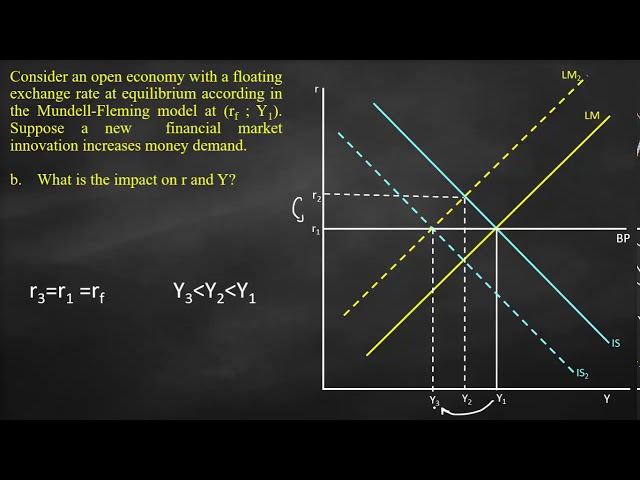
6:00
Mundell-Fleming Model: Negative Money Market Shock Analysis
@Inlecture
1.2K views•2020-05-07
5:07
Impact of Yuan in Indo-Russian Trade Amid Sanctions
@WION
261.9K views•2022-07-01
10:33
Behavioral Economics Explained: Rationality, Nudges, and Risk
@crashcourse
1.1M views•2016-03-12

113:18
The Age of Easy Money: Fed & Inflation | Full Documentary
@frontline
21.2M views•2023-03-15
Related Study Plans & Knowledge Roadmaps
Structured learning paths in Economics
economics
Sovereign Debt: Defaults, IMF & Restructuring
01Introduction to Sovereign Debt & Government Bonds
02Debt Sustainability & Credit Ratings
03Anatomy and History of Debt Crises
+ 2 more learning modules
12h5 modules
Explore Roadmap
economics
Market Design: Matching Theory & Gale-Shapley
01Introduction to Market Design and Price-Free Markets
02Two-Sided Matching & The Gale-Shapley Algorithm
03School Choice Systems and Mechanism Design
+ 2 more learning modules
10h5 modules
Explore Roadmap
economics
Impossible Trinity: Forex, Capital & Policy
01Introduction to Monetary Policy and Central Banking
02Exchange Rates and International Capital Flows
03The Mundell-Fleming Model
+ 2 more learning modules
8h5 modules
Explore Roadmap
economics
Healthcare Economics: Market Failures & Systems
01Introduction to Healthcare Markets and Market Failure
02Asymmetric Information and Adverse Selection
03Moral Hazard and Insurance Design
+ 2 more learning modules
12h5 modules
Explore Roadmap