When you believe there is no tribe for you, your brain filters out welcoming signals and amplifies negative ones, creating a self-fulfilling prophecy that prevents you from forming connections and finding community.
Overcoming Loneliness: Escaping the Self-Fulfilling Prophecy of Social Isolation
Added:Deep Dive
The psychological definition of a 'self-fulfilling prophecy' and how beliefs can unconsciously shape behavioral outcomes.

Burçlar Hakkında Dile Getirilmeyenler
176.9K
Self-fulfilling prophecy is a psychological phenomenon where believing in a prediction causes it to come true. The video explains that when people believe astrological predictions about themselves, they may unconsciously behave in ways that make those predictions reality, creating a feedback loop where belief influences outcome. This concept is illustrated through examples of how people's expectations about relationships and life events can shape their actual experiences. The video also discusses how astrological predictions are often written in vague terms that could apply to anyone, making them seem accurate regardless of the actual outcome.
Click to watch →

Cardi B Takes Offset Back | Andrew Schulz and Akaash Singh
88.8K
When people hold beliefs that all men cheat, they may unconsciously put themselves in situations where cheating becomes more likely, creating a self-fulfilling prophecy where their belief system actually causes the outcome they fear. This demonstrates how deeply held beliefs about relationships can shape behavior and outcomes, potentially leading to the very situations people claim to avoid.
Click to watch →

Como encontrar sua missão de vida
35.5K
Every belief is a self-fulfilling prophecy that will eventually manifest in reality. The brain works 24 hours a day to confirm and reinforce beliefs through biochemical mechanisms involving dopamine. When you believe something, your brain actively seeks evidence to confirm that belief, creating a feedback loop that makes beliefs increasingly powerful. This explains why people experience the same patterns repeatedly in relationships, careers, and life circumstances. The solution requires understanding that beliefs are not just thoughts but active forces that shape reality.
Click to watch →

Por que nos sabotamos? | Versão em vídeo | Autoconsciente Podcast
34.1K
Self-sabotage is rooted in limiting beliefs incorporated early in life, often from parental relationships, and reinforced through daily experiences. These beliefs create a self-fulfilling prophecy where people unconsciously behave in ways that confirm their beliefs. Examples include believing 'I must be perfect to be liked' or 'I am a failure,' which leads to avoidance of challenges and sabotage of success. The host explains that people often don't realize they're creating the very outcomes they claim to want to avoid, making professional help essential for breaking these cycles.
Click to watch →

I Actually Got Her!
260.9K
Self-fulfilling prophecies occur when believing something will happen causes it to actually happen; for example, telling oneself 'I have to pee' creates a belief that leads to the action, demonstrating how psychological expectations can influence physical behaviors and outcomes.
Click to watch →
Deep Dive
Basic principles of Cognitive Behavioral Therapy (CBT), specifically how automatic thoughts influence emotions and actions.
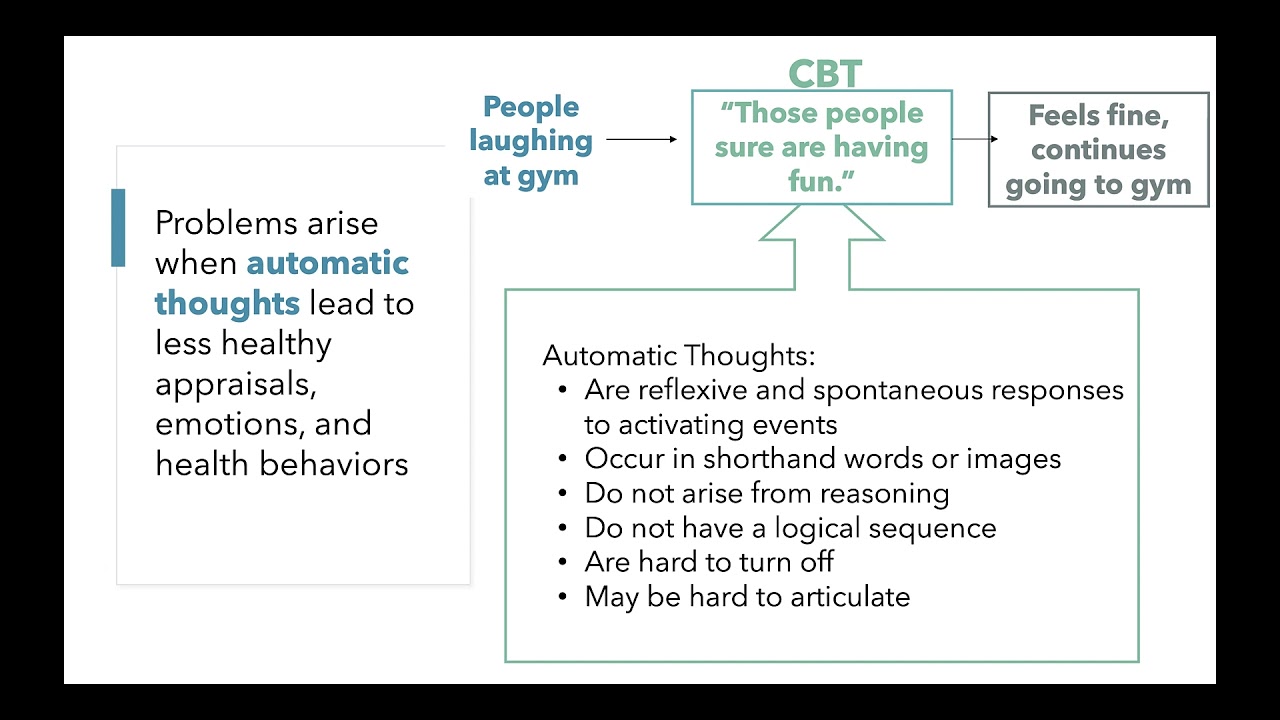
Principles of Cognitive Behavioral Therapy
1.1K
CBT operates on three core assumptions: cognitions affect behavior, cognitions can be changed, and cognitive change creates behavior change. Automatic thoughts are reflexive, spontaneous responses to events that occur quickly without logical reasoning. They manifest as brief words or images and are often difficult to recognize or articulate. These thoughts are emotional rather than logical and can be challenging to control. Understanding automatic thoughts is essential because they drive our emotional and behavioral responses. By identifying and modifying these automatic thought patterns, individuals can change their reactions to situations for better health outcomes.
Click to watch →

Rethinking Thought: Unpacking Cognitive Behavioral Therapy with Dr. Judith Beck | Behavioral Corner
426
Cognitive Behavioral Therapy (CBT) is based on the principle that our automatic thoughts—unconscious interpretations of situations—directly influence our emotions and behaviors, and by identifying and challenging these inaccurate thoughts, we can change our emotional responses and behavioral patterns; this approach has been proven effective across numerous conditions including depression, anxiety disorders, bipolar disorder, eating disorders, and substance abuse.
Click to watch →

EP3.2-จิตบำบัดปรับความคิดและพฤติกรรม
12.9K
Cognitive Behavioral Therapy (CBT), developed by Aaron Beck, is based on the principle that problems and suffering stem from thoughts. Automatic thoughts are immediate, often irrational thoughts that occur after events without logical reasoning. The same event can produce vastly different emotional responses in different people because they have different automatic thoughts. To identify automatic thoughts, one must practice journaling thoughts, distinguishing emotions from thoughts, and recognizing physical symptoms. The core CBT principle is to identify irrational automatic thoughts, evaluate their truth and usefulness, and change them accordingly.
Click to watch →

Belajar CBT : Automatic and Fast Thinking
114
Automatic thoughts are rapid, involuntary thoughts that occur outside conscious awareness and directly influence emotions and behaviors. In CBT, patients learn to identify these thoughts, which often trigger negative emotional responses like anger or anxiety. The key insight is that automatic thoughts occur so quickly they are essentially unconscious, making them difficult to recognize and challenge. CBT addresses this by guiding patients from fast thinking (automatic) to slow thinking (deliberate analysis) through guided discovery, helping them examine alternative interpretations and develop more adaptive thought patterns.
Click to watch →

Terapia Cognitiva Comportamental em detalhes: O Modelo Cognitivo
484.6K
Cognitive Behavioral Therapy (CBT) is based on the cognitive model, which explains that situations do not directly cause emotions and behaviors. Instead, an intervening thought process exists: a situation leads to a thought, which then causes emotional, behavioral, and physiological reactions. Automatic thoughts are rapid, involuntary thoughts that appear during specific situations, often as phrases or images. While everyone experiences automatic thoughts, individuals with psychological difficulties tend to have dysfunctional automatic thoughts that lead to exaggerated, out-of-proportion reactions. CBT helps individuals identify, evaluate, and respond to these thoughts in healthier ways. A key distinction in CBT is between thoughts (ideas expressed in multiple words) and emotions (feelings expressed as single words like 'sad' or 'anxious'). CBT is effective for treating various conditions including depression, anxiety disorders, OCD, panic disorder, phobias, substance abuse, eating disorders, and relationship problems. When combined with medication, it also helps individuals with schizophrenia and bipolar disorder. A primary goal is self-empowerment—teaching clients to become their own therapists.
Click to watch →
Deep Dive
An introductory understanding of common cognitive biases, such as confirmation bias and the negativity bias, which distort reality.

Why Your Life Isn't as BAD As You Think (Psychology Says | Mean World Syndrome)
11.8K
Two key cognitive biases distort our perception of reality: Negativity Bias (fixating on negative stimuli due to ancestral survival needs) and Declinism (viewing past generations as better while believing current times are worse). These biases cause us to dwell on single negative events while ignoring countless positive ones, and to believe each new generation is worse than the last, despite evidence to the contrary.
Click to watch →
The Attraction of Negativity | Marian Tupy & Jordan B Peterson
7.3K
Human cognition contains systematic biases that distort our understanding of reality. The negativity bias causes us to prefer and remember negative information over positive information, leading us to focus on criticisms rather than praise. The availability heuristic makes dramatic and traumatic events more memorable and frequent in our minds than they actually are. Additionally, negative events carry disproportionate emotional impact because death and pain represent absolute final states, while happiness has upper limits but no absolute maximum. These biases explain why people tend to believe the worst about the world despite evidence of progress.
Click to watch →

(141) Toujours et jamais
977
Two important cognitive biases are the Negativity Bias and the Confirmation Bias. The Negativity Bias causes our brain to immediately give the most unfavorable interpretation of events we perceive, which serves as a protective mechanism against potential dangers even when those dangers are not yet confirmed. The Confirmation Bias, discussed in episode 102, leads us to interpret reality in ways that confirm what we already believe or think, filtering information to support our existing beliefs.
Click to watch →

Le guide ultime du glow up – routines, mindset & lifestyle
2.3K
The brain has powerful cognitive biases. The negativity bias makes us naturally notice problems and threats first, which serves a protective function. The confirmation bias causes the brain to filter reality to show evidence that matches existing beliefs and to push us toward actions that confirm those beliefs. These biases explain why we often see what we expect to see and why changing our perspective can be challenging.
Click to watch →

El poder del PENSAMIENTO POSITIVO ⭐️ ft Ismael Cala | EP 06
159.4K
Human minds have two fundamental cognitive biases. Confirmation bias causes us to believe our personal experiences represent absolute truth, even when reality may differ. Negativity bias, rooted in evolutionary survival mechanisms, causes our brains to store negative, morbid, and painful information with greater emphasis than positive experiences. This explains why news media focuses on tragedies and disasters, as these capture human attention more effectively than positive stories.
Click to watch →
Deep Dive
The distinction between objective social isolation (physically being alone) and subjective loneliness (the perceived lack of meaningful connection).

Тебе сказали, что одиночество — это сила. Вот что забыли добавить
439
Holt-Lunstad distinguished between objective social isolation (few social connections) and subjective loneliness (feeling lonely despite having connections). These are different phenomena affecting health through different mechanisms: objective isolation impacts the immune system and reduces anti-inflammatory cytokines, while subjective loneliness affects the neuroendocrine system, increasing cortisol, disrupting sleep architecture, and accelerating cellular aging.
Click to watch →

LFL "Social isolation and loneliness" Dr. Verena Menec (Nov 4, 2020)
627
Social isolation is an objective state characterized by having no social relationships, a small social network, or limited communication with one's social network. Loneliness is a subjective experience resulting from the perceived mismatch between one's actual relationship network and desired relationships. These two concepts are correlated but distinct - one can have a large social network yet still feel lonely (lonely in a crowd), or be socially isolated without feeling lonely (content being alone).
Click to watch →

Loneliness is making us physically sick, but social prescribing can treat it
377
Social isolation and loneliness are interrelated but distinct concepts. Social isolation is more objective—it refers to being physically alone or having infrequent social contact. Loneliness is a subjective and distressing feeling resulting from the discrepancy between one's actual level of connection and desired level of connection. One can be objectively isolated but not feel lonely (and may even enjoy solitude), or conversely, be surrounded by people yet still feel profoundly lonely.
Click to watch →

Izolacja społeczna NISZCZY TWOJE zdrowie ☹️
6.4K
Social isolation has two distinct types. Objective isolation refers to the actual reduction in the number of human contacts, measurable by external observers (e.g., living alone, lacking romantic relationships). Subjective isolation, commonly called loneliness, is the painful feeling of disconnection resulting from the gap between desired and actual social relationships. Importantly, loneliness is more closely related to relationship quality than quantity.
Click to watch →

Division of Senior and Adult Services 4th ANNUAL ADVISORY BOARD MEETING
100
Loneliness is subjective - it's how you feel, a distressing experience resulting from perceived isolation or inadequate meaningful connections. Social isolation is objective - it means having fewer social relationships, social roles, group memberships, and infrequent social interactions. The person in the loneliness picture may be surrounded by people but still feel alone.
Click to watch →
Prerequisite Knowledge
- Concept 01The psychological definition of a 'self-fulfilling prophecy' and how beliefs can unconsciously shape behavioral outcomes.
- Concept 02Basic principles of Cognitive Behavioral Therapy (CBT), specifically how automatic thoughts influence emotions and actions.
- Concept 03An introductory understanding of common cognitive biases, such as confirmation bias and the negativity bias, which distort reality.
- Concept 04The distinction between objective social isolation (physically being alone) and subjective loneliness (the perceived lack of meaningful connection).
Subsequent Learning
- Step 01The study of Attachment Theory and how early childhood attachment styles (secure, anxious, avoidant) manifest in adult relationship dynamics.
- Step 02Advanced interpersonal communication strategies, including self-disclosure, active listening, and managing vulnerability.
- Step 03The evolutionary psychology perspective on social connection, examining why the brain interprets social exclusion as a physical survival threat.
- Step 04Clinical and therapeutic interventions for chronic loneliness, such as Acceptance and Commitment Therapy (ACT) or Social Cognitive Training.
Overcoming Alienation
Overcoming Alienation
0:00Playing Section
- 1
Feeling like an outsider becomes a self-fulfilling prophecy by avoiding communities.
- 2
This mindset filters out welcoming signals and amplifies negative interpretations.
- 3
Recognizing this cycle is crucial for breaking the pattern of social isolation.
Structural and Societal Determinants of Loneliness
While cognitive approaches attribute loneliness to individual psychological biases and self-fulfilling prophecies, a sociological perspective argues that isolation is primarily driven by systemic and structural factors. This viewpoint contends that hyper-individualistic cultural norms, economic precarity, demanding work structures, and the erosion of public community spaces ('third places') are the true drivers of modern loneliness. By framing loneliness strictly as an individual cognitive error, we risk pathologizing what is often a healthy, rational response to a fragmented society. Proponents of this structural critique advocate for collective, policy-level interventions—such as investing in public infrastructure, labor reform, and community-building initiatives—rather than placing the sole burden of overcoming isolation on the individual's psychological adjustment.
Deep Dive
The study of Attachment Theory and how early childhood attachment styles (secure, anxious, avoidant) manifest in adult relationship dynamics.

Stilurile de atașament în relațiile de cuplu
11.3K
Attachment styles form in childhood and shape adult relationships. Secure attachment develops from consistent, responsive caregiving where parents are emotionally and physically present, especially during critical early years (0-3 years). Avoidant attachment emerges when children are forced into premature independence due to parental neglect or emotional unavailability. Anxious attachment results from inconsistent caregiving where children receive love intermittently, creating uncertainty about their worth. Disorganized attachment, the most problematic, stems from childhood trauma and creates contradictory relationship behaviors. In adulthood, these patterns manifest as specific relationship dynamics: anxious individuals constantly seek reassurance and fear abandonment, while avoidant individuals withdraw at conflict and prioritize independence.
Click to watch →

Childhood Attachment Failures - Impact On Adult Relationships
46K
Childhood attachment styles—secure, anxious, and avoidant—shape adult relationship patterns: secure attachment enables healthy connections through consistent support and trust, anxious attachment creates needy and insecure relationships due to inconsistent caregiving, and avoidant attachment results in emotionally distant relationships where individuals struggle to accept love or express emotional needs.
Click to watch →

Attachment Styles & Infidelity: What You Need to Know
198
Attachment theory explains how early parent-child relationships shape lifelong emotional patterns. Secure attachment develops from consistent parental attunement, teaching self-soothing and balanced interdependence. Anxious attachment emerges from inconsistent caregiving, creating overdependence on external validation and fear of abandonment. Avoidant attachment forms when children learn emotional withdrawal after discovering caregivers cannot provide reliable support. These styles fundamentally influence adult relationship dynamics, determining how individuals regulate emotions, tolerate separation, and form intimate bonds throughout life.
Click to watch →

#35 Relationship Lab: Attachment Theory With Philippe Lewis
235
Attachment theory, developed by John Bowlby, identifies three primary attachment styles based on caregiver responsiveness: anxious (feeling abandoned when caregivers are absent), avoidant (disengaging because needs aren't met), and secure (trusting caregivers will respond). A fourth style, disorganized (4% of children), occurs with abuse or trauma. These styles develop from childhood experiences where children learn whether their needs will be met. Attachment parenting emphasizes connection, face-to-face time, and responsiveness to help children develop secure attachment. These early patterns significantly influence adult relationships, including sexuality and partnership dynamics. Adults often engage with partners as if they were babies, feeling like they're five years old even when they're 25 or 36. Attachment styles are survival strategies developed in early childhood based on caregiver responsiveness. Anxious individuals learned to turn up their attachment system volume because they felt abandoned, while avoidant individuals learned to turn it down because they felt overwhelmed. Approximately half the population is secure, about a quarter is anxious, and about a quarter is avoidant. Anxious-avoidant relationships are particularly volatile because both partners find each other attractive due to complementary insecure styles, but this creates self-fulfilling prophecies that perpetuate instability.
Click to watch →

Attachment Theory & Styles Easily Broken Down
140
Attachment Theory explains how early caregiver relationships shape adult relationships through trust and self-belief. There are four major attachment styles: Secure (positive self and others, developed through consistent support); Anxious Preoccupied (negative self, positive others, caused by helicopter or inconsistent parenting); Dismissive Avoidant (positive self, negative others, from emotional neglect); Fearful Avoidant (negative self and others, from fearing caregivers). Each style affects adult relationships differently: Secure individuals maintain balance and healthy conflict resolution; Anxious individuals become clingy and need reassurance; Avoidant individuals prioritize independence and avoid intimacy; Fearful individuals experience emotional extremes and struggle with trust. Understanding these patterns helps recognize relationship dynamics and work toward healthier attachment.
Click to watch →
Deep Dive
Advanced interpersonal communication strategies, including self-disclosure, active listening, and managing vulnerability.

Kommunikation-Special: Alles was du wissen musst #164
117
Three essential communication strategies for healthy relationships: (1) Active listening - staying present, asking questions, validating feelings without interrupting; (2) Self-disclosure - expressing vulnerabilities and needs in calm moments to build emotional intimacy; (3) Repair conversations - addressing underlying issues after conflicts rather than letting them slide. These strategies transform communication from blame to collaboration, helping partners understand each other's triggers and patterns. Practice these regularly to improve relationship communication and prevent misunderstandings from escalating.
Click to watch →

Johari Window 1.2 | Self-Coaching Exercises to increase self-awareness
10.7K
Self-disclosure is often scarier than receiving feedback because it eliminates the escape of blaming others' perceptions. Sharing vulnerabilities paradoxically generates overwhelming empathy and connection, as it gives permission to others to embrace their own imperfections. Active listening—engaging fully with body and emotions—allows listeners to experience their own reactions, which can mirror the speaker's hidden pain and catalyze mutual healing. This creates sacred spaces where both parties can reveal and process difficult truths together.
Click to watch →

5 GESTOS que DELATAN una MENTIRA (aunque la persona PAREZCA sincera) |
550
While strategic vulnerability was discussed, there is a more sophisticated level—correspondence in self-disclosure. If one person shares something superficial and the other immediately jumps to share something deeply personal, there is disequilibrium that creates discomfort. If someone is sharing something deeply vulnerable and one only offers platitudes or remains completely closed, there is also disequilibrium. Mastery is in calibrating one's openness to correspond slightly more than the other's, inviting them to go deeper without forcing them. It is like dancing—they take a step toward vulnerability, one takes a slightly larger step, demonstrating it is safe to go deeper. They respond with another step, and gradually both go deeper together in a way that feels natural, mutual, and safe. This requires exquisite attention and willingness to be vulnerable oneself. One cannot ask for vulnerability one is not willing to give.
Click to watch →

block blast Bagus Indo17 sedang live sekarang!
12.7K
This segment demonstrates advanced communication strategies including emotional vulnerability through apologies and personal disclosures, audience engagement techniques, and maintaining connection over extended periods. The speaker shows how to express remorse, build trust through authenticity, and prevent audience fatigue through varied communication patterns. These skills are essential for content creators, educators, and public speakers seeking to build lasting audience relationships and sustain engagement.
Click to watch →

10 Tips to Boost Your Communication Skills || Speak Like a Leader 🔥|| Improve Your English Fluency✅️
656.9K
Voice modulation transforms communication from flat delivery to magnetic presence by controlling pitch, pace, and pauses. Varying pitch prevents sounding anxious or boring, while adjusting pace matches message intensity—fast for excitement, slow for seriousness. Strategic pauses after key points create suspense and emphasize importance. The broken record technique provides essential boundary-setting: calmly repeating your main point until understood shows firmness without aggression. Humor completes this toolkit by breaking tension, creating comfort, and building trust through lightness and relatability. However, true communication transcends technical skills to embrace vulnerability as the ultimate strength. Sharing struggles, fears, and failures creates profound connection because everyone battles silently. Vulnerability builds instant trust, makes you relatable, demonstrates confidence, and creates lasting emotional impact. Effective vulnerability requires precision: sharing the right story at the right time in the right way to create connection, not pity. Walls keep people out; vulnerability invites them in. Real communication isn't mind-to-mind—it's heart-to-heart.
Click to watch →
Deep Dive
The evolutionary psychology perspective on social connection, examining why the brain interprets social exclusion as a physical survival threat.

Snadno ovlivnitelná lidská mysl
298.2K
For our ancestors, social exclusion was literally a death sentence—being left alone meant increased vulnerability to predators and reduced chances of passing on genes. This evolutionary pressure shaped human psychology to make social exclusion extremely painful. When the brain detects that someone is being excluded from a group, the limbic system immediately sends signals to the orbitofrontal cortex, which activates the fight-or-flight response. This neural mechanism prepared our ancestors to respond to social exclusion as a life-threatening situation. The brain interprets being observed as a potential social threat, triggering defensive responses that can lead to withdrawal or confrontation.
Click to watch →

Being excluded environment #shorts
136
The human brain evolved to treat social exclusion as a physical threat because in ancestral environments, being excluded from one's tribe meant no food, no protection, and death; this hardwired 'Social Threat Detection System' causes modern humans to experience anxiety when excluded from groups or left out of communications, as the brain cannot distinguish between physical dangers and social rejection.
Click to watch →

NO ESTÁS BLOQUEADO: ESTÁS MAL PROGRAMADO - AUDIOLIBRO | JACK BAKER
208
The brain does not distinguish between physical survival and emotional survival. For the brain, social rejection is a threat, exclusion is a threat, disapproval is a threat—not because it will cause immediate physical harm but because in an evolutionary moment, exclusion from the group implied death. This mechanism remains active. The brain continues interpreting rejection as an existential threat and responds with the same intensity as it would to physical danger. Once the brain classifies something as danger, it does not review it, does not ask if it remains dangerous, simply avoids it. Each time it avoids, it confirms that avoidance was the correct decision.
Click to watch →
2024년 제2회 한국 영유아 교육·보육 패널 학술대회: 아이들에게 전해줄 행복 지혜(서은국 연세대 교수)
687
Social exclusion is perceived by the brain as a threat to survival because it historically reduced access to resources and support. The speaker argues that this evolutionary perspective explains why social exclusion causes such intense emotional pain. The brain's response to social exclusion is similar to its response to physical threats, reflecting the evolutionary importance of social connection for survival.
Click to watch →

Your Brain Thinks Rejection = Death… Here’s Why 😳 #psychologyfacts #socialanxiety #personalgrowth
1.2K
For our ancestors, being excluded from the group was a death sentence because they could not survive alone on the savanna. Exile meant death, so the brain evolved to treat social exclusion as a physical threat.
Click to watch →
Deep Dive
Clinical and therapeutic interventions for chronic loneliness, such as Acceptance and Commitment Therapy (ACT) or Social Cognitive Training.

Why You Can See Through People (And Why It Makes You Feel Alone)
605
Acceptance and Commitment Therapy (ACT) is an evidence-based approach for people struggling with chronic loneliness. It helps people identify their values and take action aligned with those values, even in the face of emotional discomfort. For example, if one values genuine connection but fears vulnerability, ACT helps take small steps toward vulnerability from a place of choosing what matters.
Click to watch →

How Small Habits Can Beat Loneliness!
110
Acceptance and Commitment Therapy (ACT) is a proven method that doesn't try to erase uncomfortable feelings but teaches you to hold them without letting them control you. Picture yourself sitting in a small boat. The waves of loneliness are there. You feel them rocking you. But instead of fighting the water, ACT helps you learn to steer despite the waves. You may not calm the sea, but you can still move toward your values. This approach accepts loneliness as a natural part of the human experience while still committing to meaningful action despite the discomfort.
Click to watch →

Diversity Conversation: Frank Conner and John Cacioppo
1.2K
The most effective intervention for reducing loneliness involves social cognitive therapy that helps individuals reappraise how they think about others. Since lonely people's brains default to self-preservation modes that reduce empathy and perspective-taking, awareness of this tendency allows individuals to consciously override it. This training enables lonely people to recognize when they're not being empathic and deliberately shift their focus to understanding others' needs, breaking the cycle of isolation.
Click to watch →
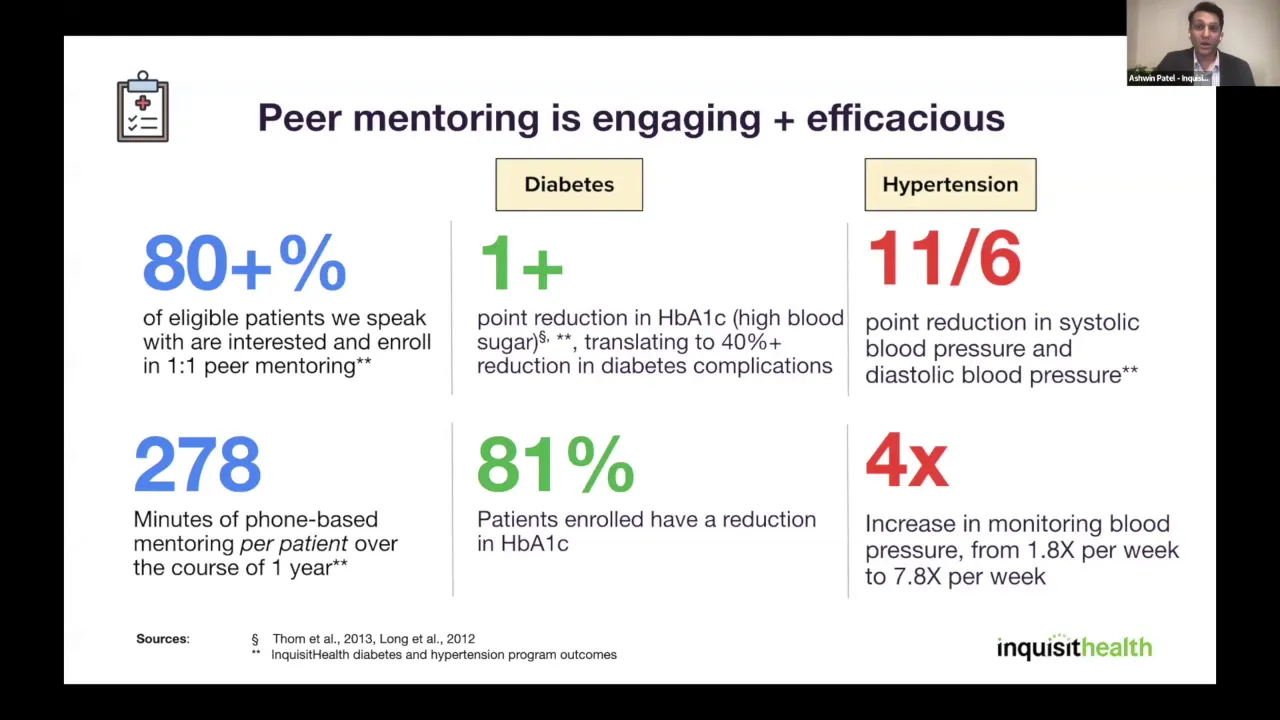
InquisitHealth - "Social Isolation"
153
Peer ACT (Peer-Delivered Brief Acceptance and Commitment Therapy) is an evidence-based approach developed at Dartmouth for reducing loneliness and its associated feelings. This therapeutic framework is paired with chronic disease coaching and mentoring, allowing mentors to deploy this intervention alongside their regular chronic disease support work. Since loneliness affects approximately 25% of patients with poorly controlled chronic conditions, integrating mental health support within chronic disease management represents a comprehensive approach to patient care.
Click to watch →

Alone Together - Luzia Heu, Diana van Bergen, Hanna van Loo e.a.
154
Effective psychiatric treatment for loneliness includes: (1) investigating loneliness's role in the patient's condition; (2) involving the patient's social network in care; (3) improving relationship quality through systemic or interpersonal psychotherapy; (4) enhancing social skills through assertiveness training; (5) addressing negative self-perceptions through cognitive-behavioral therapy; (6) supporting work/study activities that provide structure and social connection.
Click to watch →
Overcoming Alienation
Overcoming Alienation
0:00- 1
Feeling like an outsider becomes a self-fulfilling prophecy by avoiding communities.
- 2
This mindset filters out welcoming signals and amplifies negative interpretations.
- 3
Recognizing this cycle is crucial for breaking the pattern of social isolation.
Structural and Societal Determinants of Loneliness
While cognitive approaches attribute loneliness to individual psychological biases and self-fulfilling prophecies, a sociological perspective argues that isolation is primarily driven by systemic and structural factors. This viewpoint contends that hyper-individualistic cultural norms, economic precarity, demanding work structures, and the erosion of public community spaces ('third places') are the true drivers of modern loneliness. By framing loneliness strictly as an individual cognitive error, we risk pathologizing what is often a healthy, rational response to a fragmented society. Proponents of this structural critique advocate for collective, policy-level interventions—such as investing in public infrastructure, labor reform, and community-building initiatives—rather than placing the sole burden of overcoming isolation on the individual's psychological adjustment.
The psychological definition of a 'self-fulfilling prophecy' and how beliefs can unconsciously shape behavioral outcomes.
Basic principles of Cognitive Behavioral Therapy (CBT), specifically how automatic thoughts influence emotions and actions.
An introductory understanding of common cognitive biases, such as confirmation bias and the negativity bias, which distort reality.
The distinction between objective social isolation (physically being alone) and subjective loneliness (the perceived lack of meaningful connection).
The study of Attachment Theory and how early childhood attachment styles (secure, anxious, avoidant) manifest in adult relationship dynamics.
Advanced interpersonal communication strategies, including self-disclosure, active listening, and managing vulnerability.
The evolutionary psychology perspective on social connection, examining why the brain interprets social exclusion as a physical survival threat.
Clinical and therapeutic interventions for chronic loneliness, such as Acceptance and Commitment Therapy (ACT) or Social Cognitive Training.
223.5K views23.1Klikes1:00@HealthyGamerGGOriginal Release: 2024-07-01
so if you feel like you're always an outsider there's no tribe for you my sincere advice is that you look at the impact of that feeling and the biggest problem is that often times if we're not careful just like narcissistic behavior if we're not careful it will always become a self fulfilling prophecy because if you go somewhere and you feel like an outsider then you're not going to go back and now you have one more data point of a community that you didn't join and now your mind is thinking wow like I don't even know if there's a community out there for me because I've gone to two and now I'm going to community C I don't know if this is going to work maybe I'm just a loser and I'll never make friends you walk into that Community with that bias in your mind it's difficult to form connections why because you have self-dialogue you're talking up here your mind is all up here you're not even paying attention to the signals and we know this that once you start to believe that there's no tribe for you your brain filters out and actively removes any reassuring or welcoming signals and amplifies negative signals and the most damning of them all the ambiguous signals get interpreted in the negative way
Up Next

28:49
Understanding Loneliness: Causes, Effects, and Coping Strategies
@medium
202 views•2023-09-21

68:32
Cognitive Skills for Differentiated Instruction | Teacher PD
@BrainWareLearning
631 views•2017-12-17

24:13
Understanding Video Game Addiction Psychology and Recovery
@HealthyGamerGG
136.1K views•2025-05-17

6:40
The Nocebo Effect: How Beliefs Can Cause Real Harm
@CGPGrey
10.4M views•2013-12-23
Related Study Plans & Knowledge Roadmaps
Structured learning paths in Psychology
psychology
Neuroscience of Creativity: Networks & Training
01Foundations of Creative Cognition
02The Cognitive Neuroscience of Insight & Fixation
03The Triple Network Model of Creativity
+ 1 more learning modules
15h4 modules
Explore Roadmap
psychology
Imposter Syndrome: Etiology & CBT Framework
01Defining the Imposter Phenomenon
02Socio-Developmental Etiologies
03CBT Fundamentals & Thought Distortions
+ 2 more learning modules
15h5 modules
Explore Roadmap
psychology
Adult ADHD: Executive Dysfunction & Scaffolding
01Neurobiology of the ADHD Brain
02The Core Triad of Executive Deficits
03Executive Dysfunction and Emotional Regulation
+ 2 more learning modules
12h5 modules
Explore Roadmap
psychology
Loneliness: Evolution, Neurobiology & CBT
01Evolutionary Origins of Human Connection and Loneliness
02The Neurobiology and Physiology of Chronic Loneliness
03Maladaptive Social Cognition: The Psychological Loop
+ 2 more learning modules
12h5 modules
Explore Roadmap