
























In 1937, frustrated truck driver Malcolm McLean envisioned loading entire trailers directly onto ships rather than manually handling individual cargo pieces, leading to the invention of containerization; this innovation reduced shipping time from approximately 16 days (8 days loading/unloading at each end) to just a few hours, dramatically lowering costs and enabling the modern global marketplace that delivers diverse products worldwide.
How the Shipping Container Revolutionized Global Trade
Added:Basic concepts of global trade, including imports, exports, and the economic theory of comparative advantage.
The traditional 'break-bulk' cargo shipping method, where goods were loaded individually by hand, and its associated labor costs and inefficiencies.
The economic principle of 'economies of scale' and how reducing transportation costs impacts the final retail price of consumer goods.
An understanding of different transportation modes (maritime, rail, and trucking) and the historical challenges of transferring cargo between them.
The rise of 'Just-in-Time' (JIT) manufacturing and modern global supply chain logistics, which heavily rely on predictable container shipping schedules.
The environmental impacts of mega-container ships, including heavy fuel oil emissions, marine pollution, and the industry's transition toward sustainable fuels.
The geopolitical and economic vulnerability of maritime chokepoints, such as the Suez Canal, Panama Canal, and the Strait of Malacca.
The future of cargo logistics, including port automation, IoT-enabled smart containers, and the application of blockchain in supply chain tracking.
619.7K views7.6Klikes4:46Original Release: 2012-03-12
(Music) Everything is everywhere these days.
Check out the supermarket -- orange juice from China, nuts from India, swordfish from Japan, lagers from Czechoslovakia, scores of European cheeses.
You name it, it's there. Not when I was growing up.
You'd never taste a range of French cheeses or Bohemian lager beer.
At least, you couldn't unless you were very rich and could go anywhere when the fancy took you. All that has changed.
But it's not just foods. Got an iPhone?
Everyone knows it was invented and designed at Cupertino in California, but who knows where the complex bits and pieces of its innards are made or assembled?
Apple doesn't say.
The industry credits China, Japan, Germany, South Korea and, of course, the United States itself.
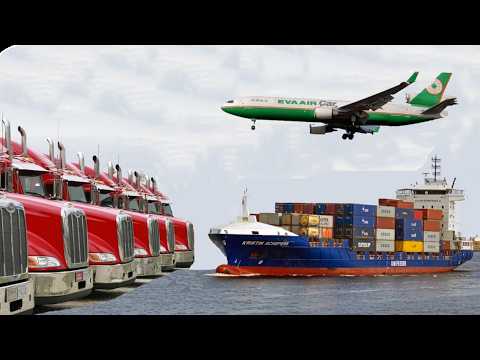
Just think for a moment of the trillions of parts and finished goods moving cheaply around the world every second, a small portion by air, but most by sea.
We call it globalization, but the man who basically made globalization a reality in our lives is too little known. This is his story.
The story of the man who makes your day.
In the Great Depression of the '30s, when millions of Americans were out of work, worse than now, Malcolm McLean was a 24-year-old truck driver.
He got a job to take cotton bales from Fayetteville in North Carolina all the way to a pier in Hoboken, New Jersey for shipping overseas.
He was glad of the work, but when he arrived he got bored out of his mind, sitting in his truck waiting and waiting and waiting on the docks as the worker ants muscled crates and bundles off other trucks and into slings that lifted the goods into the hold of the ship.
On board the ship itself, with much yelling and arm waving, the stevedores then unloaded each sling and saw its contents placed in a designated position in the hold.
Malcolm wasn't just bored, he was fuming.
His income depended on getting back to North Carolina to pick up more loads in his truck.
Out of the frustration, inspiration struck.
Wouldn't it be great, he thought, if my trailer could be lifted and placed on the ship without its cotton bales being touched. Yes, it would be great.
It would be revolutionary. For centuries, general non-bulk cargo had been shipped in the process he watched.
It was called break bulk shipping.
Boxes, bales, crates handled piece by piece.
What Malcolm envisaged would have saved him only a day, but it would have saved everyone else something like two weeks in loading and unloading the ship.
On average, it was eight days to haul and distribute break bulk shipments in the hold, plus another eight days at the other end to retrieve and distribute.
All that time would have been saved if Malcolm McLean could have just driven his truck onto the ship and at the other end, driven it off.
Well, today that concept is a reality.
The concept that occurred to Malcolm is known as containerization.
It has done more than just save a great deal of time.
It's the reason why we have a thriving global marketplace, offering us that infinite variety of things, and it's the reason we can move cargo from remote parts of the world at minimal cost.
Malcolm had his idea in 1937.
The 24-year-old truck driver sitting in his truck in Hoboken was 40 before he did anything about it.
By then, he'd built his one truck into a big trucking company. He borrowed money from an enterprising vice president at Citibank in New York, and set about designing the steel boxes and the decks of the ships to carry them stacked one on top of another.
A lot of people thought he was crazy.
Inventors always attract armies of naysayers who can never remember how critical they were.
For our part, we should remember Malcolm McLean.
His first container ship, the Ideal X, sailed from Shed 154 at Marsh Street, Port Newark with 58 well-filled boxes.
It was the beginning of the container era, shrinking our world and enlarging human choice.
Up Next

23:08
Building Iconic Brands: Marketing Strategies from Rohan Oza
@CNBC
16.7K views•2017-09-28

46:36
Retention Habits of Top DTC Ecommerce Brands Revealed
@SendItPodcast
44K views•2026-03-03

5:45
Ethical Dilemmas in Business: The Burger Crisis Case Study
@TEDEd
2.5M views•2020-07-28

17:30
The Planned Obsolescence of Light Bulbs and Tech
@veritasium
25.3M views•2021-03-26
Related Study Plans & Knowledge Roadmaps
Structured learning paths in Business
business
Pop-Up Retail: Strategy, Design & Execution
01Introduction to Pop-Up Retail & Strategic Goal Setting
02Budgeting, Site Selection, and Legal Essentials
03Experiential Retail Design & Visual Merchandising
+ 2 more learning modules
15h5 modules
Explore Roadmap
business
Reg CF: Startup Funding, Marketing & Launch
01Introduction to Equity Crowdfunding & Reg CF
02Platform Selection & Legal Preparation
03Crafting High-Converting Campaign Assets
+ 2 more learning modules
14h5 modules
Explore Roadmap
business
Productized Services: Scaling Solo Freelance
01Foundations of Productized Services
02Packaging and Scope Definition
03Pricing and Subscription Models
+ 2 more learning modules
15h5 modules
Explore Roadmap
business
Gov Procurement: Find, Bid & Win Contracts
01Introduction to Government Procurement & Business Setup
02Small Business Certifications & Set-Asides
03Finding and Analyzing Contract Opportunities
+ 2 more learning modules
14h5 modules
Explore Roadmap