














![STD-12 [REVISION] [ECO CHAPTER-4] [BANKING & MONETARY POLICY] - By, Tarun Makhija [Jai Ambe Classes]](https://i.ytimg.com/vi/p-QkFub5OR8/hqdefault.jpg)









The Basel Accords are a series of international banking regulations developed by the Basel Committee on Banking Supervision, established in 1974 following the collapse of Herstatt Bank in Germany. The framework evolved from Basel I (1988) which introduced minimum capital requirements and risk-weighted assets, through Basel II (2004) which implemented a three-pillar approach covering capital adequacy, supervisory review, and market discipline, to Basel III (2010) which strengthened requirements with higher common equity tiers, capital buffers, leverage ratios, and liquidity standards to address systemic risks exposed by the 2008 financial crisis.
Basel Accords Explained: Origins & Framework | Banking Regulation
Added:Fundamentals of commercial banking, including bank balance sheets, assets (loans), and liabilities (deposits).
The core distinction between bank capital (solvency/equity) and bank liquidity (cash flow/funding).
An introductory understanding of financial risks, specifically credit risk (default risk) and market risk.
The general role of central banks and national regulatory bodies in supervising the financial sector.
The 2008 Global Financial Crisis and how its systemic failures catalyzed the creation of the Basel III framework.
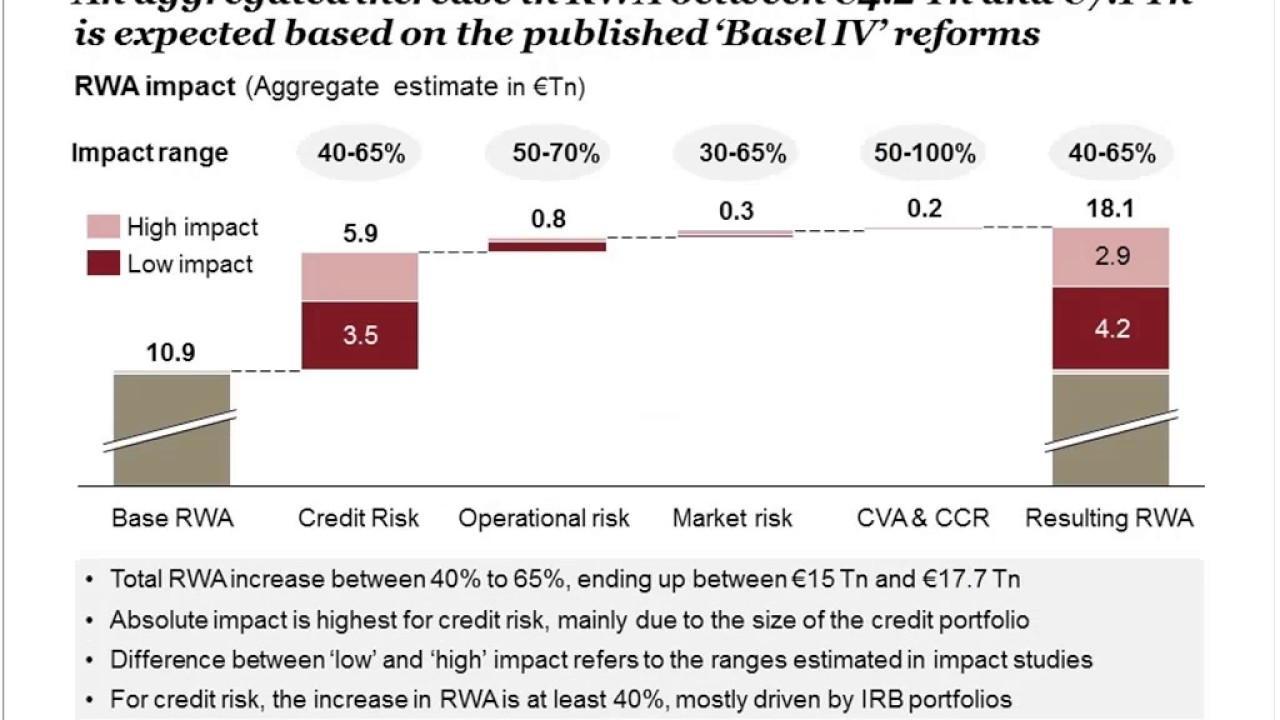
The upcoming Basel IV reforms, which focus on reducing variability in risk-weighted assets and introducing standardized output floors.
The implementation of liquidity metrics under Basel III, specifically the Liquidity Coverage Ratio (LCR) and the Net Stable Funding Ratio (NSFR).
Stress testing frameworks (such as CCAR in the United States or EBA stress tests in Europe) used by regulators to simulate economic crises.
The process of translating global Basel guidelines into national legislation, such as the Dodd-Frank Act in the US or the Capital Requirements Directive (CRD) in the EU.
96.4K views1.9Klikes25:12Original Release: 2020-04-16
hello and welcome to the screencast seminar on banking regulation today we're going to present to you the original base of the quartz as well as the development of its three pillar framework the financial ecosystem of a country plays an important role in shaping and maintaining the economic development for a nation it mainly consists of financial markets and financial near mediates which control the flow of funds from those who have savings to those who have a more productive use for them other financial players such as government regulators corporates and individuals contribute to a highly complex financial system with different needs and interests one of the most essential functions of the financial system is to share risk which is mainly handled by the banking sector to do so banks are betting that financial players such as individuals and companies to whom they lend capital will make enough money to pay back their loans this procedure results in generating risk therefore makes regulation indispensable even though there are a lot of arguments why control and supervision of banks makes sense the question remains whether and how far banks should be regulated in order to have a broader understanding of banking regulation we're gonna have a look at the base law courts and the three pillar approach subsequently we're covering the journey from Basel 1 to Basel 3 the story of the Basel Accords begins in 1974 in response of the liquidation of the Cologne based hash at Bank tens Andhra Bank governor's formed a Standing Committee at the Bank for International Settlements called the Basel Committee on Banking Supervision which later became the birthplace of the Basel Accords so what exactly happened there in Cologne on June 26 1974 Hacha bank received a large number of payments in deutsche mark from different financial institutions on the back of previously executed foreign exchange transactions in exchange for the payments hasha Bank was expected to deliver use dollars to these institutions in New York since the clearing systems in Europe closed before those located in the US it was common practice to send the European currency to European counterparties before u.s.
counterparties would receive their payments and US dollars unfortunately for the sending banks in the Hacha Bank was declared bankrupt by the German regulator before they could receive the dollar payments the arishok collapse reviewed immense deficits in regards of the control and supervision of international banking these events prompted the establishment of the Basel Committee which formulates supervisory standards and regulatory guidelines and recommendations the Basel Accords expecting national authorities to implement them eventually however it is important to note that the committee's decision have no legal force so that individual countries are not obligated to implement its decisions so what are the Basel Accords the Basel Accords refers to the Banking Supervision Accords which constitutes a series of recommendations on banking and financial regulation set forth by the Basel Committee on Banking Supervision the objective of the Basel Committee was to create Prudential rules for banks with an initial focus in establishing minimum capital requirements to do so the BCBS has been focusing on three main tasks exchange of information improvements of supervisory processes and the establishment of Prudential minimum standards to date there have been three adjustments of the base of regulations referred to as Basel 1 Basel 2 and Basel 3 these agreements define the main objectives of bank capital a measure of the degree of risk related to bank assets the rules relating to minimum capital that must be held by credit institution for covering risks and in the houses measures supervision and market discipline two different adaptions of the basel cores will be introduced subsequently the journey of the implementation of the Basel Accords starts in 1988 with the development of Basel 1 which introduced a set of minimum capital requirements imposed on credit institutions the Basel one agreement contains three layers which provide the following first definition of equity capital which differentiated between core capital and supplementary capital thus the global tracking of equity capital was standardized for the first time second determining the risk weights of bank assets according to their credit risks assets could be classified in one of five first classes starting from zero percent which is equal to série risk going up to a hundred percent which means high risk depending on risk class either 0 10 20 50 or 100 percent of the assets value was considered risky and likely to be impaired the some of these risk weights was labeled risk weighted assets are W a from then on last but not least the definition of a capital adequacy indicator respectively the minimum requirements the banks had to maintain between capital and assets weighted by risk level depending on the calculation method the minimum value of this indicator must at least be 8 percent when it expresses the total capital ratio which is tier 1 plus t r2 plus tier 3 divided by all risk weighted assets this means that banks with an international presence have to withhold capital equal to 8 percent of their risk weighted assets while a minimum 4 percent has to originate from the tier 1 so what exactly is tier 1 2 & 3 capital tier 1 capital is composed of core capital which primarily consists of common stock undisclosed reserves broadly speaking tier 1 capital is capital that can be depleted without placing the bank into insolvency administration or liquidation tier 2 capital is the secondary component of bank capital which is required by regulators it is designated as supplementary capital and is composed of items such as revaluation reserve undisclosed reserves hybrid instruments and subordinated term debt tier 3 capital designates capital which many banks hold in order to support certain risk classes such as market risk commodities risk and foreign currency risk this includes a greater variety of debt than tier one and two capitals as previously shown the Basel 1 a court mainly focused on appropriate risk weighing and credit risk which was the financial industry's main risk at that time when the first Basel agreement was introduced in 1988 the world was a rather simple place to conduct financial transactions however over the next several years as the world evolved so that the financial sector new institutions came to existence while innovative products and services were introduced finally the nature of financial risk started changing and many complicated products started to circumvent some of the base of one rules the shortcomings of basel one contain among other things in complete coverage of risk sources an arbitrary measure and a lack of risk sensitivity since basel one focused on the key financial risk metrics particularly credit risks while ignoring the need for an overall robust risk management process the Basel Committee on Banking Supervision recognized that it was time to adjust Basel one to the new financial environment this way basel one was transformed into basel ii which was first introduced in 2004 the proposed basel ii framework was mainly a reaction to the critics of the increasing and efficiency of the base of one Accord and of the capital arbitrage opportunities that new product and service developments had facilitated the second agreement was build up on the fundamentals of Basel 1 but changed the primitive capital adequacy rules into a more general risk management regime the base of tool court was based on the three pillars approach implemented through minimum capital requirements a supervisory review process and market discipline the first pillar minimum capital requirements established that the capital adequacy ratio must be at least 8 percent just like in Basel 1 calculated as the ratio between the bank's equity and assets however this time the assets are weighted according to three risks first credit risks which were already covered in Basel 1 this time however with a higher focus on risk sensitivity the relatively simple calculation of the rwa x' from the first version of basel was either replaced by a more complex standard process of calculating the required values or even recognized internal models second market risks similar to the handing of credit risks basel ii offered options to evaluate market risks with either predefined standard approaches or the use of internal model last button at least operation risks the third section within the first pillar was first introduced as operation risk in the base of two framework the BCPs defines operation risk as the risk of loss resulting from inadequate or failed internal processes people and systems or from external events finally the minimum requirements of own funds are calculated by the following formula as shown in the formula the calculation of the capital requirements for market and operational risk differs from the one for credit risks thus the amount of equity capilla for those risks are multiplied by the reciprocal value of eight percent which is 12.5 to recognize how much the reference value of the eight percent quota increased the introduction of the second pillar finally added soft requirements to banking regulation in addition to the Hart requirements for minimum capital in doing so the second pillar did not only address financial institutions but also national regulators focusing on four principles first internal performance assessment procedures of its own equity and implementation of strategy to maintain it second the Supervisory Authority is responsible for the assessment mode conducted by the bangs if necessary the regulating institutions must take adequate actions third the bank supervision can expect banks to fulfill capital requirements that lie above the minimum standard last but not least rapid intervention by the supervisory authority to prevent the decline in capital the third pillar represents logical complement of the first two pillars in doing so market disciplined supplements regulation sharing of information facilitates assessment of the bank by other market players including investors analysts customers other banks and rating agencies it requires financial institutions to comply with more detail reporting requirements regarding the ownership structure risk exposures risk assessment processes and capital adequacy to the risk profile this increased level of transparency ought to help market participants to have a sufficient understanding of a bank's activity and thus identify negative developments more quick so that the market can aim disciplinary actions at institutions without the interference of a regulatory authority this three printer approach was expected to make the financial sector a more stable and secure place however subsequently there were drastic changes in the global financial environment were shot to the financial crisis of 2008 just a few years after the implementation of basel ii the 2008 financial crisis happened the worst economic disaster since the Great Depression of the 1930s so what happened there in 2008 and what kind of implications could be drawn afterwards for the basel court in 2007 it began with a crisis in the subprime mortgage market in the united states and developed into a full-blown international banking crisis with the collapse of the investment bank Lehman Brothers on September 15 2008 the proceeding factor for the 2008 financial crisis was a high default rate in the united states supreme home mortgage sector the bursting of the supreme bubble among many more costs for this bubble were identified in low interest rates which encouraged mortgage lending lex regulation allowed predatory lending in the private sector and the Community Reinvestment Act a US federal law designed to help low and moderate income Americans get mortgage loans which encouraged banks to grant mortgages to high-risk families the higher mortgage approval rates led to a large pool of homebuyers which drove up housing prices this bubble would finally be burst due to increasing mortgage delinquency rates beginning in August 2006 the high delinquency rates led to a rapid evaluation of financial instruments like mortgage-backed securities including bundled loan portfolios derivatives and credit default swaps as the value of these assets blunted the market for these securities evaporated and banks had heavily invested in these assets began to experience a liquidity crisis finally the investment bank Lehman Brothers filed for bankruptcy while others institutions such as Freddie Mac and Fannie Mae had to be taken over by the federal government the financial crisis of 2007 and 8 did not only reveal the vulnerability of the banking sector but also the severe shortcomings of pay - in the 2009 release paper also known as Basel 2.5 the Basel Committee on Banking Supervision revise the current norms and attempt to react to the apparent flaws of Basel - especially in regards of the process of secure sation during the financial crisis this process was used by banks to bundle up their chunks of prime mortgages in bonds thus enabling themselves to outsource the risk other institutions used those bonds and repeated this process again resulting in the concealment of the chunks of prime mortgages with triple-a ratings to address these issues adequately basel 2.5 implemented modifications and adjustments of all three pillars the changes can be narrowed down to four main features the introduction of the incremental risk charge which is an estimate of default and credit migration risk of unsecured ties credit products in the trading book credit migration risk is when a customer mooses loan from one bank to another bank furthermore the IRAC model also captures recovery risk and assumes that average recoveries are lower when default rates are higher the second feature was the introduction of an additional chart for comprehensive risk measure this was introduced to adequately measure how one risk related to other risks often the increase of one risk also leads to an increase in another risk thirdly basel 2.5 introduced stressed value at risk as an additional requirement to calculate capital requirements the concept of s var was that under stressed conditions financial institutions may require more capital and such capital requirements are not fully covered by normal valued risk calculations last but not least the modification of basel ii introduced charges for secure station and recirculation positions since the popularity of these instruments played a significant role in 2008 financial crisis in the end basel 2.5 was just a quick response to the disastrous events in the financial world however it was obvious that this was not enough to prevent the system from getting pulled into another financial disaster the 2008 financial crisis outlined the additional systemic risks that the failure one large institution could cost a failure of one or more of its counterparties which could then trigger a chain reaction at this point just within weeks of the Lehman Brothers collapse and the pressure from the g20 countries the Basel Committee began to work on a new Accord Basel 3 in December 2010 Basel 3 was released as the third and latest version of the Basel Accords it is a global regulatory framework set by the BCBS on capital adequacy including new leverage ratio and capital buffers market liquidity risk with new short term and long term liquidity ratios and stress testing focusing on stability Basel 3 was intended to strengthen bank capital requirements by increasing bank liquidity and decreasing bank leverage as previously mentioned the key principles of the latest version of the Basel Accords referred to enhancements in minimum capital and liquidity requirements and the introduction of a leverage ratio in regards of capital requirements the following measures and capital buffers have been introduced to specially strengthen the first pillar higher common equity tier 1 also known as CET 1 manifests an increase from 2% to 4.5% of common equity of risk weighted assets since 2015 a minimum CET 1 ratio has to be maintained at all times by the bank the ratio is calculated by CET 1 divided by all the risk weight assets which must be higher than 4.5% the capital conversion buffer is designed to absorb losses during times of economic and/or financial stress financial institutions are required to withhold a capital conversion buffer of 2.5 percent bringing the total common equity requirement to 7% 4.5% from the common equity requirement and 2.5 percent from the capital conversion buffer the counter cyclical capital buffer is a buffer allowing regulatory authorities to require up to an additional 2.5 percent during periods of high credit growth the minimum total capital ratio remains at 8% however the addition of the capital conversion buffer leads to an increase in total amount of capital a financial institution has to withhold to 10.5% of weighted assets 8.5% must be tier 1 capital whereas tier 2 capital is harmonized and tier 3 capital is abolished the Basel Committee has also introduced new global liquidity standards manifested by the short term liquidity coverage ratio LCR and the longer term that stable funding ratio these standards have been introduced to ensure that banks have sufficient liquid assets to survive acute and longer-term stress scenarios to do so banks have to raise high quality liquid assets represented by the LCR and acquire more stable sources of funding represented by the nsfr making sure that they're in agreement with the principles of liquidity risk management the LCR is calculated by high quality liquid assets divided by the total net liquidity outflows over 30 days whereas the nsfr is determined by the available amount of stable funding divided by the required amount of stable funding in addition to modifications of the capital and liquidity requirements Basel 3 introduced a non risk weighted leverage ratio to prevent banks pulling up excessive on and off balance sheet leverage in doing so banks were expected to maintain leverage ratio in excess of 3% it is calculated by dividing tier 1 capital by the banks average total consolidated assets in 2013 the US Federal Reserve Bank announced that the minimum Basel 3 leverage ratio would be 6% for 8 systematically important financial institutions and 5% for their bank holding companies as we could see Basel 3 implemented and added some significant enhancements to the 3 pillar framework of Basel two it is poised to have a significant impact on the world's financial systems and economies let's have a quick summarizing look at the main improvements from Basel 3 over Basel two today in Basel 3 we have enhanced transparency consistency and quality of capital base we do have the risk coverage we have enhanced liquidity standards including LCR and NSF are and we do have a laboratory she introduced as a risk invariant measure of balance sheet growth as previously outlined faithful three represents is a Connecticut milestone in the development of uniform capital requirements its focus on the quality and quantity of core capital is the frameworks very cornerstone moreover in the attempt to correct the flaws of Basel one and two the Basel Committee has designed a regime that incorporates the quiddity requirements as well as a number of major potential tools directed at the reduction of systemic risk however none of these regulations are expected to be implemented inexpensively that's why over the next several years regulatory authorities must necessarily way Basel threes costs and benefits at each state of the new regimes implementation simultaneously banks around the world must alter their business models to varying degrees in order to thrive on the Basel three after gaining detailed insights into the Basel framework it is time to highlight the most essential features of the different basel courts let's have a final look at the journey from basel 1 to Basel 3 what were the most important characteristics the journey starts in 1974 with the liquidation of the German heritage bank which led to the establishment of the Basel Committee of Banking Supervision and the need for financial regulation in 1988 the Basel Committee published its first version of the Basel Accords Basel 1 Basel once emphasis wasn't rather simple financial risk metrics and therefore included the definition of equity capital and a capital adequacy indicator as well as the determination of risk weighted assets according to the pursuing credit risk however over the next several years the financial world evolved becoming a much more complex actor with new institutions more sophisticated products and innovative business models the Basel Committee recognized the quickly changing financial environment and started working on a new version of the Basel Accords which was first introduced in 2004 basel ii basel ii introduced a three polar framework for the first time the three pillars covered minimum capital requirements here the capital adequacy ratio must be at least 8% just like in Basel 1 however this time more risk categories were considered such as credit risks market risk and operational risks the second pillar supervisory route process gave regulators better tools over those previously available and provided the framework for national regulatory bodies to deal with various types of risks including systemic risks liquidity risks and legal risks the last pillar market discipline aims to complement the minimum capital requirements and supervisory review process by developing a set of disclosure requirements which will allow the market participants to evaluate the capital adequacy of an institution these requirements involve inter alia regular publication of information every six months by national banks and quarterly by international active banks despite the birth of the three pillar approach basel ii could not prevent the 2007 financial crisis from happening therefore the Basel Committee attempted to come up with a quick solution a review of the base of to framework also known as Basel 2.5 this updated version mainly focused on the introduction of the incremental risk charge which estimated the default and credit migration risk of unsecured ties credit products an additional charge for comprehensive risk measure which adequately measures how one risk relates to other risks a stressed valued risk as an additional requirement to calculate capital requirements and an additional charge for secure is a ssin Andrey secured station despite this rather quick solution the Basel Committee recognized that it was time for holistic approach to prevent the financial sector from collapsing again and again finally Basel 3 was released in 2010 the latest version of the Basel Accords implemented significant enhancements within the Basel frameworks the first pillar was strengthened by enhanced capital requirements such as the increase in common equity tier 1 from 2% to 4.5% a first grade assets and the introduction of capital buffers which additionally contributed to the total common equity furthermore a non risk weighted leverage ratio was introduced to prevent banks building up excessive on and off balance sheet leverage by maintaining the leverage ratio in excess of 3% last but not least new global liquidity standards played a major role in the Basel 3 framework those standards include the short term liquidity coverage ratio LCR and a longer term net stable funding ratio designed to ensure that banks have sufficient liquid assets to survive acute and longer-term stress scenarios as we could see just like the financial world that the basic courts evolved from a rather simple approach to holistic regulation framework however this does not mean that the basel journey is over yet its critics have found their voice attempting to uncover potential flaws the basel story remains exciting thank you
Up Next

5:53
Understanding Brand Licensing: A Guide for Manufacturers
@inventRight
4.2K views•2023-12-12

46:36
Retention Habits of Top DTC Ecommerce Brands Revealed
@SendItPodcast
44K views•2026-03-03

15:23
Decoy Effect: How Pricing Psychology Influences Consumer Spending
@bobinvestsUS
90K views•2026-01-05

17:30
The Planned Obsolescence of Light Bulbs and Tech
@veritasium
25.3M views•2021-03-26
Related Study Plans & Knowledge Roadmaps
Structured learning paths in Business
business
Pop-Up Retail: Strategy, Design & Execution
01Introduction to Pop-Up Retail & Strategic Goal Setting
02Budgeting, Site Selection, and Legal Essentials
03Experiential Retail Design & Visual Merchandising
+ 2 more learning modules
15h5 modules
Explore Roadmap
business
Reg CF: Startup Funding, Marketing & Launch
01Introduction to Equity Crowdfunding & Reg CF
02Platform Selection & Legal Preparation
03Crafting High-Converting Campaign Assets
+ 2 more learning modules
14h5 modules
Explore Roadmap
business
Productized Services: Scaling Solo Freelance
01Foundations of Productized Services
02Packaging and Scope Definition
03Pricing and Subscription Models
+ 2 more learning modules
15h5 modules
Explore Roadmap
business
Gov Procurement: Find, Bid & Win Contracts
01Introduction to Government Procurement & Business Setup
02Small Business Certifications & Set-Asides
03Finding and Analyzing Contract Opportunities
+ 2 more learning modules
14h5 modules
Explore Roadmap