


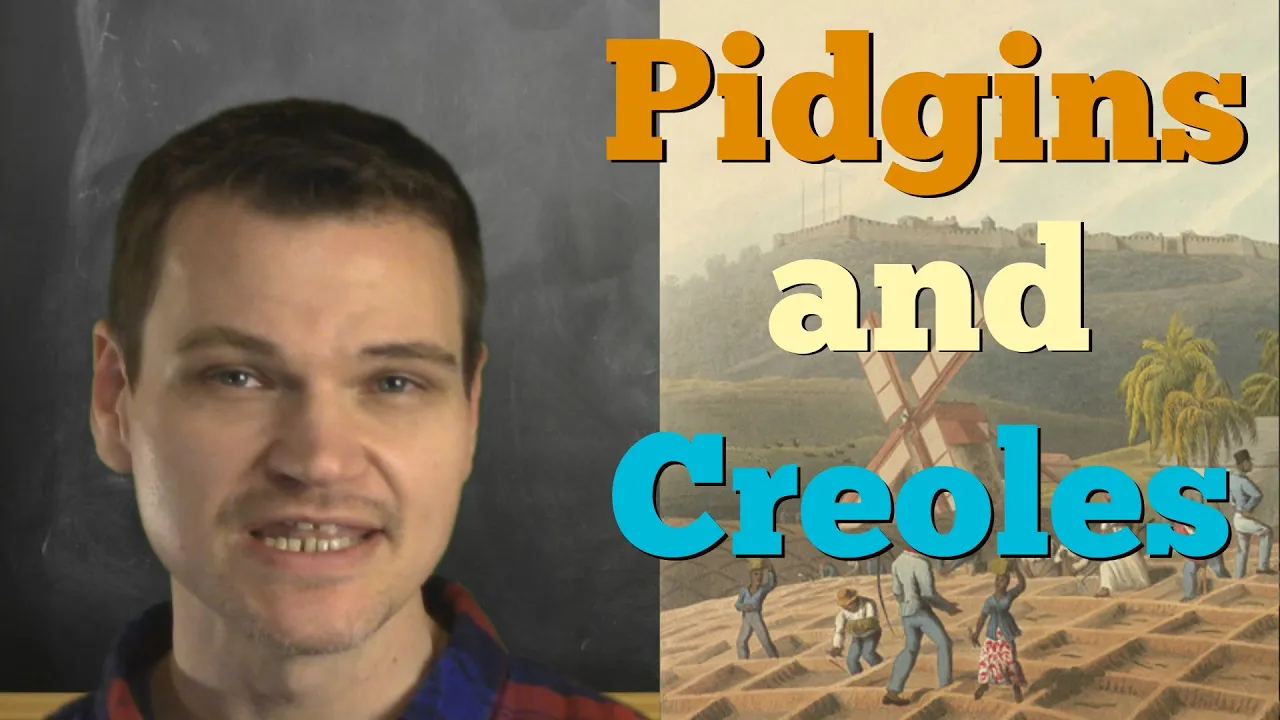





















Creoles are not merely language mixtures but represent a distinct category of languages that systematically lose grammatical complexity compared to their parent languages, as evidenced by cases like Pollen Karros (Spanish-Kikongo) which lacks features present in both parent languages, unlike uniformitarian predictions of feature combination; this streamlining occurs because Creoles originate from a break in transmission with reduced linguistic resources, making them fundamentally different from regular language contact varieties.
Are Creoles Just Hybrid Languages? A Critical Analysis
Added:The distinction between pidgins and creoles, including traditional theories of creole genesis such as the superstrate, substrate, and bioprogram hypotheses.
The foundational concept of linguistic uniformitarianism, which posits that the cognitive and social processes of language change have remained constant throughout human history.
Basic sociolinguistic principles of language contact, language shift, and the socio-historical contexts of colonial plantation economies.
An introductory understanding of morphosyntax and language typology to evaluate claims about the structural simplicity or complexity of creoles.
A deep dive into the 'Creole Exceptionalism' debate, specifically analyzing the opposing arguments of scholars like Michel DeGraff and John McWhorter.
The study of Palenquero morphosyntax, its Spanish superstrate and Bantu substrate influences, and its implications for language revitalization efforts in Colombia.
An examination of how creole languages challenge traditional historical linguistics models, such as the comparative method and the family tree (cladistic) model of language evolution.
The application of cognitive linguistics to creole genesis, exploring how universal grammar and second language acquisition strategies shape contact languages.
6.4K views130likes23:46Original Release: 2017-09-18
Creoles are not a distinct kind of language true or false that is the question that I want to address in a brief series of presentations like this where what I want to get at is do linguists have any reason to be interested in these languages because I think they do an increasingly influential group of Creoles --tz-- think although they don't put it this way that linguist shouldn't be interested in any genuine way in Creole languages as a group of languages for them Creoles are just what happens when languages mixed together and that will be my lesson one and we have to understand why this is an important question because if Creoles are just what happens when language is mixed together then there's no difference between Creoles and all languages because all languages are language mixtures to some extent so we're dealing with what you could call a battle between the Creole exceptional lists and the uniformitarian I am a proud Creole Exceptionalist the uniformitarian are a different group so what's a uniformitarian they don't call themselves that but I don't want to have to keep saying their names over and over again and they share a particular actually eccentric but in interesting ways to many attractive perspective I have to use names I'm talking about Solly Kokomo Fuente Michele de Graaff ena Cabo and Umberto on Salda these are people who think that Creole languages form the same way that check Navajo and Estonian did and they think that calling any group of languages contact languages much less Creoles is a taxonomic mistake and also sinister for other reasons you can probably predict but that I will barely touch on in this particular lesson so to the Creole Exceptionalist Creoles are of course mixed but they are much more streamlined than their parents so you can see in this schema here that you have black and gray and they produce a language that it's part black and part gray but it's smaller and that's because if a language starts as a pidgin if it starts with a break in transmission with starkly reduced resources and it's not even a true language at all and then it flowers into a real language then especially at first it doesn't have the junk that needlessly accretes in older languages such as grammatical gender and lexical tone and all sorts of things that we're so used to seeing in languages that are there but aren't necessary to language now it must be clear that by less complex I don't mean lesser I don't think that Creoles have too little of anything older languages have too much that was really the main motivation of my book the language house where I tried to explain that so much of what we think of as what language typically is and that somehow necessary to it is really just to use an unscientific term junk none of it has anything to do with cognitive sophistication and I will do one of these lessons about what complexity means because that's something that there's been a great deal of confusion about this is just a taste anyway the uniformitarian schema is that a creole language just combines features from its source languages feature selections what sally cook them with when that calls it for example so black square gray square and the result is a square with some black and some gray in it that's the same size now no fleming in my experience has a penchant for saying that he's been misinterpreted and often deliberately when you tried to disagree with him even politely so I want to make clear the sorts of things he's written that motivate my statements here so for example the extent of morphological complexity in terms of range of distinction retained by a contact language largely reflects the morphological structures of the target language and the particular languages that it came in contact with he said that what he means is that in contact languages there is no loss of complexity it's been an illusion that we think so or and here's something because I think a lot of people think Salah Kokomo funny is just saying that we have to take all of the languages in a Genesis context into account but frankly nobody needs to say that he's saying something more interesting in its way than that he has said second language acquisition research is largely irrelevant to Creole Genesis theory he lays it out in black and white that is what he's saying or let's take another uniformitarian the more recently arrived enoch abu very nicely puts it the claim that Creoles are simplified versions of their sources is a fallacy just as it would be to claim in biology that hybrids are genetically simplified children of their parents so you'll see work by for example a bow I chose this at random but he'll have a piece called Creole distinctiveness a dead end and there it is in print in a prestigious place and it looks like that's somehow then decided and now a bow has a whole book from a prestigious house but you know let's face it just because somebody has compiled a document with lots of pages just because somebody has written something that is relatively long doesn't mean that they've proven it simply by the fact that if you drop it on your foot it hurts and so for example this is an entire book but the idea that Creoles are just mixtures of languages is a radical proposition that is spitting in the eye of 50 years of pidgin and Creole studies now radical can be fun but the question is does this proposition hold up and the truth is Creole studies has subjected this idea to almost curiously little serious engagement that's going to change now so test and it might surprise many of you to know outside of Creole studies that this test has not been applied let's test the idea that Creoles are just what happens when languages mixed together pollen Cairo is a spanish-based creole it's spoken in colombia and it was created by speakers of really just two languages you've got Spanish you've got ki Congo so the question is a very simple test is pollen Cairo just a hybrid of Spanish and ki Congo here we go here's ki Congo look how prefixed it is it's also suffixed this is a highly inflected language that's what man 2 is like now so with Spanish we often think that European languages are going to be semi analytic like English and French at least the colonial ones we tend to forget how highly inflected Iberian languages are so Spanish really has about as many bells and whistles as key Congo we're talking about the same sentence here notice these great white stones are those which we have seen I wanted to choose a nice spontaneous colloquial sentence and there it is now if languages that we call Creoles or just language mixtures and we've all been crazy and thinking them as anything different then we should be assuming that the pollen Karros slide I'm about to show is a heavily inflected slide that pollen Cairo is a heavily inflected language because mom and dad were look at pollen Cairo BAM notice that this is a very different language from key Congo and Spanish and yes I know that their linguist these days who are questioning whether we can really be confident about the difference between an affix and a clinic and a free word but notice that here that whole debate which in itself is very interesting really only applies to one or two of these morphemes this is a language that has simply lost a great many of the distinctions that both Spanish and key Congo make and it doesn't replace them with anything else it's just gone now remember Mulaney has written the extent of morphological complexity retained by a contact language largely reflects the morphological structures of the target language and the particular languages that it came in contact with we have just seen a stinging rebuke of that idea so look at all the stuff the pollen karo is missing that both of its parents have so it's not a matter of it having not taken something from Spanish but then taken something from kiko go noun phrase Concord gone obligatory marking of number which is true of both Spanish and key Congo gone definite determiner nothing now key Congo doesn't have that strictly but it has the Bantu augment marker which behaves a lot like a definite determiner nobody would be surprised if a language created from one that had a definite article in one that had an augment marker had some sort of definite article didn't happen in pollen Caro perfect from past and didn't gone nothing like that in the entrenched fashion that you have in both Spanish and key Congo differential object marking and so I kiss Charles basal a Carlos that thing that's frustrating from English that's differential object marking and you know key Congo has the equivalent to but no nothing like that in pollen Caro or why isn't pollen Caro if what Creoles are is just mixtures of languages like kupo Pia this is a language spoken in Brazil Portuguese and key Congo came together and the result is basically key Congo words situated sweetly within Portuguese as grammar in all of its elaboration well isn't that what this uniformitarian idea would predict but no pollen karo is nothing like kupo Pia and kupo Pia is nothing like Creoles now obviously we have to consider that maybe pollen caro is a fluke because you can't abandon your theory just because there's some hair out of place that wouldn't be good science but the problem is that uniformitarianism is incompatible with most Creoles you could basically like blindfolding yourself in throwing a dart at a board and almost anywhere the dart wind in Creole world this idea that languages are just mixtures that Creole languages are just mixtures just it fails frankly guinea-bissau Creole Portuguese West Atlantic languages if any of you are familiar with them well enough said and Portuguese and yet Guinea Bissau Creole Portuguese is a highly analytic language yes it's got a fix or two but it's a highly analytic language newbie creole Arabic never read about that in the uniformitarian literature it is arabic again enough said and then some nilo-saharan languages and wow these languages are some of the most morphologically elaborate i've ever known it's the kind of language family where you wonder how actual people could speak the language while also walking at the same time and yet newbie Creole Arabic is a Creole with that typical profile that we've seen Mauritian Creole French French okay French is semi analytic but Bantu sure isn't Mort is Tamil Knorr Malagasy Knorr Wolof Mandinka we could argue but there is no way that we could look at those languages and think that Mauritian Creole French a highly analytic language is somehow a predictable result within this uniformitarian schema so for example I've often been asked as a Creoles somebody intelligently asks well what would happen if in a Creole Genesis situation both of the languages were heavily inflected and many people want to know would the creole be heavily inflected has that been tested and they often ask because the uniformitarian have a way of making it seem like all Creoles happen to have been based on rather analytic English and French and then non inflected languages in Africa such as Bay or Yoruba or akan but that's not true Creoles have been based on a very wide variety of languages and the test has long been done so Michele de Graaff asks in passing in one of his his opuses what should be asked as whether a hypothetical Creole derived from contact among say Caucasian languages of that says type would end up looking like saramakan okay but that idea has long been explored and I just showed you the result here for the record of just some relevant references making the point that Creoles lack as much as they retain from their source languages to an extent that renders them distinct results of language contact pay particular attention to Peter Bacher's work which I have here as well as of course work of my own so any work you read from the uniformitarian perspective that doesn't acknowledge the pollen karo challenge has not given you the data you need to decide whether Creoles are a kind of language now certainly sometimes people who air a uniformitarian paper or book they don't happen to be specialists in Creole studies just like I'm not a specialist in things outside of language change and Creole studies and so it ends up looking like uniformitarianism is a settled business in a way that it isn't that is true of this piece that has appeared in nature recently by Damiano Ozzy and Susanna Michaelis and Markham Haskell man saying that creole exceptionalism has been disproved because you can see that Creole languages retain features from their source languages and don't get them from somewhere else that's what this title about grammars or robustly transmitted means but very simply does this piece which has gotten so much attention including in language log prove the Creoles are not a kind of language it proves that Creoles are language mixtures beautifully although I'm not sure anybody has denied that for a very long time since Derek Bickerton he wouldn't like this paper but he stands alone at this point if he still believes that Creoles are not replete with substrate influence but no one denies the mixture so the question is how robust is this transmission in Creole languages how about a schema here's a big red square here's a big blue square and in between is a lavender Square now the lavender Square is lavender because red and blue combined and they created that color okay but there's something else that created this square in between it's not just a combination of the two it looks like it's it's smaller and so you look at this and you think to yourself what's being proven here now now imagine somebody saying well it's ridiculous that the purple square is smaller it can't be smaller than the red of the blue squares that's just an illusion because purple is one part red in one part blue what do you mean it's smaller I'm just not looking at it properly you're you're discriminating against it only if that makes sense can you say that the nature article proves that Creoles don't come from some kind of break in transmission now one doesn't wish the caricature and you may reasonably suspect me of doing it right now of course you might be wondering do they really think there's no evidence of Creoles coming from pigeons because of course some evidence of that kind is incontrovertible everybody knows that talk pissin started as a pigeon that there was a pigeon at the root of Hawaiian Creole English everybody knows that right yeah including the uniformitarian but they want us to believe something that really is peculiar so here's tock pissin here's run off this is how you say I was going in both languages now in both cases you have the over generalization of the liek form such that it's just me across the board instead of there being I and me you had the past and the progressive indicated with these separate morphemes you have this extreme analyticity the languages seem to be akin it's why they're discussed in the same books and at the same conferences but the uniformitarian 's want us to think that talk pissin came from a pidgin because you can't deny that but that something like strong or haitian or Cape Verdean came from just languages mixing together it was all different now what's the explanation well moof when a says different evolutionary trajectories can nonetheless produce similar structural outcomes okay that sounds kind of Darwinian it's it's you know it's a neat idea but we need more elsewhere he has said structural similarities between expanded pidgins and creoles reflect the fact that they were developed largely by linguistic adults interacting regularly among themselves using materials from typologically related european and/or substrate languages to meet diverse and complex communicative needs but what really does this mean but doesn't this say that tock Kissin and sranan developed in the same way or diverse and complex communicative needs isn't that a little mystically put and how are these diverse and complex communicative means different in surinam versus Oceania and Noah mph when a has never addressed these sorts of questions he has not engaged on these sorts of things he just proclaims them so really if the result was the same why should we suppose that the genesis process was different I mean if you're gonna make that claim then you'd better bring your a-game because it really does go against Occam's razor to suppose such a thing now is it because there's no documentation of pidgin spoken on plantations that's a big move one a point but I'm sorry that's not a smackdown point at all quite simply on early plantations almost nobody visited and barely anybody ever wrote anything down except when somebody dropped dead which was often and somebody would put a cross on a piece of paper there was no linguistic documentation of anything so some of us deduce the plantation Creoles were born of the same processes took pissin because they differ from their source languages in the exact same way and were born omits precisely similar socio-historical conditions in other words because science so let me tell you something untrue Creoles are simply languages developed by subordinate people amidst European colonialism from about 1492 1900 I just told you an untruth I'm going to tell you another one listen to me lie there is no structural litmus test that shows that a language is a Creole sounds so sensible you'll read it in a lot of places it's not true in later lessons we will address all the things that you've heard or read that supposedly prove the Creoles aren't linguistically interesting and that 50 years of Creole studies has been a tacitly racist yes I went there and I'm gonna do it again mistake such as little preview here does Chomsky and minimalist theory reveal the Creoles are just mixtures like all other languages I'm afraid not such as no features have been discovered that occur only in Creoles but no one has ever said there were any anything you read claiming that is like saying that somebody has denied gravity by saying that they don't see anything floating sideways no one would or has said anything of the sort now I have indeed said that there are three things that a language can lack together that reveal that a language was born from a break in transmission but next thing that we're gonna address and one of these lessons is has anyone revealed a language with no such history that has those three features together I'm afraid not despite what you may have heard I will explain and I'm gonna explain it hard so for Matt every two weeks for seven segments maybe eight I am gonna address a canard that the uniformitarian have broadcast about Creole exceptionalism a week later I'll address questions and comments that the post elicits and then a week after that I will proceed to addressing another canard now if their past response to Creole exceptional let's work as any God the uniformitarian will continue to speak and write as if the points on making in this series had never been raised except in parenthetical asides however if by chance the uniformitarian z' actually respond to these points for once after 20 years I'm gonna do another series in response and it's going to be higher tech than this one and I'm going to broadcast it more widely and that cycle will continue indefinitely the misrepresentation of Creole exceptionalism to the linguistics community stops now wrapping up for today Creole Studies has not been a 50-year mistake the idea that Creoles are just language mixtures is a radical proposition which in the end fails please send questions if you have them and do stay tuned for more lessons I'm going for something whole here it's on let's go
Up Next

8:00
Michif: The Unique Mixed Language of French and Cree
@ThePolyglotFiles
20.4K views•2017-02-25
36:52
Constraint Interaction in Optimality Theory: Epenthesis & Deletion
@Vidyamitra
180 views•2018-08-20

8:59
Forensic Linguistics: How Language Solves Crimes | PBS
@pbsstoried
1M views•2024-01-25

21:32
Accent Expert Explains U.S. Regional Dialects | Part 1
@WIRED
9.3M views•2021-01-21
Related Study Plans & Knowledge Roadmaps
Structured learning paths in Linguistics
linguistics
Optimality Theory: Tableaux & Constraints
01Phonological Basics: Sounds, Syllables & Rules
02Foundations of Optimality Theory: GEN, CON, and EVAL
03The Constraint Inventory: Markedness vs. Faithfulness
+ 2 more learning modules
15h5 modules
Explore Roadmap
linguistics
Morphosyntactic Alignment: S, A & P Systems
01Foundations of Syntax: Transitivity and Arguments
02The Linguistic Variables: Mapping S, A, and P
03Nominative-Accusative Alignment
+ 3 more learning modules
12h6 modules
Explore Roadmap
linguistics
Analyzing Sign Language: Phonology & Syntax
01Foundations of Sign Language Linguistics
02Phonology: The Five Parameters of a Sign
03Morphology: Word Formation and Classifiers
+ 2 more learning modules
14h5 modules
Explore Roadmap
linguistics
Pragmatics: Speech Acts, Grice & Politeness
01Introduction to Pragmatics: Meaning in Context
02Grice’s Cooperative Principle & Implicature
03Speech Act Theory
+ 2 more learning modules
14h5 modules
Explore Roadmap