![Phonology: Intro to linguistics [Video 3]](https://i.ytimg.com/vi_webp/1JYahvKUvPU/maxresdefault.webp)





















![AI እንዴት ነው የሚሰራው?[ክፍል -1] /Techtalk/ Part 1](https://i.ytimg.com/vi/1HzqbqVvB20/maxresdefault.jpg)
![Max Garagnani - Simulating word acquisition and semantic grounding in [...] [2016]](https://i.ytimg.com/vi_webp/7EAAAycjPgo/maxresdefault.webp)


Babies are born as 'citizens of the world' who can discriminate all sounds across languages, but by their first birthday, they become 'culture-bound listeners' who only recognize sounds from their native language; this transformation occurs because babies take statistical information from the speech sounds around them, and crucially, this statistical learning only happens when babies interact with human caregivers, not through passive media like television.
The Linguistic Genius of Babies | Patricia Kuhl | TEDxTalk
Added:Basic phonology and the concept of 'phonemes' (the distinct units of sound in a specified language).
Fundamental theories of first language acquisition (e.g., Chomsky's Universal Grammar versus empiricist views).
The concept of neuroplasticity and how the brain adapts to environmental stimuli during early development.
An introductory understanding of statistical learning or pattern recognition in human cognition.
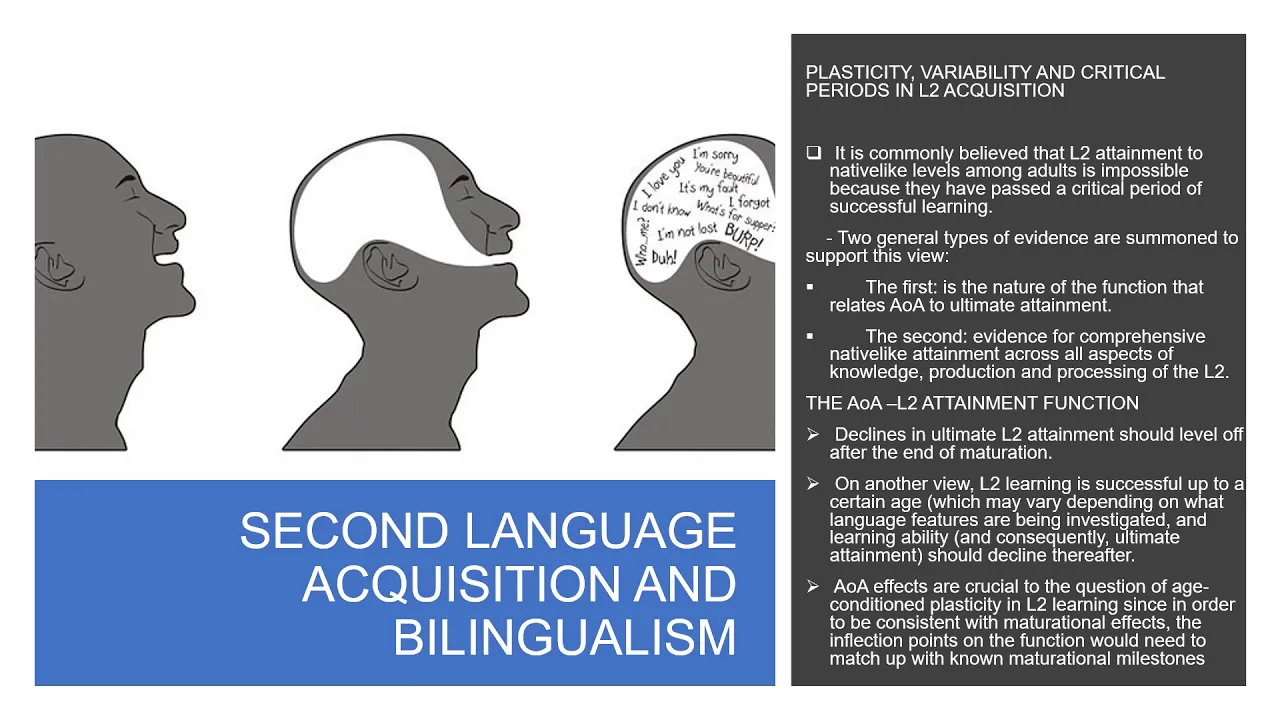
The Critical Period Hypothesis and its implications for second language acquisition in adolescents and adults.
The 'Social Gating Hypothesis' and why human interaction is superior to screen-based media for infant learning.
Cognitive and neurological differences between monolingual and bilingual brain development.
Computational modeling of language acquisition, including how AI models mimic infant statistical auditory learning.
137.6K views1.1Klikes10:18Original Release: 2013-07-10
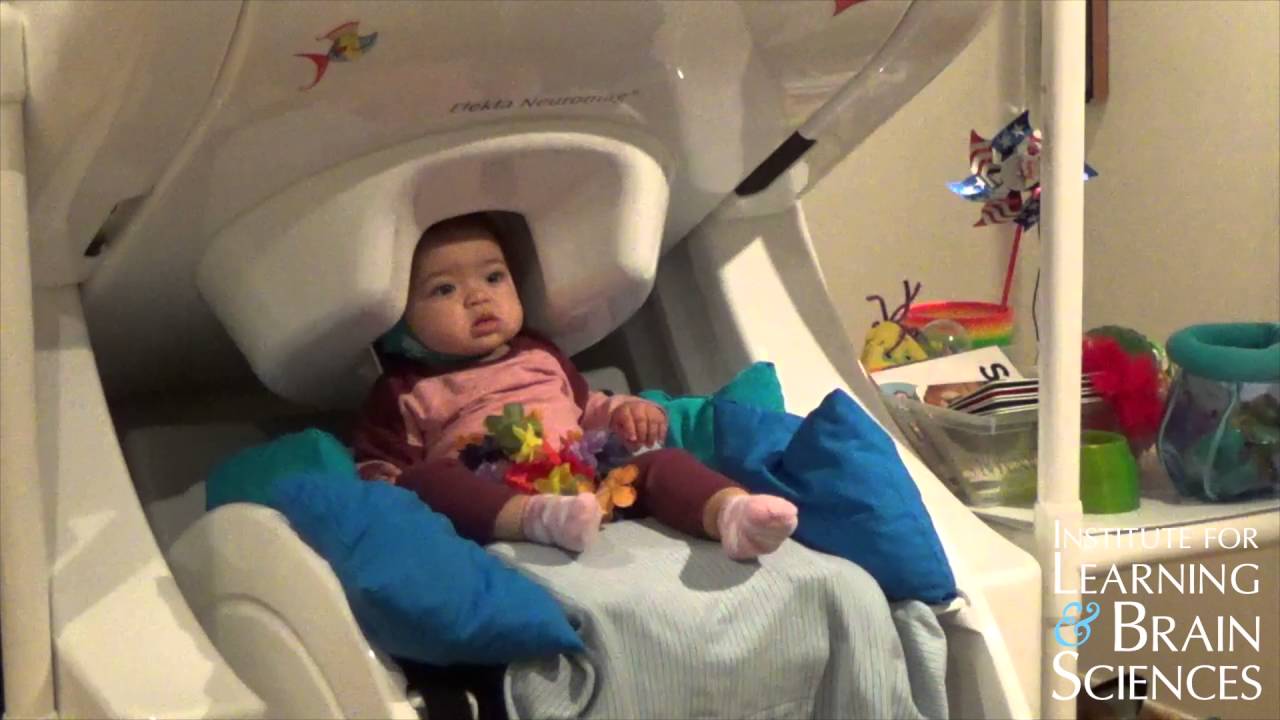
[Music] [Music] [Applause] I want you to take a look at this baby what you're drawn to are her eyes and the skin you love to touch but today I'm going to talk to you about something you can't see what's going on up in that little brain of her the modern tools of Neuroscience are demonstrating to us that what's going on up there is nothing short of rocket science and what we're learning is going to shed some light on what the Romantic writers and Poets described as the celestial openness of the child's mind what we see here is a mother in India and she's speaking cororo which is a newly discovered language and she's talking to her baby what this mother and the 800 people who speak cororo in the world understand that it to preserve this language they need to speak it to the babies and therein lies a critical puzzle why is it that you can't preserve a language by speaking to you and I to the adults well it's got to do with your brain what we see here is that language has a critical period for learning the way to read this slide is to look at your age on the horizontal axis you've done that and you'll see on the vertical your skill at acquiring a second language the babies and children are geniuses until they turn seven and then there's a systematic decline after puberty we fall off the map no scientists dispute this curve but Laboratories all over the world are trying to figure out why it works this way work in my lab is focused on the first critical period in development and that is the period in which babies try to master which sounds are used in their language we think by studying how the sounds are learned we'll have a model for the rest of language and perhaps for critical periods that may exist in childhood for social emotional and cognitive development so we've been studying the babies using a technique that we're using all over the world in the sounds of all languages the baby sits on a parent's lap and we train them to turn their heads when a sound changes like from a to e if they do so that the appropriate time the Black Box lights up and a panda bear pounds a drum a six- Monon adors the task what have we learned well babies all over the world are what are like what I like to describe as citizens of the world they can discriminate all the sounds of all languages no matter what country we're testing and what language we're using and that's remarkable because you and I can't do that we're culture-bound listeners we can discriminate the sounds of our own language but not those of foreign languages so the question arises when do those citizens of the world turn into the language bound listeners that we are and the answer before their first birthdays what you see here is performance on that head turn task for babies tested in Tokyo and in the United States here in Seattle as they listen to raw and law sounds important to English but not to Japanese so at 6 to 8 months the babies are totally equivalent 2 months later something incredible occurs the babies in the United States are getting a lot better babies in Japan are getting a lot worse but both of those groups of babies are preparing for exactly the language that they're going to learn so the question is what's happening during this critical two-month period this is the critical period for sound development but what's going on up there so there two things going on the first is that the babies are listening intently to us and they're taking statistics as they listen to us talk they're taking statistics so listen to two mothers speaking motheres the universal language we use when we talk to kids first in English and then in Japanese I love your big blue eyes so pretty and nice during the production of speech when babies listen what they're doing is taking statistics on the language that they hear and those distributions grow as and what we've learned is that babies are sensitive to the statistics and the statistics of Japanese and English are very very different English has a lot of RS and L's the distribution shows and the distribution of Japanese is totally different where we see a group of intermediate sounds which is known as the Japanese R so babies absorb the statistics of the language and it changes their brains it changes them from the citizens of the world to the uh culture listeners that we are but we as adults are no longer absorbing those statistics we're governed by the representations in memory that were formed early in development so what we're seeing here is changing our models of what the critical period is about we're arguing from a mathematical standpoint that the learning of language material may slow down when our distributions stabilized it's raising lots of questions about bilingual people bilinguals must keep two two sets of Statistics in mind at once and flip between them one after the other depending on who they're speaking to so we asked ourselves can the babies take statistics on a brand new language and we tested this by exposing American babies who'd never heard a second language to Mandarin for the first time during the critical period we knew that when monolinguals were tested in Taipei and Seattle on the Mandarin sounds they showed the same pattern 6 8 months they're totally equivalent 2 months later something in incredible happens but the Taiwanese babies are getting better not the American babies what we did was expose American babies during this period to Mandarin it was like having Mandarin relatives come and visit for a month and move into your house and talk to the babies for 12 sessions here's what it looked like in the laboratory hey so what have we done to their little brains we we had to run a control group to make sure that just coming into the laboratory didn't improve your Mandarin skills so a group of babies came in and listened to English and we can see from the graph that exposure to English didn't improve their Mandarin but look what happened to the babies exposed to Mandarin for 12 sessions they were as good as the babies in Taiwan who'd been listening for 10 and 1/2 months what it demonstrated is that babies take statistics on a new language whatever you put in front of them they'll take statistics on but we wondered what role the human being played in this um learning exercise so we ran another group of babies in which the kids were get the same dosage the same 12 sessions but over a television set and another group of babies who had just audio exposure and looked at a teddy bear on the screen what did we do to their brains what you see here is the audio result no learning whatsoever and the video result no learning whatsoever it takes a human being for babies to take their statistics the social brain is controlling when the babies are taking their statistics we want to get inside the brain and see this thing happening as babies are in front of televisions as opposed to in front of of human beings thankfully we have a new machine magnetoencephalography that allows it to do this it looks like a hair dryer from Mars but it's completely safe completely non-invasive and Silent we're looking at millimeter accuracy with regard to spatial and millisecond accuracy uh using 306 squids these are super conducting Quantum interference devices to pick up the magnetic fields that change as we do our thinking we're the first in the world to record babies in an Meg machine while they are learning so this is little Emma she's a six Monon and she's listening to various languages in the earphones that are in her ears you can see she can move around we're tracking her head with little pellets in a cap so she's free to move completely unconstrained it's a technical tour divorce what are we seeing we're seeing the baby brain as the ba as the baby Hears A word in her language the auditory areas light up and then subsequently areas surrounding it that we think are related to coherence getting the brain coordinated with its different areas and causality one brain area causing another to activate we are embarking on a grand and golden age of knowledge about child's brain development we're going to be able to see a child's brain as they experience an emotion as they learn to speak and read as they solve a math problem as they have an idea and we're going to be able to invent brain-based interventions for children who have difficulty learning just as The Poets and writers described we're going to be able to see I think that wondrous openness utter and complete openness of the Mind of a child in investigating the child's brain we're going to uncover deep truths about what it means to be human and in the process we may be able to help keep our own minds open to learning for our entire lives thank you
Up Next

37:37
Critical Periods in First Language Acquisition: Key Evidence
@jonahumass
159 views•2020-03-28
36:52
Constraint Interaction in Optimality Theory: Epenthesis & Deletion
@Vidyamitra
180 views•2018-08-20

8:46
How Language Shapes Thought: Cognitive Science Explained
@TEDEdStudentTalks
285.5K views•2017-04-27

21:32
Accent Expert Explains U.S. Regional Dialects | Part 1
@WIRED
9.3M views•2021-01-21
Related Study Plans & Knowledge Roadmaps
Structured learning paths in Linguistics
linguistics
Optimality Theory: Tableaux & Constraints
01Phonological Basics: Sounds, Syllables & Rules
02Foundations of Optimality Theory: GEN, CON, and EVAL
03The Constraint Inventory: Markedness vs. Faithfulness
+ 2 more learning modules
15h5 modules
Explore Roadmap
linguistics
Morphosyntactic Alignment: S, A & P Systems
01Foundations of Syntax: Transitivity and Arguments
02The Linguistic Variables: Mapping S, A, and P
03Nominative-Accusative Alignment
+ 3 more learning modules
12h6 modules
Explore Roadmap
linguistics
Analyzing Sign Language: Phonology & Syntax
01Foundations of Sign Language Linguistics
02Phonology: The Five Parameters of a Sign
03Morphology: Word Formation and Classifiers
+ 2 more learning modules
14h5 modules
Explore Roadmap
linguistics
Pragmatics: Speech Acts, Grice & Politeness
01Introduction to Pragmatics: Meaning in Context
02Grice’s Cooperative Principle & Implicature
03Speech Act Theory
+ 2 more learning modules
14h5 modules
Explore Roadmap