









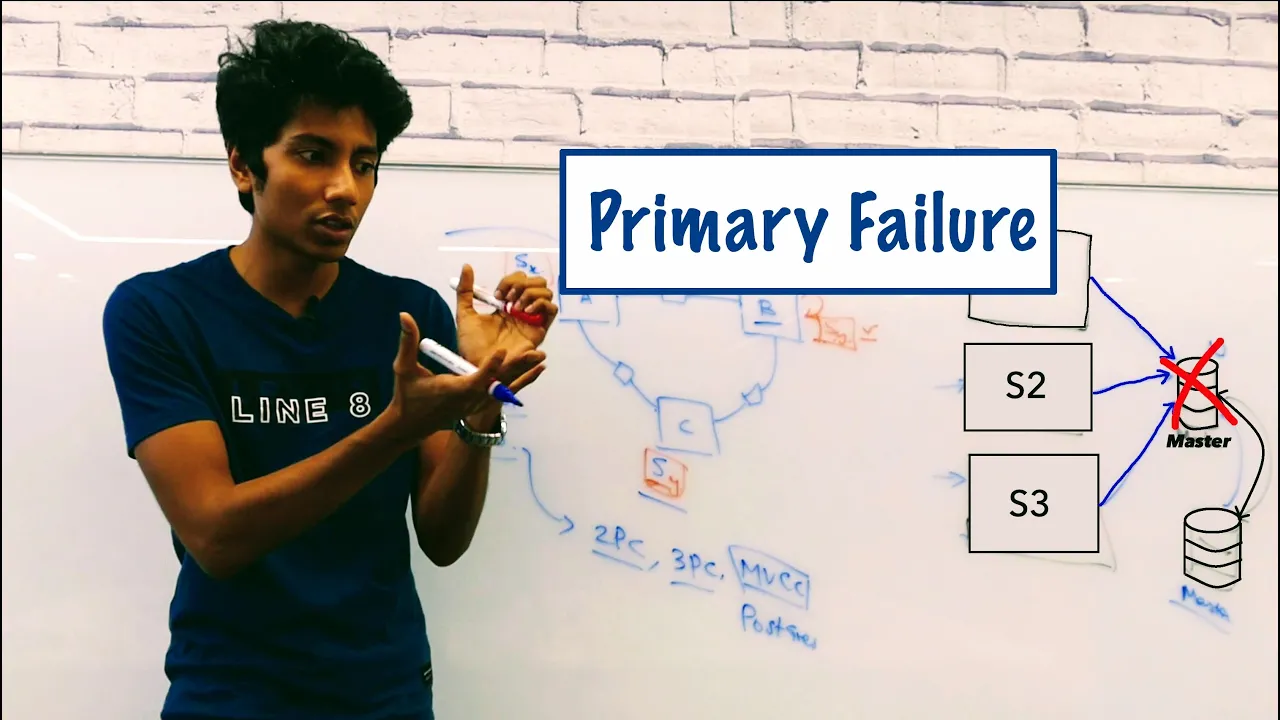








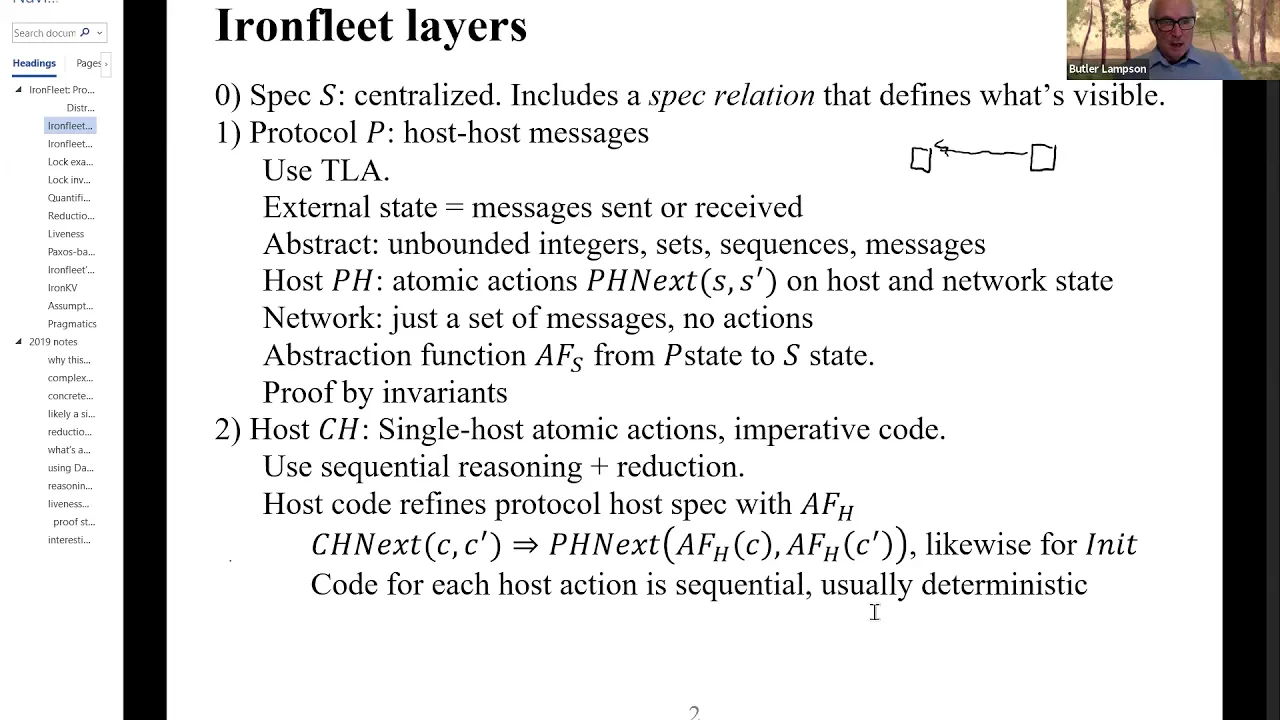








Primary-backup replication is a fault tolerance technique where a primary server and backup server execute in lockstep to ensure service availability during hardware failures; VMware FT implements this at the machine level by replicating the entire virtual machine state (memory and registers) between two physical machines, using a logging channel to synchronize execution and handle non-deterministic events like timer interrupts and external inputs, while the output rule ensures consistent client responses by delaying output until the backup acknowledges receipt of all preceding log records.
Primary-Backup Replication Explained | MIT 6.824 Lecture 4
Added:Basic distributed system architectures, including client-server communication models, network latency, and independent machine failures.
The concept of State Machine Replication (SMR) and how deterministic state machines transition based on ordered input sequences.
The distinction between deterministic and non-deterministic operations (e.g., system clocks, interrupts, and random number generators) in program execution.
The 'split-brain' problem in distributed networks and why simple dual-node setups struggle with network partitions.
Consensus protocols such as Raft or Paxos, which dynamically elect leaders and safely resolve split-brain scenarios in a replicated system.
Consistency models in distributed systems, specifically Linearizability and Sequential Consistency, to formalize correctness guarantees.
The trade-offs between State Transfer (sending raw memory/disk state) and Replicated State Machine (sending deterministic instruction logs) methodologies.
Byzantine Fault Tolerance (BFT), which extends fault tolerance to handle malicious or arbitrary node behavior rather than just fail-stop crashes.
Real-world distributed storage and coordination engines that leverage advanced replication, such as Google Spanner, Apache ZooKeeper, or etcd.
86.7K views0likes1:19:20Original Release: 2020-02-18
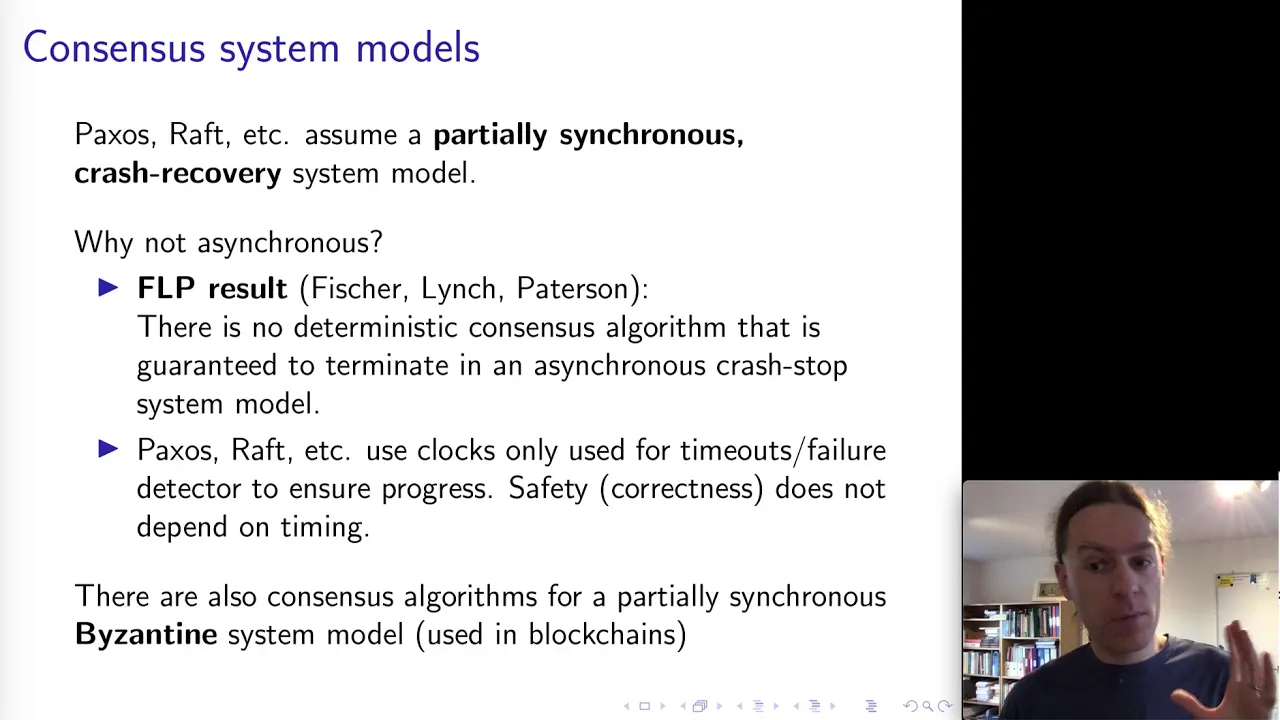
all right today I want to talk about bit more about fault tolerance and replication and then look into the details of today's paper about vmware ft the topics still fault tolerance to provide high availability that is you want to build a server that even if some hardware you know computer crashes is involved in the service we still like to provide the service and to the extent we can we'd like to provide our service also if there's network problems and the tool we're using its replication least for this part of the course so it's worth asking what kind of failures replication can be expected to deal with because it's not everything by any means so maybe the easiest way to characterize the kind of failures we're talking about is fail stop failures of a single computer and what I mean by fail stop it's a sort of generic term and fault tolerance is that if something goes wrong would say the computer the computer simply stops executing it just stops if anything goes wrong and in particular it doesn't compute incorrect results so if somebody kicks the power cable out of your server that's probably gonna generate a fail stop failure similarly if they unplug your servers network connection even though the server is still running so this is a little bit funny you know be totally cut off from the network so it looks at me outside like it just stopped so it's really these failures we can deal with with replication this also covers some hardware problems like you know maybe if the fan on your server breaks because it you know it cost 50 cents maybe that'll cause the CPU to overheat and the CPU will shut itself down cleanly and just stop executing what's not covered by the kind of replication systems we're talking about is things like bugs and software or design defects in hardware so basically not bugs because if we take some service you know say you're a MapReduce master for example you know we replicated and run it on two computers you know if there's a bug in your MapReduce master or my MapReduce master let's say replications not going to help us we're going to compute the same incorrect result on both of our copies of our MapReduce master and everything looked fine they'll agree you just happen to be the wrong answer so we can't depending against bugs in the replicated software and we can't defend against bugs in the whatever scheme we're using to manage the replication and similarly as I mentioned before we can't expect to deal with bugs in the hardware the hardware it computes incorrectly that's just that's the end for us at least with this kind of technique although you know that said there are definitely hardware and software bugs that that replication might if you're lucky might be able to cope it so if there's some unrelated software running in your server and it causes the server to crash maybe because your kernel to panic and reboot or something it has nothing to do with you know with your with the service you're replicating then that kind of failure for us for your service will may well be fail stop you know the kernel will panic and the backup replicas will take over similarly some kinds of hardware errors can be turned into fail stop errors for example if you send a packet over the network and the network corrupts it just flips a bit in your packet that will almost certainly be caught by the checksum on the packet same thing for a disk block if you write some data to disk and weand it back a month later you know maybe the magnetic surface isn't perfect and you know one of the best couple of bits were wrong in the block as it's right back it's actually error correcting that up to a certain point will fix errors in disk blocks that you'll be turning you know random hardware errors into as either correcting them if you're super lucky or at least detecting them and turning random corruption into a detected fault which you know the software then knows that something that wrong and can turn it into a fail stop fault by stopping executing or take some other remedial action but in general we really can only expect to handle fail stop faults there's other limits to replication to you know the the failures in the if we have a primary in the back of our two replicas or whatever we're really assuming that failures in the two are independent right if there tend to have correlated failures then replication is not going to help us so for example if we're a big outfit and we buy thousands of computers batches of thousands of computers identical computers from the same manufacturer and we run you know our replicas is on all on those computers we bought at the same time from the same place that's a bit of a risk maybe because presumably if one of them has a manufacturing defect in it there's a good chance that the other ones do too you know one of them's prone to overheating because the manufacturer you know didn't provide enough airflow well it probably all had that problem and so one of them overheats and dies it's a good chance that the other ones will too so that's one kind of correlated failure you just have to be careful of another one is that you know if there's an earthquake and the city where our datacenter is probably gonna take out the whole data center you know we can have all the replication we like inside that data center it's not going to help us because the failure caused by an earthquake or a citywide power failure or something the building burning down is like it's correlated failure between our replicas if they're on that building so if we care about dealing with earthquakes then we need to put our replicas in maybe in just different cities at least physically separate enough that they have separate power unlikely to be affected by the same natural disaster okay but that's all sort of hovering in the background for this discussion where we're talking about the technology you might use another question about replication is whether it's worthwhile you may ask yourself gosh you know this literally uses these replication schemes use twice as much or three times as much computer resources right we need to have you know GFS had three copies of every box we have to buy three times as much disk space the paper for today you know replicates just once but that means we have twice as many computers and CPUs and RAM it's all for expensive like is that really worth it that expense and you know that's not something we can answer technically right it's an economic question it depends on the value of having an available service you know if you're running a bank and if the consequence is the computer failing is that your customer you can't serve your customers and you can't generate revenue and your customers all hate you then it may well be worth it to blow you know an extra ten or twenty thousand bucks on a second computer so you can have a replica on the other hand if you're me and you're running the 684 web server I don't consider it worthwhile to have a hot backup of the 84 web server because the consequences of failure are very low so the whether the replication is worthwhile on how many replicas you ought to have and how much you're willing to spend on it is all about how much cost and inconvenience failure would call it cause you all right this paper sort of in the beginning mentions as there's a couple of different approaches to replication really mentions two one two calls state transfer and the other calls replicated state machine most of the schemes we're going to talk about in this class are replicated state machines it'll talk about both anyway the idea behind state transferor's that if we have two replicas of a server the way you cause them to be to stay in sync that is to be actual replicas so that the backup can has everything it needs to take over if the primary fails in a state transfer scheme the way that works is that the primary sends a copy of its entire state that is for example the contents of its RAM to the backup and the backup just sort of stores the latest state and so it's all there the primary fails in the backup can start executing with this last state it got if the primary fails so this is all about sending the state of the of the primary and for today's if today's paper worked as a state transfer system which it doesn't then the state we'd be talking about would be the contents of the RAM the contents of the memory of the primary so maybe every once while the primary would just you know make a big copy of its memory and send it across the network to the backup you can imagine if you wanted to be efficient you know maybe you would only send the parts of the memory that it's changed since the last time you sent in memory to the backup the replicated state machine this approach observes that most services are most computer things we want to replicate have some internal operation that's deterministic except when external input comes in right you know ordinarily if there's no external influences on a computer it just executes one instruction after another and what each instruction does is a deterministic function of what's in the memory and the registers of the computer and it's only when external events intervene that something unexpected may happen like a packet arrives of a some random time and that causes the server to start doing something differently I'm so replicated state machine schemes don't send the state between the replicas instead they just send those external events they just send maybe from a primary to a backup again just send things like arriving input from the outside world that the backup needs to know and the observation is that you know if you have to two computers and they start from the same state and they see the same inputs that that in the same order or at the same time the two computers will continue to be replicas of each other and sort of execute identically as long as they both see the same inputs at the same time so this transfers probably memory and this transfer some primary backup just operations from clients or external external inputs or external events and you know the reason why people tend to favor a replicated state machine is that usually operations are smaller than the state but this you know the state of a server if it's a database server might be the entire database might be you know gigabytes whereas the operations are just some clients sending and you know please read or write key 27 operations are usually small the states usually large so replicate a state machine usually looks attractive and slight downside is that the schemes tend to be quite a bit more complicated and rely on sort of more assumptions about how the computers operate whereas this is a really heavy-handed I'm just gonna send you my whole state sort of a nothing to worry about any questions about these strategies yes well the did ok so the question is suppose something went wrong with our scheme and the backup was not actually identical to the primary so you know you're suppose we were running GFS master and it's the primary it just handed out at least two chunks server one but because the two you know because we've allowed the states of the primary back to drift out of sync the backup did not issue at least to anybody it wasn't even away or anybody had asked for these so now the primary thinks you know chunks everyone has lease for some chunk in the backup doesn't the primary fails backup takes over right now chunks over one thinks it has a lease for some chunk but then the current master doesn't and is happy to hand out the lease to some other trunk server now we have to chunk servers serving the same beasts okay so that's just a close to home example but really you know almost any bad thing and kind of I think you construct any bad scenario by just imagining some service that confuse the wrong answer because the state's leverage so you're asking about randomization yeah oh y'all talk about this I'll talk about this a bit later on but it is good that the replicated state scheme definitely makes the most sense when the instructions that the primary in the back of our executing do the same thing as long as there's no external events right and that's almost true right you know for an add instruction or something yeah you know if the starting if the registers of memory of the same and they both execute an add instruction they had insurgents kind of the same inputs in the same outputs but they're in some instructions as you point out that don't like maybe there's an instruction that gets the current time of day now probably be executed at slightly different times or an instruction that gets the current processors unique ID and a serial number it's going to yield the different answers and the the the uniform answered the questions that sound like this is that the primary does it and sends the answer to the backup and the backup does not execute that instruction but instead at the point where it would execute that instruction it listens for the primary to tell it what the right answer would be and just sort of fakes that answer to the software I'll talk about you know how the VMware scheme does that okay interestingly enough though today's paper is all about a replicated state machine you may have noticed that today's paper only deals with you know processors and it's not that clear how it could be extended to a multi-core and a multi-core machine where the interleavings of the instructions from the two cores organ are non-deterministic all right so we no longer have this situation on a multi-core machine where if we just let the primary and backup execute they're you know all else being equal they're going to be the same because they won't execute on multiple cores VMware has since come out with a new possibly completely different replication system that does work on multi-core and the new system appears to me to be using state transfer instead of replicated state machine because state transferred is more robust in the face multi-core and parallelism if you use the machine and send the memory over you know that the memory image is just that just is the state of the machine and sort of it doesn't matter that there was parallelism whereas the replicated state machine scheme really has a problem with the parallelism you know on the other hand I'm guessing that this new multi-core scheme is more expensive okay all right so if we want to build a replicated state machine scheme we got a number of questions to answer so we need to decide at what level we're gonna replicate state right so what state what do we mean by state we have to worry about how how closely synchronized the primary and backup have to be right because it's likely the primary will execute a little bit ahead of the backup after all it it's the primary that sees the inputs so the backup almost necessarily must lag over that gives that means there's an opportunity if the primary fails for the prime for the backup not to be fully caught up having the backup actually executes really in lockstep with the primaries for expensive because it requires a lot of chitchat so a lot of designs a lot of what people sweat about is how close the synchronization is if the primary fails or you know actually if the backup fails to but it's more exciting if the primary fails there has to be some scheme for switching over and the clients have to know oh gosh I instead of talking to the old primary on server one I should now be talking to the the backup on server to all the clients have to somehow figure this out the switch over almost certainly it's almost impossible maybe impossible to design a cut over system in which no anomalies are every are ever visible you know in this sort of ideal world if the primary feels we'd like nobody to ever notice none of the clients to notice turns out that's basically unattainable so there's going to be a mama leaves during the cut over and we've gotta figure out a way to cope with them and finally if the one of the two if one of our replicas fails we really need to have a new replica right if we have a two replicas and one fails we're just living on borrowed time right because the second replica may fail at some point so we absolutely need to get a new replica back online as fast as possible so and that can be very expensive the state is big you know you know but the reason we like to replicate a state machine was because we thought state transfer would be expensive but the two replicas in a replicated state machine still need to have full state right we just had a cheap way of keeping them both in sync if we need to create a new replica we actually have no choice but state transfer to create the new replicas the new replica needs to have a complete copy of the state so it's going to be expensive to create new replicas and this is often people spending well actually people spend a lot of time worrying about all these questions and you know we'll see them again as we look at other replicated state machine schemes so on the topic of what state to replicate the today's paper has a very interesting answer to this question it replicates the full state of the machine that is all of memory and all the Machine registers it's like a very very detailed replication scheme just no difference at the even of the lowest levels between the primary in the backup that's quite rare for replication schemes almost always you see something that's more like GFS where GFS absolutely did not replicate you know they had replication but it wasn't replicating every single you know bit of memory between the primaries and the backups it was replicating much more application level table of chunks I had this abstraction of you know chunks and chunk identifiers and that's what it was replicating it wasn't replicating sort of everything else wasn't going to the expense of replicating every single other thing that machines we're doing okay as long as they had the same sort of application visible set of of chunks so most replication schemes out there go the GFS route in fact almost everything except pretty much this paper and a few handful of similar systems almost everything uses application at some level application level of replication because it can be much more efficient because we don't have to go to the we don't have to go to the trouble of for example making sure that interrupts occur at exactly the same point in the execution of the primary and backup GFS does not sweat that at all but this paper has to do because it replicates at such a low level so most people build efficient systems with applications specific replication the consequence of that though is that the replication has to be built into the right into the application right if you're getting a feed of application level operations for example you really need to have the application participate in that because some generic replication thing like today's paper doesn't really can't understand the semantics of what needs to be replicated so anyways so most teams are application specific like GFS and every other paper we're going to read on this topic today's paper is unique in that it replicates at the level of the machine and therefore does not care what software you run on it right it replicates the low-level memory and machine registers you can run any software you like on it as long as it runs on that kind of microprocessor that's being represented this replication scheme applies to the software can be anything and you know the downside is that it's not that efficient necessarily the upside is that you can take any existing piece of software maybe you don't even have source code for it or understand how it works and you know do within some limits you can just run it under this under VMware this replication scheme and it'll just work which is sort of magic fault-tolerance wand for arbitrary software all right now let me talk about how this is VMware or Ft first of all VMware is a virtual machine company they're what their business is a lot of their business is selling virtual machine technology and what virtual machines refer to is the idea of you know you buy a single computer and instead of booting an operating system like Linux on the hardware you boot we'll call a virtual machine monitor or hypervisor on the hardware and the hypervisor is job is actually to simulate multiple multiple computers multiple virtual computers on this piece of hardware so the virtual machine monitor may boot up you know one instance of Linux may be multiple instances of Linux may be a Windows machine you can the virtual machine monitor on this one computer can run a bunch of different operating systems you know each of these as is itself some sort of operating system kernel and then applications so this is the technology they're starting with and you know the reason for this is that if you know you need to it just turns out there's many many reasons why it's very convenient to kind of interpose this level of indirection between the hardware and the operating systems and means that we can buy one computer and run lots of different operating systems on it we can have each if we run lots and lots of little services instead of having to have lots and lots of computers one per service you can just buy one computer and run each service in the operate system that it needs I'm using his personal machines so this was their starting point they already had this stuff and a lot of sophisticated things built around it at the start of designing vmware ft so this is just virtual machines um what the papers doing is that it's gonna set up one machine or they did requires two physical machines because there's no point in running the primary and backup software in different virtual machines on the same physical machine because we're trying to guard against hardware failures so you're gonna to at least you know you have two machines running their virtual machine monitors and the primary it's going to run on one the backups and the other so on one of these machines we have a guest you know we only it might be running a lot of virtual machines we only care about one of them it's gonna be running some guest operating system and some sort of server application maybe a database server MapReduce master or something so I'll call this the primary and there'll be a second machine that you know runs the same virtual machine monitor and an identical virtual machine holding the backup so we have the same whatever the operating system is exactly the same and the virtual machine is you know giving these guest operating systems the primary and backup a each range of memory and this memory images will be identical or the goal is to make them identical in the primary in the backup we have two physical machines each one of them running a virtual machine guest with a its own copy of the service we care about we're assuming that there's a network connecting these two machines and in addition on this local area network in addition on this network there's some set of clients really they don't have to be clients they're just maybe other computers that our replicated service needs to talk with some of them our clients sending requests it turns out in this paper there the replicated service actually doesn't use a local disk and instead assumes that there's some sort of disk server that it talks to him although it's a little bit hard to realize this from the paper the scheme actually does not really treat the de server particularly especially it's just another external source of packets and place that the replicated state machine may send packets do not very much different from clients okay so the basic scheme is that the we assume that these two replicas the two virtual machines primary and backup are our exact replicas some client you know database client who knows who has some client of our replicated server sends a request to the primary and that really takes the form of a network packet that's what we're talking about that generates an interrupt and this interrupts actually goes to the virtual machine monitor at least in the first instance the virtual machine monitor sees a hot here's the input for this replicated service and so the virtual machine monitor does two things one is it sort of simulates a network packet arrival interrupt into the primary guest operating system to deliver it to the primary copy of the application and in addition the virtual machine monitor you know knows that this is an input to a replicated virtual machine and it's so it sends back out on the network a copy of that packet to the backup virtual machine monitor it's also guessing and backup virtual machine monitor knows a hot is a packet for this particular replicated state machine and it also fakes a sort of network packet arrival interrupt at the backup and delivers the packet so now both the primary and the back have a copy this packet they looks at the same input you know with a lot of details are gonna process it in the same way and stay synchronized course the service is probably going to reply to the client on the primary the service will generate a reply packet and send it on the NIC that the virtual machine monitor is emulating and then the virtual machine monitor or will we'll see that output packet on the primary they'll actually send the reply back out on the network to the client because the backup is running exactly the same sequence of instructions it also generates a reply packet back to the client and sends that reply packet on its emulated NIC it's the virtual machine monitor that's emulating that network interface card and it says aha you know the virtual machine monitor says I know this was the backup only the primary is allowed to generate output and the virtual machine monitor drops the reply packet so both of them see inputs and only the primary generates outputs as far as terminology goes the paper calls this stream of input events and other things other events we'll talk about from the stream is called the logging Channel it all goes over the same network presumably but these events the primary since the back of our called log events on the log Channel where the fault tolerance comes in is that those the primary crashes what the backup is going to see is that it stops getting stuff on the stops getting log entries a log entry stops getting log entries on the logging channel and we know it it turns out that the backup can expect to get many per second because one of the things that generates log entries is periodic timer interrupts in the in the primary each one of which turns out every interrupt generates a log entries into the backup these timer interrupts are going to happen like 100 times a second so the backups can certainly expect to see a lot of chitchat on the logging Channel if the primaries up if the primary crashes then the virtual machine monitored over here will say gosh you know I haven't received anything on the logging channel for like a second or however long the primary must be dead or or something and in that case when the backup stop seeing log entries from the primary the paper the way the paper freezes it is that the back of goes live and what that means is that it stops waiting for these input events on the logging Channel from the primary and instead this virtual machine monitor just lets this backup execute freely without waiting for without being driven by input events from the primary the vmm does something to the network to cause future client requests to go to the backup instead of the primary and the VMM here stops discarding the backup personnel it's the primary not the backup stops discarding output from this virtual machine so now this or machine directly gets the inputs and there's a lot of produce output and now our backup is taken over and similarly you know that this is less interesting but has to work correctly if the backup fails a similar primary has to use a similar process to abandon the backup stop sending it events and just sort of act much more like a single non replicated server so either one of them can go live if the other one appears to be dead stops you know stops generating network traffic magic now it depends you know depends on what the networking technology is I think with the paper one possibility is that this is sitting on Ethernet every physical computer on the Internet or really every NIC has a 48 bit unique ID I'm making this up now the it could be that in fact instead of each physical computer having a unique ID each virtual machine does and when the backup takes over it essentially claims the primary's Ethernet ID as its own and it starts saying you know I'm the owner of that ID and then other people on the ethernet will start sending us packets that's my interpretation the designers believed they had identified all such sources and for each one of them the primary does whatever it is you know executes the random number generator instruction or takes an interrupt at some time the backup does not and the back of virtual machine monitor sort of detects any such instruction and and intercepts that and doesn't do it and he said the backup wheats for an event on the logging Channel saying this instruction number you know the random number was whatever it was on the primary Edwige yes yes yeah the paper hints that they got Intel to add features to the microprocessor to support exactly this but they don't say what it was okay okay so on that topic the so far that you know the story is sort of assumed that as long as the backup to sees the package from the clients it'll execute in identically to the primary and that's actually glossing over some huge and important details so one problem is that as a couple of people have mentioned there are some things that are non-deterministic now it's not the case that every single thing that happens in the computer is a deterministic function of the contents of the memory of the computer it is for a sort of straight line code execution often but certainly not always so worried about is things that may happen that are not a strict function of the current state that is that might be different if we're not careful on the primary and backup so these are sort of non-deterministic events that may happen so the designers had to sit down and like figure out what they all work and here are the ones here's the kind of stuff they talked about so one is inputs from external sources like clients which arrive just whenever they arrive right they're not predictable there are no sense in which the time at which a client request arrives or its content is a deterministic function of the services state because it's not so these actually this system is really dedicated to a world in which services only talk over the network and so the only really basically the only form of input or output in this system is supported by this system seems to be network packets coming and going so we didn't put arrives at what that really means it's a packet arrives and what a packet really consists of for us is the data in the packet plus the interrupt that's signaled that the packet had arrived so that's quite important so when a packet arrives I'm ordinarily the NIC DMA is the packet contents into memory and then raises an interrupt which the operating system feels and the interrupt happens at some point in the instruction stream and so both of those have to look identical on the primary and backup or else we're gonna have they're also executions gonna diverge and so you know the real issue is when the interrupt occurs exactly at which instruction the interrupts happen to occur and better be the same on the primary in the backup otherwise their execution is different and their states are gonna diverge and so we care about the content of the packet and the timing of the interrupt and then as a couple of people have mentioned there's a few instructions that that behave differently on different computers or differently depending on something like there's maybe a random number generator instruction there's I get time-of-day instructions that will yield different answers have called at different times and unique ID instructions another huge source of non determinism which the paper basically rules out is multi-core parallelism is a unit process or only system there's no multi-core in this world the reason for this is that if it allowed multi-core then then the service would be running on multiple cores and the instructions of the service the rest of you know the different cores are interleaved in some way which is not predictable and so really if we run the same code on the on the backup in the server if it's parallel code running on a multi-core the tubo interleave the instructions in the two cores in different ways the hardware will and that can just cause different results because you know supposing the code and the two cores you know they both asked for a lock on some data well on the master you know core one may get the lock before Core 2 on the slave just because of a tiny timing difference core to may got the lock first and the you know execution results are totally different likely to be totally different if different threads get the lock so multi-core is the grim source of non-determinism man is just totally outlawed in this papers world and indeed like as far as I can tell the techniques are not really applicable the service can't use multi-core parallel parallelism the hardware is almost certainly multi-core parallel but that's the hardware sitting underneath the virtual machine monitor the machine that the virtual machine monitor exposes to one of the guest operating systems that runs the primary backup that emulated virtual machine is a unicorn it's a unit processor machine in this paper and I'm guessing there's not an easy way for them to adapt this design to multi-core virtual machines okay so so these are really it's it's it's these events that go over the logging channel and so the format of a log record a log log entry they don't quite say but I'm guessing that there's really three things in a log entry there's the instruction number at which the event occurred because if you're delivering an interrupt or you know input or whatever it better be delivered at exactly the same place in the primary backup so we need to know the instruction number and by instruction number I mean you know the number of instructions since the Machine booted why not the instruction address but like oh or executing the four billion and 79th instructions since boot so log entry is going to have instruction number four an interrupt for input it's going to be the instruction at which the interrupt was delivered on the primary and for a weird instruction like get at time of day it's going to be the instruction number of the instruction of the get time of day or whatever instruction that was executed on the primary so that you know the backup knows where to where to call this event to occur okay so there's gonna be a type you know network input whatever a weird instruction and then there's I'm gonna be data for a packet arrival it's gonna be the packet data for one of these weird instructions it's going to be the result of the instruction when it was executed on the primary so that the backup virtual machine can sort of fake the instruction and supply that same result okay so so as an example the both of these operating systems guest operating system assumes requires that the hardware in this case emulated hardware virtual machine has a timer that ticks say a hundred times a second and causes interrupts to the operating system and that's how the operating system keeps track of time it's by counting these timer interrupts so the way that plays out those timer notice why they have to happen at exactly the same place in the primary and backup otherwise they don't execute the same no diverge so what really happens is that the there's there's a timer on the physical machine that's running the Ft virtual machine monitor and the timer on the physical machine ticks and delivers an interrupt a timer and up to the virtual machine monitor on the primary the virtual machine monitor at you know the appropriate moment stops the execution of the primary writes down the instruction number that it was at you know instruction since boot and then delivers sort of fake simulates and interrupts into the guest operating system in the primary at that instruction number saying oh you know you're emulating the timer Hardware just ticked there's the interrupt and then the primary virtual machine monitor sends that instruction number which the interrupt happened you know to the backup the backup of course it's virtual machine monitor is also taking timer interrupts from its physical timer and it's not giving them it's not giving it's a real physical timer interrupts to the to the backup operating system it's just ignoring them when the law when the log entry for the primaries timer interrupts arrives here then the backup virtual machine monitor will arrange with the CPU and this requires special CPU support to cause the physical machine to interrupt at the same instruction number at the timer interrupts tapped into the primary at that point the virtual machine monitor gets control again from the guest and then fakes the timer interrupts into the backup operating system now exact exactly the same instruction number as it occurred on the primary well yeah so the observation is that this will this relies on the CPU having some special hardware in it where the vmm can tell the hardware CPU please interrupt a thousand instructions from now and then the vmm you know where so that you know it'll interrupt at the right instruction number the same instruction as the primary did and then the vmm just tells the cpu to start X resume executing again in the backup and exactly a thousand instructions later the CPU will force an interrupt into the virtual machine monitor and that that's special hardware but it turns out it's you know on all Intel chips so it's not it's not that special anymore you know 15 years ago it was exotic now it's totally normal and it turns out there's a lot of other uses for it like um if you want to do profiling you wanna do CPU time profiling what you'd really like or one way to do CPU time profiling is to have the microprocessor interrupt every thousand instructions right and this is the hardware that's this Hardware also this is the same hardware that would cause the microprocessor to generate an interrupt every thousand instructions so it's a very natural sort of gadget to want in your CPU all right yes what if the backup gets ahead of the primary so you know we standing above know that oh you know the primary is about to take an interrupt at the millionth instruction but the backup is already you know executed the millionth and first instruction so it's gonna be if we let this happen it's gonna be too late to deliver the interrupts if we let the backup xu the head of the primary it's going to be too late to deliver the interrupts at the same point in the primary instruction stream and the backup of the instruction stream so we cannot let that happen we cannot let the backup get ahead of the primary in execution and the way VMware aft does that is that the the backup virtual machine monitor it actually keeps a buffer of waiting events that have arrived from the primary and it will not let to the backup execute unless there's at least one event in that buffer and if there's one event in that buffer then it will know from the instruction number the place at which it's got a force the backup to stop executing so always always the backup is executing with the CPU being told exactly where the next stopping point the next instruction number of a stopping point is because the backup only executes if it has a an event here that tells it where to stop next so that means it starts up after the primary because the backup can't even start executing until the primary has generated the first event and that event has arrived at the backup so the backup sort of always one event basically behind the at least one event behind the primary and if it's slower for some other whatever reason maybe there's other stuff running on that physical machine then the backup might get you know multiple events behind at the primary alright there's a one little piece of mess about arriving the specific case of arriving packets ordinarily when a packet arrives from a network interface card if we weren't running a virtual machine the network interface card would DMA the packet content into the memory of the computer that it's attached to sort of as the data arrives from the network interface card and that means you know you should never write software like this but it could be that the operating system that's running on a computer might actually see the data of a packet as its DMA or copied from the network interface card into memory right you know this is and you know we don't know what operating this system is designed so that it can support any operating system and cost maybe there is an operating system that watches arriving packets in memory as they're copied into memory so we can't let that happen because if the primary happens to be playing that trick it's gonna see you know if we allowed the network interface card to directly DMA incoming packets into the memory of the primary the primary we don't have any control over the exact timing of when the network interface card copies data into memory and so we're not going to know sort of at what times the primary did or didn't observe data from the packet arriving and so what that means is that in fact the NIC copies incoming packets into private memory of the virtual machine monitor and then the network interface card interrupts the virtual machine monitor and says oh a packet has arrived at that point the virtual machine monitor will suspend the primary and remember what instruction number had suspended at copy the entire packet into the primaries memory while the primary suspended and not looking at this copy and then emulate a network interface card interrupt into the primary and then send the packet and the instruction number to the backup the backup will also suspend the backup rope you know virtual machine monitor will spend the backup at that instruction number copy the entire packet and again to the back-up is guaranteed not to be watching the data arrive and then fakin interrupts at the same instruction numbers the primary and this is the something the bounce buffer mechanism explained in the paper okay yeah the the only instructions and that result in logging channel traffic or are weird instructions which are rare no its instructions that might yield a different result if executed on the primary and backup like instruction to get the current time of day or current processor number or ask how many instructions have been executed or and those actually turn out to be relatively rare there's also one them to get random tasks when some machines to ask or a hardware generated random number for cryptography or something and but those are not everyday instructions most instructions like add instructions they're gonna get the same result on primary and that go yeah so the way those get replicated on the back up is just by forwarding that's exactly right each network packet just it's packaged up and forwarded as it is as a network packet and is interpreted by the tcp/ip stack on both you know so I'm expecting 99.99% of the logging channel traffic to be incoming packets and only a tiny fraction to be results from special non-deterministic instructions and so we can kind of guess what the traffic load is likely to be for for a server that serves clients basically it's a copy of every client packet and then we'll sort of know what the logging channel how fast the logging channel has to be all right so um so it's worth talking a little bit about how output works and in this system really the only what output basically means only is sending packets that client send requests in as network packets the response goes back out as network packets and there's really no other form of output as I mentioned the you know both primary and backup compute the output packet they want to send and that sort of asks that simulated mix to send the packet it's really sent on the primary and simply discard it the output packet discarded on the backup okay but it turns out is a little more complicated than that so supposing we're what we're running is a some sort of simple database server and the operation the client operation that our database server supports is increment and ideas the client sends an increment requests the database server increments the value and sends back the new value so maybe on the primary well let's say everything's fine so far and the primary backup both have value 10 in memory and that's the current value at the counter and some client on the local area network sends a you know an increment request to the primary that packet is you know delivered to the primary it's you know it's executed the primary server software and the primary says oh you know current values 10 I'm gonna change to 11 and send a you know response packet back to the client saying saying 11 as their reply the same request as I mentioned gonna supposed to be sent to the backup will also be processed here it's going to change this 10 to 11 also generate a reply and we'll throw it away that's what's supposed to happen the output however you also need to ask yourself what happens if there's a failure at an awkward time if you should always in this class should always ask yourself what's the most awkward time to have a failure and what would happen you to failure occurred then so suppose the primary does indeed generate the reply here back to the client but the client the primary crashes just after sending the report its reply to the client and furthermore and much worse it turns out that you know this is just a network it doesn't guarantee to deliver packets let's suppose this log entry on the logging channel got dropped also when the when the primary died so now the state of play is the client received a reply saying 11 but the backup did not get the client request so its state is still 10 no now the backup takes over because it's seized the primary is dead and this client or maybe some other client sends an increment request a new backup and now it's really processing these requests and so the new backup when it gets the next increment requests you know it's now going to change its state to 11 and generate a second 11 response maybe the same client maybe to a different client which if the clients compare notes or if it's the same client it's just obviously cannot have happened I didn't so you know because we have to support unmodified software that does not damn that there's any funny business of replication going on that means we do not have the opportunity to you know you can imagine the client could go you know we could change the client to realize something funny it happened with the fault tolerance and do I don't know what but we don't have that option here because this whole system really only makes sense if we're running unmodified software so so this was a big this is a disaster we can't have let this happen does anybody remember from the paper how they prevent this from happening the output rule yeah so you want to do you know yeah so the output rules is the their solution to this problem and the idea is that the client he's not allowed to generate you know and generate any output the primary's not allowed to generate any output and what we're talking about now is this output here until the backup acknowledges that it has received all log records up to this point so the real sequence at the primary then let's now undone crash the primary go back to them starting at 10 the real sequence now when the output rule is that the input arrives at the time the input arrives that's when the virtual machine monitor sends a copy of the input to the backup so the the sort of time at which this log message with the input is sent is before strictly before the primary generates the output sort of obvious then after firing this log entry off across a network and now it's heading towards the backup but I'd have been lost my not the virtual machine monitor delivers a request to the primary server software it generates the output so now the replicated you know the primary has actually generated change the state 211 and generated an output packet that says eleven but the virtual machine monitor says oh wait a minute we're not allowed to generate that output until all previous log records have been acknowledged by the backup so you know this is the most recent previous log message so this output is held by the virtual machine monitor until the this log entry containing the input packet from the client is delivered to the virtual machine monitor and buffered by the virtual machine monitor but do not necessarily execute it it may be just waiting for the backup to get to that point in the instruction stream and then the virtual machine monitor here will send an active packet back saying yes I did get that input and when the acknowledgment comes back only then will the virtual machine monitor here release the packet out onto the network and so the idea is that if the client could have seen the reply then necessarily the backup must have seen the request and at least buffered it and so we no longer get this weird situation in which a client can see a reply but then there's a failure and a cut over and the replica didn't know anything about that reply if the you know there's also a situation maybe this message was lost and if this log entry was lost and then the primary crashes well since it hadn't been delivered so the backup hadn't sent the act that means if the primary crashed you know this log entry was brought in the primary crashed it must have crashed before the virtual machine monitor or at least the output packet and prayer for this client couldn't have gotten the reply and so it's not in a position to spot any irregularities they're already happy with the output rule brennon see I don't know they don't paper doesn't mention how the virtual machine monitor is implemented I mean it's pretty low level stuff because you know it's sitting there allocating memory and figuring page tables and talking to device drivers and intercepting instructions and understanding what instructions the guest was executing so we're talking about low-level stuff what language is written in you know traditionally C or C++ but I don't actually know okay this of the primary has to delay at this point waiting for the backup to say that it's up to date this is a real performance thorn in the side of just about every replication scheme this sort of synchronous wait where the we can't let the primary get too far ahead of the backup because if the primary failed while it was ahead that would be the backup lagging lagging behind clients right so just about every replication system has this problem that at some point the primary has to stall waiting for the backup and it's a real limit on performance even if the machines are like side-by-side and adjacent racks it's still you know we're talking about a half a millisecond or something to send messages back and forth with a primary stalled and if we wanna like withstand earthquakes or citywide power failures you know the primary in the backup have to be in different cities that's probably five milliseconds apart every time we produce output if we replicate in the two replicas in different city every packet that it produces this output has to first wait the five milliseconds or whatever to have the last log entry get to the backup and how they need Osment come back and then we can release a path packet and you know for sort of low intensity services that's not a problem but if we're building a you know database server that we would like to you know that if it weren't for this could process millions of requests per second then that's just unbelievably damaging for performance and this is a big reason why people you know you know if they possibly can use a replication scheme that's operating at a higher level and kind of understands the semantics of operations and so it doesn't have to stall on every packet you know it could stall on every high level operation or even notice that well you know read-only operations don't have to stall at all it's only right so that just all or something but you have to there has to be an application level replication scheme to to realize that you're absolutely right so the observation is that you don't have to stall the execution of the primary you only have to hold the output and so maybe that's not as bad as it could be but nevertheless it means that every you know in a service that could otherwise have responded in a couple of microseconds to the client you know if we have to first update the replicas in the next city we turn to you know 10 micro second interaction into it 10 millisecond interactions possibly if you have vast numbers of clients submitting concurrent requests then you may may be able to maintain high throughput even with high latency but you have to be lucky to or very clever designer to get that that's a great idea but if you log in the memory of the primary that log will disappear when the primary crashes or that's usual semantics of a server failing is that you lose everything inside the box like the contents of memory or you know if even if you didn't if the failure is that somebody unplugged the power cable accidentally from the primary even if the primary just has battery backed up RAM or I don't know what you can't get at it all right the backup can't get at it so in fact this system does log the output and the place it logs it is in the memory of the backup and in order to reliably log it there you have to observe the output rule and wait for the acknowledgment so it's entirely correct idea just can't use the primary's memory for it yes say it again that's a clever idea I'd and so the question is maybe input should go to the primary but output should come from the backup I completely haven't thought this through that might work that I don't know that's interesting yeah maybe I will okay one possibility this does expose though is that the situation you know maybe the a primary crashes after its output is released so the client does receive the reply then the primary crashes the backups input is still in this event buffer in the virtual machine monitor of the backup it hasn't been delivered to the actual replicated service when the backup goes live after the crash of the primary the backup first has to consume all of the sort of log records that are lying around that it hasn't consumed X it has to catch up to the primary otherwise it won't take over with the same state so before the backup can go live it actually has to consume all these entries the last entry is presumably is the request from the client so the backup will be live after after it after the interrupt that delivers the request from the client and that means that the backup well you know increment its counter to eleven and then generate an output packet and since it's live at this point it will generate the output packet and the client will get to eleven replies which is also if it if that really happened would be anomalous like possibly not something that could happen if there was only one server the good news is that almost certainly or the almost certainly the client is talking to this service using TCP and that this is the request and the response go back and forth on a TCP Channel the when the backup takes over the backup since the state is identical to the primaries it knows all about that TCP connection and whether all the sequence numbers are and whatnot and when it generates this packet it will generate it with the same TCP sequence number as an original packet and the TCP stack on the client will say oh wait a minute that's a duplicate packet we'll discard the duplicate packet at the TCP level and the user level software will just never see this duplicate and so this system really you know you can view this as a kind of accidental or clever trick but the fact is for any replication system where cutover can happen which is to say pretty much any replication system it's essentially impossible to design them in a way that they are guaranteed not to generate duplicate output basically you know you well you can err on either side I'm not even either not generate the output at all which would be bad which would be terrible or you can generate the output twice on a cutover that's basically no way to generate it guaranteed generated only once everybody errors on the side of possibly generating duplicate output and that means that at some level you know the client side of all replication schemes need some sort of duplicate detection scheme here we get to use TCP s that we didn't have TCP that would have to be something else maybe application level sequence numbers or I don't know what and you'll see all of this and actually you'll see versions of essentially everything I've talked about like the output rule for example in labs 2 & 3 you'll design your own replicated state machine yes yes to the first part so the scenario is the primary sends the reply and then either the primary send the clothes packet or the client closes the connect the TCP connection after it receives the primary's reply so now there's like no connection on the client side but there is a connection on the backup side and so now the backup so the backup consumes the very last log entry that as the input is now live so we're not responsible for replicating anything at this point right because the backup now live there's no other replica as the primary died so there's no like if if we don't if the backup fails to execute in lockstep with the primary that's fine actually because the primary is is dead and we do not want to execute in lockstep with it okay so the primer is now not it's live it generates an output on this TCP connection that isn't closed yet from the backup point of view this packet arrives with the client on a CCP connection that doesn't exist anymore from the clients point of view like no big whoopee on the client right he's just going to throw away the packet as if nothing happened the application won't no the client may send a reset something like a TCP error or whatever packet back to the backup and the backup does something or other with it but it doesn't matter because we're not diverging from anything because there's no primary to diverge from you can just handle a stray we said however it likes and what it'll in fact do is basically ignore but there's no now the backup has gone live there's just no we don't owe anybody anything as far as replication yeah well you can bet since the backups memory image is identical to the primaries image that they're sending packets with the very same source TCP number and they're very same everything they're sending bit for bit identical packets you know at this level the server's don't have IP addresses or for our purposes the virtual machines you know the primary in the back up virtual machines have IP addresses but the the physical computer and the vmm are transparent to the network it's not entirely true but it's basically the case that the virtual machine monitor in the physical machine don't really have identity of their own on the network because you can configure that then that way instead these they're not you know the virtual machine with a sewing operating system in its own TCP stack it doesn't IP address underneath there an address and all this other stuff which is identical between the primary in the backup and when it sends a packet it sends it with the virtual machines IP address and Ethernet address and those bits least in my mental model are just simply passed through on to the local area network it's exactly what we want and so I think he doesn't generate exactly the same packets that the primary would have generated there's maybe a little bit of trickery you know what the we if this is these are actually plugged into an Ethernet switch into the physical machines maybe it wasn't in two different ports of an Ethernet switch and we'd like the Ethernet switch to change its mind about which of these two machines that delivers packets with replicated services Ethernet address and so there's a little bit of funny business there for the most part they're just generating identical packets so let me just send them out okay so another little detail I've been glossing over is that I've been assuming that the primary just fails or the backup just fails that is fail stop right but that's not the only option another very common situation that has to be dealt with is if the two machines are still up and running and executing but there's something funny happen on the network that causes them not to be able to talk to each other but to still be able to talk to some clients so if that happened if the primary backup couldn't talk to each other but they could still talk to the clients they would both think oh the other replicas dead I better take over and go live and so now we have two machines going live with this service and now you know they're no longer sending each other log events or anything they're just diverging maybe they're accepting different client inputs and changes are stayed in different ways so now we have a split brain disaster if we let the primary in the backup go live because it was a network that has some kind of failure instead of these machines and the way that this paper solves it I mean is by appealing to an outside authority to make the decision about which of the primary of the backup is allowed to be live and so it they're you know it turns out that their storage is actually not on local disk this almost doesn't matter but their storage is on some external disk server and as well as being in this server as a like totally separate service there's nothing to do with disks there this server happens to abort this test and set test and set service over the network where you you can send a test and set request to it and there's some flag it's keeping in memory and it'll set the flag and return what the old value was so both primary and backup have to sort of acquire this test and set flag it's a little bit like a lock in order to go live they both may be send test and set requests at the same time to this test and set server the first one gets back a reply that says oh the flag used to be zero now it's one this second request to arrive the response from the testing set server is Oh actually the flag was already one when your request arrived so so basically you're not allowed to be primary and so this this test and set server and we can think of it as a single machine is the arbitrator that decides which of the two should go live if they both think the other ones dead due to a network partition any questions about this mechanism you're busted yeah if the test and set server should be dead at the critical moment when and so actually even if there's not a network partition under all circumstances in which one or the other of these wants to go live because it thinks the others dead even when the other one really is dead the one that wants to collide still has to acquire the test and set lock because one of like the deep rules of 6:18 for game is that you cannot tell whether or another computer is dead or not all you know is that you stopped receiving packets from it and you don't know whether it's because the other computer is dead or because something has gone wrong with the network between you and the other computer so all the backup ceases well I've stuck in packets maybe the primary is dead maybe it's live primary probably sees the same thing so if there's a network partition they certainly have to ask the TAT since that server but since they don't know if it's a network partition they have to ask the testing set server regardless of whether it's a partition or not so anytime either wants to collide the test and set server also has to be alive because they always have to acquire this testing set lock so the test and set server sounds like a single point of failure they were trying to build a replicated fault tolerant whatever thing but in the end you know we can't failover unless unless this is alive so that's a bit of a bummer I'm guessing though I'm making a strong guess that the test and set server is actually itself a replicated service and is fault tolerant right it's almost certainly I mean these people are being where they're like happy to sell you a million dollar highly available storage system that uses enormous amounts of replication internally um since the testing set thing is on there dis server I'm I'm guessing it's replicated too and the stuff you'll be doing in lab 2 in lab 3 is more than powerful enough for you to build your own fault-tolerant test and set server so this problem can easily be eliminated
Up Next

80:00
Fault Tolerance with Raft: Majority Voting Explained | MIT 6.824
@6.824
83.1K views•2020-03-01
87:26
Introduction to Secure Multiparty Computation with Yehuda Lindell
@fhe_org
7.7K views•2021-02-04

79:35
MIT 6.824 Lecture 1: Introduction to Distributed Systems (Spring 2020)
@6.824
741.5K views•2020-02-06
19:25
Enigma Machine Mechanics: WWII Encryption Explained
@JaredOwen
13.2M views•2021-12-11
Related Study Plans & Knowledge Roadmaps
Structured learning paths in Computer Science
computer-science
Container Runtimes: Namespaces, Cgroups & Go
01Linux Systems & Go Programming Foundations
02The Core of Isolation: Chroot and Filesystems
03Linux Namespaces: Process Isolation
+ 3 more learning modules
32h6 modules
Explore Roadmap
computer-science
Building a CHIP-8 Emulator: Rust & CPU Basics
01Computer Architecture Foundations (Bits & Bytes)
02Rust Programming for Systems Development
03CHIP-8 Virtual Hardware Specifications
+ 2 more learning modules
32h5 modules
Explore Roadmap
computer-science
Building BitTorrent: Go, P2P & Concurrency
01Go Fundamentals & Concurrency
02Networking Foundations & P2P Architecture
03Bencode Parsing & Torrent Metadata
+ 3 more learning modules
26h6 modules
Explore Roadmap
computer-science
Actor Models (C++ Concurrency & Lock-Free)
01C++ Multi-Threading Foundations
02Thread Pools and Task Scheduling
03Atomics and Lock-Free Queue Design
+ 3 more learning modules
45h6 modules
Explore Roadmap