

![La vida privada de las estrellas [10/10] Agujeros negros](https://i.ytimg.com/vi/i4gT9q5H5xc/maxresdefault.jpg)














Neutron star oscillations can be analyzed using perturbation theory, where the fundamental mode (F-mode) emerges as the most efficient emitter of gravitational waves due to its quadrupolar nature; this mode's frequency scales with the star's average density (mass/radius³), enabling astronomers to probe neutron star internal structure through gravitational wave observations like GW170817.
Neutron Star Perturbation Theory: Oscillations and Modes
Added:General Relativity and Stellar Structure: Understanding the Tolman-Oppenheimer-Volkoff (TOV) equations and how gravity balances degeneracy pressure in relativistic stars.
Nuclear Equations of State (EOS): Familiarity with how pressure, energy density, and temperature are modeled in ultra-dense, neutron-degenerate matter.
Fluid Dynamics and Linear Perturbation Theory: Basic knowledge of Euler's equations and how physical systems are mathematically perturbed to analyze stability and normal modes.
Introduction to Helioseismology: Conceptual understanding of how acoustic (p-modes) and gravity (g-modes) waves propagate through stellar interiors.
Gravitational Wave Asteroseismology: Learning how to use future gravitational wave detections to probe the interior structure and composition of neutron stars.
Rotational Instabilities and r-modes: Exploring how stellar rotation couples with fluid oscillations to drive instability via the Chandrasekhar-Friedman-Schutz (CFS) mechanism.
Tidal Deformability in Binary Mergers: Studying how tidal forces in the late inspiral phase of binary neutron star mergers excite these oscillatory modes.
Observational Constraints on High-Density Physics: Using data from instruments like NICER and LIGO/Virgo to rule out theoretical equations of state based on observed mode frequencies.
284 views9likes1:33:41Original Release: 2024-01-04
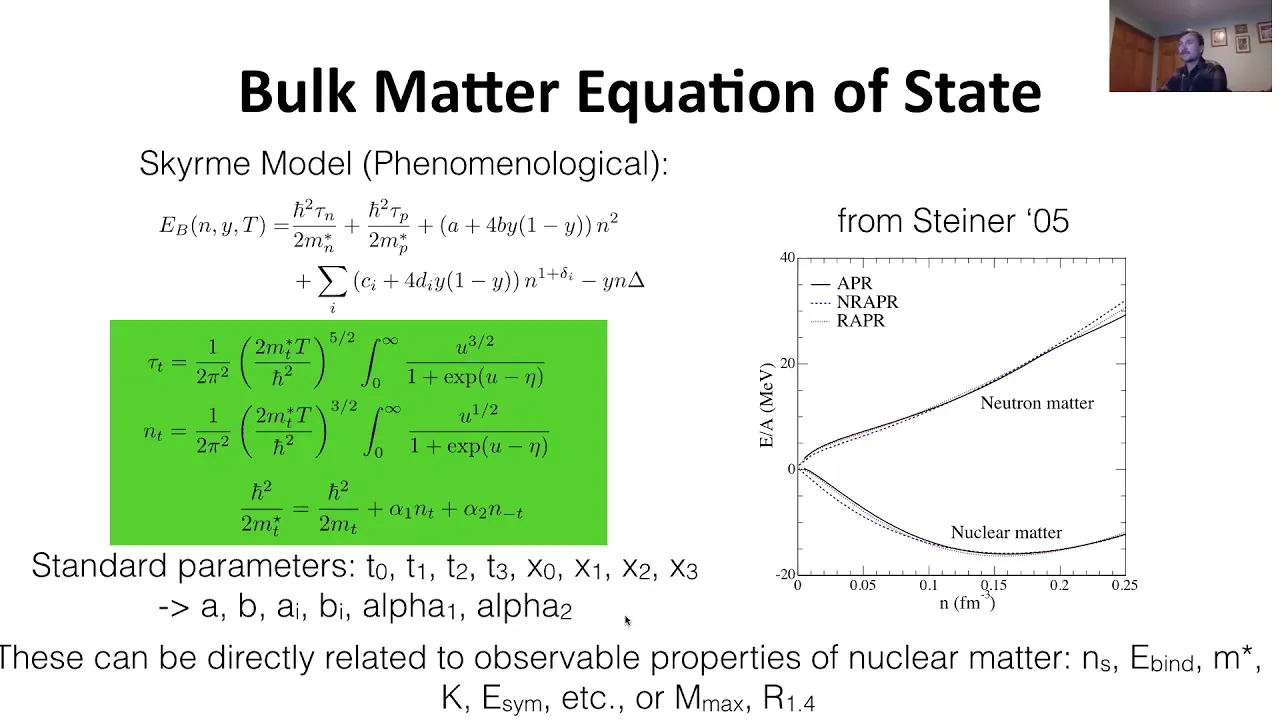
um now I'm going to try crush your dreams sorry um I want you to think back it's not going to be very long for you it's quite a long time for me suppose I want you to think back to the first time you were taught partial differential equations the wave equation was string okay and I want you to think about when you were taught this problem you solved how a string vibrates right I know this is not this is not what you expected but okay what went into that problem what was important okay boundary conditions great so let's just think about this right first we have a wave equation right I'm going to ignore damping and rubbish like that let's just do the simplest thing okay so what's in the wave equation is the Sound Speed and the Sound Speed depends on things like tension a wave speed I should say not sound and then we heard from the front the people remember you're in this problem don't know about the people in the back maybe okay so now um why did I do this well I did this because what I'm going to try to do today the next 90 minutes maybe and then I'll just stop um is we're going to look at this problem but for stars okay and I wanted to do it like this because I want you to keep in mind at the back of my mind all the time is this problem okay and this is going to be at the back of my mind tomorrow as well when we look at an application of of this and so today we're going to try to figure out and we're going to do the calculations up to a point and then one of the problems for the tutorials is to fill in some of the gaps okay we'll see how depending on how fast I go how much detail I can do um but I'm going to try to at least explain what the steps are and what the key things are okay and then um today we're going to work out pretty much the normal modes so the vibrations of this string what the modes are what they look like you know in a string it's fixed end points that look like sign right so what do they look like in a star that's the question today uh and I'm going to try to touch on um the equations of course touch on the what represents the tension which is the equation of state and touch on the boundary conditions and because we are going to do this by hand on the board and because we're not superhuman we're going to do this in neonian gravity that's otherwise you know this would become difficult at some point and I wouldn't be able to do it I'm going to show you probably on Friday why it becomes difficult okay but for now we're trying to understand the features of the problem the qualitative Behavior neonian theory is fine okay and then tomorrow we're going to look at the problem like suppose I have a driven string with some force acting on it right where you would have seen probably again in those classes how you have to solve the inom genous problem you have a driving force you need a particular solution some particular integral and how you can represent that particular integral in these normal modes you've seen this right tomorrow we're going to do that for stars and the motivation for that is the title interaction in the binary okay and then we're going to derive I hope tomorrow something called the tital deformability all the love number which was the thing that ligo tried to detect in gw170817 so we try to go all the way to that so that's an application of what we're doing today right that's my plan now simp my plan is if I fail to achieve this then that's that's too bad for me okay so we're going to start with um something slightly different I'm going to start with the middle yeah um and this follows on from yesterday remember yesterday we talked a little bit about the thermodynamics and the equation of State I want to pick up on that and build a slightly different thing okay I'm going to start by assuming that I have the simplest model for a neutron star only neutrons protons and electrons right yesterday I only had one particle species I wrote down a number density now I have three right but I'm going to take it to be cold because otherwise I've got to carry around the temperature and like you know I don't want that now okay so this may or may not be applicable to the outer core of neutral star not the surface there we've got iron so that's not like this exactly not the Deep core because they maybe we have deconfined quarks and stuff so I don't know not like this anyway because we also get muons and I don't want them today so this is the simplest uh any model that's more more complicated than this it's going to follow exactly the same steps so it's not this is this is generally useful I think okay then yesterday we had um thermodynamics we wrote down um this fundamental relation that says pressure added to energy density was yesterday number density times chemical potential right but now I have three species they each have their own chemical potentials they have their own number density right so really now when you do something like this add them up okay X is now label something like that okay and uh chemical potentials defined just like yesterday is just the partial of the energy in respect to that number density holding the other guys fixed right that's the natural extension of yesterday I just have different particles right fix the number of all the other guys take this partial derivative and they go so I'm going to write this out in full and then we're going to try to take some steps talk about the physics and simplify it okay so we have the neutrons we have the protons and we have electrons now we can ask a a question we can ask two questions the first question is do you want to deal with electromagnetism yes or no you say yes I'm saying no I don't and the reason is I know neutrons do have magnetic fields but the magnetic fields tend to not be strong enough to affect the Nuclear Physics okay the field has to be something like 10 to the 18 10 to the 19 G that's really strong okay before this becomes important I'm going to ignore the magnetic field I also don't want extra components floating around in my stress energy tensor I will not want to have charge currents okay I mean I should but I need to learn to craw before I can try to stand up and walk and run right so let's not do that so I want to ignore electromagnetic aspects and so a simple way of doing that is to impose that we have charge neutrality okay and anyway if you take a star and suppose it had net electric charge it would soon attract particles from the interstellar medium to neutralize it right so a star if you leave it sitting there should be charged neutral give or take okay that doesn't mean that the fluid elements in the star have to be charged neutral this is a different assumption which I'm making but I'm going to make it anyway now if you take it to be charge neutral that simply means means I've got as many electrons as I got protons right obiously and that means I can remove one of them from the problem I don't have both so I'm going to do that I'm going to keep the electrons I don't know why this and then I'm going to rewrite this I'm going to take remember this is also NP right I'm going to take add in here phons so that I get this is one of these things I know students love where you add something in one part of an equation and take it away somewhere else or when you add zero because people tend to really be impressed by That Trick and you say look look how clever I am I'm adding nothing here and then the result comes out and I know students really like that that's why every time I do that I tell students that they really like it and then they hate it even more is not helpful okay anyway we're going to put in the protons here because then we have the barri on number here my number density here okay and we knew from yesterday that barri on number density is conserved so that's a nice variable to have okay of course if I do that I need to subtract this from the other guy that's so I'm basically adding zero but I'm adding same thing and taking it away and then uh I'm going to change this variable I don't need to do it now but I will do it because we might might come back to this a little bit later on so I'm going do it like this I'm going to introduce the lepon fraction which is let's call it Y which is just the number of electrons per barrial like that okay and now we have a final thing we could write down um and right so far um we haven't done very much right we wrot down the full thing we threw away temperature and stuff yeah then we expanded it out decided that charge neutrality is a good thing if you don't like it then unfortunately if you start doing neutron star models and you want to use real equations of State nuclear physicists make this assumption for you because equations of State assume local charge neutrality so this is always hard Bodin if I want to go beyond that but I need to go and ask them to do some work I'm not paying them so it's difficult for me to get them to work and then I would just rearrange things because I like this variable because I have barrier on number conservation and then this was just a I don't need to do this but I it's nice to have something that's Dimension less that's all okay now um now we can ask what can I do with this okay it turns out this is a really useful combination because um if the matter is in beta equilibrium I only have neutrons protons and electrons then you might know that the Ura reactions if you know some Nuclear Physics which maybe you don't it doesn't matter is basically a neutron can Decay into proton and an electron and neutrino or protons and electrons can combine into neutrons at the cost of a neutr so this is assuming is the easiest if the matter is cold which we assume then it's transparent to neutrinos so the neutrinos just leave or come in whatever you that you can just ignore them okay they leave the system so I'm just left with this now this leads to um balance in the chemical potentials okay so if you got an equal number of reactions this way to that way this will be true this is the condition for beta equilibrium in C Neutron proton electron matter and it's not entirely by accident but this is also the combination I have here okay okay I obviously set this up to be like and then you see that if the matx in equilibrium it follows that this fundamental relation is just n un okay and now you can imagine the following logic right I can solve this for any given density so so let's call let's label them I pick a number density whatever I like I solve that equilibrium condition right that tells me what this y has to be at that density and then I plug that into the second one and then now this depends only on number density this guy here depended on the baron number density and lepon fraction those are the two variables and so it only depends on n and now as by Miracle this matter is a single parameter barotropic model from yesterday okay okay it's a really simple argument there's no fancy things it's just a little bit about what the physical reality is okay and now you see that if I'm interested in a cold Star as in equilibrium I only need a single parameter equational state of course now you're going to be skeptical and say yeah but you ignore temperature that doesn't seem right so I go back I can add the temperature in here because I know that from yesterday what should be and then the only thing I have to add is in what sense The Matrix in thermal equilibrium that gives me another condition that tells me what the temperature is as a function of number density or something and I just add that okay so you can add these things if you want I'm just trying to keep things simple so it's not not notable so so if we have a neutron star and we leave it nothing happens to it it's just sitting there probably getting a little bit bored because nothing happens to it um it's going to evolve to this but um I want you to do this I want to know how this star vibrates it's not left to its own we're going to kick it so this can't be right okay so let's think about the general problem it's hard okay so why is it hard well it's hard because up here up to here I only made the charge neutral assumption right if I want to get rid of this I need to know how these reactions enter into the calculation I need to account for the rate of the nuclear reactions how fast or slow are they right and that's hard because that's a hard problem in nuclear physics so and there are different reactions that different versions of this and they have different reaction rates and so on maybe I've got different particles this is messy I don't want to do that now I can't do it yet okay so I'm not going to do it but there is one alternative that is easy and so I'm going to show that to you so the simple alternative goes like this if these reactions are really slow but the motion is first right then suppose I have a fluid element over here if I moved it over there and left it it would change because of these reactions right but before it has time to change I move it back then I move it over there it doesn't have take it doesn't have time to adjust right and so it keeps it knows its identity right suppose it's got a certain number of protons electrons over here I move it over there and then back it doesn't have time to change so I can take the composition to be frozen okay so if the reactions are slow it's effectively fix f is the value of this lepon fraction it's the same okay now there are many mechanical analoges of this you can come up with and things like that um I don't have a spring if I had a spring with a mass on it I could vibrate it really fast up here and then this Mass doesn't really move I move it really slowly mass will move up and down right you probably seen this in some classes or something okay and so that's the analog of this you move it really fast it doesn't care M down here just sit there this is the same thing okay so then I can take this energy to be function of these two variables right because I've introduced them that's fine and what happens is now variation of this is now just something like this is the E DN fixed y n plus the E Epsilon Y at fixed n d y right that's just two parameters this is fixed so this one vanishes right there's no variation in that and so we end end up over here okay now that looks like what we had before because it only depends on one parameter right but it's not the same thermodynamical derivative here this is different from what you get over here okay that's important and so it's still a one parameter problem because I'm frozen I know if I set this at the initial data I know it okay this a one parameter problem simplifies the same way but it's not the same as the equilibrium right that's important that's a long Preamble what does this mean for stars okay so we're going to look at small perturbations away from an equilibrium yes in the back shout yes we're ignoring that completely we're just saying nothing there no reactions they're too slow so nothing happens like that which is not necessarily it's not correct right but there is a limit where the reactions are really really slow and in fact the typical reaction times in the neutron star are really really slow these reactions become important if you get into neutron star merger territory and things like that but typically they're really really slow but I'm going to show you some examples probably on Thursday and Friday where this becomes important today I just want to illustrate the difference because this is going to be important for us in one of the calculations I'm going to do okay so we want to do small perturbations away from some um equilibrium and we know that this equilibrium by this argument is paratropic right and that means that I have a one parameter problem and I can Define um the background such that that say DP is is DP row is only one and now I'm just taking row is M * n I'm going to be Newtonian so I'm just going to do it like this okay and so this is the PD row there one parameter only so it's a straight derivative and I can Define this as the Sound Speed squared right in the background okay it's a definition that you don't know at this point that this is going to be the Sound Speed it will will see it okay but right now I'm just preempting this because I know it and then we can contrast this to perturbations where um for perturbations I need to be a little bit careful now because in this argument I'm saying that this guy is fixed right in the fluid element right but the fluid element is going to move if I perturb the star so I need to ride along with this perturbed fluid element to make this statement about what I've got so I need what we call lran perturbations and I call them with Delta okay it's still like just like in fluid dynamics you have a an oion fixed at the point picture and a lran moving along with a fluid picture Okay this argument clearly says you're riding along with the fluid because you're fixing on this and this is only fixed if you ride along with it right and so what comes out here is um also actually I could add there's another way of writing this which may be helpful in a minute it's just saying instead of writing CS squared something like this with some number gamma Z okay this is called the adiabatic index doesn't matter now for the L grandon based on this we know there should basically be one parameter and so that parameter could be number or density so there should be some relation like this based from the last guy P overall times some gamma but it's not this gamma because the thermodynamic derivative was different there something else let's call it Gamma One the first gamma much more important than the gamma without any index or something okay okay it's a definition basically saying there's some function sitting here that depends on the physics I don't know what it is but it encodes this kind of thing okay and then um for practical reasons um what today I want to actually use per oium perturbations fixed at the point we'll see like advantage of this you'll see this on actually maybe tomorrow U the difference it's a little bit easier if you fixed at the point the oium perturbation little Delta commutes with all the derivatives I can just take it straight to the because it's at a fixed Point whereas if you do lran perturbations you have to be careful so I need to translate this into the other perturbation all I need to know is we'll see this later that for a scalar so we need something like Delta row and Delta p is this oion plus and this is as fancy as I'm going to get in terms of mathematics I'm really sorry but I was uh I'm inspired by the lecture from yesterday morning the lead derivative along some Vector side of row but this is just the scaler so that this this is just me trying to be fancy this is just the vectori dotted with a covariant derivative which actually just a partial because this is a scaler okay this is my definition uh this is obviously Overkill I could just write this down this looks like the convective derivative in a sense long sum placement C is the displacement factor that tells me how far away this fluid element is from the point where it started okay and it's small okay now I'm just going to plug this in this relation holds for pressure it holds for density so I'm just going down here okay I'm pluging this in so what happens now is for the pressure actually let two partials over row L P is a thing p r the r and then uh chump things around so that we just get the little Delta P here and then you see that what comes out is this first term and then remember this is the gradient oh sorry I should done consistently here um this is derivative of the background right this is a derivative of the background but I have this this holds in the background so I could put gradients here and this holds okay so that brings in this gamma and I can rewrite this in terms of another piece which there many ways of writing it but we can write it like this now Gamma One I think this is right s j j p put the Box on that yeah I think that's right okay so now this is I hesitate to say it but this is really nice we shouldn't be passionate about things like this but this is really nice because you look at this you see if the perturbations have the same equation of State as the background right then these two gamas are the same right if these two gamas are the same then obviously that comes out because this term cancels okay so what is this term okay now now if the slave driver from yesterday in the tutorial had been more efficient you could have done the first two problems but we only did one so this part of the story comes in the tutorial this afternoon which is fine because you need to do these things at the pace that works so if we done the second problem you would have done the um um derivation of the Newtonian limit for the fluid equations okay I need them now so I'm going to write them down the derivation is in problem to this s yeah hopefully or something like that we'll see so the fluid equations are continuity so the time derivative of the density plus Divergence like this that's that's continuity but you saw them because they were shown to you on the slides yesterday right and then we have momentum let's call the velocity you for no particular reason we have the convective part of this and then uh we have actually should I do that downstairs this could be this is downstairs makes no difference um so this is the gravitational potential um pressure density velocity this is the momentum equation and then I need gravity so at some point okay I've got Plus on equation and so then I need to perturb these right and we don't want to make this hard we going assume that the background is static right because it's easy and then we're going to perturb these guys um if the background is static you can just pull through the oium perturbations straight through here this you set a point so that go straight through go straight through this derivative just expand out but this V vanishes in the background the only thing you can pick Pi up is a velocity down here oh this V and U that was not clar was this okay um down here go straight through there's a perturbed velocity a perturbed acceleration if you like and here there is a this goes because whatever you do what is still going to be background velocity left so this is out here you get perur pressure perur perur pressure perur density and here's the perur potential down there okay he messy okay sorry now I don't want to deal with this mess so the calculation we're going to do is a little bit easier but let's just ask what happens to the background in the background it's static this is gone but this is also gone right so that's automatically satisfied this gives us something forget about that for now this is gone this is gone so we see that the gradient of P pressure gradient is balanced exactly by the gravitational potential okay and so this hydrostatic equilibrium right you've probably seen this many times but why this is important is because I have this guy over here and that tells you that these extra piece that I have in this equation links to the local gravity right so it's a bit disappointing it's been 40 minutes and we've rediscovered aimus principle we've rediscovered buoyancy if I move a fluid element it's got the wrong composition If gravity is at play it will feel that it's at the wrong place and gravity tries to adjust it okay so this is what we call buoyancy if a fluid element tends to flow those S right that's a lot of Preamble but it's quite important okay so now we're going to try to do 45 minutes that's a stretch we're going to try to do two calculations okay the first calculation is strip this problem down to the easiest possible case Okay so we're going to go all the way back here it's barotropic and then we're going to make one more assumption which everyone does in every single fluid dynamics textbook on the planet we're going to assume that the fluid is incompressible now neutr stars are not incompressible in any shape or form but this is still quite a good result good thing to have a look at so oh I might have gone over the line now I'm in trouble in trouble with the recording police okay so if the fluid is incompressible this is totally artificial because you can think of this as effectively the density is constant right so this again is automatic now this is just a number and then we perturb these equations and you'll see why this is nice in but a nanc um perturb this but the density is constant this is IR relevant this is a constant take it out and forget about it this goes straight through so I just get from there just the gradient of some Delta Delta UI has to vanish right here the the background is static so this is gone already um this is the perturbation of the Velocity so it's DT Delta UI this is constant so it's irrelevant to me but the pressure has a perturbation and this is obviously there okay and then if you want for completeness tication goes straight through the laan and you just get this but actually this is zero well sorry not right that so what happens now is let's go to this equation remember this is just a number and ask what happens if I take the curl of this equation right curl of a gradient is zero right great that will vanish that will vanish so the curl of the per turn velocity has to vanish right okay now you probably know because you've seen this I'm sure in uh learning vectors that if this is true then I can represent this velocity velocity by a potential so this suggests that I can write this as the gradient of some potential let's call it Kai for now this is the argument that leads you to in two seconds a beri law for fluids and then you plug this in here then you see up here that this Kai is a solution to the plus equation right um this is a gradient now this is a solution to the laas equation and take the Divergence of this this goes because this a solution to La plus this goes this goes because that's the Divergence of this so that's a solution to La plus equation we're left with this and so that tells you that R square of Delta P has to vanish all of them are solutions to laes equation that's why this example is so beautiful because you get an equation that you know but it's kind of easy to deal with right that's the advantage this now then the star is a a ball I think and also we get from the so we've seen that K Delta p and Delta 5 solve the plus and we've seen that the time momentum equation will become something like a DT on Kai plus 1/ row Delta P plus Delta f is some constant because I get it to an overall gradient of the thing I can integrate it it's some number this is per for incompressible fluid so you've probably seen that then what well now um stars are kind of round so the natural coordinates to use are spherical polar coordinates right my star is just sitting there it's certainly round this a sphere so what's the natural basis for expressing functions spherical harmonics right on the sphere spherical harmonics gives you a basis that you can use so it's natural to write down the solutions um and then we know from La ples equation that the solutions go like one set goes like R to the L where L is the power one of the indices of the spherical harmonics so regular solution for each of these is going to go something like Kai goes like some constant R to the L ym but these are the oops paron okay all of them so I'm not going to write that the other there going to be some other constant here some other constant there it's easy so now we have the solutions kind of but we need to fix these guys and we need to figure out what to deal with time so now next we say what we're looking for oscillations so as always we put in some harmonic time dependence making everything complex in order to make it less complex see me so some frequency Omega this goes like e to the I Omega T pull that down here I just get uh I Omega sign convention you can choose whatever you like Kai and now bastardizing the notation by not changing these guys just letting them be the same because otherwise why not they all depend like that and now over here because I know these guys are regular I can go to the center and say well these all vanish these will all vanish at the center and therefore that constant has to vanish so that's the equation I need and now I want to fix these coefficients and I want to do it given time with minimum effort so I'm going to cheat don't look at me like that but I'm going to cheat in a way that introduces you to some of the language which is maybe useful I'm going to make use of something that's generally called a cowling approximation from a guy called Thomas cowling that worked on solar physics and ocean waves and things like that and that's simply saying that Delta fi is zero actually maybe I could put some L's on these just to see that they're different from that that's basically these guys here High L that sort of thing okay so this is an assumption it's an assumption that says okay look I can ignore why didn't I write it all the way over here it's like getting too much exercise if you just go back to this problem you could start with this and say I don't like this equation I don't like this get rid of it and suddenly you have a simple problem right um is it Justified well no or I don't know it depends right so for ocean waves the story is a little bit like this the ocean is a really thin layer on top of the Earth right anything that happens in this thin layer is low density compared to the big gravitational potential and therefore any waves that happen over here don't really affect the gravitational potential much so ignore it okay now in a neutron star it's possible that this is okay if the fluid moves on shells right so if it shears like this right that'll be fine it shouldn't change the gravitational potential much in relativity you have to be careful because any motion affects the metric right but in newtonium this should be fine but if the star goes like this then this is not going to work and the mode we're calculating right now does exactly that so this is not a good approximation but hey it simplifies my life because the calculation is easier and anyway in one of the problems for the tutorials we're going to relax this okay so it doesn't make it much it's just an extra line or two so it's not really that bad so we do this throw this away then we need to ask about boundary conditions well there are two first the piece we've ignored but let's put it in anyway to be complete right so Delta fi and its derivative should be continuous continuous so you have to match what happens in the star to what happens outside at the surface second if you're sitting at the surface the definition of the surface is that the pressure vanishes there's matter inside No Matter outside the pressure has to vanish if you move the surface you ride along with the surface you're a cork right you will ride along with this point where the pressure vanishes right now we used the lran perturbation to ride along with the fluid so this just says at the surface the lran perturbation of the pressure vanishes basically says the surface is where the surface is that's that condition and of course from what we've done we're working with oian variations so this tells us that Delta P for the L has to go like x i l radial component D RP the surface that depends on the background and so on at some surface and then what do we need we squeeze in the solution up here and then erase somewh so now let's see where we are I have this equation but I cross this out right I know that each of these go like say a r to the L and the other one goes like b r to the L something like that that's fine so I have an equation here that only involves the A's and the B's right because these guys are the same okay so there's an algeb little equation for a and b and the frequency then I have this condition this involves one of those the other guy to be coefficient this one uh that's background this guy is not quite this guy right so that's the final bit I need to go back and remember what was that Kai that Kai was given by there I am again over here right I need to relate this to the Cai the displacement but that's really easy so I need to remember here that grad Delta U I Del I Delta U no that's Delta UI was grad I of of Kai and then I also know that the displacement Vector is just given by Delta UI is the time derivative of the displacement vector okay and then I need to think now I'm working in covariant uh notation and so on I need to keep track of the this is downstairs I need the upstairs so the metric will come in it's it's just a flat 3D spherical polar coordinate metric there's some factors of R coming in actually no this is just radial component doesn't do anything sorry okay so now we see there's an i Omega here that goes into this story over here and then basically you got two algebraic equations that you need to solve is easy you will do it yourself later and now comes a statement for the frequency which is 4 Pi G because here there's a background gravitational potential lurking as per my argument so you should not be surprised there's some G's coming in and then there's an L because uh in defining here for the radial component which I need there I need to take a radial derivative I've got R to the L so that brings down an L okay and then there a three I think it's a really disappointingly short answer after so much work okay but this is really important this is what we call the fundamental mode and it is the mode of oscillation of a star that couples the most strongest to gravitation waves and it's easy to see why because it goes like R to the L in the r Direction and no funny noes so when you do things like calculate gravitational quadripole R radiation reaction there's no cancellations in that integral it all contributes so this is the most efficient emitter of gravitational waves that we're going to have okay and if you do okay so now I simplify life a lot what happens if I go back and say what did I simplify I simplify this okay so put this back in but this also solves the passes equation you just get a third equation from here you get that you adjust this number and you see that this approximation for a quadr l equals two is good to something at 20 30% so it's not very good but it gives you an idea okay if you want to go further you go back and say well you made this incompressible so that's a nuisance so then you go back over here and say put the density perturbations back in you get more equations I couldn't solve this on the board you have to do this on the computer but what you find is this is a really good approximation anyway you do a lot of work but the mode looks like this doesn't change much changes frequency and things like that but it doesn't change much so this is good and what does it tell us it tells us that the frequency here scales with so actually there's a row here as well which was constant right in general it scales with the average densi a mass over radius cubed and that tells us in turn that if I were to at some point observe some neutron star that oscillates and this is the mode I can say something about the mass per radius Cube so the density right which means I know more than just the mass so if I had an independent measure of mass say By Radio pulse or timing I'm I'm Dreaming okay whatever then I should say something about the radius and now I have a handle on mass and radius which is a handle on the equation of State okay so that's our first connection with this argument that we can use seismology to probe neutron star physics okay this is the beginning of that story it took nearly two lectures to get there but I talk too much so maybe that's I could do it faster okay leave okay now I want to do um a slightly different demonstration so we know that if we take this opposite limit where it's not paratropic we have this so can I learn something about that problem if I make that assumption instead okay so that's what we're going to try to do well clearly um in this calculation this incompressible model is useless right it's just going to break absolutely everything so that's not going to work so in general I need to put the perm pressure back in this is out and then everything gets messy okay but let's take some steps in that direction and see where we get to and hopefully we get to a point where we can see what's what's going on but I'll have to skip a few things because it gets kind of long okay so the first thing we're going to say try to learn from this that's not true anymore from incompressible but that is still get some inspiration from what we did right and the right thing got really really went downhill that's the way it happens so I need know I need some displacement Vector it's all over over the case right so what did we have have but we had something like this right s i of some gradient of some Kai maybe not exactly the same Kai because of T let's just call it kite right so what is this well we knew that Kai tilder was in expressed in spherical harmonics so this is some function right radial derivative Kai Tilda in the Delta i r right say this the radial direction is like that and then there was some gradient or now I'm cing a mess for myself but um actually it's better to write it like this sorry this is better it gets um so we have a vector Kai which is a gradient of Kai till the just the question is where I put the basic vect things okay so then this is just a radial derivative of this car in the radial Direction whatever we normalize it I don't care let's do it like this plus the gradient of IED times the gradient to the spherical H right maybe that's better okay because I know this was expressed in sperical harmonic so that has to be true oh sorry oh let's call it Kai oh no I made a mess with myself oh God that was sloppy sorry about that let's do it like this k l y LM that's what want then this is the rate of derivative k l y LM plus now it makes sense i l rent ym and that is then um on the two sphere an expression of angular behavior that looks better right so uh is this General well it's not General because this couples these two guys it's the same function and that's there because of the incompressible Assumption but it could be different and this is not as general as it is because this is not the complete basis in three dimensions right I've only got something that points in the radial Direction something that points in some direction on the sphere but that's not the most General decomposition right I need another variable so I also need so first two things there's no reason why these radial and angular pieces should be coupled and I also need a third Direction so I need something like radial cross grad ym which is going to be auth to both right so then I have a complete basis in 3D okay so that's inspired by this clearly and but it's much more General and then the way we tend to write it is thatai has three pieces but now in the this guy points in both the Theta and F directions right and this guy points in both the Theta and five directions so the way we write it it comes out as a really horrendous expression but there you go should write it down for completeness this is in general some sum of all the L's you to make it red we have a radial piece with some functions WL and then the spherical harmonics that's this first piece and then because it's a vector now I can do this Del I it's a component right we have an angular piece in the Theta direction that has a bit from here that tends to be called V and then there's some r p is because it's sperical polars and because that's the gradient that's the Theta and then the Theta component of this guy has the F derivative in it but because these guys go like e to the I M5 I know what the f derivative is it brings in this m and then there's some signs and then some function U and that's the ym and then that's the Delta IA and there's one more plus complex sorry same thing from the gradient I need a f derivative as an i and then plus this U sin Theta partial Theta ym because done and that's the Delta I right and that's the whole thing it's horrible actually it's not that so I just want to write that out because we need to talk about what the bits are okay so now a general model for this mode we did has this w this V it doesn't have this sorry an I here yeah but I've I've soaked that up in here right say an i times you here it's a bit sneaky this is just a convention okay so no at the moment just standard B standard harmonics because are good in non- rotating stuff they become Vector sperical harmonics if you FDLE about a little bit more okay at the moment I'm just building a basis and then from that you go into buildings Vector col on X so the F mode involves cly this W and the V we call this polar or spheroidal or whatever that's words for this it's called a polar mod uh it doesn't involve this you um and this is called an axel perturbation this notation comes from basically from Shandra seer's book on black hole perturbation but there's Lit Literature is full of different things doesn't matter the key point is this is what we calculated this we haven't calculated in fact you can show that this degree of Freedom doesn't come in at all in non-rotating stars as long as you don't unless you have elasticity or something like that but when the star rotates this comes into play and we're going to show that on one of the lectures okay because now we're kind of done right well kind of done apart from there's a lot of work to do the other thing we did we expanded all the scalers in spherical harmonics and we're going to do that still so for example we have Delta p is some sum of all the L's Delta p l y LM stuff like that okay and then all we need to do is March back here and ask what happens to these equations when we plug this in and that's a fair bit of work so I'm just going to skip to the chase okay the radial component of this perturbed equation once we do everything will look a bit like this frequency squared because we work with displacements no just do it like this write this straight out in these components that's better we get the radial derivative on pressure background pressure radial derivative was Delta row you can see what happens is we perturb this piece get a minus one/ row s Delta row times the gradient impr pressure right then we have the time der ative of the Velocity as the second time derivative of the displacement there an Omega squar with putting an n on the I values we're going to calculate there's some factors there's matter the radial piece and then let's do the cowling approximation again because frankly otherwise we won't get lunch until 5:00 p.m. that's from the radio the angular equations only give you one and it's really easy you get this V squ it's just Delta p l over row and that's really easy because these guys are expressed these guys gone through it away these guys the perturbations are expressed in spherical harmonics and then um this guy is just gradient and so this comes really easy and then the continuity equation gives me one getting that oh that's messy too okay it's a total D so this is the this piece here and then I have a Time the time deriver to there remember so what happen is here then it's R WL plus some R WL over row derivative of row oh I'm going to run out space is minus I hope you didn't write that down but now we have formulated the problem okay we have one two three equations for one two three four one one one two three four variables and this guy just putting L's on everything and then putting in the radial piece this going to be a WL right closes it okay there's four equations four unknowns you need this equation of State this is going to be important it give you something different okay so quite there and we have 10 minutes so that should be okay there's no way on this planet we're going to do this by hand so we're going to cheat and the way we're going to cheat is to say let's look locally so short range waves right look at some small scale and say say that all the perturbation say Delta PL goes like some e to the I KR where this a wave number okay it's a local perturbation so that this combined with the T gives some oscillation okay like dber solution if you want for the string where we started okay that's nice because all these radial derivatives just becomes i k times this and then this becomes an algebraic problem for the amplitudes again which is nice okay and so we can skip all the way to the end I think this basically leads to if we put actually let's do it like this put that P hat I think something like this P hat in the ik sorry I know it's annoying just erase it but basically it's now a nice problem because becomes something like this for that P hat I just get the Omega squ minus some new thing n s the WL hat over R 2 and then for that w i just say ik w hat over R 2 again is something like minus- l l 2 over Omega s Sound Speed so this ski three billion steps that's just to get to the end and I've introduced two things that we don't know what they are so maybe I should tell you it's always helpful I have this guy which is nothing less than these L l+ one that I get from the sperical harmonics and then there's some factor of r squared and Sound Speed squared so something that depends on the Sound Speed sitting here and then this n have has the beautiful name of the brunt vas solar frequency which you all going to be asked to spell the final test the ultimate test it is defined somewhere here I need to be careful with that that's the one we always get wrong so this guy is just the row g s local acceleration over p 1 / gamma minus 1 Gamma 1 so that's a definition where G is just um e background potential Dr so this is something that involves the Sound Speed is sitting here this is something that involves this factor that we picked up over here and it's sitting there okay and now we solve these two that's really easy because it's a 2X two Matrix problem right I just multiply these two together multiply these two together and I get a dispersion relation that's my warning maybe it's like pavo's talk that's the signal that says I should be hungry and it kind of works it's fair enough okay so what comes out is wave number times The Sound Speed squared is the product of these two funny factors that's the final bit okay now what does it tell us well this is a quatic for Omega n it's a quadratic for Omega n s right it would have two Roots right so there would be two sets of modes coming out of this calculation right okay um we see that this is always positive so this has to be always positive right so suppose I take this L that's some number now let's start here actually start here suppose this n is smaller than the frequency right and this is positive so this this has to be positive right which says something about where the frequency has to be right this has to be smaller than one so this frequency has to be higher than this right so in the high frequency limit basically what you find is there are frequency that go like the sound speed okay these are called pressure modes or P modes because they are to do with the sound waves okay in the other limit this is negative so this has to be negative so this has to be smaller than this right and that gives us low frequency Solutions where this Omega squar goes a bit like that n squ with some factors thrown here it doesn't really matter these are called gravity or G modes and you see how all stems from this thing where we started the equation of state right and how this Factor comes in to this definition if this doesn't vanish it these guys don't exist so these guys only exist if the star is what we call stratified if there's some uh gradients in composition or something whereas the sound waves are always there okay so one minute look write anything else don't worry so we started from the very beginning we looked at more thermodynamics from yesterday we added some Physics arguments right it took us at the end of the day somewhere down here where we distinguished between what happens in the background to what happens in the fluid motion okay then we looked at two examples a very simple one that gave us that F mode solution I couldn't repeat that here the F mode would sit somewhere in between these Solutions so it's not kind of in this space but it doesn't matter and that is nice because this calculation you can do by hand it doesn't take very long because you only solve lasses equation it's an undergraduate calculation this next calculation is long compared it's not difficult it's a bit longer which is why I'm leaving it for a tutorial hey but fill in some of the blanks justes to see how things go okay um the key point is we need a basis for expanding the perturbations this is the key step I know there's a lot of writing here for no apparent reason but we needed it okay so this is the key step we know from the incompressible case that the perturbations behave a bit like this we're looking for a basis so clearly the basis should have a radial piece and angular pieces and it's natural to use the gradient of the spherical harmonics and this cross product that's a natural basis to start building from okay then we give them names you can call them whatever you want monkey Bana a lunch right doesn't matter people have different conventions but this is what always happens you look at books on Stellar perturbation Stellar oscillations papers this is what people do okay neonian in relativity as we'll see later it's exactly the same okay so this is the fundamental bits then I think I did a little bit too much writing writing this out because frankly I could just have skipped them but I did this at least I thought I did this because it could in principle allow you to tie in with where we came from to where we're going in hind site this was probably overkill on the board okay but the key point is you can simplify it I can't solve this by hand there's no way but is fully specified here the boundary condition is the same as before and then I can simplify it there's some steps here as well I've simplified things a little bit but it doesn't really matter to get out these two sets of modes which is the final result but the general star if it has some variation in gravity if you like composition or something we have two extra sets of modes so that takes us in 90 minutes from strings which we can do you know simple calculation through to Stars through to the fundamental mode which is the fundamental mode because it's sort of the lowest overtone if you want but it's also shows up everywhere from Supernova core collapse to neutr Stone merges through to these other modes that depend more on the physics if there's one take- home message it is that the spectrum of oscillation modes in a star depends on the physics so you need to understand the equation of state and how that filters through the calculation now you have earned your lunge and so unless there are any questions any questions anyone would like to hold everyone else back from lunch or if you have any questions just come and find me over lunch okay because I think you really earned it now thank you for that
Up Next

95:14
Neutron Star Perturbation Theory & Tidal Dynamics | Lecture 3
@ICTStalks
543 views•2023-10-11

12:53
21cm Hyperfine Transition in Neutral Hydrogen: Radio Astronomy Basics
@AaronRobertParsons
12.4K views•2011-10-13
85:01
Gravitational Waves from Neutron Stars Lecture 4 by Nils Andersson
@ICTStalks
336 views•2017-08-07

27:14
Entropy and the Second Law of Thermodynamics Explained
@veritasium
27.5M views•2023-07-01
Related Study Plans & Knowledge Roadmaps
Structured learning paths in Physics
physics
Nuclear Physics (Decay, Fission & Reactors)
01Atomic Structure and the Binding Force
02Radioactive Decay and Half-Life
03Nuclear Fission Mechanics and Chain Reactions
+ 2 more learning modules
12h5 modules
Explore Roadmap
physics
Soft Matter (Polymers, Colloids & Rheology)
01Foundations of Soft Matter & Thermal Forces
02Polymer Physics and Macromolecules
03Colloids, Surfactants, and Self-Assembly
+ 2 more learning modules
38h5 modules
Explore Roadmap
physics
Analytical Mechanics: Lagrangian & Hamiltonian
01Mathematical Foundations: Calculus of Variations
02From Newtonian Mechanics to Constraint Dynamics
03The Principle of Least Action & Lagrangian Mechanics
+ 3 more learning modules
28h6 modules
Explore Roadmap
physics
General Relativity (Spacetime & Cosmology)
01Foundations of Relativity: Special Relativity
02The Geometry of Spacetime: Equivalence Principle & Curvature
03Einstein's Field Equations: The Mathematics of Gravity
+ 2 more learning modules
55h5 modules
Explore Roadmap