Understanding Nuclear Physics: Radioactive Decay, Fission Mechanics, and the Physics of Nuclear Reactors
This curriculum is designed to guide learners from the basic building blocks of the atomic nucleus up to the advanced engineering and safety physics behind modern nuclear power reactors. Through structured video instruction, math breakdowns, and physical modeling, you will build a robust academic foundation in nuclear physics.
Prerequisites
- Basic high school algebra and trigonometry
- General physics fundamentals (force, energy, and electromagnetism)
- Basic chemistry concepts (elements, isotopes, and atomic mass)
Estimated Study Time: 12 Hours
Module 1: Atomic Structure and the Binding Force
This module establishes the foundational physics of the atomic nucleus. You will explore how nucleons (protons and neutrons) are bound together by the strong nuclear force, the significance of the nuclear radius, and the phenomenon of "mass defect"—where the combined mass of individual nucleons is greater than the actual mass of the resulting nucleus. This mass difference is converted into nuclear binding energy, the key driver of all nuclear reactions.
Recommended Videos
Mass Defect and Binding Energy Explained | IB Physics
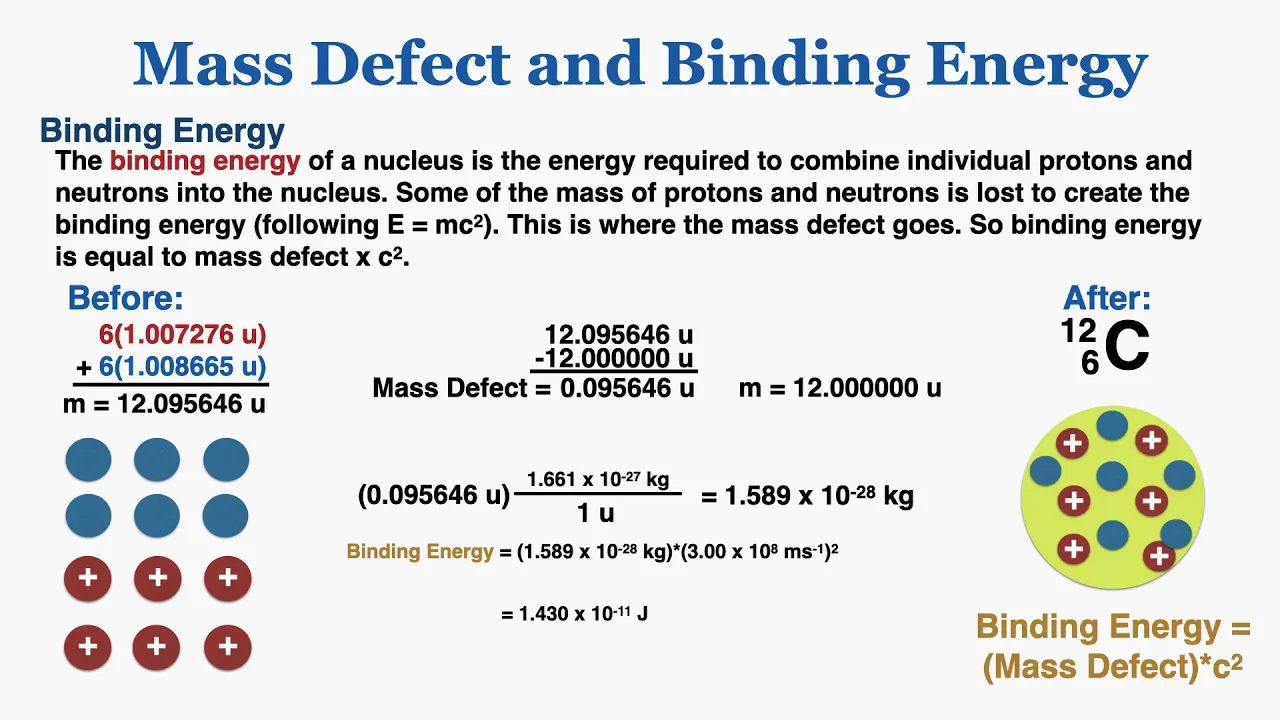
Why this video is valuable: This tutorial provides a clear, mathematically sound introduction to how mass defect is calculated in real physics exercises. It explains the relationship between binding energy and nuclear stability, showing how the mass of constituent nucleons differs from the final bound atomic nucleus.
Nuclear Physics Begins! | Structure of Nucleus & Mass Defect | IIT/NEET Lec-1

Why this video is valuable: This lecture focuses on the physical structure of the nucleus, exploring atomic radius calculations () and detailing why the attractive strong nuclear force creates negative potential energy that manifests as a loss of mass.
Lecture 38 Nucleus 1
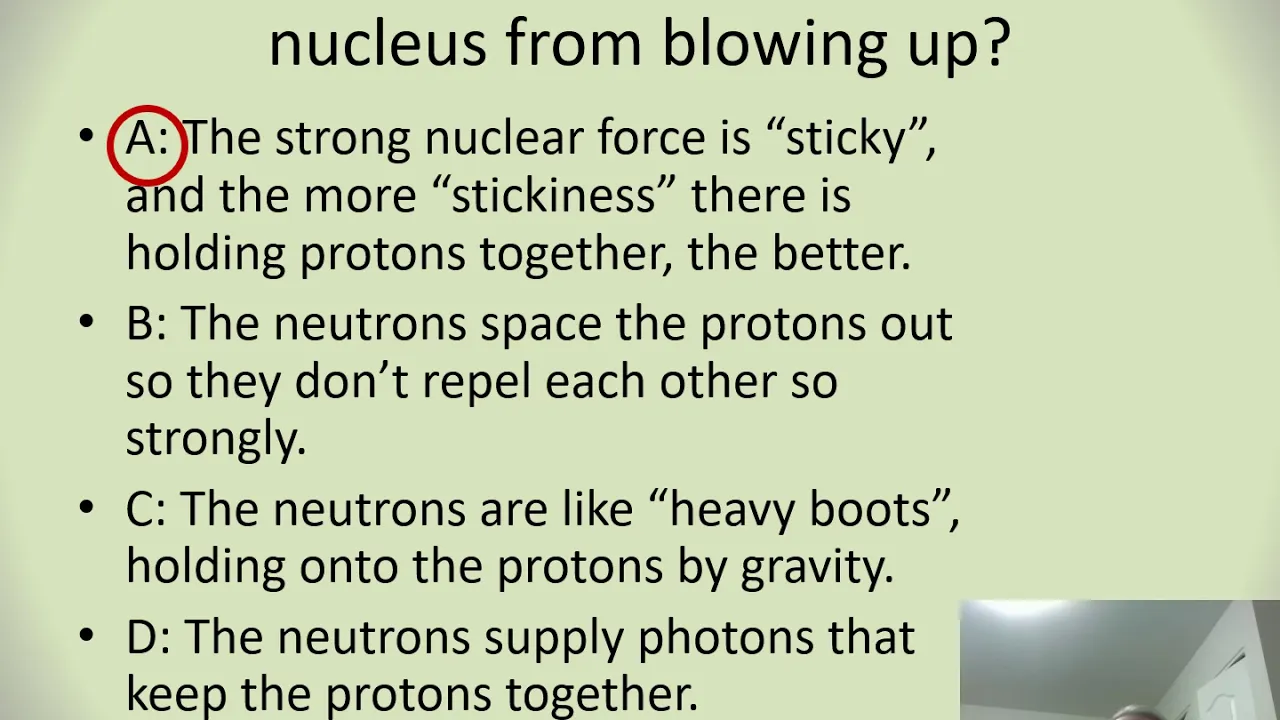
Why this video is valuable: This university-level clip unpacks the extreme depth of the nuclear potential energy well. It compares the atomic electron shells (bound by electromagnetic forces) with nucleons bound deep inside the nucleus by the strong force, highlighting structural dimensions and scales.
Knowledge Checkpoint
- Calculate the mass defect () of a nucleus given the masses of individual protons, neutrons, and the final bound nuclear mass.
- Convert mass defect in atomic mass units (amu) to binding energy in millions of electron volts (MeV) using (or the shortcut).
- Explain why the average binding energy per nucleon peaks around Iron-56 () and what this implies for the processes of fission and fusion.
- Define the range and characteristics of the strong nuclear force compared to the electrostatic repulsion between protons.
Module 2: Radioactive Decay and Half-Life
Unstable atomic nuclei undergo spontaneous radioactive decay to reach more stable energy configurations. This module focuses on the mechanics of alpha (), beta ( and ), and gamma () decay. You will learn to write balanced nuclear equations, track conservation laws (charge, nucleon number, mass-energy), and calculate radioactive decay rates using half-life equations.
Recommended Videos
One Shot : Nuclear Physics & PYQ's | Modern Physics L-3 | JEE Sprint 2021

Why this video is valuable: This targeted review offers a rapid-fire breakdown of the three primary decay modes, explicitly mapping out how parent nuclides convert to daughter nuclides. It walks through mass and atomic number changes step-by-step.
Alpha Decay, Beta Decay, Positron Emission, Electron Capture and Gamma Radiation

Why this video is valuable: This video provides a concise overview of nuclear instability. It introduces the proton-to-neutron ratio (the belt of stability) and explains why specific isotopes undergo distinct decay modes to attain stability.
RADIOACTIVITY (JAMB PHYSICS) | Calculation on Radioactivity & JAMB Past Questions
Why this video is valuable: This mathematical tutorial demonstrates how to solve half-life and remaining mass problems using the classic radioactive decay formula: .
Knowledge Checkpoint
- Write balanced nuclear equations for alpha decay, beta-minus decay, positron emission, and electron capture.
- Determine how the atomic number () and mass number () change for a parent nucleus under each decay type.
- Calculate the remaining quantity of a radioactive isotope after a specified time interval, given its initial mass and half-life.
- Use the decay constant () to solve for the instantaneous activity () of a sample.
Module 3: Nuclear Fission Mechanics and Chain Reactions
This module transitions from spontaneous decay to induced nuclear reactions. You will examine the physics of nuclear fission, focusing on how heavy, fissile isotopes (such as Uranium-235) destabilize upon absorbing a thermal neutron. You will analyze the energy output calculations of fission fragments and learn how the release of extra prompt neutrons makes sustained, critical chain reactions possible.
Recommended Videos
Nuclear Fission - Physics - Science - Get That C In your GCSE and IGCSE
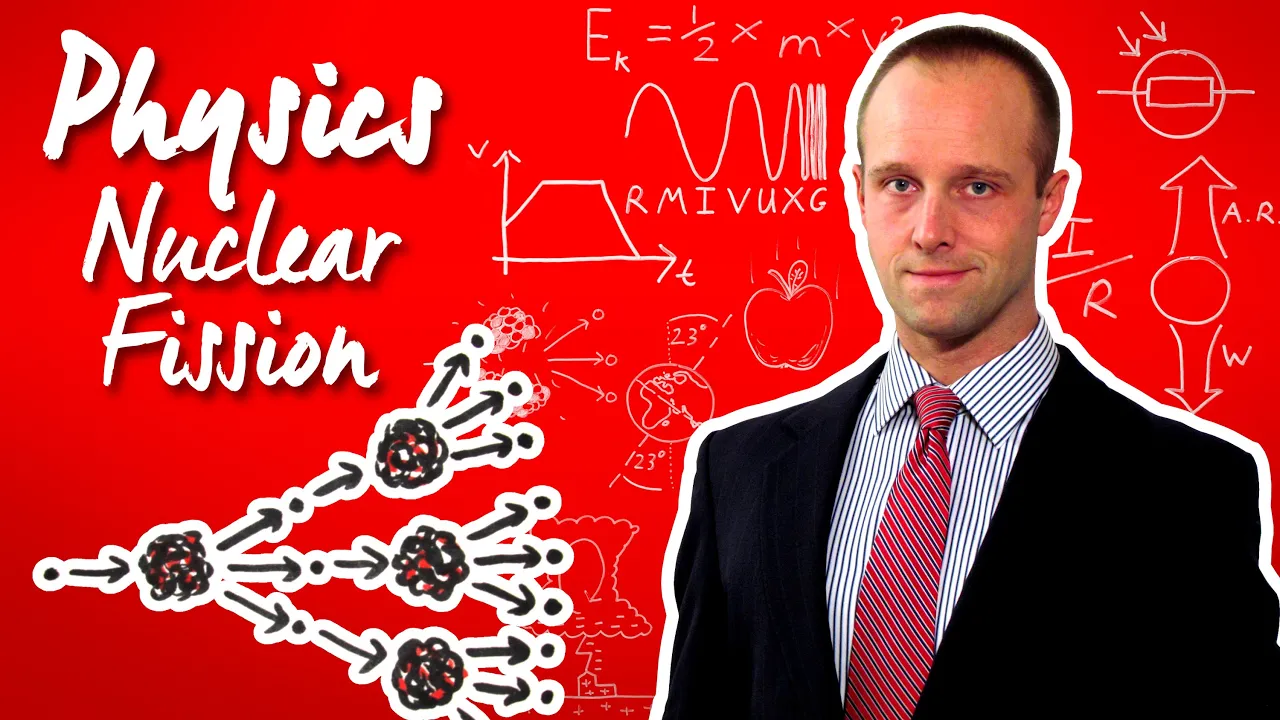
Why this video is valuable: A straightforward visualization showing how a low-energy neutron splits a heavy Uranium-235 nucleus into smaller, highly energetic daughter nuclei (fission fragments) and releases free neutrons.
Physics for Future Presidents: Lec 07 - Nukes

Why this video is valuable: Delivered as an intuitive lecture, this video details the difference between fissile materials and non-fissile isotopes, explaining how geometric growth occurs when neutrons successfully strike adjacent fuel atoms.
Chain Reaction and its Outcome | Nuclear Physics | Video Explanation

Why this video is valuable: This animation differentiates between controlled chain reactions (used in power generation) and uncontrolled chain reactions (seen in nuclear weapons), visualizing the multiplication factor of free neutrons.
Knowledge Checkpoint
- Describe the sequence of events when a nucleus absorbs a slow neutron and transforms into the unstable compound nucleus before splitting.
- Calculate the energy released in a single fission event by subtracting the mass of the products from the reactants and applying .
- Define "critical mass" and identify the environmental conditions required to sustain a chain reaction.
- Distinguish between subcritical, critical, and supercritical states of a neutron population.
Module 4: Physics of Nuclear Reactors
Nuclear reactors are engineered systems designed to maintain a controlled, steady-state fission chain reaction to generate heat. This module breaks down reactor physics, focusing on how kinetic fission energy is converted into steam. You will learn the mechanical roles of fuel assemblies, neutron moderators (which slow fast neutrons down to thermal energies), and control rods (which absorb excess neutrons). Finally, you will compare Pressurized Water Reactors (PWRs) and Boiling Water Reactors (BWRs).
Recommended Videos
The Most Used Nuclear Reactors: PWR and BWR
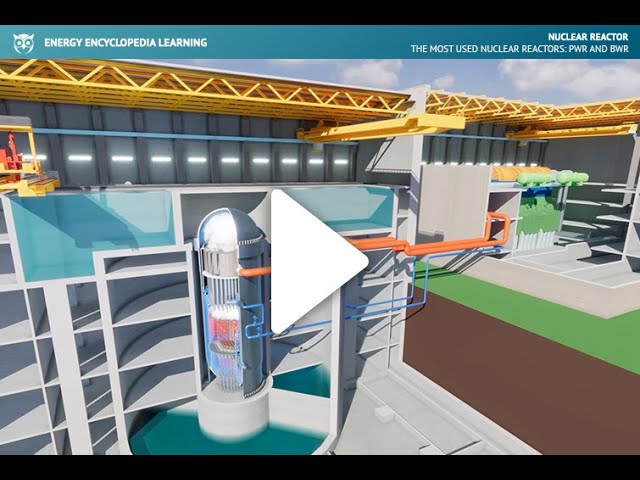
Why this video is valuable: This comparison highlights the thermodynamic differences between PWRs and BWRs. It clearly explains the dual-loop pressure control of PWRs versus the direct boiling single-loop of BWRs.
16. Nuclear Reactor Construction and Operation
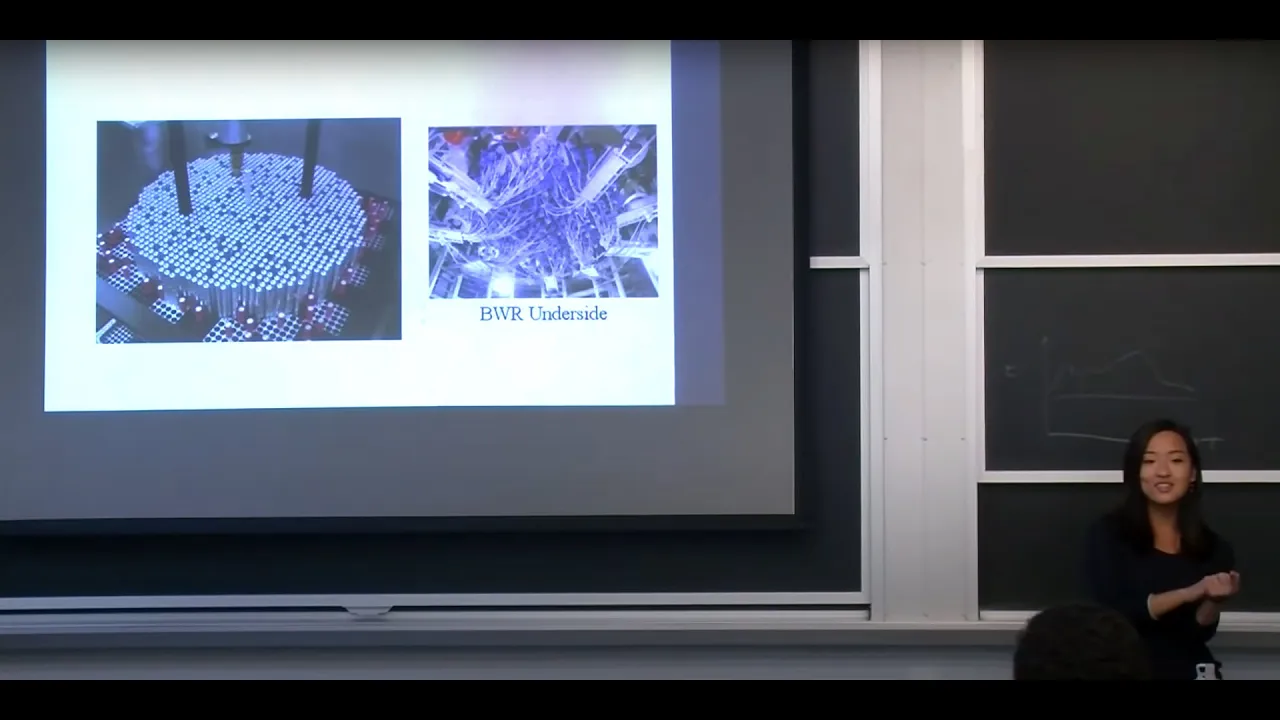
Why this video is valuable: Presented by MIT OpenCourseWare, this lecture provides academic rigor on light water reactor design. It explains why ordinary light water acts as both a coolant and a neutron moderator, and shows how fuel rod arrays are configured.
saVRee Snacks #13 -How Pressurized Water Reactor (PWR) Power Plants Work!
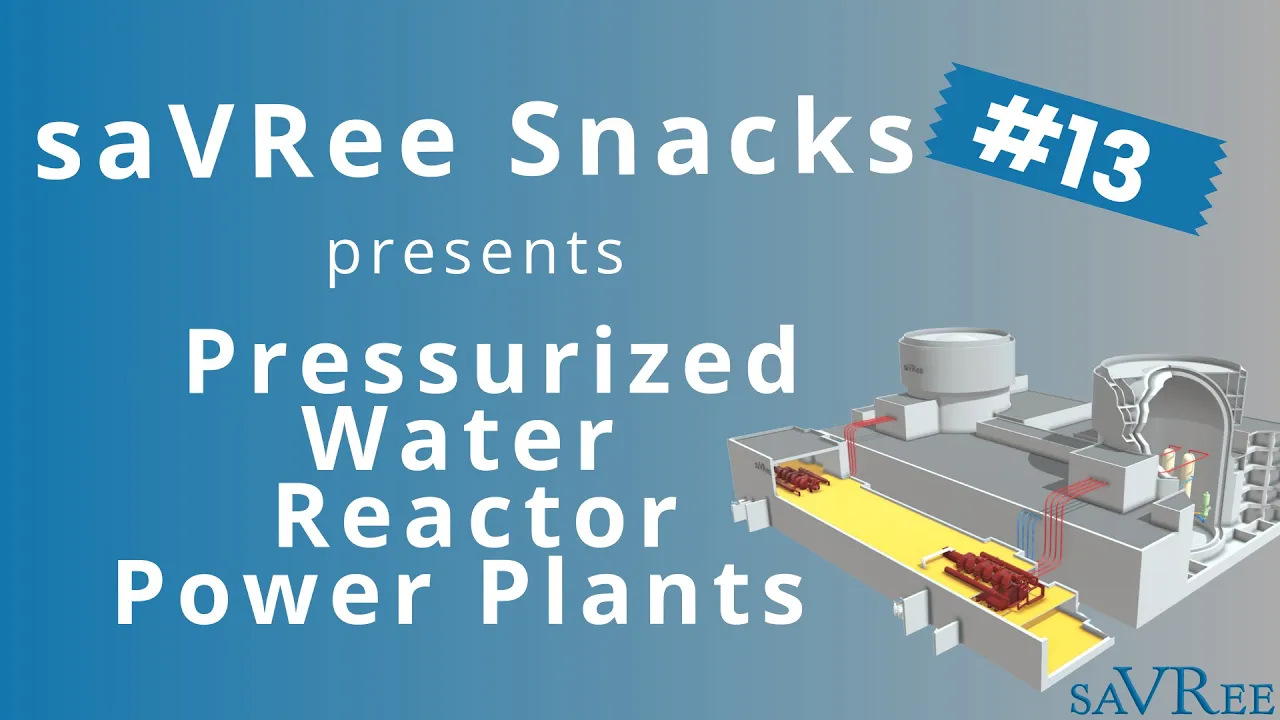
Why this video is valuable: This high-quality 3D CAD visualization walks through the secondary steam-generation loop, turbines, condenser systems, and primary pressure boundaries of a PWR.
Knowledge Checkpoint
- Explain why neutrons must be moderated (slowed down) to thermal speeds to effectively induce fission in .
- Describe the physical mechanisms by which control rods (containing neutron absorbers like boron or cadmium) regulate reactor power.
- Draw a diagram comparing the coolant loops of a Pressurized Water Reactor (PWR) and a Boiling Water Reactor (BWR).
- Explain how a negative void coefficient acts as an inherent, self-limiting safety feature when reactor coolant boils.
Module 5: Reactor Safety, Meltdowns, and Advanced Designs
Nuclear safety systems are designed to protect against the loss of coolant and the release of radiation. This final module covers the physical causes of reactor core meltdowns—specifically focusing on the phenomenon of decay heat, which continues to generate thermal energy even after control rods have stopped fission. You will analyze historical accidents and touch upon next-generation fuel designs.
Gap Note on Advanced Designs: While this module covers safety and meltdown mechanics extensively, the available video pool does not contain deep-dive academic videos on thorium-based molten salt or breeder reactor thermodynamics. To supplement this module, you are encouraged to independently search for academic lectures on "Fast Breeder Reactors (FBR)" and "Liquid Fluoride Thorium Reactors (LFTR)".
Recommended Videos
How Nuclear Meltdowns Happen — and How We Prevent Them

Why this video is valuable: This comprehensive explainer breaks down Loss-of-Coolant Accidents (LOCAs), the oxidation chemistry of zirconium alloy fuel cladding at high temperatures, the generation of explosive hydrogen gas, and modern active/passive mitigation systems.
Nuclear Engineer Reacts to The Simpsons - Homer Saves Springfield from a Nuclear Meltdown
Why this video is valuable: Despite the lighthearted premise, this video features a professional nuclear engineer who uses pop culture scenarios to deliver accurate lessons on the physical barriers of defense-in-depth: the ceramic fuel pellet matrix, zirconium cladding, the reactor vessel, and the reinforced concrete containment dome.
What do we face from Fukushima with Harry Jabs, MS, Dipl. Physics and Len Saputo, MD. Part 1 of 4

Why this video is valuable: This discussion features a physicist explaining the danger of "decay heat"—the thermal energy generated by the radioactive decay of fission products after reactor shutdown (amounting to roughly 6-10% of full power initially), and why continuous active cooling is critical to prevent a meltdown.
Knowledge Checkpoint
- Define "decay heat" and explain why a reactor core can still melt down several days after fission has been completely halted by control rods.
- Describe the chemical reaction between zirconium fuel cladding and superheated steam during a loss-of-coolant incident, and the danger of the resulting hydrogen gas.
- Identify the three physical containment barriers designed to prevent the escape of radioactive fission products into the biosphere.
- Explain how modern reactors utilize passive safety features (relying on gravity and natural convection) to prevent core damage without requiring external electrical power.
Course Map
Key People Index
- Dr. Andy Masley (Physics Educator)
- Context: Renowned for high-school and introductory undergraduate level physics breakdowns, specifically regarding the energy conversions in mass-defect calculations and the binding energy curve.
- Prof. Onkar Ramdasi (Academic Lecturer)
- Context: Expert in structuring the fundamental physical definitions of nuclear systems, focusing on mass differences and binding forces.
- Harry Jabs, MS (Dipl. Physics)
- Context: A practicing physicist whose public work focuses on explaining the real-world thermodynamic aftermath of major nuclear accidents, with an emphasis on decay heat dynamics and reactor core chemistry.
Final Self-Assessment
Complete this comprehensive self-assessment to verify your mastery of the curriculum material:
- I can calculate the mass defect of any isotope given the number of protons and neutrons and the isotopic mass, and convert it to total binding energy.
- I can identify the region of maximum nuclear stability on the Binding Energy per Nucleon curve and explain how it dictates fission and fusion energy release.
- I can write balanced equations for alpha, beta-minus, beta-plus, and gamma decay, ensuring conservation of nucleon number, charge, and mass-energy.
- I can use half-life equations to determine either the decay constant, elapsed time, original activity, or final remaining mass of a radioactive sample.
- I can explain the physical difference between fertile and fissile isotopes (e.g., vs ) and how slow thermal neutrons trigger fission.
- I can define the parameter (neutron multiplication factor) and describe the states of subcritical (), critical (), and supercritical () systems.
- I can explain how a neutron moderator works at the atomic scale (e.g., transferring momentum to hydrogen atoms in water molecules).
- I can compare BWR and PWR plants, describing how high pressure prevents boiling in a PWR primary loop and how heat is transferred to a secondary loop.
- I can explain the physical origin of decay heat and why emergency backup generator systems are necessary to prevent meltdowns in light-water reactors.
- I can describe the chemical process of hydrogen generation via the zirconium-steam reaction and the role of hydrogen recombiners in reactor containment.