









![E3.4 Binding energy per nucleon [IB Physics SL/HL]](https://i.ytimg.com/vi_webp/c-ZyyDNb2Mg/maxresdefault.webp)











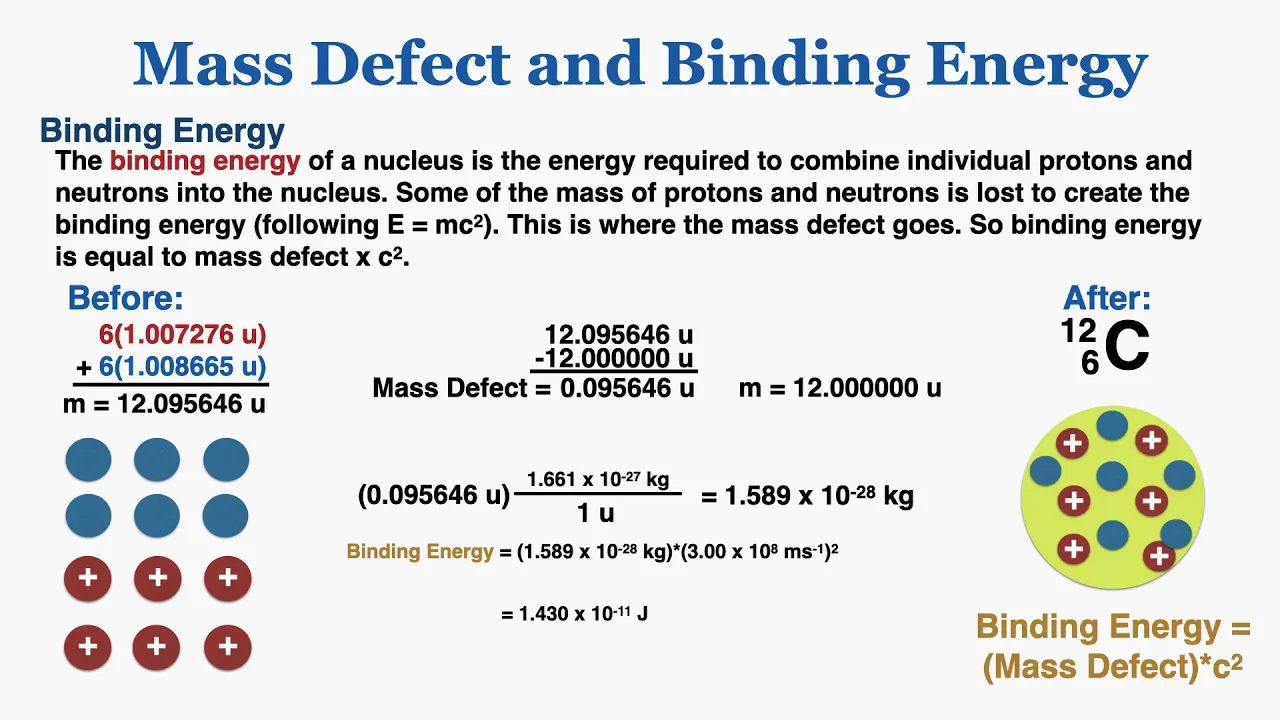
Mass defect is the difference between the sum of the masses of individual nucleons (protons and neutrons) and the actual mass of the nucleus, occurring because when nucleons combine to form a nucleus, some mass is converted to binding energy according to Einstein's mass-energy equivalence (E=mc²), which holds the nucleus together.
Nuclear Physics L1: Nucleus Structure & Mass Defect | IIT/NEET Prep
Added:Basic atomic structure, including the properties of protons, neutrons, and electrons, as well as Rutherford's alpha-scattering experiment.
Einstein's mass-energy equivalence principle (E=mc²) and how mass can be converted into energy.
Familiarity with atomic-scale units of measurement, specifically the atomic mass unit (amu or u) and energy units like electron-volts (eV and MeV).
Coulomb's Law of electrostatic forces to understand the repulsive forces acting between protons within a tight space.
Nuclear Binding Energy and the Binding Energy per Nucleon curve, which determines nuclear stability and why certain elements undergo fission or fusion.
The nature and characteristics of the Strong Nuclear Force that holds nucleons together despite electrostatic repulsion.
Radioactivity and radioactive decay laws, including alpha, beta, and gamma decay processes, half-life, and mean life.
Nuclear Fission and Fusion reactions, including calculation of the Q-value (energy released) in nuclear reactions.
529 views0likes46:03Original Release: 2026-01-07
Okay.
Nuclear.
Nuclear means you know we talking not electronucleus the charge and entire mass of the atom is constant center called nucleus total mass is assumed to be at the nucleus only because protons and neutrons are the mass electrons are very less mass okay that's why we not considering electrons the atom is - 10us.
Okay. What are the things we studying?
nuclear structure properties like mass density nuclear fision and fision also yesterday. If you done this one done, Done.
Okay. Now we'll stud nucleus protons. Neutrons.
Okay.
Nucleus is made up of protons and neutrons. They're called nucleons.
Nucleons number of protons and neutrons we call as nucleons. Okay.
Plus C is nothing but plus 1.6 inus charge here. Okay. And mass you know 1.6726 inus 37 kg and we consider that as 1 amu 1. Why we adding larger number?
Because mass when we consider neutron and proton which one is more or same proton and neutron so neutron is more little more that's why we put this one and symbol it is h1 charge and mass mass This is similar proton because hydrogen may also number of protons are one. So proton we symbol change is one.
Done.
Okay. Next.
Subatomic chemistry only. Next. Neutron.
Neutron also subatomic particle. The charge is zero. Mass is 1.6749 26.
Neutral is but we consider energ and neutron symbol N. Therefore this is charge and this is mass and Xray also which I send out maybe questions. Okay.
nucleus we studied protons and neutrons. Now some terminology we know member mass member majorly in this chapter numericals are binding energy and mass effect questions only come exam.
Okay. Now basic terminology we learn atomic structure. First one is atomic number. Atomic number you know but number of protons in the nucleus is called atomic number and number of protons is always equal to number of electrons in neutral atomic.
Number of also equal to next one is mass number. Mass number symbol A atomic number symbol Z. Okay. Mass number. Mass number is nothing but uh it is also called as nucleon number. See mass is different. This is different. Nucleon number is called mass is the total number of neutrons and protons in the nucleus. Mass number and atomic mass is different. Mass number of protons and neutrons mass number. Okay. or nucleon number as a.
So a is always equal to number of protons plus number of neutrons.
Then number plus is called angle.
Okay. So next atomic mass. Atomic mass is mass of one atom of the element. Atom element mass we call as atomic mass.
Tell me atomic mass means how to find element. How to find atomic mass? Mass of mass of protons plus mass of neutrons.
Right? Mass of proton means one mass of the proton is MP and number of protons are NP.
So total mass is how much? NP into MP plus mass of neutron will be n into MN.
Right? I I I already told mass of neutron and mass of proton is nothing but am right 1. So same.
So therefore NP plus N* 1 A. Okay. And this NP is nothing but mass number A.
Okay.
Yeah representation excel is there a atomic number mass number okay tell me suppose oxygen 86 number of protons I want number of neutrons and number of electrons also or atomic number is how much this Eight.
Mass number is mass number is how much?
16. Um atomic mass is how much?
16 amu. Okay.
Mass number mass.
Okay. So mass of mass is equal to 16 mu.
Okay.
Number is how much number? Six. Mass number two.
>> Massic leadership.
So mass will be 12 atomic mass. Okay, these are the things. Next we classify classification of nucle. What are the classification of nucleate? Isotopes, isobars, isotopes. Okay. So tell me what are isotopes? Means atoms of the element whose nuclear have same number of protons but different number of neutrons. Example same atomic number but different mass number is called as isotopes. Same atomic number different mass number. They'll give some examples they will tell whether they are isotopes or not isotopes. They will tell okay identify small. Okay. So example chlorine 17 35 and chlorine 17 37 isotopes are same atomic number but different mass they're all isotopes same atomic number but different mass Okay.
Average atomic mass. Suppose I want to calcate average mass. So what you tell suppose chlorine they given some percentage. Okay. How to calculate? You know already right. How to calcate?
Suppose 1735.
Suppose chlorine is here 1735 and chlorine is 177 given the percent isotopes right given the percentage given this is available at 7%.
And this is I want to find average atomic mass.
Average atomic mass. They give you any percent mass. Okay.
Tell me this 75 by 100 into 35 plus 25 by 100 into 37.
And the last >> 35.5 >> 35.5 okay only one decimal 35.5 is okay into the mass percent into the mass okay now is bar of the isotopes Okay. So, same mass number but different atomic number.
Okay. If the atomic numbers are different, elements are different.
Right? So, that's why examples will be different elements. Carbon nitrogen.
Carbon 6 14 and nitrogen 74.
Same mass number but different atomic number. These are called as isobars.
Next one is isotones.
Isotones means same number of neutrons.
Same number of neutrons. Correct.
Isot atoms of different elements whose nuclear same number of neutrons same number of neutrons are called as isotton. Suppose lithium 37 and berium 48 is the number of neutrons uh mass number minus number okay 7 - 3 is correct 8 - 4 also four so number of neutrons are same that's why these are isotones also I'll send the PDF you can take a print out next.
Now nuclear shape size and lens okay shape of the nucleus is assumed to be spical 90% and spical formula 4x3 size shape always and the volume you will be 4x3 pi rq shucuc for size also then next size how to find size volume of nucleus volume of nucleus is proportional to Number of nucleons inside it. Number of nucleons inside it.
More the number of nucleons more the volume of the nucleus. Right? Nucleon number 10 20 30 protons are there means volume also will increase. So and we know that means v is proportional to nucle but a number of nucles is a okay volume is how much? 4x3 pi rq is proportional to a. So R is proportional to A R= R A size means radius radius you have to find R a 1x3 where R these are radius nucleus radius of nucleus and r is a fixed value that is 1.2 for me to approximately 1.5 per minute whenever not even take 1.2 and peri means 10 - 15 1 = 10 - 15 m.
Okay. And this is the formula.
Volume is proportional to nuclear number and r= a mass number. Okay.
Okay.
Okay.
I want radius of copper 64 in per meal you have given that value >> 5.6 into 10^ minus 15 >> 1 5.6 6 into 10 into 10.
Yes. Answer is because radius is r = r = 1.4 into 64.
So 4 cube 4 cancel. So r = 5.6 six of the Example suppose X element is there mass number is 35 and Y element is there mass number is okay he's asking what is the volume of X by volume of 1 by five.
>> Yes, 1x 5 because volume is proportional to mass, right? So that means v_sub1 by v2= a1 by a2 by 12 volume to mass number and r= r a 1x okay now density density density by dity density is equal to mass by volume formula Okay, mass is nothing but I told you a into a mu by volume. volume is 4x3 pi rq and here I'm subuting a mu by 4 by 3 r = r a 1 by 3 I'm cubing more sets rq will be r into a right so r Q R Q into A A cancel and 1 AMU right 1 AMU you know how to convert into kgs 1.67 into 10^ - 24 kg by 4x3 by 1.2 2 per 1.2 10 - 15 whole cube. If you solve you get approximately as 2.3 into 10^ 17 Egle density it is like harducity.
Okay. And whether density depends on the mass number. Whether density depends on mass number. Here a is getting cancel.
Very important. They will ask same atoms nucleus hardness that density get.
Okay. So it does not depend on mass number is independent of mass number. It is same for nuclear of all atoms and nuclear density is 10^ 14 times more than the water density nearly 14 times because 17uc We learn actually before they used to have a big chapter this one because radioactity they removed that is very good thing.
Okay. So when doing questions almost 60% chapter done mass energy equivalence mass effect and binding energy nuclear stability and binding energy per neutral. We learn who is this person you know the friend.
Okay. Okay. He is a person who talked about equals MC².
Okay.
In 195 special theory of relativity that mass is a form of energy. Mass and energy some relationship is there. Mass is a form of energy.
He predicted mass and energies are equivalent and given the m= mass energy upon c² or equ= mc² right = mc² from this mass how to calculate energy upon c² okay this mass and energy relationship we talking So whenever You know, I told that already.
Sorry.
Don't know medical terms we should not touch without any permission body they don't know no one knows they want to study because okay so they went and they done everything they saw the sizes first of all brain size generally normal human brain and brain collecting the data is more okay number of neurons normal person can think up to 100 second nearly 10,000 to 20,000 times thinking power neurons is genetic that much thinking if you see this everything he canate thinking We are acting like you know normal customer thinking you know so much we cannot do that much also okay that's why you know 1900 centuries and 1600 Okay.
I ask some question. Which is having more mass? One is stationary or identical moving? Which is having more mass? Cattle station.
Moving mass.
Ball. Simple example.
You know moving ball has more mass right moving with some velocity what is mass means what you tell amount of matter contained in the body.
Okay. Now, what is mass due to stationary ball and accord? It has some energy. Which energy? It has kindinetic energy. Accord mass is nothing but kindinetic energy upon C². This also mass extra mass is getting added that's why moving mass has more energy okay extra mass is getting added in the body that's why mass is moving Yeah.
Okay. Now it's mass basic concept. Now atoms how the Einstein is applying we have to know. Okay. First of all understand which is a fundamental particle of an atom.
Uh proton of neutron of electron and fundamental particle mean not divided right.
Fundamental particle of an atom.
particles electron.
Out of the three particles, which is the most fun particle which cannot be further divided.
Okay. See fundamental particle is actually electron.
Proton and neutrons are also further divided.
Quarks quarks. Okay.
divided into up but electron is still there's no further divided electron is not further divided fundamental particle of the atom okay according what is mass we will see amount of energy present in the body is called mass energy Okay.
will apply and you know if the mass disappears energy is getting released always whenever mass is getting disappeared energy is getting released we will see and take Object.
Object is made of what?
Object is made up of what?
Atoms. Like object atoms.
Atoms. Okay. Atoms. There is a force of attraction between them. There's a force of attraction at there is a force of attraction.
Okay. Now these atoms are stationary or slightly moving at moving moving. So at which energy it has since moving it has energy of the atoms plus and also energy of the atoms are there whenever there is a force of attraction between them is there there is a potential energy also when there is a force of attraction between them there's a potential potential energy of the atoms low energies are there okay now tell Okay. Atoms are made up of Atoms made up of protons and electrons, right?
So nucleus electrons are the okay electrons defined asinetic energy and we also stud force of attraction between them is a potential energy also. So if you askinetic energy of the electron potential energy of the electron right now is made up of nucleons protons and neutrons okay protons and neutrons I'm taking there's a force of attraction between them nuclear force acting attractive force I This protons and neutrons also moving right. So which which energy is as potential energy of the nucleus nucleons the nucleic energy of the nucons and these are electrons electrons right? Okay. Now tell me this protons and neutrons are made up of I told you quarks right? Quartz. Okay. So there will be a quartz and quartz will be there. Okay. And this is made up of quartz quartz. Even so this also there is a force of attraction between them and this is also moving. So therein of the quarks and potential energy of the quartz right amount of matter in the body mass mass will not change from place to place we'll go for next okay mass energy of the atoms plus potential energy of atoms plus kindinetic energy of the electrons plus potential energy of the electrons plus kinetic energy of the nucleons plus potential energy of the nucleons plus kinetic energy of the quarks plus potential energy of the qus upon c². This is mass.
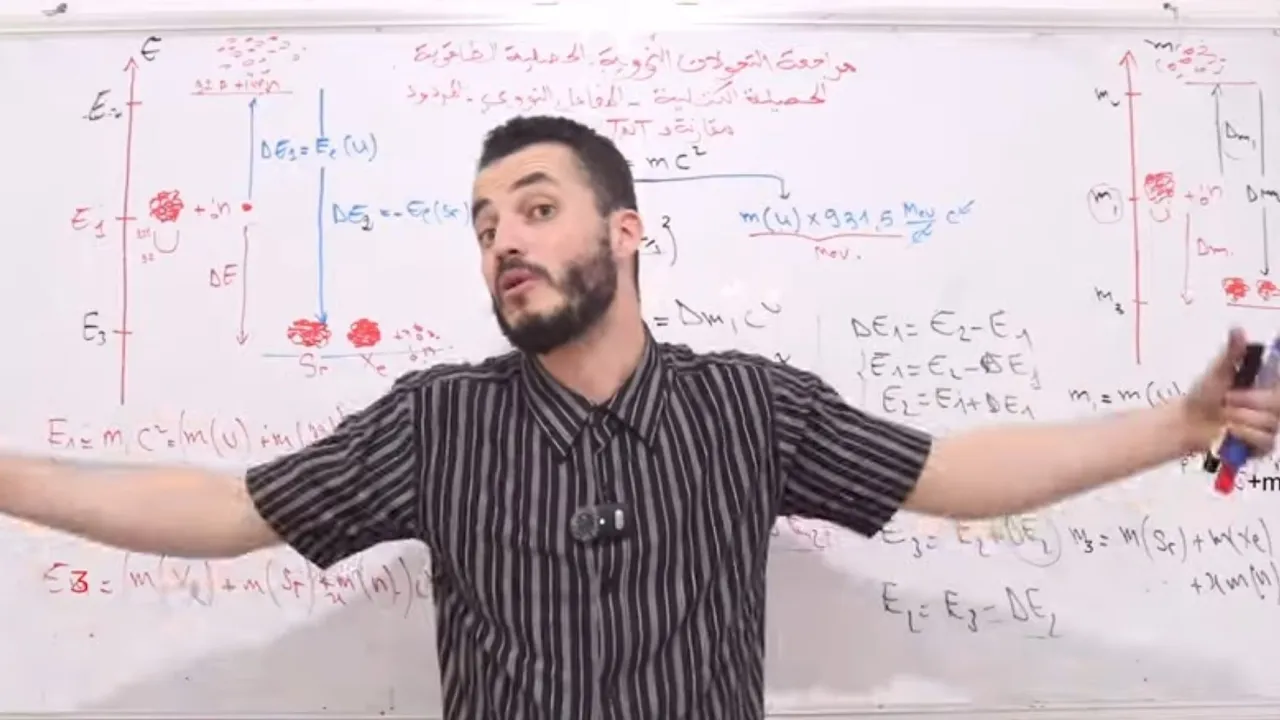
Mass is nothing but amount of energy present in the body. Okay. by C² see the speed of light right speed of light we'll get energy of the object reactions are happening at the time when combining or breaking the nucleons.
So much of heat is coming and some of the mass is getting disappear in the nuclear reaction. they don't.
So that study was done by Okay.
Okay. Mass defect.
The mass of the nucle nucleons is less than the sum of the mass of the nucleons making it.
Suppose you have nucleons nucleons.
Okay.
Say I made nucleus.
Say I nucleus neutron proton neutron neutron suppose each one is some you know potato okay I'll measure individual weights I will write and I will add all the weight okay and Again we measure the weight same or different same right same but in nuclear coming to nuclear reactions what is happening is there Okay, they observed here nucleons mass and nucleons mass they observed is mass is greater than is mass but the sum of the mass getting disappear. Okay, here what is happening is mass of the nucleons is greater than mass of the nucleus.
They wrote and after converting the nucleus they wrote this is happening mass of the nucleons is greater than mass of the nucleus and that means indirectly I can difference of mass if I calculate mass of neutrons minus mass of nucleus this is nothing but mass defect we delta is nothing but del and he explain massable he explain also that we'll see so some mass getting disappear when nucleons is converted to nucleus can tell me why why mass is getting disappearing example It is getting disappeared.
Okay. But okay. And when I brought all nucleons together is there is a force of attraction again between them.
Whenever there is a force of attraction there is a negative potential energy will be there.
always this is mass e² total energy zalus when I brought there is a energy getting added upon c² mass is this because when I brought all nucleons there is a potential energy coming to picture according to Einstein the mass mass energy upon C² total energy is much upon C square when you divide the mass is getting disappeared that's why mass is getting disappeared okay and this is nothing but a mass defect and mass defect for 0.3456 questions I'll give the nucleus you have to tell okay some of the mass disappears during the formation of nucleus called mass defect that is called mass defect name is mass defective This complete model I'm taking test element Xomic number Z mass number is Zam they'll give one element number mass number they will tell to calculate mass defect okay here how many protons are there protons how many neutrons are there a minus Z neutrons right neutrons are there and one proton mass m and 1 mass mn.
Okay. So mass defect basic formula is what? What is the mass effect? Basic formula is mass of nucleons minus mass of nucleus also is there and neutrons also is there right now mass of nucleons means how many protons are there Marlo you have totalass Tell me how many are there? Protons are there a mass. So total mass will be how much?
See mass m how many are there? So into mutton mass is the number of neutrons mass. So into mus of the nucleus mass of the nucleus x capital x mass u mass of the nucleus x for this is nothing but mass effect the formula mass into m plus a minus into musx okay sometimes mass of the pro mass of proton mass of the hydrogen is same right sometime like this delta mal into MH plus A - Z into M and this generally is in mass We'll calculate the we'll do the numerical space on this.
Up Next
9:02
Radioactivity Calculations | JAMB Physics Guide
@Tutor_Ginux
483 views•2025-03-31

12:53
21cm Hyperfine Transition in Neutral Hydrogen: Radio Astronomy Basics
@AaronRobertParsons
12.4K views•2011-10-13

32:32
NMR Spin Physics I: Zeeman Effect, Resonance Condition & Larmor Frequency
@nptel-indianinstituteofsci8064
2.3K views•2024-01-17

27:14
Entropy and the Second Law of Thermodynamics Explained
@veritasium
27.5M views•2023-07-01
Related Study Plans & Knowledge Roadmaps
Structured learning paths in Physics
physics
Nuclear Physics (Decay, Fission & Reactors)
01Atomic Structure and the Binding Force
02Radioactive Decay and Half-Life
03Nuclear Fission Mechanics and Chain Reactions
+ 2 more learning modules
12h5 modules
Explore Roadmap
physics
Soft Matter (Polymers, Colloids & Rheology)
01Foundations of Soft Matter & Thermal Forces
02Polymer Physics and Macromolecules
03Colloids, Surfactants, and Self-Assembly
+ 2 more learning modules
38h5 modules
Explore Roadmap
physics
Analytical Mechanics: Lagrangian & Hamiltonian
01Mathematical Foundations: Calculus of Variations
02From Newtonian Mechanics to Constraint Dynamics
03The Principle of Least Action & Lagrangian Mechanics
+ 3 more learning modules
28h6 modules
Explore Roadmap
physics
General Relativity (Spacetime & Cosmology)
01Foundations of Relativity: Special Relativity
02The Geometry of Spacetime: Equivalence Principle & Curvature
03Einstein's Field Equations: The Mathematics of Gravity
+ 2 more learning modules
55h5 modules
Explore Roadmap