












A tuned mass damper is a device that reduces unwanted vibrations in tall structures by attaching a smaller, optimally-tuned mass (with specific weight, friction, and spring strength) to the main structure; this secondary mass absorbs and dissipates the primary structure's oscillatory energy through friction, effectively damping out the shaking without requiring excessive structural stiffness.
How Tuned Mass Dampers Stop Structures from Shaking
Added:The fundamentals of Simple Harmonic Motion (SHM), including concepts of mass, stiffness, frequency, and amplitude.
The concept of resonance, specifically how external periodic forces matching a structure's natural frequency can cause catastrophic vibration amplification.
Basic mechanisms of damping (such as viscous damping) and how they dissipate kinetic energy from a system.
An introductory understanding of structural loading, particularly how wind shear and seismic waves exert dynamic lateral forces on tall structures.
Active Mass Dampers (AMDs) and semi-active control systems that utilize real-time computer sensors and actuators to actively combat wind and seismic forces.
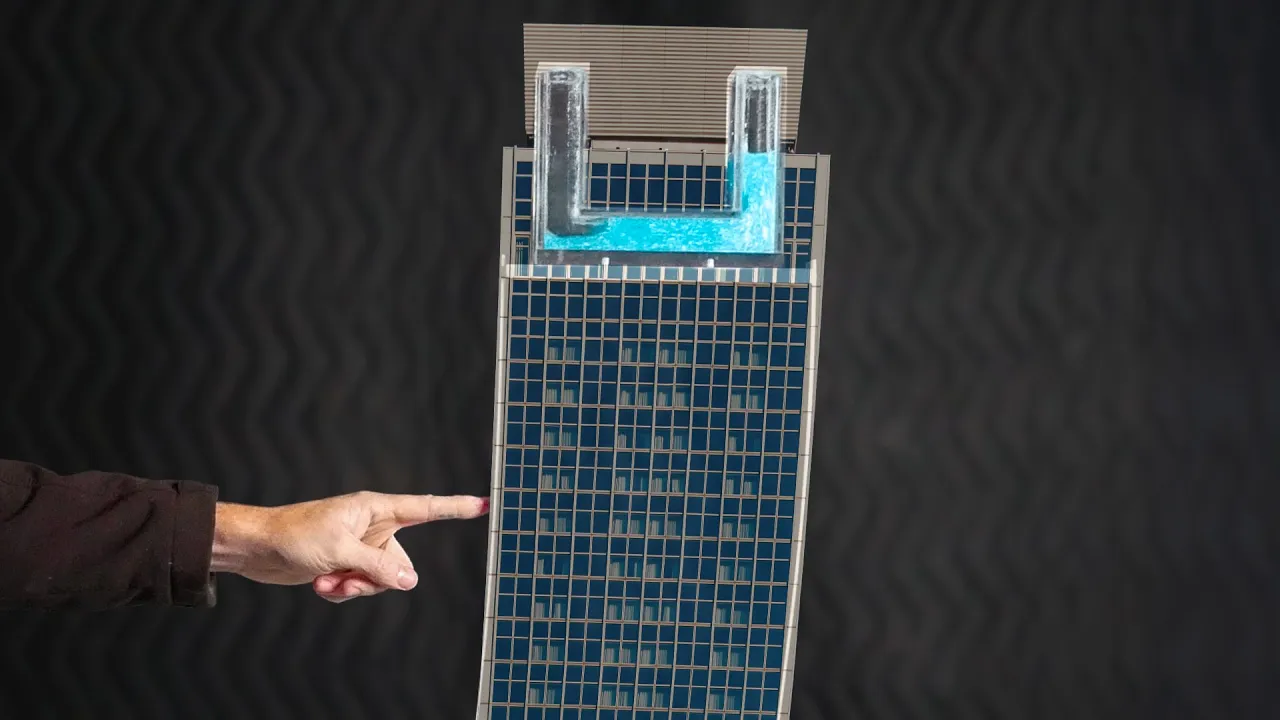
Tuned Liquid Dampers (TLDs), which utilize the sloshing of water in specialized tanks to absorb structural energy instead of solid steel masses.
Real-world structural engineering case studies, such as the design and operation of the 660-metric-ton pendulum inside Taipei 101.
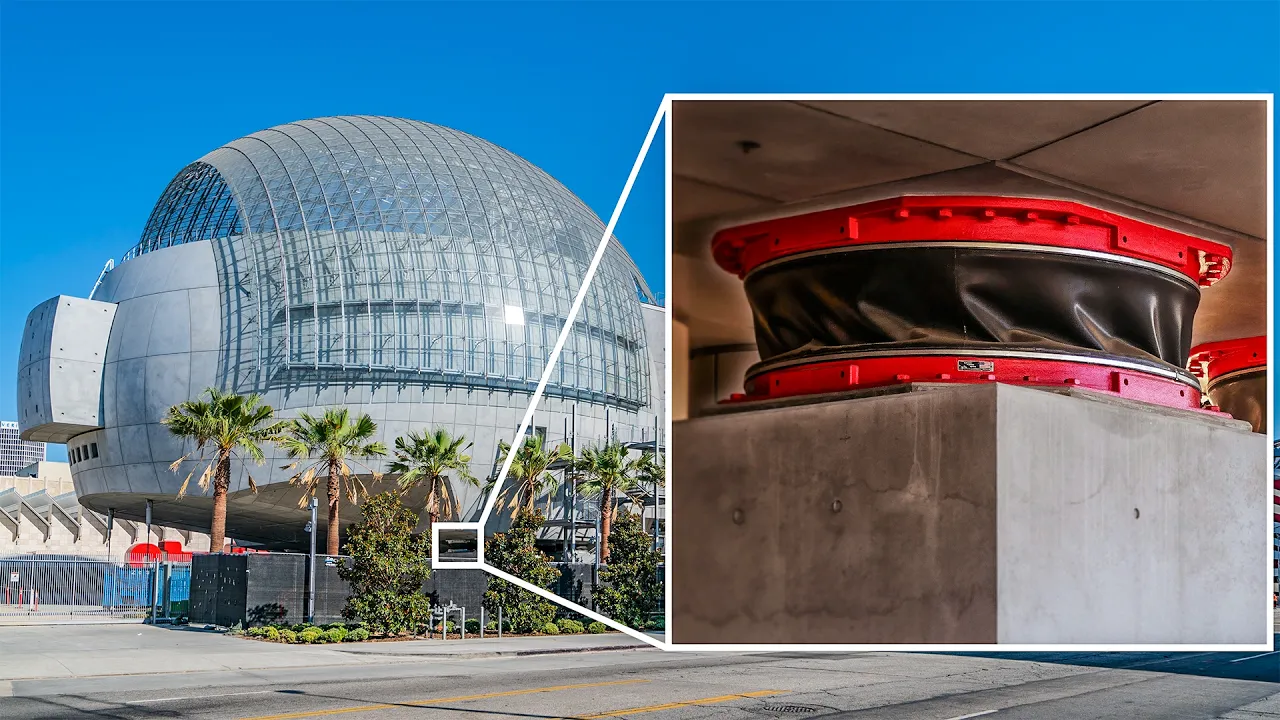
Base isolation systems, an alternative seismic design strategy that physically decouples a building's superstructure from its foundation.
Advanced mathematical modeling of multi-degree-of-freedom (MDOF) systems to calculate and optimize the mass ratio, tuning frequency, and damping ratio of a TMD.
573K views26.5Klikes4:32Original Release: 2018-08-28
For this video Lego sent me some of their Saturn V rocket sets.
But this isn't a video about space - I actually want to talk about the physics of how to keep tall things from shaking, like how to keep skyscrapers from swaying too much in the wind, or in an earthquake.
The taller something is, the more liable it is to sway back and forth, so to demonstrate this, the Saturn V seemed by far like the best and coolest Lego set for the job (even if not the most realistic).
If you don’t your tall thing to sway, either because you’re worried it’ll fall apart or you’re worried it’ll freak out the people inside, you could just make it stiffer – either by adding more stuff or using more rigid materials – this isn’t always the most elegant solution, and gets expensive fast.
But there’s another, clever solution.
From a physics perspective, a tall thing like a building is really an upside-down pendulum - when it gets bent a little bit to one side, the building’s natural stiffness pulls it back the other way, and so on.
And there's a neat phenomenon that happens with pendulums when you attach two of them together with a spring: they start swapping energy back and forth – first one oscillates, then both together, then the other has all the oscillations, then the first again, and so on.
The same thing happens with solid blocks and springs, too, or any two oscillating things that are coupled together.
In a perfect frictionless simulation this energy swapping will go on forever.
But in the real world there's friction and air resistance and the spring itself might heat up, causing the objects to lose energy, and the oscillations dampen over time.
And this phenomenon is what you can use to ‘discourage’ your upside-down pendulum from shaking in ways you don’t want it to.
A big tall object is going to want to sway back and forth at its own natural frequency of swaying (which depends on its height, weight, and stiffness).
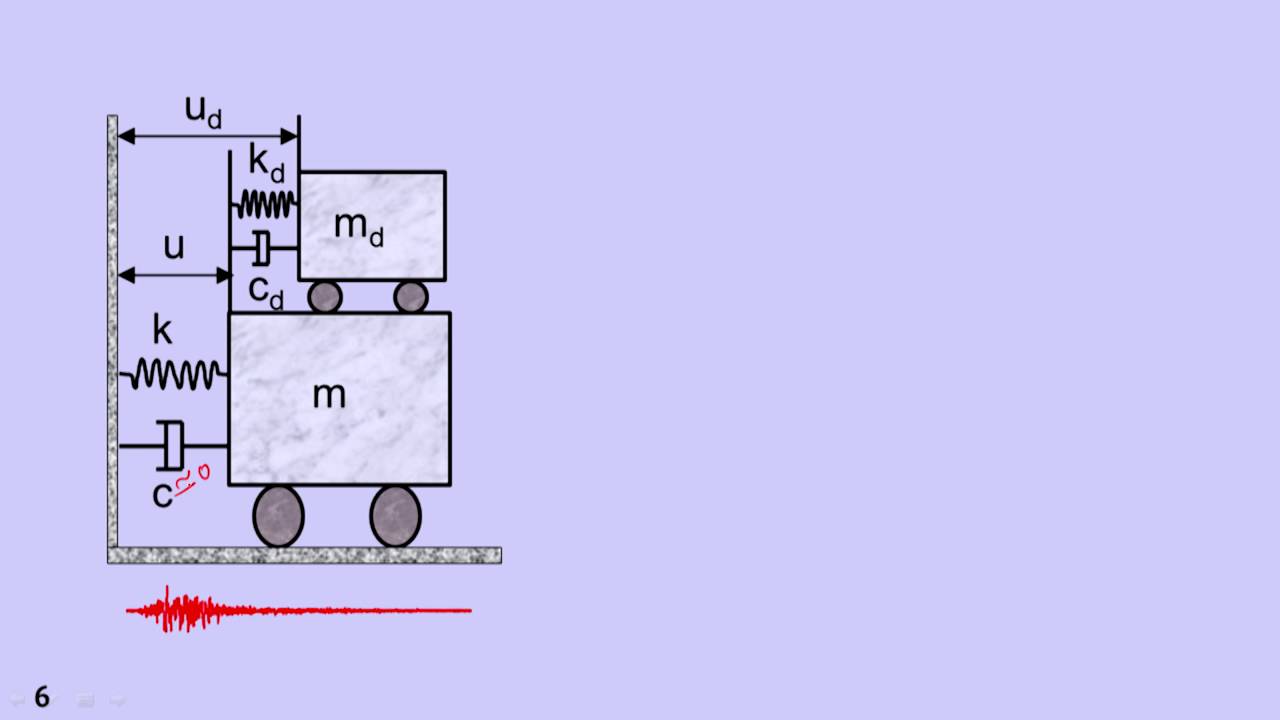
If you then attach a smaller object to it that can sway to and fro, and add a little bit of friction, then any time the big object trades its energy to the little object, the little object loses the energy to friction rather than trading it back to the big object, and this dampens out the big object's oscillations.
In practice, you normally put the little object inside the big object, which looks more like this, but the principle is the same.
And you don’t want to use just any old little object and any old spring.
It turns out that for a particular big thing, there’s an optimal combination of weight and friction and spring strength for the little object.
And only with your setup perfectly tuned will you get the fastest possible loss of energy and the best slowing down of the shaking.
That’s why this setup is called a “tuned mass damper” – “damper” because it dampens the swaying, and “tuned” because the little object is specifically tuned to steal energy from this particular big thing’s natural tendency to swing.
Which brings us to the Lego Saturn V rockets: in one of the rockets I’ve put a weighted pendulum in the place the lunar module should go, while the other just has the weights stuck in place.
If all goes well, and if I’ve done my math right, then when I bump the table, the rocket with the pendulum should sway a lot less than the rocket without.
As you can see, the tuned mass damper does actually help!
(though it’s a bit subtle).
Here’s a graph of the motion of the rocket in each case, which makes it more obvious.
And though tuned mass dampers definitely weren’t used in the saturn V rocket in this way (since this is where the lunar module went), they are used in skyscrapers and even in other things that aren’t buildings (though they’re usually hard to notice).
For example, if you look closely at power lines, a lot of them have this little dumbbell thing on them, which is a tuned mass damper that keeps the lines from shaking too vigorously in the wind.
And tuned mass dampers have been used to reduce unwanted vibrations in airplane engines, formula 1 racing cars, and audio speaker cones.
So there you go – the tuned mass damper, aka the physics of how to use little things to stop big things from shaking!
As you've probably guessed by now, this video was sponsored by LEGO - I've been a huge fan of LEGO for pretty much my entire life, spending hours and hours building and rebuilding all sorts of LEGO projects as a child and teenager, and even more recently sneaking some into MinutePhysics videos.
So I'm excited that LEGO wanted to full-on sponsor a video.
The Saturn V sets are super cleverly designed and really fun to build, and of course I'm a big Apollo fan and I love how the rocket actually stages like the real thing.
Anyway, the folks at LEGO want me to point you to their online and physical stores which, naturally, have the largest collection of lego sets, and also allow you to find and buy individual pieces a la carte for custom projects, get expert lego help, and with LEGO VIP you can get early access to new LEGO sets.
Thanks so much to LEGO for sponsoring this video and filling my childhood with creative delight.
Up Next
73:35
Deriving Maxwell's Equations in Geometric Algebra (QED Prereqs) 11
@XylyXylyX
2.6K views•2024-09-08
23:39
Vector Derivative in Geometric Calculus: Gradient and Maxwell's Equations
@AlanMacdonald1
12.8K views•2016-03-19
21:43
Feynman's Lost Lecture: Why Planets Orbit in Ellipses | Physics Explained
@MinutePhysics
3.7M views•2018-07-20

33:44
The Blue LED: A Decade-Long Scientific Challenge Explained
@veritasium
46.5M views•2024-02-08
Related Study Plans & Knowledge Roadmaps
Structured learning paths in Physics
physics
Medical Physics: Imaging, MRI & Radiotherapy
01Foundations of Radiation and Matter Interaction
02X-Ray Imaging and Computed Tomography (CT)
03Magnetic Resonance Imaging (MRI) Physics
+ 3 more learning modules
15h6 modules
Explore Roadmap
physics
Nuclear Physics (Decay, Fission & Reactors)
01Atomic Structure and the Binding Force
02Radioactive Decay and Half-Life
03Nuclear Fission Mechanics and Chain Reactions
+ 2 more learning modules
12h5 modules
Explore Roadmap
physics
Soft Matter (Polymers, Colloids & Rheology)
01Foundations of Soft Matter & Thermal Forces
02Polymer Physics and Macromolecules
03Colloids, Surfactants, and Self-Assembly
+ 2 more learning modules
38h5 modules
Explore Roadmap
physics
Analytical Mechanics: Lagrangian & Hamiltonian
01Mathematical Foundations: Calculus of Variations
02From Newtonian Mechanics to Constraint Dynamics
03The Principle of Least Action & Lagrangian Mechanics
+ 3 more learning modules
28h6 modules
Explore Roadmap