









![63 - TEORÍA CUÁNTICA de CAMPOS [ Función de Green del Campo Electromagnético ]](https://i.ytimg.com/vi_webp/U9I-OLI9unA/maxresdefault.webp)











The vector derivative generalizes the gradient to differentiate multivector-valued functions on manifolds by using reciprocal basis vectors instead of tangent vectors, enabling differentiation even when coordinate systems are non-orthogonal; this framework unifies divergence and curl into a single operator and provides a more elegant formulation of Maxwell's equations compared to traditional vector calculus.
Vector Derivative in Geometric Calculus: Gradient and Maxwell's Equations
Added:Standard vector calculus concepts, including the traditional definitions and operations of gradient, divergence, and curl.
Foundational concepts of Geometric (Clifford) Algebra, specifically the geometric product, outer (wedge) product, and multivectors.
Classical Maxwell's equations of electromagnetism expressed in Gibbs-Heaviside vector notation.
Multivariable calculus, including partial derivatives, line/surface integrals, and basic differential equations.
Spacetime Algebra (STA) and the formulation of covariant relativistic electrodynamics in 4D Minkowski space.
Using Geometric Calculus to solve electromagnetic wave equations and boundary value problems via Green's functions.
Formulating Gauge Theory Gravity and general relativity using the gauge-covariant formulation of geometric calculus.
Comparing and contrasting Geometric Calculus with the framework of Differential Forms in differential geometry.
Applying geometric algebra in advanced engineering contexts, such as antenna design, computer vision, and robotics kinematics.
12.8K views276likes23:39Original Release: 2016-03-19
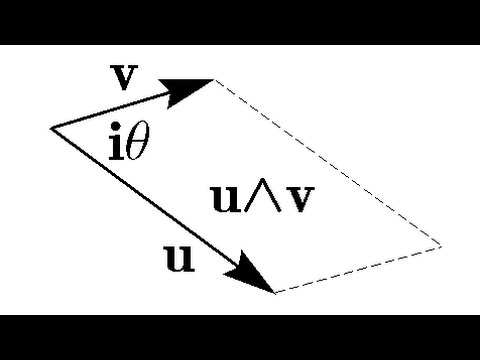
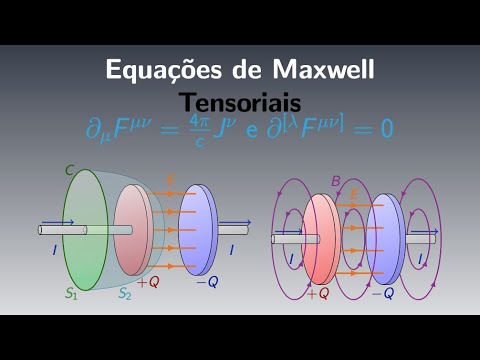
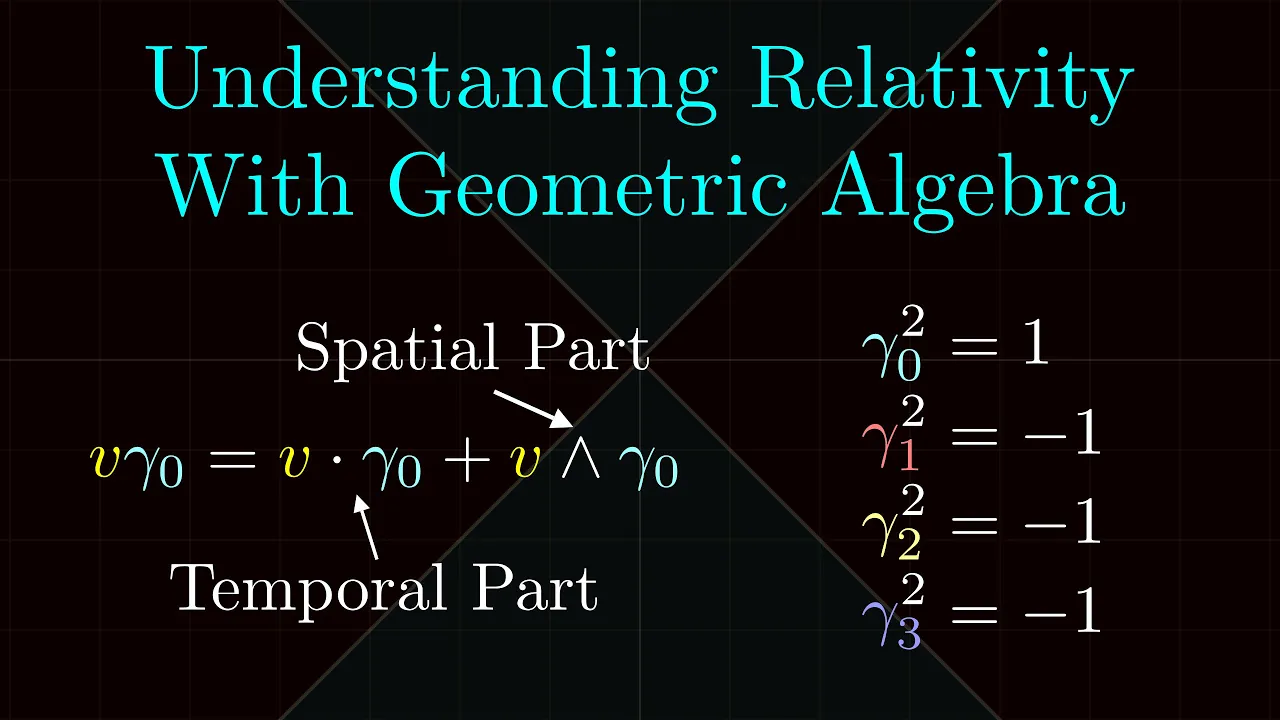
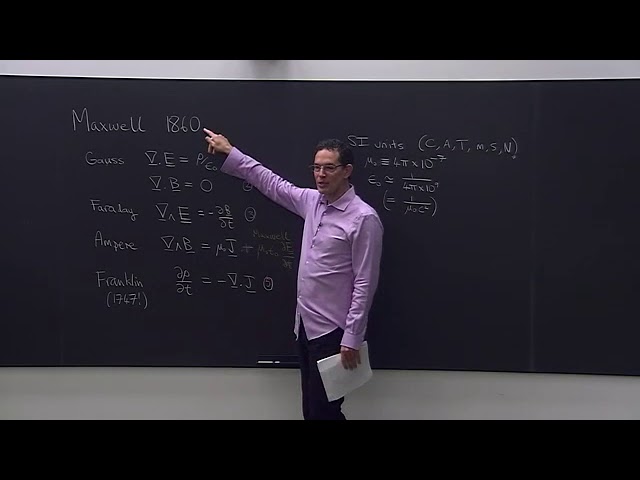
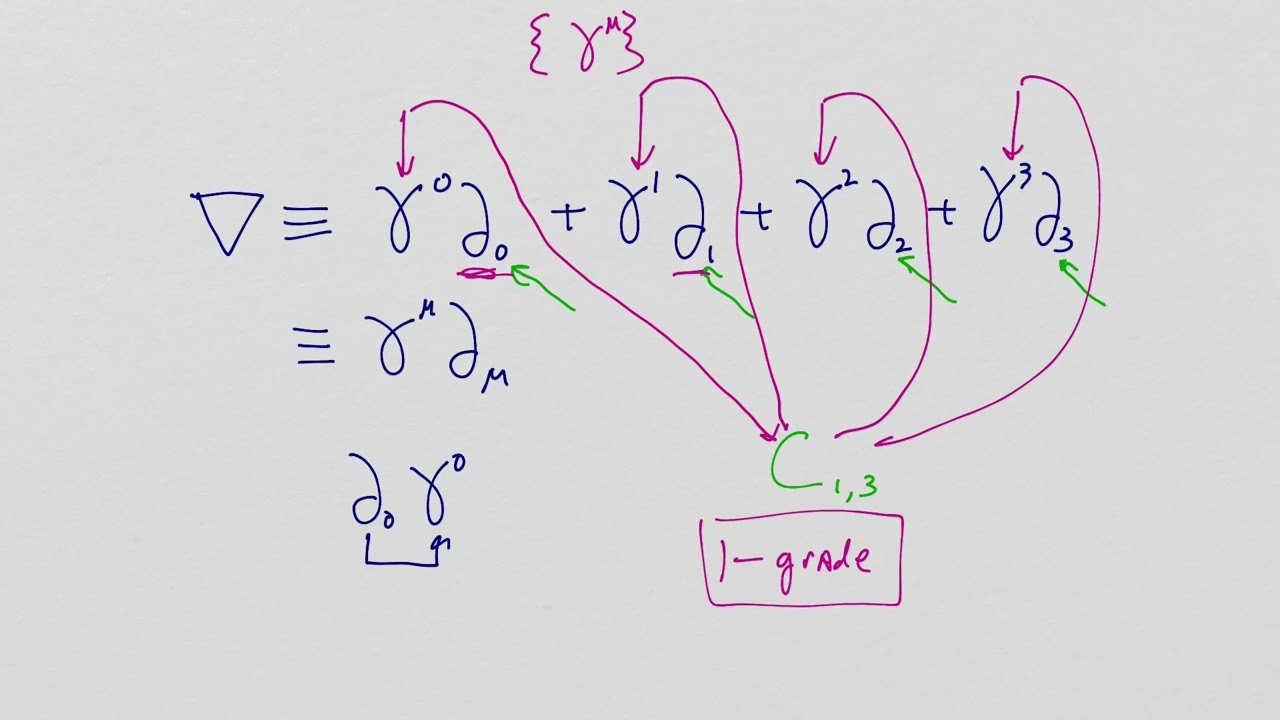
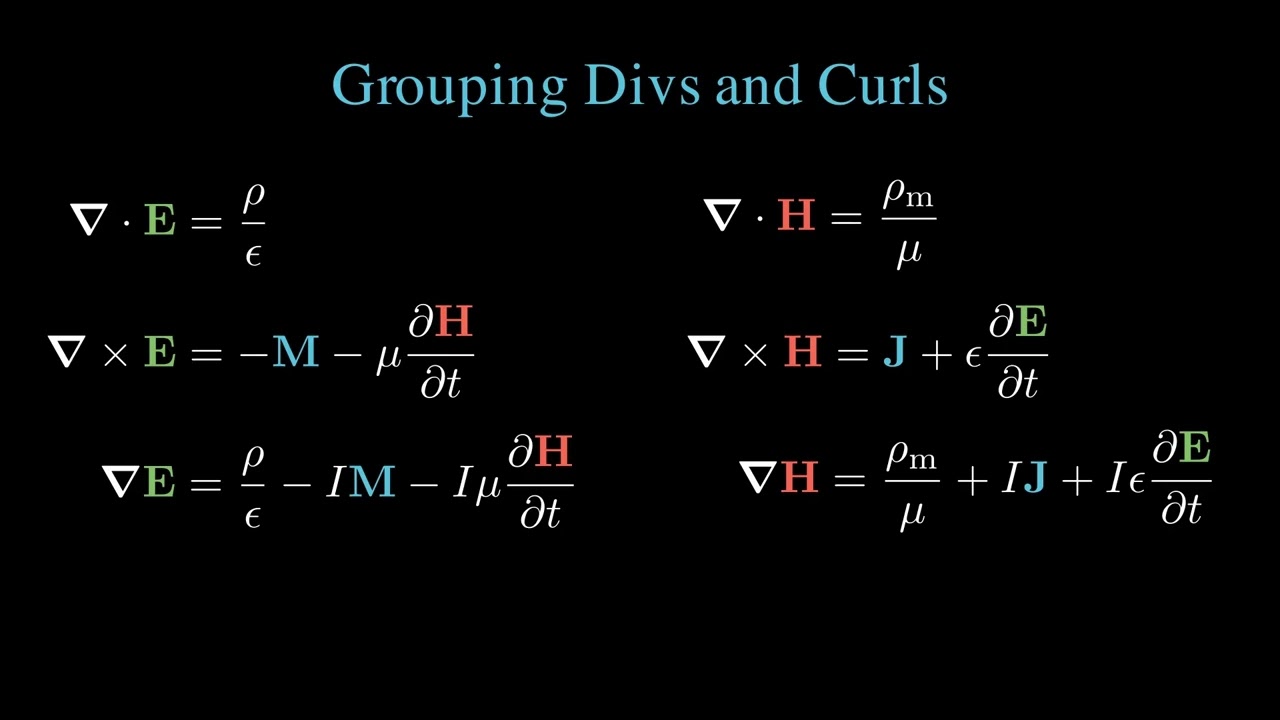
the second part of my playlist is devoted to the vector derivative we want to be able to differentiate multiv Vector valued functions defined on and perhaps only on manifolds the vector derivative does this it generalizes the gradient on ourn before discussing the vector derivative I want to say a a bit about the gradient operator it's an aside from a straight line to the fundamental theorem but it's an important aspect of geometric calculus and so I need to discuss it so let's define the gradient we'll start with an orthonormal basis E1 E2 for R2 and a multiv vector valued function f defined on some open subset of R2 here's the definition this is familiar except that usually the partial derivative is written to the left of the basis Vector for a scalar valued function f this doesn't matter because scalars commute with vectors but for a multi Vector valued function this partial d derivative need not commute with E1 so we have to make a choice and I choose in this playlist to place the partial derivatives on the right now I've defined the gradient only for R2 but it's perfectly obvious how to extend to RN I'll often use R2 as a standin for RN when it makes the notation simpler to read and it's obvious how to generalize to higher Dimensions next I introduce a vector operator Dell which is equal to this the coefficients behave as scalers they commute this is the equality of mixed partial derivatives and they preserve grades this partial derivative has the same grade as F itself then you can think of the gradient of f as a geometric product the vector Dell times the multiv vector F written this way and that expands to this we're now ready to introduce produced the Divergence and curl we'll start out with the gradient from the last Slide the vector Dell geometric product F which expands to this the Divergence is the vector Dell inner product F which can be written this way way and expanded and the curl recall that in geometric algebra we replace the cross product with the outer product the curl then being the vector Dell outer product F which looks like this and which expands to this recall the fundamental identity of geometric algebra the geometric product of two vectors is equal to their inner product plus their outer product this can be generalized replacing V with a general multiv Vector M simple counter example so that I can't then also replace you with a general multiv Vector well in the same way as this equation holds this equation holds Vector times multiv Vector equals Vector inner multiv Vector plus Vector outer multiv Vector the gradient is equal to the Divergence plus the curl unifying the Divergence and the and the curl into a single operator the Great radiant operator has the wonderful property that it's invertible if I have a multi Vector valued function on an open set u in R2 I can express the invertibility of f by saying that f is determined by its gradient on U and its function values on the boundary of U next we need the notion of the Dual of a mold Vector I'll start with a definition that of a unit pseudoscalar I Illustrated with the unit sudu scaler of G3 it's obtained by multiplying members of an orthonormal basis for R3 giving the unit pseudoscalar I if I choose a different orthonormal basis with the same orientation I'll get the same unit pseudoscalar and now we can Define the Dual the Dual of a molda vector denoted M Star is obtained by multiplying the mul Vector M by I inverse on the right this I inverse is easy to come by as I now show here's the unit pseudo scaler for R3 and here is the members of the uh unisa scalar but given in Reverse let's multiply them E3 * E3 is 1 so that goes away E2 * E2 is one so that goes away and finally E1 * E1 is 1 that's all we're left with so that tells us that this is the inverse of this which is I okay we're ready for the geometric interpretation of this duel and here it is I have a blade B which represents a certain Subspace s we know that blades represent subspaces then B Star the Dual of B represents the ortho orthogonal complement of s vector algebra provides no simple algebraic way to to pass from a Subspace to its orthogonal complement vector algebra doesn't even represent subspaces let's look that at the most important case of this orthogonal complement in R3 here's the origin in R3 and here's a vector that ve Vector represents a certain Subspace here's a b Vector that b Vector is a subset of a two-dimensional Subspace and I want the vector in the bi Vector to be orthogonal as indicated here and I want the length of V to be equal to the area of B then V and B are each other's du The Duel of V is B and The Duel of B is V well not quite if I take the Duel of V to get B and then I take the Duel of B I don't get V in fact I get minus V but that's okay because minus V represents the same Subspace as does V couple of identities The Duel of an outer Pro outer product is an inner product but I have to replace the rightmost member of the product with its dual and exactly dually The Duel of an inner product is an outer product but again I have to I have to replace the right member by its duel and finally the Dual of the outer product of two vectors in R3 is equal to their cross product so I still have the cross product if I need it this slide and the next compare the formulations of Maxwell's electrodynamic theory in Vector calculus and in geometric calculus in Vector calculus the magnetic field is represented by a vector usually the vector is denoted in uppercase B but I have another use for uppercase B which is this in geometric calculus the magnetic field is represented by minus the Dual of this Vector which is a b Vector of course it's given by this in Vector calculus the magnetic field is represented by a vector and geometric calculus by a b Vector the bi Vector representation has many advantages here's an example I've indicated here a loop of wire carrying a current so such a current will generate a magnetic field the magnetic Vector representation of the field in Vector calculation is this Vector the vector is orthogonal to the to the loop its direction is given by the right hand rule wrap the fingers of your right hand around the loop in the direction of the current and your thumb will point in the direction of B little B the representation of the magnetic field in geometric calculus is a b vector and I've indicated the bi vctor uh here the area of this rectangle is equal to the length of this Vector the orientation of the B Vector is given Direct ly geometrically no human intervention required the orientation is the same as the orientation of the current now let's re reflect the whole setup in a mirror indicated here so the current Loop reflects to this current Loop the B Vector rep uh reflects to this B vector and you'll notice the orientation of this B Vector is correct it's the orientation of the current the reflection of B I've indicated here but it's not the representation of the magnetic field as you can check applying the right hand rule rather the proper representation is is the negative of this reflected B for this reason the magnetic field is at least in this sense not a vector people instead call it a pseudo Vector Maxwell's equations are the equations which govern the electromagnetic field Maxwell's theory is usually formulated using Vector calculus R3 Vector calculus I want to compare that formulation with the geometric calculus formulation in G3 so let's start with the vector calculus version Maxwell's equations in Vector calculus represent the electromagnetic field with two separate Vector Fields the electric field e and the magnetic field B Max those equations in empty space where there's no matter are given by these four equations four differential equations involving e and B I'm going to play with these equations a bit and put them in a different form so first these are the same the Dual of the outer product as I mentioned is the cross product so that explains this here I've simply taken the Duel of both sides of the equation and the same here remembering that the Dual of an inner product is an outer product and I have to replace the right member with its duel so these four equations are equivalent to the original four recall the magnetic B Vector field which is given by this formula a where B is a bi Vector orthogonal to B and I want to now substitute Big B for little B and I get these equations again these are the same uh the Dual of an outer product is an inner product I have to replace Place B with its duel well its dual is minus Big B but I would compensated for that by the change in sign here the Dual the Dual B Star is minus B and we'll take care of the minus sign the Dual of a cross product is a minus and outer product so we get this the Dual of B little B is minus Big B but since I have a zero on the right I can have it just as I've shown so the original four equations in geometric calculus notation are given by these four equations but I'm not done yet in geometric calculus the electromagnetic field is represented by a single field Vector field plus b Vector field I can't do this in in Vector calculus I can't add the electric Vector field and the Magnetic Vector field if I add them uh they become mixed up and they lose their separate identities then I claim that the four Maxwell equations that you see are equivalent to this single Maxwell equation and the proof is straightforward this multiv Vector has a scalar part as a vector part it is a bi Vector part and it has a tri Vector part all of which are equal to zero and setting those four equal to zero gives me exactly the four Max whales equations above so when get rid of those four and we have this pair of equations this represents a magnetic field and this is the differential equation Satisfied by that electromagnetic field this electromagnetic field obeys the wave equation it's an electromagnetic wave and it's easy to see that it obeys the wave equation I write down the left side of the wave equation looks like this and I want to get zero well if I factor this I get this and this by Maxwell equation just above is equal to zero and there we have it this is a much more difficult thing to do in Vector calculus showing that the vector calculus electromagnetic IC Fields e and B each satisfy the wave equation and just to finish up I'll add the geometric calculation formulation of the Loren Force so we have here electromagnet electromagnetism in G3 we can now return from our detour in discussing the gradient to the the V to take up the vector derivative we need a couple of Concepts the first of which is of a reciprocal basis I start with a basis for RN then it is a theorem that there is a unique reciprocal basis b super I I being a superscript and not a exponent satisfying these two equations you see right away that an orthonormal basis is its own reciprocal basis here's an example I'll start with a black basis here B one B2 then the blue basis is the recip IAL basis for example if I take the inner product of b super one with B sub one I'm supposed to get one and if I take the inner product here with the inner product here I do in fact get one if I take the inner product of b super 2 this Vector with B sub one I'm supposed to get Z zero if I take the inner product I indeed do get zero recall our earlier discussion of the tangent space t subp to a manifold at a point p on the manifold we need a basis for that tangent space so I'll parameterize a surface X of U v x of UV um UV is a point q and x of Q is p I'm going to abbreviate this partial derivative to this by definition that partial derivative is this and earlier we had another notation for this which was given by this where this is a tangent Vector uh to the surface at P well never mind all that the important point is that since this is a tangent Vector this is a tangent vector and the theorem is that this pair is a basis for the tangent space recall that we wanted to differentiate mold of vector valued functions on manifolds and that the vector derivative does this it generalizes the gradient I'm now finally ready to define the vector derivative I'll start with a parameterization of a surface we just learned that this is a basis for the tangent space I'll denote this by the reciprocal basis here is a multi Vector valued function to find on the surface and here is its Vector derivative you see it's rather like a gradient except I use reciprocal vectors here rather than the vectors themselves the reason being that x sub U and X of e aren't necessarily orthogonal so I need to use in fact the reciprocal vectors here
Up Next
73:35
Deriving Maxwell's Equations in Geometric Algebra (QED Prereqs) 11
@XylyXylyX
2.6K views•2024-09-08
9:28
Maxwell's Equations in Geometric Algebra | Multivector Form
@PeeterJoot
13.5K views•2023-10-30

32:32
NMR Spin Physics I: Zeeman Effect, Resonance Condition & Larmor Frequency
@nptel-indianinstituteofsci8064
2.3K views•2024-01-17

33:44
The Blue LED: A Decade-Long Scientific Challenge Explained
@veritasium
46.5M views•2024-02-08
Related Study Plans & Knowledge Roadmaps
Structured learning paths in Physics
physics
Medical Physics: Imaging, MRI & Radiotherapy
01Foundations of Radiation and Matter Interaction
02X-Ray Imaging and Computed Tomography (CT)
03Magnetic Resonance Imaging (MRI) Physics
+ 3 more learning modules
15h6 modules
Explore Roadmap
physics
Nuclear Physics (Decay, Fission & Reactors)
01Atomic Structure and the Binding Force
02Radioactive Decay and Half-Life
03Nuclear Fission Mechanics and Chain Reactions
+ 2 more learning modules
12h5 modules
Explore Roadmap
physics
Soft Matter (Polymers, Colloids & Rheology)
01Foundations of Soft Matter & Thermal Forces
02Polymer Physics and Macromolecules
03Colloids, Surfactants, and Self-Assembly
+ 2 more learning modules
38h5 modules
Explore Roadmap
physics
Analytical Mechanics: Lagrangian & Hamiltonian
01Mathematical Foundations: Calculus of Variations
02From Newtonian Mechanics to Constraint Dynamics
03The Principle of Least Action & Lagrangian Mechanics
+ 3 more learning modules
28h6 modules
Explore Roadmap