![[선형대수학] 2강. 물리적 벡터](https://i.ytimg.com/vi/nX6-bgPFsA8/hqdefault.jpg)









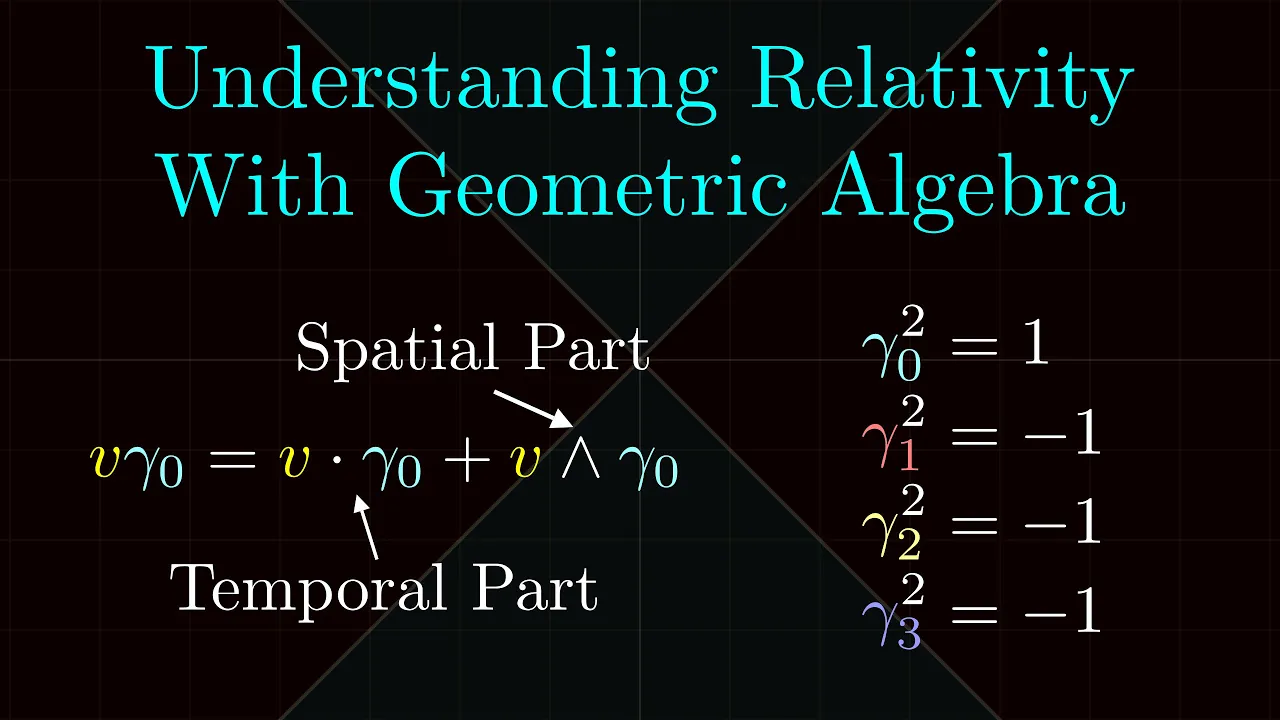
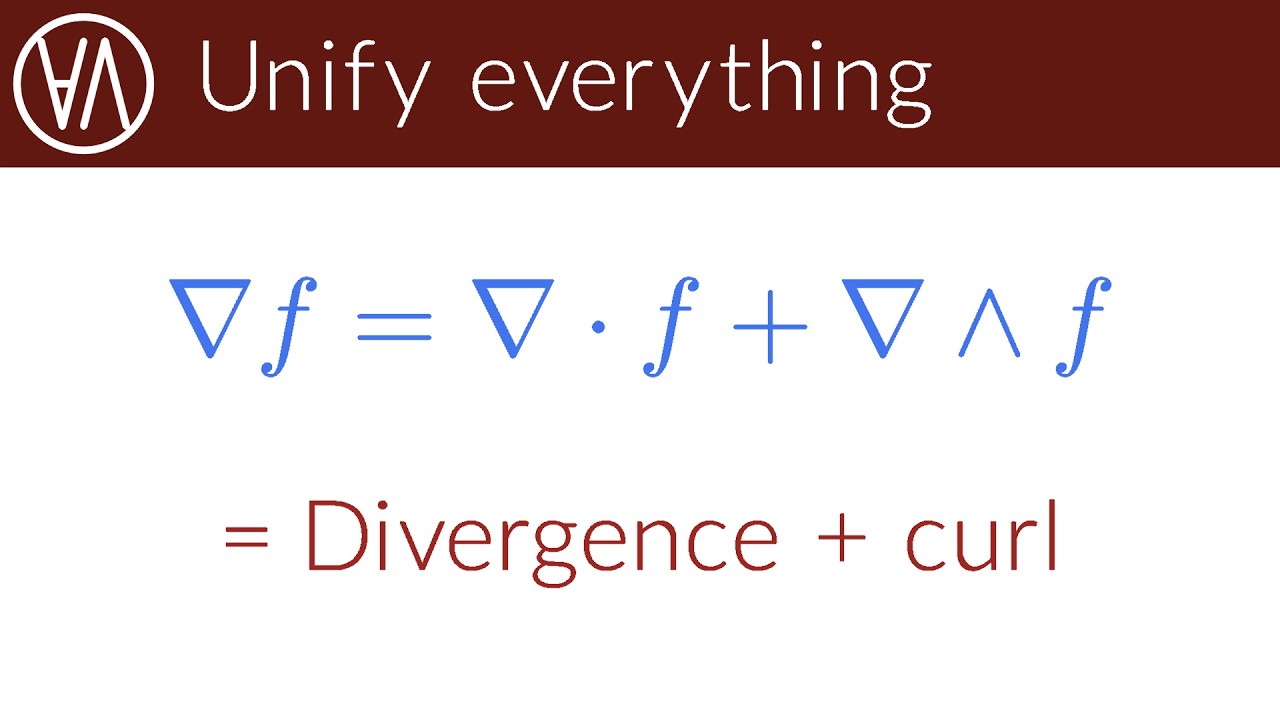








Geometric algebra is a unified mathematical language that replaces multiple specialized mathematical tools (complex numbers, quaternions, spinors, Pauli matrices) with a single framework based on the geometric product of vectors, enabling elegant descriptions of physical phenomena such as Maxwell's equations in a single equation rather than four separate ones.
Introduction to Geometric Algebra for Physics
Added:Standard linear algebra, including vector spaces, dot products, and cross products in 3D space.
Basic understanding of complex numbers and their algebraic properties.
Classical electromagnetism, specifically Maxwell's equations in their traditional vector calculus form.
An introductory concept of spatial rotations, including rotation matrices and quaternions.
Spacetime Algebra (STA) and its application to formulating Special and General Relativity.
Quantum mechanics reformulations using Geometric Algebra, focusing on spin-1/2 particles, spinors, and the Dirac equation.
Conformal Geometric Algebra (CGA) and its practical applications in computer graphics, robotics, and computer vision.
Gauge Theory Gravity (GTG), which describes gravitation using geometric algebra on flat spacetime.
999K views29.5Klikes44:23Original Release: 2020-08-18
Have you ever been confused by how many different mathematical things are used in physics?
Such as complex numbers?
Or quaternions?
How about the confusingness that is the cross product, along with its friend, the curl?
What about spinors?
Matrices?
What if I told you that all of these things and more could be replaced by one simple idea, and all it required was to understand this expression, the product of two vectors.
This video is a quick introduction to geometric algebra, an incredibly powerful mathematical language that can be used to describe almost all of physics.
Before we start, there are a few things I need to get out of the way.
First, mathematically, geometric algebra is the same as a branch of math called Clifford algebra.
The reason it has a different name is because of its emphasis.
Clifford algebra focuses on abstract mathematical and algebraic properties, while geometric algebra focuses on geometric and physical applications.
Second, there is a lot of material to cover, and a lot of this might seem complicated to you.
Don't expect to understand everything right away.
My goal here is not to show you how to do geometric algebra, but to show you what can be done with geometric algebra.
If all you get out of seeing this is a sense of how amazing geometric algebra is, I've done my job.
Third, don't worry if you don't know a mathematical reference.
To help aid you in learning these concepts, and to show you the power of geometric algebra, I will often compare parts of geometric algebra with other parts of math and physics.
Most of the time this is not actually relevant, so if you haven't heard about quaternions or the Pauli spin matrices, don't fret it when I mention them, because they're not important here.
Finally, I will admit, some things here are incorrectly simplified.
To make this easier to understand, I will not mention a few of the complications that arise when trying to formulate geometric algebra.
Any time this happens, the error is minor and should not hinder future comprehension.
Please see the description for information on what these things are.
So here's how I'm going to present the basics of geometric algebra to you.
First, we will explore basic geometric ideas.
We all know what a vector is, but there are more things than just vectors.
We will first learn about these things.
Second, we will explore various kinds of products between these things, such as the dot product.
After this, we will look at what geometric algebra actually is, and will look at it specifically in two dimensions, and then in three dimensions.
Finally, we will look at one particular application of geometric algebra to electrodynamics, where we will look at Maxwell's equation.
To start off, let's look at scalars.
We usually think of scalars as a real number, or maybe a complex number.
They can be thought of as being zero-dimensional entities.
We know how to do various things with scalars.
We know how to add them.
We also know how to multiply two scalars.
We know how to do much more with scalars, but this is enough for our purposes.
Let's talk about vectors now.
They can be thought of as one-dimensional entities, or a number with a direction.
One important property of a vector is its magnitude, or length.
Something that's interesting about vectors is that we consider any two vectors that have the same length and direction as being equal.
We consider all of these vectors to be equal.
We know how to do various things with vectors as well, such as multiplying by a scalar.
We also know how to add vectors, by putting one vector on the end of the other.
Can we multiply vectors, like we can with scalars?
We'll come back to this soon.
One final important thing about vectors: we can describe any vector in terms of some basis, which is a set of vectors that spans all of space.
For instance, given this basis, you can represent the vector as a combination of these two basis vectors.
This should be enough about vectors for now.
At this point, a pattern seems to emerge.
We have a zero-dimensional object, called a scalar.
We also have a one-dimensional object, called a vector.
Is there some kind of two-dimensional object, or maybe even more higher-dimensional objects?
Just like how vectors are an oriented line, let's think of an oriented area.
Because this is like a two-dimensional vector, we will call this a bivector.
Like vectors, bivectors have a magnitude as well.
Whereas with a vector, the magnitude was the length of the vector, the magnitude of a bivector is its area.
Just like vectors, we consider any bivector with the same area and the same orientation to be the same bivector, such as this bivector.
However, that also means that this bivector and even this bivector are all equal to each other.
We can also multiply a bivector with a scalar, which causes the area of the bivector to be multiplied by that scalar.
Like vectors, we can add two bivectors, although it may be a bit hard to picture how it could be done.
Well, you just stick them together!
Now, you might be thinking, if the shape of a bivector doesn't matter, isn't this just like a scalar, since the area is the only thing that matters?
This is similar to the case of vectors in one dimension.
In one dimension, the vector only has one direction to point, and its length is the only thing that matters.
So, bivectors get a lot more interesting when you go to higher dimensions.
Here is a bivector in three dimensions.
Here is another.
Now, even though these two bivectors have the same magnitude, they are not equal because their orientation in 3D space is not the same, just like how two vectors with the same length but different orientation are not the same.
To add the two bivectors, you can morph them into equivalent bivectors that share a side and put those sides together.
Then, the result of the addition is the bivector shown here.
Now, if adding bivectors seems confusing to you, don't worry.
In a few moments, I'll show that while the geometric picture of bivector addition may be confusing, the calculations are much simpler.
Now, just like how we can describe vectors in terms of a basis, we can describe bivectors in terms of a basis as well.
The basis that is important for us is this one shown here.
Each represents an orthogonal plane in three-dimensional space, so there are three of them.
This bivector we have been looking at has this expansion in this basis.
The nice thing about talking about bivectors in terms of a basis is that it makes adding two bivectors trivial!
You just add the components, just like you do with vectors.
Why stop with two-dimensional bivectors?
Let's make an oriented volume!
We call this a trivector.
I won't go too into detail about trivectors because they act like bivectors in many ways.
Their magnitude is their volume, and they add in a way similar to bivectors.
Of course, we can keep increasing the dimension, making 4-vectors, 5-vectors, etc., but we don't need to worry about that here.
In general, a k-dimensional vector-like object is called a k-vector.
Now that we have discovered new geometric primitives, let's determine what kinds of products we can make with these.
This will culminate in one product called the geometric product, which is the heart of geometric algebra.
To start with, we will discuss the inner product, or dot product, between two vectors.
This should be familiar to you.
The inner product is the length of the projection of one vector onto the other.
This is also equal to the product of the cosine of the angle between them and the magnitude of the vectors.
We know a few facts about the inner product, such as commutativity, distributivity, and linearity.
It is interesting to note that the inner product of two vectors is a scalar.
It's actually possible to find the inner product between a vector and a bivector, or between any kinds of k-vectors, but this can get complicated and we don't need to go into it here.
The problem with the inner product is that it doesn't give enough information about the original vectors.
Flipping one vector around the other doesn't change the inner product, and in higher dimensions, there is even more freedom.
Is there some other kind of product that can fill in the missing information?
Before we move on, really quickly, the answer is NOT THE CROSS PRODUCT!
The cross product only works in three dimensions.
Our problem still exists in two dimensions, and in higher dimensions as well.
We need to find something else.
Let's start over.
Here's two vectors.
The inner product went from vectors down a dimension to scalars, so let's try to make an outer product, represented by this wedge symbol, that increases the dimension to a bivector.
What bivector should it be?
Well, let's just make the parallelogram made by the two vectors!
What is the orientation of the bivector?
The orientation is along the direction of the first vector listed, in this case, u.
If you swapped the two vectors, the orientation would be reversed.
This means that instead of being commutative like the inner product, the outer product is anticommutative.
However, the other properties of the inner product still hold, such as distributivity and linearity.
Like the inner product, there is an equation for the magnitude of this bivector.
The difference is that instead of using the cosine of the angle, it uses the sine of the angle.
One other thing to note about the outer product is what the outer product of two parallel vectors is.
What's the parallelogram made by these two vectors?
There isn't really any.
Thus, the outer product is zero.
Moreover, the outer product of any vector with itself is zero.
You can also do the outer product between a bivector and a vector.
This makes a trivector as shown here.
Like the inner product, you can do the outer product between any kinds of k-vectors.
However, if the arguments of an outer product overlap in some way, such as two parallel vectors, the result will be zero.
One nice thing about the outer product is that it now lets us specify the bivector basis in terms of the vector basis.
The normal vector basis is shown here, above this one just to let you see both at once.
If you look at this for long enough, you can see that each unit bivector is the outer product of two of the unit vectors.
Thus, people usually represent the unit bivectors as the outer product of the unit vectors.
Now, the outer product has the same problem as the inner product, in that it doesn't give enough information about the original vectors.
Maybe we could combine the inner product and the outer product in some way... Why not just add them?
Now, there should be something nagging at you right now: the inner product is a scalar, and the outer product is a bivector.
How in the world do you add a scalar and a bivector?
Well, do we have to know?
When we use complex numbers, we don't let that stop us.
We just always add the two together even though we have no way of algebraically doing so.
Thus, I'll do the same here with scalars and bivectors.
I will also say that adding any kinds of k-vectors together is okay as well, following the same idea.
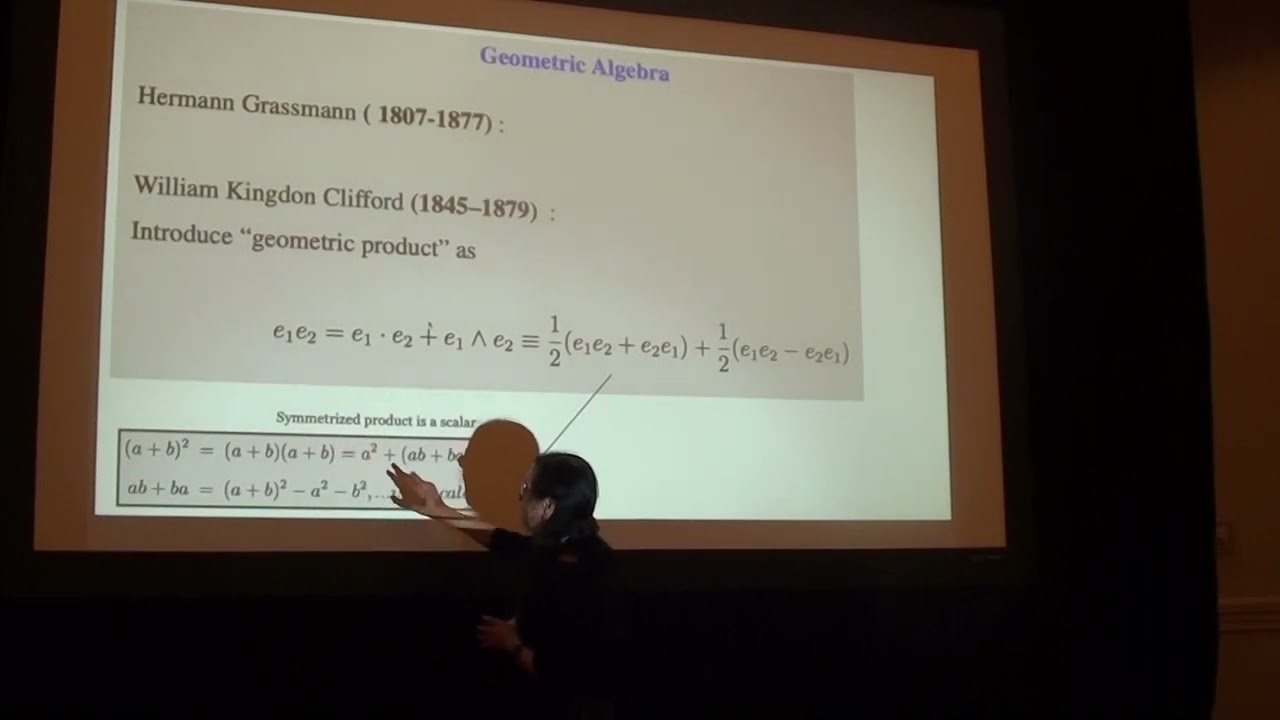
This sum of the inner and outer products is called the geometric product, and is written just like normal multiplication.
Even though this definition might seem strange and not that useful, this geometric product is the heart of geometric algebra.
To try to make sense of it, let's work with it for a bit.
First, let's consider the geometric product of a vector with itself.
We know the inner product of a vector with itself is the magnitude squared, and that the outer product of a vector with itself is zero, so a vector squared is just its magnitude squared.
This might not seem special, but consider this vector: When it is multiplied by u, it turns out that the result is one.
This means that we just found the inverse of u, and thus not only can we multiply vectors, we can divide them as well!
That's pretty neat.
Let's see what happens when you swap the order of the arguments in the geometric product.
The inner product is commutative, while the outer product is anticommutative, so here is the formula for the geometric product when the arguments are swapped.
Something interesting we can do with these two equations is to add and subtract them.
After a bit of work, we now have equations for the inner and outer products in terms of the geometric product!
Let's talk about the geometric product between the usual basis vectors next.
If we can figure out what the product does to the basis vectors, we could find the geometric product of any two vectors by writing them in terms of the basis vectors.
We already figured out what the geometric product of a vector with itself is, so the product of one of the basis vectors with itself is one.
What's the geometric product of two of the basis vectors that are different?
We know that the inner product of two orthogonal vectors is zero, so that's out.
Thus, the geometric product of two different basis vectors is simply their outer product.
Furthermore, because the outer product anticommutes, the geometric product of two different basis vectors anticommutes as well.
Because it is easier to write this way, the bivector basis is usually written as geometric products instead of outer products.
These two rules are essential for understanding the rest of the video.
We'll be using them often, so make sure you remember them.
Now, armed with the ability to find the geometric product of the basis vectors, we can write an explicit formula for the geometric product without mentioning the inner or outer products!
I will demonstrate the process on two generic 3D vectors, u and v.
We can find their product by distributing the components of the two vectors into nine terms, and then using our knowledge about the geometric product of the basis vectors to simplify.
First, any of the basis vectors squared is one, so these go away.
Next, we can swap any two of the basis vectors, at the cost of a minus sign.
Now, some parts of this are scalars, and other parts are bivectors.
Let's combine all of the scalar parts to one side and all of the bivector parts to the other.
We can also factor out the basis bivectors here to make it a bit simpler.
Thus, here is the formula for the geometric product of two vectors, but only in three dimensions.
It may seem complicated, but remember that you can always calculate it just by remembering the rules for the geometric product of the basis vectors instead of using this formula.
We can compare this formula to our original equation for the geometric product to get explicit equations for the inner and outer products in three dimensions.
Each equation contains a scalar part and a bivector part, so we can equate those to get equations for both the inner product and the outer product.
The inner product formula is nothing new, but it's nice to see that we get the right equation.
The outer product formula is new though... or is it?
Actually, this looks similar to the cross product formula!
In three dimensions, there is a simple formula relating the outer product and the cross product, which I'll get to later.
The reason the outer product is better is that it extends to more dimensions and the derivation of the formula was much more natural than the formula for the cross product.
As we'll see soon, in applications, the outer product is simpler than the cross product conceptually.
Stepping back a bit, think about the process we used to multiply the two vectors.
Would that process only work for vectors?
Maybe we can extend the geometric product to more than just vectors, and we can multiply any kinds of k-vectors!
For example, let's perform this multiplication.
Here, we're multiplying the sum of a scalar and a bivector with a trivector.
How do we do that?
The same as before!
We distribute and then use our knowledge of the geometric product of the basis vectors.
Thus, we can find the geometric product of anything, not just vectors.
Now that we have explored the geometric product, we can finally start exploring geometric algebra itself.
In linear algebra, we work with vectors.
In two dimensions, a vector has two components.
In geometric algebra, we work with multivectors.
A multivector is the sum of different kinds of vectors.
In two dimensions, the most general multivector is shown here, which has a scalar component, a, a vector component, b x hat plus c y hat, and a bivector component, d x hat y hat.
All together, a two-dimensional multivector has four components, not two.
Geometric algebra, mathematically, is the study of multivectors and the geometric product.
Our first order of business here in this two-dimensional land is to think about the bivectors.
As we discussed earlier, in two dimensions, bivectors are kind of stupid.
They only have one component, so they seem like scalars.
As we'll see in a moment, they do have a few differences, so we'll call them pseudoscalars.
We wil also give the unit pseudoscalar, x hat y hat, a new name: i.
What's so special about i?
And what makes it different from normal scalars?
The main distinguishing feature is how it multiplies with other objects.
Let's consider multipyling a vector by i.
Consider this vector, which is 2 x hat plus 3 y hat.
What happens if we multiply this by i?
We can work out the algebra of the product like usual.
In the end, multiplying by i ended up rotating the vector by a right angle.
Remember that the geometric product is not necessarily commutative, so let's see what happens if we multiply by i on the left.
So, multiplying by i on the left ends up rotating the vector by a right angle again, but this time in the opposite direction.
Now that we've seen how multiplying vectors by i works, let's consider multipyling i by itself.
We can calculate this product just like any of the other previous ones.
So, i squared is negative one.
Wait a second... This equation looks familiar!
Yes, it turns out that imaginary numbers are actually pseudoscalars!
This is why i is used to represent the unit pseudoscalar.
Also, complex numbers are equivalent to the 2D multivectors that are the sum of a scalar and a bivector.
In fact, the geometric product of two of these multivectors is the same as the product between complex numbers!
In addition, as we saw earlier, multiplying a vector by i is the same thing as multiplying a complex number by i.
This fact holds in general, and multiplying a vector by a complex number acts like complex multiplication, rotating and scaling the vector.
This actually makes for a very simple way to perform rotations.
Say you want to rotate a vector v by an angle theta.
All we need to do is find the complex number that represents this rotation.
If you know your complex numbers, you know that this is e to the i theta.
Now, you might be freaking out about the fact that we're raising a number to a bivector power, but remember, bivectors are imaginary numbers, so we can raise a number to a bivector power the same way that we raise a number to an imaginary power.
Multiplying by this value rotates the vector by theta.
We can also try multiplying on the other side.
When we multiply on the left by e to the i theta, it ends up rotating the vector in the other direction, again by an angle of theta.
Remember that with complex multiplication, multiplying by the conjugate rotates in the opposite direction.
Thus, when multiplying a vector by a complex number on the right, it is the same as multiplying it on the left by the complex conjugate.
Now that we know what complex numbers are like in geometric algebra, let's return to the geometric product of two vectors.
Wait a minute, this is the sum of a scalar and a bivector, which together is a complex number!
What rotation does this represent?
Well, remember that much earlier, we found that the inner product is related to the cosine of the angle between the vectors, and that the outer product is related to the sine of the angle between the vectors.
After doing a little algebra, we find that the rotation specified by the product of two vectors is precisely the angle between the vectors!
It also scales by their magnitudes as well.
This finally gives us a concrete view of the geometric product of two vectors: it represents the action of rotating by the angle between them, and scaling by their magnitudes.
This gives us a new way to calculate rotations that doesn't even involve complex exponentials, sines, or cosines!
Say you wanted to rotate a vector w by the angle between two other vectors, u and v.
We just learned that the product of u and v is this rotation, in addition to scaling by the magnitudes of u and v.
However, if we normalize u and v, the scaling will go away.
Thus, the rotated vector is precisely w u hat v hat.
One final thing: consider the equation that we had found earlier for swapping the vectors in the geometric product: This equation is the same as when the vectors weren't swapped, except that the imaginary part is negative.
Wait a minute, this is actually the complex conjugate!
Swapping the order of two vectors is the same as finding the complex conjugate.
In addition, we found earlier that multiplying a vector on the right by a complex number is the same as multiplying on the left by its conjugate.
We can combine these two equations to determine that reversing the order of the product of the three vectors doesn't change it, and they both perform the same rotation on w.
Now, a word of warning: all of this was geometric algebra in two dimensions.
In higher dimensions, things work similarly, but a few things are slightly different.
Now, if you thought that the craziness was over, you are mistaken.
In two dimensions, we happened to describe complex numbers in the process.
In three dimensions, there is much, much more that some of us might recognize.
Let's go there next.
Two-dimensional geometric algebra looked at multivectors in two-dimensional space, which were composed of a scalar part, a vector part, and a bivector part.
In three-dimensional geometric algebra, we will look at multivectors in three-dimensional space, which have a scalar, vector, and bivector part like two-dimensional multivectors, but now there is a trivector part as well.
In two dimensions, the vector part had two components and the bivector part had one component, making for a total of four components in each multivector.
In three dimensions, the vector part has three components, the bivector part now has three components as well, and the trivector part has one component.
Thus, in a three-dimensional multivector, there are actually eight components.
Three-dimensional geometric algebra studies these objects.
Just like with bivectors in two dimensions, trivectors in three dimensions are kind of stupid, and again act somewhat like scalars.
In three dimensions, the trivectors are called the pseudoscalars, and the bivectors no longer have that name.
The unit pseudoscalar here is still called i.
Like before, i squared is negative one, so the trivectors can be thought of as the imaginary numbers.
However, in this case, they don't represent rotations.
What properties do the pseudoscalars have here?
First, in three dimensions, it turns out that i commutes with any multivector!
This fact is very useful, and it makes manipulating equations much simpler.
Let's now look at the product of vectors with i.
We can expand out the definition of i, the two xs cancel, and the result is a bivector.
This actually always works out this way, so that the product of a vector and i is a bivector.
But what bivector is it?
Let's look at the vectors and bivectors involved.
Looking at this picture, you can see that the vector x hat and the bivector y hat z hat are perpendicular to each other.
In fact, if you look at the orientation of everything involved, you'll notice that it follows the right hand rule, such that if you curl your fingers around the orientation of the bivector, your thumb will point in the direction of the vector.
In fact, this is true for any vector!
Also, if we multiply both sides of the equation by i, we see that multiplying a bivector by i turns it into a vector, but in accordance with the left hand rule because of the minus sign.
In fact, because bivectors can be represented by its normal vector in three dimensions, some people write a general 3D multivector like this, where it is just in terms of vectors and scalars.
I don't like it so much conceptually because you are confusing vectors with bivectors, but I'll use this notation at times because it is standard.
Actually, because vectors and bivectors are similar in three dimensions, some people call bivectors pseudovectors.
More on that in a moment.
First, I need to bring up something I mentioned earlier.
We found previously that in three dimensions, the outer product can be calculated in terms of components according to this formula.
The cross product can be found according to this formula.
These equations are very similar, except that one produces a vector, and the other produces a bivector.
Well, we just learned how to simply turn a vector into a bivector, and in fact, the outer product is simply i times the cross product!
You might be thinking, "Oh cool, so we don't really need the outer product if we can express it in terms of the cross product."
I would say it's the other way around: we don't need the cross product, and in fact, we have been held back by the cross product.
Every time we see a cross product in a physics equation, it should produce a bivector, not a vector.
For example, consider torque.
If you are pushing something with a force f to rotate it at a radius r, the torque is traditionally defined to be the cross product of these two vectors.
This causes the torque to point in a ridiculous direction that has nothing to do with the rotation.
Now watch what happens when the cross product is changed to an outer product.
In this case, the torque is this bivector.
We already know that bivectors represent rotations, so now the torque is a rotation object (as it should be), and it is oriented in the direction of rotation!
This is much better than representing torque as a vector that's not even in the plane of rotation.
Some of you may have gotten upset at me for using the terms "pseudovector" and "pseudoscalar" when they are already used in physics in another way.
Well, they're actually the same thing!
Every pseudovector in traditional terminology, such as angular momentum and the magnetic field, is actually a bivector, and every pseudoscalar in traditional terminology, such as magnetic flux, is actually a trivector.
The only reason we have been confusing them is because of a mathematical pun: the fact that the vector and pseudovector bases and the scalar and pseudoscalar bases have the same size.
Let's look at the product of the basis vectors.
We could leave these products as is, but these are bivectors, and we know that bivectors can be represented as i times a vector.
Let's figure it out.
We can multiply by a unit vector twice anywhere we want because that is equal to one.
After swapping around a couple of the vectors in the third equation, we see that each equation has x hat y hat z hat, or i.
So these are the products of the basis vectors.
Wait a second... Along with the fact that each basis vector squared is one, This is exactly the equations that define the Pauli spin matrices!
Using the fact that the Pauli spin matrices are actually just the unit vectors in disguise, geometric algebra brings about a great number of simplifications to the mathematics of quantum mechanics, and it actually starts looking more similar to classical mechanics when rephrased in terms of geometric algebra.
Let's look at the basis bivectors next.
First off, like in two dimensions, all unit bivectors square to negative one.
What's the product of all of them?
Well, the y's cancel and the rest is just a unit bivector squared, so the result is negative one.
Wait a minute... This is the equation that describes quaternion multiplication!
In three dimensions, a scalar plus a bivector is a quaternion, when in two dimensions it was a complex number.
The last thing we'll do here is look at three dimensional rotations.
I never felt good about three dimensional rotations until I learned the way to do it in geometric algebra.
It is similar to the two dimensional case, but there are a couple extra hiccups.
Let's start simple.
We want to rotate this vector by 90 degrees around the z axis.
For reference, the components of the vector we are trying to rotate from and the vector we are trying to rotate to are shown here in the bottom left.
Notice that only the x and y components change; the z component doesn't change at all.
Now, rotating around the z axis is the same as rotating in the xy plane.
We already handled rotating in the xy plane back when we were looking at two dimensions.
Thus, at first glance, it would seem that multiplying this by x hat y hat, which was i in that case, will rotate the vector.
Let's see what happens.
Well...it almost worked.
The x and the y coordinates got rotated correctly, but the z coordinate got turned into this trivector.
Let's try something else.
Remember how in two dimensions, multiplying on the left by the complex conjugate still did the same rotation?
Maybe this equation is mostly correct in three dimensions, except that the trivector won't pop up.
Remember that the complex conjugate is the same as swapping the vectors, so the conjugate of x hat y hat is y hat x hat.
Let's try using this equation instead to rotate.
Darn it, the same thing happened.
Well, almost the same thing.
The x and the y coordinates rotated correctly again, but the z coordinate got turned into a trivector again.
However, notice that the orientation of the trivector is the opposite of what it was last time.
Wait a minute... If the z component was messed up in opposite ways in each case, maybe if we apply both at once, the problem will go away!
I won't go through all the details, but here's the result.
The z component is correct!
Success!
Oh wait a minute... The x and y got messed up!
Oh, of course they did.
We rotated twice.
However, this is a great way to do a 180 degree rotation.
Let's look at this a bit closer and we may find a way to fix this last issue.
We know that x hat y hat is really just a quarter turn in the xy plane, so we can write it as a complex exponential.
If you think this equation looks funny, remember that x hat y hat works just like imaginary one, so we can calculate this like we do with complex numbers.
In the end, we did this quarter turn twice, making for a total rotation of one half turn.
Well, if we want the final rotation to be a quarter turn, let's just cut all the angles in half!
Let's try using an eigth of a turn for rotating instead of a quarter of a turn and see what happens.
Remember that on the left you need to use the conjugate.
There's a lot of tedious calculations in here that I'm going to skip, but this works!
That may have all seemed really complicated, but the gist of it is simple: To rotate a vector v by an angle theta in the plane I, where I is the unit bivector in that plane, You use the complex exponential with half of the angle.
The angle is cut in half because we have to rotate twice.
When used to represent a rotation in this way, this value is called a rotor.
Something nice about this equation is that it works in any dimension!
Notice one interesting thing about rotors: As we increase the angle of the rotation, the rotor doesn't spin as fast as the vector.
In fact, once we have completed a whole rotation, the rotor has only gone through half a rotation!
This is because the rotor is applied twice to the vector.
If we wanted to bring the rotor through a full rotation, we would have to do another rotation on the vector.
Wait a minute... This looks like a spinor from quantum mechanics!
The way that spinors rotate is always said to be a part of so-called quantum weirdness, but in fact, it's just based on the fact that the best way to represent rotations involves applying the rotation twice.
I could keep going about rotations, but I'll stop here.
When you see people talking about geometric algebra, you may see descriptions such as "a unified mathematical language for the whole of physics" or "the most powerful and general language available for the development of mathematical physics".
I was a bit skeptical when I first heard these claims.
Sure, it's a nice mathematical tool that I'll keep in my toolbelt, but it can't be THIS good.
However... my viewpoint changed entirely when I saw what geometric algebra did to Maxwell's equations.
For future reference, here are Maxwell's equations.
There are other ways to formulate Maxwell's equations, but this is the most well-known version.
Some of the other ones are simpler than this, but oftentimes they just hide the complexity in notation.
Okay, the geometric algebra version I am about to present might seem like it hides the complexity in notation as well, but I would argue that each new bit of notation makes perfect sense.
First, let's consider the differential operators included in Maxwell's equations.
There are two of them: The partial derivative with respect to time, and the gradient, which is the sum of the partial derivatives with respect to space.
We know from relativity that space and time are related, so it would be useful to combine these two operators.
Well, in geometric algebra, we can add scalars and vectors, so why not just add them?
Before you get confused by my use of the gradient symbol again, notice that the spacial gradient has a vector arrow, while the more general gradient does not.
One issue with this equation is that the units don't quite work out.
We can fix this by adding a factor of the speed of light to the time derivative.
Doing this may seem familiar if you've worked with relativity enough.
This combination also makes sense because we now just have the sum of four derivatives, so in the end it's pretty similar to the traditional gradient.
Next, let's consider the sources that create electric and magnetic fields.
There are two of them: The charge density, and the current.
It would be useful to combine these as well.
Just like before, we can just add them.
Actually, subtract them.
Don't worry about the minus sign.
Just like before, I used the same letter for both the vector part and the whole value.
Again, the current has a vector arrow, while the more general source does not.
This equation also has some units issues, which can again be fixed by adding a factor of c to the charge density.
Again, this combination is seen in relativity, so it's nothing new in physics.
It also gives an interesting interpretation of charge density as a current that is moving through time instead of space.
Finally, we want to combine the electric and magnetic fields in some way that makes sense.
Unlike before, we can NOT just add them.
The issue here is that both the electric field and magnetic field are vectors, and so their components mix.
However, remember that the magnetic field is usually defined through a cross product.
Thus, the magnetic field should actually be a bivector, not a vector.
Thus, our electromagnetic field will be the electric field plus the unit trivector, i, times the magnetic field.
Remember that i turns a vector into a bivector.
We have a unit problem again, but we can fix that with another strategically placed factor of c.
Some people actually call c B the magnetic field, so this factor of c is not too strangely placed.
This combination of the electric and magnetic fields should make sense.
The electric field is a vector, the magnetic field is a bivector, and this is the simplest way to combine them.
Anyway, we now have everything we need to describe Maxwell's equations with geometric algebra.
Are you ready?
That's it.
This is Maxwell's equation.
Not equations, plural, but equation, singular.
This one simple equation describes all electromagnetic phenomena.
And remember, we did not set out to get here.
We initially just wanted to multiply vectors, and the natural progression of things led us here.
Okay, I will admit, I cheated a bit.
This equation is using natural units.
In SI units, the equation changes slightly with a couple constants.
But still, this equation is incredibly simple.
To show that this is equivalent to the traditional set of four equations, first, we can expand out all of the definitions we made earlier.
Next, we can distribute this product on the left.
These two terms involving the gradient can be expanded in terms of our original definition of the geometric product.
This seems like a monster at this point, but by moving a few things around, something can be salvaged.
If you look at this equation, you can see that on the left-hand side, there is a scalar part, a vector part, a bivector part, and a trivector part, and on the right-hand side, there is a scalar part and a vector part.
There is also a bivector and trivector part on the right-hand side as well, but they are both zero.
For the whole expression to be equal, the scalar parts must be equal, the vector parts must be equal, and so on.
Thus, from this equation, we can make four new equations.
The first equation is Gauss' law!
In the second equation, let's deal with these constants.
First, divide everything by c.
c^2 is related to the electromagnetic constants, so we can substitute.
We can use the equation found earlier relating the outer product to the cross product, rearrange, and cancel the negatives.
We now have Ampere's law.
For the third equation, all we have to do is write the outer product in terms of the cross product, cancel the i, then rearrange.
We now have Faraday's law.
Finally, for the last equation, we can just cancel i c to get the last of the four equations.
Thus, the original equation is in fact equivalent to Maxwell's equations.
Now, you may be thinking, "okay, that's a nice looking equation, but you can't solve it in that form, right?
You would have to convert it to our old way to solve it!"
On the contrary, you can solve it in this form, and it's much easier!
The geometric product acts like normal multiplication in enough ways that you can do calculus with it.
Differential equations of this form can be solved through the use of a Green's function, if you've heard of them.
Here is a concrete, simple example.
Imagine that we are solving the equation for electrostatics in two dimensions, and consider some region R with no sources inside.
Then, when you work out the math of finding the Green's function and all that, the solution you get is this, which just so happens to be the Cauchy integral formula from complex analysis!
Okay, fine, I picked this simple case just to show that you get the Cauchy integral formula, but still, this method is very general and works for many cases, even in three dimensions.
It makes it much easier to get analytic solutions to Maxwell's equation.
The more I study geometric algebra, the more I start to agree with the quotes I showed earlier.
Geometric algebra should be the universal language of physics.
Not using it is like trying to use English words to speak Chinese.
I hope you have seen the reasons for this throughout the video.
First, geometric algebra is powerful.
It can be used to represent basically anything we want it to in physics.
Second, geometric algebra is simple, at least compared to the alternatives.
Third, because of the first two, geometric algebra makes connections between topics that previously seemed unrelated.
By being both simple and powerful, it is able to show how two different things, such as quaternions and spinors, are actually two sides of the same coin.
It also reveals many similarities between classical and quantum mechanics.
Fourth, geometric algebra makes many other things unecessary.
We wouldn't have to learn about complex numbers, quaternions, spinors, Pauli spin matrices, and more if we used geometric algebra.
This would make teaching significantly easier.
Finally, geometric algebra simplifies almost everything it touches.
I don't think you have to look any further than Maxwell's equation for evidence for that one.
If physicists started using geometric algebra for more things, I am sure that we would see huge advancements in our scientific knowledge.
Up Next
51:15
Why Can't You Multiply Vectors? (Explained with Geometric Algebra)
@acegikmo
501.3K views•2023-10-26
51:00
Conformal Geometric Algebra Explained: Lines, Spheres & Inverse Kinematics
@bivector
1.5K views•2024-09-05

54:37
Projective Geometric Algebra Explained: A Swift Introduction
@sudgylacmoe
112.9K views•2023-08-13

6:00
The Mathematical Impossibility of Accurate World Maps
@Vox
23.3M views•2016-12-02
Related Study Plans & Knowledge Roadmaps
Structured learning paths in Mathematics
mathematics
Tensor Calculus: Vectors to Riemann Curvature
01Mathematical Foundations: Linear Algebra & Calculus
02Covectors, Dual Spaces, and Tensor Basics
03The Metric Tensor and Index Gymnastics
+ 2 more learning modules
40h5 modules
Explore Roadmap
mathematics
Gödel's Incompleteness: Logic, Proofs & Limits
01Introduction to Formal Systems & Hilbert's Dream
02Set Theory, Cardinality, and Cantor's Diagonal Argument
03Arithmetization and Gödel Numbering
+ 2 more learning modules
14h5 modules
Explore Roadmap
mathematics
Galois Theory: Fields, Groups & Solvability
01Foundations of Abstract Algebra: Groups & Fields
02Polynomials & Field Extensions
03Splitting Fields & Symmetries
+ 2 more learning modules
24h5 modules
Explore Roadmap
mathematics
Non-Euclidean Geometry: Models & Geodesics
01Euclid's Fifth Postulate and the Birth of New Geometries
02Hyperbolic Space and the Poincaré Disk Model
03Geodesics: Defining Straight Lines in Curved Spaces
+ 2 more learning modules
15h5 modules
Explore Roadmap