Galois Theory: Fields, Groups & Solvability
Learning Goal: Galois Theory: Building the mathematical journey from polynomial equations and field extensions to automorphism groups and the insolvability of the quintic.
Galois Theory is one of the crown jewels of modern mathematics. It builds a beautiful bridge between two seemingly distinct fields: field theory (the study of number systems where addition, subtraction, multiplication, and division are possible) and group theory (the study of symmetry). This curriculum will guide you through this mathematical landscape, starting from the basic foundations of abstract algebra and culminating in the profound proof of why there is no general formula to solve quintic (fifth-degree) equations.
Prerequisites
- Basic Linear Algebra: Familiarity with vector spaces, bases, and dimension.
- Introductory Algebra: Solid command over polynomial arithmetic and factoring.
Estimated Study Time
- Total Time: 24 hours (includes video viewing, conceptual digestion, and problem-solving).
Module 1: Foundations of Abstract Algebra: Groups & Fields
Before exploring how fields and groups interact, we must master each structure independently. This module introduces the fundamental structures of abstract algebra: fields (where we compute) and groups (where we study symmetry, specifically the permutation of elements using the symmetric group ).
Video Lessons

This highly intuitive video introduces the definition of a group using symmetrical operations and movements. It shifts the perspective of algebra away from symbol manipulation and toward studying patterns, structures, and behaviors.
Knowledge Checkpoint
- Understand the four fundamental observations of group actions (closure, associativity, identity, and invertibility).
- Recognize group structures in physical symmetries, music, nature, and puzzles.
A masterclass in abstract structures, this video explains what a field is by unpacking its dual-group nature: a field must form a commutative group under addition, and its non-zero elements must form a commutative group under multiplication, connected by the distributive property.
Knowledge Checkpoint
- State the definition of a field and explain its 11 foundational axioms.
- Distinguish why the integers () do not form a field, while the rationals () do.

This video covers the symmetric group , which is the collection of all bijective mappings (permutations) of a set of elements to itself. Symmetries of roots in a polynomial will ultimately live inside this group.
Knowledge Checkpoint
- Explain why the order of the symmetric group is exactly .
- Compute simple composition operations within the symmetric group .
Module 2: Polynomials & Field Extensions
This module covers field extensions, the Tower Law, and minimal polynomials. To find roots of polynomials that do not exist in our base field (like over ), we must "adjoin" elements to build larger fields.
Video Lessons

Fields medalist Richard Borcherds delivers a lecture on field extensions (), explaining how larger fields behave as vector spaces over their subfields. He carefully delineates the vital difference between algebraic elements (roots of polynomials) and transcendental elements.
Knowledge Checkpoint
- Define what a field extension is and explain how can be treated as a vector space over .
- Explain the difference between algebraic and transcendental elements.

This video demonstrates how to find the minimal polynomial of an algebraic element over the rational numbers. It provides a practical, step-by-step method to isolate the element and build an irreducible monic polynomial.
Knowledge Checkpoint
- Define the "minimal polynomial" of an algebraic element.
- Given an algebraic number like , construct its minimal polynomial over .

This video proves the linear independence of the combined basis elements in the Tower Law (). It shows how degrees of field extensions multiply transitively when stacking extensions.
Knowledge Checkpoint
- State the Tower Law for a tower of fields .
- Prove that if is a basis for over , and is a basis for over , then the set of products is linearly independent over .
Module 3: Splitting Fields & Symmetries
To analyze a polynomial completely, we must construct a field that contains all of its roots. This is called the splitting field. However, to establish the bridge to group theory, these extensions must behave nicely. This module covers splitting fields, normal extensions, and the critical concept of separability (where polynomials have no repeated roots).
Video Lessons

This video provides a direct, algebraic introduction to constructing splitting fields by successively adjoining all roots of a polynomial until it factors completely into linear terms.
Knowledge Checkpoint
- Define a "splitting field" of a polynomial over .
- Explain why the splitting field of over is , while the splitting field of must contain complex roots.
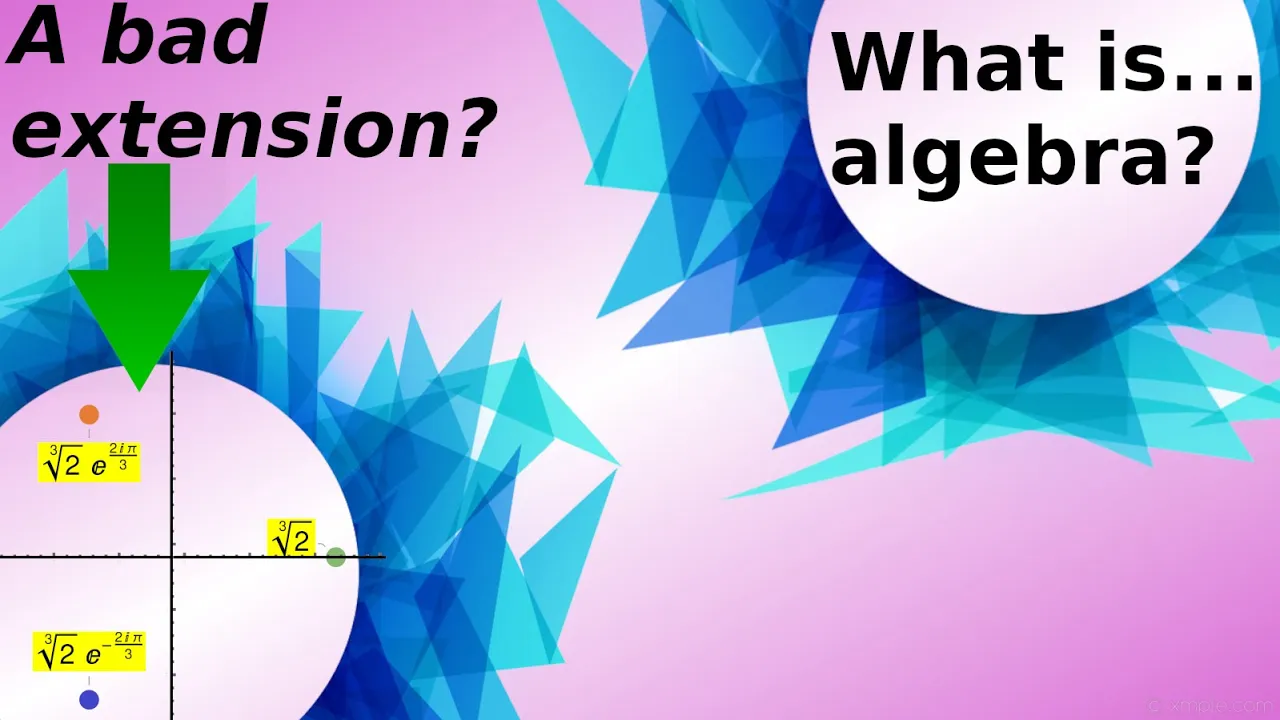
A highly-detailed look at normal and separable extensions. Normal extensions ensure that if an irreducible polynomial has one root in the field, it must split completely there. Separable extensions ensure we do not deal with redundant repeated roots. Together, these properties define a Galois extension.
Knowledge Checkpoint
- Define a normal field extension.
- Define a separable field extension.
- Explain why the field extension is separable but not normal.
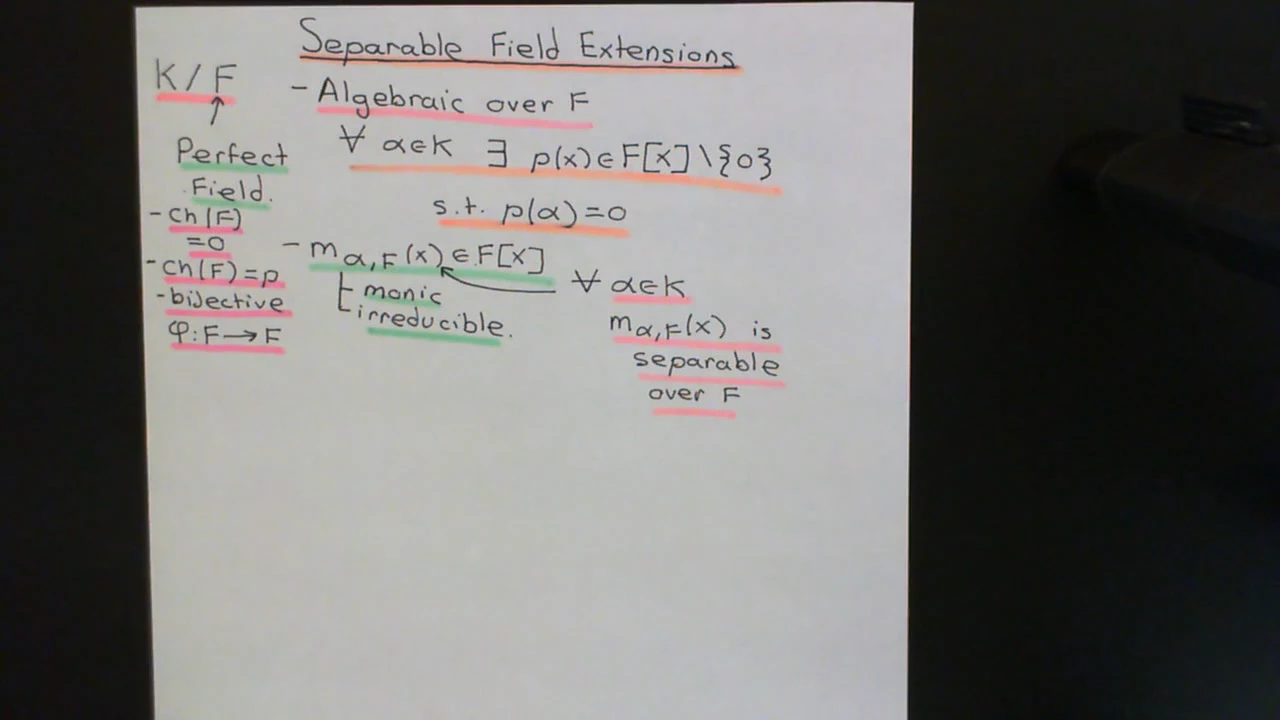
This video explains why separability is rarely an issue in characteristic 0 (like or ) but becomes critical in finite fields of characteristic . It shows how minimal polynomials of elements are defined as separable.
Knowledge Checkpoint
- Explain why every algebraic extension of a field of characteristic 0 is automatically separable.
- Define a separable polynomial and explain what a "separable element" means.
Module 4: The Galois Group & Fundamental Theorem
With the building blocks of field extensions and symmetries established, we can now define the Galois Group—the group of automorphisms of a field extension that fix the base field pointwise. This module culminates in the Fundamental Theorem of Galois Theory, which proves a 1-to-1 correspondence between intermediate subfields and subgroups of the Galois group.
Video Lessons
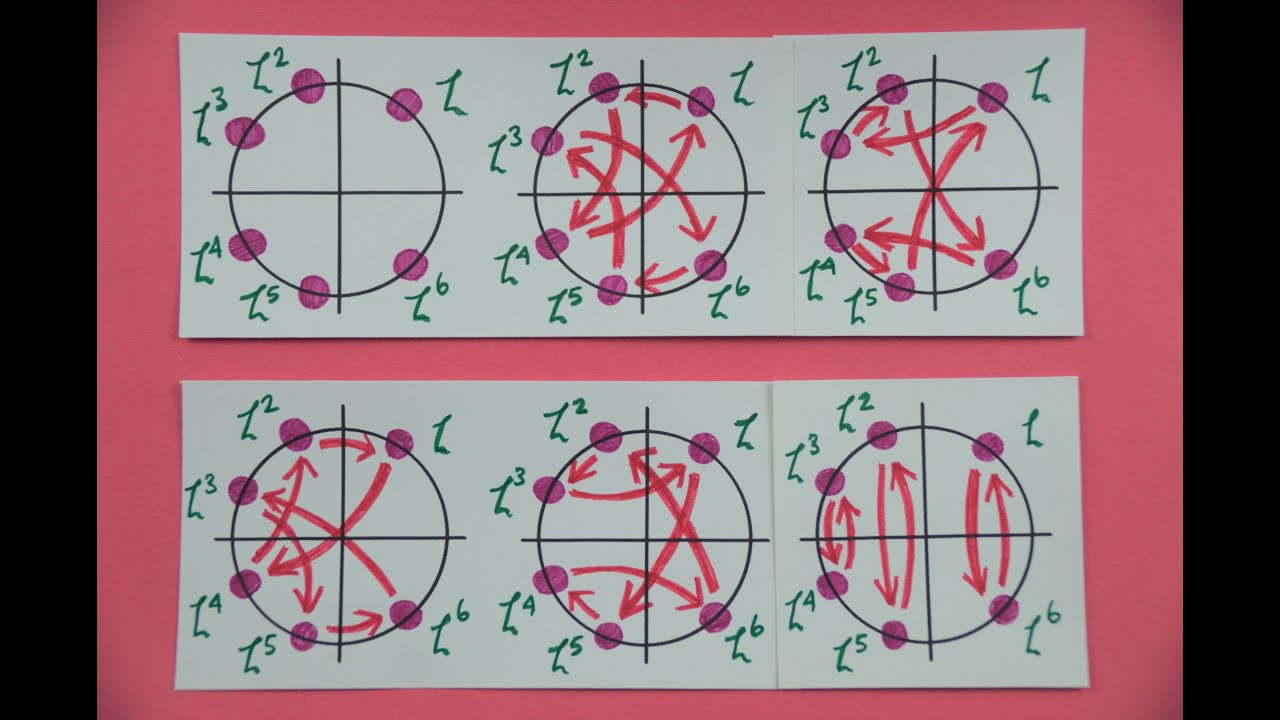
This video explains the intuition behind the Fundamental Theorem of Galois Theory. It showcases how symmetries in fields form a group, and how finding subgroups lets us systematically dissect intermediate field structures.
Knowledge Checkpoint
- Explain how a field automorphism "scrambles" the roots of a polynomial while preserving the underlying arithmetic structure.
- Define the Galois group of an extension.
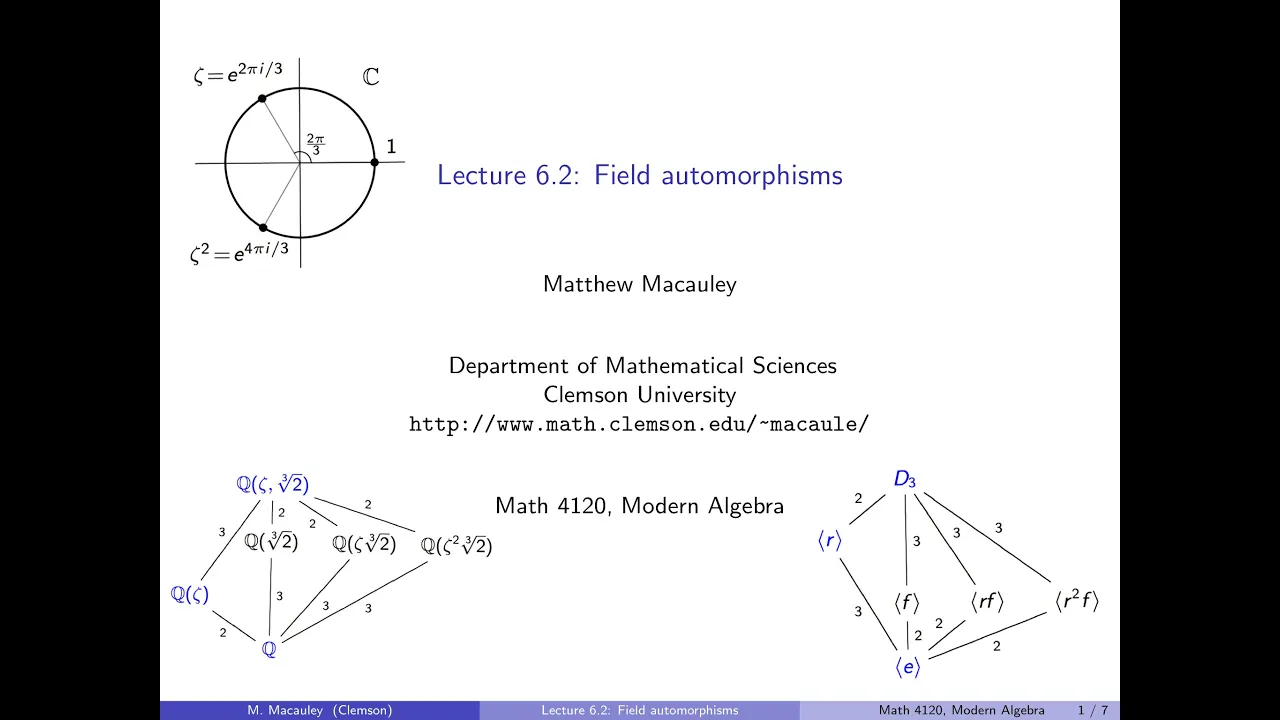
This short, visual presentation maps out the subgroup lattice of a Galois group and shows how it perfectly matches (but in reverse order) the subfield lattice of its splitting field.
Knowledge Checkpoint
- Draw the subgroup lattice of the dihedral group alongside the subfield lattice of the splitting field of over .
- Understand the "inclusion-reversing" nature of the Galois correspondence.
Professor Borcherds provides a proof of the Fundamental Theorem of Galois Theory, walking through intermediate field correspondences and explaining why normal subgroups correspond directly to normal intermediate extensions.
Knowledge Checkpoint
- State the Fundamental Theorem of Galois Theory in its entirety.
- Explain why a subfield extension over is normal if and only if its corresponding Galois subgroup is a normal subgroup of .
Module 5: Solvability by Radicals & The Quintic
This module connects Galois groups to the solvability of polynomials. You will study "solvable groups" and see why the symmetric group breaks the chain of solvability, proving why a general algebraic formula for the quintic cannot exist.
Video Lessons

This lecture introduces solvable groups. A group is solvable if it has a composition series with cyclic factors of prime order. This is the exact group-theoretic equivalent of being able to extract nested roots (radicals) in field extensions.
Knowledge Checkpoint
- Define a solvable group using subnormal series.
- Explain why all finite abelian groups are solvable, but the symmetric group is not (due to the simple alternating group ).

This video outlines the proof of Abel's theorem: that a polynomial is solvable by radicals if and only if its Galois group is a solvable group. This is the bridge that translates an algebraic insolvability problem into a group-theoretic proof.
Knowledge Checkpoint
- Explain how adjoining a radical to a field corresponds to building an abelian extension.
- Describe the chain of radical extensions required to solve a polynomial equation.

A visual and conceptual summary of how the Galois group converts equations into symmetry structures. It demonstrates that since the Galois group of a general quintic is —which is not a solvable group—there cannot be any formula made of nested roots and basic arithmetic that solves it.
Knowledge Checkpoint
- Explain why the insolvability of implies the insolvability of the general quintic equation.
- Contrast the quintic with quadratic, cubic, and quartic formulas, highlighting where the chain of solvability breaks down.

For students seeking alternative viewpoints, this video provides a topological perspective on why the quintic formula does not exist. It examines loops in the complex coefficient space and shows how winding roots around branch points mirrors the algebraic structure of commutator subgroups.
Knowledge Checkpoint
- Connect the algebraic "commutator subgroup" concept to the topological paths of roots moving in the complex plane.
- Explain how nested radicals act as multi-sheeted Riemann surfaces that fail to resolve the branching symmetries of 5 roots.
Course Map
Key People Index
- Évariste Galois (1811–1832): A French mathematician who, before dying in a duel at age 20, laid the foundations of group theory and connected it to the theory of polynomial equations.
- Niels Henrik Abel (1802–1829): A Norwegian mathematician who independently proved that the general quintic equation cannot be solved by radicals, working alongside Ruffini to establish the Abel-Ruffini theorem.
- Richard E. Borcherds: A British mathematician and Fields Medalist (1998) whose graduate-level lectures on Galois Theory provide the core rigor for this curriculum.
- Scipione del Ferro (1465–1526): An Italian mathematician who solved the depressed cubic equation, triggering the historical quest to solve higher-degree polynomials.
Final Self-Assessment
Review this comprehensive list of advanced concepts. If you can confidently explain and complete each checkmark, you have mastered undergraduate-level Galois Theory:
- Axiom Mastery: Can you write down all the defining axioms of a Group and a Field from memory?
- Algebraic vs. Transcendental: Can you prove why is transcendental over , whereas is algebraic?
- The Tower Law: Given extensions , can you state and apply to find the degree of over ?
- Minimal Polynomial Construction: Can you construct the minimal polynomial of over ?
- Normal Extensions: Can you explain why the extension over is not normal, and identify its normal closure?
- Separability: Why is a polynomial with repeated roots in its splitting field considered "inseparable," and under what field characteristics does this occur?
- Galois Group Calculations: Can you calculate the order of the Galois group for over ? What group is it isomorphic to?
- Galois Correspondence: Can you describe the bijective, inclusion-reversing correspondence between the subfields of the splitting field of and the subgroups of ?
- Group Solvability: Why is not a solvable group? What is the role of the normal subgroup in this proof?
- The Quintic Proof: Can you explain how Abel's theorem translates the impossibility of solving the general quintic equation into a statement about the unsolvability of the group ?