The symmetric group S_n is the set of all one-to-one and onto mappings (bijections) from a set containing n elements to itself, forming a group under composition. The order of S_n is n factorial (n!), meaning it contains n! distinct elements. For example, S_1 has order 1 (only the identity), S_2 has order 2, and S_3 has order 6.
Symmetric Group in Group Theory: A Complete Guide
Added:Deep Dive
The foundational definition of a group, including the four key axioms: closure, associativity, identity, and invertibility.

Visual Group Theory Lecture 1.1: What Is a Group? Rubik's Cube Intro
200.4K
A group is formally defined as a set of actions satisfying four axioms: (1) There is a predefined list of actions that never changes (closure under combination); (2) Every action is reversible (existence of inverse elements); (3) Every action is deterministic (associativity of operations); (4) Any sequence of consecutive actions is also an action (closure under composition). These axioms provide the foundational rules for studying groups.
Click to watch →

Definition Gruppe
102.3K
A group must satisfy four axioms: (1) Closure: For all a, b in G, a ∘ b is in G. (2) Associativity: (a ∘ b) ∘ c = a ∘ (b ∘ c) for all a, b, c in G. (3) Identity Element: There exists an element N such that a ∘ N = N ∘ a = a for all a in G. (4) Inverse Elements: For every a in G, there exists a⁻¹ in G such that a ∘ a⁻¹ = a⁻¹ ∘ a = N. Natural numbers with addition satisfy closure, associativity, and have identity 0, but fail the inverse axiom. Integers with addition satisfy all four axioms.
Click to watch →

What is Group Theory? — Group Theory Ep. 1
1.2M
A group is defined by four axioms: (1) Closure - combining any two group elements produces another element within the group; (2) Associativity - the order of operations does not matter when combining three elements; (3) Neutral element (identity) - there exists an element e such that operating it with any other element leaves that element unchanged; (4) Inverse element - every element has a corresponding inverse that, when combined with the original element, returns the neutral element. These axioms provide a general framework that applies to many mathematical structures including integers under addition, rational numbers under multiplication, and symmetry transformations.
Click to watch →

Was ist eine Gruppe? - Mathematik
8.4K
A group must satisfy four fundamental axioms: (1) Closure - when you apply the binary operation to any two elements in the set, the result must also be an element of the set; (2) Associativity - the way elements are grouped during operations does not affect the result, i.e., (a*b)*c = a*(b*c); (3) Identity Element - there exists an element e in the set such that combining it with any element a gives back a (a*e = e*a = a); (4) Inverse Element - for every element a in the set, there exists an element b such that combining a and b yields the identity element (a*b = b*a = e).
Click to watch →

Abstract Algebra Bsc 3rd Year | Bsc Mathematics | Abstract Algebra Lecture in Hindi | Pk Sharma |
27.4K
A group is a mathematical structure consisting of a non-empty set equipped with a binary operation that satisfies four essential axioms. First, closure requires that for any two elements in the set, their operation result must also be an element of the same set. Second, associativity requires that for any three elements a, b, c, the equation (a ∘ b) ∘ c = a ∘ (b ∘ c) must hold. Third, the identity element axiom states there exists an element e such that for every element a, a ∘ e = e ∘ a = a. Fourth, the inverse element axiom requires that for every element a, there exists an element b such that a ∘ b = b ∘ a = e. These axioms form the foundation of group theory and are essential for understanding algebraic structures.
Click to watch →
Deep Dive
The concept of functions, specifically bijections (one-to-one and onto mappings) on finite sets.

REAL ANALYSIS 3 | INFINITE SETS & MORE | CSIR NET JUNE 2026 LIVE BATCH WITH MANISH SIR #csirnet2026
575
When counting bijections (one-to-one and onto functions) between two finite sets A and B, both sets must have the same number of elements (cardinality). If set A has elements A1, A2, ..., An and set B has elements B1, B2, ..., Bn, then: For A1, there are n choices in B. For A2, there are n-1 choices (since one element is already used). For A3, there are n-2 choices, and so on. The total number of bijections is n! (n factorial). If the cardinalities don't match, no bijection can exist because either the one-to-one or onto condition will fail.
Click to watch →
L2.3 Injection, Surjection and Bijection | IGNOU BSCFMT/BSCM BMTC131 Calculus | Vigyan Academy
349
A function is bijective if it is both one-one and onto. The identity function f(x) = x is bijective. A set A is finite if and only if there exists a bijective function from A to some set B. The instructor proves this by showing that if A has n elements, we can define a bijection to {1, 2, ..., n}. Conversely, if a bijection exists, A must be finite. This establishes a fundamental relationship between set finiteness and the existence of bijections.
Click to watch →

Lecture 1.0 | Introduction to topological spaces | Prof Sunil Mukhi | POC 2021
15.4K
A function f from set A to set B assigns each element a in A a unique element b in B. Three important properties define different types of functions: (1) Onto (surjective): Every element in B is mapped to by at least one element in A; (2) One-to-One (injective): No two distinct elements in A map to the same element in B; (3) Bijective: Both onto and one-to-one, meaning there is a perfect pairing between elements of A and B. For finite sets, bijection implies equal cardinality, but infinite sets can have non-obvious bijections.
Click to watch →
Relations and Functions - Multiple Choice Questions (Que 1 to 10) | Class 12 Maths Ch 1 | CBSE 2024
3.3K
A function is bijective (bijection) if it is both one-one (injective) and onto (surjective). For a finite set with n elements, the number of bijective functions from the set to itself is n! (n factorial). For example, if a set has 5 elements, there are 5! = 120 bijective functions.
Click to watch →
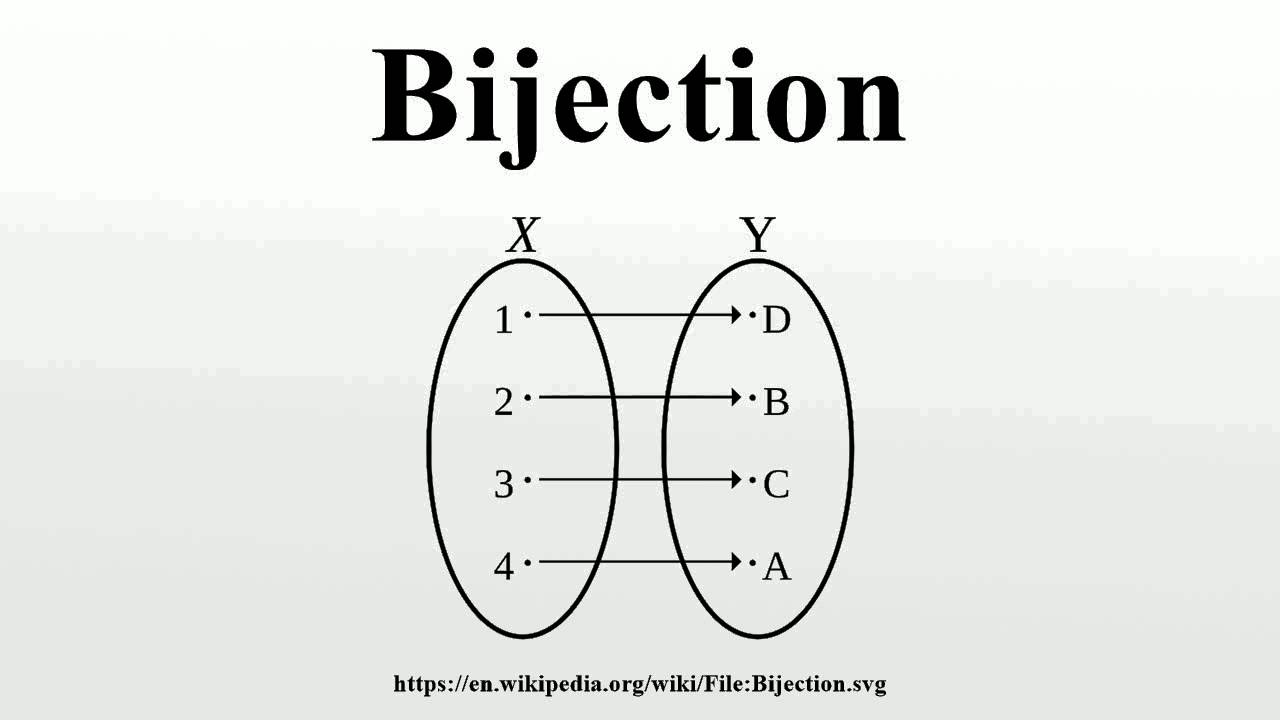
Bijection
338
A bijective function (one-to-one correspondence) pairs every element of one set with exactly one element of another set, with no unpaired elements. It is both one-to-one (injective) and onto (surjective). For finite sets, bijections imply equal cardinality, which in axiomatic set theory defines 'same number of elements.' Four properties must hold: each element of X pairs with at least one Y, no X element pairs with multiple Ys, each Y element pairs with at least one X, and no Y element pairs with multiple Xs. Functions satisfying the first property are surjections; those satisfying the second are injections. A bijection is both. Examples include identity functions, linear functions f(x) = ax + b (a ≠ 0), and tangent on restricted intervals. Non-examples include exponential functions (not onto) and squaring functions (not one-to-one). A bijection is invertible iff it is bijective. The composition of two bijective functions is bijective. Bijective functions from X to itself form the symmetric group S_X under composition. They preserve cardinalities: |f(A)| = |A| and |f⁻¹(B)| = |B|. For finite sets with equal cardinality, bijection, surjection, and injection are equivalent. For finite sets S, the number of permutations equals the number of total orderings (n!). Bijective functions are isomorphisms in the category of sets, but not in more complex categories like groups (where isomorphisms must be homomorphisms). Partial bijections generalize to partial functions, requiring only injectivity since partial functions are already undefined on portions of their domain. The set of all partial bijections on a base set forms the symmetric inverse semigroup.
Click to watch →
Deep Dive
Basic set theory, including notation, cardinality, and the concept of permutations as rearrangements of elements.

Permutaciones
121
In mathematics, a permutation is a rearrangement of elements in a set. The term 'permutar' means to interchange or rearrange. A permutation of a set A is a bijection from A to itself, which can be represented as a list or array where each element appears exactly once. For example, the permutation (0 1 2) → (1 2 0) means 0 goes to position 1, 1 goes to position 2, and 2 goes to position 0. The composition of a permutation with its inverse yields the identity permutation.
Click to watch →
#5. Analyse combinatoire, dénombrement (Bac+1)
50.8K
A permutation is a p-arrangement where p equals the cardinal n of the set E. Thus, a permutation is a rearrangement of all elements of E. The number of permutations of a set of cardinal n is n! (n factorial). A permutation can be viewed as a bijection from the set {1, 2, ..., n} to the set E. For example, arranging n different books on a shelf.
Click to watch →

Set theory (La théorie des ensembles )| Algebra 01
47.2K
Set theory studies collections of objects called sets, denoted by capital letters (A, B, C). Elements are denoted by lowercase letters (x, y, z). The symbol '∈' indicates membership, '∉' indicates non-membership. Sets can be defined by listing elements (roster method) or by properties (set-builder notation). The empty set (∅) contains no elements. Cardinality |A| counts elements. A subset A ⊆ B contains only elements of B. The power set P(A) contains all subsets of A, with |P(A)| = 2^n for n elements. Common sets include natural numbers (N), real numbers (R), and positive reals (R+).
Click to watch →

Lec 16 | MIT 6.042J Mathematics for Computer Science, Fall 2010
82.3K
A set is an unordered collection of distinct elements, denoted by curly braces. The cardinality (size) of a set is the number of elements, denoted by two vertical bars. A sequence is an ordered collection where order matters and elements need not be distinct. A permutation of a set is a sequence containing each element exactly once. The number of permutations of an n-element set is n factorial (n!), calculated as n × (n-1) × ... × 1. For example, a 3-element set has 3 × 2 × 1 = 6 permutations.
Click to watch →

Zauberwürfelmathematik - Teil 7 / Abschnitt 3
1.4K
A permutation is a bijective function from a finite set M to itself. The set M must be finite (have a finite number of elements), and the function must be bijective (both injective and surjective). The notation |M| represents the cardinality of set M, which is the number of elements in M. A permutation rearranges elements without adding or removing any. For example, on the set M = {1, 2, 3}, a permutation can be defined by specifying where each element maps: 1 → 2, 2 → 1, and 3 → 3. This can be represented in matrix notation as a rearrangement of the elements, showing how the permutation transforms the original set.
Click to watch →
Deep Dive
An understanding of subgroups and the significance of Lagrange's Theorem on group orders.

Chapter 3: Lagrange's theorem, Subgroups and Cosets | Essence of Group Theory
42.3K
Lagrange's theorem states that the order (size) of any subgroup H of a finite group G divides the order of G, which can be proven using the rectangular tiling argument where the group is partitioned into cosets of H, each of size equal to H; this theorem generalizes the orbit-stabilizer theorem, which shows that the size of the orbit of an element equals the number of cosets of its stabilizer subgroup.
Click to watch →

Subgroup | Top Ten Series for CSIR NET, IIT JAM, GATE & CUET PG | Group Theory By GP Sir
7.2K
Lagrange's Theorem states that the order of any subgroup must divide the order of the group. For |G| = 20, possible subgroup orders are 1, 2, 4, 5, 10, 20. However, not every divisor corresponds to a subgroup (e.g., A4 of order 12 has no subgroup of order 6). The order of H ∩ K equals gcd(|H|, |K|).
Click to watch →
Group Theory | Cosets | Lagrange Theorem Group Theory | Abstract Algebra
622.4K
Lagrange's Theorem states that the order of every subgroup of a finite group is a divisor of the order of the group, which follows from the fact that left cosets of a subgroup partition the group into disjoint subsets of equal size.
Click to watch →
LT GRADE MAINS || MATHS || GROUP THEOREM | LAGRANGE THEOREM | CLASS- 01|| BY SUJEET SIR #ltmaths
915
Lagrange's Theorem states that for any finite group G and any subgroup H of G, the order of H divides the order of G. The instructor emphasizes that this is a fundamental theorem that will appear in exams like PCS and IS. The theorem is presented as: 'The order of any subgroup of a finite group divides the order of the group.' This result is essential for understanding the structure of finite groups and has important implications for group theory.
Click to watch →

Untergruppen (Twitch VOD)
3.2K
A subgroup is a non-empty subset of a group that itself forms a group under the same operation, meaning it must satisfy closure, associativity, contain the identity element, and contain inverses for all its elements. Lagrange's Theorem states that for any finite group G and its subgroup U, the order (number of elements) of U must divide the order of G. This theorem is illustrated through examples including the Klein four-group (symmetry group of a rectangle) and the cyclic group of order 6 (rotational symmetries of a regular hexagon), showing how subgroup orders (1, 2, 3, 4) always divide the total group order.
Click to watch →
Prerequisite Knowledge
- Concept 01The foundational definition of a group, including the four key axioms: closure, associativity, identity, and invertibility.
- Concept 02The concept of functions, specifically bijections (one-to-one and onto mappings) on finite sets.
- Concept 03Basic set theory, including notation, cardinality, and the concept of permutations as rearrangements of elements.
- Concept 04An understanding of subgroups and the significance of Lagrange's Theorem on group orders.
Subsequent Learning
- Step 01Cayley's Theorem, which proves that every group is isomorphic to a subgroup of a symmetric group.
- Step 02Alternating groups, the concept of even and odd permutations, and the signature homomorphism.
- Step 03Conjugacy classes in symmetric groups and how they are classified by cycle structures and integer partitions.
- Step 04The theory of group actions, specifically focusing on orbits, stabilizers, and the Orbit-Stabilizer Theorem.
- Step 05Introduction to Galois Theory, showing how the insolvability of the quintic equation relates to the symmetric group S_5.
Definition
Notation
Order Calculation
Example S3
Definition
0:03Playing Section
- 1
Symmetric group is all bijections from a set to itself.
- 2
Also known as permutation group in mathematics.
- 3
Forms a group under function composition operation.
The Geometric and Categorical Perspective in Group Theory
While standard exam curricula heavily emphasize the Symmetric Group ($S_n$) and concrete permutation groups—often justified by Cayley’s Theorem—modern advanced mathematics introduces a critical shift toward geometric and category-theoretic perspectives. Critics of an over-reliance on permutation groups argue that analyzing groups purely as permutations of finite sets is computationally tedious and obscures deeper structural symmetries. Instead, Geometric Group Theory treats groups as geometric objects acting on spaces (such as metric spaces and Cayley graphs), revealing topological and asymptotic properties. Simultaneously, Category Theory advocates for a 'coordinate-free' approach, defining groups not by their individual elements or permutations, but by their morphisms, universal properties, and representations in vector spaces. Introducing these abstract and geometric viewpoints broadens a student's horizon beyond finite combinatorics, preparing them for higher-level research where groups are understood through their global actions and structural relationships rather than mere element manipulation.
Deep Dive
Cayley's Theorem, which proves that every group is isomorphic to a subgroup of a symmetric group.
CAYLEY'S THEOREM | Cayley's Theorem proof | Group Theory | Ug pg maths | Bsc maths
23.7K
Cayley's Theorem states that every group G is isomorphic to a subgroup of the symmetric group on G, meaning every group can be represented as a permutation group. The proof involves constructing a mapping from G to the symmetric group S_G by defining, for each element g in G, a permutation f_g that maps each element x to gx (left multiplication). This mapping preserves the group operation, making it a homomorphism, and is injective because if f_g = f_h, then gx = hx for all x, implying g = h. Thus, G embeds into S_G as a subgroup.
Click to watch →
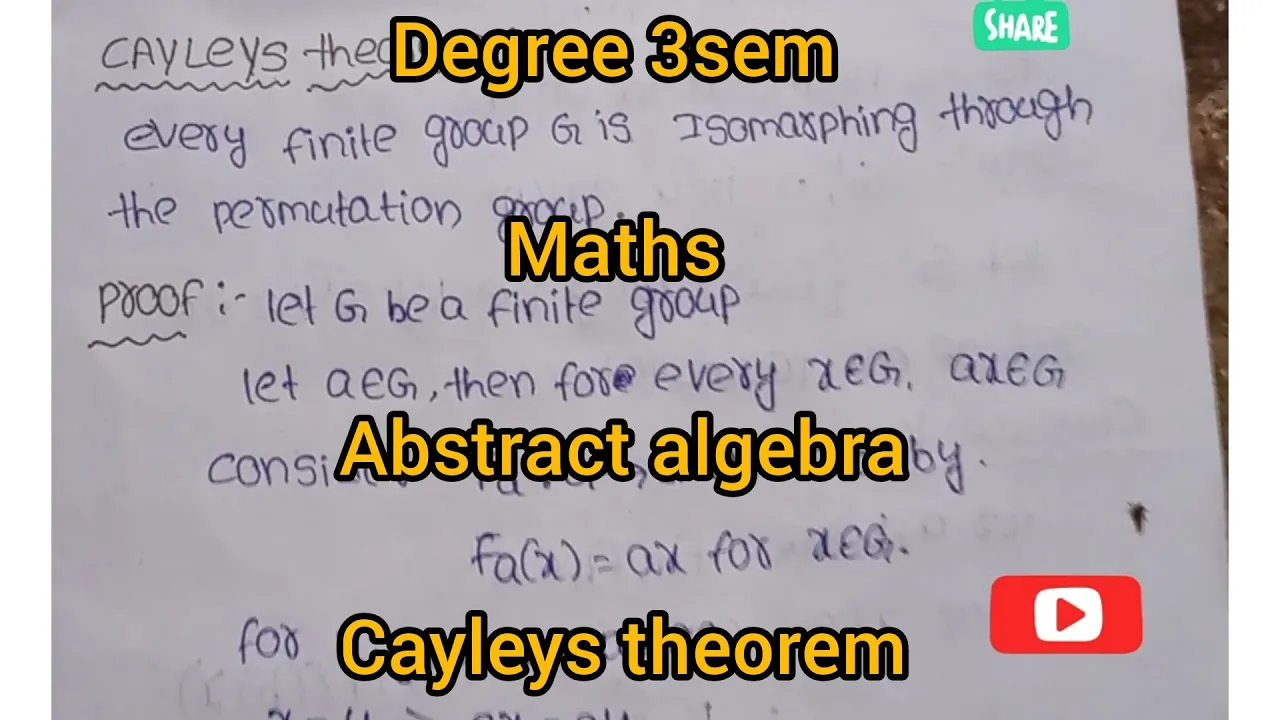
#degree 3 sem//maths//abstract algebra//cayley's theorem.
55.1K
Cayley's theorem states that every group G is isomorphic to a subgroup of the symmetric group on G, meaning every group can be represented as a group of permutations of its own elements. The theorem is proven by defining a mapping φ: G → S_G (the symmetric group on G) where φ(a) is the permutation defined by φ(a)(x) = a·x for all x in G. This mapping is a group homomorphism because φ(ab)(x) = (ab)·x = a·(b·x) = φ(a)(φ(b)(x)), and it is injective because if φ(a) = φ(b), then a·x = b·x for all x, which implies a = b.
Click to watch →
Homomorphisms and Isomorphisms -- Abstract Algebra 8
10.5K
Cayley's theorem states that every group is isomorphic to a subgroup of a symmetric group. Define φ: G → S_G by φ(g) = L_g, where L_g(x) = g*x is left multiplication. This map is a homomorphism: φ(gh) = L_{gh} = L_g ∘ L_h = φ(g)∘φ(h). It is injective because if L_g = L_h then g = g*e = L_g(e) = L_h(e) = h. Thus G ≅ Im(φ) ≤ S_G, showing every group embeds into some permutation group.
Click to watch →

Cayley's Theorem | Dr. Ambily P Mathew | Department of Mathematics
13.6K
Cayley's Theorem states that every group G is isomorphic to a group of permutations, specifically a subgroup of the symmetric group S_G. The proof constructs a mapping λ_x: G → G defined by λ_x(g) = x·g for all g in G, showing that each λ_x is a permutation (one-to-one and onto). The set G' = {λ_x | x ∈ G} forms a subgroup of S_G under composition, and the mapping φ: G → G' defined by φ(x) = λ_x is an isomorphism, proving that every group can be represented as a permutation group.
Click to watch →
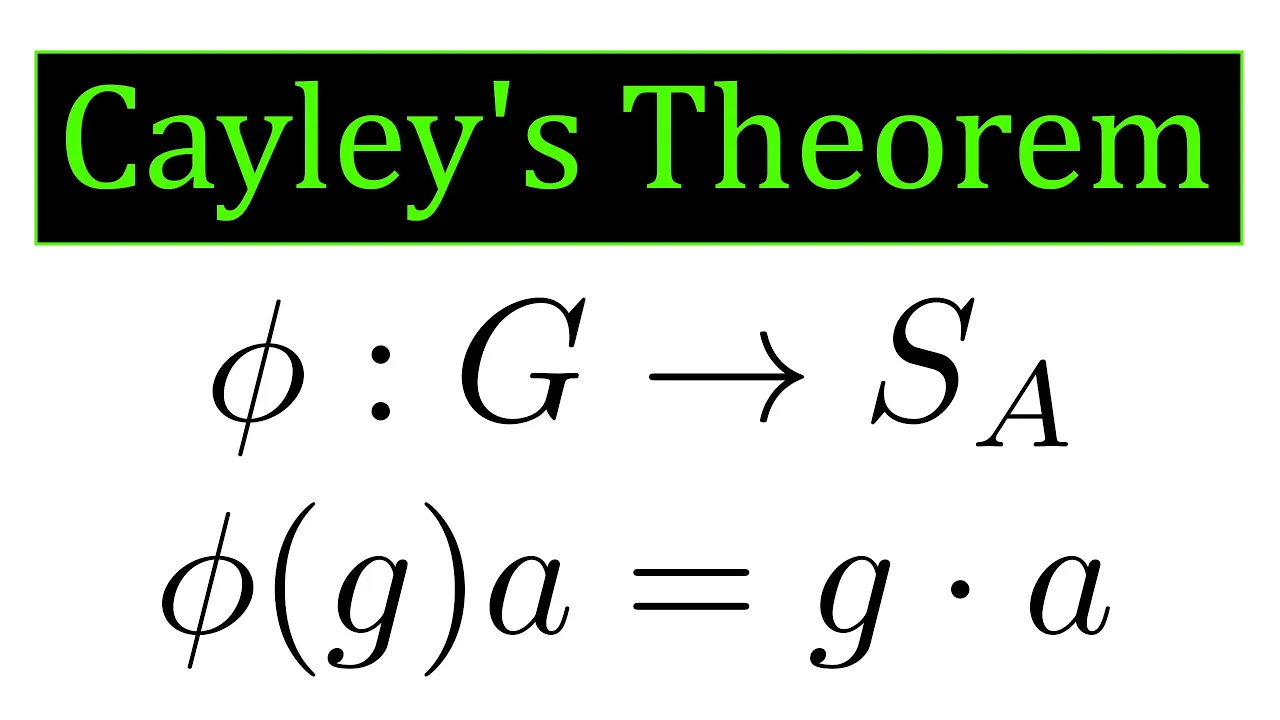
Cayley's Theorem Explanation: Every Group is a Permutation Group
9.9K
Cayley's Theorem states that every group is isomorphic to a subgroup of a symmetric group, meaning every group can be represented as a permutation group. This is proven by considering a group G acting on itself by left multiplication, which induces a homomorphism from G to the symmetric group on G. Since this homomorphism has a trivial kernel (only the identity element maps to the identity permutation), the First Isomorphism Theorem shows that G is isomorphic to its image, which is a subgroup of the symmetric group. This demonstrates that every abstract group can be concretely realized as a group of permutations.
Click to watch →
Deep Dive
Alternating groups, the concept of even and odd permutations, and the signature homomorphism.
Group Theory | Permutation Group | Even & Odd Permutation | Order Of Permutation
931.6K
The signature (or sign) of a permutation is +1 if the permutation is even, and -1 if the permutation is odd. It is a homomorphism from the symmetric group to the multiplicative group {+1, -1}. The signature is equal to (-1)^k, where k is the number of inversions in the permutation.
Click to watch →

COURS sur le déterminant- Partie 1-Une forme n linéaire alternée - la formule avec les signatures
12.2K
Permutations decompose into transpositions (swaps of two elements), classified as even or odd based on the number of swaps. The signature (+1 for even, -1 for odd) is a group homomorphism: the signature of a composition equals the product of individual signatures. This algebraic structure underlies alternating forms, as each transposition introduces a sign change. Understanding permutation parity provides the mathematical machinery needed to handle higher-dimensional determinants systematically.
Click to watch →

4) Alternating Group & Even Odd Permutation | (Lecture-4) 5th Sem || Groups & Rings | Bsc Maths MDU
6.7K
The alternating group A_n is the subgroup of the symmetric group S_n containing only even permutations, which are permutations that can be expressed as a product of an even number of transpositions; a transposition (swapping two elements) is always an odd permutation, and the parity of a cycle of length k is even if k is odd and odd if k is even, with the composition rules being: even × even = even, even × odd = odd, odd × even = odd, and odd × odd = even.
Click to watch →

24. Четность перестановки. Гомоморфизм. Алексей Савватеев. 100 уроков математики
5.5K
The parity of a permutation is determined by the number of inversions (pairs of indices where a larger element precedes a smaller one) in its lower row: if the number of inversions is even, the permutation is even; if odd, it is odd. The composition of permutations follows the same parity rules as adding even and odd numbers: even + even = even, odd + odd = even, and even + odd = odd. This parity function is a group homomorphism from the symmetric group to the group of two elements (even and odd). The set of all even permutations forms a subgroup of the symmetric group, called the alternating group.
Click to watch →
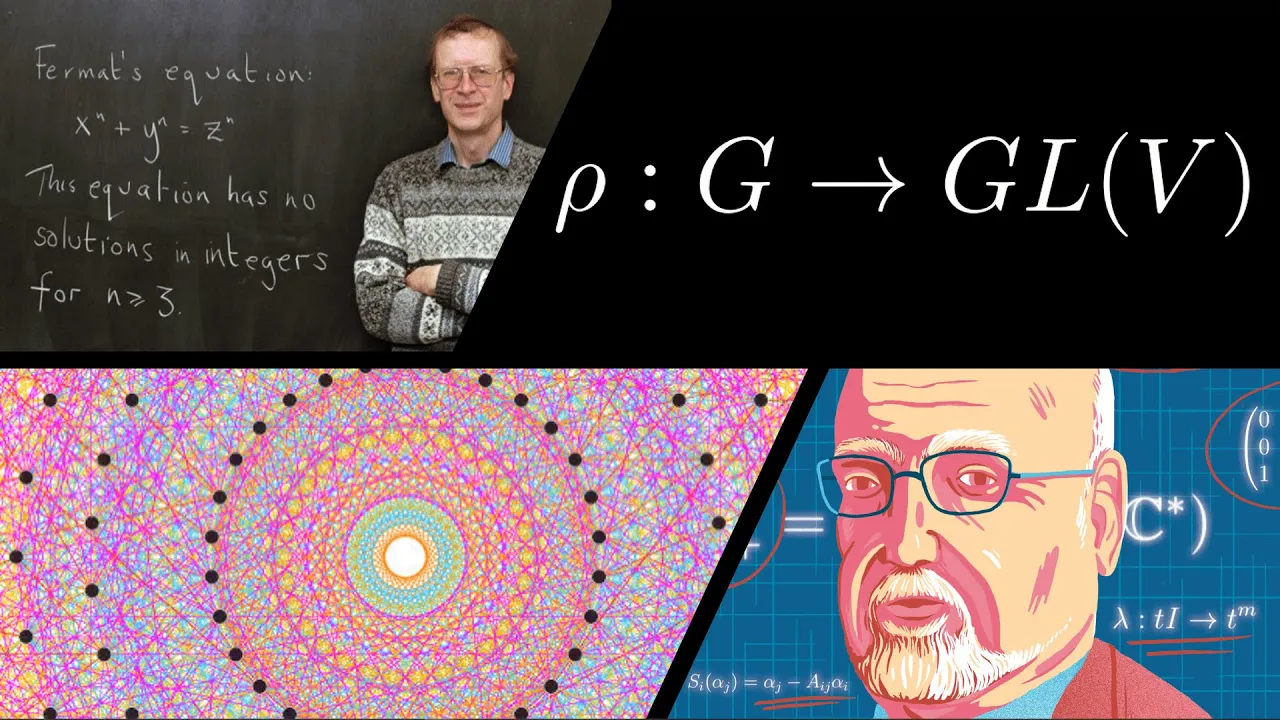
What's a representation? An intro to modern math's magical machinery | #SoME2
75.7K
This section explores permutations and their classification. Any permutation can be decomposed into transpositions (swaps). If a permutation requires an even number of transpositions, it is called even; if odd, it is called odd. The alternating group A₅ consists of all even permutations of five elements and forms a group because composing two even permutations yields another even permutation. A three-dimensional representation of A₅ maps elements to 3×3 complex matrices. A 3-cycle maps to a rotation matrix involving the golden ratio φ, while a double transposition maps to another rotation matrix. Both types of matrices are orthogonal with determinant 1, meaning they only rotate space without distorting it.
Click to watch →
Deep Dive
Conjugacy classes in symmetric groups and how they are classified by cycle structures and integer partitions.
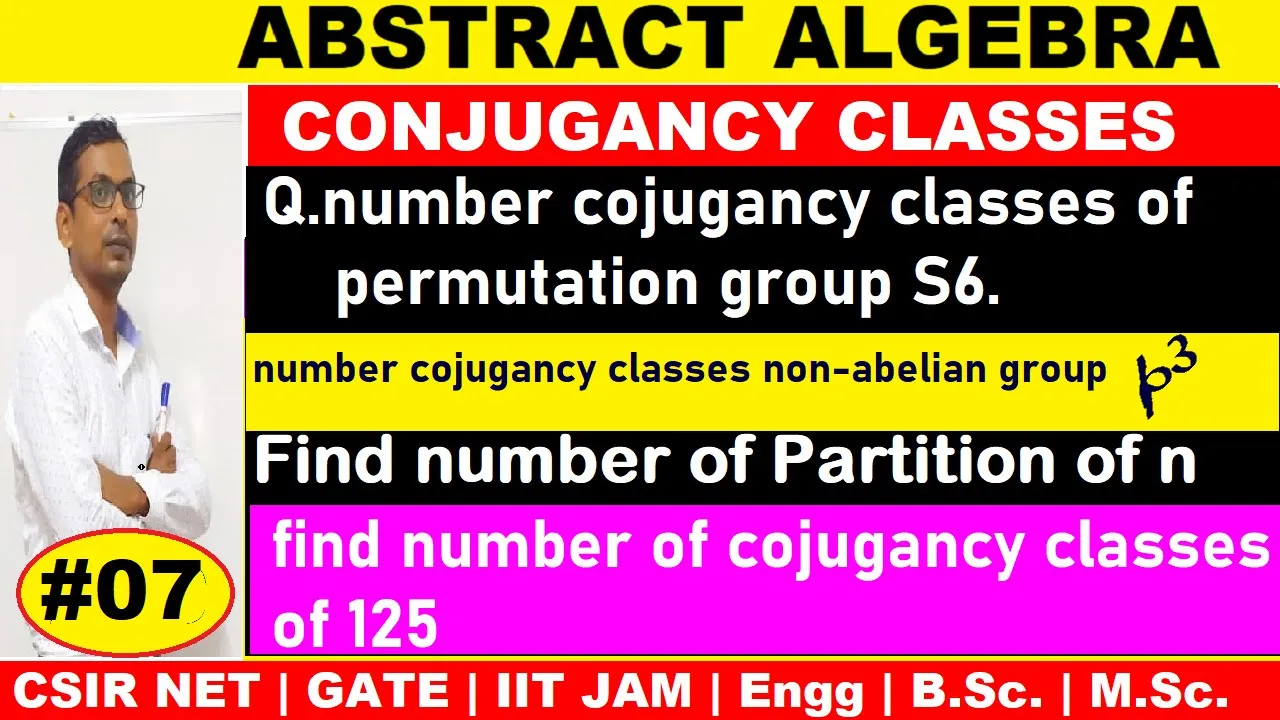
#07 Conjugancy classes of Sn | Equivalance classes of S6 | how to find partition of number n
33.3K
The number of conjugacy classes in the symmetric group Sₙ is equal to the number of integer partitions of n, where a partition of n is a way of writing n as a sum of positive integers (order does not matter). For example, the number of conjugacy classes in S₆ is 11 because there are 11 partitions of 6.
Click to watch →

Lec 24.7: Cycle Type : Definition, theorems and examples
5.8K
The number of conjugacy classes in Sₙ equals the number of partitions of n. Each partition of n corresponds to a unique cycle type, and each cycle type corresponds to a unique conjugacy class. This establishes a fundamental correspondence between integer partitions and conjugacy classes in symmetric groups.
Click to watch →

Group Actions and the Class Equation
3.4K
In symmetric groups S_n, conjugacy classes are in one-to-one correspondence with integer partitions of n. Each partition corresponds to cycle types: for example, in S₄, the partitions 4, 3+1, 2+2, 2+1+1, and 1+1+1+1 correspond to 4-cycles, 3-cycles, double transpositions, transpositions, and identity respectively. The number of elements in each conjugacy class can be calculated combinatorially based on the cycle type.
Click to watch →

Lecture 95 | Class Equation - 4 | Group theory | IIT JAM | CSIR NET | GATE | Vivekmaths
3.7K
In symmetric groups S_n, elements are classified by cycle structure, described by lengths of disjoint cycles summing to n. The size of a conjugacy class equals n! divided by the product of (k_i × m_i!), where k_i are cycle lengths and m_i are their multiplicities. The centralizer order is n! divided by the conjugacy class size, following |C_G(g)| = |G| / |Cl(g)|. The number of conjugacy classes in S_n equals the number of partitions of n. For S_4, classes correspond to partitions: identity (1), transpositions (6), double transpositions (3), 3-cycles (8), and 4-cycles (6). For S_5, class sizes are calculated using the formula, yielding 30 for structure 2+2+1+1 and 20 for structure 3+2+1. The number of permutations of length r in S_n is n! / (n-r)!.
Click to watch →

Pourquoi Log et Exp sont inverses l'une de l'autre?
1.3K
In the symmetric group S_n, two permutations are conjugate if and only if they correspond to the same partition of n. A partition is a sequence of strictly positive integers in non-increasing order summing to n. For example, in S_8, the partition 3+2+2+1 corresponds to a specific conjugacy class. The multiplicity notation m_k counts how many parts of size k appear in the partition, with Σ(m_k × k) = n. The conjugacy classes partition S_n, and their cardinalities sum to n!.
Click to watch →
Deep Dive
The theory of group actions, specifically focusing on orbits, stabilizers, and the Orbit-Stabilizer Theorem.
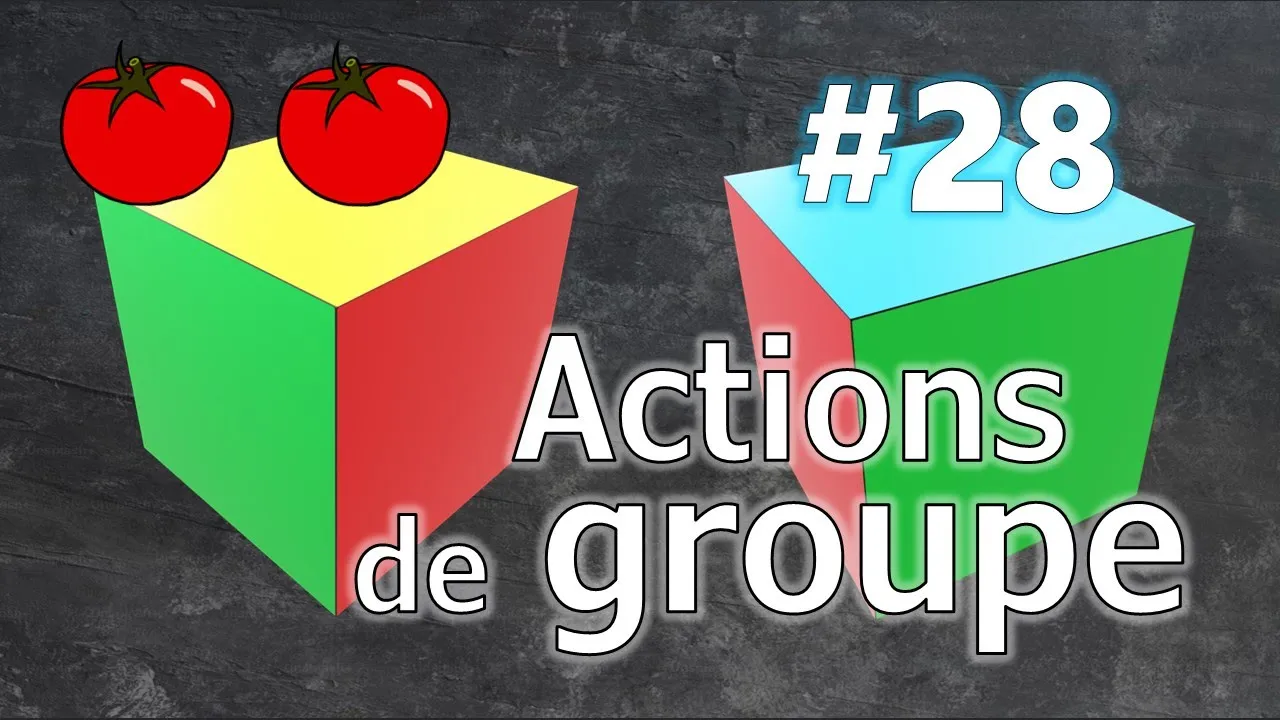
Thomaths 28 : Actions de groupe
6.1K
For group actions: orbit of m is {g·m | g∈G}, stabilizer is {g∈G | g·m=m}. The orbit-stabilizer theorem states |Stab(m)| × |Orb(m)| = |G|. This shows larger orbits correspond to smaller stabilizers. For a cube's vertex, orbit has 8 vertices, stabilizer has 3 rotations (0°, 120°, 240°), giving 24 total rotational symmetries.
Click to watch →

Group Action | Faithful Action | Regular Action | Stabilizers and Orbit #exam
234
The stabilizer of an element a is the set of all g in G such that φ(g, a) = a, denoted G_a. The kernel equals the intersection of stabilizers of all elements in A. The orbit of an element a is the set of all elements reachable from a: Orb(a) = {φ(g, a) | g in G}. The Orbit-Stabilizer Theorem states that |Orb(a)| = [G : G_a], where [G : G_a] is the index of G_a in G. Elements in the same orbit have the same orbit.
Click to watch →

Алгебра-2. Лекция 3, А.И.Ильин
236
A group G acts on a set X if there is a mapping G × X → X satisfying (g1g2)x = g1(g2x) and ex = x. Key concepts include orbits (Gx = {gx | g ∈ G}) and stabilizers (Stab(x) = {g ∈ G | gx = x}). Examples include: conjugation action on G (orbits are conjugacy classes, stabilizers are centralizers), S_n acting on {1,...,n} (transitive, stabilizer is S_{n-1}), isometry group of plane (orbits are origin and circles), and action on left cosets of H (transitive, stabilizer is xHx⁻¹). The Orbit-Stabilizer Theorem establishes a natural bijection between the orbit of x and the coset space G/Stab(x), given by gStab(x) ↦ gx. This implies |Orb(x)| = [G : Stab(x)]. For conjugation action, this gives |Cl(x)| = [G : C_G(x)].
Click to watch →
Algebraic structures. Lecture 4: group actions (by Walter Mazorchuk)
354
A group action of a group G on a set X is a map G × X → X satisfying e·x = x and a·(b·x) = (ab)·x for all a, b ∈ G and x ∈ X, which is equivalent to a group homomorphism from G to the symmetric group SX; key concepts include invariant subsets, transitive actions (where the only invariant subsets are X and ∅), orbits (the set of all elements reachable from a given element via group action), and stabilizers (subgroups fixing a particular element), with the fundamental orbit-stabilizer theorem stating that for any element m in X, the size of its orbit equals the index of its stabilizer in G, i.e., |Orb(m)| = |G| / |Stab(m)|.
Click to watch →
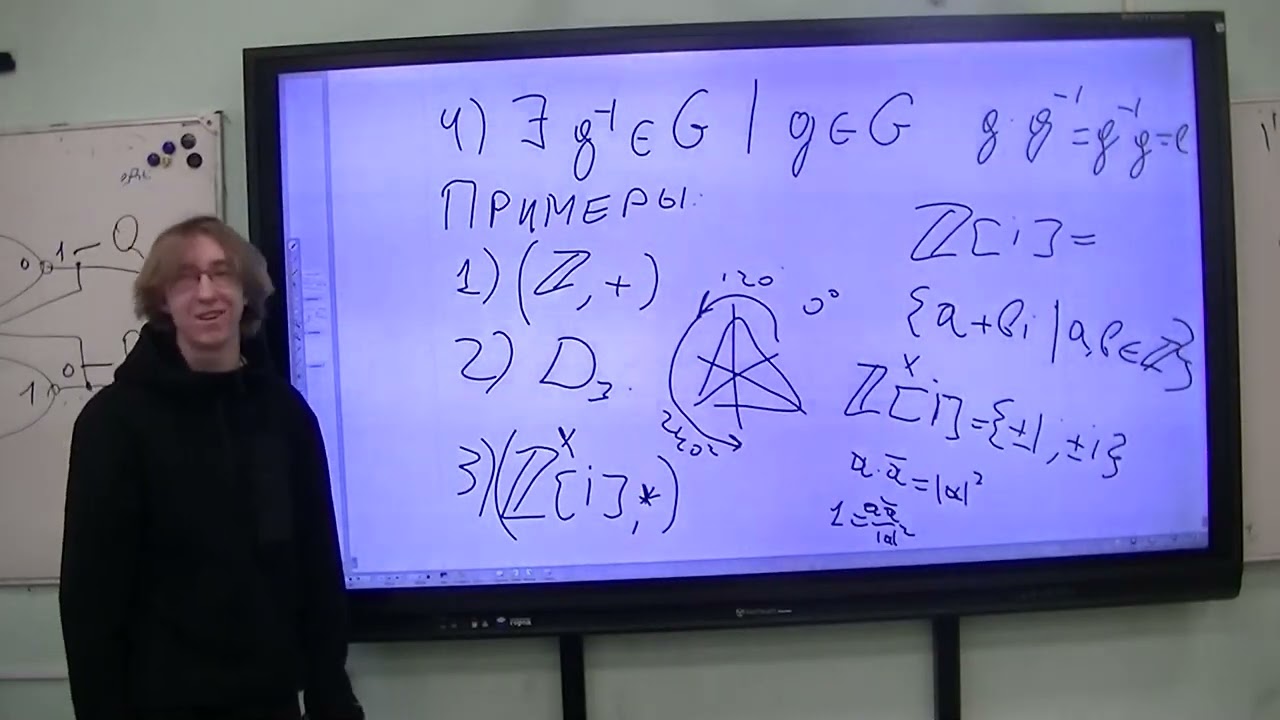
Данила Тонокногов, "Лемма Бернсайда и введение в теорию групп"
224
A group G acts on a set X via a map satisfying identity and compatibility axioms, inducing permutations of X. The orbit of x is the set of elements x can be mapped to; the stabilizer is the subgroup fixing x. The Orbit-Stabilizer Theorem states |Orb(x)|·|Stab(x)| = |G|. The stabilizer is a subgroup because it contains identity, is closed under inverses, and under multiplication. The proof constructs a bijection between left cosets of Stab(x) and the orbit. This theorem is fundamental for understanding how groups transform sets and counting orbits.
Click to watch →
Deep Dive
Introduction to Galois Theory, showing how the insolvability of the quintic equation relates to the symmetric group S_5.

Grant Sanderson (3Blue1Brown) | Unsolvability of the Quintic | The Cartesian Cafe w/ Timothy Nguyen
132.4K
The symmetric group S₅ contains 120 permutations of five elements. Its subgroup A₅ (even permutations) contains 60 elements and is generated by all 5-cycles. A critical observation is that any 5-cycle must act trivially on any expression taking only 4 values, because applying a 5-cycle five times returns to identity while the expression would have cycled through 5 values. Since A₅ has index 2 in S₅, any expression invariant under A₅ must be invariant under all of S₅, making it impossible to construct a resolvent quartic for quintics as was possible for lower degrees.
Click to watch →

The Insolvability of the Quintic
205.6K
The quintic (polynomials of degree 5 or higher) has no general solution formula in radicals because the symmetric group Sₙ is not solvable for n ≥ 5, whereas S₂, S₃, and S₄ are solvable groups; this result emerges from Galois Theory, which connects the solvability of polynomials to the structure of their Galois groups through field extensions and the concept of solvable groups.
Click to watch →
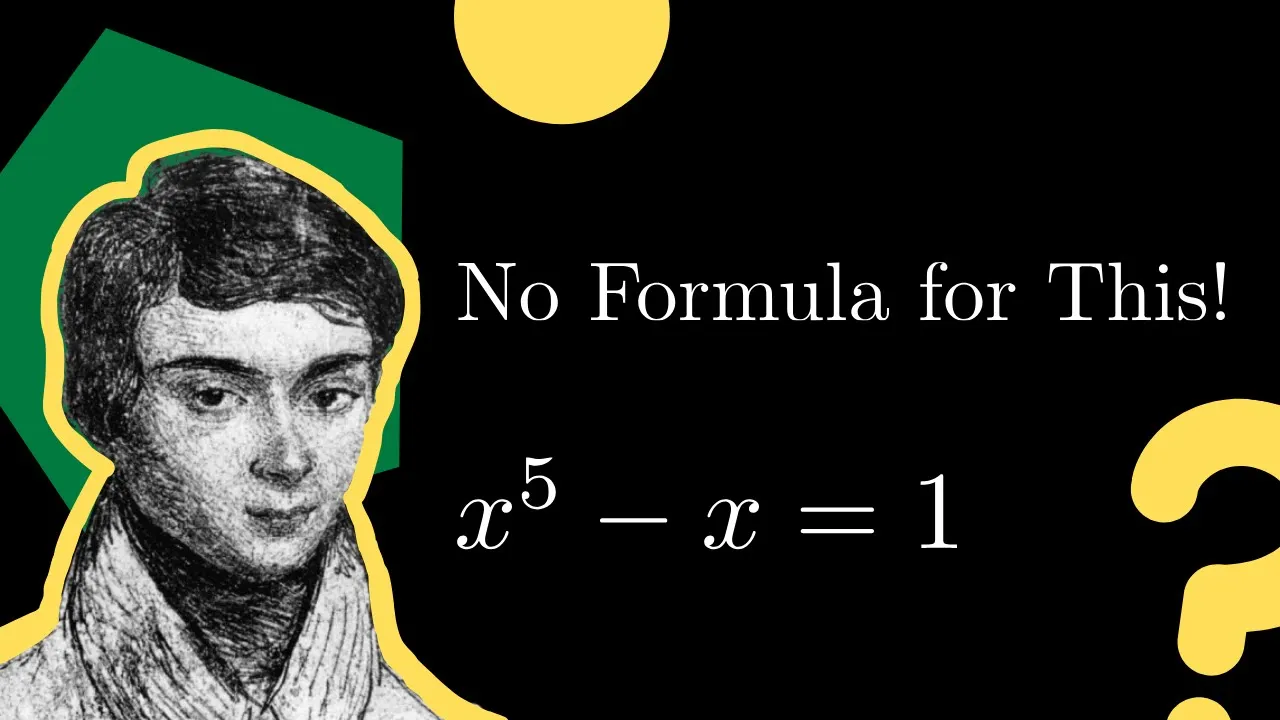
Why this Equation Has No Formula (Galois Theory)
70K
While quadratic, cubic, and quartic equations can be solved using formulas built from arithmetic operations and nth roots, the general quintic equation (degree 5) cannot be solved by such formulas. This mystery puzzled mathematicians for over 350 years until Evariste Galois solved it in 1830. Galois revolutionized algebra by realizing that solving equations is fundamentally about studying symmetries rather than grinding through formulas. He showed that if the Galois group (the group of symmetries of the roots) forms a cyclic tower, then the roots can be expressed using radicals. However, if the symmetries are more complex and not cyclic, no combination of the allowed operations can express all the roots. For the general quintic over rationals, the Galois group is S5 (the full set of permutations of five objects), which contains A5—a simple group with no smaller building blocks. This structural rigidity means no formula in radicals can capture the quintic's roots. The solutions can be expressed using elliptic modular functions, which encode the symmetries of A5.
Click to watch →

Non-Existence of the Quintic Formula
568
The symmetric group S5 can be generated by a single transposition and a single 5-cycle. By conjugating the transposition by powers of the 5-cycle, we obtain all adjacent transpositions. Then, by conjugating these transpositions by each other, we can obtain any transposition involving any pair of elements. Since all permutations can be written as products of transpositions, this generates the entire symmetric group S5. This completes the proof that the Galois group is indeed S5, and since S5 is not solvable, the polynomial is not solvable by radicals.
Click to watch →
Galois Theory Explained Simply
543.6K
Not all Galois groups are solvable. The symmetric group S₅ (all permutations of 5 roots) cannot be built as a series of cyclic extensions. This is why general quintic equations (degree 5) and higher are not solvable by radicals—they lack formulas expressible in terms of radicals. The breakthrough of Galois theory was proving that an equation is solvable by radicals if and only if its Galois group is solvable.
Click to watch →
Definition
Notation
Order Calculation
Example S3
Definition
0:03- 1
Symmetric group is all bijections from a set to itself.
- 2
Also known as permutation group in mathematics.
- 3
Forms a group under function composition operation.
The Geometric and Categorical Perspective in Group Theory
While standard exam curricula heavily emphasize the Symmetric Group ($S_n$) and concrete permutation groups—often justified by Cayley’s Theorem—modern advanced mathematics introduces a critical shift toward geometric and category-theoretic perspectives. Critics of an over-reliance on permutation groups argue that analyzing groups purely as permutations of finite sets is computationally tedious and obscures deeper structural symmetries. Instead, Geometric Group Theory treats groups as geometric objects acting on spaces (such as metric spaces and Cayley graphs), revealing topological and asymptotic properties. Simultaneously, Category Theory advocates for a 'coordinate-free' approach, defining groups not by their individual elements or permutations, but by their morphisms, universal properties, and representations in vector spaces. Introducing these abstract and geometric viewpoints broadens a student's horizon beyond finite combinatorics, preparing them for higher-level research where groups are understood through their global actions and structural relationships rather than mere element manipulation.
The foundational definition of a group, including the four key axioms: closure, associativity, identity, and invertibility.
The concept of functions, specifically bijections (one-to-one and onto mappings) on finite sets.
Basic set theory, including notation, cardinality, and the concept of permutations as rearrangements of elements.
An understanding of subgroups and the significance of Lagrange's Theorem on group orders.
Cayley's Theorem, which proves that every group is isomorphic to a subgroup of a symmetric group.
Alternating groups, the concept of even and odd permutations, and the signature homomorphism.
Conjugacy classes in symmetric groups and how they are classified by cycle structures and integer partitions.
The theory of group actions, specifically focusing on orbits, stabilizers, and the Orbit-Stabilizer Theorem.
Introduction to Galois Theory, showing how the insolvability of the quintic equation relates to the symmetric group S_5.
6.8K views96likes1:00@R-H.SOriginal Release: 2023-05-13
hello student welcome back to my Channel video on the topic symmetric group or permutation group set of all one one and on to mapping from set containing and elements to itself former group it is denoted by s n order of SN is equal to n factorial here we see the example S1 order of S1 is equal to 1 and the element of H1 is identity order of S2 is 2 factorial which is 2. order of S3 is 3 factorial which is six and the element of S3 we can see from the cycle make a cycle and got it thank you
Up Next

8:05
Field Definition Expanded: Key Object in Abstract Algebra Explained
@Socratica
405.7K views•2018-07-13

4:43
Elliptic Curve Cryptography Explained: ECC, ECDSA, ECDH
@PracticalNetworking
28.5K views•2024-10-21
10:44
Fourier Series Introduction: The Big Idea Explained
@DrTrefor
387K views•2021-05-03

6:00
The Mathematical Impossibility of Accurate World Maps
@Vox
23.3M views•2016-12-02
Related Study Plans & Knowledge Roadmaps
Structured learning paths in Mathematics
mathematics
Tensor Calculus: Vectors to Riemann Curvature
01Mathematical Foundations: Linear Algebra & Calculus
02Covectors, Dual Spaces, and Tensor Basics
03The Metric Tensor and Index Gymnastics
+ 2 more learning modules
40h5 modules
Explore Roadmap
mathematics
Gödel's Incompleteness: Logic, Proofs & Limits
01Introduction to Formal Systems & Hilbert's Dream
02Set Theory, Cardinality, and Cantor's Diagonal Argument
03Arithmetization and Gödel Numbering
+ 2 more learning modules
14h5 modules
Explore Roadmap
mathematics
Galois Theory: Fields, Groups & Solvability
01Foundations of Abstract Algebra: Groups & Fields
02Polynomials & Field Extensions
03Splitting Fields & Symmetries
+ 2 more learning modules
24h5 modules
Explore Roadmap
mathematics
Non-Euclidean Geometry: Models & Geodesics
01Euclid's Fifth Postulate and the Birth of New Geometries
02Hyperbolic Space and the Poincaré Disk Model
03Geodesics: Defining Straight Lines in Curved Spaces
+ 2 more learning modules
15h5 modules
Explore Roadmap