Visualizing Non-Euclidean Geometry: Mastering Hyperbolic and Elliptic Spaces
Learning Goal: Master the conceptual, mathematical, and visual foundations of hyperbolic and elliptic spaces. Understand how Euclid's parallel postulate failed, how Poincaré modeled hyperbolic space inside a finite disk, how geodesics generalize straight lines on curved surfaces, and how the Gauss-Bonnet theorem bridges local curvature with global topology.
Prerequisites
- Required: High school geometry, basic algebra, and trigonometry.
- Recommended: Familiarity with basic calculus (derivatives and integrals) and introductory topology (Euler characteristic) to get the most out of the advanced curvature modules.
Estimated Study Time
- Total: ~15 Hours (includes video instruction, supplementary mathematical derivations, and visualization exercises).
Module 1: Euclid's Fifth Postulate and the Birth of New Geometries
Module Overview
For over two millennia, Euclid's Elements stood as the absolute foundation of mathematical truth. However, his Fifth Postulate (the Parallel Postulate) was far more complicated than the other four, prompting centuries of failed proofs trying to derive it from simpler axioms. This module explores how the rejection of the Parallel Postulate birthed entirely new, mathematically consistent, non-Euclidean universes.
Recommended Videos

- Why this video: Veritasium provides an exceptional, highly visual historical narrative explaining Euclid’s axiomatic framework. It highlights how the struggle to prove the Parallel Postulate unexpectedly revealed that our physical reality is not bound to a flat plane.
- Why this video: This video contextualizes the mathematical paradigm shift of the 19th century. It breaks down the philosophical challenges of asserting that parallel lines could meet or diverge, framing non-Euclidean geometry as a liberation of mathematical thought.
- Why this video: This installment explores the breakthroughs of Bolyai, Lobachevsky, and Gauss. It details the initial resistance from the academic establishment to these "impossible" geometries and explains how they were ultimately proved to be as logically consistent as Euclid's system.
Knowledge Checkpoint
- Understand why Euclid's fifth postulate is distinct from the first four axioms.
- Articulate the difference between flat (Euclidean) space, negatively curved (hyperbolic) space, and positively curved (elliptic) space based on their parallel properties.
- Explain how Bolyai and Lobachevsky used proof by contradiction to discover hyperbolic geometry.
Module 2: Hyperbolic Space and the Poincaré Disk Model
Module Overview
Because humans exist in flat or positively curved 3D space, visualizing a space where parallel lines infinitely diverge is counterintuitive. Henri Poincaré resolved this with his Poincaré Disk Model, projecting the infinite hyperbolic plane onto a finite open disk in the Euclidean plane. In this module, you will master the mechanics of this model, including its metric distortion, and explore how artists like M.C. Escher visualized hyperbolic infinity.
Recommended Videos
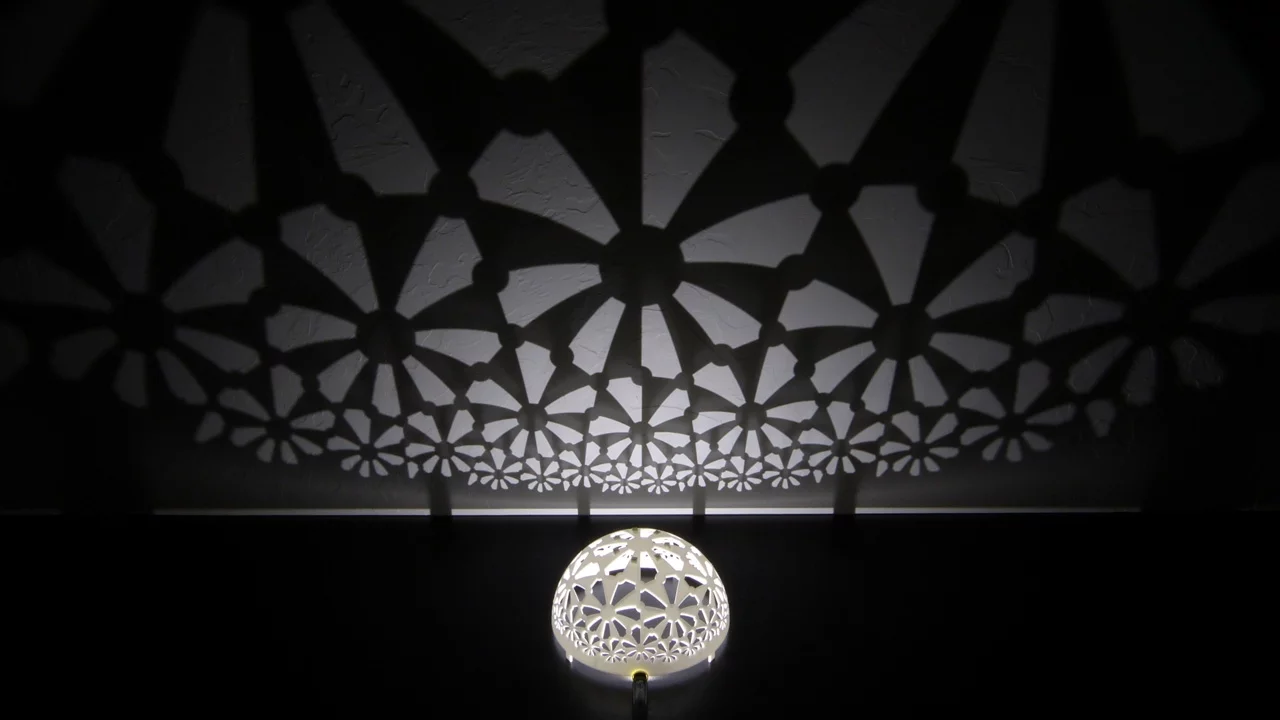
- Why this video: Henry Segerman utilizes 3D-printed models and light projections to physically demonstrate how the Poincaré disk model, the upper half-plane model, and the hemispherical model relate to one another via conformal projections.

- Why this video: This archival footage features the legendary geometer H.S.M. Coxeter explaining how the mathematician's work directly inspired artist M.C. Escher to generate exact tessellations of the hyperbolic plane in his Circle Limit woodcuts.

- Why this video: Dr. Daina Taimiņa shows how to overcome the visual limitations of 2D projections by physically crocheting hyperbolic surfaces. This tactile approach illustrates how exponential growth in stitch counts naturally creates negative curvature in three dimensions.
Curriculum Gap Note: Poincaré Metric Calculus
The video pool provides excellent conceptual visualizations, but lacks a detailed mathematical derivation of the Poincaré disk metric.
To bridge this gap, note that the metric tensor of the Poincaré disk of radius is defined as: This indicates that as you approach the boundary (), the scale factor explodes to infinity. This means that an object of "constant" hyperbolic length appears smaller and smaller to Euclidean eyes as it nears the edge of the disk.
To calculate the hyperbolic distance between two points in the disk, use the formula:
For step-by-step metric computations, search independently for: "Poincare disk metric distance formula explained".
Knowledge Checkpoint
- Describe how the boundary of the Poincaré disk represents "infinity" in the hyperbolic plane.
- Explain why angles are preserved (conformal mapping) in the Poincaré model, while Euclidean distances are distorted.
- Understand why tiles of equal hyperbolic size (as in Escher's Circle Limit) must shrink in Euclidean area as they approach the boundary.
Module 3: Elliptic Geometry and Spherical Spaces
Module Overview
Elliptic geometry is the geometry of constant positive curvature. Often introduced via spherical geometry, it describes a universe where parallel lines do not exist and the sum of the angles of a triangle always exceeds . This module explores how positive curvature alters spatial relationships, and details the structural difference between spherical geometry and true elliptic geometry.
Recommended Videos
- Why this video: CodeParade provides an interactive, game-engine-based exploration of what it looks like to be physically inside curved spaces, highlighting how light and vision change in positively versus negatively curved worlds.
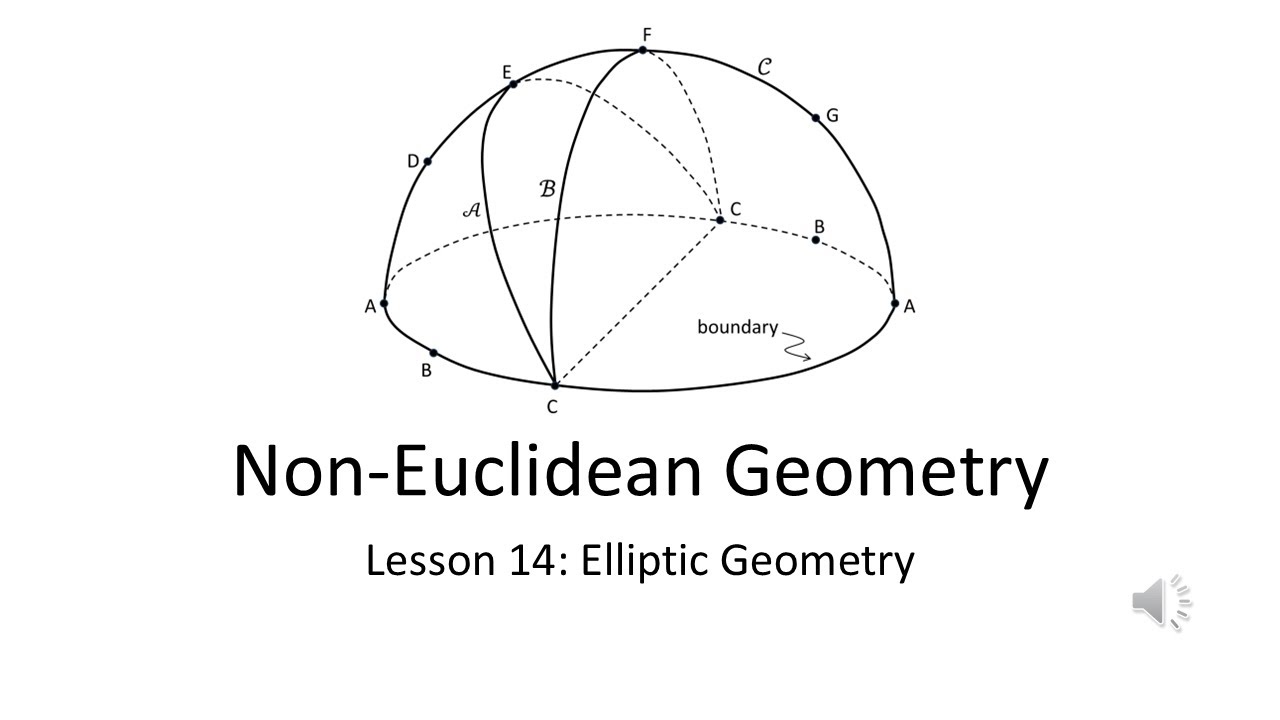
- Why this video: This academic lecture is crucial because it directly addresses a common gap: the mathematical distinction between spherical geometry (double-elliptic) and true elliptic geometry (single-elliptic). It demonstrates how identifying antipodal points resolves axiom conflicts.
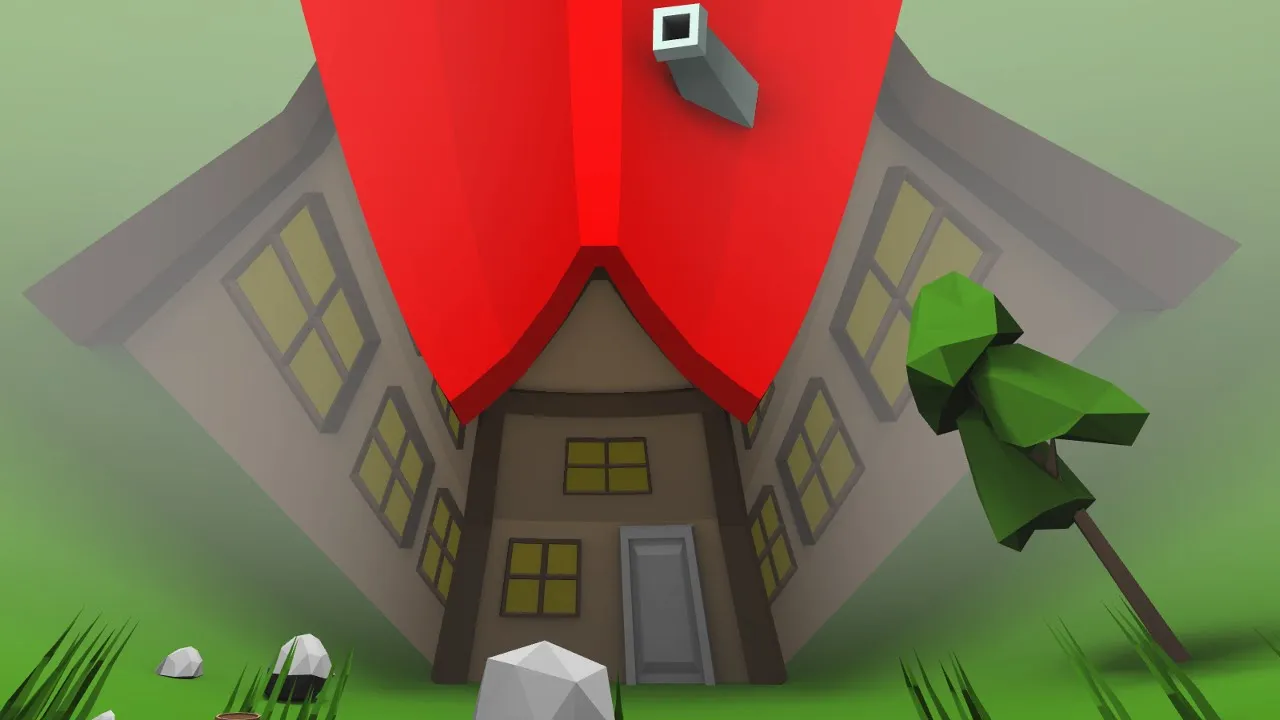
- Why this video: A short but powerful visual demonstration of "reverse perspective" in positively curved spherical space, where distant objects appear larger and upside down as light rays refocus.
Curriculum Gap Note: Spherical vs. Elliptic Topology
Spherical geometry () and Elliptic geometry (the Real Projective Plane, ) are fundamentally different:
- Spherical Geometry (): Two distinct points on the sphere always define a unique "straight line" (great circle), except when the points are antipodal (like the North and South Poles), where infinitely many great circles pass through them. Additionally, two distinct great circles always intersect at two points.
- Elliptic Geometry (): To satisfy the Euclidean axiom that "any two points define a unique line," elliptic geometry defines a "point" as a pair of antipodal points on a sphere. Thus, the antipodal points and are identified as the exact same point. In elliptic geometry, any two distinct lines intersect at exactly one point, matching the projective structure of space.
Knowledge Checkpoint
- Explain how a triangle on a sphere can have three angles, and write the formula for spherical excess.
- Articulate the difference between spherical geometry and elliptic geometry regarding antipodal points.
- Understand why there are no parallel lines in spherical or elliptic space.
Module 4: Geodesics: Defining Straight Lines in Curved Spaces
Module Overview
In flat space, a straight line is the shortest distance between two points. On curved surfaces, this concept generalizes to geodesics. Geodesics are curves that locally minimize length and do not bend to the left or right within the surface (their acceleration vector is parallel to the surface normal). In this module, you will compare geodesics on flat, spherical, and hyperbolic manifolds.
Recommended Videos

- Why this video: Parth G provides a clear and intuitive introduction to geodesics. He bridges the gap between everyday experience (like plane flight paths) and the differential geometry definition of extremal paths.

- Why this video: This lecture mathematically proves why "great circles" are the shortest paths (geodesics) on a sphere using variational principles. It also derives the connection between geodesic triangles and the excess angle sum.
- Why this video: This video uses the concept of parallel transport to define straightness on curved surfaces. It shows how an ant walking forward without turning naturally traces out a geodesic, providing a physical, coordinate-free intuition.
Curriculum Gap Note: Geodesics in the Poincaré Disk
The video pool does not contain a step-by-step visual demonstration of how geodesics are constructed in the Poincaré disk model.
In the Poincaré disk model, geodesics are of two types:
-
Diameters of the disk: Straight Euclidean line segments passing through the center of the disk.
-
Circular arcs: Euclidean circular arcs that intersect the boundary circle () at exactly right angles ().
 Hyperbolic Geodesics in Poincaré Disk
              .--------.
           .-/    |     \-.
          /   \   |    /   \
         |     \  |   /     |
         |------o-+--+------|  <-- Diameter Geodesic
         |     /  |   \     |
          \   /   |    \   /
           .-\    |     /-.
              '--------'
               ^      ^
               |      |-- Orthogonal Circular Arc Geodesic
               |-- Center Point (o)
For mathematical derivations of these circular arcs using inversion in circles, search independently for: "geodesics on Poincaré disk tutorial".
Knowledge Checkpoint
- Define a geodesic mathematically and explain why a great circle on a sphere is a geodesic.
- Describe the two geometric shapes that hyperbolic geodesics can take within the Poincaré disk model.
- Explain how parallel transport can be used to determine if a curve is a geodesic.
Module 5: Curvature, Topology, and the Gauss-Bonnet Theorem
Module Overview
The Gauss-Bonnet theorem is one of the most beautiful results in all of mathematics. It connects differential geometry (local curvature, which you measure with angles and distances) with topology (global invariants, like the number of holes a surface has). This module covers Gaussian curvature, the Euler characteristic, and explains the integration of curvature over closed surfaces.
Recommended Videos
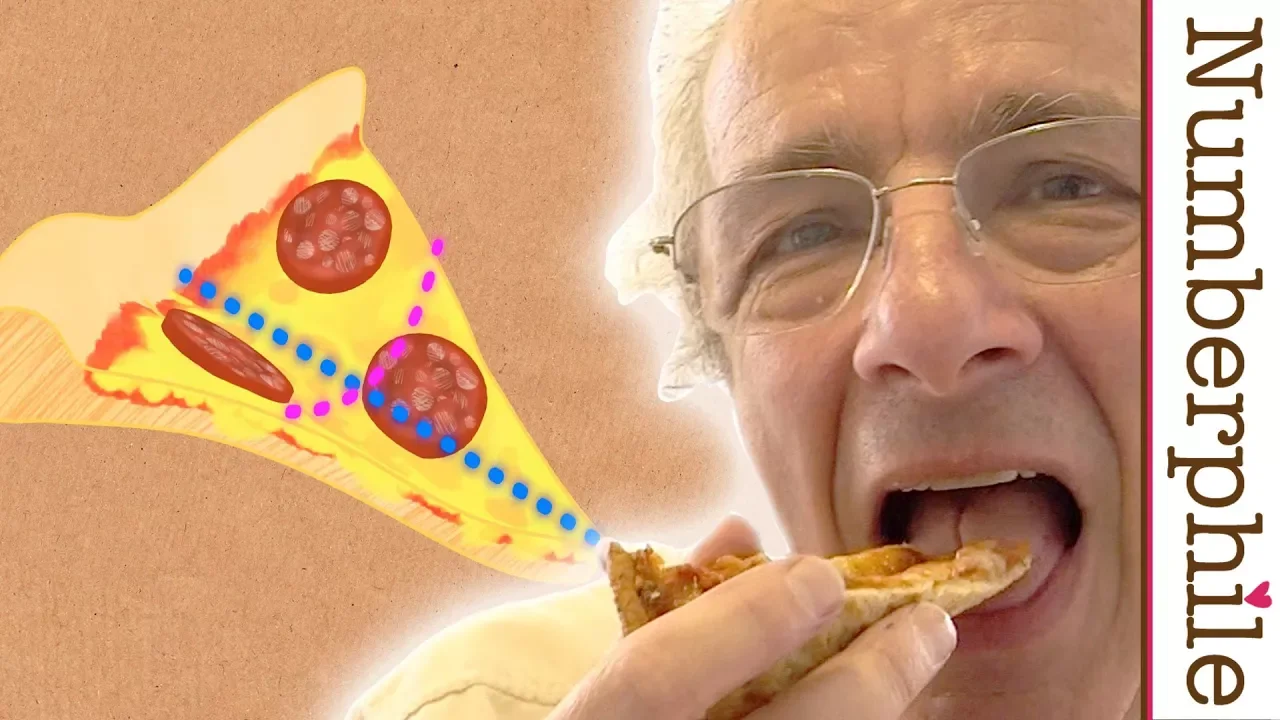
- Why this video: This classic video explains Gauss's Theorema Egregium (Remarkable Theorem) using pizza. It explains the distinction between intrinsic curvature (which cannot be changed without stretching the surface) and extrinsic curvature (bending a sheet of paper).
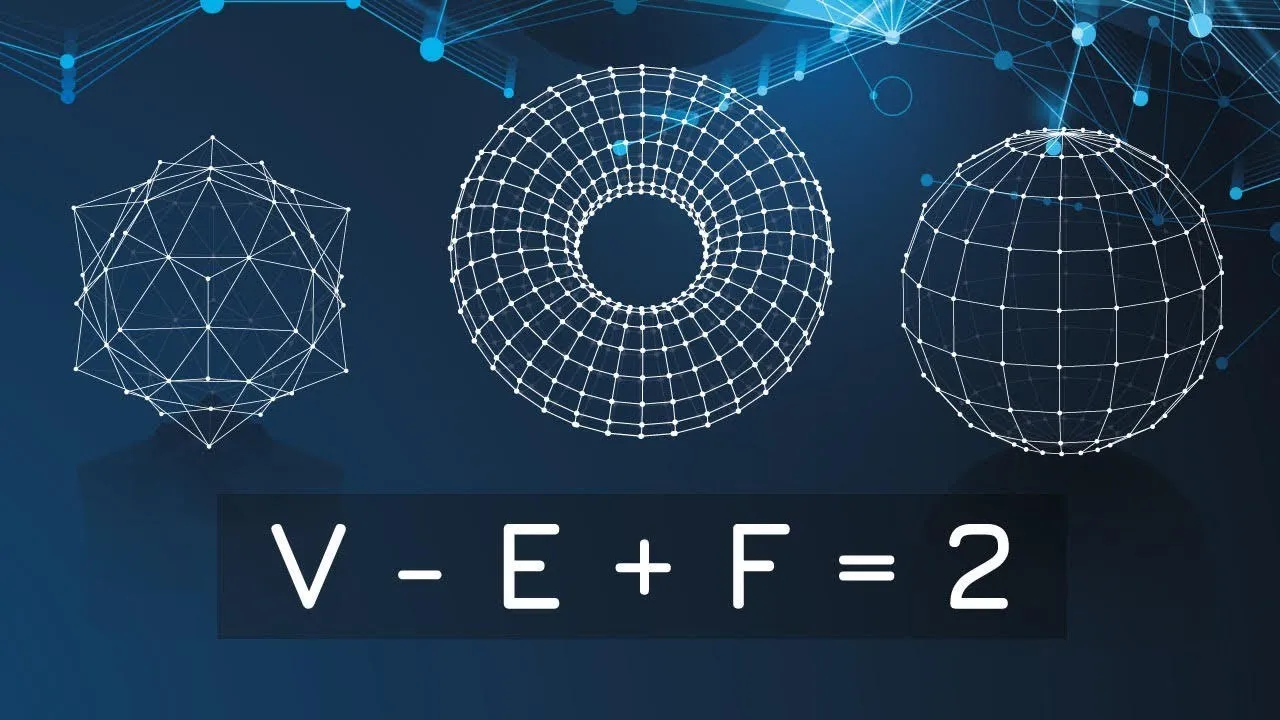
- Why this video: Zach Star details the topological side of the puzzle: the Euler characteristic (). He demonstrates how this integer remains invariant regardless of how a surface is stretched or deformed, setting up the topological foundation of Gauss-Bonnet.

- Why this video: Legendary mathematician and investor Jim Simons gives a personal account of his work with Chern, starting from the basic Gauss-Bonnet theorem. He explains how the local integral of curvature over a surface naturally yields the global Euler characteristic.

- Why this video: For the mathematically daring student, this is a formal, rigorous university proof of the Gauss-Bonnet Theorem. It works through the calculus, differential forms, and boundary terms required to prove the theorem on compact oriented surfaces.
Curriculum Gap Note: The Intuitive Gauss-Bonnet Link
Advanced mathematics lectures can obscure the physical beauty of the Gauss-Bonnet theorem. Below is a conceptual breakdown.
The Gauss-Bonnet theorem states that for a compact, smooth 2D manifold without boundary: Where:
- is the Gaussian curvature at each point.
- is the local area element.
- is the Euler characteristic of the surface ( for a surface with holes).
This implies that no matter how you deform a surface (such as denting a sphere or squeezing a donut), the total integrated curvature remains completely unchanged!
- If you dent a sphere to make one part flat (), other parts must bulge out to become more highly curved () so that the total integral always sums to (since ).
- If you have a torus (), the positive and negative curvature regions must cancel out exactly to , no matter how you warp the torus.
For further visualization of this connection, search: "Gauss-Bonnet theorem visualization intuitive explanation".
Knowledge Checkpoint
- Define Gaussian curvature () and identify why a flat cylinder has a Gaussian curvature of .
- Calculate the Euler characteristic () for a sphere, a torus, and a double-torus.
- State the Gauss-Bonnet formula and explain why squeezing a sphere does not change its total integrated curvature.
Course Map
Key People Index
- Euclid of Alexandria (c. 300 BC): Father of Geometry; established the deductive axiomatic method in his treatise, Elements.
- Carl Friedrich Gauss (1777–1855): Discovered hyperbolic geometry but kept it secret; revolutionized differential geometry with his Theorema Egregium, proving that curvature is an intrinsic property of surfaces.
- János Bolyai (1802–1860) & Nikolai Lobachevsky (1792–1856): Independently developed and published the first consistent systems of non-Euclidean (hyperbolic) geometry.
- Bernhard Riemann (1826–1866): Generalized geometry to arbitrary dimensions (Riemannian geometry) and formalized elliptic spaces.
- Henri Poincaré (1854–1912): Created multiple models of hyperbolic geometry (including the Poincaré Disk), proving its absolute logical consistency relative to Euclidean geometry.
- M.C. Escher (1898–1972): Dutch artist whose masterly intuitive woodcuts bridged hyperbolic geometry and public imagination.
- Pierre Ossian Bonnet (1819–1892): French mathematician who generalized the curvature-topology relation to surfaces with boundary, completing the Gauss-Bonnet theorem.
Final Self-Assessment
Complete this comprehensive self-assessment to verify your mastery of the curriculum.
- Can you explain why Euclid's parallel postulate cannot be proven from his first four postulates?
- Given a line and a point not on , how many parallel lines pass through in Euclidean, Hyperbolic, and Elliptic space, respectively?
- Why is the boundary circle of the Poincaré disk considered to be at infinite distance from any point inside the disk?
- If you draw a triangle in the Poincaré disk model, are its sides straight Euclidean lines or curved arcs? Under what condition are they straight Euclidean lines?
- How does identifying antipodal points transform a sphere () into the Real Projective Plane (), and why is this necessary for elliptic geometry?
- If a triangle on a surface has interior angles of , , and , what can you deduce about the Gaussian curvature of that surface?
- What is the physical definition of a geodesic, and what does it mean for a geodesic's acceleration vector to be parallel to the surface normal?
- Why can you bend a flat piece of paper into a cylinder without stretching it, but you cannot wrap it onto a sphere without wrinkling or tearing? (Explain in terms of Theorema Egregium).
- If you poke a hole through a sphere (making it a torus), how does its total integrated curvature change according to the Gauss-Bonnet theorem?
- Explain the difference between intrinsic and extrinsic properties of a surface. Which category does Gaussian curvature belong to?