









![[May SAT Math] Never Miss TRIG Questions Again - Everything Type in 8 minutes.](https://i.ytimg.com/vi_webp/tOFrejkAQH4/maxresdefault.webp)





![[REPLAY#8] Hình Dạng Của Vũ Trụ | Thư Viện Thiên Văn](https://i.ytimg.com/vi/dHdnTlUU0s0/hqdefault.jpg)







Non-Euclidean geometry describes spaces with constant curvature that differ fundamentally from flat Euclidean space; in spherical geometry, the sum of triangle angles exceeds 180° and parallel lines converge, while in hyperbolic geometry, the sum is less than 180° and parallel lines diverge, with both exhibiting holonomy (rotation upon returning to a starting point) and having distinct formulas for circle circumference (2πr in Euclidean, 2πsin(r) in spherical, 2πsinh(r) in hyperbolic) and triangle area (area = sum(angles) - π in spherical, area = π - sum(angles) in hyperbolic).
Non-Euclidean Geometry Explained: Curved Spaces and Hyperbolic Physics
Added:Euclid's Postulates: Specifically the Parallel Postulate, which is the foundational axiom that distinguishes Euclidean geometry from non-Euclidean systems.
The Concept of Geodesics: Understanding that a geodesic is the shortest path between two points on a given surface (e.g., a straight line in flat space).
Basic Coordinate Geometry and Projections: Familiarity with Cartesian coordinates and how three-dimensional objects are projected onto two-dimensional surfaces.
Fundamental Trigonometry: An understanding of standard trigonometric functions and properties of triangles in flat space (like the sum of angles equaling 180 degrees).
General Relativity: Exploring how Albert Einstein used four-dimensional curved spacetime (pseudo-Riemannian geometry) to explain gravity.
Differential Geometry: The rigorous mathematical study of curves, surfaces, manifolds, and curvature using calculus.
Cosmology and the Shape of the Universe: Investigating astronomical models that attempt to measure whether the universe is flat, open (hyperbolic), or closed (spherical).
Hyperbolic Models and Projections: Deepening knowledge of the Poincaré disk model, the Klein model, and the upper half-plane model for visualizing hyperbolic space.
Applications in Computer Science: Examining how hyperbolic geometry is used in network topology, machine learning graph embeddings, and 3D graphics rendering.
2.9M views103.4Klikes10:54Original Release: 2020-06-26
Hyperbolic space is so cool. But if you've ever seen any kind of visualization, odds are it was this, or this or, oh God, the worst one!
Please stop using this one!
But none of these really gave me a feeling of what it's like to live in a curved space And that was the reason I started Hyperbolica.
So I've come up with what I think is the easiest way to understand hyperbolic space.
Let's start off with Euclidean and spherical spaces in two dimensions, and then hyperbolic space in three dimensions come naturally later.
So here's just a regular flatland 2D Euclidean plane that goes on in every direction and has no curvature But, if we add some positive curvature, we get a spherical shell.
This is not a solid ball, there's no inside or outside.
It's just an infinitely thin two-dimensional shell.
We're only looking at it in 3D, because we are higher dimensional beings looking down at the flat-landers.
You might think this is really similar to us living on the surface of Earth, But there's actually a big difference and it has to do with light and lines.
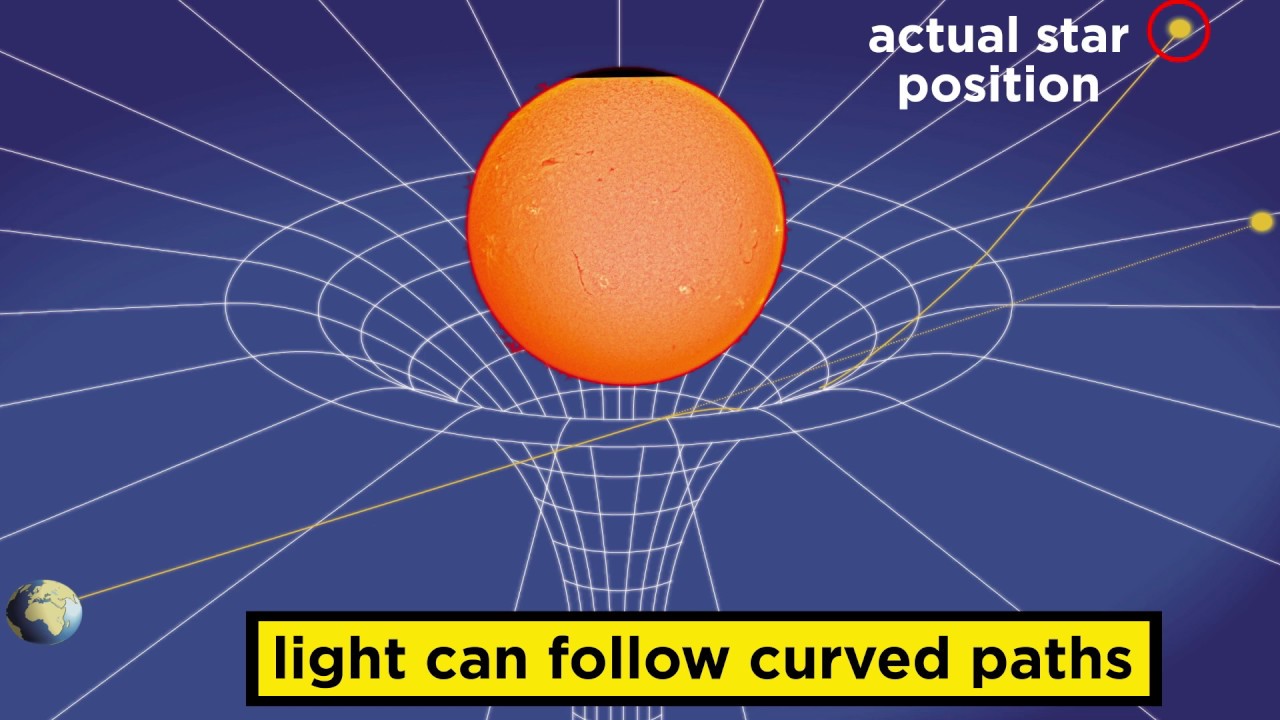
Think about light bending around the curved space of a black hole.
Light always travels in the shortest path in a straight line, it's just that the space itself is curved.
So if the earth actually had a spherical space-time, then looking out at the horizon, the light you see would actually travel all the way around the earth.
In fact, there wouldn't be a horizon anymore!
Things would be a lot weirder.
Another way to think about curvature is with tiling.
There's only three ways to tile the Euclidean plane with regular polygons: 4 squares at a vertex, 6 triangles at a vertex, or 3 hexagons at a vertex.
If you were to say, try pentagons, you'd find that there's not enough space for 4, and too much gap for 3.
But those gaps could get filled with spherical curvature. Then you have the familiar dodecahedron.
You can also do three squares around each vertex, Three triangles Four triangles Or five. Triangles Just a reminder, all these edges are straight lines.
Everything lives on that two-dimensional shell, and there's no third dimension to curve into.
We're only using it to help visualize the space.
So now let's move on to hyperbolic space.
The theme you'll see for the rest of the video is that for everything weird about spherical geometry, the opposite is true for hyperbolic geometry For example, you just saw that we could have fewer squares around each vertex compared to Euclidean space, so in hyperbolic space we can have more.
But how could you cram in another square?
Well, maybe we can do the same trick as the sphere and just bring it out into the third dimension We can! Here's how it looks. This is hyperbolic crochet, courtesy of Mrs. Parade You can see how five squares meet at every vertex now But it's still hard to visualize everything even with a 3D model, because if you try to flatten it in one area, everywhere else starts curving.
It's impossible to see it all at once, and it gets even worse as we look at bigger and bigger pieces of the hyperbolic plane.
Although it does give you a sense of how much larger hyperbolic space is compared to Euclidean And don't forget, these are all still 2D geometries that were using an extra dimension to help visualize If you want to go up to 3D spaces, then good luck trying to visualize the 3D surface of a 4D hypersphere, Or whatever this mess would look like in four dimensions.
In order to make any sense of things at this point, We're going to need a different way to visualize the hyperbolic plane.
The trick we're going to use is projection.
You're probably familiar with 3D projection. That is taking a 3D object and projecting it to your eyeball or a screen After all, you're looking at this cube on your 2D screen, but you still perceive it as 3D, even though we've completely distorted it.
I mean, this is supposed to be a square but look at all these angles.
Is the cube warped?
Of course not! It's just that projected angles and distances can change depending on where you look at it from, and what projection you use.
Similarly, we can project a curved geometry to a flat one or vice versa You're probably familiar with the Mercator projection for a sphere, but as you can tell it introduces distortions.
Greenland and Africa look about the same size here, but Africa is actually 14 times larger Unfortunately, it's impossible to map a sphere to a plane without introducing distortion, and that's why there's hundreds of different projections, because either distances, angles, areas, or shapes will get distorted.
And which compromise you want depends on the application.
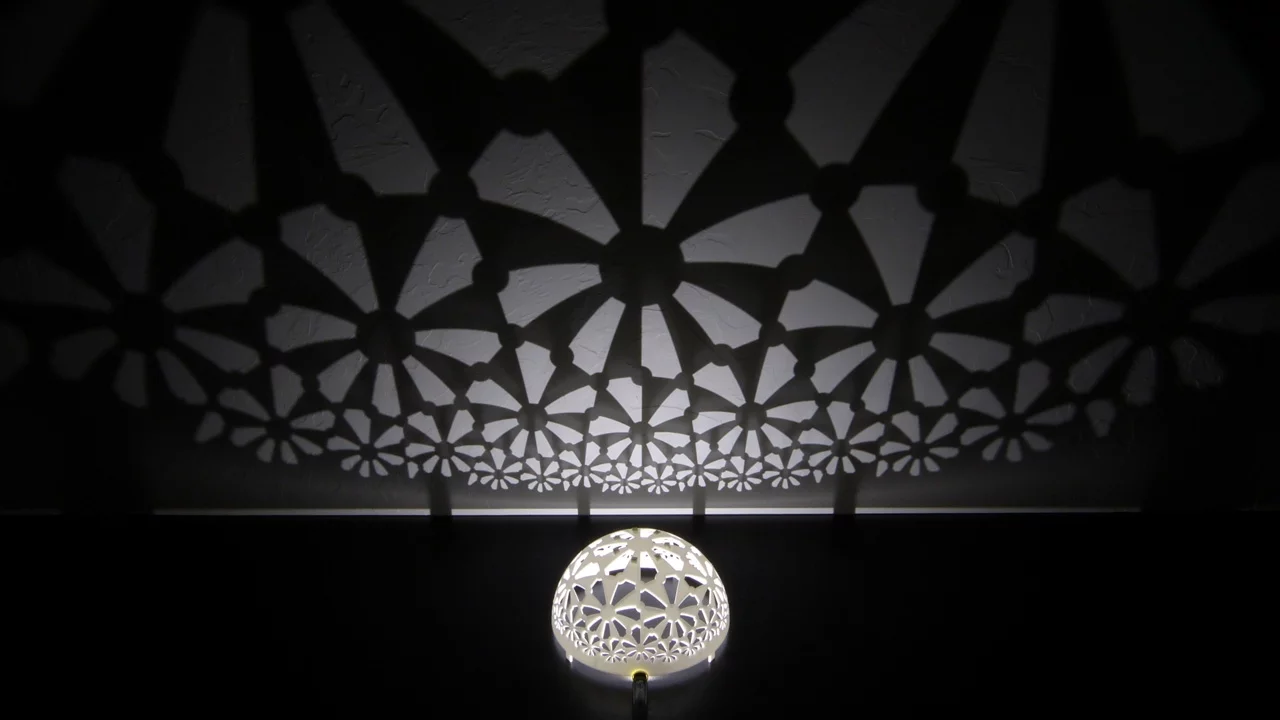
I'm going to be focusing on a very useful type of projection, stereographic projection [Text for translations]: Gnomonic Stereographic Orthographic. Top row is Hyperbolic Geometry, Bottom row is Spherical Geometry I'm not gonna go into too much detail on this because Henry Segerman already has a great video that shows how all these projections work On the spherical and hyperbolic planes using just light and shadows. It's super cool. So definitely check out that video Also, I want to thank Henry because he's been a huge help with Hyperbolica I really don't think I could have done it without him and his YouTube channel is totally underrated So go subscribe if you like things like this Okay, now that we have a better way to visualize spherical and hyperbolic space, we can start making some sense of its weird properties But first I have to talk about parallel univer— uh... I mean lines. Parallel lines.
They don't exist in a spherical space Any pair of straight lines will always converge and intersect eventually So the whole concept of two things being parallel is not a global property anymore; it's a local phenomena that only exists at a point on the line.
Remember how everything hyperbolic is the opposite of spherical?
Well, in hyperbolic space, lines will always diverge.
Remember, both of these are straight lines, just like how this is actually a square It just depends on what angle you're looking at it from So walking over to the other line will shift the perspective, to see it was straight the whole time Speaking of walking, let's take a walk on the sphere.
Let's walk up one tile, right one tile, and then down one tile.
We're back where we started and we just walked around a triangle with three right angles.
In Euclidean space a triangles angles have to sum to 180º, but in spherical space it's always larger But did you notice that something else weird happened?
We walked around without ever changing our view direction, but when we came back to the starting point, everything's been rotated 90º to the left.
This is called "Holonomy" and it's something you don't experience in Euclidean geometry.
Basically as you move around the space, you accumulate extra rotation, even if you never change the direction you're facing.
So take a guess what happens on a hyperbolic walk.
We'll walk up one tile, right one tile, Down 1 tile, left one tile, and finally up one more time.
Now we've walked on a pentagon with five right angles.
This time, the sum is less than you would expect for a Euclidian pentagon, because polygon angles have a smaller sum in hyperbolic space than Euclidean.
And we have the same Holonomy effect, but this time rotated in the opposite direction.
One last effect I want to talk about is a physical one In the real world objects are made up of smaller particles and when an object moves, all of its particles move as well But remember, there's no parallel lines in curved space So an object's particles can't actually all move in the same direction.
In spherical geometry, this means you'd experience a sort of squishing tidal force as you try to move through space This is very similar to spaghettification around a black hole, which is also caused by curved space.
And in hyperbolic space, objects experience a stretching tidal force as they move.
With enough speed and curvature, hitting a hyperbolic baseball could actually rip it apart [Rip] Okay, let's switch over to some formulas.
How would a curved space affect the circumference of a circle?
It's 2πr in Euclidean space But it's 2π sin(𝑟) in spherical space It should kind of make sense why this is true as the radius gets larger It reaches a maximum circumference, then shrinks down to 0 and repeats cyclically Want to guess what the hyperbolic opposite is?
It's hyperbolic sine, of course!
And this is another really good example of just how large hyperbolic space is Because this is basically an exponential here That means it could take a million times longer to walk around a circle than it would to just walk across it the area of a circle also has similar formulas.
Again, area is exponential for hyperbolic space, but interestingly, it grows at the same rate as the circumference, unlike Euclidean space where it grows as the square.
But, the Pythagorean formula also has really beautiful analogues in curved space.
Finally, this was one of the coolest formulas and there's no Euclidean version of it.
In a unit curved space, you can find the area of any triangle given only its angles, and the formula is so simple!
For spherical space, it's just as sum of the angles minus Pi, that's it!
And hyperbolic space, it's Pi minus a sum of the angles. Isn't that neat?
And there's a good insight from this formula Since the sum is always less than 180º in hyperbolic space it means there's actually a maximum possible area a triangle can have, and that's when all the angles are zero degrees and the area is Pi.
It happens because all lines eventually diverge So if you tried to make the triangle any larger, the edges would never be able to intersect at a vertex.
So I hope that's given all of you a little better understanding of curved spaces, in the next video, I'm gonna talk more about three-dimensional spaces, how I'm able to render them in Unity, and some of the really cool math behind it If you want to build even more intuition about hyperbolic space in the mean time, there's also HyperRogue.
It's one of the only other hyperbolic games out there right now, and it's worth checking out! Link is in the description.
So thanks for coming on this journey and stay hyperbolic!
[Music]
Up Next

35:14
Sum of Angles in Triangles: Curved Surfaces & Curvature | Riemann Geometry
@nptel-indianinstituteofsci8064
2.8K views•2025-12-24
4:43
Elliptic Curve Cryptography Explained: ECC, ECDSA, ECDH
@PracticalNetworking
28.5K views•2024-10-21
4:00
Understanding Spherical Geometry: From Flatland to 3D Spaces
@CodeParade
1.8M views•2020-07-28
6:00
The Mathematical Impossibility of Accurate World Maps
@Vox
23.3M views•2016-12-02
Related Study Plans & Knowledge Roadmaps
Structured learning paths in Mathematics
mathematics
Tensor Calculus: Vectors to Riemann Curvature
01Mathematical Foundations: Linear Algebra & Calculus
02Covectors, Dual Spaces, and Tensor Basics
03The Metric Tensor and Index Gymnastics
+ 2 more learning modules
40h5 modules
Explore Roadmap
mathematics
Gödel's Incompleteness: Logic, Proofs & Limits
01Introduction to Formal Systems & Hilbert's Dream
02Set Theory, Cardinality, and Cantor's Diagonal Argument
03Arithmetization and Gödel Numbering
+ 2 more learning modules
14h5 modules
Explore Roadmap
mathematics
Galois Theory: Fields, Groups & Solvability
01Foundations of Abstract Algebra: Groups & Fields
02Polynomials & Field Extensions
03Splitting Fields & Symmetries
+ 2 more learning modules
24h5 modules
Explore Roadmap
mathematics
Non-Euclidean Geometry: Models & Geodesics
01Euclid's Fifth Postulate and the Birth of New Geometries
02Hyperbolic Space and the Poincaré Disk Model
03Geodesics: Defining Straight Lines in Curved Spaces
+ 2 more learning modules
15h5 modules
Explore Roadmap