

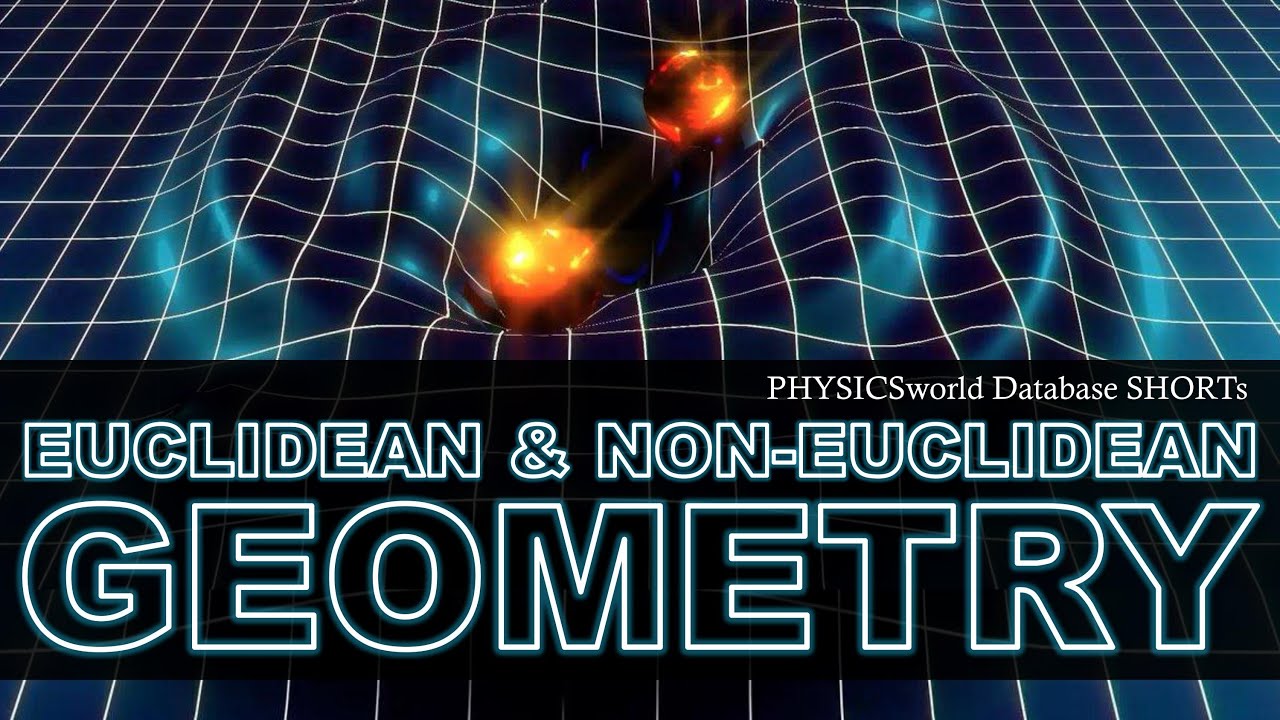

















Hyperbolic geometry can be visualized through multiple models (Poincaré disk, upper half-plane, hemisphere, and Klein models) that project the hyperbolic plane onto the Euclidean plane; these models differ in how they preserve or distort geometric properties, with stereographic projection preserving angles while distorting lengths, and orthogonal projection transforming geodesics into straight lines but distorting both lengths and angles.
Hyperbolic Geometry Models via Stereographic and Orthogonal Projections
Added:Basic concepts of non-Euclidean geometry, specifically how hyperbolic geometry differs from Euclidean geometry regarding the parallel postulate.
The fundamentals of geometric projections, particularly stereographic projection from a sphere to a plane and orthogonal projection.
Elementary differential geometry, including the concept of a metric tensor, conformal (angle-preserving) maps, and distortion.
Familiarity with the sphere as a geometric manifold and basic coordinate systems on curved surfaces.
Establishing the formal mathematical transformations and isometries between the Beltrami-Klein model, the Poincaré disk model, and the hyperboloid model.
Analyzing geodesics (straight lines) and computing distances, angles, and area of triangles within different hyperbolic models.
The study of isometry groups of the hyperbolic plane, focusing on Möbius transformations and the projective special linear group PSL(2, R).
Real-world applications of hyperbolic geometry, such as modeling spacetime in special relativity (Minkowski space) and hierarchical data representation in machine learning (hyperbolic embeddings).
255.6K views11.3Klikes4:26Original Release: 2015-12-14
— Hi, my name is Henry Segerman. — And I'm Saul Schleimer.
The best way to represent the surface of the earth is with a globe.
However, flat maps are much more convenient.
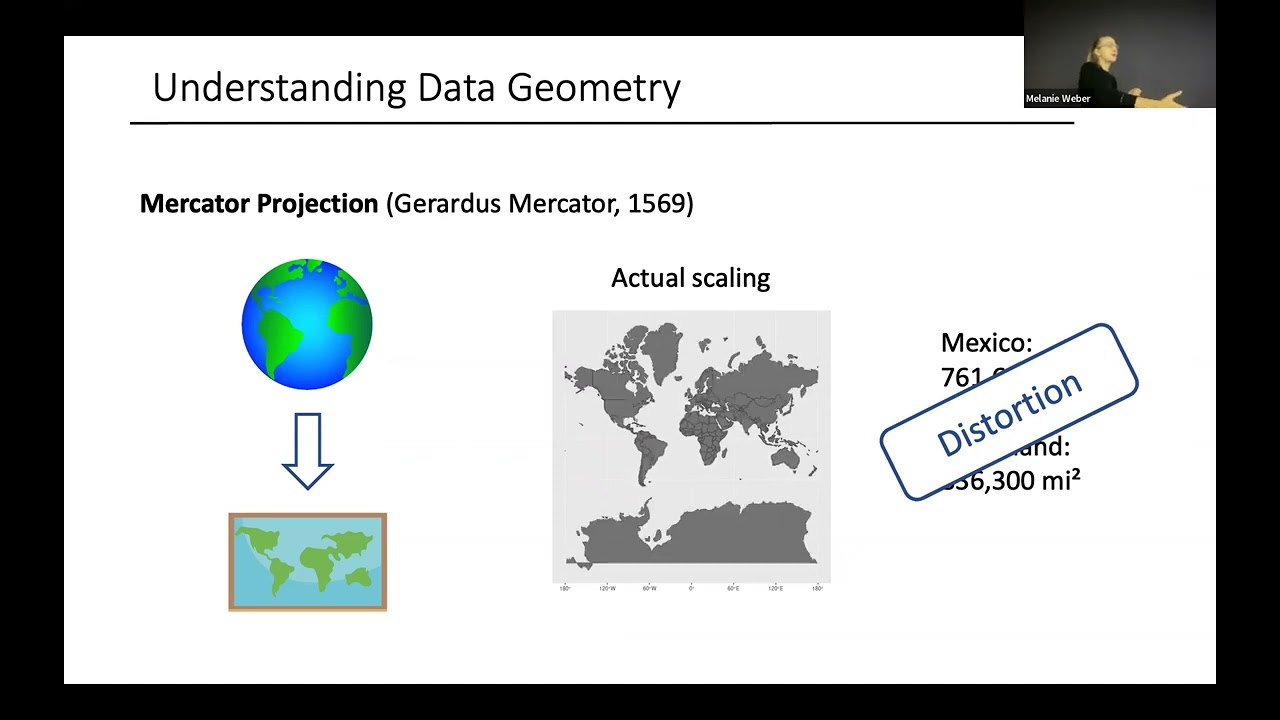
The most familiar map is the Mercator projection.
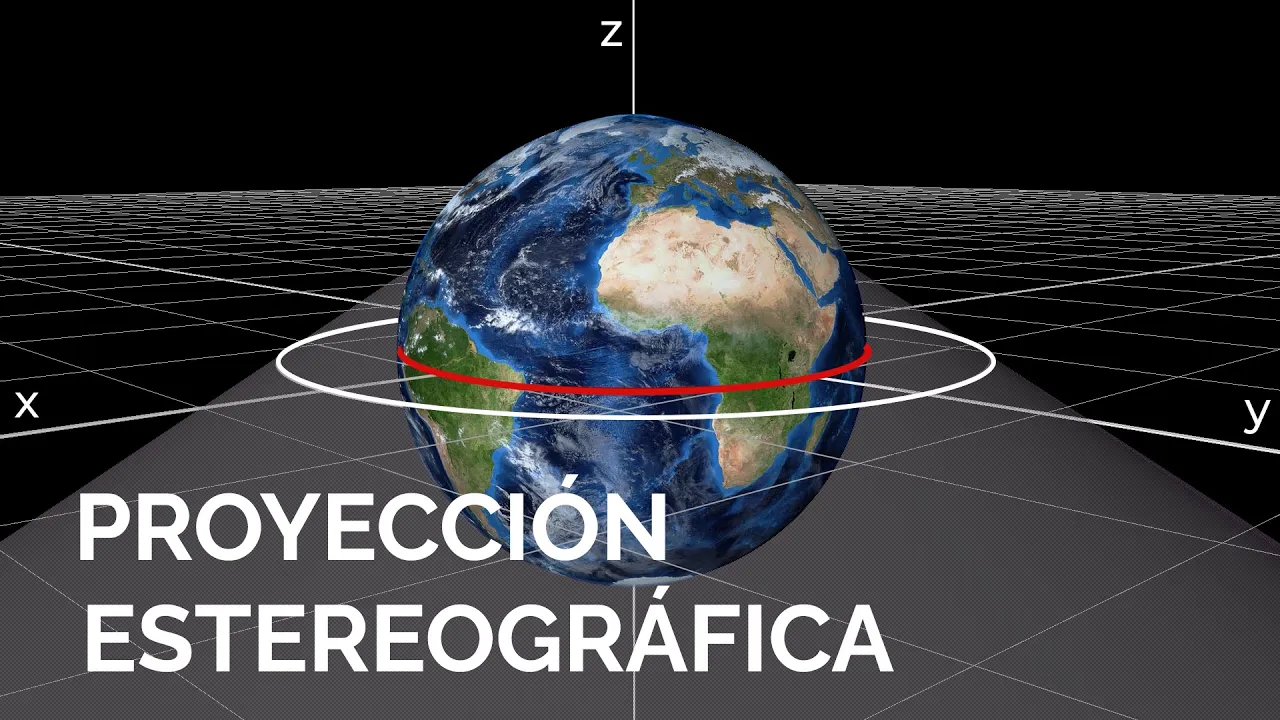
Another, less common map, is stereographic projection.
All maps distort the sphere in some way.
This is not an accident.
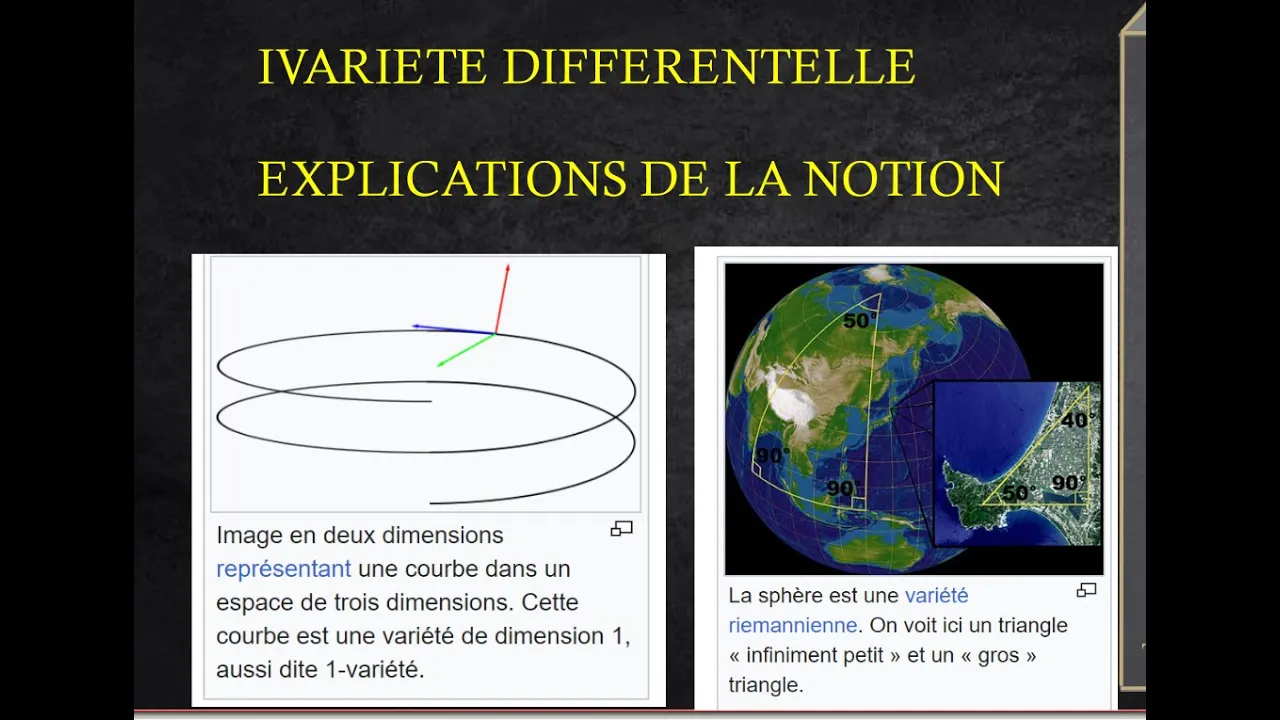
It happens because the sphere is round, that is, has positive curvature, while the Euclidean plane is flat. It has zero curvature.
The natural question is: “What is a plane with negative curvature?” This question leads us to the Lobachevsky, or hyperbolic, plane.
One way to see a piece of the hyperbolic plane is to build the pseudosphere.
However, the theorem of Hilbert tells us that there's no way to faithfully place all of the hyperbolic plane inside 3-space.
There always has to be an edge, for example here at the bottom of the pseudosphere.
If we want to see all of the hyperbolic plane, we have to use maps, just like we use maps of the sphere to the Euclidean plane.
The best-known map or “model” of the hyperbolic plane is the Poincaré disk model.
This was first discovered by Beltrami.
To understand this model, let's go back to the sphere for a bit.
This sphere is 3D printed with a tiling by identical triangles.
When we stereographically project the tiling to the Euclidean plane, sizes are distorted; the triangles here look much bigger than the ones here.
Let's compare the sphere tiling to a tiling of the hyperbolic plane.
We can't see the true hyperbolic plane, we can only see the model.
All the triangles are identical, even though they look different in the model.
Before we continue, we should really say what a triangle is.
It is a figure with three sides, each of which is a geodesic; that is, a shortest path between nearby points.
On the sphere, geodesics are great circles.
For example, the equator is a great circle.
Note that any pair of great circles meet exactly twice.
In the Euclidean plane geodesics are ordinary straight lines.
Note that now geodesics are either meet once or meet zero times; that is, they are parallel.
In the Poincaré disk model the geodesics are straight lines through the center or arcs of circles that perpendicular to the boundary of the disk.
Here the string doesn't tell us where the geodesics are.
Again, this is because we can only see the distorted projection, not the true geometry.
In the hyperbolic plane, geodesics can only meet once - meet once at the boundary, or meet zero times.
Although lengths are distorted, angles are still correctly represented.
This is just like stereographic projection from the sphere to the plane.
There are many other ways to represent the hyperbolic plane inside Euclidean space.
Here's a 3D printed hemisphere model.
In this model, geodesics are intersections of the hemisphere with vertical planes, giving circles perpendicular to the boundary.
Again, lengths are distorted, but angles are correct.
We can get the Poincaré disk model from the hemisphere model using stereographic projection.
Another well-known model is the upper half-plane model, again first discovered by Beltrami.
It is also obtained by stereographic projection.
The geodesics are vertical lines and semi-circles hitting the boundary at right angles.
Once again, lengths are distorted, but angles are correct.
A fourth model of hyperbolic geometry is the Klein model.
This was again first discovered by Beltrami.
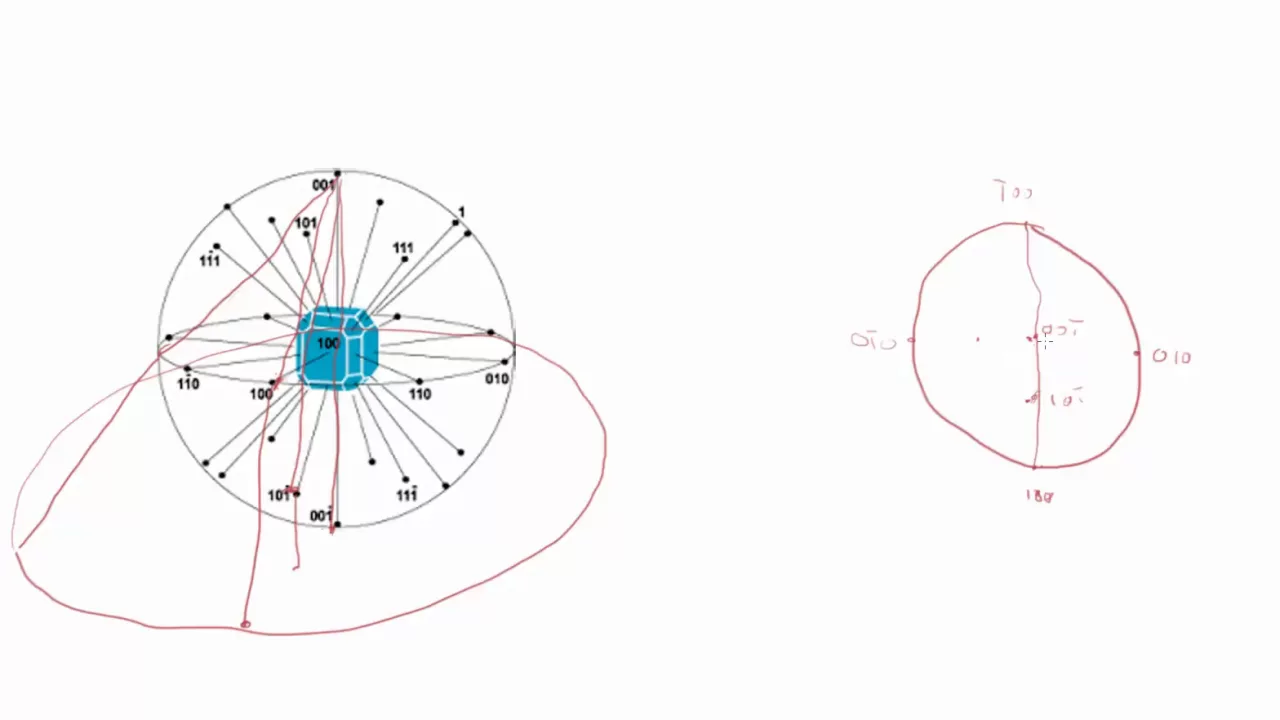
To get the Klein model from the hemisphere model, we need to use orthogonal projection instead of stereographic projection.
That is, we need to use light rays that come in parallel instead of coming out of a point.
Now, light rays come from very far away are essentially parallel. So, we're gonna use the sun.
We've set up this white board to be orthogonal to the rays of the sun.
So I put the hemisphere model on it, and I pull it off, and underneath we see the Klein model.
Notice that the Klein model lives in a disk, just like the Poincaré disk model, and it distorts distances very badly towards the boundary.
It also distorts angles. You can see how circles are turned into ovals.
One very nice feature of the Klein model, however, is that hyperbolic geodesics are Euclidean straight lines.
The Klein model is similar to another projection of the sphere to the Euclidean plane.
We can get the “gnomonic” projection using a point light source at the center of the sphere.
As in the Klein model, neither lengths nor angles are correct, but again, geodesics are ordinary straight lines.
Here's a version of a diagram from a paper of Cannon, Floyd, Kenyon, and Parry.
It shows how the four models are related by stereographic and by orthogonal projections.
Thanks for watching.
Up Next

7:16
The History of Non-Euclidean Geometry: Euclid's Fifth Postulate Explained
@extrahistory
1.8M views•2018-05-26
4:43
Elliptic Curve Cryptography Explained: ECC, ECDSA, ECDH
@PracticalNetworking
28.5K views•2024-10-21
10:44
Fourier Series Introduction: The Big Idea Explained
@DrTrefor
387K views•2021-05-03
6:00
The Mathematical Impossibility of Accurate World Maps
@Vox
23.3M views•2016-12-02
Related Study Plans & Knowledge Roadmaps
Structured learning paths in Mathematics
mathematics
Tensor Calculus: Vectors to Riemann Curvature
01Mathematical Foundations: Linear Algebra & Calculus
02Covectors, Dual Spaces, and Tensor Basics
03The Metric Tensor and Index Gymnastics
+ 2 more learning modules
40h5 modules
Explore Roadmap
mathematics
Gödel's Incompleteness: Logic, Proofs & Limits
01Introduction to Formal Systems & Hilbert's Dream
02Set Theory, Cardinality, and Cantor's Diagonal Argument
03Arithmetization and Gödel Numbering
+ 2 more learning modules
14h5 modules
Explore Roadmap
mathematics
Galois Theory: Fields, Groups & Solvability
01Foundations of Abstract Algebra: Groups & Fields
02Polynomials & Field Extensions
03Splitting Fields & Symmetries
+ 2 more learning modules
24h5 modules
Explore Roadmap
mathematics
Non-Euclidean Geometry: Models & Geodesics
01Euclid's Fifth Postulate and the Birth of New Geometries
02Hyperbolic Space and the Poincaré Disk Model
03Geodesics: Defining Straight Lines in Curved Spaces
+ 2 more learning modules
15h5 modules
Explore Roadmap