






![Geometrinin Babası : Öklid [Eukleides ]](https://i.ytimg.com/vi/VoQItpNWopA/hqdefault.jpg?sqp=-oaymwEmCOADEOgC8quKqQMa8AEB-AHUBoAC4AOKAgwIABABGHIgUyg7MA8=&rs=AOn4CLBhfSwNCD7HmTPWorpPluBWtQGJ6w)




![[지식in] 비유클리드 기하학이란?](https://i.ytimg.com/vi/wmZqOQVzigo/hqdefault.jpg)






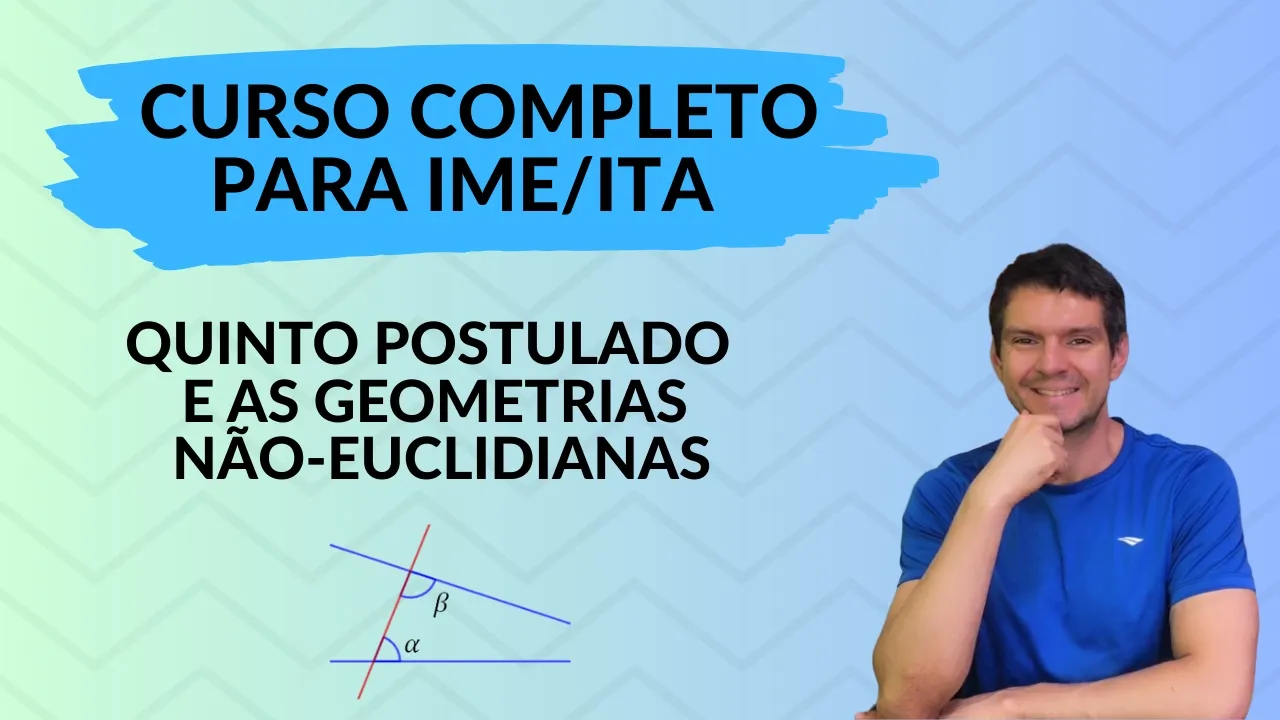
Euclid's Fifth Postulate, which states that if a straight line falling across two straight lines makes internal angles on the same side less than two right angles, those lines will eventually meet on that side, has been a central mystery in mathematics for over 2,000 years because it feels unlike the other simple postulates and seems like it should be provable rather than assumed, ultimately leading to the development of non-Euclidean geometries.
The History of Non-Euclidean Geometry: Euclid's Fifth Postulate Explained
Added:Familiarity with basic Euclidean geometry, specifically the concepts of parallel lines, angles, and the properties of triangles.
An understanding of axiomatic systems in mathematics, including the distinction between axioms, postulates, and theorems.
Basic knowledge of Euclid's 'Elements' and how it established the foundational framework for deductive reasoning.
Familiarity with the logical method of proof by contradiction (reductio ad absurdum), which played a major role in historical attempts to prove the fifth postulate.
Study of Hyperbolic Geometry (Bolyai-Lobachevsky geometry), where the fifth postulate is modified to allow infinitely many parallel lines through a given point.
Study of Elliptic and Spherical Geometry, where parallel lines do not exist and the sum of angles in a triangle is greater than 180 degrees.
The application of non-Euclidean geometry in modern physics, particularly in Albert Einstein's General Theory of Relativity to describe the curvature of spacetime.
An introduction to Differential Geometry, examining how curvature is calculated mathematically on complex surfaces and multidimensional manifolds.
1.8M views39.7Klikes7:16Original Release: 2018-05-26
From the Nile and the Euphrates Flowed knowledge of an art on which so many other arts are based. From the Fertile Crescent up to Greece mathematics began to flow Sometime in the 6th century BCE, the great Geometer, Pythagoras of Samos went to Egypt He returned even more fascinated with geometrical ideas than he had been when he had left He knew there was wisdom and possibilities he had to share He saw geometry as part of a larger whole. Part of a philosophy about the perfection of the Universe He needed to share this too and he knew how to do it.
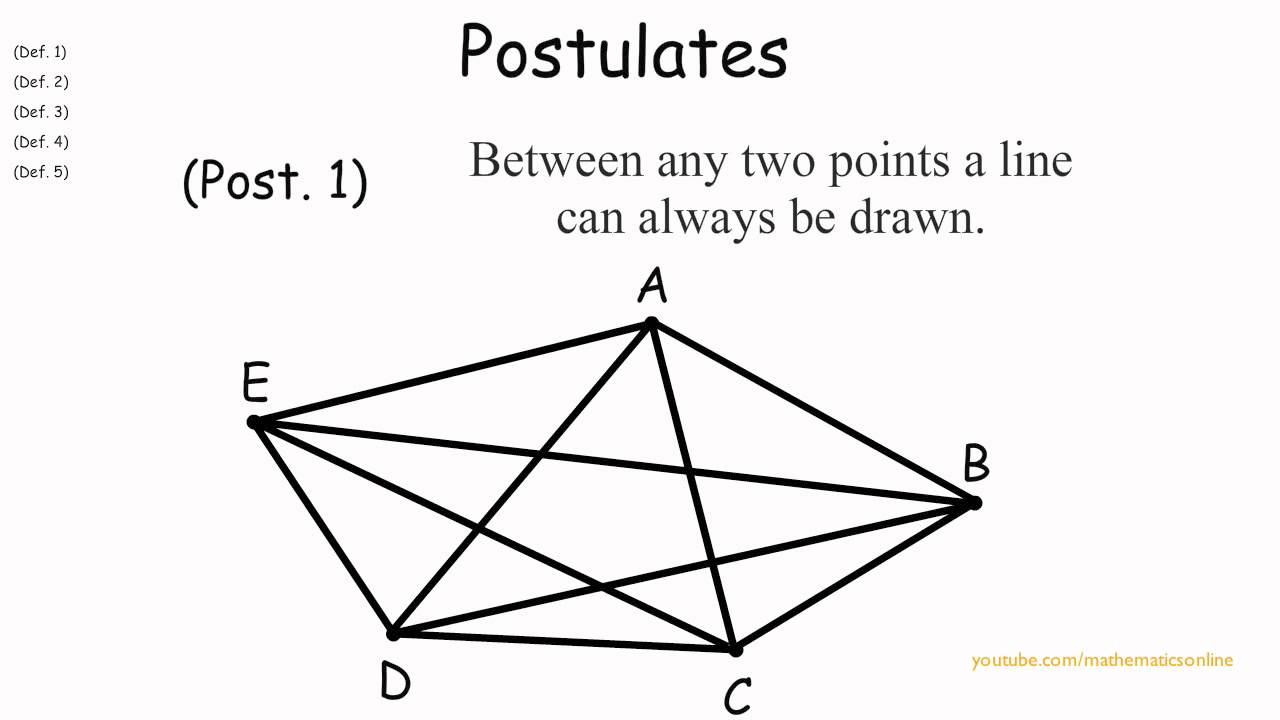
He envisioned the study of geometry as one of the disciplines that would lead a human being to be more in touch with the true perfection of the universe So he went to Magna Graecia. The Greek colonies in what we would now call Italy and set up a mystery cult to study philosophy and practice the sacred art of Geometry and his cult did great But the thing about mystery cults is well, they like their mysteries So they're not always great at you know Writing a bunch of stuff down, thus while the pythagoreans Taught and shared their knowledge and weren't nearly as secretive as most of these groups They were more interested in the philosophy of Pythagoras and the ways Mathematics pointed to a beautiful perfection underlying the universe than they were in providing a unified mathematical system So enter Euclid, a figure we know surprisingly little about, but whose work had a nearly indescribable impact on human history Euclid wrote a book or rather in the parlance of the time thirteen books called the elements for over two thousand years this work would stand as the height of logical rigor This book right here is the root of almost all mathematics Modern Geometry, Algebra Calculus, all of them founded in this work to this day It is the second most republished work in history after the Bible. In this book Euclid brought together all of the geometric knowledge of the Ancient World transcribing the discoveries of the Pythagoreans and others and extending them adding his own proofs and discoveries to this great catalogue of the known But what makes this work truly one of the pinnacles of human achievement is how he put it together how it was organised because the book begins with a small number of definitions, postulates, and common notions and says that with those everything else, every single thing in Geometry Follows logically. He then organises his proofs, the various geometric problems he presents so that they all build off of one another No proof in the entire book will require knowledge beyond those initial definitions and the proofs that came before it.
Showing just how far we can go with a few simple ideas the elements is the Foundation of mathematical thinking and in a lot of ways the foundation for how we think of logic today. It was a huge achievement But there was one small issue That bothered some of those studying this text. An issue that appears to have bothered even Euclid himself And that was the 5th Postulate. Most of the postulates in the book are fairly simple and straightforward They say things like you can draw a straight line between any two points or all right angles are equal But the fifth postulate is not simple in the slightest It's more complex and it just feels different than any of the rest. How complex is it?
Well, The 5th Postulate states, quote "If a straight line falling across two straight lines makes internal angles on the same side less than two right angles The two straight lines if produced indefinitely meet on that side on which are the angles less than two right angles."
*UGH! That felt gross to say. Feels a lot messier than all right angles are equal to one another right?
So let's just break it down real quick. A straight line falling across two straight lines Okay.
That's just a lines crossed by two other line somewhere. "Makes internal angles on the same side less than two right angles." and this is basically saying if the internal or Interior angles, these angles which face each other right here made by the two lines crossing that third line add up to less than two Right angles or 180 degrees, "Then the two straight lines if produced indefinitely meet on the side where the angles are less than two right angles, so, okay.
If that thing I said about the interior angles before is true, then if you extend those two lines forever They are going to intersect at some points on the side where the interior angles are less than right angles so putting all that together, if you draw a line and you have two other lines cross it if their Interior angles add up to less than 180 degrees Those lines are eventually going to intersect if you draw them out far enough or put even more simply lines angled towards each other are going to Intersect if you draw them out far enough and when you put it that way it actually seems kind of obvious, right?
In fact, we are so used to that concept that it barely even seems worth annunciated But Euclid was nothing if not thorough and hidden in this concept is another All-important one because let's look at those two lines crossing the third line again. What are the possibilities here?
Well, if their interior angles on a side are less than 180 degrees We already know they're going to meet but what if they are greater than 180 degrees?
Well, then the interior angles on the other side are gonna be less than 180 degrees, right?
So they're just gonna intersect on that side It's basically the same thing just flipped around, but what happens if the two angles add up to exactly 180 degrees? Well Then by this schema those lines would never meet. What this postulate actually does is define what we today call Parallel lines, but we know that this postulate was a problem even for Euclid it's the last postulate he puts in the book and even after he's Enunciated it He goes about proving almost every single thing that can be proven in geometry Without it before at last relying on Postulate 5 to build the rest of what we think of as standard Geometry today And he wasn't alone in being bothered by Postulate 5's weirdness for over 2,000 years, Postulate 5 would bug people. It feels like it should be a proposition not a postulate It feels like there should be a logical proof for it And if we could make such a proof, then all of geometry truly would be consistent The last lingering question would be answered and we really would have that beautiful system that the Pythagoreans Desired so much but if Euclid couldn't find a solution to Postulate 5, who could?
Find out next time as we explore all the ways people built off of Euclid and all the different attempts people made to reconcile this one last tiny piece of our perfect Geometry.
[End Music]
Up Next

31:10
The Parallel Postulate: How Euclid's Fifth Axiom Revealed Hidden Universes
@veritasium
16.9M views•2023-10-21
4:43
Elliptic Curve Cryptography Explained: ECC, ECDSA, ECDH
@PracticalNetworking
28.5K views•2024-10-21
7:52
Non-Euclidean Geometry History: Bolyai, Lobachevsky, and Riemann Explained
@extrahistory
994.4K views•2018-06-16
6:00
The Mathematical Impossibility of Accurate World Maps
@Vox
23.3M views•2016-12-02
Related Study Plans & Knowledge Roadmaps
Structured learning paths in Mathematics
mathematics
Tensor Calculus: Vectors to Riemann Curvature
01Mathematical Foundations: Linear Algebra & Calculus
02Covectors, Dual Spaces, and Tensor Basics
03The Metric Tensor and Index Gymnastics
+ 2 more learning modules
40h5 modules
Explore Roadmap
mathematics
Gödel's Incompleteness: Logic, Proofs & Limits
01Introduction to Formal Systems & Hilbert's Dream
02Set Theory, Cardinality, and Cantor's Diagonal Argument
03Arithmetization and Gödel Numbering
+ 2 more learning modules
14h5 modules
Explore Roadmap
mathematics
Galois Theory: Fields, Groups & Solvability
01Foundations of Abstract Algebra: Groups & Fields
02Polynomials & Field Extensions
03Splitting Fields & Symmetries
+ 2 more learning modules
24h5 modules
Explore Roadmap
mathematics
Non-Euclidean Geometry: Models & Geodesics
01Euclid's Fifth Postulate and the Birth of New Geometries
02Hyperbolic Space and the Poincaré Disk Model
03Geodesics: Defining Straight Lines in Curved Spaces
+ 2 more learning modules
15h5 modules
Explore Roadmap