
















A single line in Euclid's 'Elements'—the fifth postulate about parallel lines—was questioned for over 2,000 years until mathematicians realized it could be modified to create entirely new geometries; these non-Euclidean geometries, including hyperbolic geometry discovered by János Bolyai and spherical geometry, became essential to Einstein's general relativity, which describes how massive objects curve spacetime and how we can determine the universe's flat geometry by measuring cosmic microwave background radiation.
The Parallel Postulate: How Euclid's Fifth Axiom Revealed Hidden Universes
Added:Euclid's Elements and the axiomatic method: Understanding how mathematical systems are constructed from foundational, unproven assumptions (axioms and postulates).
Basic Euclidean Geometry: Familiarity with the concepts of points, lines, planes, and the classical definition of parallel lines in a flat two-dimensional plane.
The nature of mathematical proof: Knowing how theorems are logically derived from initial axioms using deductive reasoning.
Hyperbolic and Elliptic Geometries: Exploring the specific, non-flat geometric models created by altering Euclid's fifth postulate (e.g., spherical geometry and saddle-shaped spaces).
Differential Geometry and Curvature: Studying Riemann's generalization of geometry to higher dimensions and how mathematical curvature is defined intrinsically.
Einstein's General Theory of Relativity: Learning how gravity is described not as a force, but as the geometric warping and curvature of four-dimensional spacetime.
Physical Cosmology: Investigating how astrophysicists use the cosmic microwave background and other data to determine the actual geometric shape and ultimate fate of our universe.
16.9M views324.6Klikes31:10Original Release: 2023-10-21
(dramatic music) - [Derek] A single sentence in one of the oldest math books held the key to understanding our universe.
Euclid's "Elements" has been published in more editions than any other book except the Bible.
It was the go to math text for over 2,000 years.
But for all that time, mathematicians were skeptical of a single line which seemed like a mistake.
Ultimately, some of the greatest math minds realized that Euclid wasn't wrong after all, but there was more to the story.
Slight tweaks to this line opened up strange new universes out of nothing.
Surprisingly, 80 years later, we found out those strange new universes are core to understanding our own universe.
(contemplative music) Around 300 BC, the Greek mathematician, Euclid, takes on a massive project to summarize all mathematics known at the time, to essentially create the one book that contains everything that everyone knows about mathematics.
But that's no easy task.
See, before Euclid, there was a bit of a problem with math.
- People would prove things, but they would just be going around in circles.
"Why does a triangle have 180 degrees?"
"'Cause if you take two parallel lines -" "Yeah, but why do parallel lines exist?"
"Oh, that's because you can make a square.
"Why does a square exist?"
You have this infinite recursion of what the fundamental reason why something is true is.
- [Derek] It's kind of like in the dictionary, every word is defined in terms of other words, so how do you get to ground truth?
Euclid used a solution that was pioneered by the Greeks.
Let's just accept a few of the most simple, basic things as being true, these are our postulates.
Then, based upon these postulates, we can prove theorems one at a time, building up our math using logic, so that as long as those first statements are true, then everything else that follows from them must definitely be true.
He had perfected the gold standard for rigorous mathematical proof that all modern math relies on.
Euclid used this method when he published his 13 book series called, "The Elements," in which he proved 465 theorems, covering almost all of mathematics known at the time, including geometry and number theory.
And all these theorems depended on were some definitions, a few common notions, and five postulates.
- We go right to book one, and book one starts with definitions, you gotta start somewhere.
And the definition is, "A point is that which has no part.
A line is a breadthless length."
And, "The ends of lines are points."
By line, he really means a curve, and then it has some ends.
"A straight line is a line that lies evenly within the points on itself."
And then so on, and so forth.
He's got 23 definitions, then he's got the five postulates.
(energetic music) - [Derek] The first four are simple.
One, if you have two points, you can draw a straight line between them.
Two, if you have a straight line, you can extend it indefinitely.
Three, given a center and a radius, you can draw a circle.
And the fourth is that all right angles are equal to each other.
- [Alex] But postulate five gets the big guns.
- [Derek] Which is that, if a straight line falling on two straight lines makes the interior angles on the same side less than two right angles, the two straight lines, if produced indefinitely, meet on that side, on which are the angles less than the two right angles.
- What the hell is he talking about?
That's a postulate?
Like all of these are, you know, half of a sentence, and they're all blatantly obvious.
And then comes five, out of left field, and it's like an entire paragraph.
What is he doing?
(contemplative music) - [Derek] This made mathematicians suspicious; it seemed like Euclid made a mistake.
Greek philosopher Proclus thought Postulate 5 ought even to be struck outta the postulates altogether, for it is a theorem.
But if it's a theorem, we should be able to prove it from the first four postulates, so that's what many people tried.
Some, including Ptolemy and Proclus, believed they had succeeded, but they hadn't.
In fact, all they'd managed to do was just restate Postulate 5 in different words.
Here's one formulation.
If you have a line, and a point that is not on that line, then there is a single unique line which will be parallel to the first line.
For this reason, the fifth postulate is often called the Parallel postulate.
(contemplative music) When the method of direct proof failed, other mathematicians, including al-Haytham and Omar Khayyam, tried a different approach, proof by contradiction.
The idea is simple, you keep the first four postulates the same, but assume that the fifth postulate is false.
Then you use those new postulates to prove theorems, and if that leads to a contradiction, for example, true equals false, well, then it means your new fifth postulate must be wrong.
And, therefore, the only remaining option would be that Euclid's version of the fifth postulate is correct, and you would've proven the fifth postulate.
So, what would it look like if the fifth postulate were false?
Well, according to Euclid, through a point not on a line, there could only be one line that is parallel to the first.
One alternative is that there are no parallel lines that you could draw through that point.
- Well, people tried that, and they realized that thin lines had to be finite in length.
And they're like, "Well, that can't be."
- [Derek] So this option was ruled out, it contradicted the second postulate, which states that lines can be extended indefinitely.
The other alternative is that you can draw more than one parallel line through a point not on the first line.
- So that's what they would do, they would assume the postulate five fails, and they're like, "This has gotta be wrong. Where's the contradiction?"
They couldn't find the contradiction.
(intense acoustic music) - [Derek] So proof by contradiction also failed.
In total, mathematicians spent more than 2,000 years trying to prove the fifth postulate, but everyone who tried failed.
(contemplative music) Then, around 1820, János Bolyai, a 17 year old student, started spending his days and nights working on the mystery.
His father became worried, and he wrote to his son, "You must not attempt this approach to parallels.
I know this way to the very end, I have traversed this bottomless night, which extinguished all light and joy in my life.
I intrigue you, leave the science of parallels alone.
Learn from my example."
But the young Bolyai didn't listen to his father, he could not leave the science of parallels alone.
After years of work, he realized that maybe the fifth postulate can't be proven from the other four, it could be completely independent.
(soft music) See, according to Euclid, you could have only one parallel line through a point.
But Bolyai imagined a world where there could be more than one parallel line through that point.
But how?
Well, who said you needed to have a flat surface?
On a surface that is curved like this, you can draw more than one line that is parallel to the original line.
But wait a second, those lines don't look straight.
Well, what makes straight lines special is that they're the shortest paths between two points.
On this surface, those shortest paths just look bent, because the surface is curved.
Here's a more familiar example.
Airplanes always try to fly the shortest path between two cities, they're basically flying in a straight line, but that line doesn't look straight on a map because the surface is curved.
These shortest paths on curved surfaces are called geodesics.
So, all these lines are straight, they just don't look it, because the world Bolyai had imagined turned out to be curved.
We now know this as hyperbolic geometry.
- You know, when I used to think of the hyperbolic plane, I would just imagine it as one giant saddle.
But that's not really what it is, the hyperbolic plane is much more like this piece of crocheting.
So, it starts out pretty flat and even in the middle, but as you move outwards, more and more fabric is created, and that would push parallel lines apart.
And the further and further out you go, the amount of fabric grows exponentially, and that ends up causing this crumpling effect.
So if you really wanna think about the hyperbolic plane, I think you've gotta think about saddles, on saddles, on saddles, like it's a infinite crumpling mess.
(soft music) - [Derek] But that little piece of crochet isn't the full hyperbolic plane.
To show that, we need to make a map, one that fits the entire plane into a disc.
To show how this works, we're gonna fill the entire plane with these triangles.
Starting in the middle, just as with the crochet, things look pretty normal, but as you go farther out from the center, you get all this extra space, so you can fit more and more triangles.
So they appear smaller, but they are actually the same size.
Now, since the hyperbolic plane is infinite, you can keep adding triangles forever, and they all need to fit on the disk.
So as you get closer to the edge, the triangles will appear smaller, and smaller, and smaller, infinitely smaller, never ending, and you can never quite reach the edge.
This is known as the Poincare Disk Model.
Here, straight lines are arcs of circles that intersect the disc at 90 degrees, and just like on our original shape, a straight line down the middle appears straight, while straight lines next to it appear to curve away.
What's remarkable is that Bolyai didn't have a model of hyperbolic geometry yet, he was just drawing Euclidean triangles with the assumption that Euclid's fifth postulate didn't hold.
And while Bolyai found that the behavior in hyperbolic geometry is very different than Euclid's, mathematically, it seemed just as consistent.
(soft music) In 1823, the 20-year-old János wrote to his dad, "I have discovered such wonderful things that I was amazed.
Out of nothing, I have created a strange new universe."
(contemplative music) But Bolyai had been doing more than just tackling ancient math mysteries.
In his twenties, he joined the army, where he continued developing two of his other passions, playing the violin and dueling.
He had mastered both, but with a sword in particular, he was unmatched.
Perhaps because of his many talents, Bolyai grew arrogant, and found it difficult to accept authority from his superiors.
That made him hard to get along with.
This reached a peak when, during one of his deployments, 13 cavalry officers from his garrison challenged him to a duel.
Bolyai accepted their challenge, on the condition that after every two duels, he could play for a little while on his violin.
Bolyai fought each of them in succession, winning all 13 duels, and leaving behind all his adversaries on the square.
While Bolyai loved dueling, his first love was still mathematics.
In 1832, 9 years after he discovered his strange new universe, he published his findings as a 24 page appendix to his father's textbook.
Extremely proud and excited about his son's work, Farkas Bolyai sent it to perhaps the greatest mathematician of all time, Carl Friedrich Gauss.
After careful examination, Gauss replied a few months later, "To praise it would amount to praising myself for the entire content of the work coincides almost exactly with my own meditations, which have occupied my mind for the past 30 or 35 years."
(soft music) Years earlier, Gauss had wandered a similar path.
In 1824, he wrote a private letter to one of his friends, in which he describes discovering a curious geometry, one with paradoxical, and to the uninitiated, absurd theorems.
For example, Gauss writes, "The three angles of a triangle become as small as one wishes, if only the sides are taken large enough.
Yet the area of the triangle can never exceed a definite limit."
In other words, you can have a triangle that's infinitely long, but the area is finite.
You can see why by using the Poincare disk model.
A small triangle looks pretty ordinary, but as you make it bigger, the angles start to become smaller and smaller.
Eventually, all those angles go to zero, because all these lines intersect the disk at 90 degrees.
Now, these lines are infinitely long, but because of the geometry, the area is finite.
In the same private letter, Gauss wrote, "All my efforts to discover a contradiction and inconsistency in this non-Euclidean geometry have been without success."
Just like Bolyai, Gauss had found that this geometry seemed thoroughly consistent.
He named it non-Euclidean geometry, a name that stuck.
It describes geometries where Euclid's first four postulates hold, but the fifth doesn't.
But Gauss decided not to publish his findings for fear of ridicule.
This aversion to a different kind of geometry should at least be a little surprising, because there is one other geometry that we should be very familiar with, spherical geometry, since we all live on a sphere.
(soft music) On a sphere, straight lines are parts of great circles, these are the circles with the largest possible circumference.
On Earth, the equator, and circles of longitude, are examples of great circles, and we can use this to see how straight lines behave.
These lines seem to go in the same direction, but as you keep extending them, you find that they intersect once, and then again on the other side of the earth.
And this will always happen for any two great circles, because they must each have the largest possible circumference, so, on a sphere, there are no parallel lines.
Gauss had long been fascinated by spherical geometry.
He was also a geodesist, and frequently took measurements of the Earth.
In the 1820s, he was tasked with surveying the Kingdom of Hanover to help make a map.
As part of this survey, he climbed the mountains near Gottingen.
With the help of people situated on other landmarks, they were able to carefully measure the angles of several triangles, which would then be used to determine the position of one place relative to another.
As a reference for the survey, and to help determine the roundness of the Earth, they also precisely measured the angles of a large triangle formed by three mountains.
But for all of Gauss' romantic notions of taking measurements on top of mountains, (contemplative music) he was not the kindest correspondent.
When Bolyai received his hero's response, he was devastated, believing that Gauss was trying to undermine him and steal his ideas.
He was so embittered by Gauss' response that he never published again.
In 1848, Bolyai had to endure another hardship when he found out that Russian mathematician, Nikolai Lobachevsky, had independently discovered non-Euclidean geometry, several years before Bolyai had published his 24 page long appendix.
When Bolyai died in 1860, he left behind 20,000 pages of unpublished mathematical manuscripts.
He would not know that Gauss did independently discover non-Euclidean geometry, nor would he know, that upon receiving the appendix, Gauss had written to a friend, "I regard this young geometer, Bolyai, as a genius of the first order."
(soft music) While Bolyai was embittered, non-Euclidean geometries continued to develop.
Until 1854, spherical geometry wasn't actually considered a non-Euclidean geometry.
That's because, on a sphere, lines can't be extended indefinitely.
This is what earlier mathematicians had stumbled upon, and therefore dismissed this geometry, since Euclid's second postulate wouldn't hold.
But in 1854, Riemann changed the second postulate from an infinite extension to something that is, quote, "unbounded," so that the second postulate still holds on a sphere.
With this change, spherical geometry became another valid non-Euclidean geometry.
By using the generalized four postulates, and taking the fifth as there being no parallel lines, you could now derive spherical or elliptic geometry.
Would you consider the fifth postulate a mistake?
Would it have been better if he just never wrote that down?
- If he never wrote that down, he would've stunted his geometry, 'cause he wouldn't be able to prove a lot of things that he claimed to have.
It's beautiful that he wrote this.
It's beautiful that people spent 2,000 years trying to refute him, only to discover that, in fact, he was right in writing this in the first place.
- [Derek] So, while Euclid was right to write down the fifth postulate, he did make a different mistake.
- So here's the problem with what Euclid was doing.
Definition 1, "A point is that which has no part."
What does it mean to have a part?
What is a part?
What does it mean not to have a part?
"A line is a breadthless length."
What does it mean to have breadth?
Lying evenly within itself, within the points on itself?
What the hell is he talking about?
We read this two minutes ago, and we were nodding along like, "Yeah, completely makes sense what he's saying."
It's all nonsense.
Don't give me a definition that's gonna have an infinite recursion.
If you give me a definition in terms of other things, then you have to tell me what those things are.
If you tell me what that is, you have to tell me what the thing before it is.
- Are the definitions a bad idea?
- You shouldn't have definitions, you should have undefined terms.
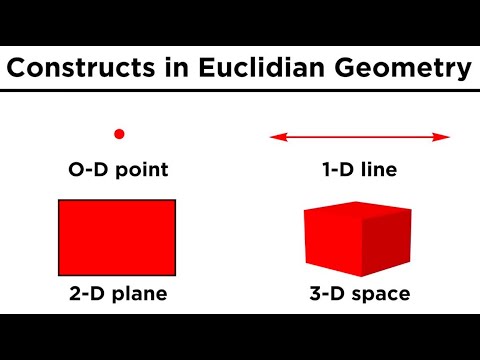
I'm not gonna tell you what a point is, I'm not gonna tell you what a line is, I'm not gonna tell you what a plane is.
All I'm gonna tell you is what the postulates are that they're assumed to satisfy.
It's the relationships between the objects that's important, not the definitions of the objects themselves.
And once you free your mind to that possibility, all of a sudden, you realize that there's a perfectly good geometric world in which, by line, you mean great circle, and by plane, you mean sphere, and by point, you mean a point on a sphere, and then four of those axioms are satisfied, just not the fifth.
And similarly, there's another model, something called a disk model for hyperbolic space, which, the disk is the plane.
What I mean by straight lines is arcs of circles that are orthogonal to the disk, and then points are points inside the disk.
And the disk is the plane.
- [Derek] See, you can think of geometry as a game.
(thoughtful music) The first four postulates are like the minimum rules required to play that game, and then the fifth postulate selects the world that you'll play in.
If you pick that there are no parallel lines, you're playing in spherical geometry.
If you choose one parallel line, you're playing in flat geometry.
And if you go for more than one parallel line, then you're playing in hyperbolic geometry.
But Riemann decided to take it one step further.
Instead of selecting just one world to play in, why not combine them all into one?
During his inaugural speech in 1854, he laid out the groundwork for a geometry where the curvature could differ from place to place.
One part might be flat, another part might be slightly curved, and yet another part might have a very strong curvature.
And this geometry wouldn't be limited to two-dimensional planes either, it could be extended to three or more dimensions.
(contemplative music) Another breakthrough came in 1868, when Eugenio Beltrami unequivocally proved that hyperbolic and spherical geometry were just as consistent as Euclid's flat geometry.
That is, if there were any inconsistencies in hyperbolic or spherical geometry, then they must also be present in Euclid's flat geometry.
The prospects for these new geometries were looking great.
And it turns out, this was just the beginning.
(soft music) In 1905, Einstein proposed the special theory of relativity, which is based on just two postulates.
One, "The laws of physics are the same in all inertial frames of reference."
And two, "The speed of light in a vacuum is the same for all inertial observers."
So, as a result, space and time must be relative.
But that created a problem for Newtonian gravity, because, according to Newton, the force of gravity is inversely proportional to the distance between the two objects squared.
But in Einstein's special relativity, that distance is no longer well-defined.
In whose reference frame are we measuring?
And so Einstein had to find a way to reconcile relativity and gravity.
Two years later, in 1907, Einstein had the happiest thought of his life, he imagined a man falling off the roof of a house.
And what made Einstein so joyful is that he realized that while the man is falling, he would feel absolutely weightless, and if he let go of an object, it would just remain in uniform motion relative to him.
It would be just like being in space, not near any masses, floating around in a spaceship at constant velocity.
And that is an inertial observer.
Now, here's the big breakthrough, Einstein realized that they're not just similar, they are identical, because there is no experiment you could do to determine whether you're in free fall in a uniform gravitational field, or whether you are in deep space, not near any massive objects.
And so the free-falling man too must be an inertial observer, meaning he is not accelerating, and he's not experiencing any force of gravity.
But if gravity is not a force, then how do you explain things like the space station orbiting Earth?
Shouldn't it just fly off in a straight line?
Well, astronauts in the space station also feel weightless.
And that's the key, it feels just as if they're traveling at constant velocity in a straight line.
It feels like that because that's precisely what they're doing, they're traveling in a straight line.
How, then, could that straight line appear curved to a distant observer?
The answer is, because the space time that straight line is on is curved.
See, massive objects curve spacetime, and objects moving through curved spacetime will follow the shortest path through that curved geometry, the geodesic.
So, while astronauts in the space station are following a straight line, it appears curved to a distant observer because the Earth curves the spacetime around it.
So, the behavior of straight lines in curved geometries is core to understanding the universe we live in.
And in the more than a hundred years since it was published, the general theory of relativity has been remarkably successful.
(soft music) In 2014, astronomers briefly observed a supernova, a violent and extremely bright death of a star.
In fact, they saw the exact same supernova in four different places.
How?
Well, in between the supernova and earth, there was a massive galaxy, which curved space time, so light from the supernova, which was spreading out in all directions, had several different paths to reach the earth, and four of those reached Earth at approximately the same time.
The galaxy had functioned as a massive gravitational lens.
The astronomers realized that other galaxies in the cluster might also lens the light from that supernova, but with different path lengths and gravitational potentials, so the light would reach earth at different times.
After careful modeling, they predicted that they should see a replay of that supernova just a year later.
And on the 11th of December, 2015, just as predicted, they saw the same supernova once more.
In addition to being able to observe the effects of curved spacetime, we can now even measure the ripples of space time itself, gravitational waves formed by cosmic events, far, far away, like the merger of black holes.
And according to a recent survey by NANOGrav, the fabric of spacetime seems to be buzzing with the remnants of grand cosmic events.
In the hundred years since general relativity was published, countless findings have supported its predictions, and at its very core are the curved geometries of Bolyai and Riemann.
But so far, all the effects we've looked at are local distortions of spacetime.
What is the shape of the entire universe?
(stars whooshing) (contemplative music) Using the differences between the geometries, we can find that out too.
In flat geometry, we expect all the angles of a triangle to add up to 180 degrees without fail.
But in spherical geometry, the angles don't add up to 180 degrees, but to more.
Similarly in hyperbolic geometry, the angles add up to less than 180 degrees.
So, to determine the shape of the universe, you just need to measure the angles of a triangle.
And measuring a triangle is precisely what Gauss was doing 200 years ago.
In fact, this led some to speculate that he was actually trying to measure the curvature of space itself.
The angle he found, 180 degrees, within observational error.
But that shouldn't be very surprising.
Take this balloon, for example, which approximates a sphere.
If I draw a small triangle on it, well, the surface I'm drawing on is basically flat, so the angles inside the triangle will add up to essentially 180 degrees.
Only if I make the triangle large enough will the effects of curvature come into play, and then the angles in the triangle will add up to more than 180 degrees.
And this was the problem with Gauss' experiment, even if he was trying to measure the curvature of space itself, for which there is no solid evidence, the triangle he measured would've been far too small relative to the size of the universe.
(ball thudding) (soft music) So, in order to overcome the scale issue that Gauss encountered, we need to scale the triangles formed between mountains up to the largest triangles we can.
And since looking further and further away is the same as looking further back in time, we need to look back as far as possible, to the very first light we can see, the Cosmic Microwave Background, or CMB, a picture from when the universe was just 380,000 years old.
While the CMB is almost completely uniform, there are some spots that are slightly hotter or colder.
Now, we know how far away the CMB is, so if we can figure out how large such a spot is, then we can draw a cosmic triangle.
It's thought that the first density and temperature variations originated from quantum fluctuations in the very early universe, which were then blown up as the universe expanded.
But due to this rapid expansion, not all regions were in causal contact with each other.
So, using the information we have of how the early universe evolved, astronomers can predict how often spots of different sizes should appear in the CMB.
This is what this power spectrum shows, essentially a histogram of how often each spot size should occur if the universe is flat.
So now we have something to compare our measurement to.
If the universe is flat, the angle we measure on the sky should be the same as we'd expect.
But if the universe is curved like a sphere, the angles of the triangle should add up to more than 180 degrees, so the angle we'd measure would be larger than predicted, and this peak would shift to the left.
Similarly, if the universe has hyperbolic geometry, then spots should appear smaller than predicted, and this peak would shift to the right.
So, what do we measure?
This is the data from the Plank mission, which is almost exactly what you'd expect if the universe were flat.
This mission also gives us the current best estimate for the curvature of the universe, which is 0.0007, plus minus 0.0019.
So that's basically zero within the margin of error.
So we're fairly certain that the universe we live in is flat.
But living in a flat universe seems to be remarkably serendipitous.
(contemplative music) Right now, the average mass energy density comes down to the equivalent of about six hydrogen atoms per cubic meter.
If, on average, that was just one more hydrogen atom, the universe would've been more spherically curved.
If there were just one less, the curvature would be hyperbolic geometry.
And so far, we're not entirely sure why the universe has the mass energy density it has.
What we do know is that general relativity is one of our best physical theories of reality, and at the very heart of it, are those paradoxical and seemingly absurd geometries, ones we found because mathematicians spent over 2,000 years thinking about a single sentence from the world's most famous math text.
(high-tech blooping) When it comes to human brilliance, it's not just what you know, it's also how you think, and a great way to improve how you think is by building your knowledge and problem solving skills.
So if you're looking for a free and easy way to do just that, then check out this video's sponsor, brilliant.org.
With Brilliant, you can master key concepts in everything from math and data science to programming and technology.
All you have to do is set your goal, and Brilliant will design the perfect learning path for you, giving you all the tools you need to reach it.
Want to follow in the footsteps of Euclid and Bolyai?
Then Brilliant's latest course, Measurement, is the perfect addition to your problem solving toolkit.
The course takes you on a tour through the essentials of geometry, getting you hands-on with concepts to help sharpen your spatial reasoning skills.
A solid foundation in geometry can be a launchpad to hundreds of applications, everything from computer graphics and data clustering in AI algorithms to understanding Einstein's theory of general relativity.
Beyond measurement, Brilliant has a huge library of things to learn.
But what I love most about Brilliant is that they connect what you learn to real world examples.
And because each lesson is hands-on, you'll build intuition, so you can put what you've learned to good use.
To try everything Brilliant has to offer for free for a full 30 days, visit brilliant.org/veritasium, or click that link down in the description.
For the first 200 of you, you'll get 20% off Brilliant's annual premium subscription.
So, I wanna thank Brilliant for sponsoring this video, and I wanna thank you for watching.
Up Next

17:14
Hyperbolic Geometry Through Crochet: Daina Taimina at TEDxRiga
@TEDx
92.3K views•2012-07-13
4:43
Elliptic Curve Cryptography Explained: ECC, ECDSA, ECDH
@PracticalNetworking
28.5K views•2024-10-21
35:21
Knot Theory: The Mathematics Behind Ties, Shoelaces & DNA
@veritasium
10.1M views•2023-09-03
6:00
The Mathematical Impossibility of Accurate World Maps
@Vox
23.3M views•2016-12-02
Related Study Plans & Knowledge Roadmaps
Structured learning paths in Mathematics
mathematics
Tensor Calculus: Vectors to Riemann Curvature
01Mathematical Foundations: Linear Algebra & Calculus
02Covectors, Dual Spaces, and Tensor Basics
03The Metric Tensor and Index Gymnastics
+ 2 more learning modules
40h5 modules
Explore Roadmap
mathematics
Gödel's Incompleteness: Logic, Proofs & Limits
01Introduction to Formal Systems & Hilbert's Dream
02Set Theory, Cardinality, and Cantor's Diagonal Argument
03Arithmetization and Gödel Numbering
+ 2 more learning modules
14h5 modules
Explore Roadmap
mathematics
Galois Theory: Fields, Groups & Solvability
01Foundations of Abstract Algebra: Groups & Fields
02Polynomials & Field Extensions
03Splitting Fields & Symmetries
+ 2 more learning modules
24h5 modules
Explore Roadmap
mathematics
Non-Euclidean Geometry: Models & Geodesics
01Euclid's Fifth Postulate and the Birth of New Geometries
02Hyperbolic Space and the Poincaré Disk Model
03Geodesics: Defining Straight Lines in Curved Spaces
+ 2 more learning modules
15h5 modules
Explore Roadmap