











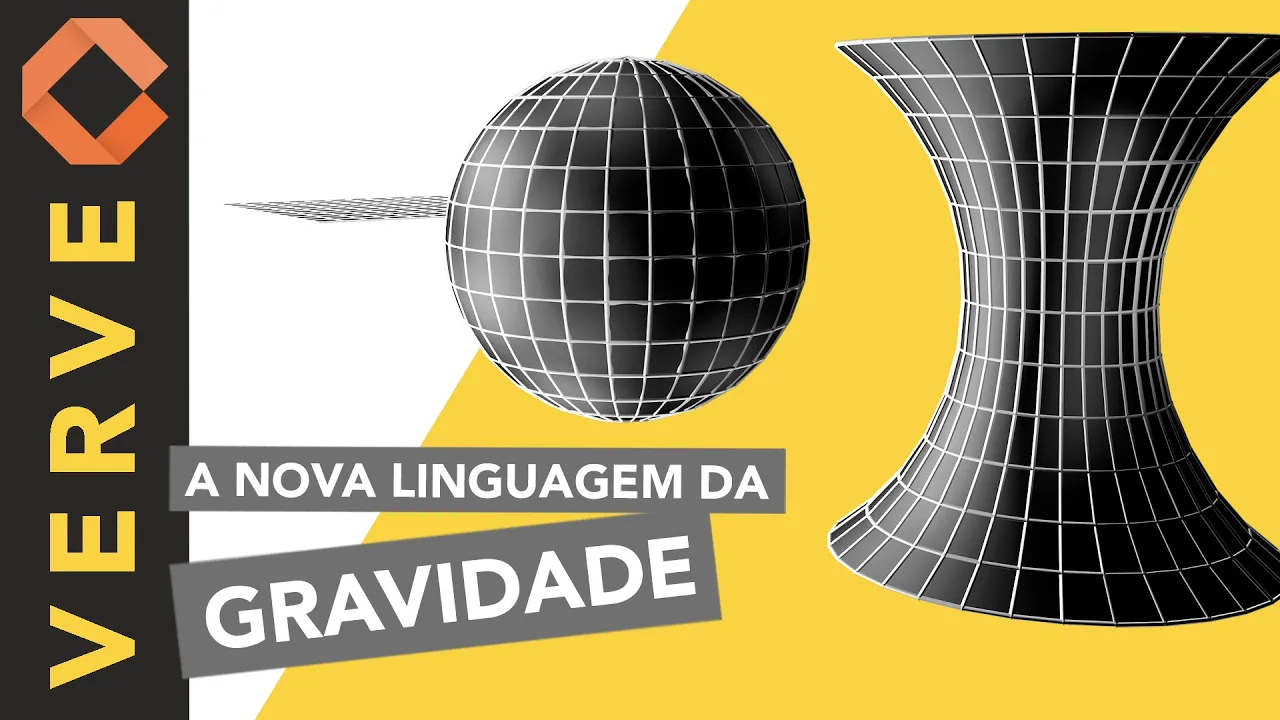





Hyperbolic planes can be physically modeled using crochet, where exponential growth in stitch count creates the characteristic negative curvature of hyperbolic geometry; unlike Euclidean geometry where parallel lines remain equidistant, on a hyperbolic plane parallel lines diverge away from each other after intersecting at one point, and triangles have interior angles that sum to less than 180 degrees, making abstract mathematical concepts tangible and accessible through hands-on creation.
Hyperbolic Geometry Through Crochet: Daina Taimina at TEDxRiga
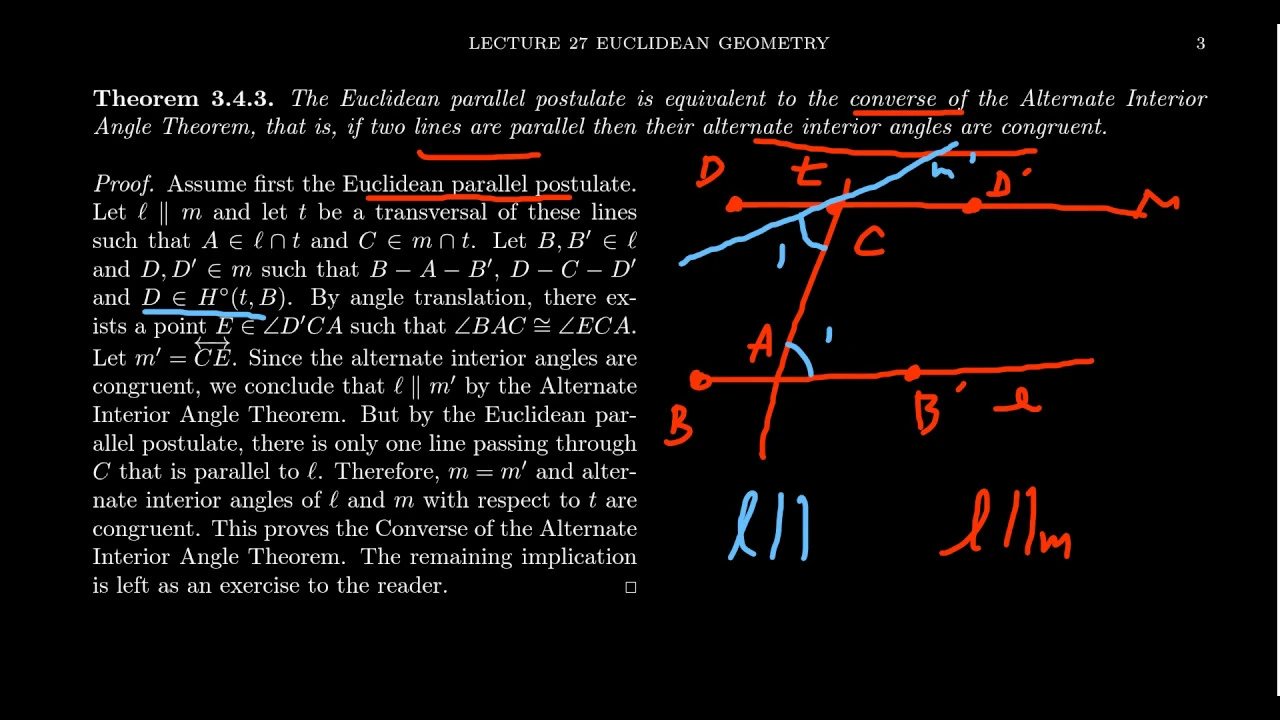
Added:Euclidean Geometry and the Parallel Postulate: Understanding traditional flat-plane geometry and how Euclid's fifth postulate defines it.
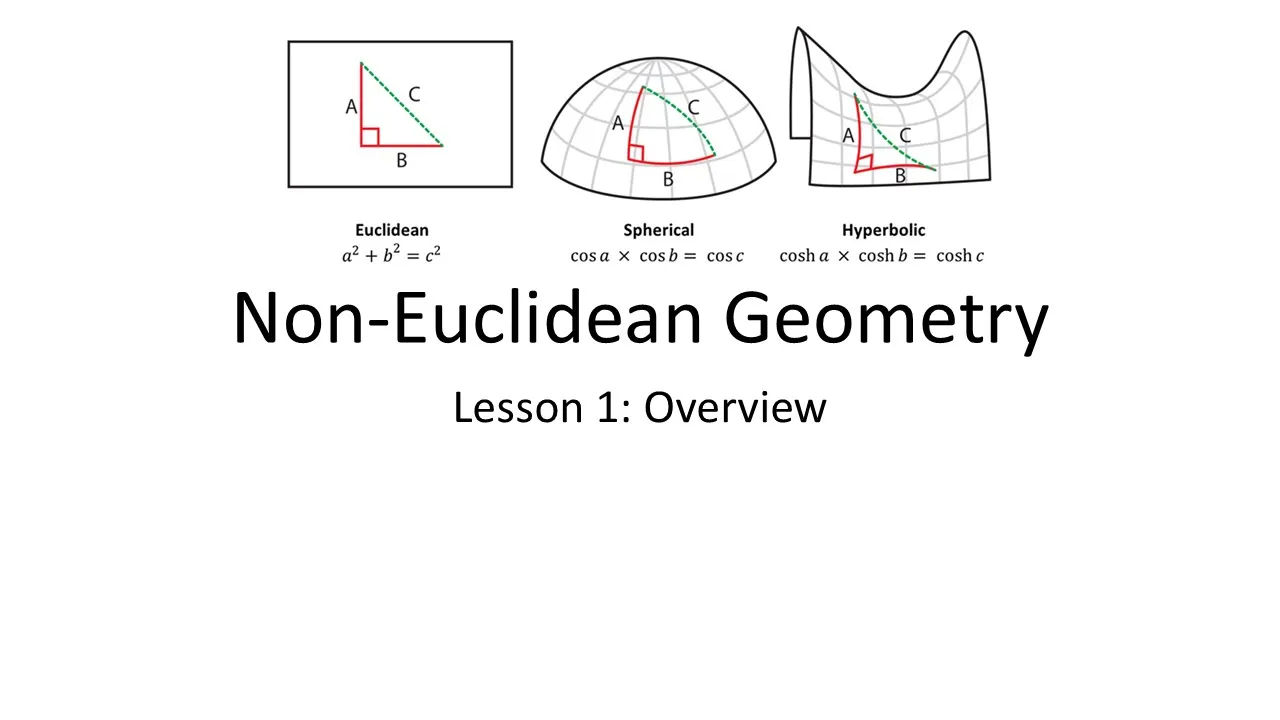
Introduction to Non-Euclidean Geometry: The historical mathematical shift that conceptualized spaces where parallel lines can diverge or converge.
The Concept of Curvature: Distinguishing between positive curvature (spheres), zero curvature (flat planes), and negative curvature (saddle shapes).
Basic Textile Mechanics: Understanding how increasing stitches in knitting or crochet physically expands surface area and causes fabric to ruffle.
The Poincaré Disk and Half-Plane Models: Studying analytical methods for mapping and visualizing hyperbolic space on a flat 2D plane.
Hyperbolic Geometry in Nature: Investigating how marine organisms (like corals and sea slugs) use negative curvature to maximize surface area for nutrient absorption.
Advanced Differential Geometry: Transitioning from tactile crochet models to formal mathematical frameworks of metrics, geodesics, and curvature tensors.
Cosmology and Physics Applications: Exploring how non-Euclidean geometries model the large-scale structure of the universe and spacetime curvature in general relativity.
92.3K views1.8Klikes17:14Original Release: 2012-07-13
Transcriber: Ilze Garda Reviewer: Denise RQ Does this look scary?
Does it? No. You would touch it, would you?
Of course, you would.
Would you think with the same ease about hyperbolic geometry?
(Audience) No. Daina Taimina: No. Why?
(Audience) Yes. DT: That's good. Good.
So, well, why not? OK, here is my story.
It's 1977.
I am a senior at the University of Latvia, just across the canal here.
Behind those three tiny windows, there was an auditorium; I'm sitting there; as senior, I'm having great dreams about what I'm going to do after the graduation, [dreams] that all of us have at that age.
But there are a couple of classes I need to finish, and one of them is hyperbolic geometry.
Well, not my favorite one, but a required one, and I have trouble with it.
Generally, I was a good student, but I had trouble with that.
And what's the case? What happened?
At that time, it seemed like this hyperbolic geometry required too much imagination from me.
The instructor draw these two pictures on a chalkboard and added: "So this one on the left side is Euclidean geometry, and to the right is Lobachevsky geometry; both of them are correct."
I had the question, "Why?"
Well, the answer was: "You have to make an assumption, or you have imagine that."
How could I imagine something which I didn't know how to imagine?
That was pre-Google era, and then my previous experience told me that I couldn't make an assumption, because in my previous experience, only one of them could be correct.
Anyway, I had this puzzling question, but I finished the class.
I disliked it, [but] it was a pass/fail class, so I passed, otherwise I wouldn't be here.
But I truly believed that was it, I would never have to think about hyperbolic geometry again.
It wasn't in my dreams that 20 years later I would be on the other side of the world at Cornell University, facing the fact that for a whole semester I'd have to teach hyperbolic geometry.
(Laughter) I couldn't use my previous experience - I didn't want my students to think about that course like I was thinking about it - so I had to do something: I attended a workshop, and that was where I first saw this model of a hyperbolic plane.
My fingers itched to touch it, but I wasn't allowed because that thing would fall apart.
I tried to make something, an application, something like this.
So I had to do something, I had to make some tactile model.
What I faced was the problem that I had to visualize [that exponential growth in a tactile way,] I remembered how, as a child, I was taught about powers of two and how the exponential growth comes through rumors.
You know, I have something, I tell Pāvils, - and tell him not to tell anybody else - but next day, all of us tells it to just one more person, and so on, and so it goes.
Nowadays, you mention Ponzi scheme, and that's it - everybody gets the point.
It's easier.
At the same workshop, I just draw this pattern, and then I thought, "Oh!"
And then my "Aha!" moment happened: "This looks like a crochet pattern."
The same night I started to crochet.
So the stitches grow exponentially, - instead of crocheting flat, I started to add stitches to increase the number of stitches - they grew exponentially, so I had to slow it down, and the first model came out too [ruffled], and I couldn't do anything.
So I tried, I had to slow down this exponential growth and make this ratio closer to one.
So I tried the next one which was closer to one, and then I could do something that I could show.
And now we could have the video, we can switch.
I crocheted a plane and tried to-- video, please.
So how can I get a straight line on a hyperbolic plane?
If I have a plain sheet of paper, then I can get a perfectly straight line just by folding it; here we go.
OK?
So I can do the same thing if I have a hyperbolic plane: now I can use this, and you will see that this is it.
Yeah, so I can fold it the same way, but it doesn't look nice.
That's how it goes.
But if I have a crocheted one, I can fold it nicely, and here I have a straight line.
So I kept folding, and - voila! - and here was the picture which I had so much trouble imagining as a student.
(Applause) Thank you.
Here's another version, that was the original one.
So here it is, here is a straight line, and here are the intersecting lines, but all of these three lines here - and it means, if there are three here, there can be infinitely many - wouldn't cross the third one.
What does it come from?
It comes - just as my understanding and that of my students' came, luckily - from the simple fact that if I fold it, then in a tactile way, through my fingers, I can really experience how these 2 lines come closer only at one point, and then they diverge away on both sides.
And that is that phenomena [happening] on a hyperbolic plane which is actually hard to imagine if you don't have this experience.
Now you [ask] the question, why do we care about hyperbolic planes, don't you?
(Laughter) I can tell you, it is actually very rich and beautiful, you won't believe it, but that is true.
It also gives us a way to think about shapes in nature, - I'll show you some examples later - it also makes us think about the shape of our Universe, which has been a puzzling question for thousands of years, and actually it is still an open question what the real shape of our Universe is.
Well, I'm not going that far, but I can show you some interesting properties of the hyperbolic plane.
First, to understand that, we have to understand how we characterize a hyperbolic plane.
[The thing is] that if we have a surface with a constant curvature, we can define a geometry on it.
And if we can define a geometry on it, we can describe it.
Well, what is a curvature?
We all know there are positive numbers, negative numbers, and a zero in between.
We can make the same analogy with surfaces, and that was suggested by Carl Friedrich Gauss in the early 19th century.
He said: "Why don't we also characterize surfaces with curvatures?"
In two dimensions, it can also be flat - more or less like the floor I'm standing on, which is flat, and therefore its curvature is zero - or we can have a constant positive or a constant negative [curvature].
How to get it? Let's use some tilings.
If we have regular hexagons, we can nicely tile a flat plane.
Now, if at each vertex three hexagons come together, that gives us a perfect 360 degree angle, and it becomes flat.
[The pattern] is no longer fashionable, but it will come back.
If at each vertex I remove one of these hexagons, I get a pentagon, it will eventually close [in one].
So that is an example of a constant positive curvature, or a way of making soccer balls.
Nowadays, they've changed this design, but that's done deliberately to destroy my talk. (Laughter) If I remove a hexagon and instead use a heptagon, or a seven-sided polygon, you see that this surface starts to bend away; it bends again, but now it's infinite.
This is an example of a constant negative curvature.
We can explore these things, and we can explore the properties of a hyperbolic plane by using these paper models, but, of course, I have crocheted ones.
One of the things that we can explore is some of the interior angles of a triangle.
We all learned in school that in an Euclidean plane, a triangle has 180 degrees, and it's constant.
If we have a sphere, it's more than 180 degrees, - actually, you can cut that in an apple or something else, just to check - and that really works like that.
If we are on a hyperbolic plane, we can have a triangle where some of its interior angles are approaching zero, they are getting really small, or it can be almost zero like in this case.
Let's go this model, and I can demonstrate what happens with this, because, as soon as I learned how to crochet hyperbolic planes, my husband who is a topologist said: "You have to make this model."
He knew it from theory, but he had never held it in his hands.
In a hyperbolic plane, I can make a regular octagon with 45 degree angles; that would be in a Euclidean plane an equivalent of a stop sign.
Now, what I can do is I can identify or glue its sides.
This way, from this hyperbolic stop sign, I can get something that has a very fancy name, - in topology, it's absolutely official - and you can easily guess from it what it is, so this is a hyperbolic pair of pants.
If I continue, there are two more points that I can identify like this, - you can see it better in the blue [model] on the screen - and then - something that I forgot to order from the organizers, sorry; at this point, I need the fourth dimension; can you provide it? - sorry, you have to imagine, you have to turn to your imagination.
So, we can have these holes glued here, and these holes glued together, this hole here, and this one here, and we get a two-holed torus.
That is a proof that a two-holed torus has hyperbolic geometry in it.
Here we go.
OK, there is something else that we can do.
When I was in school, I was taught to write numbers on nice and neat squared paper, and you had to do it very [purposely].
If I would be in a hyperbolic plane, I wouldn't be able to do it because if I would try to fold it and get a right angle on this hyperbolic plane, whatever I would try - and you're welcome to try that afterwards - I can fold it and get a right angle, but I end up with regular pentagons.
There are no right angle squares on a hyperbolic plane.
So let's go back there.
Here are my trials, and this is a close-up of these right angle pentagons on a hyperbolic plane.
And here are some things from nature.
Next time you'll see the nature, you will recognize where the negative curvature is.
So this is what we see.
Of course, there are some stereotypes about mathematics.
Because when I started to do these presentations 15 years ago, when I started to use these planes, there were people who said: "Oh, yeah, now that's great!"
Students liked it, college professors adapted it, but then there were people who said: "What are you doing? Mathematicians do not crochet, they do mathematics."
There is still this stereotype that mathematics is something to stare at, with some confusing rules, and accessible only to some chosen people, I'm not the one.
Well, the same thing [happens] by the way, with crochet too.
Crochet is something that women do when they have nothing else to do.
So when we tried to publish an article about crocheting hyperbolic planes in a journal, the editor's first reaction was: "What? Crochet instructions in a math journal?"
He really didn't believe that will something useful, but I won, I convinced him, and he published it eventually.
Three years later, I was very happy to see another crochet model on the cover of the same journal.
Minke Osinga and Berndt Krauskopf crocheted a Lorentzian manifold using a computer-generated pattern, and they used it to show a model of chaos.
Well, this is very important.
I always use to warn my audiences: "For God's sake, please give it up." Before you've started it.
"Fear it no less than the sensual passion, because it, too, may take up all your time and deprive you of your health, peace of mind and happiness in life."
That was a warning that a father, Wolfgang Bolyai, said to his son Janos Bolyai, one of the discoverers of the non-Euclidean geometry, when he said that he wanted to do it.
Well, it has become viral.
Crocheting hyperbolic planes, the idea of explaining the hyperbolic geometry through them was adopted by Margaret Wertheim, and she has done it now worldwide, popularizing the project about hyperbolic crochet coral reef.
This is the Latvian reef, it was in 2009, curated by Tija Vīksna, And it has even made it to a TED talk in 2009.
When somebody hears that I am a mathematician, I always hear [them say]: "Oh, I was so bad at math!"
When I was in school - this goes back to what [Aldis Kalniņš] said about these negative remarks - I was told by the art teacher: "You might be the best in math, but you are horrible in arts."
Therefore it was like a lightning when I got invitations to participate in art shows.
My first art show was at 1111 Pennsylvania Avenue, the same one that connects the White House with the Capitol in Washington DC.
I said: "Yes, you can have my works," but I thought, "What on earth am I going to do?"
Because I am a mathematician, I had to learn how to be an artist.
Mathematics is not scary when you can touch it.
The editor of my book said: "It's the best if you can make it yourself."
The editor of my book, Charlotte Henderson, after editing my book, decided to learn to crochet and crocheted one herself.
And then she said: "Once I did it, the properties of hyperbolic geometry that were previously accepted by my head, I could now accept with my heart."
She even wrote a poem [about] using the crochet.
Crocheting is using a simple method to connect people, and it is really giving inspiration in music, poetry, psychotherapy, and biology, and physics, [and others].
The great mathematician Bill Thurton wrote in the foreword of my book: "Mathematics is an art of human understanding.
Mathematics sings when we feel it in our whole brain.
People like music, but they are afraid to sing.
You only learn to sing by singing."
Do dare to do unexpected connections, be ready for tears and joy, for praise and rejection.
So now, would you touch it?
Could we have some adventures with hyperbolic planes?
Thank you.
(Applause)
Up Next
4:00
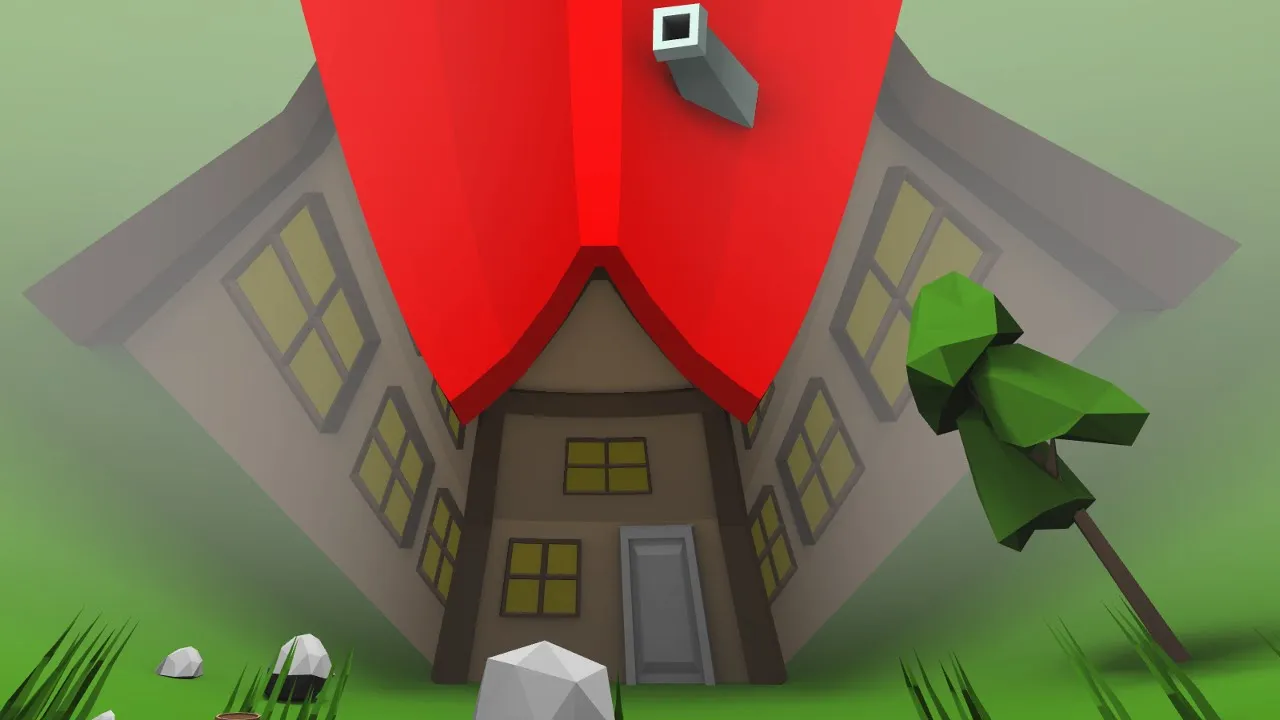
Understanding Spherical Geometry: From Flatland to 3D Spaces
@CodeParade
1.8M views•2020-07-28
4:43
Elliptic Curve Cryptography Explained: ECC, ECDSA, ECDH
@PracticalNetworking
28.5K views•2024-10-21
10:44
Fourier Series Introduction: The Big Idea Explained
@DrTrefor
387K views•2021-05-03
6:00
The Mathematical Impossibility of Accurate World Maps
@Vox
23.3M views•2016-12-02
Related Study Plans & Knowledge Roadmaps
Structured learning paths in Mathematics
mathematics
Tensor Calculus: Vectors to Riemann Curvature
01Mathematical Foundations: Linear Algebra & Calculus
02Covectors, Dual Spaces, and Tensor Basics
03The Metric Tensor and Index Gymnastics
+ 2 more learning modules
40h5 modules
Explore Roadmap
mathematics
Gödel's Incompleteness: Logic, Proofs & Limits
01Introduction to Formal Systems & Hilbert's Dream
02Set Theory, Cardinality, and Cantor's Diagonal Argument
03Arithmetization and Gödel Numbering
+ 2 more learning modules
14h5 modules
Explore Roadmap
mathematics
Galois Theory: Fields, Groups & Solvability
01Foundations of Abstract Algebra: Groups & Fields
02Polynomials & Field Extensions
03Splitting Fields & Symmetries
+ 2 more learning modules
24h5 modules
Explore Roadmap
mathematics
Non-Euclidean Geometry: Models & Geodesics
01Euclid's Fifth Postulate and the Birth of New Geometries
02Hyperbolic Space and the Poincaré Disk Model
03Geodesics: Defining Straight Lines in Curved Spaces
+ 2 more learning modules
15h5 modules
Explore Roadmap