In spherical geometry, distant objects appear larger and inverted compared to Euclidean expectations, creating a reverse perspective where faraway things look enormous and upside down, unlike hyperbolic geometry which appears more familiar but distorts space differently; this happens because all light rays eventually converge on the ground, eliminating a traditional sky view and causing objects on the opposite side of the world to appear as giant, flipped images.
Understanding Spherical Geometry: From Flatland to 3D Spaces
Added:Deep Dive
Euclidean Geometry foundations, specifically Euclid's postulates and the significance of the Parallel Postulate.

A Problem with the Parallel Postulate - Numberphile
158.5K
Euclid's Elements (c. 300 BC) established deductive geometry based on five postulates. The parallel postulate states that given a line L and a point P not on L, exactly one line through P does not intersect L. This uniqueness condition distinguishes Euclidean geometry. For centuries, this postulate seemed self-evident and served as the paradigmatic example of mathematical knowledge. However, its apparent obviousness masked deeper questions about its logical status and whether it could be derived from simpler principles.
Click to watch →

HÌNH DẠNG VŨ TRỤ - Tập 1: Cơ sở của hình học (4K)
15.8K
Euclid's five postulates establish the foundation of Euclidean geometry: (1) A line can be drawn between any two points; (2) A line can be extended indefinitely; (3) A circle can be drawn with any center and radius; (4) All right angles are equal; (5) The parallel postulate. The first four postulates describe space as infinite, connected, and uniform. The fifth postulate states that if interior angles on one side of a transversal sum to less than 180 degrees, the lines will intersect on that side. For centuries, mathematicians attempted to prove the fifth postulate from the other four, believing it might not be independent. Playfair's axiom (through a point not on a line, exactly one parallel exists) provides an equivalent but more intuitive formulation. The failure to prove the fifth postulate eventually led to non-Euclidean geometries, revolutionizing our understanding of space.
Click to watch →

Introduction to Euclid's Geometry - Full Chapter Explanation & NCERT Solutions | Class 9 Maths Ch 5
99.1K
Euclidean geometry is named after Euclid, an ancient Greek mathematician who compiled geometric knowledge into 'Elements,' divided into 13 books. The word 'geometry' comes from Greek 'geo' (earth) and 'metron' (measurement), originally used for measuring land. Geometry was studied in ancient civilizations (India, Egypt, Babylon, Greece, China) for practical purposes like calculating land areas and planning cities. Thales provided the first theoretical proofs, stating that given a center and fixed distance, one can construct a circle. Pythagoras followed with the Pythagorean Theorem. Euclid collected all previous knowledge and added his own discoveries. Euclid's seven definitions establish basic concepts: a point has no part, a line is breadthless length, a surface has length and breadth only, and a plane surface lies evenly with straight lines on itself. Axioms are universal truths accepted without proof that apply to all mathematics, while postulates are similar but specific to geometry. Euclid's seven axioms: (1) Things equal to the same thing are equal to each other. (2) If equals are added to equals, wholes are equal. (3) If equals are subtracted from equals, remainders are equal. (4) Things coinciding are equal. (5) The whole is greater than the part. (6) Things double of the same thing are equal. (7) Things half of the same thing are equal. Euclid's five postulates: (1) A straight line can be drawn between any two points. (2) A finite line can be extended indefinitely. (3) A circle can be drawn with any center and radius. (4) All right angles are equal. (5) If a line falling on two lines makes interior angles less than two right angles, the lines will intersect on that side. The fifth postulate (parallel postulate) is the most complex and historically significant. A system of axioms is consistent if no contradictions can be derived from them. Euclid used his axioms and postulates with deductive reasoning to prove 465 propositions (theorems) in his 'Elements.'
Click to watch →
Sir Roger Penrose | The Emperor’s New Mind: Consciousness & Computer (311)
93.2K
Euclidean geometry is based on axioms including the parallel postulate: given a line and a point not on it, exactly one line through the point does not intersect the original line. For centuries, mathematicians tried proving this from other axioms, believing it derivable. Hyperbolic geometry emerged when attempts failed, showing alternative consistent geometries exist. Gauss measured large triangles to test whether Euclidean geometry truly describes physical space, demonstrating that geometry itself is an empirical question about the physical world rather than purely abstract mathematics.
Click to watch →
Los postulados de Euclides
510.9K
Euclid's five postulates form the foundation of Euclidean geometry, with the fifth postulate stating that through a point exterior to a line, exactly one parallel line can be drawn; however, when this postulate is negated by assuming either no parallel lines or multiple parallel lines can pass through such a point, we arrive at non-Euclidean geometries like spherical geometry (where no parallel lines exist, used in navigation and astronomy) and hyperbolic geometry (where multiple parallel lines exist, which underlies Einstein's theory of relativity).
Click to watch →
Deep Dive
Basic coordinate geometry and dimension theory, including the concept of projection and the transition from 2D planes to 3D space.
Coordinate Geometry 01 | Introduction | CLASS 11 | JEE | PACE SERIES
800.7K
Coordinate geometry, also called analytical geometry, combines algebra and trigonometry to solve geometric problems, developed by René Descartes. Unlike pure Euclidean geometry, it uses numerical coordinates for analysis. The subject progresses through five core topics: Point (zero-dimensional foundation), Straight Line (one-dimensional), Circle (closed curve), Parabola (U-shaped curve), and Hyperbola (double-curved). Understanding dimensions is essential: points have no length/width/height, lines have only length, circles and polygons are two-dimensional, while cylinders and cones are three-dimensional. This dimensional framework enables systematic study of geometric relationships using algebraic methods.
Click to watch →

The perpendicular projections and Euclids theorem/2nd Prep 2026,2nd Term/ماث للثاني الإعدادى ترم ثان
1.2K
This comprehensive section covers the complete theory of projection in geometry. It begins with defining point projection as the foot of the perpendicular from a point to a line, and extends to line segment projection by projecting endpoints and connecting them. The section then transitions to coordinate geometry, demonstrating how to find projections of points in 3D space onto planes by dropping perpendiculars. Multiple worked examples show calculations for projecting points onto different coordinate planes, including cases where points lie on lines versus not, and how to handle coordinate systems with repeated variables. The section emphasizes that projection length is always less than or equal to the original length, with equality only when parallel.
Click to watch →
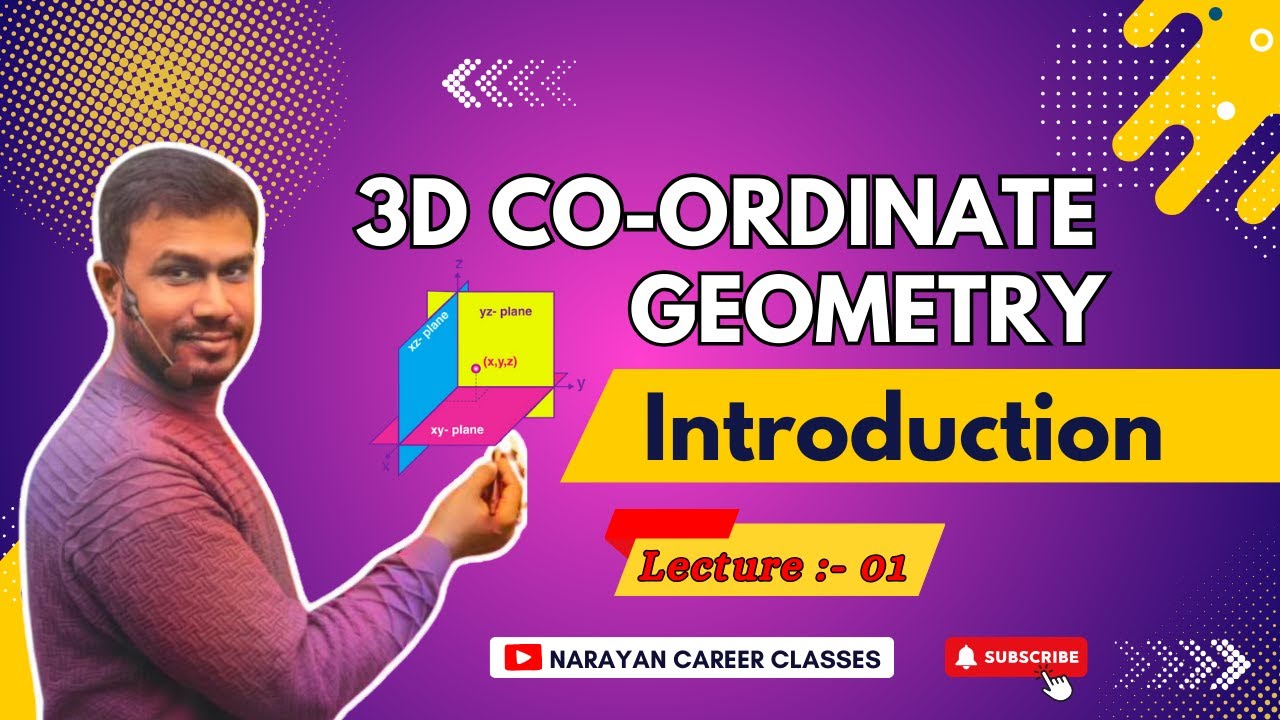
Three Dimensional Co- Ordinate Geometry | Introduction | Offline Class Video | #class12 #maths
102
3D Coordinate Geometry extends 2D Coordinate Geometry to three-dimensional space. The number of coordinates needed depends on dimension: 1D requires 1 coordinate, 2D requires 2 coordinates, and 3D requires 3 coordinates. The three axes (X, Y, Z) are mutually perpendicular and intersect at the origin (0,0,0). When any coordinate is set to zero, the dimension reduces: z=0 moves to a plane, y=0 moves to a line. This fundamental understanding forms the basis for all subsequent concepts in 3D geometry.
Click to watch →

lesson 1 solid geometry
148
To transition from a 2D to a 3D coordinate system, you add a third dimension called the z-axis (height). The x-y plane (which was the 2D system) is placed at the bottom, and the z-axis extends upward from the origin. The three axes (x, y, and z) all intersect at the origin point (0,0,0) and are perpendicular to each other.
Click to watch →

3-D Geometry 01 | Basics of 3D Geometry, Direction Cosines & Direction Ratios | 12th JEE/CUET
5.3K
This section covers the foundational concepts of three-dimensional geometry. It begins with the transition from 2D to 3D, where points now have three coordinates (x, y, z) instead of two. Key topics include: the coordinate axes dividing space into eight octants, with the first octant having all positive coordinates and the seventh having all negative; coordinate planes (XY, YZ, XZ) that divide space and define regions; and the distance formula extended from 2D to 3D by adding the z-component squared. The section emphasizes that most 3D geometry concepts are direct extensions of 2D principles with the addition of the z-axis component.
Click to watch →
Deep Dive
Fundamental properties of a sphere, including great circles, geodesics, and spherical coordinates (latitude and longitude).
Introducation to Sperical Geometry
10K
Spherical geometry applies measurement concepts to Earth's surface, studying coordinates, locations, distances, and time differences. Lines of longitude (meridians) are vertical lines running from pole to pole, with the Prime Meridian (Greenwich Meridian) at 0° in Greenwich, East London, serving as the starting point. Longitude lines are measured as East or West of this reference. Lines of latitude are horizontal lines parallel to the equator, measured as North or South from the 0° equator line. Angular measurement works by measuring the angle from the equator to latitude lines or from the Prime Meridian to longitude lines. Great circles are circles passing through both poles, dividing Earth into equal halves—all longitude lines are great circles, and the equator is the only great circle among latitude lines. Arc length between two points is calculated using: Arc Length = (θ/360) × 2πr, where θ is the central angle and r is Earth's radius (6,400 km).
Click to watch →
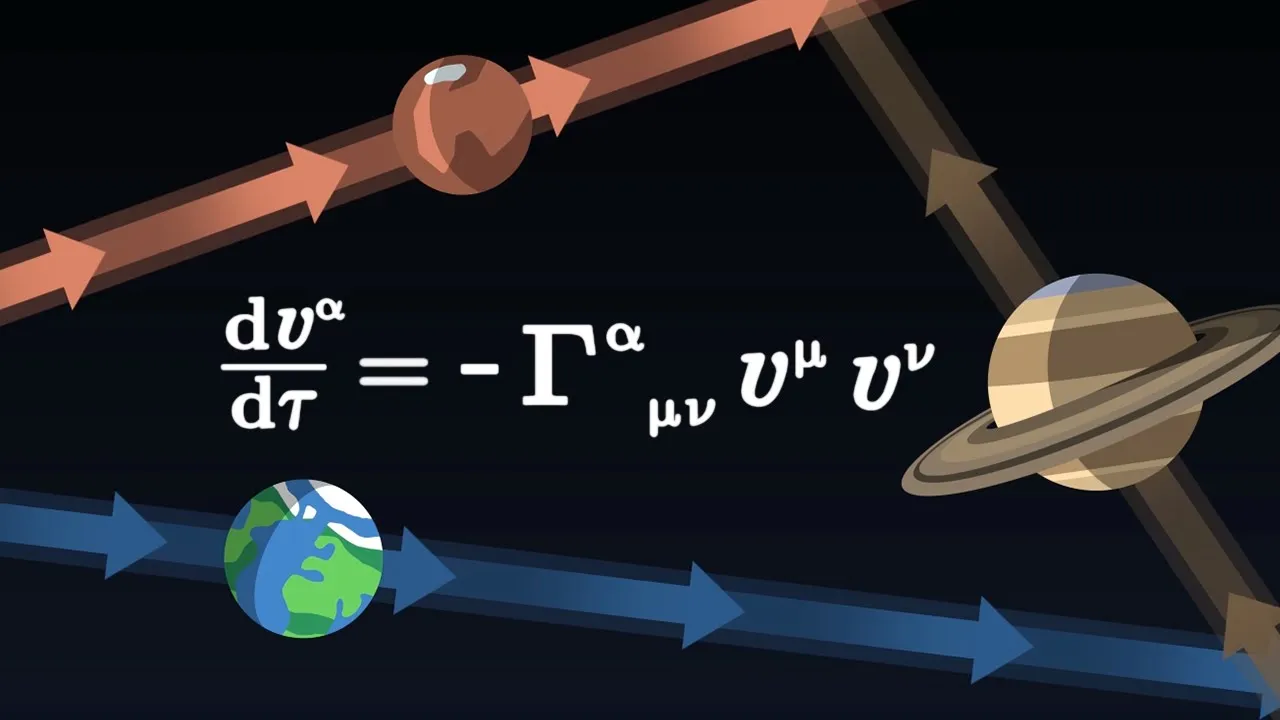
Relativité Générale 3/8 - Géodésiques
171.5K
On the surface of a sphere like Earth, geodesics correspond to great circles (the largest possible circles on a sphere). An airplane traveling along a great circle is moving in a perfectly straight line on the spherical surface, even though its latitude and longitude coordinates appear to curve. The apparent curvature comes from the coordinate system, not from the actual path. True geodesics represent the shortest distance between points on a curved surface.
Click to watch →
Classical Tensor Analysis: toward curvature (part 6)
466
On a unit sphere, geodesics are great circles—circles obtained by intersecting the sphere with a plane passing through the origin. For a unit sphere parameterized by latitude λ and longitude φ, the metric tensor is g_αβ = [[1, 0], [0, cos²λ]], and the line element is ds² = dλ² + cos²λ dφ². This shows that the distance in the longitudinal direction depends on the latitude, being zero at the poles and maximum at the equator. The non-zero Christoffel symbols on a unit sphere are: Γ^λ_φφ = -cosλ sinλ, Γ^φ_λφ = Γ^φ_φλ = tanλ. These symbols show how the coordinate basis vectors change on the sphere. The geodesic equations on a unit sphere are: d²λ/ds² - cosλ sinλ (dφ/ds)² = 0 and d²φ/ds² + 2 tanλ (dλ/ds)(dφ/ds) = 0. These equations describe how a particle moves along a great circle.
Click to watch →
Фоменко А. Т. - Дифференциальная геометрия и топология - 9. Геодезические поверхности
1.9K
On the standard sphere S² with the induced metric from R³, the geodesics are the great circles (equators). This can be shown by solving the geodesic equations in spherical coordinates or by noting that great circles are intersections of the sphere with planes through the origin. Any two great circles can be mapped to each other by a rotation of the sphere, which is an isometry preserving geodesics.
Click to watch →
Introduction to Spherical Coordinate System with example | Cartesian to Spherical Coordinate| Lec 22
7.6K
The spherical coordinate system is a three-dimensional coordinate system where the three directions are mutually perpendicular. A great circle is defined as a circle on a sphere with maximum radius, meaning it passes through the center of the sphere. Any circle formed on the surface of a sphere that has the maximum possible radius is classified as a great circle.
Click to watch →
Deep Dive
The concept of curvature, distinguishing between intrinsic curvature (like on a sphere) and extrinsic curvature.

Mindscape Ask Me Anything, Sean Carroll | March 2026
15K
Intrinsic curvature is the curvature that a space or manifold has by itself, without being embedded in a higher-dimensional space. Extrinsic curvature is the curvature that comes from how a space is embedded in a larger space. General relativity describes spacetime as having intrinsic curvature—there is no larger space in which the universe is embedded. However, it is mathematically possible to describe intrinsic curvature as extrinsic curvature in a higher-dimensional flat spacetime, though this would require additional dimensions and serve no physical purpose.
Click to watch →

General Relativity: Tensor Analysis & Metric Tensor | Lecture 2 (Susskind)
682.6K
Extrinsic curvature refers to how a space is embedded in a higher-dimensional space. For example, a page can be laid flat or curled in 3D space, and this embedding difference creates extrinsic curvature. Intrinsic curvature, however, is the geometry that a tiny bug crawling along the surface would detect - it can measure distances and angles within the surface but never looks out of the surface to detect embedding.
Click to watch →

4 cose che non sai sullo SPAZIOTEMPO
71.1K
There are two types of curvature: extrinsic curvature (the curvature of an object in relation to a larger space) and intrinsic curvature (the curvature determined using only operations on elements of the object itself). The video explains that space-time in relativity has intrinsic curvature, which is different from the extrinsic curvature shown in common visualizations like the rubber sheet analogy.
Click to watch →

The Biggest Ideas in the Universe | 13. Geometry and Topology
172.5K
Extrinsic curvature describes how a surface bends within an embedding space (like looking at a circle from outside). Intrinsic curvature describes properties that exist within the surface itself, regardless of how it sits in space. For example, a circle on a plane and a wobbly blob have the same intrinsic curvature (zero), even though they look different extrinsically.
Click to watch →
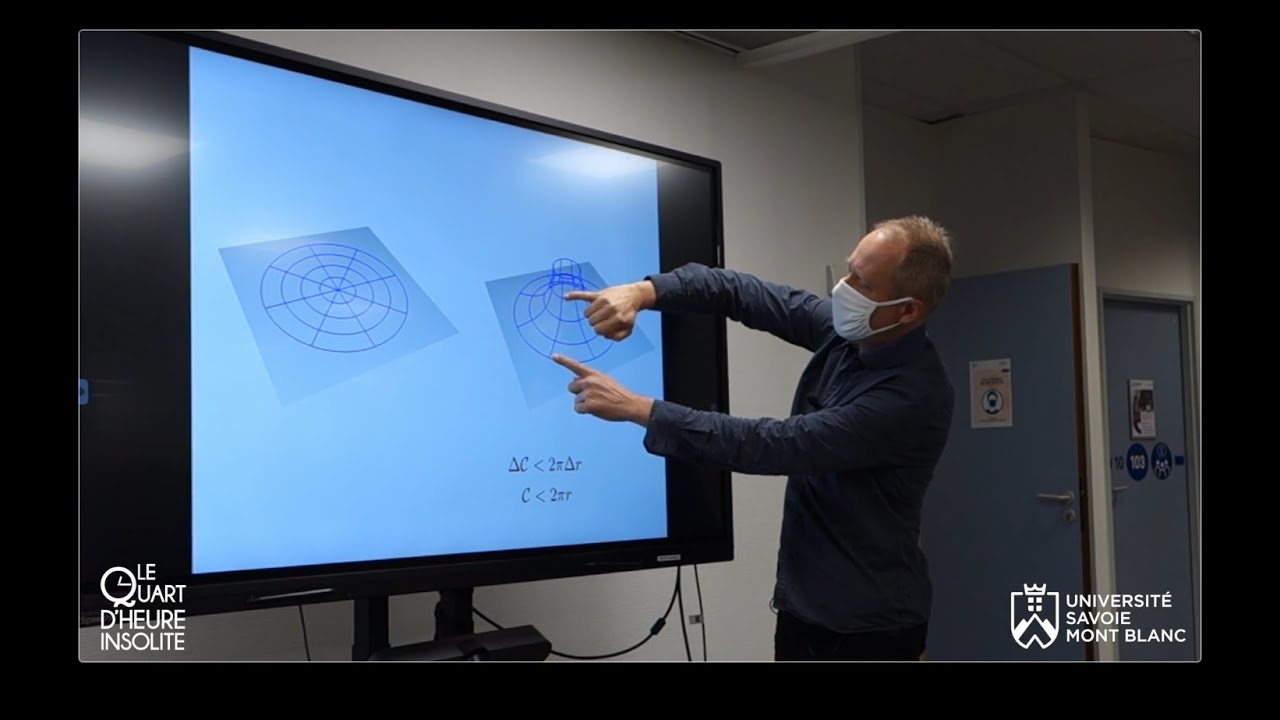
Quart d'Heure Insolite #24 : Dessine-moi un trou noir !
21.2K
Curvature can be intrinsic or extrinsic. Extrinsic curvature refers to how a surface bends in a higher-dimensional space (like a sheet of paper bent into a cone). Intrinsic curvature is a property of the surface itself, detectable without reference to any higher dimension. A cone has extrinsic curvature but no intrinsic curvature—a bug walking on a cone would not detect any geometric anomalies. True intrinsic curvature (like on a sphere) cannot be flattened without tearing or stretching. On a sphere, as you increase the radius of circles, the circumference eventually decreases after passing the equator, creating counterintuitive geometric relationships. Our three-dimensional space can also have intrinsic curvature. If our space were curved like the surface of a sphere, as you increase the radius of spheres, the surface area would not increase proportionally as expected in flat space. Eventually, the surface area would decrease as you approach the 'antipodes' of the sphere. This is analogous to inflating a balloon: as you blow air into it, the surface eventually closes up behind you.
Click to watch →
Prerequisite Knowledge
- Concept 01Euclidean Geometry foundations, specifically Euclid's postulates and the significance of the Parallel Postulate.
- Concept 02Basic coordinate geometry and dimension theory, including the concept of projection and the transition from 2D planes to 3D space.
- Concept 03Fundamental properties of a sphere, including great circles, geodesics, and spherical coordinates (latitude and longitude).
- Concept 04The concept of curvature, distinguishing between intrinsic curvature (like on a sphere) and extrinsic curvature.
Subsequent Learning
- Step 01Hyperbolic Geometry, exploring negative curvature, saddle surfaces, and Poincaré models to contrast with spherical geometry.
- Step 02Differential Geometry and Riemannian Manifolds, which provide the advanced mathematical framework for analyzing curved spaces mathematically.
- Step 03General Relativity and Cosmology, applying non-Euclidean geometry to understand the curvature of spacetime and gravity.
- Step 04Cartography and Navigation systems, examining how map projections handle distortions when representing a 3D spherical Earth on a 2D plane.
Spherical View
3D Effects
Exploration
Spherical View
0:00Playing Section
- 1
Hyperbolic geometry feels familiar, while spherical is more extreme.
- 2
In spherical space, distant objects appear larger and upside down.
- 3
All sight lines hit the ground, leaving no visible horizon.
Geometric Conventionalism
While exploring spherical and hyperbolic geometries highlights their distinct mathematical properties, Henri Poincaré’s 'Geometric Conventionalism' presents a profound philosophical counterpoint. Poincaré argued that no experiment can empirically prove whether physical space is Euclidean, spherical, or hyperbolic. According to this view, geometry is not an inherent property of physical space but rather a convention chosen for convenience. Any physical phenomenon that seems to suggest a spherical or non-Euclidean universe—such as bending light paths or 'reverse perspective'—can be equally explained using standard Euclidean geometry by introducing compensating physical forces that distort our measuring instruments. Therefore, conventionalism suggests that treating spherical geometry as a uniquely 'true' representation of alternative physical spaces is ontologically misleading; it is merely one of several mathematically equivalent coordinate systems we use to describe physical phenomena.
Deep Dive
Hyperbolic Geometry, exploring negative curvature, saddle surfaces, and Poincaré models to contrast with spherical geometry.

How Fast Is It - 04 - General Relativity I - Geometry (1080p)
172.6K
Non-Euclidean geometries exist beyond Euclidean flat space. Hyperbolic geometry has negative curvature: parallel geodesics diverge and get further apart, the sum of triangle angles is less than 180°, and circle circumference exceeds 2πr. The best example is a saddle surface. Spherical geometry has positive curvature: parallel geodesics converge and meet, triangle angles sum to more than 180°, and circle circumference is less than 2πr. The Earth's surface exemplifies spherical geometry.
Click to watch →

Mark Norfleet - Hyperbolic Geometry
3.1K
Hyperbolic geometry is a non-Euclidean geometry with constant negative curvature. Models help us understand this geometry, similar to how maps distort geography. The projective disk model represents the hyperbolic plane as a disk where points inside are the space points and lines are straight chords connecting boundary points. This model is easy to draw but distorts angles significantly. The Poincaré disk model preserves angles but is difficult to draw, with lines consisting of open diameters and circular arcs perpendicular to the boundary. The upper half plane model represents hyperbolic geometry as complex numbers with positive imaginary part, with the real axis as the boundary at infinity. Lines are vertical rays perpendicular to the real axis and semicircles centered on the real axis. Ideal triangles (with all vertices at infinity) have area π, a fundamental result distinguishing hyperbolic from Euclidean geometry. The hyperboloid model represents hyperbolic geometry using vectors in R³ satisfying x² + y² - z² = -1 with z > 0 (upper sheet). Light-like vectors (x² + y² - z² = 0) form a cone representing points at infinity. Geodesics are intersections of 2D subspaces through the origin with the hyperboloid. This model is useful for calculations because it uses familiar vector space structure.
Click to watch →
Odifreddi in cucina: la geometria delle arance, dei salami e dei cavolfiori
29.5K
Hyperbolic geometry (also called saddle geometry) describes surfaces with negative curvature, like a saddle or hyperboloid. In hyperbolic geometry, the sum of angles in a triangle is always less than 180 degrees. This geometry is the opposite of spherical geometry and represents a fundamental alternative to Euclidean geometry. It has applications in art, architecture, and theoretical physics.
Click to watch →

03. Geometrie iperboliche
609
Hyperbolic geometry, also called Bolyai-Lobachevsky geometry, has concrete models. In Klein's model, space consists of points inside a circle, with 'lines' as chords. In Poincaré's model, space is also points inside a circle, but 'lines' are arcs of circles intersecting the boundary perpendicularly. Both models satisfy Euclid's first four postulates but reject the fifth, demonstrating that hyperbolic geometry is a valid, consistent system.
Click to watch →
Hamilton Lecture 2021: Glimpses into Hyperbolic geometry
1.6K
Hyperbolic geometry can be visualized as geometry on a surface everywhere shaped like a saddle or Pringle chip, as opposed to a sphere. This surface has constant negative curvature. A key property is that when you draw a small circle on this surface and compare its area to a Euclidean circle of the same radius, the hyperbolic circle has a larger area. This curvature distinguishes it fundamentally from spherical geometry (positive curvature) and Euclidean geometry (zero curvature).
Click to watch →
Deep Dive
Differential Geometry and Riemannian Manifolds, which provide the advanced mathematical framework for analyzing curved spaces mathematically.
How to self study pure math - a step-by-step guide
2.2M
Differential geometry studies curved surfaces called manifolds in higher-dimensional space. The book 'Introduction to Differentiable Manifolds and Riemannian Geometry' provides rigorous treatment with intuitive discussions and pictures. Key topics include calculus in n-dimensional space, vector fields, tensor fields, integration on manifolds, Stokes's theorem (generalizing the fundamental theorem of calculus), and De Rham's theorem linking topology and calculus. The second half covers Riemannian manifolds with notions of distance.
Click to watch →
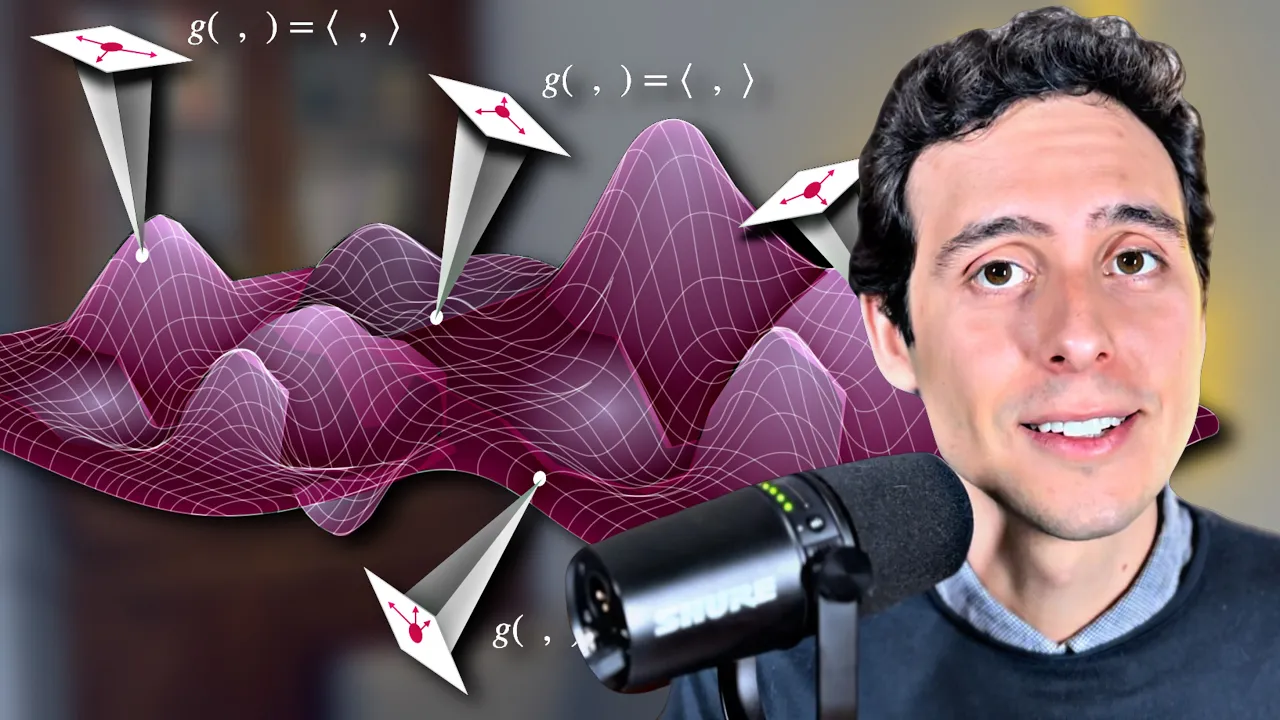
Riemannian Manifolds in 12 Minutes
31.4K
A Riemannian manifold is a smooth manifold (C∞, Hausdorff, second countable) equipped with a smoothly varying Euclidean inner product on each tangent space, enabling geometric measurements like length, angle, and curvature on curved spaces; key properties include local Euclidean structure (every small patch resembles flat space), smoothness allowing calculus operations, Hausdorff separation of points, and second countability ensuring the space isn't too large, with examples ranging from standard Euclidean space to spheres and hyperbolic spaces.
Click to watch →

Um Mapa da Matemática
47.4K
Differential geometry studies geometric objects like curves and surfaces in Euclidean space using differentiation and integration. A curve can be parameterized by a variable t, allowing calculation of derivatives with respect to t to define properties like velocity. This discipline leads to advanced areas including manifold theory and Riemannian geometry, which are active research areas in mathematics.
Click to watch →
Mathematical Preliminaries-II: Riemannian manifolds
159
A Riemannian manifold is defined as a pair (M, g) where M is a differential manifold and g is a symmetric, non-degenerate (0,2) tensor field called the metric. The metric enables definition of inner products between tangent vectors via g(U, V) = U^μ V^ν g_μν and provides a notion of distance through ds² = g_μν dx^μ dx^ν. Symmetry ensures g_μν = g_νμ, while non-degeneracy guarantees the metric matrix is invertible. When metrics take both positive and negative values, the manifold becomes pseudo-Riemannian with signature (p, q). In general relativity, spacetime is modeled as a Lorentzian manifold with signature (3,1), where the line element ds² can be positive (spacelike), negative (timelike), or zero (null). The inverse metric g^μν satisfies g^μρ g_ρν = δ^μ_ν, enabling raising and lowering of tensor indices. These foundational concepts provide the mathematical framework for describing curved spacetime in general relativity.
Click to watch →
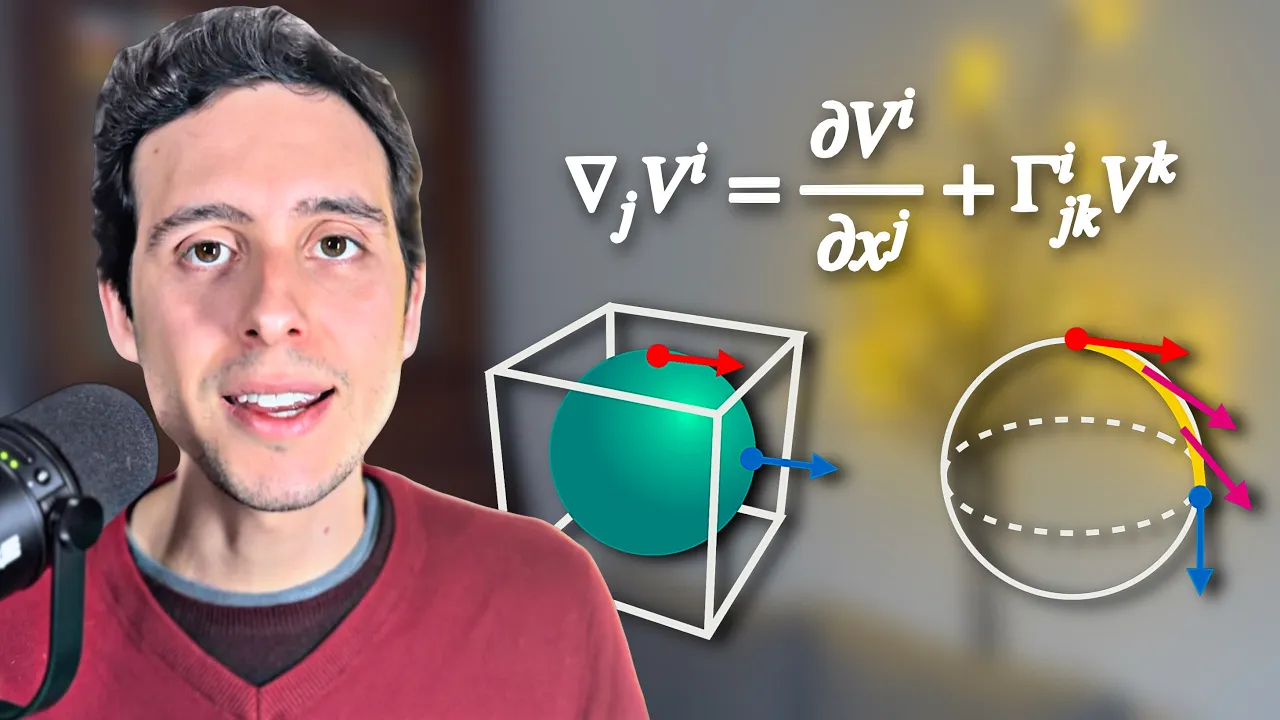
Differential Geometry is Impossible Without These 7 Things
105.8K
This section establishes the core mathematical machinery enabling rigorous study of curved spaces. Riemannian geometry defines manifolds locally by metric tensors, allowing distance and angle measurement independent of external coordinates. Christoffel symbols (developed by Christoffel) encode how coordinate systems change on curved spaces, enabling comparison of vectors at different points and defining parallelism. Tensor calculus organizes geometric information into coordinate-independent objects: scalars, vectors, matrices, and higher-dimensional tensors. The Riemann curvature tensor encapsulates all curvature information at each point, from which simpler tensors like Ricci curvature (essential in general relativity) and scalar curvature emerge. These tools collectively provide a language for describing intrinsic geometry that works across limitless dimensions, forming the foundation for Einstein's theory of gravity and modern theoretical physics.
Click to watch →
Deep Dive
General Relativity and Cosmology, applying non-Euclidean geometry to understand the curvature of spacetime and gravity.
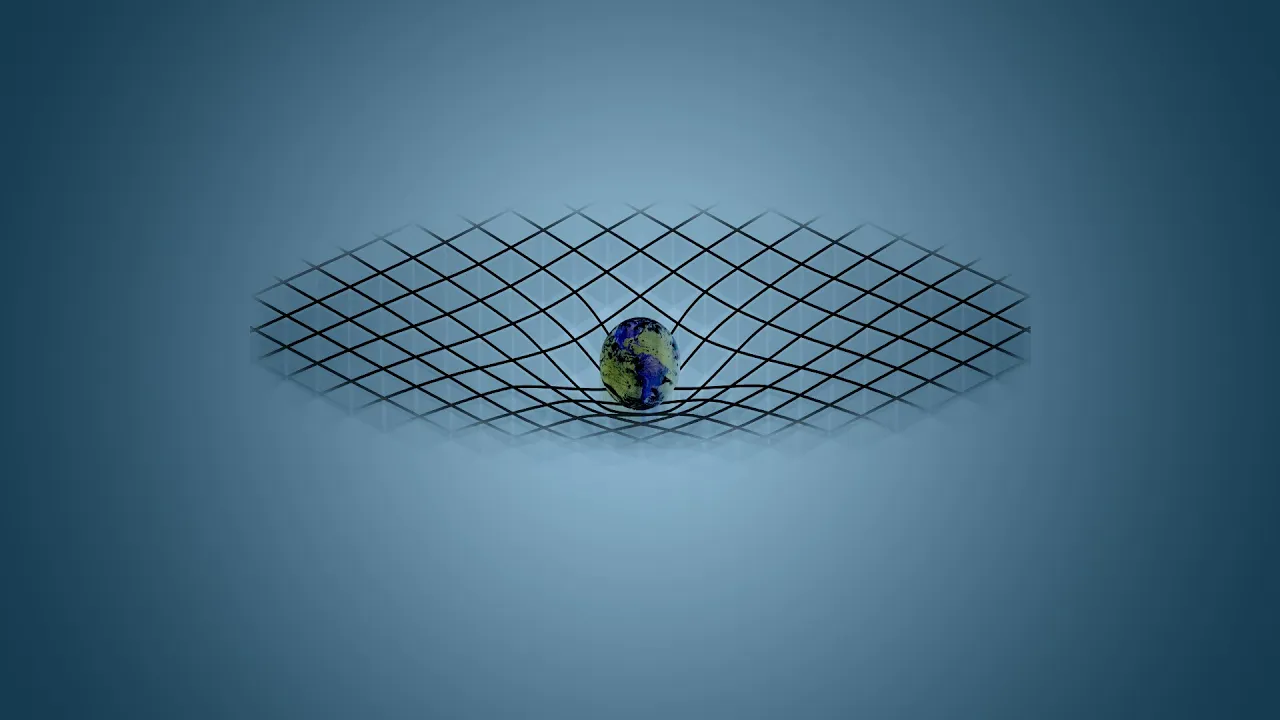
La relativité générale - Ep.22 - e-penser
2.2M
Euclidean (flat) geometry assumes parallel lines never meet and triangle angles sum to 180 degrees. Einstein realized that gravity requires non-Euclidean geometry where spacetime can curve. In curved spacetime, parallel lines can converge or diverge, and triangle angles may not sum to 180 degrees. This mathematical framework, developed with Grossmann's help, allowed Einstein to describe how mass curves spacetime.
Click to watch →

The Entire History Of Mathematics From Ancient Times To Now Explained Slowly (For Sleep)
113
Non-Euclidean geometry wasn't just an abstract curiosity. When Einstein developed his general theory of relativity in 1915, he needed exactly this kind of geometry to describe how mass curves spacetime. The geometry of the universe, it turns out, really is non-Euclidean. Euclid's parallel postulate is approximately true for everyday distances—the curvature of spacetime is too slight to notice when measuring rooms and roads. But on cosmic scales, space curves. The mathematics that Gauss was afraid to publish and that Bolyai and Lobachevsky developed in obscurity turned out to be the language of gravity itself. This demonstrates how mathematical truth can transcend human intuition and reveal the true structure of the universe.
Click to watch →
Introduction to General Relativity | General Theory of Relativity | General Relativity Explained
840
General relativity fundamentally depends on geometry, particularly non-Euclidean geometry which emerges when Euclid's parallel postulate is replaced. Two main types exist: elliptic geometry (positive curvature, triangle angles > 180°, parallel lines converge) and hyperbolic geometry (negative curvature, triangle angles < 180°, parallel lines diverge). In curved spacetime, geodesics (shortest paths) can be curved rather than straight. In special relativity, the light cone represents hyperbolic geometry as designed by Minkowski to create invariant spacetime. In cosmology, elliptic geometry models idealized universes with finite volume that curve back on themselves. The historical development by Gauss, Lobachevsky, and Riemann laid foundations for modern physics and general relativity.
Click to watch →
General Relativity Introduction: What is curved spacetime?
280
General relativity uses curved spacetime because special relativity's structure is fundamental and elegant—it's more straightforward to generalize by allowing spacetime to be curved than to integrate gravity into flat spacetime. The geometry of curved surfaces (like spheres or spacetime with gravity) is non-Euclidean because it departs from Euclid's axioms, particularly the parallel postulate. This geometry is essential for mapping curved surfaces and understanding spacetime. The 'mass' of curved surfaces is important for mapping three-dimensional curved surfaces onto two-dimensional planes while preserving certain properties. This mathematical framework allows us to describe gravitational phenomena accurately.
Click to watch →
Einstein ou l'art de dépasser les limites du monde - Etienne Klein, à l'USI
543.6K
Einstein realized that special relativity's flat spacetime (Minkowski space) was insufficient for describing gravity. He needed non-Euclidean geometries to describe curved spacetime, which he studied with his former classmate Marcel Grossmann. This mathematical framework allowed Einstein to formulate general relativity, where gravity emerges from the curvature of spacetime rather than as a force acting at a distance.
Click to watch →
Deep Dive
Cartography and Navigation systems, examining how map projections handle distortions when representing a 3D spherical Earth on a 2D plane.
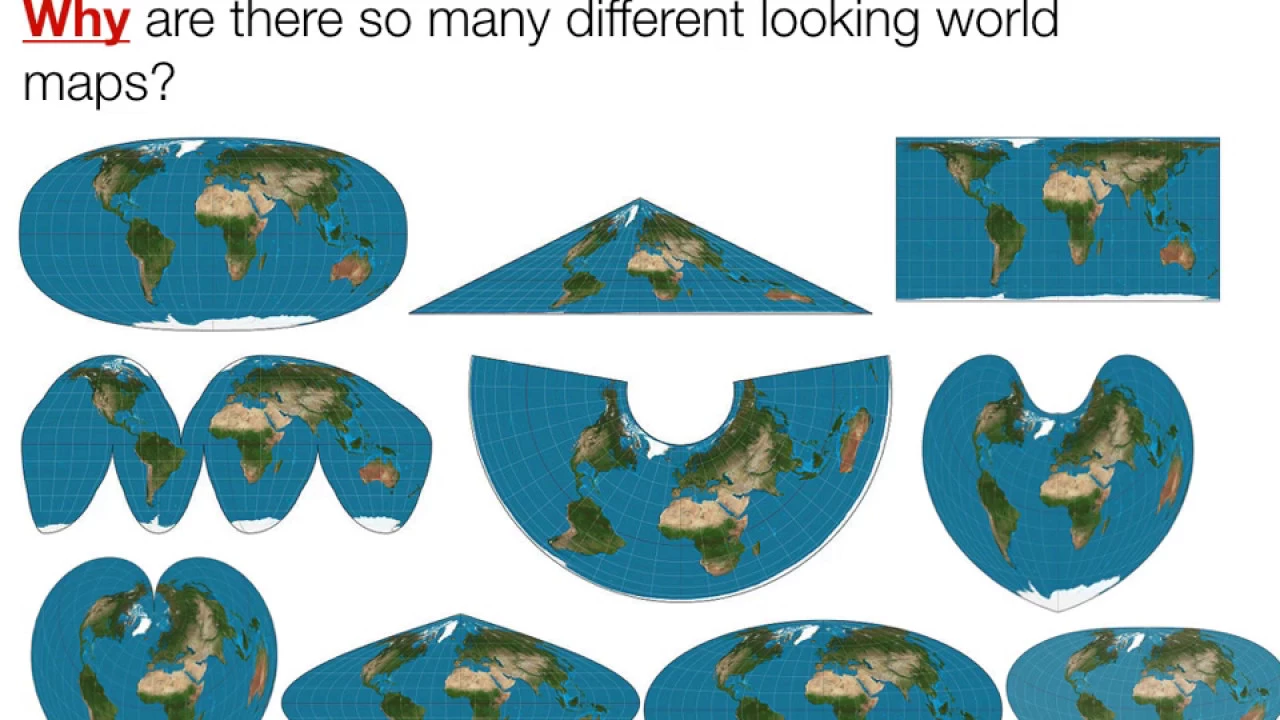
Lecture; Maps, Maps, Maps The Basics of Cartography
16.3K
Map projections are methods of representing the surface of a sphere (the Earth) onto a flat plane. When a 3D object is made flat, something necessarily has to be distorted. Different projections create different distortions in size, shape, and direction. For example, in some projections Greenland appears as large as Africa, while in others it appears much smaller. The choice of projection affects how accurately the map represents the Earth's surface.
Click to watch →
Projeções Cartográficas e o balão que deu a vida por essa aula. (Aula 12)
33.5K
When representing a three-dimensional spherical object (like Earth) on a two-dimensional flat surface, distortions or deformations are inevitable. The globe presents the least distortion, but maps sacrifice accuracy for practicality since globes cannot be easily carried or stored.
Click to watch →

PROJEÇÕES CARTOGRÁFICAS (CARTOGRAFIA) - MAPA DE MERCATOR, PETERS, TIPOS DE PROJEÇÕES, DISTORÇÕES
151K
Cartographic projections are tools that transcribe the three-dimensional Earth globe onto two-dimensional flat maps. Mathematically, it is impossible to perfectly transcribe a spherical surface onto a flat surface without distortion, so all maps contain some form of error or deformation. The three basic types of projections are cylindrical, conic, and planar (azimuthal). The cylindrical projection places the globe inside an imaginary cylinder, with the equator as the line of least distortion. Regions near the equator are represented more accurately, while regions at higher latitudes become increasingly distorted. This projection is most suitable for representing equatorial regions.
Click to watch →

Projections
497
When representing the three-dimensional spherical Earth on a two-dimensional flat surface, some form of distortion is inevitable. This is because you cannot perfectly flatten a sphere without stretching, tearing, or compressing it. The fundamental challenge is that the Earth's curved surface cannot be accurately represented on a flat map without losing some accuracy in shape, area, distance, or direction.
Click to watch →
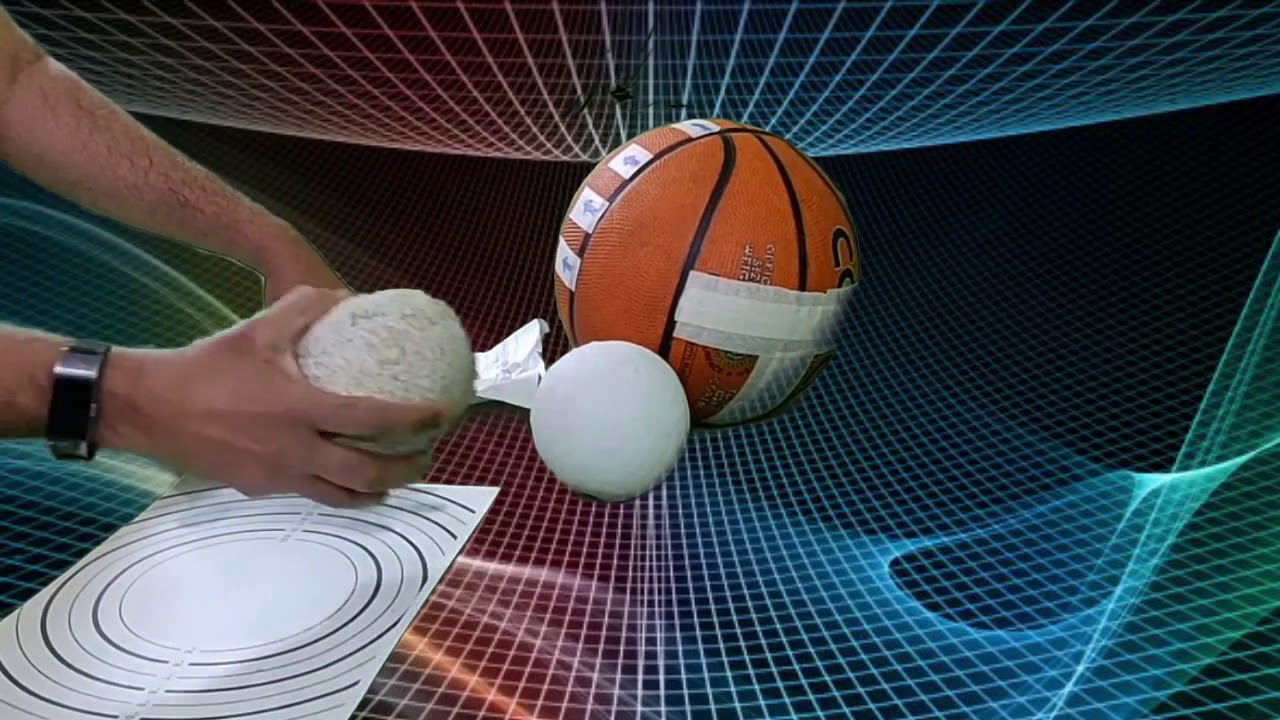
PH4205-L08-2 Sphere
347
Cartography is the science of mapping curved surfaces like Earth onto flat paper. Since a sphere cannot be mapped one-to-one to a plane, cartographers use various projections that trade off different types of distortion. Different projections preserve different properties (area, shape, distance, direction) depending on the map's purpose. This is why different world maps look different. The distortion becomes more apparent when comparing sizes of continents on projected maps versus their actual sizes on the sphere.
Click to watch →
Spherical View
3D Effects
Exploration
Spherical View
0:00- 1
Hyperbolic geometry feels familiar, while spherical is more extreme.
- 2
In spherical space, distant objects appear larger and upside down.
- 3
All sight lines hit the ground, leaving no visible horizon.
Geometric Conventionalism
While exploring spherical and hyperbolic geometries highlights their distinct mathematical properties, Henri Poincaré’s 'Geometric Conventionalism' presents a profound philosophical counterpoint. Poincaré argued that no experiment can empirically prove whether physical space is Euclidean, spherical, or hyperbolic. According to this view, geometry is not an inherent property of physical space but rather a convention chosen for convenience. Any physical phenomenon that seems to suggest a spherical or non-Euclidean universe—such as bending light paths or 'reverse perspective'—can be equally explained using standard Euclidean geometry by introducing compensating physical forces that distort our measuring instruments. Therefore, conventionalism suggests that treating spherical geometry as a uniquely 'true' representation of alternative physical spaces is ontologically misleading; it is merely one of several mathematically equivalent coordinate systems we use to describe physical phenomena.
Euclidean Geometry foundations, specifically Euclid's postulates and the significance of the Parallel Postulate.
Basic coordinate geometry and dimension theory, including the concept of projection and the transition from 2D planes to 3D space.
Fundamental properties of a sphere, including great circles, geodesics, and spherical coordinates (latitude and longitude).
The concept of curvature, distinguishing between intrinsic curvature (like on a sphere) and extrinsic curvature.
Hyperbolic Geometry, exploring negative curvature, saddle surfaces, and Poincaré models to contrast with spherical geometry.
Differential Geometry and Riemannian Manifolds, which provide the advanced mathematical framework for analyzing curved spaces mathematically.
General Relativity and Cosmology, applying non-Euclidean geometry to understand the curvature of spacetime and gravity.
Cartography and Navigation systems, examining how map projections handle distortions when representing a 3D spherical Earth on a 2D plane.
1.8M views84.5Klikes4:00@CodeParadeOriginal Release: 2020-07-28
I was going to talk about rendering but actually this is something I forgot to mention in the last video You'd think that hyperbolic geometry is harder to understand than spherical because it's harder to visualize And that's true, but when it comes to what you actually see, it's quite the opposite In general hyperbolic geometry looks like a more exaggerated euclidean geometry You know because it's "hyperbolic". Things appear to get smaller faster more space fits into the same perceived space But things seem overall familiar But let's take a trip to spherical flatland We'll just say that everything below the equator is underground and everything above is open space So we can jump up and down and walk around In fact, if we keep walking in either direction, we'll eventually come back to where we started But what would you actually see?
Let's cast some rays from our perspective to see where they end up Objects close by aren't really affected much and look like you'd expect But an object on the other side Well, look how many of our light rays hit this rock this tiny object literally on the other side of the world would look enormouIn the sky and appear upside down Sort of like a giant magnifying lens The result is a reverse perspective farther away objects can appear larger than closer ones Also notice that all rays eventually hit the ground There's no sky per se at least not when you can see without using fog or a draw distance Alright, are you ready to go up one dimension higher?
We're going to switch to first person now, but all the same things. I just talked about in 2d apply to 3d Should be pretty obvious now why I chose the title of this video The reverse perspective is obvious far away things appear huge and flipped upside down Take a look at this house. It's pretty normal up close But now, let's go to the opposite side of the level It's a pretty crazy effect it's kind of like the house is inside out The roof is above us and the walls are around us but not in the way you'd expect Also, if you walk in a straight line to the left or right it looks like the world is rotating even though you're actually going straight Here I added a fence to divide the level in half It's a really neat effect, are you fenced in or fenced out?
Anyway, there's a lot of really cool things to explore in spherical geometry and I still want to leave some things for you to discover When the game comes out So be sure to add Hyperbolica to your steam wishlist or subscribe to get the latest updates and i'll see you all next time
Up Next
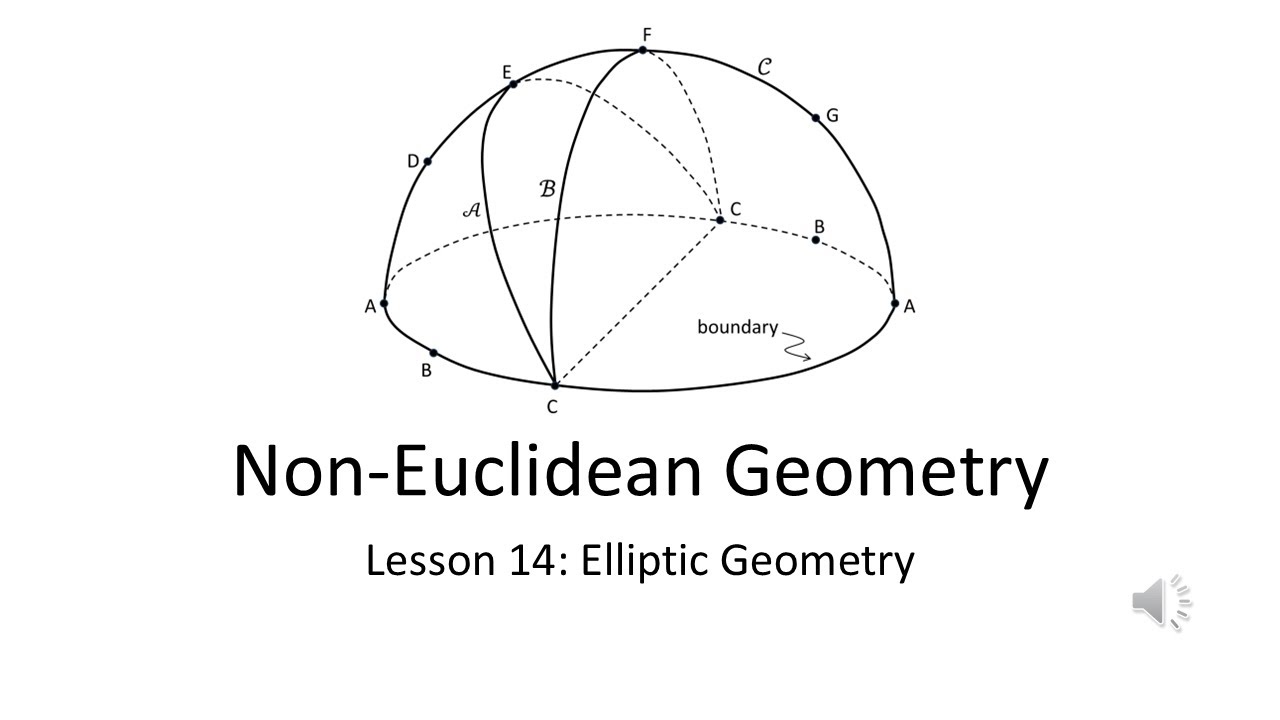
28:10
Elliptic Geometry: Spherical and Hemispherical Models Explained
@sfratini
369 views•2025-03-16
4:43
Elliptic Curve Cryptography Explained: ECC, ECDSA, ECDH
@PracticalNetworking
28.5K views•2024-10-21
10:54
Non-Euclidean Geometry Explained: Curved Spaces and Hyperbolic Physics
@CodeParade
2.9M views•2020-06-26
6:00
The Mathematical Impossibility of Accurate World Maps
@Vox
23.3M views•2016-12-02
Related Study Plans & Knowledge Roadmaps
Structured learning paths in Mathematics
mathematics
Tensor Calculus: Vectors to Riemann Curvature
01Mathematical Foundations: Linear Algebra & Calculus
02Covectors, Dual Spaces, and Tensor Basics
03The Metric Tensor and Index Gymnastics
+ 2 more learning modules
40h5 modules
Explore Roadmap
mathematics
Gödel's Incompleteness: Logic, Proofs & Limits
01Introduction to Formal Systems & Hilbert's Dream
02Set Theory, Cardinality, and Cantor's Diagonal Argument
03Arithmetization and Gödel Numbering
+ 2 more learning modules
14h5 modules
Explore Roadmap
mathematics
Galois Theory: Fields, Groups & Solvability
01Foundations of Abstract Algebra: Groups & Fields
02Polynomials & Field Extensions
03Splitting Fields & Symmetries
+ 2 more learning modules
24h5 modules
Explore Roadmap
mathematics
Non-Euclidean Geometry: Models & Geodesics
01Euclid's Fifth Postulate and the Birth of New Geometries
02Hyperbolic Space and the Poincaré Disk Model
03Geodesics: Defining Straight Lines in Curved Spaces
+ 2 more learning modules
15h5 modules
Explore Roadmap