




![МАТЕМАТИКА МОЖЕ ВРЯТУВАТИ ВАМ ЖИТТЯ 🤯 [VERITASIUM]](https://i.ytimg.com/vi/c6zxT14L-G8/maxresdefault.jpg)








![Узлы и их родственники: самые яркие их «внешние» приложения [1] // Алексей Сосинский](https://i.ytimg.com/vi/bRlo8rc_C7s/maxresdefault.jpg)


Knot theory, a branch of mathematics that studies and classifies knots, has evolved from a theoretical curiosity into a powerful tool with wide-ranging applications in chemistry, biology, and medicine. By developing mathematical invariants like tricolorability, p-colorability, and polynomial invariants (Alexander, Jones, HOMFLY), mathematicians can distinguish between different knots and prove their equivalence. This mathematical framework has enabled the creation of synthetic knotted molecules, understanding of DNA replication mechanisms, and development of chemotherapy drugs targeting bacterial and cancer cells. The field demonstrates how abstract mathematical research can yield practical benefits, transforming what was once considered a failed theory of everything into a cornerstone of modern science.
Knot Theory: The Mathematics Behind Ties, Shoelaces & DNA
Added:- Most of us tie our shoe laces wrong.
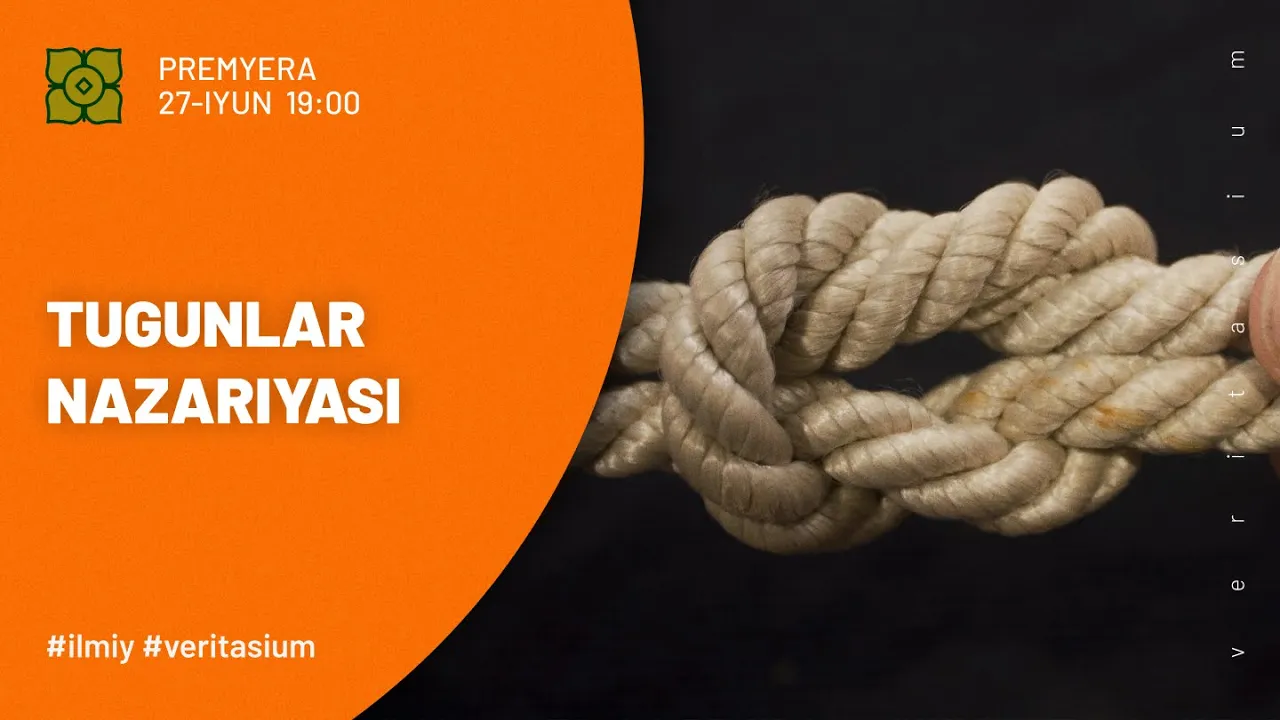
There are two ways to tie a knot in your shoe laces.
In one, you go counterclockwise around the loop, and in the other, you go clockwise.
These two methods look almost identical, but one of these knots is far superior to the other.
It doesn't loosen or come untied nearly as easily.
To understand why, we need to delve into knot theory.
This is a whole branch of mathematics that aims to identify, categorize and understand every possible knot that could ever exist.
So far, we have discovered the first 352,152,252 knots.
Each one has its own particular properties and characteristics.
I think it's fascinating that there's something like a periodic table for knots out there, but it's not pure math.
Knot theory has turned out to be remarkably useful.
It is core to the structure of proteins and DNA.
It's leading to new materials that could be stronger than Kevlar.
It's even used to develop medicines that save millions of lives.
All of this just from trying to understand the humble knot.
So what is a knot?
Well, in our everyday lives, we see knots like this or this, but if you are trying to rigorously study knots, you want to be able to pull them apart so you can really see what's going on.
The problem is knots like this are held together only by tension and friction.
So if you pull on them too hard, they fall apart.
So in order to capture the knot on the rope, mathematicians got the idea to connect the two ends.
And now, well, you can tease the knot apart to study it, but it will never fundamentally change.
So in knot theory, all knots exist on closed loops.
This means the simplest knot you can have is just a circle like this.
Now, admittedly, this is not much of a knot, which is why it is called an unknot.
Here is another knot.
Again, it's made of a single piece of rope that forms a closed loop.
Here is another.
Two knots are only different if you can't make one into the other without breaking the loop.
This is the simplest knot after the unknot.
It is called the trefoil, and you can see that there's no way for me to turn this back into a circle unless I actually break it open, take out the knot and then close it up again.
Now I have two unknots.
It is surprisingly hard to tell two knots apart by eye.
Here is a simple mystery knot.
Is it an unknot, a trefoil or neither?
I'll give you a second to figure it out.
It is in fact a trefoil, which you can see if I just untwist this and rearrange the knot a little bit.
And our first complicated knot, well, it is actually just the unknot.
I'm going to try to disentangle it so you can see that.
There you go.
It was just a single loop.
In fact, these are all unknots, and this is where the problem begins.
You can't just randomly tangle some rope and connect the ends.
To make a new mathematical knot, you need to prove it's not just a tangled up version of another knot.
So how do you tell two knots apart?
This one question, also known as the knot equivalence problem, is so famously difficult that it's propelled the entire field of knot theory for over 150 years.
Alan Turing even wrote in his final publication, "No systematic method is yet known "by which one can tell whether two knots are the same.
"A decision problem which might well be unsolvable "is the one concerning knots.
"The results in this article set certain bounds "to what we can hope to achieve purely by reasoning.".
Previously, the most famous knot problem in history was the Gordian knot.
It was said that whoever untangled this massive knotted rope was destined to rule all of Asia.
Legend goes, Alexander the Great simply came along and sliced right through it.
That would not be a valid solution in knot theory.
And there are other famous knots of history.
The endless knot is seen as far back as clay tablets from the Indus Valley, and it was used in Medieval Celtic designs, Chinese knot work and Hinduism and Buddhism.
In Incan civilization, knots were tied on chords called quipu to track everything from taxes to calendars.
You can even find a knot in the coat of arms for the House of Borromeo, an Italian noble family that has existed since the 1300s.
The Borromeon rings are technically a link, which is just a knot with multiple loops of rope.
The most basic link is the unlink, two loops which aren't actually connected, much like the unknot.
After that is the Hopf link.
Then later, the Borromeon rings and more.
But the knot equivalence problem was only encountered centuries later.
In January of 1867, Scottish physicist Peter Guthrie Tait showed off his homemade smoke machine to renowned scientist William Thomson, later Lord Kelvin.
Tait had read a paper that said a vortex ring should be eternally stable in an ideal fluid.
So intrigued, he set up two wooden boxes containing a kind of toxic mixture of ammonia, sulfuric acid and salt.
When he tapped a towel stretched across the back of each box, the chemical smoke popped out of a circular cutout in perfect rings.
Kelvin, watching, was transfixed by the rings.
He had been pondering the composition of atoms, a fundamental question of the time, and suddenly he saw an answer.
He declared that atoms must be made out of vortex rings of ether, an invisible everywhere medium.
Different knots of vortex rings would make different elements.
The shape of the Hopf link explained the double spectral lines of sodium.
The simple unknot ring was hydrogen.
Tait was skeptical, but as Kelvin's vortex model of the atom became a leading theory, Tait began investigating knots in earnest.
In his mind, creating a periodic table of the elements with every new knot he found.
The crossing number is an easy way to categorize knots.
Just take the simplest form of a knot, one with no extra twists or tangles, and count up all its crossings.
By hand, Tait discovered a three crossing knot, the trefoil, then a four crossing knot, the figure eight, then two five crossing knots, three six crossing knots and seven seven crossing knots.
One quick note, knots are additive.
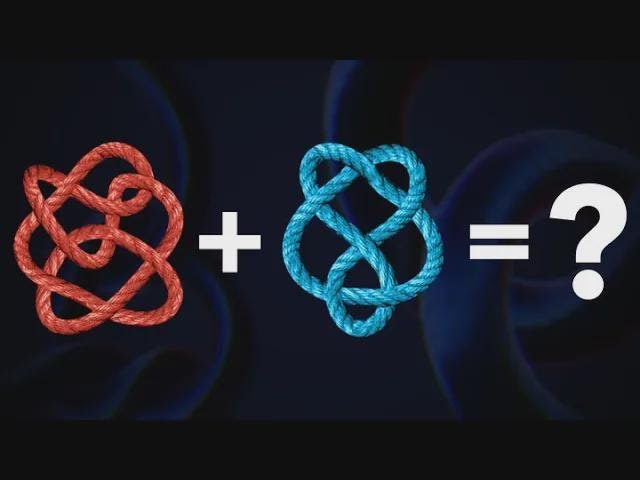
You can stick multiple knots together to make a new knot, like combining these two trefoils into a six crossing knot.
This is called a composite knot, but some knots aren't decomposable into simpler knots.
These are known as prime knots.
Since all composite knots are just built from primes, people mainly focus on tabulating prime knots.
Unfortunately for Tait, warning signs were on the horizon for Lord Kelvin's vortex theory of the atom.
Mendeleev's first periodic table had been published in 1869.
The Michelson-Morley experiment sowed seeds of doubt about an ether in 1887, and the most damning result was JJ Thomson's discovery of the electron in 1897.
So there were particles smaller than the atom which were inside atoms.
But Tait was already in too deep with knots to stop.
He had even roped in his academic rival and close friend James Clerk Maxwell of Maxwell's equations fame.
Thanks to Tait's influence, Maxwell became a knot enthusiast for the rest of his life.
His last poem written shortly before his death from stomach cancer even begins, "My soul's an amphichiral knot, "upon a liquid vortex wrought."
Assisted in part by hundreds of letters with Maxwell, Tait published his list of knots up to seven crossings in 1877, the first math paper with the word knots in its title.
Then Tait paused his search for seven years.
In a speech, he stated, "The requisite labor increases with extreme rapidity "as the number of crossings is increased.
"Someone with the requisite leisure "should try to extend this list, "if possible, up to 11."
Two mathematicians took him up on his call for help, Thomas Kirkman and Charles Little.
Together, the three of them were able to find all 21 eight crossing knots, all 49 nine crossing knots and all 166 10 crossing knots by 1899, just two years before Tait's death.
This was all done painstakingly by hand.
Tait admits in his paper, "I cannot be absolutely certain that all those groups are essentially different, one from another."
In the process of tabulating knots, he had uncovered the central problem of how to possibly tell them apart.
Somewhat miraculously, Tait, Kirkman and Little had done a near perfect job with their knot tables.
Their list stood for 75 years without change, until a single correction in 1973.
But more on that later.
For decades after Tait's death, little progress was made on the knot equivalence problem.
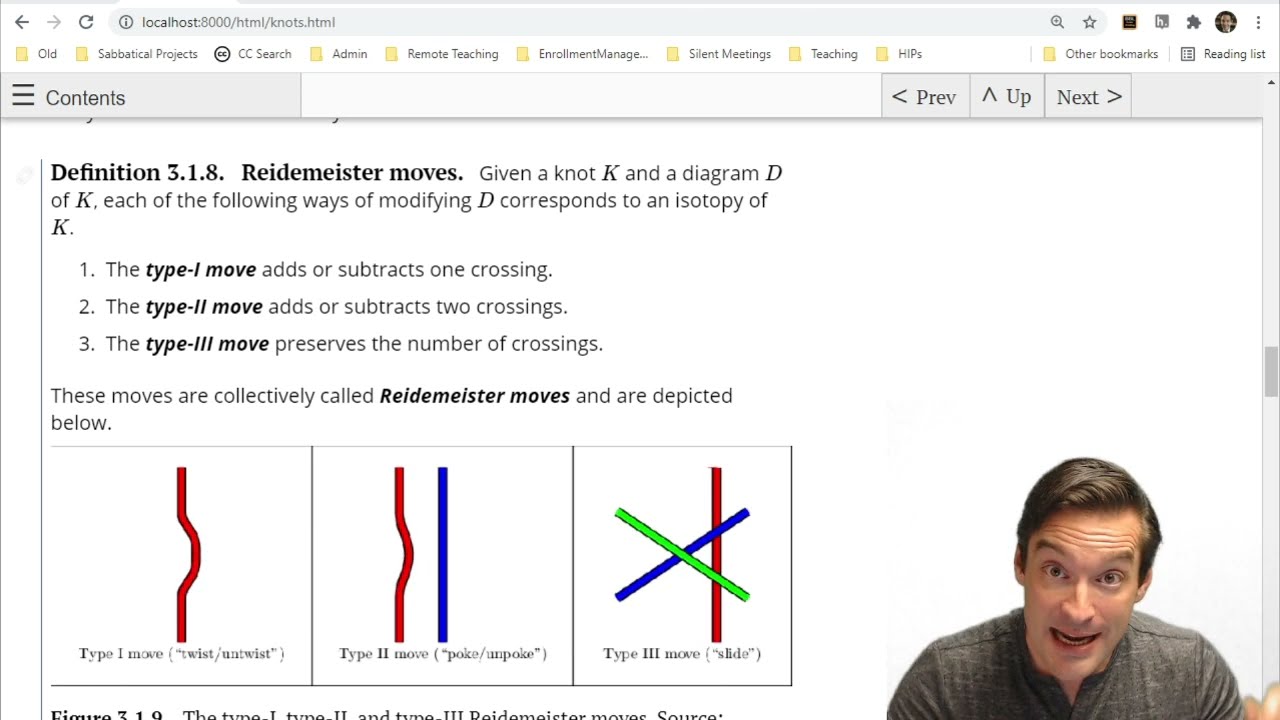
But in 1927, German mathematician Kurt Reidemeister proved a radical theorem.
You only need three types of moves to transform any two identical knots into each other.
The twist, the poke and the slide, where you move a string from one side of a crossing to the other.
Now we can prove some knots are the same.
If you can show that they're connected by Reidemeister moves, you've proven that they must be identical.
But we still don't know how to prove any knots different from each other because you could do Reidemeister moves on one knot for centuries without it ever looking like the other knot.
And maybe they're actually different, but maybe they're the same and you just never made the right move to show that that is true.
This may have been where Turing was coming from when he called the knot equivalence problem potentially undecidable.
But in 1961, mathematician Wolfgang Haken created a computer algorithm that solved the not equivalence problem definitively for this specific case of distinguishing any knot from the unknot.
That said, his paper was over 130 pages long and the algorithm would've taken longer than the age of the universe to run for large knots.
In 2001, building on Haken's work, mathematicians found a way to distinguish between any knot and the unknot by simply setting an upper bound on the number of Reidemeister moves needed to connect them.
If you check all sequences of Reidemeister moves up to that number, you can prove if the knot is the unknot or not.
There's just one problem.
That upper bound was two to the 100 billion n moves.
As of today, the upper bound has improved dramatically to just 236 n to the power of 11.
Now, while smaller than before, checking all possible sequences of Reidemeister moves up to this number is still unfathomable.
For a single crossing knot, this is larger than the number of stars in the observable universe.
In 2011, mathematicians found an upper bound on the number of Reidemeister moves needed to connect any two knots or links, solving the entire knot equivalence problem.
This is the upper bound.
First, raise two to the second power, then raise that to the power of two again.
This operation is called tetration, and it grows fast.
Now keep doing it until you have raised two to itself 10 to the million n times.
Cap it off with n again.
This is easily the largest number we have ever shown in a video.
But even just to have a solution is remarkable, given that Turing thought the problem was potentially undecidable only 60 years earlier.
If it's this hard to tell two knots apart, how have we managed to tabulate 350 million different knots?
Well, there are some properties of a knot that never change, no matter how much you twist or tangle it up.
These are called invariants, and these invariants will be different for some knots compared to other ones.
So you can use them as hallmarks of a particular knot.
They're not perfectly discriminating.
I mean, some knots will share invariants, but if two knots have different invariants then you know for sure that they are different.
Crossing number is itself aninvariant.
Two knots can't be identical if they have different crossing numbers.
But the crossing number is surprisingly difficult to calculate.
You can put extra crossings into any knot, like just throw in a bunch of twists.
Different variations of the same knot are known as different projections of that knot.
Crossing number measures the least number of crossings a knot can have, but it only works for the simplest projection of a knot, also known as its reduced form, but it's difficult to ensure that a knot is fully reduced.
Instead, we can use another invariant, one that's true right away for all projections of a knot.
So it'll give the same value both for a messy trefoil and for a reduced trefoil.
This first invariant is tricolorability or whether or knot can be colored in with three colors.
Take a diagram of a knot and color in each individual segment.
These are just separated by under crossings where you would lift your pen off the page.
Tricolorability only has two rules.
First, you must use at least two colors because you can color any knot in with one color.
And second, at crossings, the three intersecting strands must either be all the same color or all different colors.
Basically no two colored crossings.
There are just two categories of this invariant, either a knot is tricolorable or it's not.
Identical knots must match.
So if one knot is tricolorable and the other one isn't, then you know they're different knots.
It's hard to believe that tricolorability is constant across any possible projection of the same knot, but since you only need Reidemeister moves to move between projections, we just need to prove that it isn't affected by Reidemeister moves.
The twist is easy.
Everything's one color already, and it stays that way.
With the poke, the intersection of two colors means that the loop formed must become the third color.
So we have three colors at every intersection.
With the slide, you never have to break tricolorability because you start with three colors at three intersections and then switch one intersection to just one color.
So any knot will maintain its tricolorability, no matter what Reidemeister moves you do.
This is a good time to note that we never actually proved the trefoil and the unknot were two different knots, but we can do it now with tricolorability.
The unknot is not tricolorable since you can't use at least two colors to color it in, and the trefoil is easily tricolorable, just color in each of the three segments a different color.
The crossings all have three colors, so it is tricolorable.
Now we know every possible projection of the trefoil is tricolorable while every possible projection of the unknot isn't.
So these two knots must be different knots.
This invariant isn't very specific.
It only gives you two categories across all knots.
In fact, the next knot after the trefoil, the figure eight knot, isn't tricolorable.
There's always a crossing with two colors.
So how do we prove that this is different from the unknot, which also isn't tricolorable?
Tricolorability expands into a much more powerful invariant called p-colorability, where p can be any prime number besides two.
Instead of using colors, we'll number each strand with integers between zero and p minus one.
p-colorability has two rules.
First, you must use at least two different numbers.
Second, at crossings, the two bottom strands added together and divided by p must give the same remainder as twice the top strand divided by p.
Tricolorability was just a simple version of this.
If we go from three to five colorability for the figure eight knot, we can number the strands zero, one, and then this strand must give a remainder of zero, so four, and this strand must give a remainder of two, so three.
This knot is five colorable, so it's not the unknot.
p-colorability is a huge tool.
The unknot is completely uncolorable, so any knot with any colorability can't be the unknot.
p-colorability still doesn't cover everything.
Some of the most powerful invariants right now, the ones that can distinguish between the most unique knots, are polynomials.
The Alexander polynomial was the first one discovered back in 1923 before even Reidemeister moves.
Like p-colorability, it relies on only two rules.
The first is that the Alexander polynomial of the unknot is equal to one.
The second is that you can zoom in on any single crossing of a knot and vary it in three possible positions, forward, backward and separate.
The Alexander polynomial gives a relationship between the three resulting knots.
Let's do an example.
What's the Alexander polynomial for the unlink?
Well, if we zoom into this separate crossing and then vary it, we see that the other two knots formed are both the unknot, so we can plug in one for both of them, and we get that the Alexander polynomial for the unlink must be zero.
Then we can do the same for the Hopf link.
Taking this crossing as the forward crossing, then seeing that the backward crossing gives us the unlink, and the separate crossing is the unknot.
So the Alexander polynomial for the Hopf link is minus t to the 1/2 plus t to the minus 1/2.
And now we can do the trefoil.
When we vary this crossing, we get that the backward crossing gives us the unknot and the separate crossing gives the Hopf link.
So the Alexander polynomial is t minus one plus t to the negative one.
The polynomial is designed so that we get separate results for as many knots and links as we can, and this is recursive.
We can calculate the polynomial forever for bigger and bigger knots.
The Alexander polynomial stood unchanged for over 60 years as the knot invariant of choice.
But in 1984, it was upended by an unlikely discovery.
Mathematician Vaughan Jones had been working on a type of algebra for statistical mechanics, a concept in physics, when he realized his work resembled a series of equations in knot theory.
He traveled to New York to consult knot theorist Joan Birman at Columbia University, who helped refine his equations into a knot invariant.
They met again a week later and tested it against knot diagrams from Birman's filing cabinet, quickly realizing Jones had discovered a brand new polynomial invariant.
He scribbled down all their work in a 15 page letter.
The Jones polynomial is like the Alexander, but with the more specific equation for the second rule that lets it distinguish many more knots.
For this discovery, Jones won the field's medal in 1990.
The first new polynomial invariant kicked up a fervor in knot theory.
Just months after Joan's result, six mathematicians each independently found an improved version of his polynomial with two variables instead of one.
The editors of the American Math Society published all their papers together, naming it The HOMFLY polynomial.
Two Polish Mathematicians missed the news and discovered it again a couple months later, upon which it became the HOMFLY-PT polynomial.
None of these invariants works alone.
Just like if you were searching for a person, you'd start by checking a first name, then a last name, then a birthday and so on to eventually narrow your search down to just one person.
Similarly, knots have dozens of invariants, which when taken together, uniquely identify them.
With invariants to prove if knots are different and Reidemeister moves to prove if knots are the same, you can attack from two angles to meet the gargantuan task of distinguishing every single knot.
But this method isn't perfect.
These two knots were listed next to each other in Tait's knot tables for over 75 years.
They were the same by all invariant accounts.
So Tait and Little likely tried Reidemeister moves to see if they could transform one into the other.
And once they failed, they listed them as two separate knots.
Kenneth Perko, a lawyer who had studied knot theory, spotted them in 1973 while looking through Little's table of 10 crossing knots.
Suspicious of their similarities, he pulled out a yellow legal pad to sketch some Reidemeister moves, and he quickly found a way to connect the two knots.
These two projections now known as the Perko pair are the same knot.
So the knot tables of Tait, Kirkman and Little were issued their single correction.
And instead of 166 ten crossing knots, there are 165.
It had taken decades of work to tabulate all 249 prime knots up to 10 crossings.
No one dared tackle the 11 crossings until John Conway.
He found all 552, and claimed he did it in a single afternoon.
This was the last tabulation by hand.
In the '80s, Dowker and Thistlethwaite built a computer algorithm to count all 12 and 13 crossing knots.
Thistlethwaite later joined forces with Hoste and Weeks to tabulate all 14, 15 and 16 crossing knots in a paper titled "The First 1,701,936 Knots."
The method they used is still the one used today, employing a computer to list all possible knots and then using invariants to weed out duplicates.
They split into two teams and crosscheck their results, aligning perfectly on all but four knots on their first try.
In 2020, mathematician Ben Burton single-handedly tabulated all 17, 18 and 19 crossing knots, bringing the total number of known prime knots to 352,152,252.
His project was so computationally intensive, several hundred computers had to run for months before obtaining the final number.
The hardest part of knot tabulation is counting up every knot and then carefully eliminating duplicates.
But if you just want to generate a huge number of distinct knots, you can make alternating knots, knots with crossings that alternate over, under.
This computation is much easier, though it leaves out most knots.
And back in 2007, this method was used to find alternating knots up to an absurd 24 crossings.
So in total, we know of 159,965,097,353 knots.
Of course, we're missing a lot in between there.
Knot theory was always just pure math.
All the algorithms, invariants and tabulations were knowledge for the sake of knowledge.
But in 1989, chemist Jean-Pierre Sauvage tied molecules around copper ions to form the first ever synthetic knotted molecule.
This trefoil knot restricted the atoms from unfurling, trapping them in higher energy states to give the molecule new properties.
Any type of knot tied in a molecule will change its properties, and we know of over 159 billion knots.
So if you can tie a molecule into each of those knots, that's 159 billion new unique materials created from a single molecule.
Though after the trefoil, chemists have only managed to tie five other molecular knots to date.
It's a difficult task.
Since they can't just nudge individual ions into place, molecules must be built to self-assemble into knots.
Knot theory helps identify which knots match available molecular templates, symmetric knots are easier for one, and how to arrange those to assemble the knot.
The most complex knot yet created is the 819 knot with 192 atoms tied around a central chloride ion.
This molecule holds the Guinness World Record for tightest knot in the world, defined as the most crossings per unit length, in this case, eight crossings in 20 nanometers.
Since it's knotted around a chloride ion, once the ion is removed, this molecule is one of the strongest chloride binders in existence.
The field is still new for specific applications.
Chemists are just focused on creating molecular knots before thinking about materials development, but they hope to eventually build things like durable fabrics stronger than Kevlar.
Knot theory is also critical to biological processes that have saved millions of lives.
Bacterial DNA consists of a single loop of the double helix molecule.
This shape means that it always forms a knotted link when it replicates, and the bacteria can't separate into two cells with their DNA tangled up like this.
So they have an enzyme called type two topoisomerase, which snips and reconnects the DNA.
This turns their linked DNA back into an unlink so they can replicate cleanly.
If you inhibit type two tophi summaries, the bacteria can't replicate properly, and in fact they die.
This is how some of the most common antibiotics in the world called quinolones operate.
Human DNA, while not circular, is long enough to also get into tangles.
Each cell in your body contains two meters of DNA.
That's the equivalent of stuffing 200 kilometers of fishing line into a basketball.
When this mess inevitably tangles, human type two topoisomerases come to make crossing changes.
The human version of the enzyme is different enough from the bacterial version that it's unaffected by antibiotics.
But human topoisomerases are sometimes intentionally inhibited.
This stops replication and kills cells, predominantly the rapidly dividing cancer cells.
So it's one of the most common forms of chemotherapy.
Biologists needed knot theory to first understand the mechanism of type two topoisomerase.
Once they observed it was decreasing the crossing number of knots in DNA two at a time, they realized it had to be cutting and rejoining entire double strands of DNA.
And there are many other obscure topoisomerases that act on DNA.
Knot theory is used to analyze the knots they tie or untie and how they operate as a result.
It's not just DNA that knots.
1% of all proteins have various knots in their fundamental structure.
If they get misknotted, they malfunction.
So being able to accurately tell knots apart helps understand these proteins' mechanisms, as well as how to potentially repair or utilize them.
When it comes to your shoe laces, both of the common ways to tie the knot are composed of two trefoils on top of each other.
I'm going to tie some rope around my leg to make this easier to see.
When you go counterclockwise around the loop, well, then you form two identical trefoils on top of each other.
This is also known as a granny knot.
But when you go clockwise around the loop, then you get mirror imaged trefoils on top of each other.
This is also known as a square knot, and it doesn't loosen as easily.
So we should all be tying our shoelaces like this, clockwise around the loop.
Most of us aren't.
I mean, I'm not, usually.
I normally do it like this.
A simple overhand knot is just the trefoil.
The bow line knot, the most common knot for boating or just holding things together is the six two knot.
And any knot tied without using the ends, also known as in the bite, that is just an unknot.
So a slipknot is an example of an unknot.
In 2007, researchers Dorian Raymer and Douglas Smith conducted 3,415 trials of spinning string in boxes to study how knots form in the real world.
They ended up creating 120 different types of knots, some as complicated as 11 crossings.
They found that longer agitation time led to a higher chance of knotting.
Longer string did as well, except this probability decreased once the string was put in a smaller box, which restrained its motion.
So if you want to keep something like headphones from knotting in your pocket where you can't adjust string length or agitation time, then your best bet is to confine them to as small a space as possible.
Raymer and Smith also proposed a model for real world knot formation.
A series of loops are first formed when a string is placed into a container.
Then when it's agitated, a free end of the string gets woven up and down through the loops, braiding itself into them to form knots.
And let's see, a knot.
So coiling up your wires is actually setting yourself up for failure because you're forming a bunch of loops for a loose end to braid perfectly into a knot.
So instead, what you want to do is restrict its movement, whether by using a small box or increasing string stiffness.
DNA increases its stiffness by super coiling, and you can do the same with your wires.
I just double it up like this, and then I twist from the middle.
And this is going to stiffen the length of wire.
Now, this is naturally going to want to sort of coil in on itself and it's going to look like a big tangled mess, but all you have to do is take the opposite ends of the headphone and pull apart, and there's no tangles, no knots.
Their study won an Ig Nobel Prize.
It has been cited in studies of knots in surgical catheters, and even linked to an Apple patent for stiffer earbud wires.
Knot theory began as a failed theory of everything, and for the next century, it was a standalone field of math propelled by nothing more than intellectual curiosity.
But in recent years, it's reclaimed its original potential.
Today, knot theory is a theory of everything from headphone tangles to material science to chemotherapy.
In 1889, Kelvin gave a presidential address to the British Institution of Electrical Engineers about his failed atomic theory of knots.
"I am afraid I must end "by saying that the difficulties are so great "in the way of forming anything like a comprehensive theory "that we cannot even imagine a finger-post "pointing to a way that leads us towards the explanation.
"But this time next year, "this time 10 years, "this time 100 years, "I cannot doubt "but that these things which now seem to us so mysterious "will be no mysteries at all, "that the scales will fall from our eyes, "that we shall learn to look on things in a different way "when that which is now a difficulty "will be the only common sense "and intelligible way of looking at the subject."
Knot theory is a perfect example of how knowledge in one area can become a tool to understand countless others.
From learning how to tell a trefoil apart from an unknot, knot theorists have built all the way up to discovering brand new proteins.
If you want a quick and easy way to build out your own mental toolkit, you should absolutely check out this video sponsor, brilliant.org.
Brilliant is the best way to learn about almost any concept in math, data science, programming and more.
They even have a computational biology course where you can apply concepts from this video to folding protein chains.
With Brilliant, you just set your goal and they'll design the perfect learning path to help you reach it, equipping you with professional tools along the way.
Want to harness the tools of a data scientist?
Brilliant's newest course Predicting with Probability is the best place to get them.
The course has everything you need and nothing you don't to start building your data science skills.
There is no coding required.
You'll learn easily to slice and dice massive data sets, compare distributions and master fundamental concepts like Bayes' theorem, all while working with real air traffic data.
You'll learn to answer questions like which airlines have the least delays due to weather and how much more unruly passengers have gotten since the pandemic.
Data skills are absolutely necessary to navigate our world today.
And Brilliant is the best place to get them.
Beyond their data courses, Brilliant also has a massive content library, all of it highly visual, interactive, and incredibly easy to understand.
It's more than just a learning platform., it's your path to understanding the world of math, data and computer science.
By learning on Brilliant, you'll always be one step ahead as technology and the modern world advances every day.
To try everything Brilliant has to offer for free for a full 30 days, visit brilliant.org/veritasium.
I will put that link down in the description, and the first 200 of you to sign up will get 20% off Brilliant's annual premium subscription.
So I want to thank Brilliant for sponsoring this video, and I want to thank you for watching.
Up Next

Introduction to Knot Theory: Understanding Invariants and Polynomials
@DrTrefor
70K views•2022-05-09
Elliptic Curve Cryptography Explained: ECC, ECDSA, ECDH
@PracticalNetworking
28.5K views•2024-10-21

The Parallel Postulate: How Euclid's Fifth Axiom Revealed Hidden Universes
@veritasium
16.9M views•2023-10-21
The Mathematical Impossibility of Accurate World Maps
@Vox
23.3M views•2016-12-02
Related Study Plans & Knowledge Roadmaps
Structured learning paths in Mathematics