










![МАТЕМАТИКА МОЖЕ ВРЯТУВАТИ ВАМ ЖИТТЯ 🤯 [VERITASIUM]](https://i.ytimg.com/vi/c6zxT14L-G8/maxresdefault.jpg)


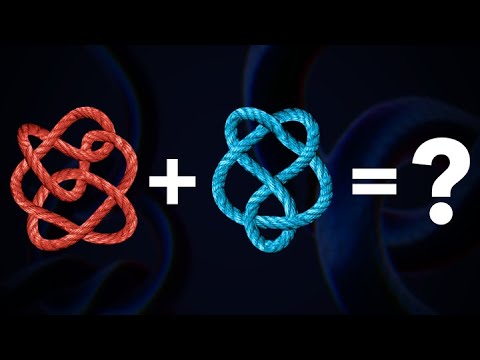
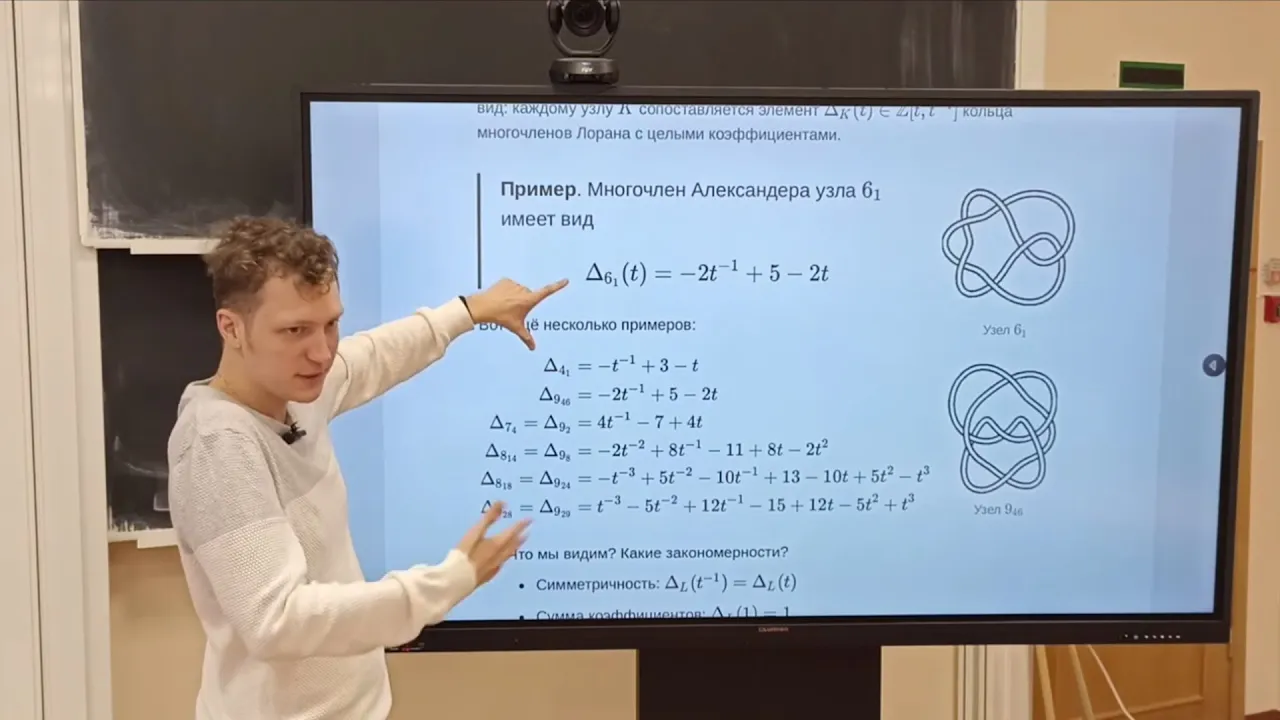



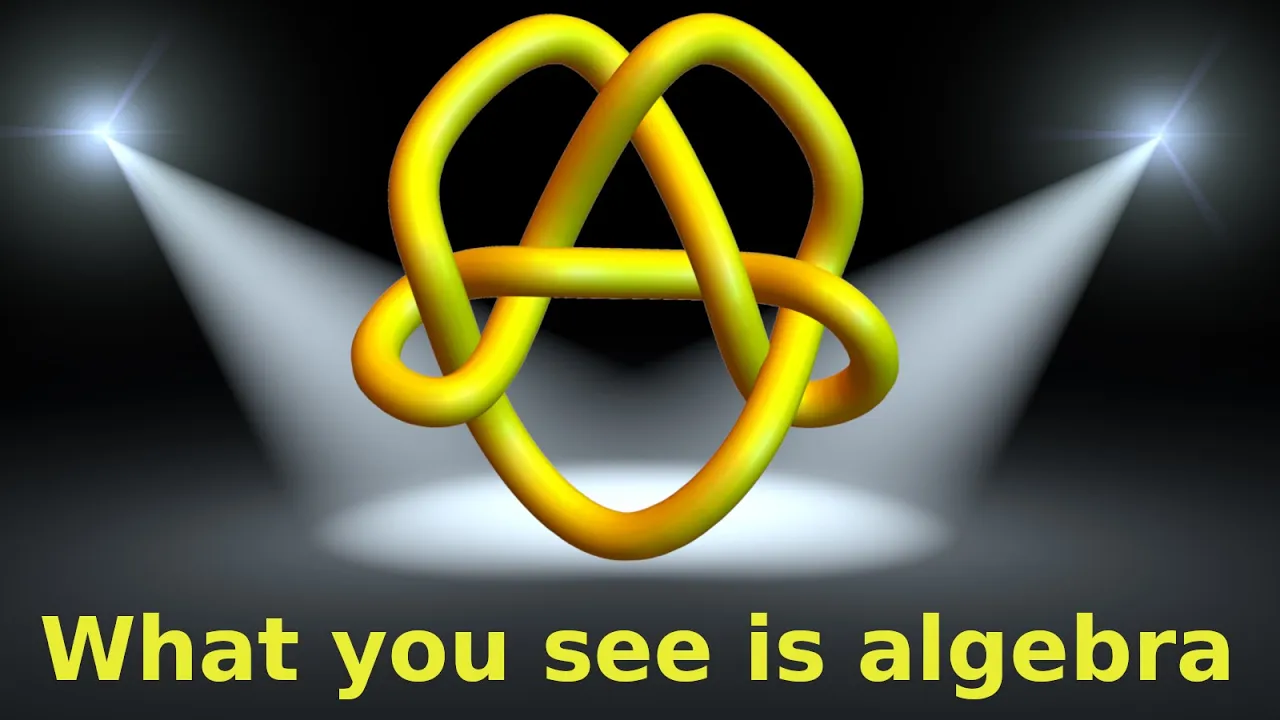

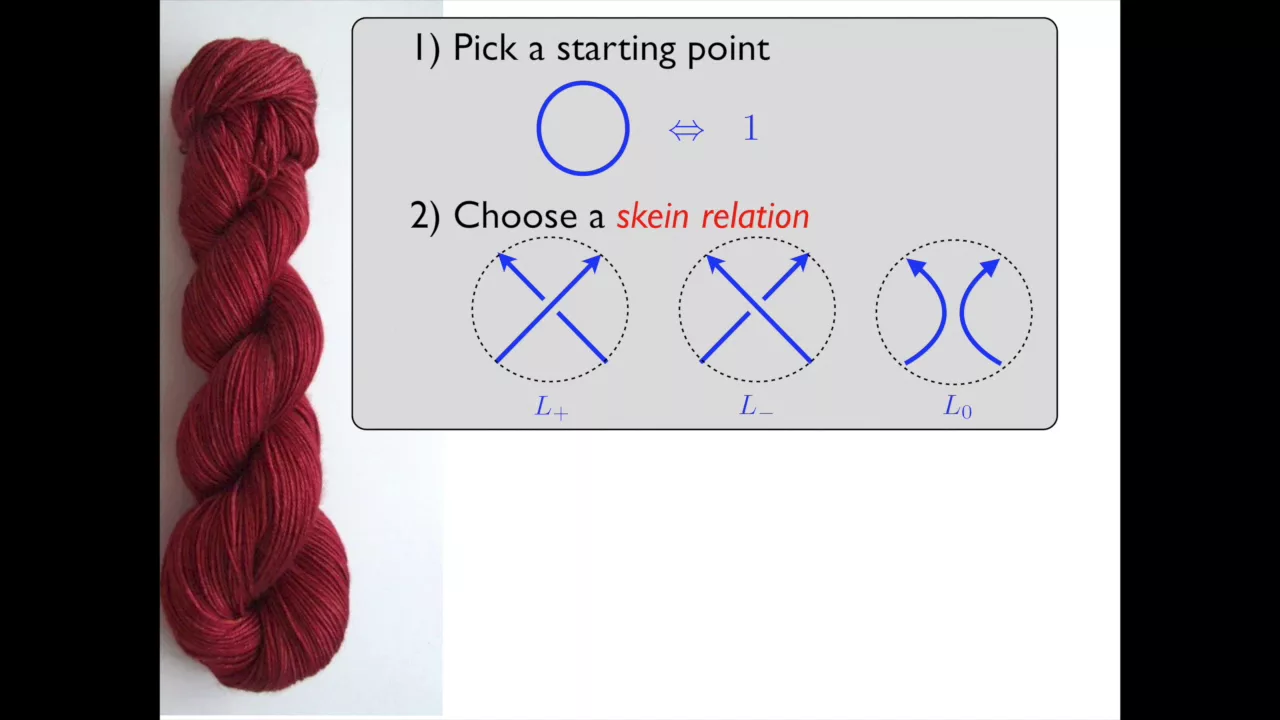
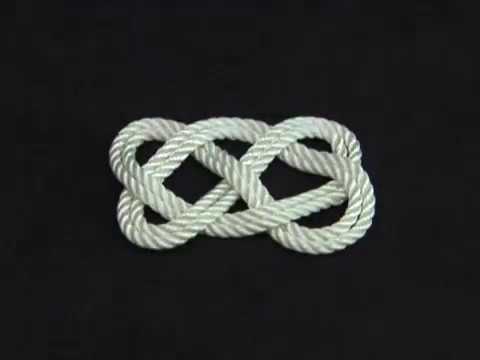
Reidemeister's Theorem states that two knot diagrams represent equivalent links in three-dimensional space if and only if they can be transformed into each other through a sequence of Reidemeister moves (R1, R2, R3), which are three specific local transformations that modify diagrams while preserving their topological structure; a diagram is defined as a 'good shadow' (a projection of a link onto a plane with no triple crossings, tangents, or cusps) equipped with crossing data specifying which strand passes over or under at each intersection.
Knot Theory: Diagrams and Reidemeister Moves Explained
Added:Basic intuitive understanding of topology, specifically the concept of continuous deformation (ambient isotopy) without cutting or gluing.
The mathematical definition of a knot as a closed, non-self-intersecting loop embedded in three-dimensional space (an embedding of S¹ in ℝ³).
The concept of a link, which consists of one or more disjoint knots tangled together.
How 3D objects are projected onto a 2D plane, including the notation used to represent over-crossings and under-crossings (regular projections).
The definition and computation of basic knot invariants, which are properties of a knot that remain unchanged under Reidemeister moves (e.g., tricolorability, unknotting number, and crossing number).
Introduction to polynomial invariants, such as the Kauffman Bracket, Jones Polynomial, and Alexander Polynomial, which are used to rigorously distinguish between different knots.
The study of Seifert surfaces and knot genus, exploring how knots can form the boundaries of two-dimensional orientable surfaces.
The connection between braids (Braid Group) and knots, including Alexander's Theorem and Markov's Theorem.
Real-world applications of knot theory in molecular biology (DNA supercoiling and enzyme action) and quantum physics.
4.9K views61likes14:39Original Release: 2015-01-16
welcome everyone to a mini lecture about diagrams and rider meister moves this this word here is ridermeister it's the name of a german topologist uh from the i guess the middle of the 20th century and uh the relevant part of the notes we're covering today is uh definition 1.8 to theorem 1.12 uh that's uh between pages two and three roughly um now what is the idea of this material it's that we're going to study knots and links and as you know knots and links are things that live in three dimensions but we're going to study them by drawing pictures of them so we're going to study these things using their diagrams which live in r2 so let's begin so here from the notes is the definition of diagram a diagram of a link l is a good shadow of l together with the data of under and over crossings so what do these words mean what's a shadow what's a good one and what's this data well that's what i'll tell you just now first what is a shadow of a link l a shadow of l is the image of l under some projection from r3 to r2 now what do we mean when we say we project from r3 to r2 well um that's just taking a linear map a subjective linear map from r3 to r2 whoops and taking the image of the subset l in r3 under that map but basically what it says is if the link is a is an object in r3 you choose a direction from which to look at it and then you draw its picture in r2 from that direction so for example if this is the trefoil thought of as a subset of r3 because we all have to have the eye of faith in order to think of this as a subset of r3 anyway if we think of this as a subset of r3 and we project it down to the plane uh which we think of as the plane of the screen here then we'll get this image which is which is a shadow and uh the shadow is of course not as nice as the knot why because it's got crossings in it points where the shadow intersects itself and of course the shadow taking the shadow is a bad thing to do why because different knots can have the same shadow so this knot here has exactly the same shadow as this one here but this one is the trefoil which we haven't yet discovered but will is interesting it's not the unknot whereas this one perhaps you can see this is the unknot i could i could unravel this to get just a single circle so that's what a shadow is what is a good shadow well you see i could make all sorts of mistakes when i take my shadow and we say that the shadow is good if we didn't make any of those mistakes so it's a good shadow if there are no triple crossings we only want two strands to cross each other at the same time there should be no tangents which is to say the uh the the image should either cross itself properly or not touch itself at all and finally there are no cusps there's no points where there are no sharp points in the image let's say so that's what it means for the shadow to be good and then uh we should equip this good shadow with the data of under and over crossings this shadow here by the way is good and what does that mean well here's a shadow of the trefoil and here is the shadow of the trefoil equipped with the crossing data so what i remember is that in my trefoil this strand here was above this strand here and i depict that by drawing this strand it's going above this one similarly here in my trifoil this strand was above this strand and i depict it by drawing it that way so we've come full circle in other words the drawings i've been drawing of all these knots and links all the time these are the diagrams that we're talking about now so this idea of the diagram it's exactly what we've been doing all along [Music] and for the rest of the course almost um we're usually going to study knots and links only by their diagrams now we come to an extremely important theorem it's called rydermeister's theorem it says the following the diagrams dn d1 and d2 they represent equivalent links in other words the links they represent are the same they are equivalent they can be deformed within r3 if and only if the diagrams differ by a sequence of ridermeister moves and deformations of diagrams that preserve the crossing data so certainly if i if i if i take a diagram and say rotate it through 90 degrees well that represents the same knot or link as the previous diagram however you could do something more complicated and that's what these ridermeister moves say so what are the randomized moves i've drawn their pictures over here we say for example let's think about the rider meister move r2 we say that two diagrams differ by rider mice to move r2 if i can find a region of the first diagram that looks like this image and by replacing this image with this one i obtain the second diagram in other words two diagrams differ by a rider meister move if i can find a little region in each such that replacing one with the other i've just done one of these three moves whoops so very important ride myself theorem is an if and only if statement if two diagrams differ by a ridermaster move then they represent the same link and indeed what that means is uh that these moves replacing something like this with something like this you should be able to realize them by smooth deformations inside r3 and hopefully you can see that for the diagram this is a magical process going from here to here because there used to be a crossing and now it's disappeared on the other hand in three dimensions it's obvious that these two are equivalent because i can just take this little loop and unravel it straighten it out pull this string tight to get this one similarly uh i can move from this this little bit of link to this one simply by sliding them apart and here i slide this over strand down across the crossing to this under strand so it's clear that these moves can be realized in three dimensions the real power of rhinomysis theorem is that it tells you the converse if two diagrams represent equivalent links equivalence realized by some very large and complicated move in three dimensions if the two diagrams represent the equivalent links then the two diagrams differ by these ridermeister moves okay so enough waffling here are some examples uh i've listed the three ridermaster moves down the bottom there and let's try and prove for ourselves uh say that this knot diagram here is equivalent to this not diagram here and the way we're going to prove that this that well we're going to we're sort of making two statements at once we're saying that this not thought of as living in r3 is equivalent to this not living in r3 or we're saying that this diagram and this diagram differ by a rider meister move so let's see that the diagrams differ by a rider meister booth so let's take a new copy of this whoops what i do is i find a region inside my diagram that looks like one or other side of one of these moves and the region i'm going to take is going to be this box here and can you see that inside the box my diagram looks like the left hand side of rydermeister move one there's a strand that comes down goes over a crossing loops background under the same crossing that's the same as what happens here down over a crossing loops background under the same crossing and then what happens is i apply rydermeister move number one and the effect it has this is a bad way to erase okay i'm just going to redraw the whole thing so the region outside the box we leave as it was the region inside the box which used to look like the left hand side of r1 we're now going to replace it with the right hand side of our one which is a strand that goes straight from one end to the other go straight from one end to the other and we see that what we've done is we've replaced this diagram here with this diagram here in other words we've gone from the left to the right there now let's see a different example let's see um how to get between this link and this one sorry i should correct my language i want to see how to get from this link diagram to this one because if i think of these as links living in r3 then it's clear that these are equivalent by defamation that just picks up the left hand circle and slides it to the left a little bit until they no longer overlap but let's see why these two diagrams differ by ridermeister moves so let's take ourselves another copy of the first one and again let's search for a little region inside this diagram that resembles one or other of the sides of one of these three moves and uh can you see it it's here i'm going to draw this little box here and then what we've got is a little bit a little region of the diagram that exactly resembles the left hand side of move r2 so what do i do i leave the outside i leave the part of the diagram outside the box as it was i apply r2 and what i do is i replace what's uh what used to be inside the box which looked like this with this now so what i what is that that's a that's a strand going from top to bottom and another one going from top to bottom so there we go and twice so we're replacing this diagram with this one okay so that's the end of our lecture i hope this was useful randomized moves are typically quite confusing so um don't despair
Up Next
18:53
Knot Diagrams and Reidemeister Moves Explained | Isotopy and Invariants
@MatthewSalomone
1.1K views•2021-07-29
4:43
Elliptic Curve Cryptography Explained: ECC, ECDSA, ECDH
@PracticalNetworking
28.5K views•2024-10-21

6:20
Jones Polynomial Definition: Invariance Proof
@richardhepworth1441
3K views•2015-03-13
6:00
The Mathematical Impossibility of Accurate World Maps
@Vox
23.3M views•2016-12-02
Related Study Plans & Knowledge Roadmaps
Structured learning paths in Mathematics
mathematics
Tensor Calculus: Vectors to Riemann Curvature
01Mathematical Foundations: Linear Algebra & Calculus
02Covectors, Dual Spaces, and Tensor Basics
03The Metric Tensor and Index Gymnastics
+ 2 more learning modules
40h5 modules
Explore Roadmap
mathematics
Gödel's Incompleteness: Logic, Proofs & Limits
01Introduction to Formal Systems & Hilbert's Dream
02Set Theory, Cardinality, and Cantor's Diagonal Argument
03Arithmetization and Gödel Numbering
+ 2 more learning modules
14h5 modules
Explore Roadmap
mathematics
Galois Theory: Fields, Groups & Solvability
01Foundations of Abstract Algebra: Groups & Fields
02Polynomials & Field Extensions
03Splitting Fields & Symmetries
+ 2 more learning modules
24h5 modules
Explore Roadmap
mathematics
Non-Euclidean Geometry: Models & Geodesics
01Euclid's Fifth Postulate and the Birth of New Geometries
02Hyperbolic Space and the Poincaré Disk Model
03Geodesics: Defining Straight Lines in Curved Spaces
+ 2 more learning modules
15h5 modules
Explore Roadmap