






![Узлы и косы [3] // Алексей Сосинский](https://i.ytimg.com/vi/ubqM1Frhz1s/hqdefault.jpg)










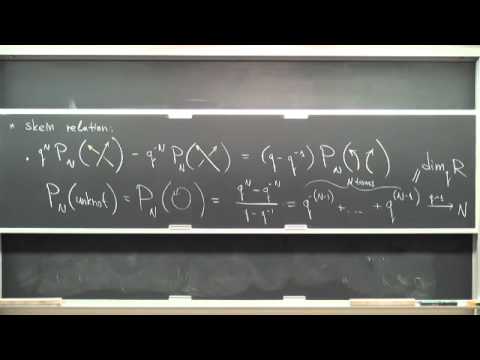
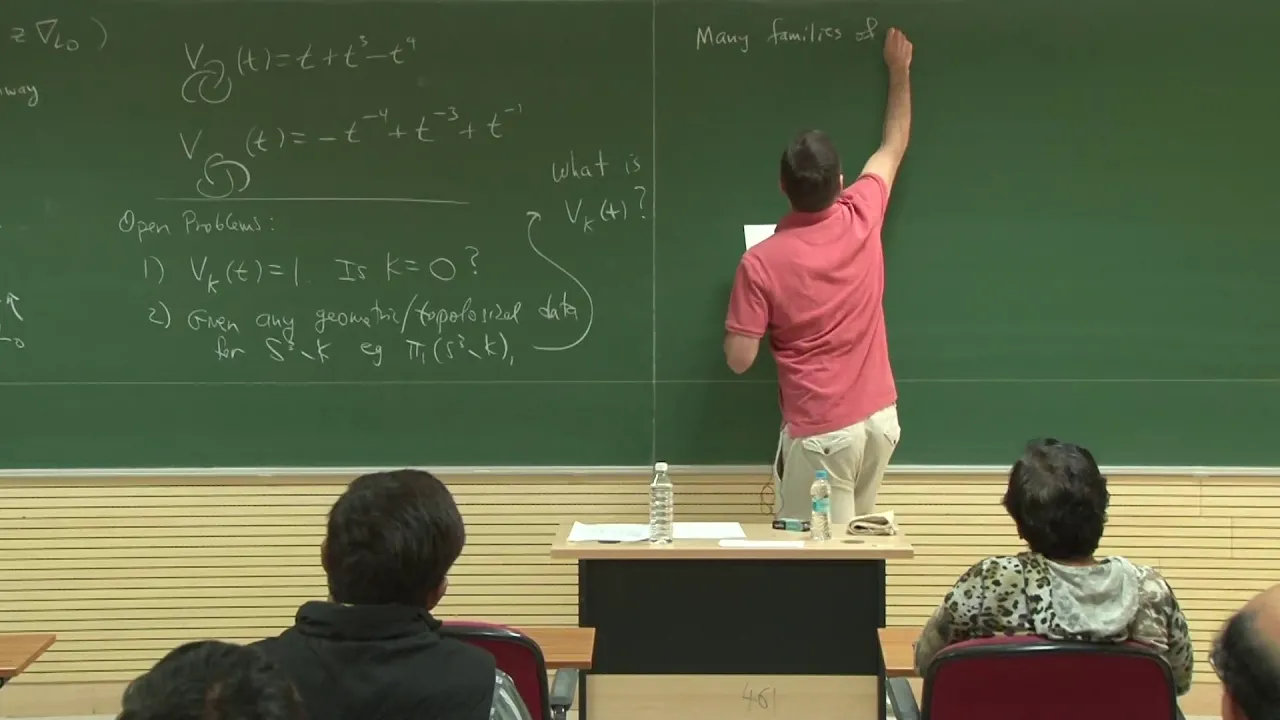






The Jones polynomial VL of an oriented link L is defined as the Kauffman bracket of any diagram D of L multiplied by -a^(-3) times the writhe W(D), with the substitution a = T^(-1/4); this polynomial is a well-defined invariant of oriented links because it remains unchanged under Reidemeister moves R1, R2, and R3, where invariance under R1 is proven by showing that the changes in the Kauffman bracket and writhe cancel each other out.
Jones Polynomial Definition: Invariance Proof
Added:Basic concepts of Knot Theory, including the mathematical definitions of knots, links, and knot diagrams.
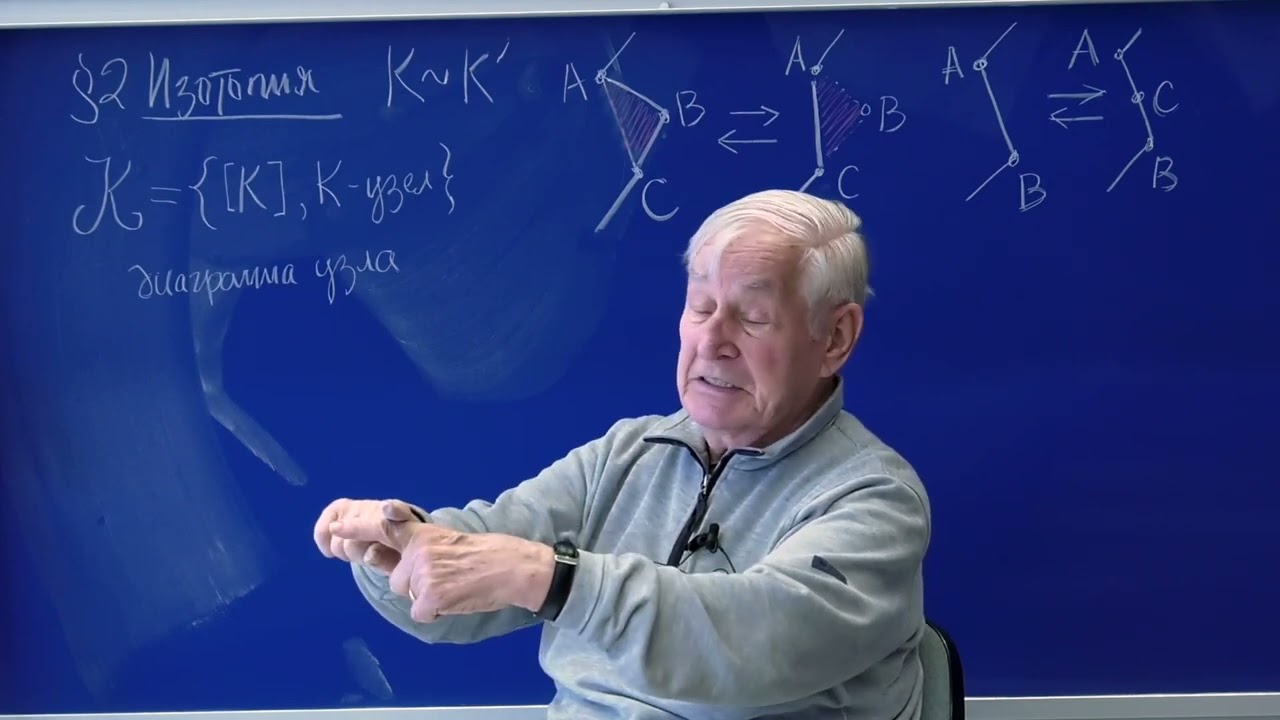
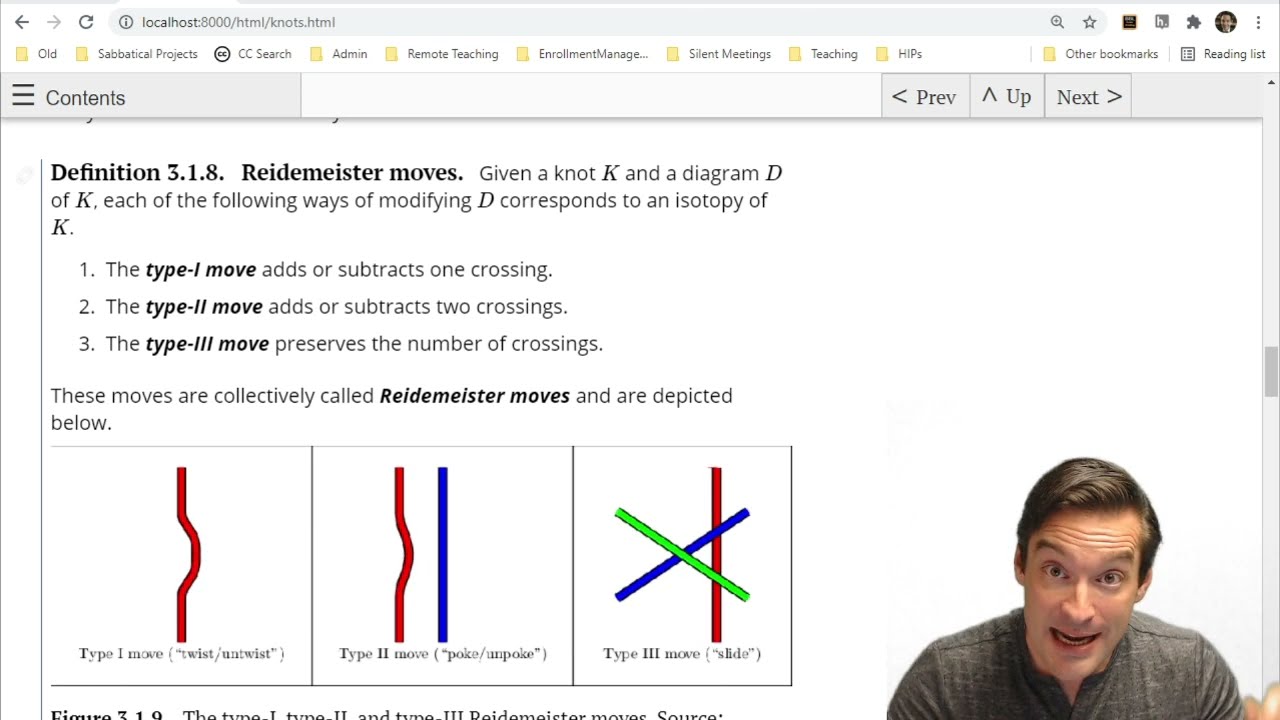
The three Reidemeister moves (Type I, II, and III) and their role in defining ambient isotopy of knots.
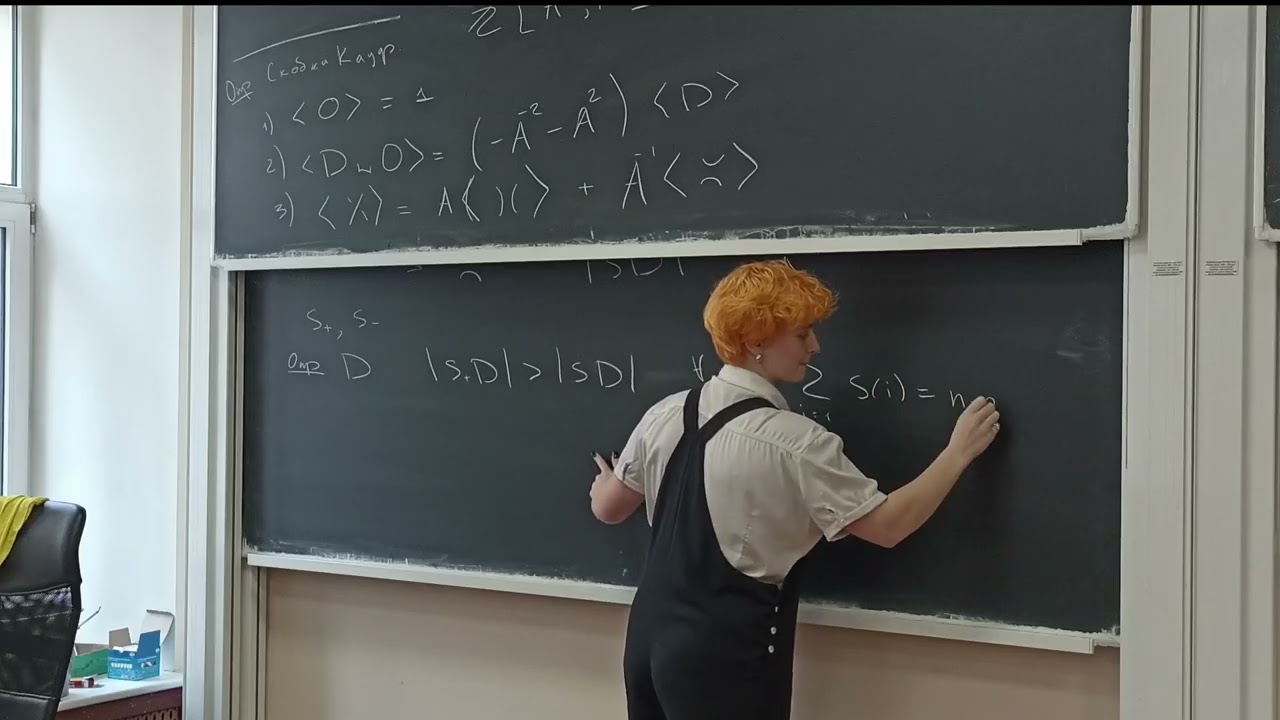
The Kauffman bracket, including its recursive skein relations on unoriented link diagrams.
The concept of writhe (the sum of signed crossings) for oriented knot and link diagrams, which is used to normalize the Kauffman bracket.
Using the Jones polynomial to detect knot chirality, such as distinguishing between the left-handed and right-handed Trefoil knots.
Exploring Khovanov Homology, a powerful modern framework that categorifies the Jones polynomial into a chain complex.
Studying the HOMFLY-PT polynomial, a two-variable generalization that unifies the Jones and Alexander polynomials.
Investigating connections to Mathematical Physics, specifically Chern-Simons theory and Topological Quantum Field Theory (TQFT).
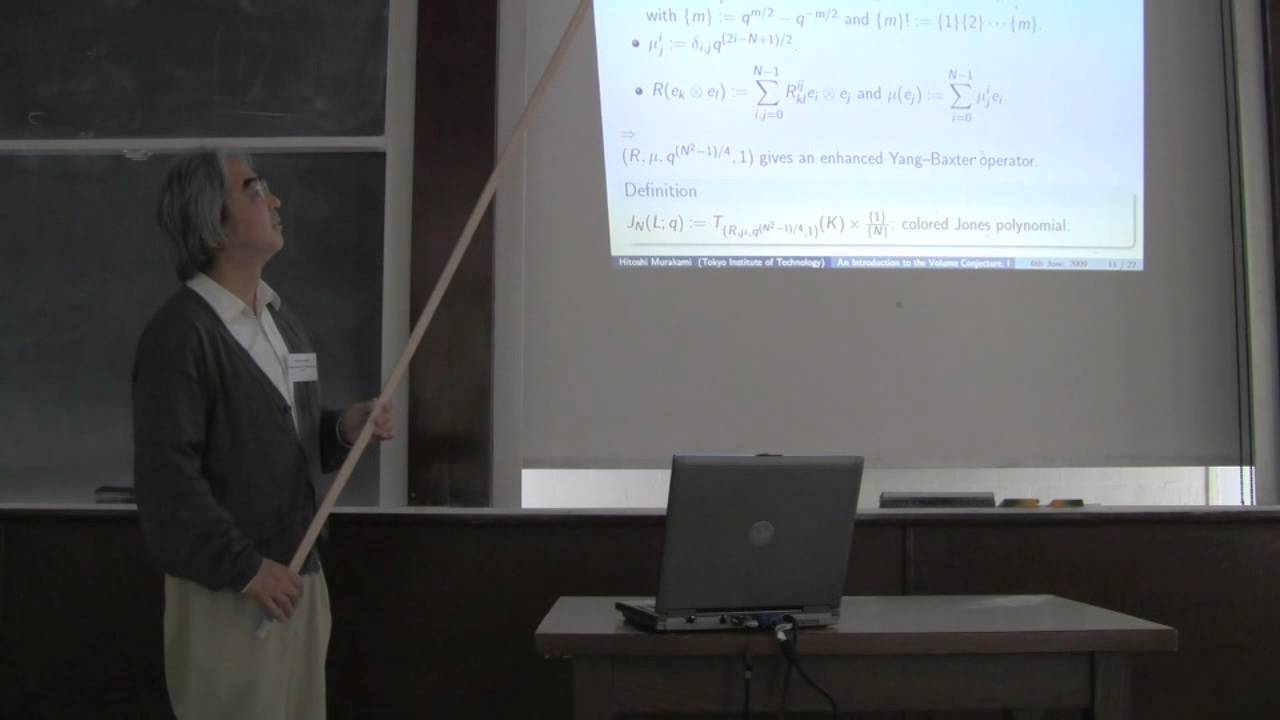
Understanding the Volume Conjecture, which relates the asymptotic behavior of colored Jones polynomials to the hyperbolic volume of knot complements.
3K views22likes6:20Original Release: 2015-03-13
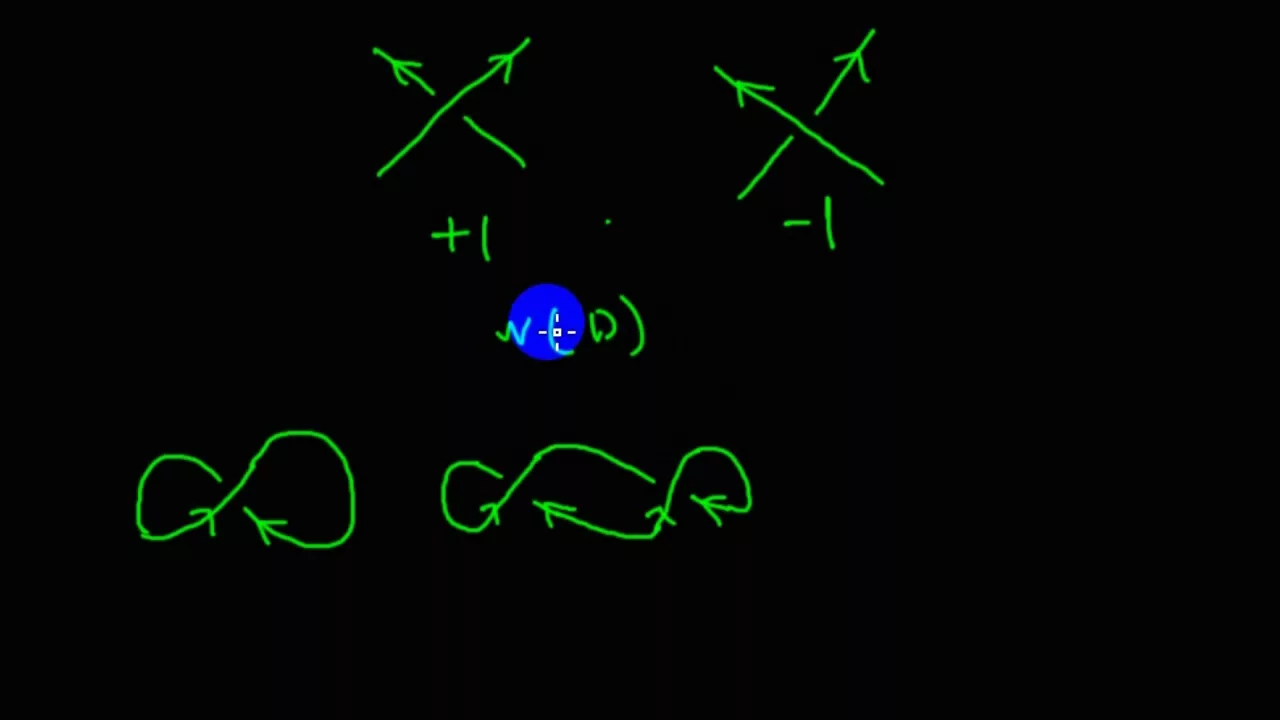
hello welcome to a mini lecture about the definition of the Jones polinomial um this is based on definition 6.16 and Theorem 6.17 from our notes so uh here is the definition the Jones polinomial of an oriented link l is well we know it's called VL and it's obtained as follows take the calman bracket of D where D is any diagram of L so pick a diagram of L take its calman bracket multiply that by minus a to the^ - 3 * the W of D so the cman bracket is a luron polinomial in the variable a so is this uh coefficient here multiply them together you get a l polinomial in the variable a and then I make the substitution T 12 is Aus 2 um this is by convention that we write it like this but really what we do is we take a and we replace it everywhere we can see it by T to the minus one4 right that's what it really means uh and then that's the Jones polinomial so if we Define any invariant in terms of diagrams we need to respond with a theorem that the Jones polinomial is a well defined invar varant of oriented links I need to prove that theorem how do I prove a theorem like this well this is a theorem of the kind uh We've proved several times now in the course I need to prove that if I change my diagram d by a ROM Master move then this right hand side here doesn't change uh so let me show you the most interesting ingredient of the whole proof which is invariance under R1 and in order to Pro invariance under R1 we need to remember how does the Calin bracket change under R1 well that's according to this rule here and how does the wyth change according to R1 well that's according to this rule here and that's what we saw in the uh previous mini lecture and these are lemas in the notes as well so what we wish to do is we wish to show that if we compute this uh this quantity that appears in the definition of the Jones polinomial if we want to compute it uh applied to a diagram that looks like the left hand side of R1 then what we get is the same as if we took the right hand side of R1 so I left the wrong symbols in there these should be the right hand sides of R1 like that uh so we wish to prove that well if we want to prove it after making the substitution uh replacing A's with powers of T then we might as well prove it before we make the substitution so it's going to be enough to do this right I can just not do the substitution then it's enough for me to try and prove this here how do we do this well to see this observe what's the left hand side well it's equal to minus a to minus 3 what's the r of uh a diagram which has a part that looks like the left hand side of ryom to move one well that's the Ry of the same diagram with romis to move one applied minus one and what is the cman bracket of a diagram that has a part that looks like the left hand side of right to move one well that's minus a to the minus 3 let's put that all in a bracket to make it clear that we're multiplying times the diagram with R1 applied so what's this this is well this is minus a to the minus 3 R of that diagram Times by minus a to the 3 time R well to Theus 3 * -1 which is - A8 to the 3 uh multiplied by - Aus 3 multiplied by C bracket of the right hand side of R1 well what is minus a cubed that's minus a cubed and what is minus a to Theus 3 that's minus Aus 3 so my minus signs cancel out let's let's make a new line I'm sorry uh okay so this is just minus a cubed this is minus Aus 3 so the minus is cancel out the a is cancel out and I simply get what I wanted the right hand side of the desired equation so this is why the Jones polinomial is well defined uh this is why it's invariant under R1 for R2 and R3 is even simpler because remember that if I wrote you the equations equivalent to these ones here for R2 and R3 there wouldn't be any confusion there right the uh the C bracket is inv variant under R2 and the r is in inv variant under right under R2 so it's obvious that the Jones polinomial is invariant under R2 similarly for R3 so this was the hardest bit of the proof so you see once we've got all the ingredients in play uh this this theorem is not too difficult and uh that's the end of the mini lecture
Up Next
59:54
Knot Theory 9: Jones Polynomial - Definitions & Properties
@MathatAndrews
9.2K views•2019-03-20
4:43
Elliptic Curve Cryptography Explained: ECC, ECDSA, ECDH
@PracticalNetworking
28.5K views•2024-10-21

8:47
Introduction to the Jones Polynomial: Oriented Link Invariant
@richardhepworth1441
11.2K views•2015-03-11

6:00
The Mathematical Impossibility of Accurate World Maps
@Vox
23.3M views•2016-12-02
Related Study Plans & Knowledge Roadmaps
Structured learning paths in Mathematics
mathematics
Tensor Calculus: Vectors to Riemann Curvature
01Mathematical Foundations: Linear Algebra & Calculus
02Covectors, Dual Spaces, and Tensor Basics
03The Metric Tensor and Index Gymnastics
+ 2 more learning modules
40h5 modules
Explore Roadmap
mathematics
Gödel's Incompleteness: Logic, Proofs & Limits
01Introduction to Formal Systems & Hilbert's Dream
02Set Theory, Cardinality, and Cantor's Diagonal Argument
03Arithmetization and Gödel Numbering
+ 2 more learning modules
14h5 modules
Explore Roadmap
mathematics
Galois Theory: Fields, Groups & Solvability
01Foundations of Abstract Algebra: Groups & Fields
02Polynomials & Field Extensions
03Splitting Fields & Symmetries
+ 2 more learning modules
24h5 modules
Explore Roadmap
mathematics
Non-Euclidean Geometry: Models & Geodesics
01Euclid's Fifth Postulate and the Birth of New Geometries
02Hyperbolic Space and the Poincaré Disk Model
03Geodesics: Defining Straight Lines in Curved Spaces
+ 2 more learning modules
15h5 modules
Explore Roadmap