



![Узлы и косы [3] // Алексей Сосинский](https://i.ytimg.com/vi/ubqM1Frhz1s/hqdefault.jpg)



![[GS#2] Théorie des nœuds (Introduction)](https://i.ytimg.com/vi/g7HSdT6-YJU/maxresdefault.jpg)
![[FULL] KAIX Introduction to knot theory](https://i.ytimg.com/vi/Zd2RcW3Kwd4/maxresdefault.jpg)










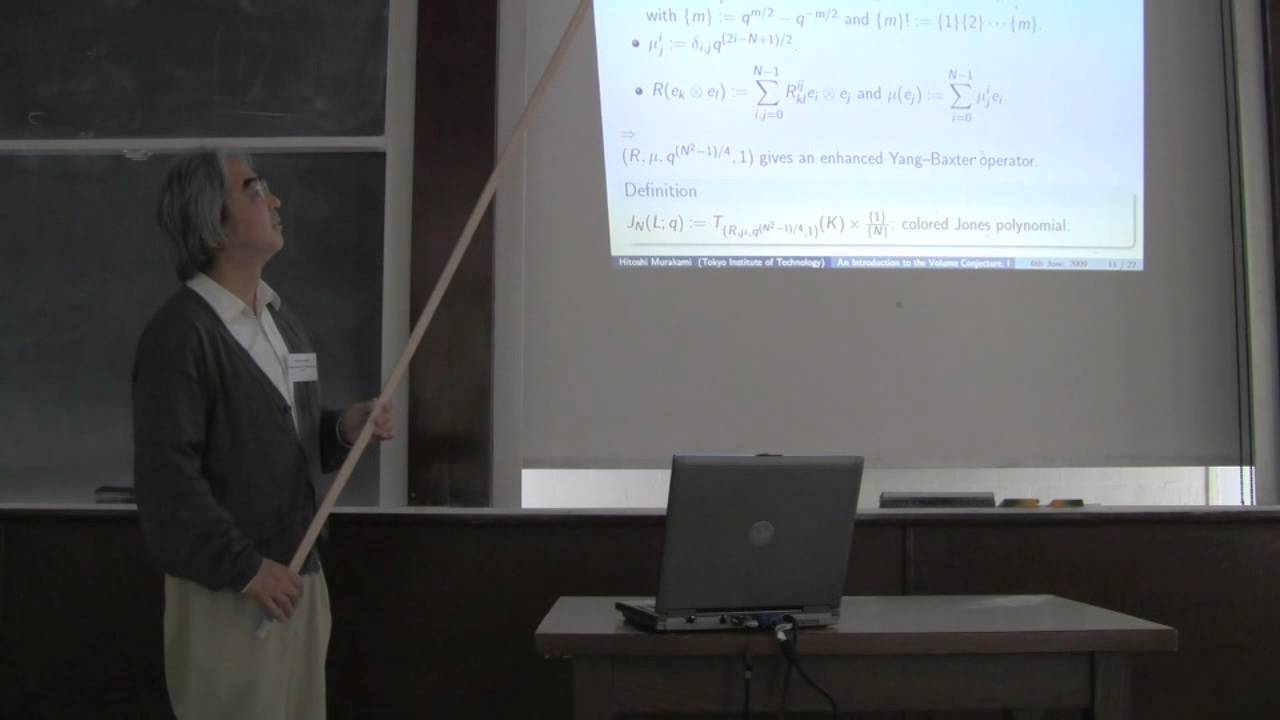

The Jones polynomial is a powerful invariant of oriented links defined by three key properties: it is a Laurent polynomial in t with half-integer exponents, the unknot evaluates to 1, and it satisfies the skein relation t⁻¹V(L+) - tV(L-) + (t² - t⁻²)V(L₀) = 0, which relates the polynomials of three oriented links that differ only in a small region around a crossing (positive crossing, negative crossing, and no crossing). This recursive relationship allows computation of the Jones polynomial for any link by reducing it to simpler links whose polynomials are already known.
Introduction to the Jones Polynomial: Oriented Link Invariant
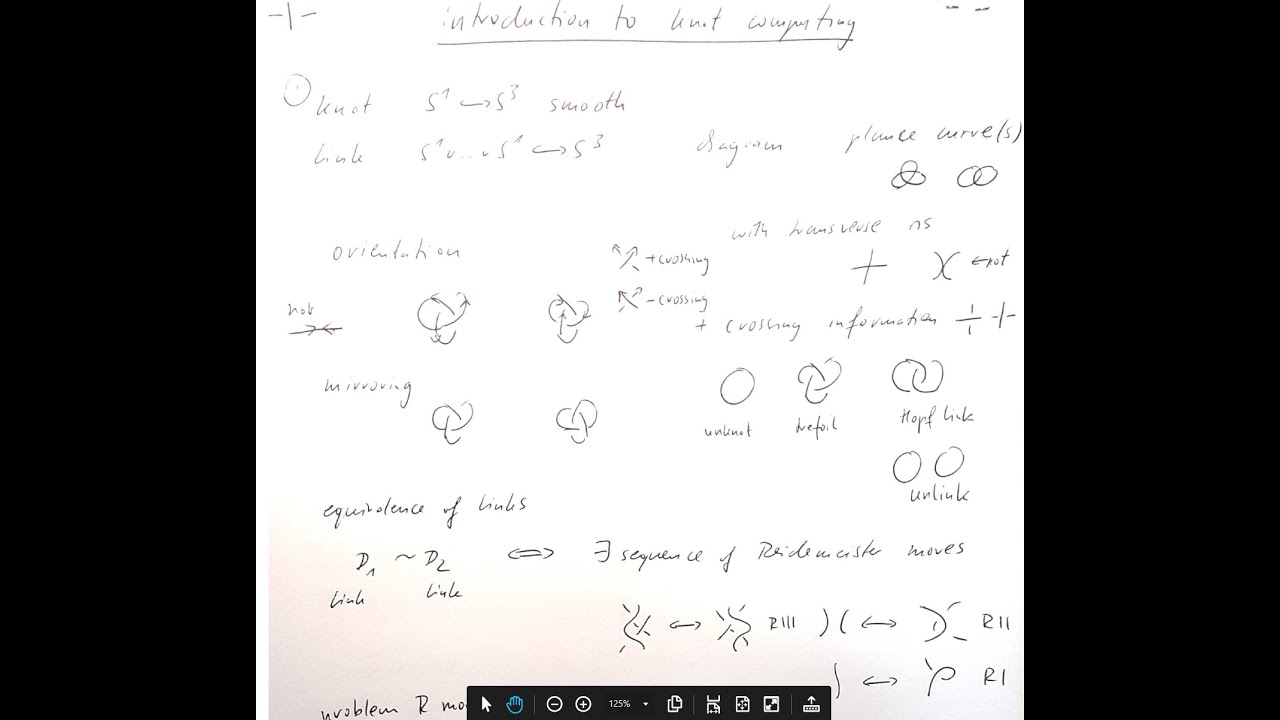
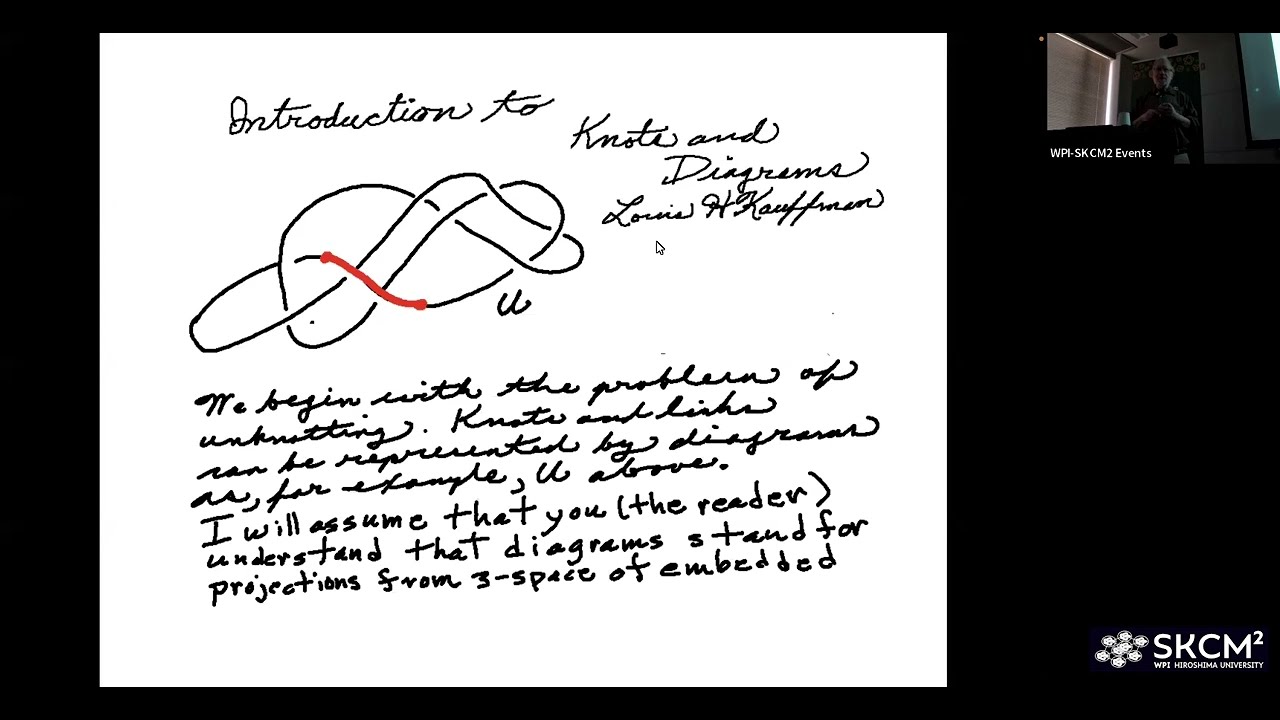
Added:Basic concepts of Knot Theory, including how knots and links are represented in 2D projection diagrams.
The three Reidemeister moves and how they define ambient isotopy of knots and links.
Knot orientation, crossings (positive vs. negative), and the calculation of the writhe of a link diagram.
The Kauffman Bracket polynomial, as it serves as the foundational state sum model used to construct the Jones polynomial.
Khovanov Homology, which categorifies the Jones polynomial and provides a stronger knot invariant.
The HOMFLY-PT polynomial, a generalized link polynomial that encompasses both the Jones and Alexander polynomials.
Chern-Simons Theory and its deep connections to quantum knot invariants and 3-manifold topology.
Physical and biological applications of knot invariants, such as analyzing DNA topology and polymer entanglement.
The Volume Conjecture, which relates the asymptotic behavior of the colored Jones polynomial to the hyperbolic volume of the knot complement.
11.2K views137likes8:47Original Release: 2015-03-11
hello and welcome to a mini lecture uh introducing you to the Jones polinomial this is a new polinomial invariant of links that we haven't seen yet uh it's an invariant of oriented links and what I'm going to tell you is based roughly on pages 31 to 32 in the notes uh so let's get started with the Jones polinomial uh we begin not with the definition but with a theorem which tells us everything we need to know about the Jones polinomial in order to work it out for a specifically link so there is an invariant uh written V of oriented links it's called The Jones polinomial and it satisfies the following properties first of all the Jones polinomial of any link is in this ring what does that mean it means it's a polinomial uh in t where the powers you can see in t are multiples of 1/2 or minus one2 in other words the powers are all integers or integers over two uh the second property is that the value of the Jones polinomial on the unot is one and the third property is this big equation here I'll tell you what it means shortly and it's called the ske relation SC relation what is a ske uh it's what wool comes in that's not a ball so if you go into a wool store you'll see wool comes in ball and it comes in skain and skaines are the other things um uh there you go bit of background there uh so what's going on here well this is an equation that relates the Jones polinomial of something called l+ The Jones polinomial of something called L minus and the some Jones polinomial of something called l0 where these things l+ and L minus and l0 are oriented links which have diagrams and those diagrams should be equal except in a small region where they differ like this you might have to be able to find a small region where l+ looks like this uh in other words it's just a positive Crossing where L minus looks like this and which is a negative Crossing and where l0 looks like this no Crossing at all and uh there's only one way to if if you see the positive Crossing then you know how to change it into a negative Crossing and you know how to change it into no Crossing at all because there's only one way to smooth it out that lets you uh keep the orientations as they were okay here's an example for you let's start with this link here it's the trivial link with two components and just for convenience I've oriented the left hand component anticlockwise and the right hand component clockwise but of course uh out of the four ways of orienting this this diagram they're all equivalent just by rotating uh one or other of the components through 180° okay so what can we do with this well we're going to try and apply the SC relation so we have to decide uh how to make this link into uh one of the three kinds on the bottom left there L plus L minus or l0 and we're going to do it like this I'm going to take three copies ah that was a bad plan wasn't it okay oh that's fine I'm going to make three copies of my link and I'm going to observe that if I just pick on this region of the diagram I have a copy of what I saw in l0 right so I can call this l0 now uh actually I'm going to take a copy of this so let's get rid of these two and let's take a copy of this one now if that is l0 then what should l+ and L minus be well l+ should be what I get from this by replacing the not atall a Crossing with a positive Crossing so let me replace that with a positive Crossing and uh so that's l+ and what will L minus be L minus will be whatever I get by replacing the thing I circled with a negative Crossing which is there so that is L minus now uh what are these links well l0 is the thing we started with so I've got a set of three links that I can apply this game relation to and the first one is l0 so that's good sorry the the third one is l0 so that's good what is L minus well oh that should be a minus sorry everyone there we go that was a minus what is L minus well look it's just the unot right wow that was a dreadful unot and what is L plus well that's also the unot right so what have I got I've got uh my new link my trivial link the two components and it fits into the SC relation l0 l+ L minus where the other two things are unknots things I already know about as far as the Jones polinomial Goes remember I know the Jones polinomial or not it's one so now if I write down the SC relation I'm going to be able to work something out so let's do that uh I know that t inverse V l+ I'm writing out this the SC relation minus t v l minus plus t to the -2 - T2 V l0 that's equal to zero so what does that tell me Well it tells me that let's just let's just uh get rid of these things I need more space okay uh be deleted there we go uh so what is l+ it's the unot what is it Jones polinomial it's one so I just have t inverse Time 1 that's T inverse what is L minus it's the Jones it's the unot it's Jones polinomial is one so I just get minus t and what is vl0 that's the thing I'm trying to work out now okay so uh I get this equation which I can then uh rewrite as saying that V l0 that's going to be T minus t inverse all divided by t-2 - T2 uh which is equal to if you work it out that's minus t^ 12 minus t to-2 so uh after all that what we did was we worked out the Jones polinomial of the trivial ink of two components okay so now let me just make a couple of remarks before we finish so uh the first remark is that the scan relation it lets you compute any one of v+ V minus v0 from the other two so if you're challenged with trying to work out the joints polinomial of some link then what you should do is you should try and find a way to think of your link as either l+ L minus or l0 and you should try and do that in such a way that the other two in this case our link was l0 and the other two were L plus and L minus maybe your link is going to be L plus and the other two are L minus and l0 whatever you do you should try and make sure that the other two are simpler simpler in the sense that you know what their Jones polinomial are already okay so there are many different ways to apply the scan relation to a given link and uh you have to choose a good one uh if you're trying to work it out and um this is actually a theoretical remark the final one you can use the scan relation uh to compute VL for any l so there is a way to use the scan relation to compute anything okay so that's the end of the mini lecture
Up Next

6:20
Jones Polynomial Definition: Invariance Proof
@richardhepworth1441
3K views•2015-03-13
4:43
Elliptic Curve Cryptography Explained: ECC, ECDSA, ECDH
@PracticalNetworking
28.5K views•2024-10-21

13:11
Kauffman Bracket, Writhe & Reidemeister Moves in Knot Theory
@richardhepworth1441
3.5K views•2015-03-13

6:00
The Mathematical Impossibility of Accurate World Maps
@Vox
23.3M views•2016-12-02
Related Study Plans & Knowledge Roadmaps
Structured learning paths in Mathematics
mathematics
Tensor Calculus: Vectors to Riemann Curvature
01Mathematical Foundations: Linear Algebra & Calculus
02Covectors, Dual Spaces, and Tensor Basics
03The Metric Tensor and Index Gymnastics
+ 2 more learning modules
40h5 modules
Explore Roadmap
mathematics
Gödel's Incompleteness: Logic, Proofs & Limits
01Introduction to Formal Systems & Hilbert's Dream
02Set Theory, Cardinality, and Cantor's Diagonal Argument
03Arithmetization and Gödel Numbering
+ 2 more learning modules
14h5 modules
Explore Roadmap
mathematics
Galois Theory: Fields, Groups & Solvability
01Foundations of Abstract Algebra: Groups & Fields
02Polynomials & Field Extensions
03Splitting Fields & Symmetries
+ 2 more learning modules
24h5 modules
Explore Roadmap
mathematics
Non-Euclidean Geometry: Models & Geodesics
01Euclid's Fifth Postulate and the Birth of New Geometries
02Hyperbolic Space and the Poincaré Disk Model
03Geodesics: Defining Straight Lines in Curved Spaces
+ 2 more learning modules
15h5 modules
Explore Roadmap