








![МАТЕМАТИКА МОЖЕ ВРЯТУВАТИ ВАМ ЖИТТЯ 🤯 [VERITASIUM]](https://i.ytimg.com/vi/c6zxT14L-G8/maxresdefault.jpg)






Knots can be distinguished using coloring invariants: a knot diagram is p-colorable (for prime p ≥ 3) if its arcs can be labeled with numbers 0 to p-1 such that at each crossing, the sum of the undercrossing labels equals twice the overcrossing label modulo p. By constructing a matrix from crossing equations and computing its determinant, we determine p-colorability—if p divides the determinant, the knot is p-colorable. This method, derived from Reidemeister's three fundamental moves, provides a powerful tool to distinguish knots, though it cannot distinguish all knots as some non-equivalent knots share the same determinant.
Knot Theory 1: Coloring, Equivalence, and the Trefoil Knot
Added:Basic topology concepts, specifically the intuitive notion of continuous deformation and homeomorphisms.
Equivalence relations and equivalence classes, to understand how different projections represent the same underlying knot.
Basic modular arithmetic (especially arithmetic modulo 3), which is essential for understanding tricolorability calculations.
Fundamentals of graph theory and planar projections, to grasp how 3D knots are represented as 2D knot diagrams with crossings.
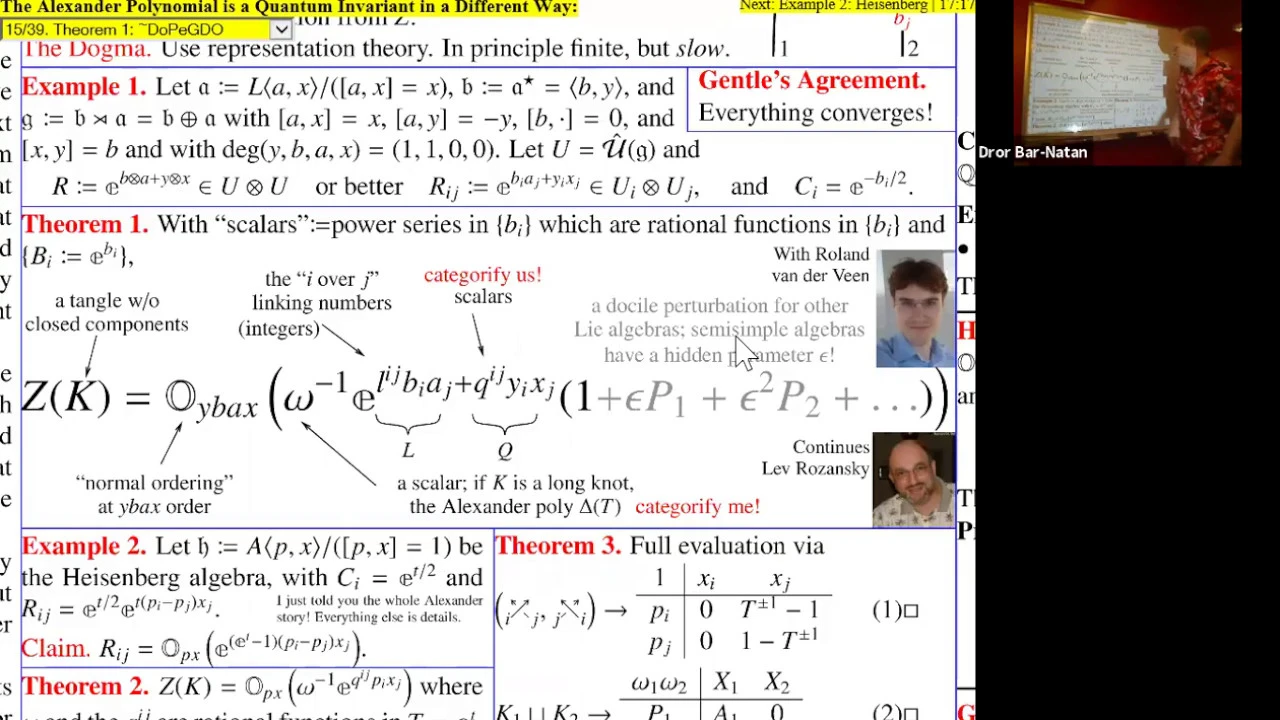
The construction of stronger algebraic invariants, such as the Alexander Polynomial and the Jones Polynomial.
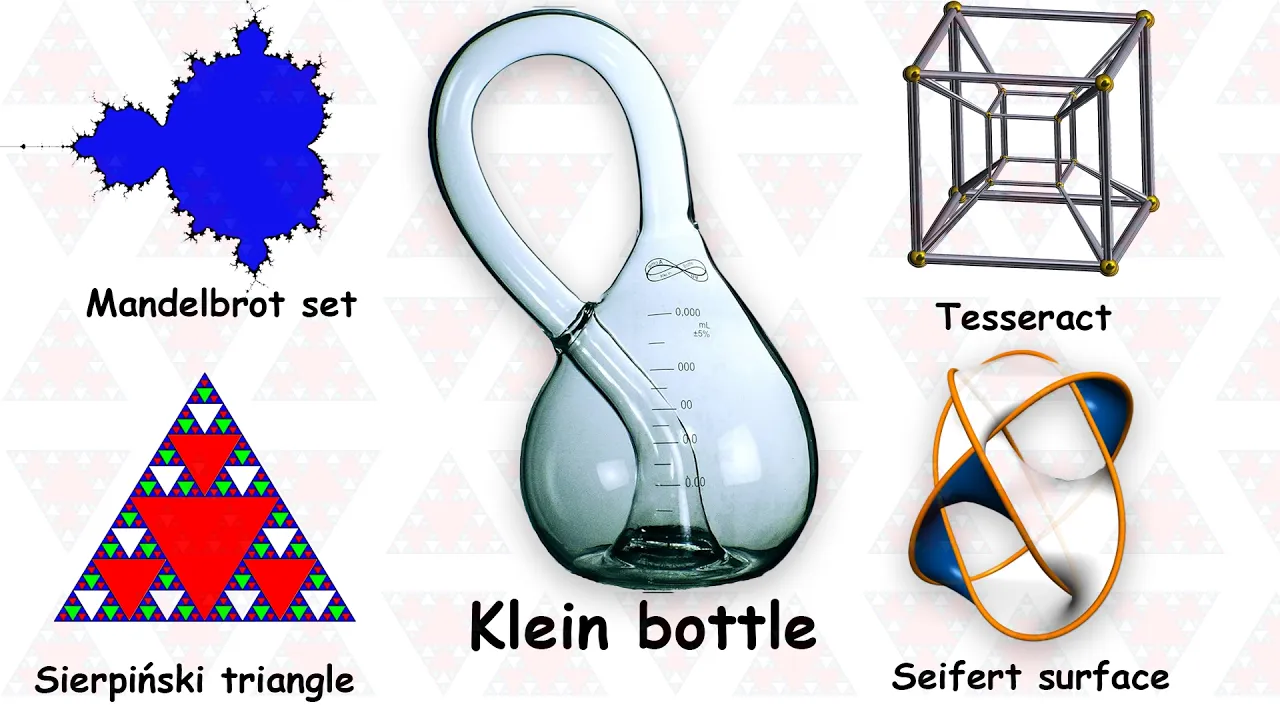
Seifert surfaces and the concept of a knot's genus, which provides a geometric way to study knot properties.
The classification of knots, including prime versus composite knots, and how to read standard knot tables.
Physical and biological applications of knot theory, such as DNA replication, protein folding, and polymer entanglement.
37.2K views846likes50:51Original Release: 2019-01-09
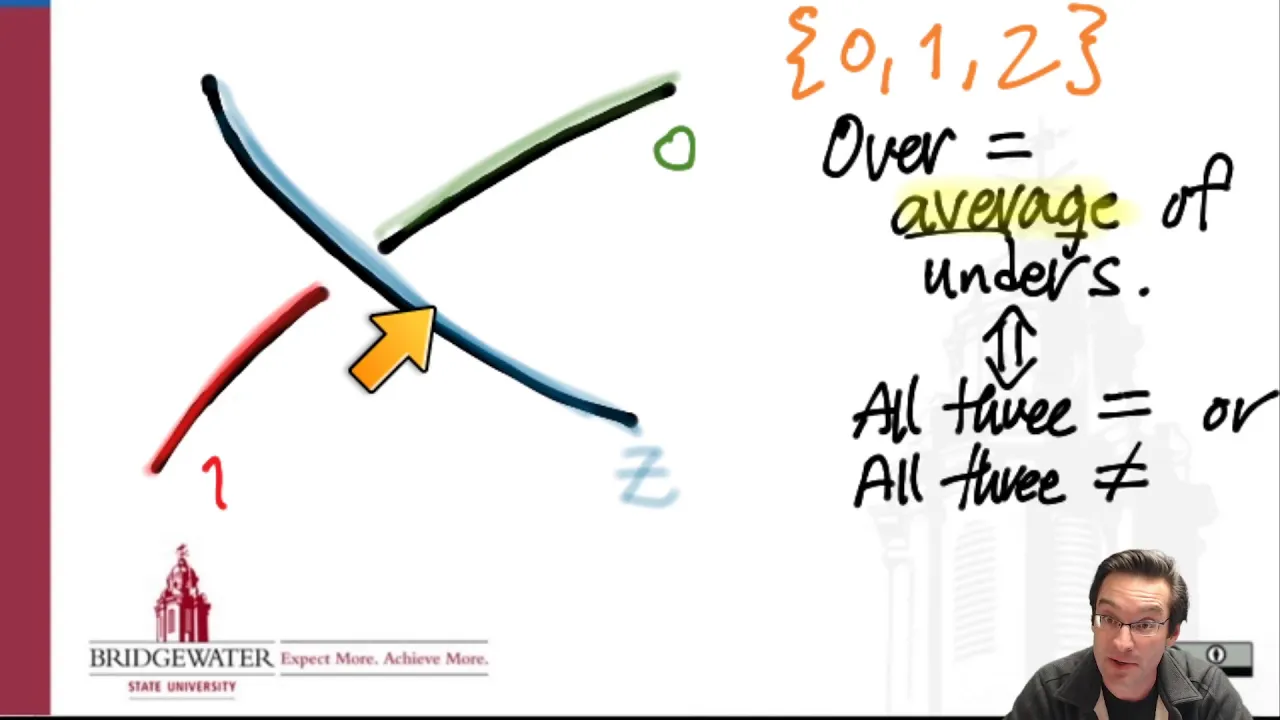
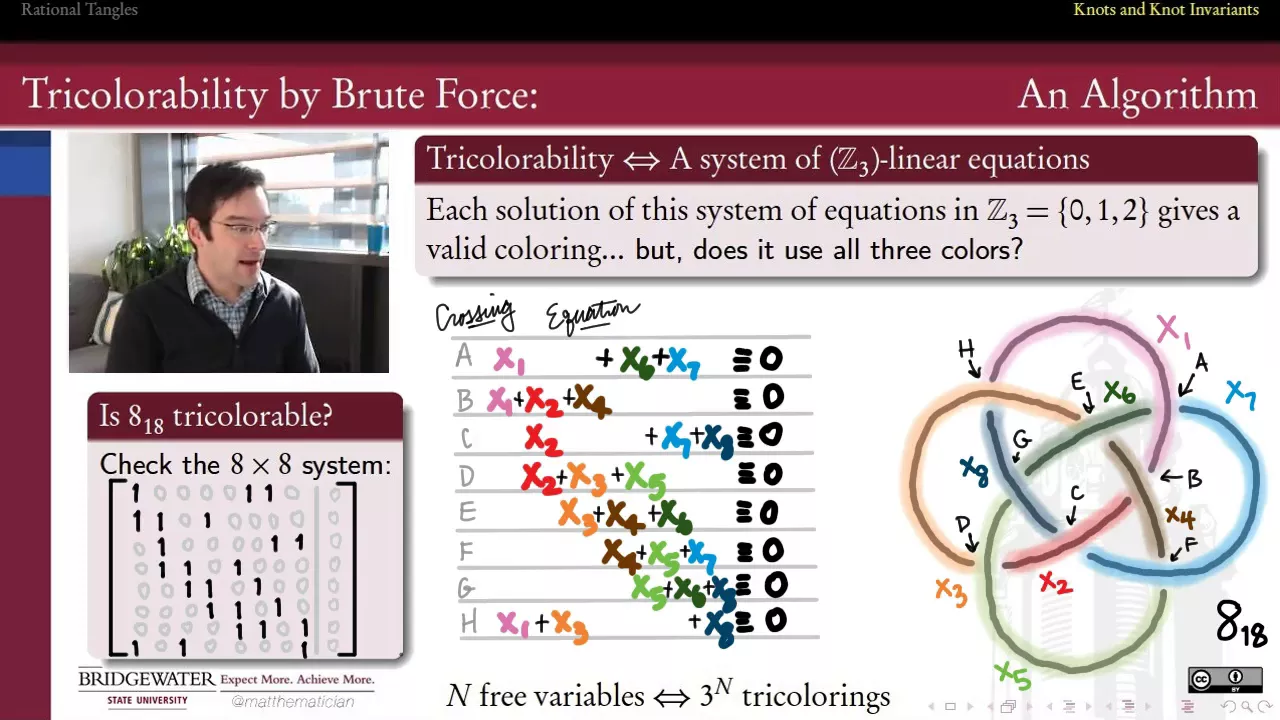
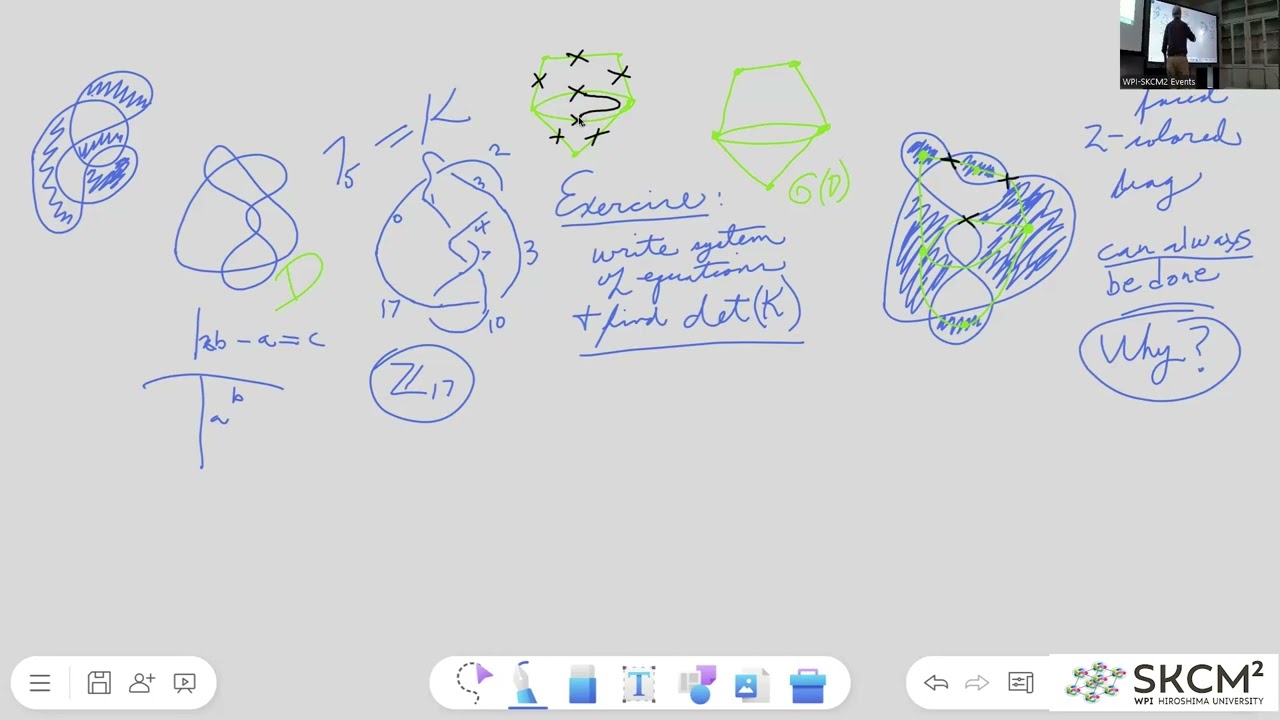
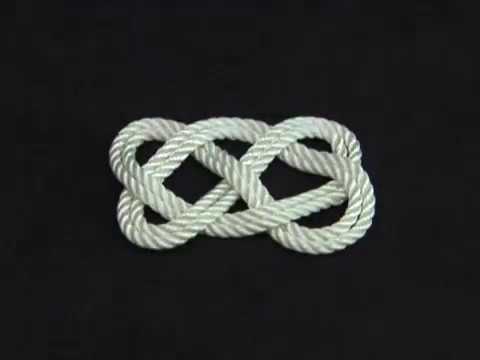
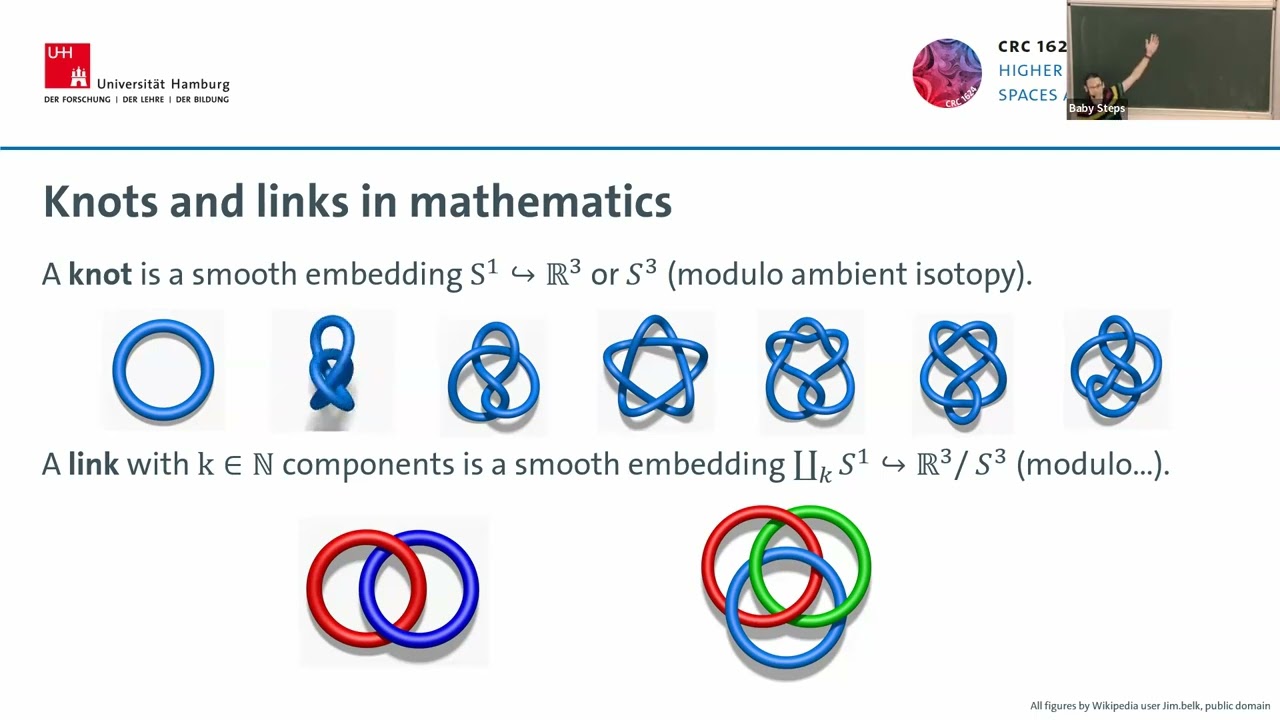
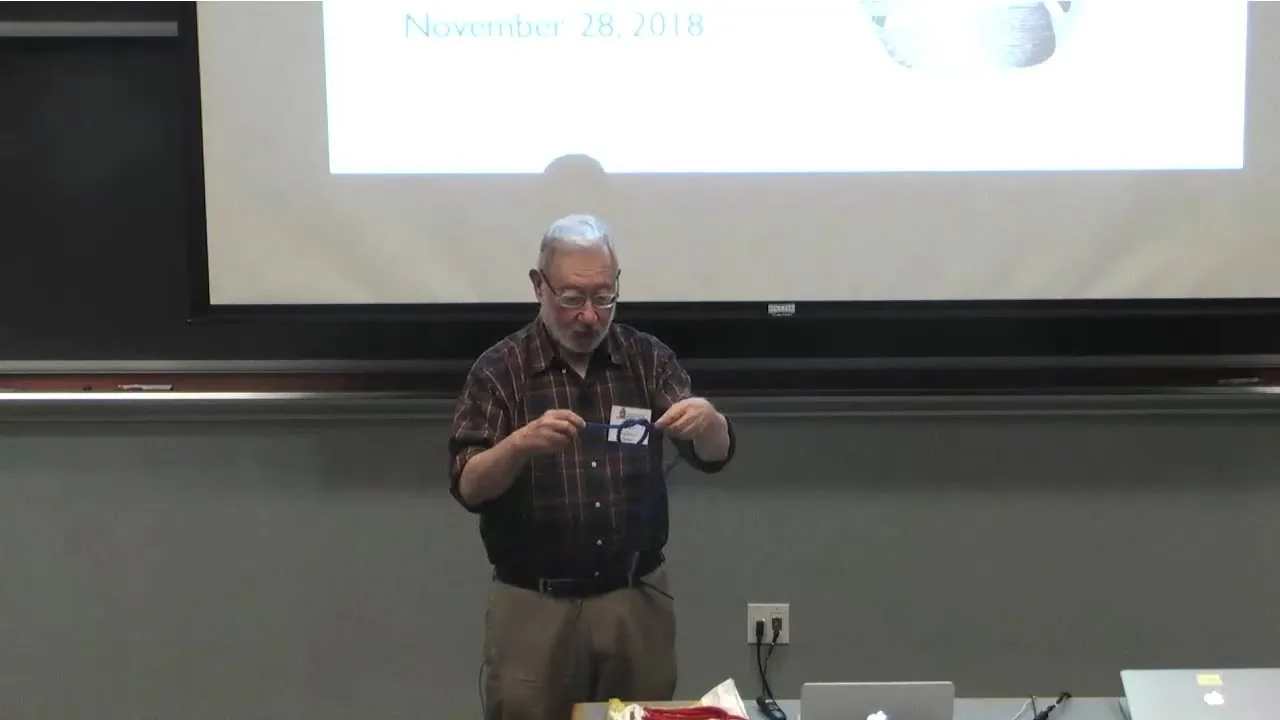
[Music] [Music] okay let's get started so the central problem in our theory is how do you know if a knot is knotted or not and you can try and say that three times fast so for instance this knot is clearly not knotted we call it the unknot however let me give you an instance of a knot that is not it you can break it open and you can tie it into an overhand knot you end up with this knot that we call the truffle oil so you see the threefold symmetry of it so I can draw that up here so we have the yun knot and then I've just drawn the just created a trefoil so this is an example of a check point and so the question is okay how do I know if the trefoil is secretly the same thing as the unknot or not so what do I mean by that is there a way to deform the trefoil without breaking it open to end up with the UH knot and maybe you notice you know like oh I can deform it and I can get here's a different not that I got from the truffle it's a little bit different it has some some more like a two-fold symmetry instead of a three-fold symmetry so yeah I took the truffle oil and if you pull one of these guys over you should end up with something that looks well let's see if I'm gonna get this right something like something like this on the second page of your handout oh that is much too complicated that is not where you get you obtain here we go yeah so you get something that looks something like this and we just we just saw that you took a trefoil threefold symmetry like in the knot above and then you just pull this guy behind and then you get this nice to full symmetry so we consider these equivalents we're going to consider these equivalent knots but the question is well how do we know if these guys are equivalent so it's pretty easy to tell if two guys equivalent you can deform one into the other but the challenge is how you know if they're not equivalent that make sense okay so let's formalize this a little bit so our definition for a knot is we're going to say a knot is an embedding of a circle so I'll denote that by s1 that's my notation for a circle it's a one-dimensional manifold the line it's a circle into three-dimensional space so for now let's do our three we might look at different data mention spaces in the future so that's what the knot is and we say two knots are equivalent if we can do this process of deforming the one into the other without breaking it open now the mathematical language for this is ambient isotopy and I'll leave it to you to look up the precise definition and think about why it's equivalent to this intuitive idea of deforming essentially what it means to be an ambient isotopy is you have not embedded into one three-dimensional space not embed into another three-dimensional space and then you say those are aiming that's a topic if there's a homeomorphism a by continuous map from the one space to the other space that meets a few criteria but it boils down to just being that equivalent to I can deform it without passing through itself so we're going to use that easier to use definition okay now this guy is equivalent to this guy just showed you but how do we know the trefoil is not equivalent to the unknot and what should convince you that you know it's not obvious that's not equivalent is that there can be some really complicated on nots there's a picture of one on your second page the handouts are very complicated or not but you know you can just tangle something up and end up with you know something very complicated looking but then eventually you're able to untangle it because I start with the unknot so I can untangle to get back to the unknot and so the question is how do I know it's not possible to untangle something like the trefoil maybe I need to like be really clever and and it's like how long should you try before you give up when you say it's impossible right and because this is mathematics well you can't just try for like an hour because then maybe it's like what you weren't very clever you know so my clever comes along and maybe in two hours they're able to to solve it and so we want to have some kind of mathematical way of showing that this truth foil is actually different than the UH knot and not just that the truck rolls different than me or not but there ways to asking questions like how many knots are there so here's a table of knots and it's all different kinds of knots they look different but how can you be sure that they're actually different and the historical motivation for this question has to go back to the late 1800s where there was this theory of this ether that permeated the universe it was like so how do waves travel sound waves travel through the air water waves travel through the water so it's believed that the light waves must travel through some medium so you know this idea this 4/6 this what that's right yeah so it's believed that there was some substance that permeated the universe hey welcome you can grab a handout some substance that permeated the universe and and so while people are trying to develop various atomic models in this era one individual Calvin Lord Calvin from whom we have the Calvin system name had this vortices theory of atoms we thought that each atom was some kind of like vortex in in this ether that was it was a circle but it was knotted up in some way and the different ways that it was knotted up would give you the different atoms and so he thought you could essentially make a periodic table by Cabul ating the knots and so then there were the efforts that he recruited a few mathematicians to try to tabulate all the knots that you could figure out which ones equivalent and which ones are distinct because in doing so then you can know these are the elements and maybe somehow the knotting not in the self that gives you the properties of the elements ok well it turns out they were completely wrong right this is now what in the atom is and atoms not a knot so the science is bad but the mathematical question arrays is interesting is how can you tell if two knots are equivalent or not and if you go back and look at some of the old tables even from like the fifties and sixties you know much later there are some mistakes you can find in it where they thought they had enlisted distinct knots but it turned out the two of them that look very different we're actually secretly equivalent so it's a really hard problem to just get some intuition about well how do I know if these knots are actually different or not I mean okay look at the truffle it's like how could it possibly be unknotted right but but you know still you want to prove that it's not unknotted you wanna prove it actually is knotted and you want some techniques that allow you distinguish more complicated knots or identify and more complicated knots as being equivalent so one of the major goals of today and ongoing lectures will be to find ways to distinguish or identify knots as being equivalent or not is that clear cool so I want to just ask you for some of your intuition about knots just see what you're thinking is coming in if you already know don't answer but they've just you know if you have some gut feeling to it out there how many knocks do you think there are infinitely many who agrees who who things maybe not maybe there's only maybe was only two right maybe there are seventeen like in geometry last semester those were who in it we did this wallpaper classification and we started there are 17 types of wallpaper right why 17 you know it's kind of a hard question to answer maybe they're 42 right maybe it's a deep fact they're 42 knots so another question we might want to answer it we won't get to today well maybe we can answer it today is how many different kinds of knots are there okay so those are some of the kinds of questions we want to begin to engage with and then in future lectures we'll start bridging out to see how knot theory connects with other areas of mathematics so today we're gonna see some linear algebra connections and then we'll move in to see some geometry and hopefully some abstract algebra and some typology connections as well so answering this really simple question about knots connects with a lot of really deep and beautiful mathematics okay so how do we distinguish if they're different answer you color them so so here's our definition is our definition we're going to say a knot diagram where the knot diagram is just what I drew on the blackboard this is the not the projection onto two dimensional spaces is the knot diagram so we're gonna say a knot diagram is colorable if each arch can be colored following some criteria so you want to color them using three colors so limit yourself to red blue and yellow or one two and three or whatever your favorite three colors alright such that such that the following conditions are met condition one you use at least two colors so don't color the whole thing blue use at least two colors overall and condition to add any crossing at any crossing if two colors are used three must be used what I mean by that is if that across seeing you use at least two colors then you actually have to use all three you can't just use two colors another way of saying this is an adage crossing either needs to be all the same color or all different colors so if you're gonna use at least two colors you commit yourself to make it interesting then you need to use at least three so let me show you what I mean by this here's my trap foil here's a crossing so when I say crossing I just mean so so this is what a crossing is a crossing is just where the knot crosses over itself and so I want to start coloring it so so maybe I choose this arc and I color it some color and then I go to maybe the second arc and I can decide when I call it the same color a different color well if I try and color the same color yellow then I'm forced to color this third one yellow as well because if I was it to use new two colors that have to use three but I don't have real for three so I have to use yellow as well but then I get into trouble because I haven't used the least two colors so the second dark instead of continent yellow I should have called it a red and then if I color this one yellow and the second Erica red the second edition says well I have to use since there's two colors of this crossing I asked you'd have to have three someone changes 31 to blue and now I've met both of the conditions I've used three colors so I've used at least two and add each crossing if there's at least two colors like here there's at least two there's yellow in red there's actually all three so we can say that this knot is colorable or at least this not diagram is colorable so so color a bowl how about the unknown why not I can't use two colors that's right like the moment you start coloring it that's like well there's only one arc here so then the knot is not colorable okay well let's try another diagram how about this diagram down here this other diagram for the truffle is a nice way to color it well again we just have three arcs total alright each arc a different color and you meet the conditions because you used at least two colors overall and add each crossing you've used all three so at each crossings had to be all the same color or all different colors and we've satisfied that for the unknot there's other versions of the UH not as well so you could give some twists to the UH nods and it's still unknotted you just twist it a little bit right so the UH nod is also equivalent to something like I just put some twists into it let me let me give it one more twist so it's plenty of Arc's okay so now it has some nice twist it you go is on twisted so it's still the UH not and maybe you want start coloring it in your leg let's try it let me color the first auric yellow and then I'm going to try and use a different color for the second arc because I don't want to end up with it all being the same so let's let's make the second dark blue Oh what's my craw yeah this crossed and I have two colors but I haven't used three so so that violates my rule so like I guess I can't color that blue I actually have two color yellow still yes sir so since these are both yell oh this must be yellow here as well and then you like how about this next cross scene well since these two are yellow this guy must be yellow as well oh no I've ended up with it all being yellow again which now violates the first condition so in trying to be true to the second condition I've violated at first and so this is not colorable as well whereas this other version of the trefoil was colorable so both of the truck foil diagrams were colorful but neither of the undocked agreements were colorable okay based on this extensive data who wants to make a claim a conjecture all enough okay so any diagram for the unknot will be on colorable okay that's a good conjecture who wants to make the conjecture even stronger good so if one of the diagrams is colorable they will all be colorable and if one of the diagrams is not colorable none of them would be colorable that's a strong conjecture but it agrees with the evidence so let's see if we can if we can find more evidence for this so conjecture we'll just say if a naught diagram is color wool then all equivalent diagrams are colorable and likewise if a naught diagram is not colorable then that means that all equivalent diagrams are not colorable well define where evidence of this go to your second page I have a number of diagrams of knots and I want you to take a minute to try to color them and so what you can do is go through and see which of these are color bold and try and determine if one of the diagrams is colorable then you conclude that the second one is colored well as well or do you ever have a case in least these examples where one is color ball and one is not so you may need to like bring colored pens to this class so think of this class as kindergarten and colorful pens would be helpful and oh yeah like honors kindergarten yeah you could just color it with numbers if you don't have a lot of colors like zero one two or one two three okay let's try one together let's try this complicated uh not was anyone able to color it you found it was all the same well this is a conjecture we haven't proven this yet we could be wrong so let's trying a little more data see if we're on the right track so you know you can begin at some point like let me let me begin by coloring this yellow and then you have two choices this next arc can either also be yellow or it could be a different color right now if I were to make this yellow what would that require if I made this yellow what do I have to do next since two of them are yellow the third only forced to be yellow and then this one will be forced to be yellow and then this one will be forced to be yellow so all of this would be forced to be yellow and then I get to these two are yellow so it has to be yellow and so on and so on so on the whole thing ends up yellow right so so we shouldn't make the second arc yellow if we make the first Circulo we should make this second one some other color like blue and then we have to make the third one a third color like red and then since it's blue and red the third one can be yellow good and since it's red in yellow this guy can be blue and since we have yellow and blue here this guy can be red okay this seems really promising since it's blue blue and red requires this to be yellow you guys feeling good about this I think we're fine so this is yellow and now we're free to make this whatever color we want well blue or yellow or red if we made this blue then this one would have to be yellow which would force this one to be yellow which would lead to a contradiction because you have two yellows in a red so this one shouldn't be blue so if this one was instead to be yellow then it'll be yellow yellow which would make this one yellow and then yellow yellow would make this one yellow which will lead to contradictions of two yellows and a red so this guy must be red there we go okay then we have red or red so this third one must be red as well and then we have red and red so this one must be red as well oh but then we get contradictions good red red yellow which violates the second edition so we did everything we could but it was not colorable so this is not colorable which is in support of Matthews conjecture because this is the unknot which we said is not color wall because the only has one arc so we can't use two colors in it I got with the rest of them did you guys find any contradictions do you find where one diagram was color blue and one was not they they seem to our work right if one was color both then they were both color ball if one was not they were both not good yeah the figure Eight's not and so you can you can chase through it just similar to our chase through this and see that no matter what you try you get into contradiction so the figure Eight's not color board very good okay so what are we to do then how are we to prove this we can collect more and more data but you know again maybe this some really clever examples somewhere that we're not thinking of so we want to get a proof and so to prove this we need to go back to some work by right of Meister and so here's how to write a Meister thought about things this was in the 1930s so he came a little bit since the late 1800s mathematicians have been working on this and this was writing my sister's great insight right I'm I just said you know there are three ways that you can move things in a not three moves the first one is a twist you can put a twist in it if you have you know imagine you just have some some arc of a knot yeah this belongs to something big or not then what you can do is you can put a little twist in it so I'm going to draw this as you call it are r1 and what it is is I have some arc and I put a little twist in it and I can do it either overhand or underhand twist either way you want to do it you're just putting a twist into it so this is the first move the second move right I must have thought about or is that another really fundamental way you can change a knot is not just by twisting it but by poking it so if I have two arcs in a knot I can poke one on top of the other separate together and so I have these two arcs and I can move it so that either one ends up on top of the other or below the other so you can call that a poke and then the last one is called a slide it's a little bit tough to visualize something's gonna draw it on the board I have some crossings somewhere and I have a third arc that goes under it and he says if this third one goes under the crossing you can just slide it up so that instead still have the same crossing but this guy on bottom you slide so it now crosses under above the crossing I just took this bottom strand and slid it under but I'm still preserving the knot I'm just changing how the diagram looks a little bit now it's completely obvious that if two diagrams alright related by sequence of right of my system moves then so if two diagrams are labels even by dress two moves then you can conclude they represent equivalent knots right because these are their simple deformations that don't break they're not open or anything that just deforming the knot in three-dimensional space is that obvious clear okay so that takes no thought whatsoever board right a nice to show this were indebted to him for his theorem is that not only is this implication true but so is the converse if any two knots are equivalent then you can move from one to the other only using these three moves so these become like the fundamental moves of the formula not right like like when we would have form that words doing all kinds of crazy stuff and they may we ended up here the rider master says you also could have gone to that same ending point only doing these three moves is the content of the theorem queer so let me show you an example bomb of your front page you have a figure eight knot and then it lists the writer match the moves that happen each time and you can look at this diagram and you can see how the first step it's doing a move of type two so remember type two is a is a part is a poke it's taking the one little bit and poking it over the other and then a move of type three and so forth and you move from the figure eight knot to its mirror image so the figure eight knots really special because you can deform the figure eight knot into its mirror image whereas with this trap for it turns out that there's no way to deform the truffle oil into its mirror image but we'll have to justify to Latin a little bit we haven't shown that yet okay really powerful right oh my sister moves not only notices give us a way to think about how to change an art into another not it can now go back to this conjecture our conjecture says as we change a diagram color ability is preserved so if the one diagram was colorable then the equivalent diagram is also colorable how can we use your itemized stress results to help us prove that very good all we have to show is that each writer Meister move preserves color ability because any move from any diagram to any other diagram is to make how much by series of Israeli master moves and if each one of these preserves color ability then you know that if the thing you start out with is colorable you go through a series of moves you're gonna end up with something that's colorable and you start off some that's not colorable then you end up with something's not cover as well so proof of the conjecture and I'll leave this as homework but the idea of it is you show r1 r2 and r3 preserve color ability that is if you started off colorable you still colorful and if you start off non callable you still non colorful so let's give an example of how you would do this let's do it with r1 at the easiest one so r1 begins with some arc maybe it's red and this is part of a larger diagram right now when I deform it I want to add a twist to it so now there's going to be a little twist there then tie an additional Artic what should I color this so it's still compatible with the rest of the diagram yeah you call the whole thing red and then you check have this crossing it's all red that's fine that meets the second condition how do I know there's at least two colors used in the entire diagram because they were there before exactly if this was culpable before the at least two colors used and so there must still be some other color some blue somewhere else with some yellow somewhere else not the same and so similarly you can argue that doing r2 and r3 it's a little more involved Mami's a few cases for our three in particular but you can show that doing them if you began with something that's colorable in choosing a move like this there's still some way to color the new arcs that make it so it's still colorable is that clear so we've proven now the conjecture or at least you will in your homework okay very nice so what's next ah let's restate the second condition a little bit more precisely how would you learn time okay that's fine we we should be on track so let's restate condition to a living more precisely instead of using colors I'm going to go back to numbers right this is math and so we're gonna use the numbers and so let's just say I color these with some numbers of labeled x y and z where x y and z and all my other labels are chosen from the colors which are numbers 0 1 & 2 okay so you know this is like red blue and yellow it's coloring it some colors but each crossing you label it each arc is labeled something either 0 1 or 2 meeting the same conditions so overall you use at least two numbers and at each cross seeing if you use either all the same cross all the same number or one of each so this could be 0 0 0 or 1 1 1 or it could be like 1 2 0 I claim that condition 2 is the statement that X plus y is equivalent to Z mod three or we are familiar with what I mean mark 3 ok this just means up to a multiple of three Oh X plus y is equivalent to two Z up to multiples of three so like this maybe comes out to be zero and three or four and seven but they're equivalent up to a multiple of three that's all that Mar 3 minutes ok so so let's think about why this is true let's go through a few examples what's one way you might have colored this XY and Z what was one combination well they could all be the same thing right they could all be like like 1 1 & 1 or 2 2 & 2 or 0 0 & 0 without meet the condition yeah you bet you because then you have x and y is the same thing as Z so X plus y would be actually equal to 2 Z so then it's different by 0 which is a multiple of 3 so so does that actually equal them ok so that cases is easy 1 1 1 or 2 2 2 or 0 0 it's done another possibility is you might have something like 0 1 & 2 but notice what happens then then you have 0 plus 1 should be equivalent to 2 times 2 which is 4 that is the differ by only a multiple of 3 so that works or you might have had something like 2 what 1 0 in which case you'd have 2 plus 1 is equivalent to 0 sure enough 2 plus 1 is 3 which differs by 0 by only a multiple of 3 so the equivalent mod 3 or we come to all of this ok so this is mathematical way of restating this second condition of making a precise but what's really nice about this is you can generalize it has what's a natural way to generalize this what's something you could change well that's three y ma 3 by we've been do you have three colors but we can generalize it so we can introduce P color ability we say a naught is P colorable so so not just three pick any old prime P color ball for some prime P that's bigger than equal to three something like five or something like seven if it meets these two conditions condition one you use at least two colors so use at least two labels from the list 0 1 2 up until where P minus 1 which turn off at 0 so to have peach oice is when you go up to P minus 1 and the second condition would be at each crossing where you're crossing has Z on the over crossing and x and y is the 2 under crossing our X you should satisfy that X plus y is equivalent to to Z mod P cool so double even 5 color was 7 color ball or 11 color roll now you might be suspicious why did I say P as we begin ago 3 there's a primary left out the prime P equals 2 and probably your homework is to think about why you can't to color anything and how it would lead to a contradiction in these conditions and so you can think to and see it's a similar to palm to what happens over here kind of the same spirit of what happened here okay if one thing forces the other thing to be something and you end up with the whole thing being the same color but you can work through those details to see why you can't to color anything okay beautiful so why is this useful when we simply had color ability what color ability did is it put knots into two baskets those that are colorable the deplorable x' and those that are colorable and those that are not right and so what allows you to do is is to distinguish okay this knots colorable this one's not this ones but it looks nice because you can see things like oh the trebles colorable but the unknot is not and so you can distinguish those right but the problem is within the color Bowl basket there's a whole lot of knots and we can't distinguish between them and within the non color wheel basket there's a whole bunch of not see we can distinguish between them and so we can't tell like are there only two kinds of knots right we've always teams into two groups and we just know that this group stuff here is different than stuff here but we can you distinguish within the group how does this solve the problem by generalizing how does it help excellent so now not only can we distinguish between are you color bowler or are you not but we can say are you three color Bowl or you're not are you five color Bowl or are you not are you seven color Bowl or are you not so there may be two knots that both the recoverable but then one of them is five color ball in the other one is not or they may be both do we color Bowl and five color Bowl but one of them is seven color Bowl and the other one is not does that make sense so we have a much richer criteria now to distinguish between not have a lot more tools a disposal infinitely many Prime's implementing the tools to distinguish between knots cool now the big challenge is how do you actually find such a labeling because this is kind of a hard definition to work with in practice and so what I want to end with today is a nice application from linear algebra that lets you quickly determine if something is colorable or not and so here's what we're going to do I'm going to give you an algorithm that takes a naught and spits out a matrix this matrix will have some determinant and it's going to turn out that this not is P colorable if and only if P divides the determinant of that matrix does that make sense so that's what we want to do now ya need some help with that don't come back so we're going to see a naught is P colorable if and only if P divides the determinant it's a really really cool application in linear algebra you guys remember matrices determinants we've seen it before yeah okay anciently algebra you'd have seen this or I'm even high school often times you see so let's end with that now I'm not going to chase through all the details of why this algorithm works in your hand tail and I'll refer you to some reading where you can go through and actually prove it but I just want to show you how it works in practice and I have a knot here well let's just do it for the treble let's keep things really simple let's just do it for the truck oil so here's my my trifle oil what we need to do is we need to label each arc and we need to label each crossing so I think up some more colors with my so I'm just going to label my arcs here X 1 X 2 X 3 and I'm going to label my crossings I'll call this like crossing one I'll call this crossing two and crossing three and then the way my matrix is going to work is it's going to be a matrix that's crossings by some data about the orcs and you know the entries of the matrix are going to be remember at each crossing our coloring condition was that X plus y when you have some crossing with XY and Z X plus y is equivalent to 2 Z mod P you can rewrite that as 2 Z minus X minus y is equivalent to 0 mod p and this is what motivates the following definition at each crossing you look and you see which arc is serving as the over crossing that's like a 2 Z here here it's arc at one a crossing one it is arc 2 X 2 so at X 2 I'm going to put a 2 and then for the 2 under crossings I'm going to put a minus 1 for each of them so for each of these under crossings I put a minus 1 clear all gonna make sense so for the second one I cross scene 2 or what where's was my two gonna be out of my matrix actually x3 serving as the overcrossing and x-two and x-one Amanda crossings and for crossing three my x1 is the over crossing so that's where the two is and my one and my three are minder crossings so that's step one of the algorithm this corresponds to setting up a system of equations right so it's the system of equations we're setting up and we're trying to see it are the some solutions from the x y&z my labelings that would satisfy all these conditions and so the matrix are setting up that system of equations it turns out the system of equations is over determined so what you have to do next is delete any one row and column one row and column and you know you can take your pick I'll just delete the last one but then that's your matrix so by matrix M is negative 1 negative 1 to negative 1 I really hope this works so what's my determinant of my matrix yeah 1 times negative 1 times negative 1 is 1 minus negative 2 so plus 2 is 3 so remember a theorem is this is P colorable if and only if P divides the determinant so what kind of color ball is this this is three color ball so this is three color now we could quickly tell that this is 3 colorable it's a really simple example but I'm now giving you the algorithm that's going to work with any not whatsoever that's right so this is three color ball but we know it's not for instance 5 or 7 or etc you know 11 colorable that's right at the terminus 33 it would be three color bow and 11 colorable yeah so I'll show you one more example really fast I have this in your notes but I'll just write it up here and I have some examples of this that you can work out so you can practice doing these determinants you know if it's quite a few arcs you might need to use some kind of computer algebra system to solve these but here's a here's a nice not let's see if I can okay so this is the not 7/4 so there's one guess why it's called 7 yeah this is the fewest I mean you can always make more crossings by twisting but the fewest number of cross you can draw with the 7 so there's 1 2 3 4 5 6 7 so this would give rise to a 7 by 7 matrix you delete a row and column so you have a 6 by 6 matrix you calculate the determinant of that matrix and it comes out to the determinant of the matrix associated with this knot is 15 all right so you get some 6 by 6 matrix by doing this algorithm comes out to be 15 so what would that tell you about with this color ability what house it's colorful yeah so that will tell you that this is 3 colorable and that is five colorable and so you would know for instance that this is not the same thing as the trefoil because i'll go they're both 3 colorable this one is 5 color ball whereas the trefoil if not so there's no way no matter how clever how long you try to turn this into the trap oil without breaking it open oh so color Billy only works for primes and just how it doesn't work for two you can think through why needs to be prime oh very good so we said this guy has seven crossings yeah so there are other guys that have seven crossings too and so the first one the second one the third one this is the fourth one yeah that's right so it's just like it a artificial indexing that doesn't have any geometric significance okay so any handouts you know take you one step further than this but I'll leave it there for now and what we found now is subsystem to distinguish between dots a word of warning though you might think we're done you might think that this is powerful enough to distinguish between any two knots it turns out that there are some knots that are not equivalent but that I have the same determinant so what does that mean that's right because you know like since they have the same determinant they have the same color ability conditions for all Prime's right and so when you think of new and variants to help us distinguish between them so while this is a powerful method that let's distinguish which a whole lot of knots there's still be some nuts that have the same determinant and you hand out IV lots of examples in calculate it and you will try and find some examples that are different we're the same determinant although you won't be able to convince yourself they are different because it's the only tool we have so far distinguish between them so it's an insufficient tool it's a pretty good tool something you can think about its have we done enough work to convince ourselves that they're implementing knots can you come up with an example of a knot that's colorable for any prime right like this was culpable for 4 3 can you think of an odd that's cobble for 5 for 7 for 11 for 13 for 17 can you come up with some generic like algorithm or some pattern right maybe you can do something similar of the cemetry is 3/4 sandwich it's 3 colorable maybe something's going on there maybe it'll be P colorable if there's some kind of P full symmetry you try and convince you that by thinking about what the matrix would be and then you could convince yourself that there are actually implementing knots so you can try and do that we see some quicker arguments to show that implementing knots but that's one way you could do it okay so we'll stop there you
Up Next

13:46
Tricolorability as a Knot Invariant Explained
@MatthewSalomone
260 views•2021-07-29
4:43
Elliptic Curve Cryptography Explained: ECC, ECDSA, ECDH
@PracticalNetworking
28.5K views•2024-10-21
59:54
Knot Theory 9: Jones Polynomial - Definitions & Properties
@MathatAndrews
9.2K views•2019-03-20

6:00
The Mathematical Impossibility of Accurate World Maps
@Vox
23.3M views•2016-12-02
Related Study Plans & Knowledge Roadmaps
Structured learning paths in Mathematics
mathematics
Tensor Calculus: Vectors to Riemann Curvature
01Mathematical Foundations: Linear Algebra & Calculus
02Covectors, Dual Spaces, and Tensor Basics
03The Metric Tensor and Index Gymnastics
+ 2 more learning modules
40h5 modules
Explore Roadmap
mathematics
Gödel's Incompleteness: Logic, Proofs & Limits
01Introduction to Formal Systems & Hilbert's Dream
02Set Theory, Cardinality, and Cantor's Diagonal Argument
03Arithmetization and Gödel Numbering
+ 2 more learning modules
14h5 modules
Explore Roadmap
mathematics
Galois Theory: Fields, Groups & Solvability
01Foundations of Abstract Algebra: Groups & Fields
02Polynomials & Field Extensions
03Splitting Fields & Symmetries
+ 2 more learning modules
24h5 modules
Explore Roadmap
mathematics
Non-Euclidean Geometry: Models & Geodesics
01Euclid's Fifth Postulate and the Birth of New Geometries
02Hyperbolic Space and the Poincaré Disk Model
03Geodesics: Defining Straight Lines in Curved Spaces
+ 2 more learning modules
15h5 modules
Explore Roadmap