






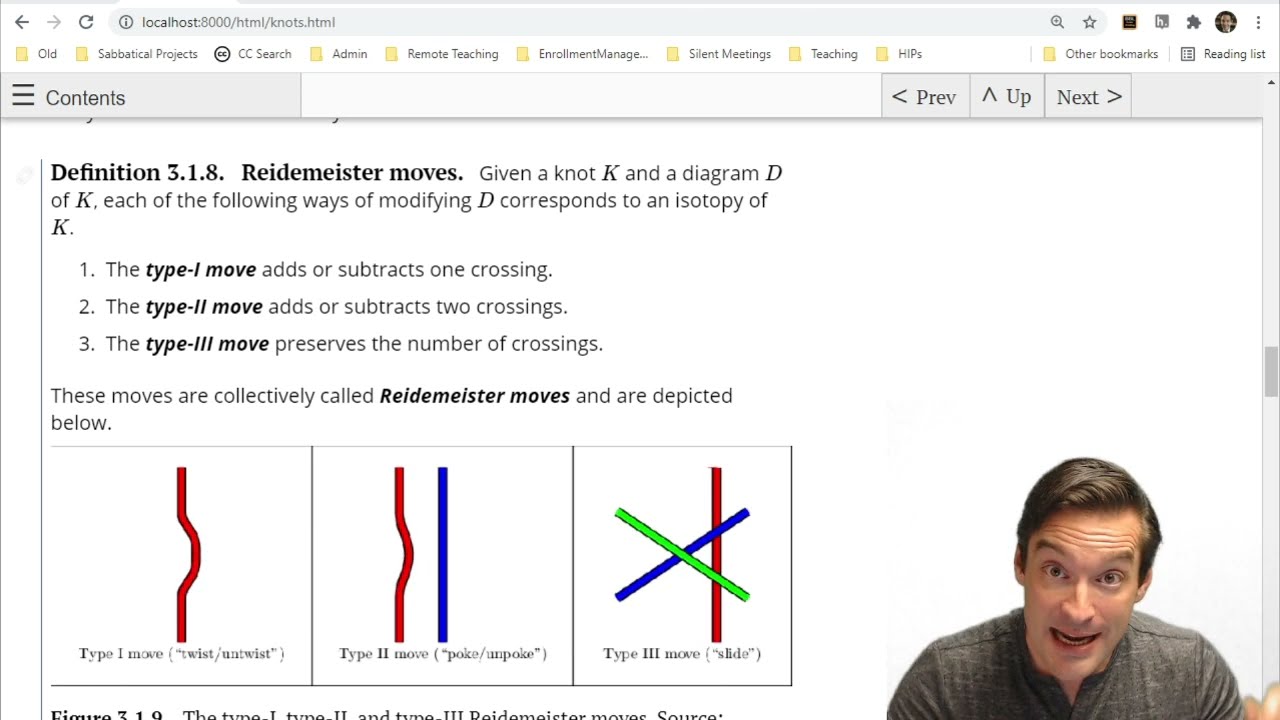








Tricolorability is a knot invariant that determines whether a knot can be colored with three colors such that at every crossing, either all three arcs have the same color or all three have different colors; this property is preserved under Reidemeister moves (Type I, II, and III), meaning it distinguishes between different knots—specifically, the trefoil knot is tricolorable while other knots may not be, allowing mathematicians to prove two diagrams represent different knots if they disagree on tricolorability.
Tricolorability as a Knot Invariant Explained
Added:Basic definition of a mathematical knot as a closed, non-self-intersecting curve in 3D space.
How to represent knots using 2D knot diagrams, including over-crossings and under-crossings.
The concept of ambient isotopy and what it means for two knots to be topologically equivalent.
The three Reidemeister moves, which are local diagrammatic moves that do not change the underlying knot.
Generalizing tricolorability to n-colorability (or p-colorability) using modular arithmetic.
Exploring more advanced polynomial knot invariants, such as the Jones Polynomial and the Alexander Polynomial.
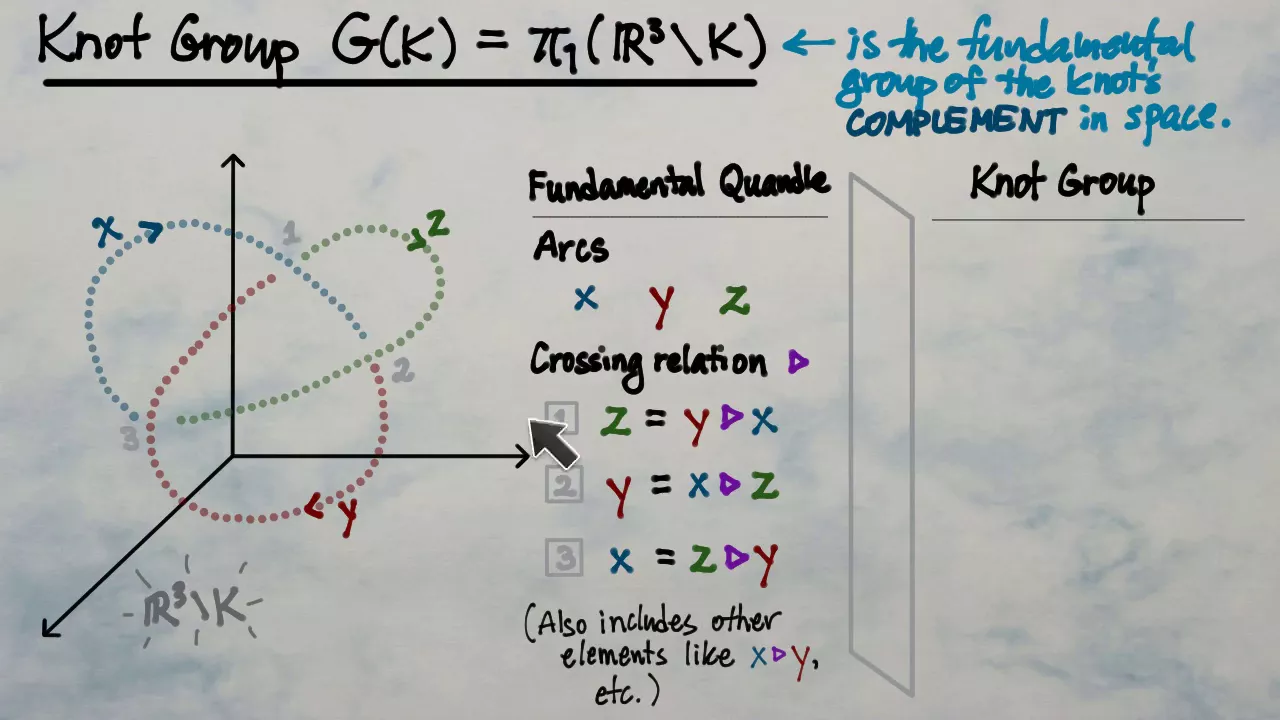
Computing the fundamental group of a knot complement (the knot group) using the Wirtinger presentation.
Understanding the applications of knot invariants in molecular biology (e.g., DNA replication and enzyme action) and physics.
260 views5likes13:46Original Release: 2021-07-29
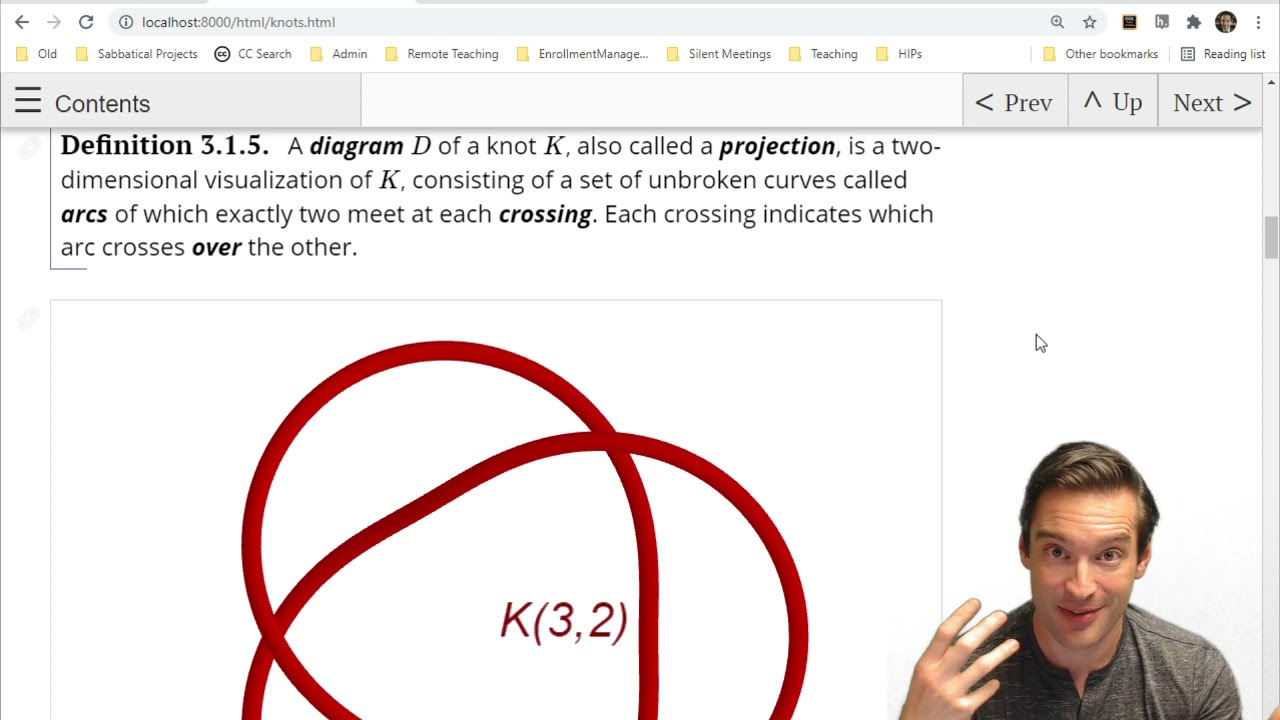
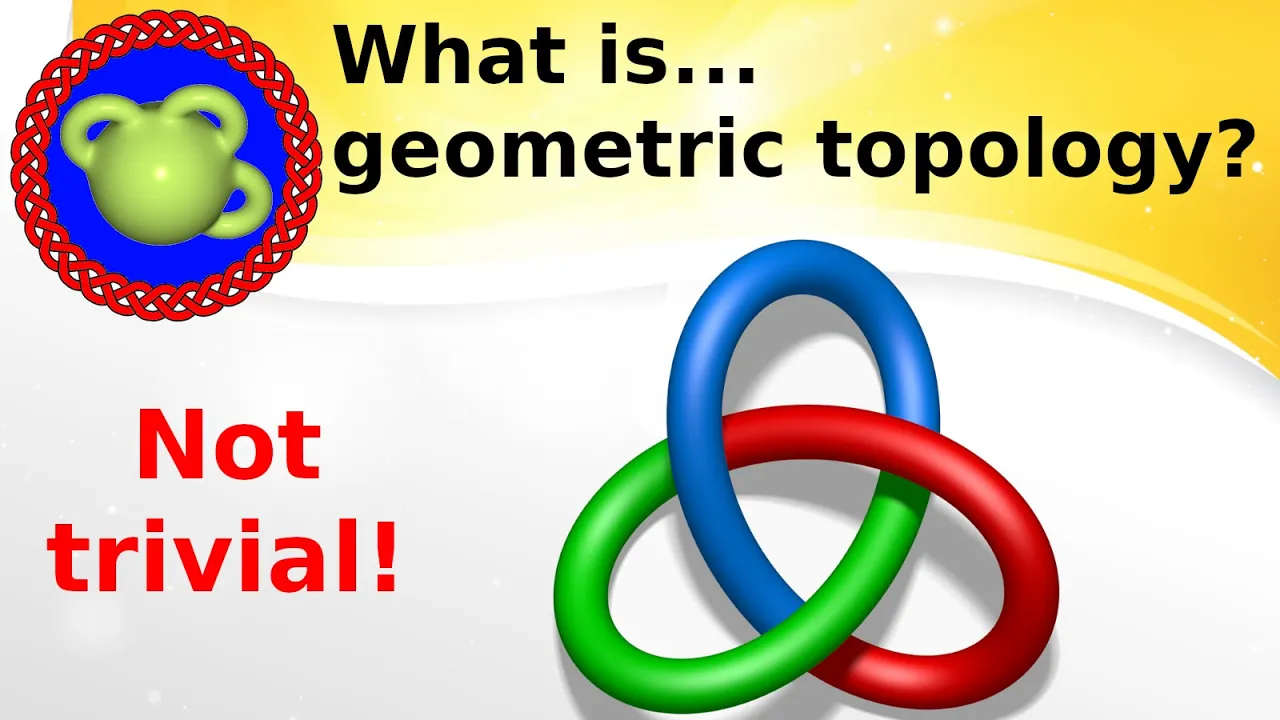
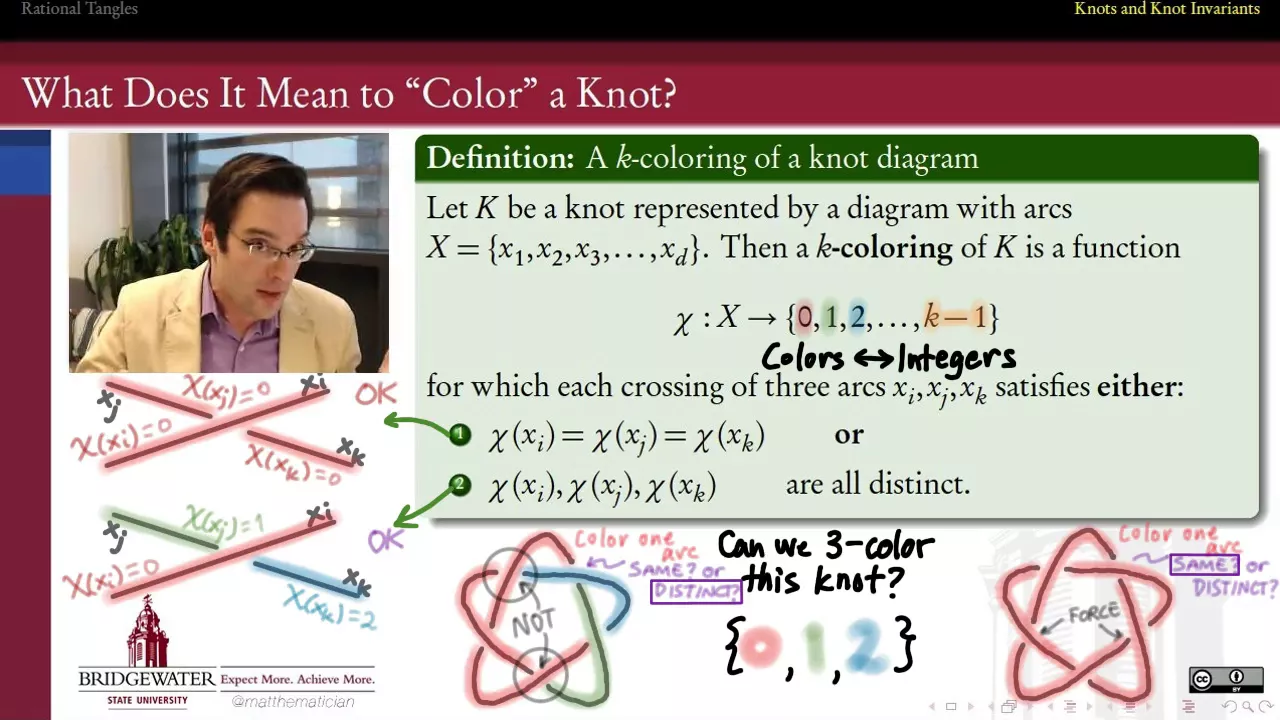
so maybe the most interesting knot invariant that we're going to study kind of in the beginning here of our tour through knot and variance is going to be what's called a coloration invariant and a coloration invariant is a way of saying how many different colors i would need to use in order to color the arcs of a diagram for my knot and let's start with the smallest number of colors for which this is an interesting question the smallest number is three so what we say is a three coloring of a knot diagram is a way of assigning to each one of the arcs in my diagram one of three distinct colors maybe we'll think of them as red green and blue and we call that coloring a valid coloring if every crossing in my colored diagram either is a meeting of three arcs having the same color or is a meeting of three arcs all of which have different colors so we'll get some practice with what this means in a minute but if i have a knot diagram that is that has a valid three coloring if there is a way for me to use three colors to color in the arcs of my diagrams such that all three are the same color or all three are different colors at each crossing on my diagram then we call that diagram tri-colorable and the only other thing we have to insist upon is that we are actually using all three colors we can't just color the whole diagram green because that would pass my test because all the arcs at every crossing would be the same color but it wouldn't be very interesting because every diagram can be colored with all the same color and past that test so it's only really interesting if there exists a coloring that uses all three colors and at which which passes the validity test for three coloration so here's here's what we're talking about if i start with a diagram of the trefoil so here's a diagram of our trefoil knot it's got three arcs and three crossings if i color all of the arcs the same color then we would say that this is a valid recoloration right because every crossing is a crossing where three arcs all have the same color because all three of them have red all three of the arc pieces that are coming into my crossings have the same color at each diagram but if i change the color on one of my arcs let's say i recolor that one green now this crossing is invalid because there exists a crossing at which it's neither the case that all three arcs at that crossing have the same color nor the case that all three arcs of that crossing have different colors right so this would be invalid because two of the arcs at this crossing have the same color as one another but the third arc has a different color so we only have a valid coloration if we can color it in such a way and now we have a valid coloration again that at every crossing either it's the case that three arcs of the same color are coming together or the three arcs of all different colors are coming together and now this is a valid three coloration that's non-trivial this is an interesting three coloration for this knot because we're using all three colors red green and blue and it's also the case that all of the crossings have the property that either all the colors are the same or all the colors are different at each crossing in this example we see all three colors coming into each crossing are different from one another so this is a valid and non-trivial three coloration for the trefoil and so it's a valid question to ask whether coloration is telling me something just about the diagrams of knots or whether the coloration is telling me something about the knots themselves is coloration actually a not invariant so to see whether or not tri-colorability is a non-invariant let's imagine once again um that i have some tri-colorable knot say that i have the ability to try color this particular diagram the question is if i apply a type 1 writemeister move can i still try color this diagram so is this diagram tri-colorable given that my original diagram was tri-colorable so the only question is what happens with this new crossing is there a way for me to assign colors to this diagram that respects the new crossing that's here so to figure that out let's just imagine that originally i had colored this arc with a color let's say we originally colored it red if i do that write a meister twist do i am i still going to have a valid coloration because we've created a new crossing and so this is a new place for the validity test for tri-colorability to potentially fail remember a crossing sorry a coloration is valid if at every crossing all three arcs either have the same color or all three arcs of that crossing have three different colors can i finish a coloration of this diagram that gives me a valid coloration at this new crossing knowing that all the rest of the crossings in my diagram already have validity to them because we assume that the original diagram was tri-colorable so how could i color this part of the diagram in a valid way at this crossing well we only still have a single arc here right adding in this new twist we know that this piece this new piece of the arc i'm going to try and color a little bit more vividly here this new piece of the arc has to have the same color as the piece that it was connected to and that piece already had a red color so this piece has to have a red color as well but the same is true of this little piece of arc over here as well because it's connected to the arc that we also had originally colored red so the only way that we can color this crossing is just to color the whole thing red but that's valid right it's valid to have all three colors be the same at the crossing so if my original knot was tri-colorable then i know that my new knot after i did my type 1 ridermaster move will still be tri-colorable i just keep the same color on whatever arc it is that i'm putting a twist in right and my old valid coloration becomes a new valid coloration after the type one ridermeister move is done all right so how about the type 2 move so we have some nasty looking knot diagram and we have a little piece of the diagram that looks like this my original diagram is tri-colorable so whatever color this string originally had in my valid tri-coloration i'm just going to kind of draw it in there as though it's red now let's perform a type 2 rydemeister move type 2 is just going to pull the sheep's head out and under and do this poke maneuver so the question is can i color this diagram in a valid way well just based on what these arcs are connected to i'm sort of stuck with coloring this piece red and coloring that piece red so that's got to be red that's got to be red so the only question i have now is what color can i assign to this little piece over here can i assign it any color that makes this a valid coloration but i look at these two crossings and say at each of these crossings i have two incident arcs that are both colored the same right this over crossing and this little under arc here are both red and so in order to make a valid coloration i would have to have this piece over here have the same color as those two so that piece would have to be red as well and the same is true at this crossing two of the incident arcs are red so the other one has to be red as well so my hand is sort of forced but the good news is after my hand is forced i've colored these two pieces red and they connect to one another and so it's okay to color that whole arc red and get a valid coloration so if i had a valid coloration before i did this poking maneuver i will still have a valid coloration after i've done the poking maneuver just by keeping the same color on that new little piece of poked arc that we put underneath the previous one so we passed the type 2 test for tri-colorability how about type 3 well for type 3 i'm actually just going to go back to the the diagram from our text of what that type 3 rydermeister move actually looks like so here it is let's suppose that i had a crossing at which i have a couple of different colors coming together and then my third string has a different color still so red to green and a blue if i had a valid tri-coloration on the left side of this diagram i'm going to have a valid tri-coloration on the right side of this diagram as well actually it's a little bit it's not the greatest diagram to use because actually this green blue crossing here is not a valid crossing for the purposes of tricoloration because we have two colors that are the same the blue and the blue but the third color the green is different so maybe i do need to make my own diagram for this so i have some nasty piece of diagram over here i have uh i'm creating a crossing here somewhere and so i'm going to imagine that maybe i have a green strand coming over maybe i have a blue strand coming out of it this way going back into my diagram somewhere and then additionally i also have some red strand coming out and passing underneath both of those and you know maybe this goes back into the diagram somewhere maybe this goes back into the diagram somewhere maybe this goes back into the diagram somewhere right so we're just sort of zooming in on a piece of this diagram where we're hoping to see um some kind of coloration effect right well here's the thing if i have two different colors at this crossing it must mean that the third color that i have at that crossing is different than the first two it's the only way to have a valid tri-coloration in the first place so if i have a green and a blue with this crossing i also have to have a red the same is true with this crossing if i have a green and a red this one has to be blue but if that one's blue then that blue is going to intersect with this blue over here which we can't have unless we colored all of it blue um so all right so maybe we'll do that maybe that's okay so if this is blue then that forces this piece to be blue anyway so the question actually i kind of want to do this differently right i kind of want the strand that i'm moving in my type 3 move this one over here i want to maybe all have the same color so let me back up a tinge here and just kind of imagine once again that i have this under arc that's sort of crossing back into here this is going back into the diagram somewhere that goes back into the diagram somewhere so i have this red strand that's passing underneath oh but i can't do that can i because that's going to again if it's red in this green or different it's going to force them all to be red at this part of the diagram this is what happens when i'm over time and i start to talk myself in circles um let's i'm just going to punt on this one for right now and say that there is a diagram that shows that this does work with a type 3 maneuver and i'm just having trouble pulling it out of thin air at the moment it's something that looks sort of very similar to this diagram but you need to kind of consider a variety of different cases like what are the colors of the various arcs that are a part of this diagram because it turns out there's start to be a lot of arcs when we draw this diagram in there but we can show that whether or not a diagram can be three-colored whether a tri-coloration that's non-trivial exists is something that's preserved by all three of these ridermaster moves and therefore it is a non-invariant so what that means is that i can tell knots apart by telling whether or not they are tri-colorable so here's an example of a knot diagram and i can kind of see if i can make a non-trivial tricoloration for it by changing the colors of some of the arcs on this diagram so if these two are both red then this third one would have to be red but if i want different colors then i would force one of these to be blue now this crossing is valid up here at the top because all three are different this crossing over here is valid because all three are different this crossing over here is not valid anymore because i have two blues but not a third blue so in order to try to make it valid we would have to turn one of these blues into a green but if i turn this blue into a green it's going to have a problem with the arc over there if i turn this blue into a green it's going to have a problem with the arc over there and so if you play around with this diagram you'll eventually figure out that there is no way for us to assign colors to the arcs of this diagram using all three of red green blue in a way that gives me a valid coloration and so what does that tell me about this knot it tells me that this knot is definitely different than that one right because if we believe that tri-colorability is a non-invariant that means that every diagram of the trefoil will either all be tri-colorable or they'll all be not tri-colorable right and here is an example of a diagram of the trefoil that is tri-colorable therefore if this is a diagram that's not tri-colorable then it can't be a diagram of the trefoil so this is how we can use not invariance to at least tell me what a diagram is not what not oh boy what not a diagram does not represent right because as soon as i find a disagreement on a property between two diagrams and a non-invariant then that disagreement is a real disagreement between knots and not just a difference between their diagrams using colors to color the arcs of a diagram of subject to these diagram rules these coloration rules is going to be our way next week of sort of laddering ourselves up to these higher algebraic invariants for knots that get much more interesting and much more complex but it's all going to begin with taking out crayons and trying to color the arcs not diagram subject to these three coloration rules
Up Next
12:51
K-Colorability as a Knot Invariant: A Proof
@MatthewSalomone
1.2K views•2018-03-08
4:43
Elliptic Curve Cryptography Explained: ECC, ECDSA, ECDH
@PracticalNetworking
28.5K views•2024-10-21

9:41
Tower Law in Field Extensions | Degree Multiplication Theorem
@MatthewSalomone
5.7K views•2014-04-10

6:00
The Mathematical Impossibility of Accurate World Maps
@Vox
23.3M views•2016-12-02
Related Study Plans & Knowledge Roadmaps
Structured learning paths in Mathematics
mathematics
Tensor Calculus: Vectors to Riemann Curvature
01Mathematical Foundations: Linear Algebra & Calculus
02Covectors, Dual Spaces, and Tensor Basics
03The Metric Tensor and Index Gymnastics
+ 2 more learning modules
40h5 modules
Explore Roadmap
mathematics
Gödel's Incompleteness: Logic, Proofs & Limits
01Introduction to Formal Systems & Hilbert's Dream
02Set Theory, Cardinality, and Cantor's Diagonal Argument
03Arithmetization and Gödel Numbering
+ 2 more learning modules
14h5 modules
Explore Roadmap
mathematics
Galois Theory: Fields, Groups & Solvability
01Foundations of Abstract Algebra: Groups & Fields
02Polynomials & Field Extensions
03Splitting Fields & Symmetries
+ 2 more learning modules
24h5 modules
Explore Roadmap
mathematics
Non-Euclidean Geometry: Models & Geodesics
01Euclid's Fifth Postulate and the Birth of New Geometries
02Hyperbolic Space and the Poincaré Disk Model
03Geodesics: Defining Straight Lines in Curved Spaces
+ 2 more learning modules
15h5 modules
Explore Roadmap