








![30강 현대대수학 프렐라이 제7판 갈로아이론의기본정리 (p.218~) [완강]](https://i.ytimg.com/vi/YAs-usTmNTc/maxresdefault.jpg)





![[현대대수학] 분리확대체 | 분리확대 성질, 완전체, 유한체 또는 표수가 0인 체는 완전체, 원시원소정리, 중복도](https://i.ytimg.com/vi/GsDzn_gSx_E/maxresdefault.jpg)


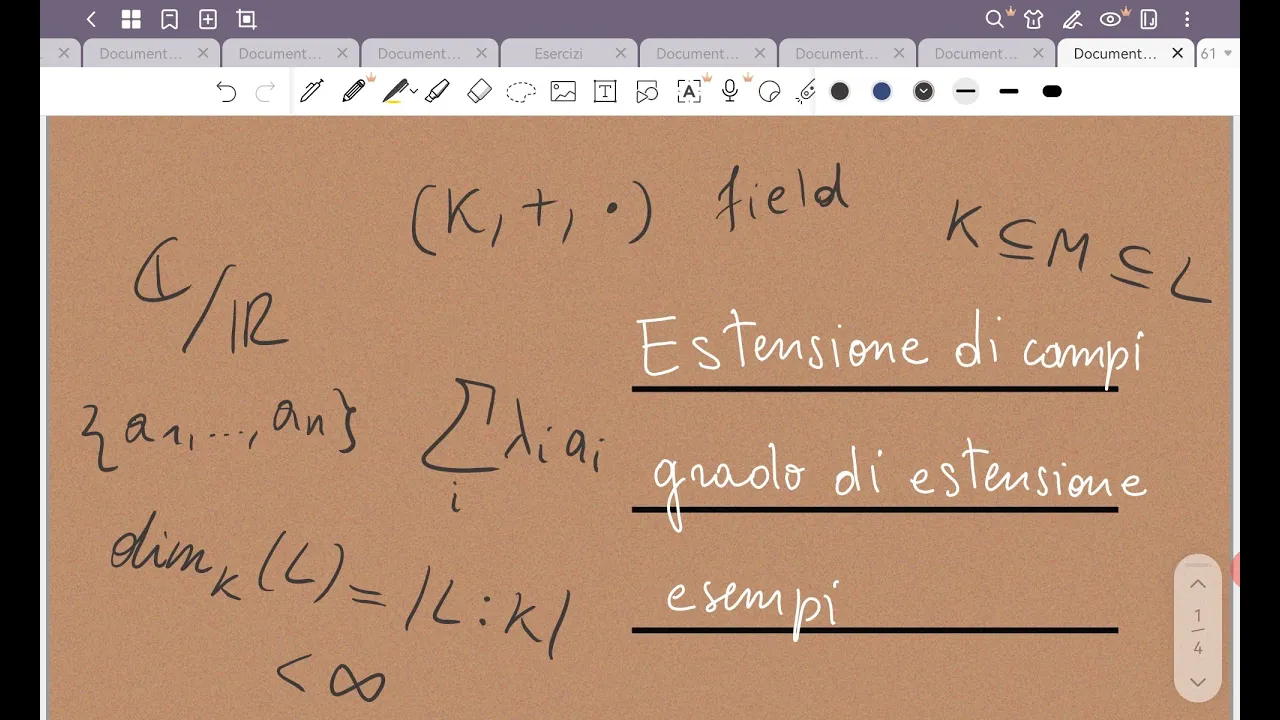
The Tower Law states that if K, L, and M are fields such that L is a finite extension of K and M is a finite extension of L, then M is also a finite extension of K, and the degree of the extension [M:K] equals the product of the degrees [M:L] × [L:K]. This fundamental result allows mathematicians to understand the structure of nested field extensions by multiplying their individual degrees, providing a powerful tool for analyzing splitting fields and algebraic number theory.
Tower Law in Field Extensions | Degree Multiplication Theorem
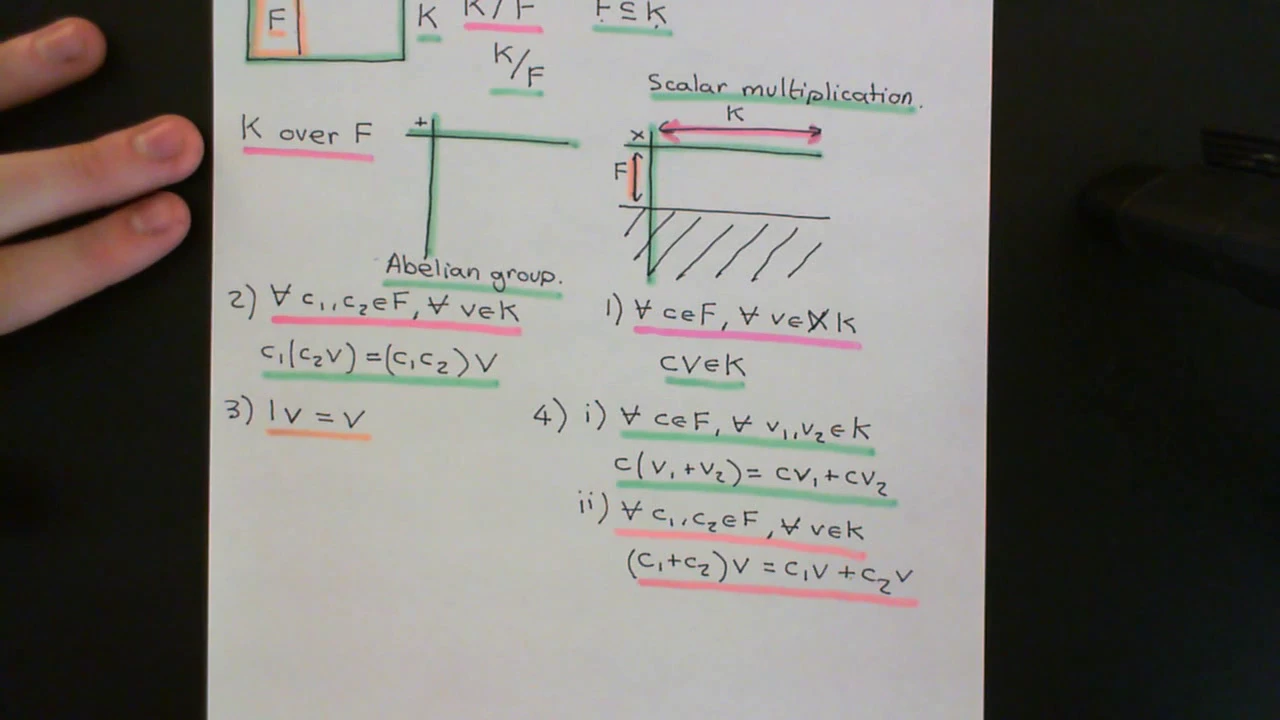
Added:The definition of a field extension and the concept of viewing a field extension as a vector space over its base field.
Fundamental linear algebra concepts, specifically vector space bases, dimension, linear independence, and spanning sets.
The definition of the degree of a field extension, denoted as [L:K], and the distinction between finite and infinite extensions.
Basic ring and field theory, including polynomial rings, irreducible polynomials, and evaluation homomorphisms.
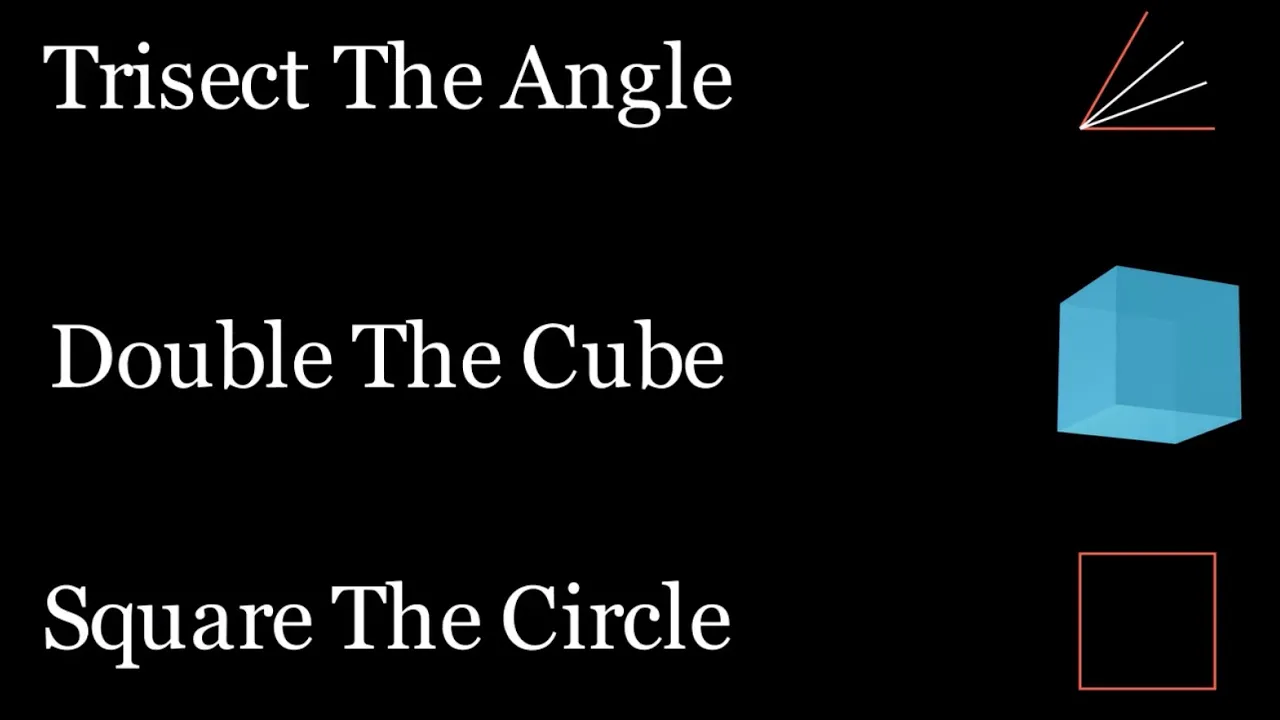
Applying the Tower Law to classical geometric construction problems, such as proving the impossibility of doubling the cube or trisecting an angle.
Exploring Galois Theory, where the degree of a field extension corresponds to the order of its Galois group.
Investigating algebraic, separable, and normal extensions, and analyzing how these properties behave transitively across towers.
Understanding the structure and classification of finite fields (Galois fields) and their subfield relationships using extension degrees.
The Primitive Element Theorem and its applications in simplifying finite separable extensions.
5.7K views77likes9:41Original Release: 2014-04-10
one of the most powerful tools we have in building a splitting field is taking an extension of an extension and the tower law tells us what happens when we take an extension of an extension it says that if K L and M are fields and L is a finite extension of K and M is a finite extension of L so we're taking here a finite extension of a finite extension the tower law is going to give us some insight into the structure of m as an extension of K in other words if we take a finite extension of a finite extension what is the relationship of the biggest extended field here to the smallest base field as an example let's take K to be the rational field and L to be the Gaussian rationals Q would joined with I that's a finite extension of degree 2 how do we know because a generic element in Q join I can be written as a plus bi where a and B are rational numbers this means that one and I form a basis for the Gaussian rationals over Q they're rationally independent because we can't have a plus bi equals 0 unless a and B are both 0 now let's a join the real cube root of 2 to the Gaussian rationals to get the biggest extended field Q are joined with AI and the real cube root of 2 what's a basis for that biggest field over its base field we get the real cube root of 2 to be new but because this biggest thing is a field we also have to have its square 2 to the 2/3 and a generic element can be written as a linear combination of 1 the cube root of 2 and the cube root of 4 2 to the 2/3 where the coefficients of that combination now are taken from Q adjoint I so they're Gaussian rational numbers C D and E here belong to Q a joint I so a basis for the biggest field here over the intermediate field is 1 2 to the 1/3 and 2 to the 2/3 we're pretty comfortable that those are rationally independent we prove that in a previous video so now the question is if we want to understand em as an extension of K the biggest field as an extension of the smallest field what we'd like to do is find a basis as explicitly as we can for the biggest field here q are joined with AI and the cube root of 2 over the smallest field which in this case is just the rationals so again a generic element of Q joined with AI and the cube root of 2 can be written as C times 1 plus D times the cube root of 2 plus e times the square of the cubed root of 2 2 to the 2/3 where C D and E we said belong to the Gaussian rational field but now we just have to make those numbers remember who they are because they're Gaussian rationals C D and E can all be written as something times 1 plus something times I where those some things are all rational numbers that's going to be our key observation because it's going to let us plunk a 0 plus B 0 I a 1 plus B 1 I a 2 plus B 2 I in place of C D and E in this generic description of one of our numbers in the biggest field then all we have to do is simplify by distributing those elements because it's a field we know we have the distributive property and once we've distributed everything and gotten a 0 B 0 a 1 B 1 a 2 B 2 by themselves we find out that they're multiplying the numbers 1 I 2 to the 1/3 I times 2 to the 1/3 2 to the 2/3 and I times 2 to the 2/3 so every element inside this biggest field can definitely be written as a linear combination of a finite number of elements therefore this biggest field is definitely a finite extension of the base field that's the first conclusion that we can draw about a finite extension of a finite extension to give you a flavor for what it looks like in the general case when we extend from K to L if that's a finite extension then we have M minus 1 linearly independent over K elements of L and then we also have 1 and those taken together form a basis for L over K then when we extend from L to we have n minus one elements which are linearly independent over L that belonged to M and combining those with one again we get a basis for M over L but when each of those coefficients in a linear combination of M over L remembers its own identity as an extension of K we end up getting a bunch more elements where each of my bees pairs up with each of my A's and so our basis or what we think might be a basis expands dramatically but at the very least every element of M can be expressed as a linear combination of this finite set of elements over K therefore this finite set of elements spans M over K which proves that M is finite over K the big question though is are these elements necessarily independent linearly independent over K if they are then they form a basis for M over K and we can say exactly what is the degree of M over K let's check it in our specific case if we know that one two to the one third and two to the two thirds are independent over the Gaussian rationals then that means that any linear combination of those three things which equals zero must guarantee that those coefficients are equal to zero where here those coefficients C D and E belong to the Gaussian rationals but then if those coefficients belonging to the Gaussian rationals are multiplying one two to the one third and two to the two thirds we showed that that was equivalent to the six rational numbers a 0 B 0 a 1 B 1 a 2 B 2 multiplying 1 AI 2 to the 1/3 to the 2/3 I times 2 to the 1/3 and I times 2 to the 2/3 therefore this equation is equivalent to the one written at the bottom here now we can say that if 0 is equal to a linear combination of those six elements then C D and E have to be 0 but C D and E are each written as a0 plus b0 I and so forth and if each of those is equal to 0 then the independence of one and I over the rationals must guarantee that each of their coefficients is equal to 0 so if a 0 plus B 0 I is equal to 0 that means that a 0 and B 0 individually must be 0 likewise for a 1 and B 1 and likewise for a 2 and B 2 so when you look at this logic from start to finish what we've proven is that any linear combination of 1 I 2 to the 1/3 I times 2 to the 1/3 2 to the 2/3 and I times 2 to the 2/3 which equals 0 necessarily guarantees that all of a 0 B 0 a 1 B 1 a 2 B 2 are equal to 0 what have we proven we've proven that that set of six elements is linearly independent over the rational numbers therefore because it also spans our biggest field over Q it is a basis for our biggest field over Q so now that we've discovered a basis for the biggest field over the smallest field we can look at the general situation and show that this always works in other words that not only do these elements span M over K they're also linearly independent over K therefore they form a basis for M over K by definition of basis now we can talk about degrees in our example the degree of our first finite extension from Q up to Q adjoint I was two because there are two elements in its basis the degree of our second finite extension was three and because we now have explicitly written down a basis for the biggest field over the smallest field we can see that it's degree is equal to 6 the total degree of the extension all we have to do to prove the general case is just find a way of organizing all of those elements that we now know as a basis for M over K we have the A's along with 1 which form a basis for L over K we have the bees which along with one form a basis for NM / L and then we showed that all of these products of the A's multiplied by the bees we'll be linearly independent over the pace field kay how many of them are there we have them arranged here in M columns and n rows and therefore this set of elements which is a basis of M over K has M times n elements and that's the conclusion that most people consider to be the most useful and important part of the tower law not just that M is a finite extension of K but we know exactly what the degree of M over K is going to be it's just equal to the product of the degree of M over L times the degree of L over K so that's the tower law it's one of our most important tools in understanding how when you extend an extension if those extensions are finite then the degrees of those extensions multiply
Up Next
10:23
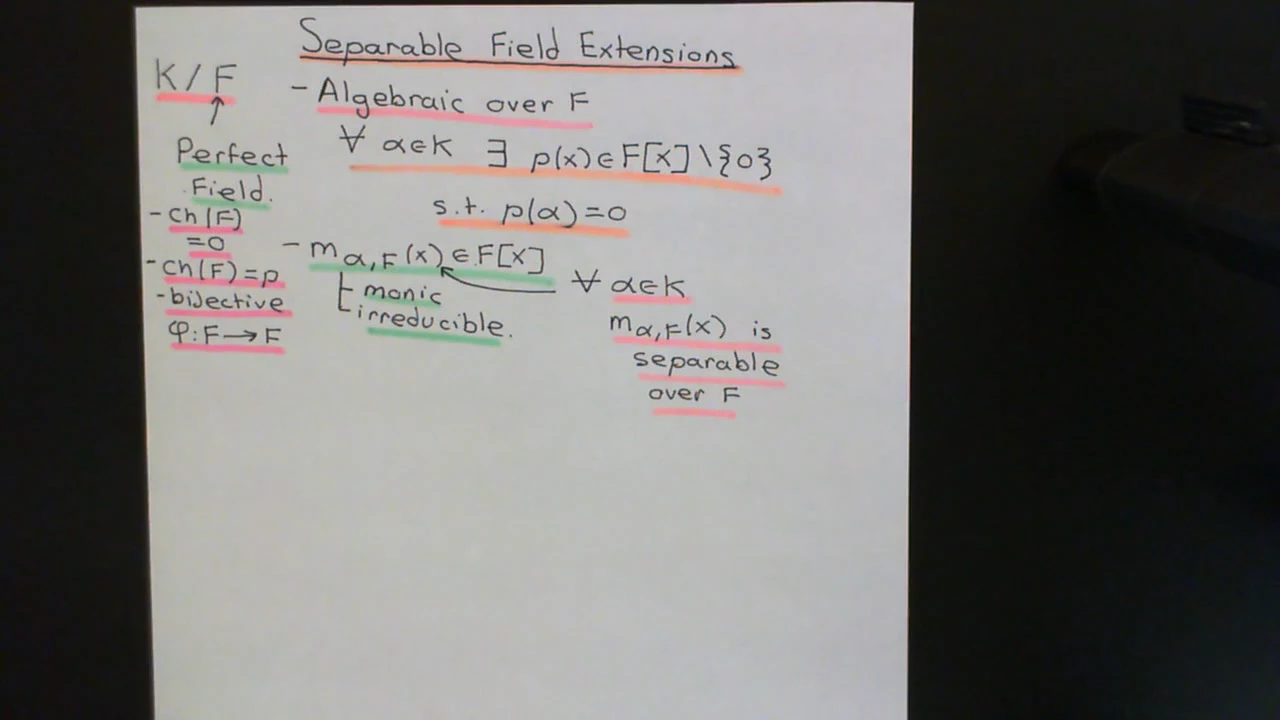
Separable Field Extensions | Algebraic Field Theory Explained
@elliotnicholson5117
5K views•2015-08-28

4:43
Elliptic Curve Cryptography Explained: ECC, ECDSA, ECDH
@PracticalNetworking
28.5K views•2024-10-21
12:51
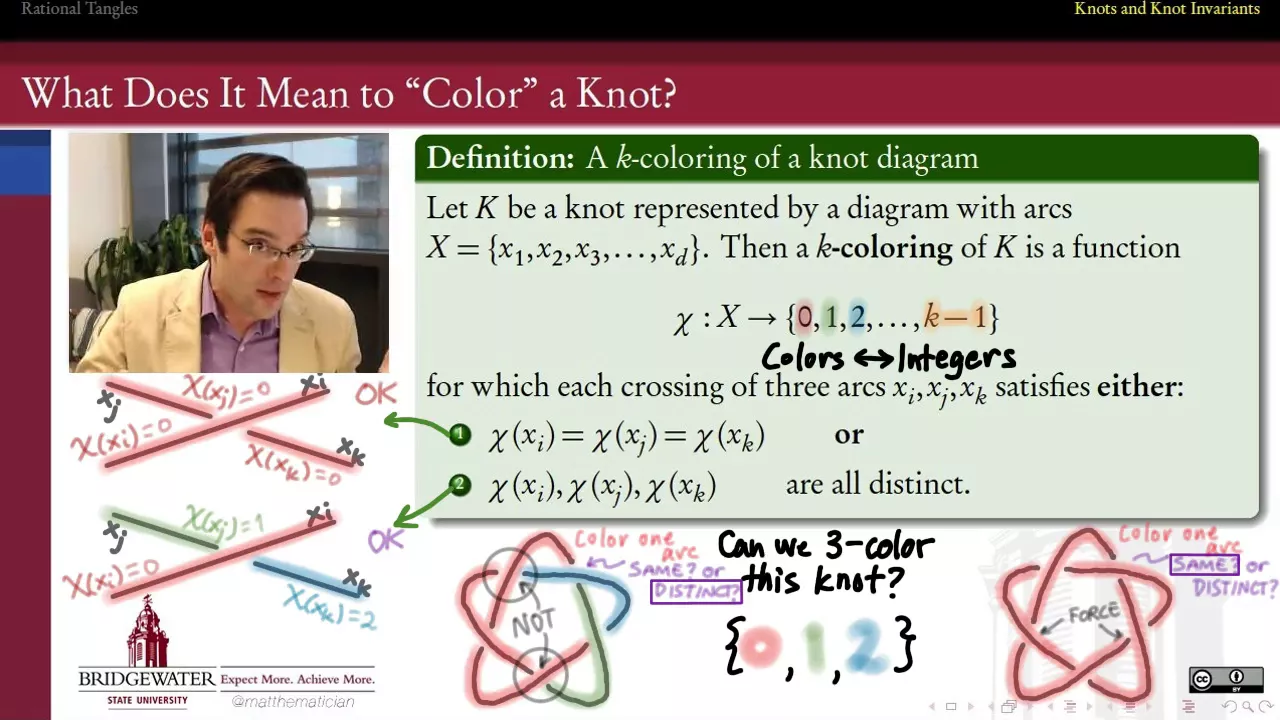
K-Colorability as a Knot Invariant: A Proof
@MatthewSalomone
1.2K views•2018-03-08

6:00
The Mathematical Impossibility of Accurate World Maps
@Vox
23.3M views•2016-12-02
Related Study Plans & Knowledge Roadmaps
Structured learning paths in Mathematics
mathematics
Tensor Calculus: Vectors to Riemann Curvature
01Mathematical Foundations: Linear Algebra & Calculus
02Covectors, Dual Spaces, and Tensor Basics
03The Metric Tensor and Index Gymnastics
+ 2 more learning modules
40h5 modules
Explore Roadmap
mathematics
Gödel's Incompleteness: Logic, Proofs & Limits
01Introduction to Formal Systems & Hilbert's Dream
02Set Theory, Cardinality, and Cantor's Diagonal Argument
03Arithmetization and Gödel Numbering
+ 2 more learning modules
14h5 modules
Explore Roadmap
mathematics
Galois Theory: Fields, Groups & Solvability
01Foundations of Abstract Algebra: Groups & Fields
02Polynomials & Field Extensions
03Splitting Fields & Symmetries
+ 2 more learning modules
24h5 modules
Explore Roadmap
mathematics
Non-Euclidean Geometry: Models & Geodesics
01Euclid's Fifth Postulate and the Birth of New Geometries
02Hyperbolic Space and the Poincaré Disk Model
03Geodesics: Defining Straight Lines in Curved Spaces
+ 2 more learning modules
15h5 modules
Explore Roadmap