






















In field theory, a field extension L/K is a pair of fields where K is contained in L, and the degree [L:K] is the dimension of L as a vector space over K. An element α in L is algebraic over K if it is a root of some non-zero polynomial with coefficients in K; equivalently, α is algebraic if and only if it is contained in a finite extension of K. The degree of a field extension is multiplicative in towers: if K ⊆ L ⊆ M, then [M:K] = [M:L] × [L:K]. Consequently, the sum, product, and quotient of algebraic numbers over K are also algebraic, and any root of a polynomial with algebraic coefficients is algebraic.
Galois Theory: Field Extensions & Algebraic Numbers
Added:Basic Field Theory: Understanding the definition of a field, subfields, and field homomorphisms.
Polynomial Rings: Familiarity with polynomial rings over a field, including irreducible polynomials and the division algorithm.
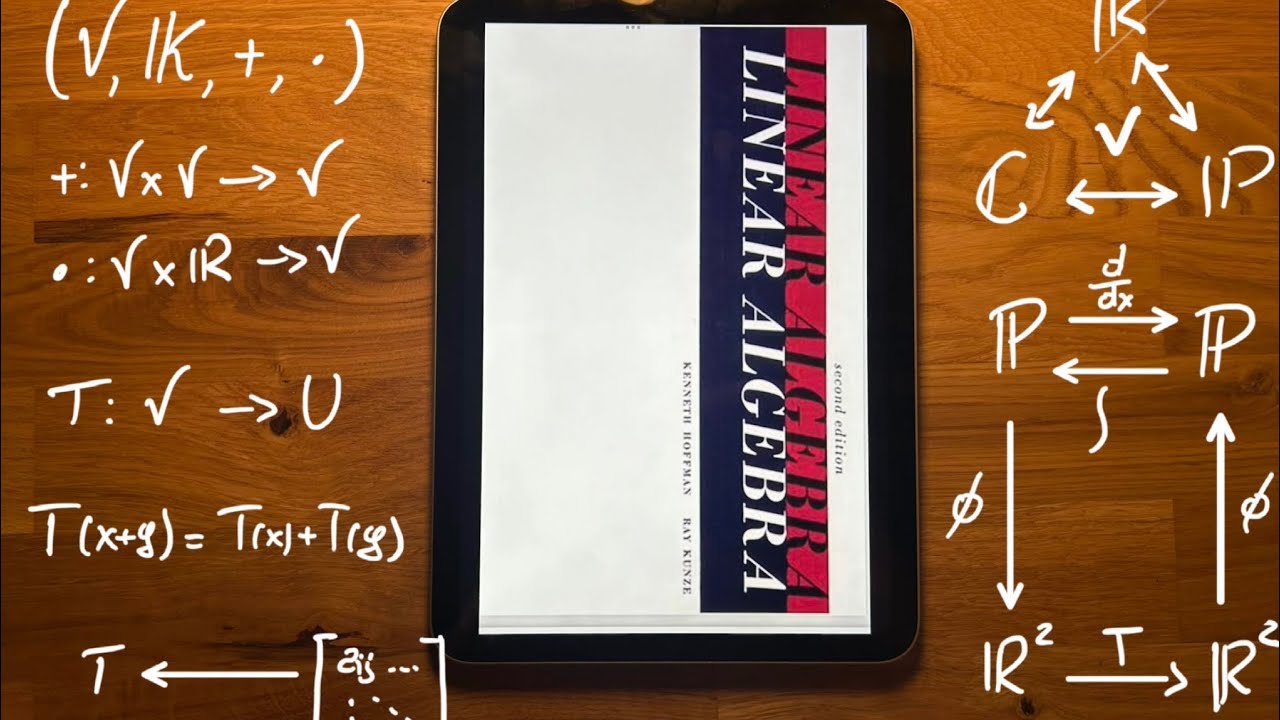
Linear Algebra Concepts: Mastery of vector spaces, bases, and dimension, which are essential for understanding the degree of a field extension.
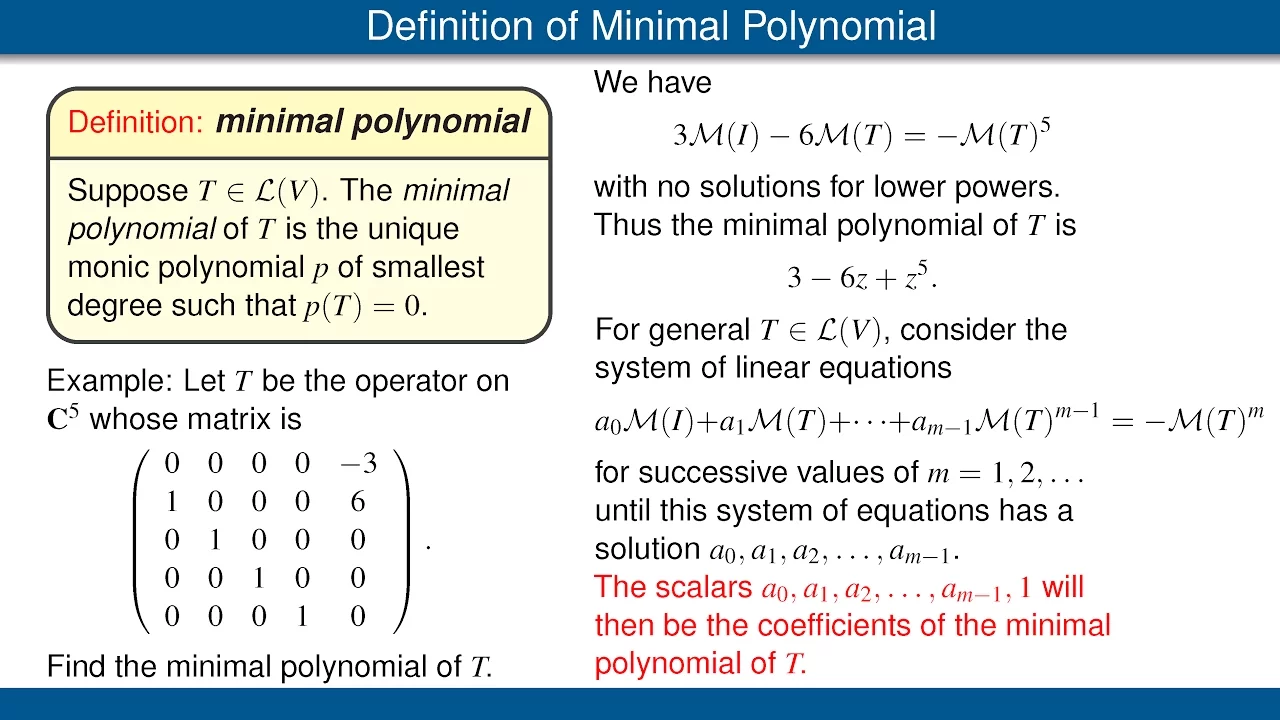
Minimal Polynomials: The definition and properties of the minimal polynomial of an algebraic element over a base field.
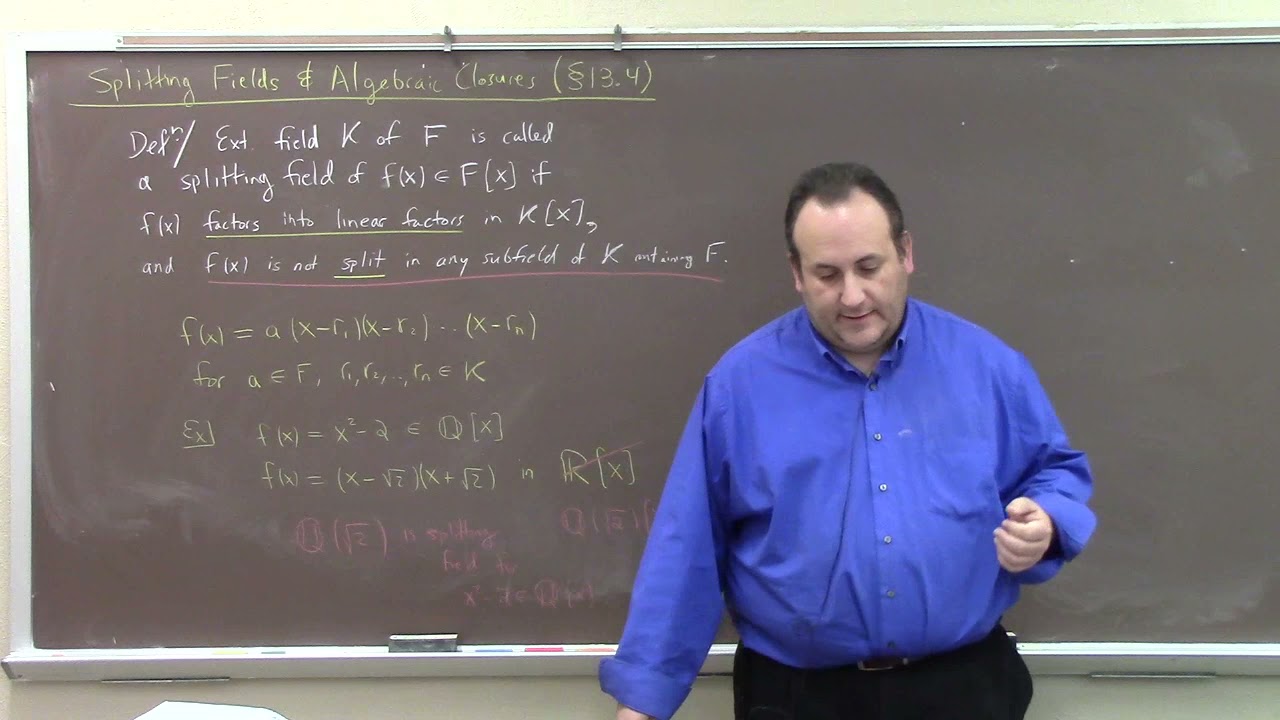
Splitting Fields and Algebraic Closures: Learning how to construct fields where a given polynomial splits completely into linear factors.
Normal and Separable Extensions: Exploring the structural properties of extensions that behave well under field automorphisms.
Galois Groups and the Fundamental Theorem of Galois Theory: Establishing the Galois correspondence between subfields of an extension and subgroups of its automorphism group.
Applications to Solvability and Geometric Constructions: Using Galois theory to analyze the solvability of polynomial equations by radicals and classical ruler-and-compass constructions.
47.3K views892likes27:30Original Release: 2020-12-27
this lecture is part of an online course on galwa theory and will be a sort of review of field extensions so we just recall that a field extension just means two fields one of which is contained in the other so k and l are going to be fields and this is sometimes denoted by l over k for some reason and we gather theory is mainly about the study of fields but it turns out to be really useful to study pairs of fields or field extensions and the reason for this is that if we want to study a field l um it's quite often useful to sort of build up to it by starting with a smaller field l naught and building a chain of bigger and bigger fields until we reach l and and then we sort of prove things about l by starting with l naught and kind of hopping up one field at a time so so we need to study field extensions in order to be able to do this so here are some basic examples um we can have the rational numbers contained in the reals so this is rationals and this is the reals and the real numbers are contained in the complex numbers so these are two standard examples of extensions um if we've got an extension we define the degree of the extension l over k um is this degree is denoted by l k in square brackets i have no idea why and this is just the dimension of l as a vector space over k for example the degree of the complex numbers over the reals is just two because the complex numbers form a two-dimensional real vector space and the degree of the real numbers over the rationals is infinite because the real numbers are an infinite dimensional vector space over the rationals um if you're a sort of set theory type person you you you know that there are that this symbol infinity is actually kind of a bit sloppy because there are lots of different infinities and set theory and you can ask which you know is is this a countable infinity or an uncountable infinity and so on um we don't really care um galway theory is mostly about finite extensions and if an extension is infinite it's pretty much out of reach no matter what sort of infinity it is so we won't worry about that um so um the extension is called finite so the extension l over k is called finite if the degree is finite so for instance the complex numbers are a finite extension of the reals um now um suppose we've got an extension k contained in l and we've got some element alpha in l alpha is called algebraic over k if alpha is the root of a polynomial p of x with coefficients in the field k alpha is called transcendental over k if it's not transcendental has nothing to do with any religious meaning of being transcendental um and if it's algebraic there's a smallest irreducible polynomial that it's a root of so the degree of alpha is is the degree of uh is the smallest degree of of a polynomial p and if if alpha is transcendental i suppose you could say it as degree infinity if you like but i don't think people use that much so let's see some examples let's take k to be the rational numbers um if you say if you talk about a number being algebraic or transcendental without specifying the field then you usually mean you're working over the field of tr of rational numbers and so if we take k to be the rationals you can look at say the number alpha which is a fifth root of two and this is obviously algebraic because it's a root of x to the five minus two equals zero and it has degree five because this polynomial has degree five um if you look at the numbers pi or e in the reals then these are transcendental um this is sort of difficult to prove so mate um proved he was transcendental back in the 19th century and linderman proved that pie was transcendental a few years afterwards and um this started off a large huge theory of transcendental numbers where you try and prove various numbers are transcendental well these are rather difficult examples of transcendental numbers so let me give you an easy example of a transcendental element of a field if you look at the field q it's contained in the field of rational functions over q so you remember rational functions are going to be any polynomial divided by any other non-zero polynomial and now you notice that x is transcendental over the field of rational numbers um and here's an example of a number where it's not perhaps immediately obvious whether it's transcendental algebraic what about the number cosine of 2 pi over 7 is this algebraic or transcendental and if you didn't know about it might sort of guess it's transcendental because cosine is a very transcendental function pi is transcendental and so but it's actually algebraic and one easy way to see that it's algebraic is to notice let's call this number alpha alpha is equal to zeta plus zeta to the minus one over 2 where zeta is a fifth root of unity e to the 2 pi i over 7.
so let's just draw a picture to see what's going on if we look at the unit circle um then um you can look at the seventh roots of unity and you know you you know that they they all lie on the unit circle in the complex plane and form a nice regular seven-sided polygon and zeta is going to be this one here it's traditional to use zeta for roots of unity so so we know z to the seven is equal to one um and alpha is going to be just this point here um so you recall from euler's formula this is cosine of 2 pi over 7 plus i times sine of 2 pi over 7.
well this isn't actually irreducible because it's got a factor of zeta minus 1. so we can find an irreducible polynomial with the root of zeta by quotient out by that and we find 1 plus theta plus theta squared plus theta cubed plus e to the four plus z to the five plus eight to the six equals one and now from this we want to find an explicit irreducible polynomial satisfied by alpha well let's divide this thing by zeta cubed so we get zeta to the minus three plus zeta to the minus two plus z is one plus one plus zeta plus zeta squared plus theta cubed equals zero and now we notice that two alpha cubed can be written as zeta to the minus three plus three zero to the minus one plus three zeta plus zeta cubed and what we're trying to do is to express this in terms of alpha so if we look at two alpha squared then it's one times that plus two times one plus one times zeta squared and if we look at two alpha it's equal to one times zeta to the minus 1 plus 1 times zeta and 2 alpha to the 0 is just equal to 1.
so if we take the linear combination 2 alpha cubed plus 2 alpha squared that will give us one one three two three one and then we can um if we subtract two times two alpha and then subtract um um one you see this is equal to zeta to the minus three plus z to the minus two and so on all the way up to plus c to cube which is equal to zero so so here we found an ir and a polynomial satisfied by alpha so it's eight alpha cubed plus four alpha squared minus four alpha minus one equals zero so here's a here's a polynomial with alpha as a root and it's got rational coefficients and by the way you might wonder what the other roots of this polynomial are well that's not very difficult to see because you can do the same thing with zeta squared or with zeta cubed so you find the other roots are going to be cosine of two pi over seven times two and cosine of two pi over seven times three and in case you're wondering why you don't get cosine of two pi over seven times four the answer is you do it's just that cosine of two pi over seven times four is equal to cosine of two pi over seven times three so um um so so next we observe that there's this simple criterion suppose we've got a for a number to be algebraic suppose we've got two fields k and m then alpha in m is algebraic over k if and only if alpha is contained in a finite extension of k and this is very easy to prove let's first suppose that alpha is in a finite extension um l well then we have l over k we'll have degree n less than infinity for some n and now all we do is look at one alpha alpha squared up to alpha to the n and what we notice is that these are n plus one elements of an n-dimensional vector space over k so there must be a linear relation a non-trivial linear relation so we have a naught plus a one times alpha plus plus a n alpha to the n equals zero and this just is a polynomial satisfied by alpha so it implies alpha is algebraic over k of course um on the other hand uh we want to show that if alpha is an inner if alpha is algebraic then alpha is contained in a finite extension and for this we first recall um a way of constructing finite extensions which is suppose p of x is an irreducible polynomial in k of x then um we can form an algebraic extension we take the ring of all polynomials over k and we quotient out by the ideal of all multiples of p so then this is a field well it's it's automatically a ring because if you take any ring and quotient out by an ideal then um that's always a ring i guess i should said commutative ring but whatever so the problem is existence of inverses in other words if we've got an element of this ring does it have an inverse well suppose we have some element qx in kx over p with q not equal 0 in this this means that q and p are co-prime in k of x because p is irreducible and we're assuming q is not equal to norton here that means q is not a multiple of p you should recall that the ring of polynomials over a field is a euclidean domain and a unique factorization domain now since it's a euclidean domain since these two elements are co-prime we can find polynomials ax times q of x plus b of x times p of x such that this is equal to one and for do this we use the euclidean algorithm as in a um basic ring theory which is supposed to be a prerequisite for this course and now if you look at this it just means that a of x is the inverse of q of x if p is equal to naught so in in k of x over p of x so so elements of this ring have inverses and you can actually find the inverse using the euclidean algorithm for polynomials if you like so let's get back to what we're trying to show we're trying to show that if alpha is algebraic this implies alpha is in a finite extension of k so um well alpha is algebraic means that alpha is a root of p x um in k of x where p can be assumed to be irreducible um so all we do is we look at the field k of x modulo p of x and this is contained in so this contains k and it also contains l and now we can have a map from this field to l which just takes x to alpha and it's well defined because alpha is the root of this polynomial p which makes it easy to extend w which means that the map from k of x to l um vanishes on p of x so the image of k of x over p of x in l is a field containing alpha and furthermore we see this field has dimension is equal to the degree of the polynomial p over l so it's a finite extension so this is a finite extension of k so this shows that not only are elements of finite extensions algebraic but that algebraic elements are always contained in finite extensions um so next um we ask how does the degree behave if we've got a tower of extensions so as i mentioned we're going to spend a lot of time working with long towers of extensions and we want to know what's the degree of m over k and it's equal to the degree of m over l times the degree of l over k so the degree is multiplicative in extensions and you can ask why well this is very easy what we do is we pick a basis x1 up to x m of l over k where m is equal to l over k and we pick a basis y one to y n for m over l where n is of course just the degree of m over l and then we check that the numbers x i y j for one less than or equal to i less than or equal to m one less than j less than or equal to n form a basis for the vector space m over the field k and i'm not going to carry out this check because it's very easy you can do it as an exercise or something if you want um the main thing we're going to use uh in the in the next few minutes is that in particular if if this extension is finite and this extension is finite then this extension here is finite so we only need a very special case of this although we'll be using the full result later so now we're going to show that if alpha and beta in some extension l are algebraic over k then so are alpha plus beta alpha times beta alpha divided by beta and alpha minus beta provided beta is non-zero of course um this isn't completely trivial so let's look at the following example suppose we look at the square root of 2 well that's algebraic and the cube root of 2 is also algebraic and the fifth root of 2 is also obviously algebraic but if you add them together and try and find a polynomial of these as a root you probably won't be able to unless you're extremely persistent or have a big computer that's because the smallest polynomial over the rationals with these three numbers as a root has degree 30. so it's not immediately obvious that the sum of two algebraic numbers is algebraic it's not so easy to write down an explicit polynomial with this as a root so we can say this is algebraic but maybe not immediately obvious that it's algebraic well here's here's one way to see it this is algebraic what we do is we look at the field k and it's contained in the field k of alpha and this is going to be a finite extension so this means the smallest subfield containing k and alpha which is as alpha is algebraic this is some finite extent whose degree is the degree of alpha and then this is containing the extension k alpha beta because beta is algebraic over k so it's certainly algebraic over k of alpha so this is also a finite extension and the degree is less than or equal to the degree of k of beta over k it might actually be less than this because um beta might satisfy will satisfy an irreducible polynomial over k because it's algebraic but this polynomial might become reducible over k of alpha so so this degree here might actually be a little bit less than you expect but this doesn't really matter the point is this extension is um these two extensions are finite so this whole big extension is finite and what this means is that anything in this extension is finite over k and therefore algebraic so this contains alpha plus beta alpha beta and so on so alpha plus beta now for beta and so on or or algebraic i'll just remind you that although this proof looks almost trivial if you actually try and unravel it and find the polynomial explicitly you suddenly discover you're doing some rather tedious and messy linear algebra there's a similar result we can where we can show that if alpha is a root of a polynomial with algebraic coefficients that this means um again we're we're working over fields k and alpha is in some field l so then alpha is algebraic and what this means is so if alpha to the n plus a n minus 1 alpha to the n minus 1 and so on plus a naught equals naught and if all the a i are algebraic this implies alpha is algebraic well we can prove this in a very similar way to to our proof the sum of two algebraic numbers as algebraics all we do is we take our field k and we look at and then then we join a naught and then we join a norton a1 and we go all the way up to k a naught up to a n minus one and then we adjoin k a naught up to a n minus one and and at this point we do something a little bit different we join alpha so i'll write alpha in fluorescent pink to to remind you that that's not a n and all these extensions here are finite extensions that's because we assumed all the a i's are algebraic and this extension here is finite and the reason this is finite is because we've got a polynomial satisfied by alpha with roots in this field so just as before we see this big extension here is finite and since alpha is now in a finite extension of k we see that alpha is algebraic um so let's see an example of this um so um we showed that e and pi well we mentioned that e and pi are transcendental it's a very hard open problem say is e plus pi transcendental i mean everybody believes it is um it would be really astonishing if it wasn't but but proving it's transcendental is seems to be beyond what transcendental number theory can do at the moment we can also ask is e times pi transcendental and again this is a incredibly difficult open question um okay the answer to both of them is probably yes but nobody knows how to prove it um but what i'm going to do is i'm going to solve one of these so sort of a theorem e plus pi or e times pi is transcendental and the proof of this is almost trivial what we do is we look at the the polynomial x squared minus e plus pi x plus e times pi and the roots are obviously e and pi now if e plus pi and e times pi are both algebraic implies the roots this implies the coefficients of this polynomial algebraic so this should imply the roots e and pi are algebraic well we know they're not by hermite and lindemann's theorem so so e plus pi and e plus pi can't both be algebraic so here i've got two impossibly difficult questions almost impossibly difficult but i can answer one of them i i just don't know which of them i can answer um actually there's a sort of slight logical problem here um that there's a um philosophy of mathematics called intuitionism which says that if you assert you've proved either a or b this means you've either proved a or you've proved b and an intuitionist would deny that i've proved that one of these two numbers is transcendental because i have no idea how to prove e plus pi is transcendental and i have no idea how to prove e times pi is transcendental so an intuitionist would say i'm not allowed to assert that that i've proved that one of these numbers is transcendental but whatever in classical mathematics i've proved that at least one of them is transcendental okay that's um enough for the review of um extensions and algebraic numbers the next lecture will be on splitting fields of polynomials
Up Next

16:15
Visual Group Theory Lecture 1.1: What Is a Group? Rubik's Cube Intro
@ProfessorMacauley
200.4K views•2016-02-24

4:43
Elliptic Curve Cryptography Explained: ECC, ECDSA, ECDH
@PracticalNetworking
28.5K views•2024-10-21

27:53
Abel's Theorem: Unsolvable Quintic Equations Explained
@richarde.borcherds7998
11.7K views•2021-01-08

6:00
The Mathematical Impossibility of Accurate World Maps
@Vox
23.3M views•2016-12-02
Related Study Plans & Knowledge Roadmaps
Structured learning paths in Mathematics
mathematics
Tensor Calculus: Vectors to Riemann Curvature
01Mathematical Foundations: Linear Algebra & Calculus
02Covectors, Dual Spaces, and Tensor Basics
03The Metric Tensor and Index Gymnastics
+ 2 more learning modules
40h5 modules
Explore Roadmap
mathematics
Gödel's Incompleteness: Logic, Proofs & Limits
01Introduction to Formal Systems & Hilbert's Dream
02Set Theory, Cardinality, and Cantor's Diagonal Argument
03Arithmetization and Gödel Numbering
+ 2 more learning modules
14h5 modules
Explore Roadmap
mathematics
Galois Theory: Fields, Groups & Solvability
01Foundations of Abstract Algebra: Groups & Fields
02Polynomials & Field Extensions
03Splitting Fields & Symmetries
+ 2 more learning modules
24h5 modules
Explore Roadmap
mathematics
Non-Euclidean Geometry: Models & Geodesics
01Euclid's Fifth Postulate and the Birth of New Geometries
02Hyperbolic Space and the Poincaré Disk Model
03Geodesics: Defining Straight Lines in Curved Spaces
+ 2 more learning modules
15h5 modules
Explore Roadmap